Lover Avenged Summary, Characters and Themes
Lover Avenged by J.R. Ward is a dark paranormal romance centered on Rehvenge, a powerful vampire businessman whose polished public image hides dangerous secrets. He belongs to the aristocratic world of the glymera but lives on its edges, trapped between duty, violence, blackmail, and a nature he must constantly control.
Against this shadowed life stands Ehlena, a hardworking nurse whose compassion and discipline make her both vulnerable and strong. The story mixes romance, political betrayal, family loyalty, and war, showing how love can challenge shame, fear, and the identities people build to survive. It’s the 7th book of the Black Dagger Brotherhood series.
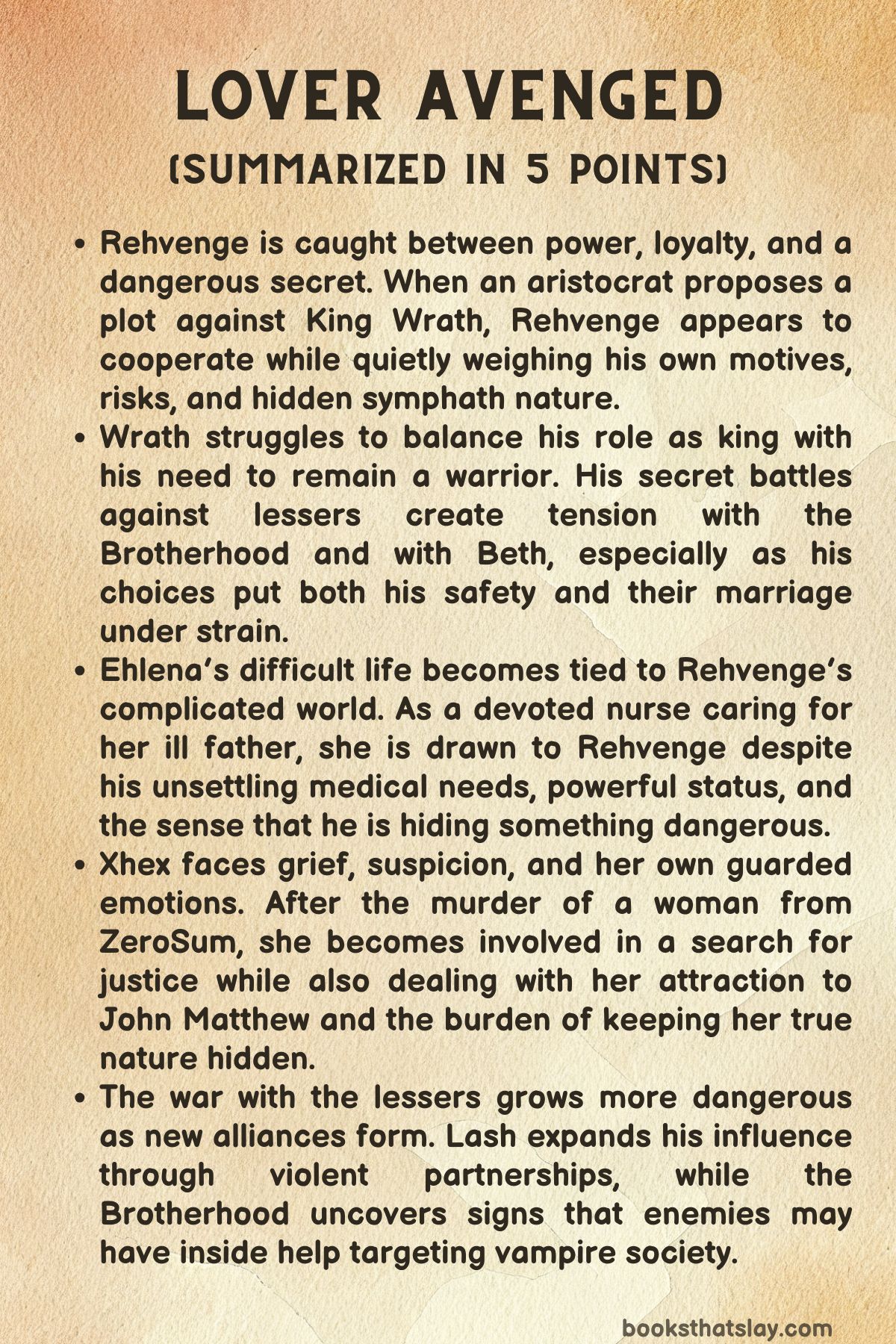
Summary
Lover Avenged follows Rehvenge, a wealthy and feared vampire with ties to the aristocracy, the nightclub world, and the hidden race of symphaths. Publicly, he is a powerful male with money, influence, and control.
Privately, he lives under constant pressure. He is half symphath, a secret that could destroy him and endanger his sister Bella and his trusted security chief, Xhex.
To keep his violent instincts contained, he depends on regular doses of dopamine and scorpion antivenin. These drugs help him suppress the parts of himself he fears most, but they also weaken his body and leave him dependent on a dangerous routine.
Rehvenge is drawn into a political conspiracy when Montrag, a member of the glymera, approaches him with a proposal to assassinate King Wrath. Montrag and other nobles claim they want democracy, but their real goal is to remove the monarchy and place power in the hands of the aristocratic council.
Rehvenge appears to listen and cooperate, but he is not as easily controlled as Montrag believes. He sees the danger in the plot and begins deciding how to turn the conspiracy to his own advantage while protecting the people he cares about.
At the same time, Wrath is struggling with the burdens of kingship. Although he is the vampire king, he secretly continues to fight lessers in the field with the Black Dagger Brotherhood.
He believes his people need him not only as a ruler but as a warrior. His brothers, especially Butch and Vishous, disagree.
They know that if Wrath dies, the race could face chaos. After one fight, Wrath learns that the Lessening Society may have had inside help locating vampire homes during earlier raids.
This discovery increases the threat around the glymera and makes Montrag’s treason even more serious.
Wrath’s choices also damage his marriage to Beth. He hides his injuries and lies about his nights in the field.
Beth eventually realizes he has deceived her, and the conflict between them grows. Their marriage is already strained by Wrath’s refusal to have children and by Beth’s fear that he is choosing danger over their future together.
After a painful argument, Beth leaves for Safe Place, forcing Wrath to face the loneliness created by his own stubbornness.
Ehlena, a nurse at Havers’s clinic, lives a very different life from the aristocrats and warriors around her. She is poor, exhausted, and responsible for caring for her mentally ill father.
Her household is fragile, and she carries the weight of unpaid bills, emotional fatigue, and fear for her father’s condition. At work, she is competent and principled, but her life gives her little room for comfort or hope.
When Rehvenge comes to the clinic for treatment, Ehlena notices more than his beauty and power. She sees his infected injection sites, the extreme medication he receives, and the pain he tries to hide.
Rehvenge flirts with her at first, using charm as a shield, but Ehlena does not surrender easily to him. She is attracted to him, yet she senses that he is dangerous and that his life contains truths he will not reveal.
Their connection grows through concern, curiosity, and private conversations. Ehlena finds his card and learns of his aristocratic background, which makes him seem even farther from her world.
Still, she is drawn to him because she sees vulnerability behind his controlled exterior. Rehvenge, for his part, is moved by her honesty and care.
He is used to fear, desire, and manipulation, but Ehlena offers something quieter and more sincere.
Rehvenge’s hidden life is made worse by the symphath princess, who blackmails him. She knows his secret and Xhex’s, and she uses that knowledge to force him into degrading monthly sexual encounters.
These meetings leave him physically damaged and emotionally shaken. He hates the control she has over him, yet he submits to protect his family and his secrets.
His shame becomes one of the main barriers between him and Ehlena.
After one of these meetings, Rehvenge is in terrible condition. Ehlena, worried about him, agrees to bring him medicine at the Commodore.
She has already crossed moral and professional lines by taking medication from the clinic because she believes he needs help. Their meeting becomes intimate and revealing.
Rehvenge admits that there is another female in his life, though not one he loves, and he tells Ehlena he is impotent. The truth is incomplete, but it is as close as he can come to admitting the ugliness of his situation.
During dinner, the attraction between them becomes impossible to ignore. They kiss and begin to move toward sex, but Rehvenge panics when his body responds.
Because he has believed himself incapable and because his sexuality is tied to shame, coercion, and his symphath side, the moment frightens him. Instead of accepting the possibility of pleasure and love, he withdraws and locks himself away, overwhelmed by fear and self-disgust.
Ehlena is left facing both her desire for him and the reality that he is hiding deep wounds.
While Rehvenge and Ehlena’s relationship develops, Xhex faces her own conflicts. As head of security at ZeroSum, she is hard, disciplined, and feared.
When Chrissy, one of the club’s workers, is murdered by her abusive boyfriend Grady, Xhex identifies the body and becomes tied to the police investigation. Detective José de la Cruz suspects she may try to kill Grady herself.
His suspicion is not unreasonable, since Xhex is fully capable of revenge and has little patience for men who prey on vulnerable women.
Xhex is also struggling with her attraction to John Matthew. John discovers that she is a symphath after seeing her using painful restraints to control herself.
Instead of exposing or rejecting her, he keeps her secret. This act creates a fragile trust between them.
Xhex gives him access to a secure place where he can hide when he needs distance from the Brotherhood, showing that despite her harshness, she is capable of loyalty and care.
Rehvenge uses Xhex’s skill to resolve the Montrag problem. He sends her to assassinate Montrag, and she enters the aristocrat’s mansion, kills him, and takes his eyes as proof.
Rehvenge then summons Wrath and gives him evidence of the treason plot. By doing this, he removes Montrag while also handing the conspiracy to the king.
His actions are ruthless, but they are also calculated to protect the throne from nobles who would weaken it for their own gain.
The enemy threat grows through Lash, who now leads lessers and seeks greater power. He builds alliances with the symphaths and brings Grady into his operations.
Lash wants information, human tools, and new ways to locate vampires. His actions expand the war beyond direct attacks, turning it into a conflict shaped by betrayal, hidden alliances, and the exploitation of personal weakness.
By the end of the book, the story has placed its central characters under intense pressure. Rehvenge is caught between love and blackmail, between his public identity and his secret nature.
Ehlena must decide how far compassion can go before it becomes dangerous. Wrath faces the cost of being both king and warrior, while Beth confronts the pain of being shut out by the male she loves.
Xhex stands between vengeance, survival, and her growing bond with John. The plot brings together romance, political threat, family duty, and war, with each character forced to face the truth that control is often weaker than honesty.
Characters
Rehvenge
Rehvenge is one of the most conflicted and morally layered figures in Lover Avenged. He lives between two identities: the outward identity of a powerful aristocrat, businessman, and ally of the vampire world, and the hidden identity of a half-symphath who must constantly suppress violent impulses.
His use of dopamine and scorpion antivenin shows that his self-control is not effortless; it is medically maintained, painful, and fragile. This makes him dangerous, but not simply villainous, because much of his behavior comes from a desperate need to keep himself from becoming what others would fear or condemn.
His involvement with Montrag’s assassination also shows his cold strategic intelligence. He appears to cooperate with treason, but instead turns the conspiracy into a weapon against the traitors and protects Wrath’s throne in his own ruthless way.
Rehvenge’s relationship with Ehlena reveals a more vulnerable side of him. With her, he is not only seductive or commanding; he is ashamed, uncertain, and afraid of being truly known.
His confession that another female has power over him hints at the emotional and sexual degradation he suffers because of the symphath princess’s blackmail. His claim of impotence is not only physical but symbolic, because he sees himself as damaged and controlled.
When his body responds to Ehlena, his shame shows how deeply he believes he is unworthy of honest love. Rehvenge is therefore a character shaped by secrecy, power, punishment, and longing.
He can be brutal and manipulative, yet the book presents him as someone trying to protect others from the worst parts of himself.
Ehlena
Ehlena is defined by duty, compassion, and quiet endurance. As a nurse at Havers’s clinic, she is deeply responsible and observant, noticing details in Rehvenge’s condition that others either ignore or accept without question.
Her concern for his infected injection sites and the amount of medication he receives reveals her professional integrity, but her later decision to steal medicine for him shows that her compassion can push her beyond rules. She is not reckless by nature; rather, she is someone who has spent so long caring for others that she sometimes mistakes sacrifice for necessity.
Her home life adds emotional depth to her character. Caring for her mentally ill father while barely surviving financially makes her life exhausting and lonely.
She has very little space for personal desire, which is why her attraction to Rehvenge feels both frightening and awakening. She knows he is dangerous, wealthy, and connected to a world far beyond her own, but she is drawn to the vulnerability beneath his polished exterior.
Ehlena’s strength is not loud or aggressive; it appears in persistence, tenderness, and moral courage. In the story, she represents the possibility that love can be an act of recognition, because she sees Rehvenge not only as a patient or aristocrat but as a suffering person.
Wrath
Wrath is a king who cannot stop seeing himself as a warrior first. His secret fighting against lessers shows both bravery and irresponsibility.
He believes his race needs him in battle, not only on the throne, and this belief comes from a deep need to remain useful, masculine, and connected to the Brotherhood’s mission. However, his actions also place the vampire race in danger because his death would create political chaos.
Wrath’s refusal to stop fighting is not simple arrogance; it is tied to identity, fear, and the burden of leadership.
His conflict with Beth exposes the personal cost of his choices. By lying to her about his injuries and continuing to risk himself, he damages the trust in their marriage.
His refusal to have children adds another layer to his fear, because he is not only resisting fatherhood but also resisting vulnerability and the future. Wrath’s storyline shows the tension between public duty and private responsibility.
He wants to serve his people, but he struggles to understand that being king sometimes requires restraint rather than combat.
Beth
Beth functions as Wrath’s emotional mirror and moral challenger. She loves him, but she is not willing to accept secrecy and self-destruction as part of that love.
When she discovers that he has been wounded and lied to her, her reaction shows that the issue is not only physical danger but betrayal. Wrath’s choices make her feel excluded from the truth of his life, even though she is his mate and queen.
Beth’s desire for children deepens the conflict between them. She represents continuity, family, and emotional openness, while Wrath is trapped in fear and duty.
Her departure for Safe Place after their argument shows that she has limits and that love does not mean silently enduring pain. Beth is important because she forces Wrath’s inner conflict into the open.
Through her, the book shows that leadership and marriage both require honesty, not only strength.
Xhex
Xhex is one of the most powerful and guarded characters in the story. As head of security at ZeroSum, she is disciplined, efficient, and intimidating.
Her ability to identify Chrissy’s body, manage violence around the club, and carry out Montrag’s assassination shows that she can function in brutal circumstances without hesitation. Yet her toughness is not emotional emptiness.
Chrissy’s murder affects her, and Detective de la Cruz’s suspicion that she may seek revenge suggests that Xhex’s sense of justice can easily become personal vengeance.
Her symphath nature adds complexity to her control. The painful restraints John discovers show that her strength is not effortless; like Rehvenge, she must fight against dangerous impulses within herself.
Her attraction to John Matthew makes her vulnerable in a way she dislikes, because intimacy threatens the hard boundaries she has built around her identity. Xhex is both predator and protector, both emotionally closed and deeply affected.
Her character embodies the struggle between instinct and self-command.
John Matthew
John Matthew is emotionally sensitive, observant, and caught between innocence and maturity. His connection with Xhex reveals his ability to see beyond fear.
When he discovers her symphath nature, he chooses not to expose her, which shows loyalty and emotional intelligence. He understands that secrets can be matters of survival, not simply deception.
His silence protects her dignity and deepens the bond between them.
At the same time, John is still searching for his place among stronger, older, and more experienced figures. His need to hide from the Brotherhood suggests emotional pressure and a desire for independence.
Xhex giving him access to a secure place becomes symbolically important because it gives him refuge outside the expectations placed on him. John’s role in the book is quiet but meaningful: he represents trust, restraint, and the beginning of adult emotional courage.
Montrag
Montrag represents the corruption and entitlement of the vampire aristocracy. His proposal to kill Wrath and replace the monarchy with a so-called democracy is not truly democratic, because the intended system would be controlled by nobles.
His political language hides a selfish hunger for power. He is dangerous not because he is physically dominant, but because he uses class, influence, and conspiracy as weapons.
His murder by Xhex is the consequence of his arrogance. Montrag believes he can manipulate Rehvenge and participate in treason without being outmaneuvered.
Instead, he becomes evidence in Rehvenge’s larger plan to expose the threat against Wrath. As a character, Montrag is less emotionally complex than others, but he is important because he reveals the rot within the glymera.
He shows how aristocratic privilege can become treason when power matters more than loyalty.
Lash
Lash is a figure of expanding evil and opportunism. Now aligned with the Lessening Society, he seeks power through alliances, manipulation, and violence.
His willingness to work with symphaths and use Grady as a human asset shows that he is strategic rather than merely impulsive. He understands that war is not won only through direct attacks; it can also be advanced through information, infiltration, and exploitation.
His role contrasts sharply with Rehvenge’s. Both men move in morally dark spaces, but Lash embraces corruption, while Rehvenge struggles against it.
Lash’s connection to the lessers and his interest in locating vampires make him a growing threat to the vampire world. He is dangerous because he gathers damaged, violent, or ambitious people around him and turns them into tools.
In the story, Lash represents organized cruelty and the spread of evil through alliance.
Grady
Grady is a violent and abusive human whose murder of Chrissy reveals his brutality. He is not presented as a complicated tragic figure but as a man whose cruelty has direct consequences for vulnerable people around him.
His abuse and murder of Chrissy make him a target of Xhex’s anger and Detective de la Cruz’s concern. He becomes important not because of inner depth, but because his violence connects the human world, ZeroSum, and the larger supernatural conflict.
When Lash brings Grady into his operations, Grady becomes even more dangerous. He is useful because he is already morally degraded and willing to participate in violence.
His bloodied jacket appearing near another murder scene suggests that his crimes may be part of a widening pattern. Grady represents human viciousness being absorbed into a larger supernatural war.
Detective José de la Cruz
Detective José de la Cruz brings a grounded human investigative presence into the story. He is perceptive enough to recognize that Xhex may not respond to Chrissy’s murder through legal channels.
His suspicion that she might kill Grady herself shows that he understands both the emotional stakes and the danger of vigilante justice. He may not fully grasp the supernatural world around him, but he is intelligent, watchful, and morally serious.
His confrontations with Xhex create tension because he stands for law in a world where many characters operate outside it. He is not naïve, but he is limited by the human systems he works within.
His role is important because he forces characters like Xhex to face consequences beyond their private codes of justice. Through him, the book keeps one foot in ordinary crime and police procedure even while the larger conflict remains supernatural.
Butch
Butch serves as both fighter and conscience within the Brotherhood’s circle. His ability to help destroy lessers permanently makes him essential in the war, but his importance is not only practical.
He is also one of the people willing to confront Wrath about the risks he is taking. This shows loyalty that is honest rather than obedient.
Butch respects Wrath, but he does not simply accept reckless behavior because Wrath is king.
His presence also reinforces the Brotherhood’s collective concern. Wrath may think of his secret fighting as personal duty, but Butch helps show that it affects everyone around him.
Butch’s character in this part of the story is steady, direct, and protective. He understands violence, but he also understands that leadership cannot be treated like a private battlefield.
Vishous
Vishous is sharp, perceptive, and deeply uneasy about Wrath’s choices. He catches Wrath’s deception and warns him about visions that suggest isolation and danger.
His role is important because he combines emotional loyalty with a supernatural awareness that others do not have. When Vishous worries, the concern carries weight because it is not based only on fear but also on insight.
He challenges Wrath in a way that shows the strength of their bond. Like Butch, he does not mistake loyalty for silence.
Vishous’s warnings reveal the emotional pressure inside the Brotherhood, where love often appears as confrontation. He helps make clear that Wrath’s secret fighting is not heroic in a simple sense; it is dangerous, isolating, and potentially catastrophic.
Havers
Havers appears as a medical authority whose clinic is central to both Ehlena’s work and Rehvenge’s survival. He provides Rehvenge with dopamine and antivenin, but the amount of medication disturbs Ehlena.
This creates uncertainty around him as a healer. He may be acting within his understanding of Rehvenge’s condition, but his treatment also seems troubling because it enables Rehvenge’s hidden life to continue without full emotional or moral reckoning.
As Ehlena’s employer, Havers also represents institutional order. His clinic is a place of care, death, rules, and hierarchy.
Ehlena’s decision to steal medication from it becomes a major moral break because she is violating the structure he represents. Havers is not central emotionally, but he is important as a figure connected to medicine, authority, and the limits of professional care.
Ehlena’s Father
Ehlena’s father is a tragic figure whose mental illness shapes Ehlena’s daily life. He is not simply a burden; he is someone she loves, protects, and sacrifices for.
His condition creates emotional and financial pressure, leaving Ehlena with little freedom. Through him, the story shows the quiet exhaustion of caregiving and the way family duty can consume a person’s life.
His presence also explains part of Ehlena’s attraction to Rehvenge. She is used to caring for damaged people, used to crisis, and used to putting someone else’s needs ahead of her own.
This does not make her weak, but it does make her vulnerable to relationships where danger and compassion become intertwined. Ehlena’s father therefore deepens her character by showing the private hardship behind her professional calm.
The Symphath Princess
The symphath princess is a figure of coercion, secrecy, and sexual power. Her blackmail of Rehvenge is one of the darkest forces in his life.
By threatening to expose both him and Xhex, she controls him through shame and fear. The monthly encounters she forces on him are degrading, and they reveal how power can be used not only politically but intimately.
She is important because she exposes Rehvenge’s vulnerability. To others, he may appear dominant and untouchable, but with her he is trapped.
Her control over him helps explain his shame with Ehlena and his belief that he is contaminated by his hidden life. As a character, the symphath princess represents predatory possession.
She does not love Rehvenge; she uses him.
The Symphath King
The symphath king represents political danger from another hidden world. His meeting with Lash shows that the war is expanding beyond vampires and lessers into more complicated alliances.
His offer of support in exchange for the death of his mate reveals a cold and calculating nature. He treats murder as negotiation and alliance as a transaction.
His role is significant because he shows that the symphaths are not merely individual threats but a political force. Through him, the story widens its scope.
The conflict is not only battlefield violence; it is also diplomacy, betrayal, and the use of private hatred for public gain. The symphath king’s presence makes the supernatural world feel more unstable and politically dangerous.
Chrissy
Chrissy is a victim whose death has a strong emotional and narrative impact. Though she does not drive the action directly after her murder, her death exposes the violence surrounding ZeroSum and forces Xhex, de la Cruz, and Grady into sharper conflict.
She represents the vulnerability of women trapped near abusive men and dangerous environments.
Her murder also humanizes Xhex’s world. ZeroSum may be filled with power, sex, money, and threat, but Chrissy’s death shows the real cost beneath that surface.
She is not just a plot device; she is a reminder that violence leaves grief, anger, and moral consequences behind. Her death helps reveal who other characters are by showing how they respond to injustice.
Qhuinn
Qhuinn appears in connection with John Matthew, especially when he searches for him. His role in this part of the book is protective and concerned.
He is part of the social and emotional network around John, and his search suggests that John’s disappearance or secrecy matters to those close to him.
Although he is not as central here as Rehvenge, Ehlena, Wrath, or Xhex, Qhuinn helps show John’s place within a larger circle. John may seek distance, but he is not truly alone.
Qhuinn’s presence reminds the reader that Brotherhood-adjacent relationships are often intense, loyal, and complicated by fear for one another’s safety.
Stephan
Stephan is a minor but emotionally meaningful character. His death affects Ehlena because she had been connected to him through the possibility of a date, and then she must face him as a dead patient.
This sudden shift from potential companionship to mortality unsettles her deeply. It reminds her how fragile life is and how quickly ordinary hopes can be erased.
Stephan’s role also helps push Ehlena toward Rehvenge. After preparing his body for burial, she becomes more emotionally open and more willing to reach out.
His death therefore functions as a turning point in her inner life. He represents lost possibility, loneliness, and the emotional weight carried by those who work close to death.
Themes
Power, Treason, and Political Control
The conflict around King Wrath shows how political language can hide selfish ambition. Montrag presents the plan to kill the king as a move toward democracy, but the “democracy” he imagines is not freedom for the vampire race.
It is a system designed to place power in the hands of the glymera, keeping ordinary vampires under aristocratic control. This makes the political threat in Lover Avenged more than a simple assassination plot; it becomes a challenge to the meaning of leadership itself.
Wrath’s rule is imperfect because he refuses to separate his identity as king from his identity as warrior, yet his willingness to risk himself comes from duty rather than greed. Rehvenge’s role adds moral complexity because he appears to cooperate with treason while secretly turning the conspiracy back on itself.
Through this, the story contrasts corrupt power, reluctant power, and strategic power, showing that authority becomes dangerous when it is driven by entitlement instead of responsibility.
Identity, Secrecy, and Self-Control
Rehvenge’s hidden symphath nature makes identity one of the most painful conflicts in the narrative. He is not simply hiding a fact about himself; he is fighting impulses that could destroy his relationships, reputation, and freedom.
His dependence on dopamine and antivenin shows how much effort it takes for him to maintain control, while his blackmail by the symphath princess turns secrecy into a form of imprisonment. Xhex’s struggle reflects the same theme from a different angle.
Her restraints reveal that control is not symbolic but physical, private, and costly. John Matthew’s decision not to expose her becomes important because it offers trust where fear and judgment might have been expected.
Ehlena’s growing concern for Rehvenge also challenges the divide between what a person is and what a person chooses to do. The theme suggests that identity is not defined only by blood, nature, or instinct, but by the daily struggle to master what could harm others.
Love, Vulnerability, and Shame
The relationship between Rehvenge and Ehlena develops through tension between desire and fear. Ehlena is drawn to him, but she also senses danger, secrecy, and emotional damage beneath his confidence.
Rehvenge’s flirtation first seems bold and controlled, yet his private life reveals a man who feels trapped by his body, his past, and the power others hold over him. His claim of impotence is not only a physical confession but also an emotional shield.
When his body responds to Ehlena, the moment should bring closeness, but instead it produces shame because it breaks the story he has told about himself. Ehlena’s choice to bring him medicine, even at personal risk, shows how care can become an act of rebellion against fear.
In Lover Avenged, love is not shown as easy rescue; it forces characters to face what they hide, what they need, and what they believe makes them unworthy.
Duty, Risk, and Personal Sacrifice
Wrath’s secret return to fighting lessers shows the burden of duty when public responsibility clashes with personal identity. As king, he is expected to survive, lead, and protect the race from a position of command.
As a warrior, he believes he must fight beside the Brotherhood and prove that he is still useful in the field. His refusal to stop is not simple recklessness, because it comes from a real fear that ruling from a distance will make him less connected to his people.
Yet his secrecy wounds Beth and creates distrust inside his marriage. The same pattern appears in Ehlena’s life, where caring for her father and helping Rehvenge force her into choices that threaten her job, safety, and moral certainty.
Xhex also sacrifices emotional peace to maintain control and seek justice for Chrissy. The theme shows that sacrifice can be noble, but when it is mixed with secrecy, pride, or fear, it can harm the very people it is meant to protect.