Lula Dean’s Little Library of Banned Books Summary, Characters and Themes
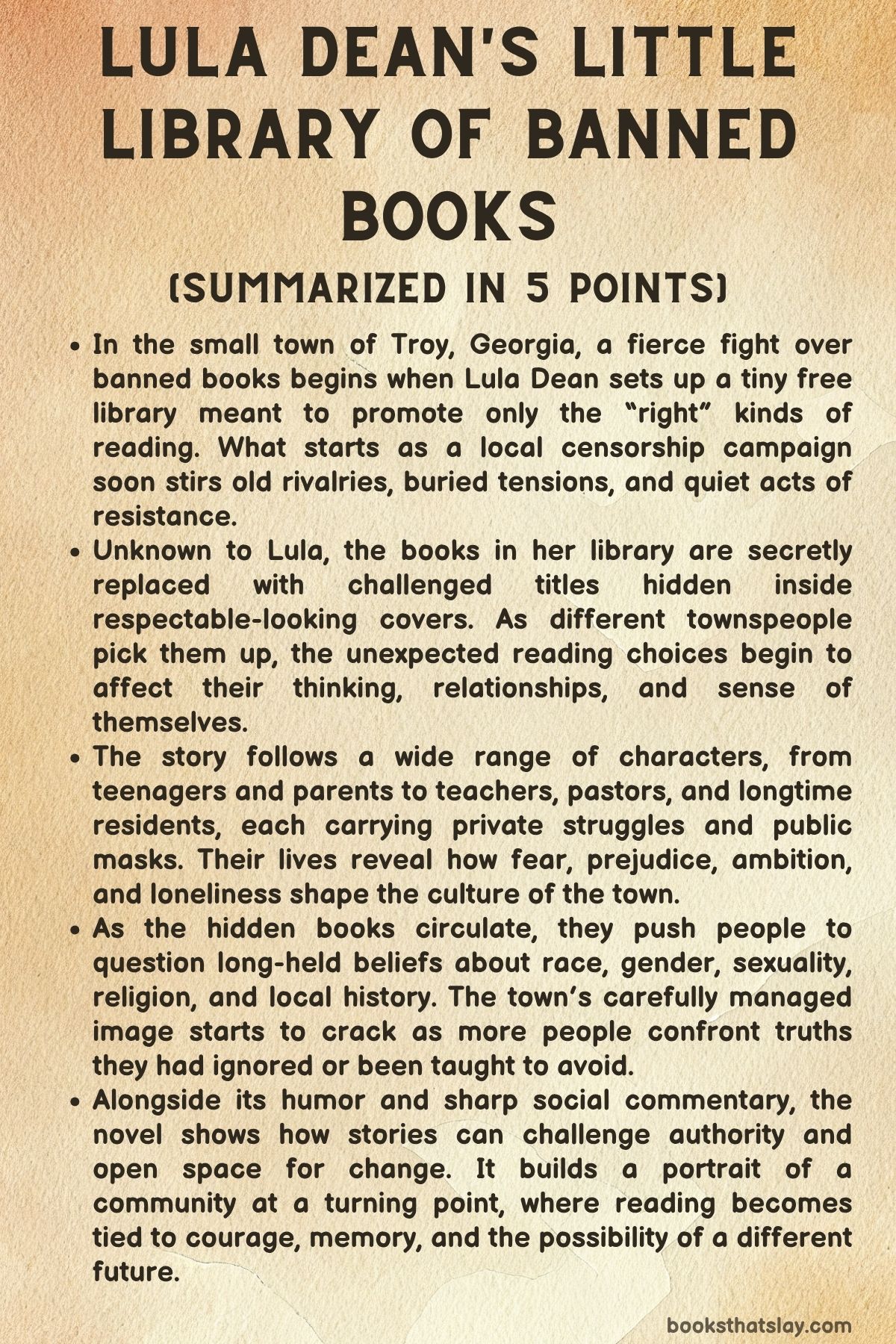
Lula Dean’s Little Library of Banned Books by Kirsten Miller is a sharp, funny, and socially observant novel set in a small Georgia town where a campaign against “dangerous” books sets off a chain of unexpected consequences. The story begins with a local moral crusader trying to control what people read, but it grows into something much larger: a portrait of prejudice, hypocrisy, courage, memory, and change.
As banned books quietly pass from hand to hand under false covers, they open minds, unsettle old beliefs, and push people toward honesty. The novel mixes satire, community drama, and political conflict while showing how reading can alter both private lives and public life.
Summary
In the town of Troy, Georgia, Lula Dean becomes the face of a local movement to remove books from the public library. She presents herself as a defender of decency and tradition, insisting that certain books threaten children and the moral order of the town.
To continue her campaign in a more public and permanent way, she installs a small free library outside her house, filling it with titles she approves of. What she does not know is that Lindsay Underwood, the lesbian daughter of her longtime rival Beverly Underwood, decides to strike back.
With help from Ronnie Childers, Lindsay replaces the books inside Lula’s little library with banned titles hidden beneath harmless-looking dust jackets. From that point on, the library begins doing the exact opposite of what Lula intended.
As the books circulate, different people in Troy pick them up by chance and find themselves changed by what they read. An elderly woman named Wilma Jean Cummings, whose greedy children are trying to strip her of control over her own life and wealth, comes across a surprising book that gives her both amusement and nerve.
Inspired, she shocks her family, hires legal help, and firmly reclaims her independence. Elsewhere, Dawn Dugan, trapped in a marriage to an abusive neo-Nazi, finds Anne Frank’s diary hidden inside an innocent cover.
Reading it forces her to confront the hateful world her husband has built around their family, especially the damage being done to their son. She exposes her husband publicly and leaves town with the boy, refusing to let him be shaped any further by his father’s ideology.
The hidden books keep moving through Troy and quietly undoing the town’s fear-driven assumptions. Delvin Crump, a Black mail carrier who has spent years observing the ugliness that people prefer not to name, finds a novel about slavery and memory inside a book that seems to celebrate Confederate heroes.
The discovery reminds him that not everyone in town agrees with the hateful version of history being defended in public. Crystal Moore, whose husband is cheating on her, expects advice on how to save her marriage but instead finds a book that pushes her to think about her own desires and freedom.
Rather than begging for her husband’s attention, she chooses divorce and a new sense of self.
The library also affects younger people. Elijah Wright, a Black football player struggling to understand his older brother Isaac’s sexuality, reads a novel about a gay relationship after assuming it will prove the town’s warnings correct.
Instead, he realizes that books do not “turn” people into anything. His fear begins to loosen, and that helps him see his brother with more compassion.
A young boy named Beau Sykes, confused and worried about women’s bodies, finds a book that explains menstruation in a simple and human way. It answers his questions without shame, exposing how ridiculous and harmful the adults’ panic about books really is.
While these private changes are happening, the novel reveals the older wounds beneath Troy’s current conflict. Beverly Underwood has opposed Lula for years, partly because she sees that Lula’s campaign is powered less by principle than by resentment and a hunger for attention.
Long ago, Beverly defended a classmate, Darlene Cagle, after Darlene was raped by three boys. Beverly made sure the boys faced consequences, but the town largely moved on.
Years later, one of those boys has become Troy’s mayor. When Darlene reads a novel about sexual violence hidden inside a misleading cover, she is moved to tell the truth publicly at last.
Her revelation destroys the mayor’s reputation and exposes the town’s long habit of protecting men while silencing women.
Questions of race and history grow even larger as the novel turns toward the town square, where a statue of Confederate general Augustus Wainwright stands as a symbol of false Southern honor. Beverly, once raised on myths about noble ancestors, had her worldview changed years earlier by a librarian who gave her a book about slavery and made her confront what men like Wainwright truly were.
Beverly’s later research into family history and DNA reveals that Wainwright raped enslaved Black women and fathered descendants whose lives remain tied to his violence. Isaac Wright, who is among those descendants, decides to challenge the town’s public memory directly.
Lula, meanwhile, continues to enjoy the attention her campaign brings. She runs for mayor and attracts outside support from Mitch Sweeney, a hometown actor turned right-wing celebrity who sees culture-war outrage as a path into politics.
But his return to Troy reveals his shallowness, as well as the danger of the forces Lula has stirred up. One of the most volatile people in town is Logan Walsh, a deeply damaged young man shaped by abuse, isolation, and extremist ideology.
He becomes increasingly dangerous as Troy starts to shift away from the old order he wants to defend.
At a public rally meant to celebrate Confederate heritage, Isaac, Elijah, and Bella interrupt Lula’s event with a banner declaring that they are descendants of Augustus Wainwright and demanding the statue’s removal. The crowd erupts.
Logan appears with a gun, and Mitch blunders into the chaos, accidentally injuring Bella. The rally collapses into confusion, exposing how unstable Lula’s movement really is.
From there, the conflict in Troy sharpens. As people begin connecting the swapped books to the changes happening all over town, Lula tries to regain control by demanding punishment.
The danger peaks when Delvin and Jeb Sweeney, Mitch’s more grounded and decent brother, realize Logan may be planning a mass attack at an upcoming Wainwright family reunion. Delvin’s instincts, shaped by both experience and hard-earned caution, prove correct.
He and Jeb discover Logan’s preparations, including weapons and a target map. Cornered, Logan dies by suicide before he can carry out the attack.
His death shakes the town and sends Lindsay into guilt, because she fears the prank with the books somehow caused everything. In truth, the books did not create Logan’s violence.
They exposed what had already been festering in Troy for years.
Lindsay eventually confesses that she, not Beverly, switched the books in Lula’s library. Ronnie tries to protect her by offering to take the blame as well.
Around them, however, more and more townspeople speak up about what the books gave them: clarity, courage, knowledge, self-respect, and empathy. Wilma returns to legal battle mode to reduce the charges.
Others begin searching for the best way to end Lula’s power once and for all.
That opportunity arrives through Lula’s own family. Her estranged twins return to town.
Talia and her sibling, now known as Moxie Laguerre, reveal Lula’s private hypocrisy, including her hidden stash of erotic fiction and the cruel way she treated her child’s gender expression. They also expose the role she played in destroying the career of a gay music teacher she blamed for influences that were never his doing.
Faced with public humiliation and the possibility of losing her children forever, Lula finally backs down.
In the aftermath, Troy begins to change. Beverly helps organize a large reunion of Wainwright descendants, turning buried history into public truth.
Even people who once defended the old order begin to rethink themselves. Mitch, eager as ever for attention, reinvents himself yet again, but this time in support of a more hopeful story.
The town slowly moves away from fear and toward a more honest version of itself.
A decade later, Troy is transformed. The Confederate statue is gone, replaced by one honoring an unknown Black woman, a symbol of all the women erased by history.
Beverly has risen to statewide leadership, Isaac has entered national politics, and the town has a new library. Lula is no longer the force she once was.
In place of her old project stands a different literary future, one shaped not by censorship, but by memory, truth, and the people brave enough to read.
Characters
Lula Dean
Lula Dean is the engine of conflict because she turns private bitterness into public power. She presents herself as a guardian of morality, but her actions show that she is driven less by principle than by resentment, vanity, and a need to matter.
Her campaign against books gives her something she has always wanted: influence over other people’s lives. The novel makes clear that her self-righteousness is rooted in old humiliations and disappointments.
She has carried grudges for decades, especially against Beverly, and she converts those grudges into political theater. What makes her effective is not wisdom or strength, but her ability to exploit fear that already exists in the town.
She understands how to dress up malice as virtue and how to make control look like care.
At the same time, she is not written as a flat villain. Her loneliness matters.
After the death of her husband and the departure of her children, she is left with a life that feels small and unimportant. Instead of facing that emptiness honestly, she builds a moral crusade around it.
That choice gives the character a sharp psychological edge. She wants respect, but she seeks it through intimidation.
She wants community, but she tries to create it by dividing people. She wants order, but she spreads instability.
Her hypocrisy becomes especially revealing when her private life is exposed. She condemns material she herself consumes, and she attacks forms of identity that exist within her own family.
In that sense, she stands for the way repression can curdle into cruelty. By the end, her collapse is not only political but personal.
She is forced to confront the gap between the righteous woman she performs in public and the frightened, controlling, deeply insecure person she has always been.
Beverly Underwood
Beverly Underwood functions as Lula’s moral opposite, but she is much more than a simple foil. She represents discipline, courage, and a mature sense of responsibility.
Where Lula uses gossip and panic, Beverly relies on judgment and accountability. Her authority comes not from noise but from steadiness.
She has lived in Troy long enough to understand its habits of silence, its racial history, and its fear of social embarrassment. Because of that, she recognizes early that the book-ban campaign is not about protecting children.
It is about policing identity, punishing difference, and preserving small-town hierarchies. Beverly sees all of that clearly, yet the novel also shows the cost of being the person who sees clearly in a place that prefers comforting lies.
Her strength is tied to memory and action. Years earlier, when Darlene was assaulted, Beverly refused to let the town bury the truth in shame.
Later, when she learns more about her Confederate ancestor, she does not cling to family mythology. She allows knowledge to alter her understanding of herself and her town.
This willingness to change is one of her defining traits. She is not trapped by inherited stories.
She is willing to lose illusions in order to gain truth. As a mother, she is protective without becoming controlling.
She knows Lindsay’s sexuality makes her vulnerable in Troy’s climate, and that awareness shapes many of her choices. Beverly’s character is also marked by frustration, because she often carries the burden of being the sensible one while others make reckless or selfish decisions.
Yet she never becomes passive. Her development points toward public leadership because she has already spent years practicing moral leadership in private.
She earns authority through integrity, and that makes her one of the book’s strongest embodiments of civic courage.
Lindsay Underwood
Lindsay is the spark that sets the story in motion, but her importance goes beyond the original prank. She represents youthful intelligence, impatience, and moral risk.
She is angry for good reason. She sees the ugliness behind the book-ban movement and refuses to answer it with polite silence.
Her choice to replace the books is mischievous, political, and hopeful all at once. She believes people can change if they are given access to the very stories Lula wants hidden.
That belief turns out to be correct, but the novel refuses to let her remain in a simple role as clever rebel. Once events grow more dangerous, Lindsay is forced to face the unpredictability of action.
She learns that even a righteous intervention can produce consequences she never imagined.
What gives Lindsay depth is her mixture of boldness and vulnerability. She is not just the brave daughter of a principled mother.
She is also a young woman trying to exist honestly in a town ready to use her identity against her. That tension makes her prank more than a political gesture.
It is also an act of resistance against a culture that wants people like her erased or shamed. When violence and exposure follow, she reacts with guilt rather than self-congratulation.
She worries that she has caused harm, especially after Logan’s death, and that response shows a conscience that is very much alive. Lindsay is not radical because she enjoys chaos.
She is radical because she cannot accept a public order built on intimidation and lies. Her emotional arc moves from defiant certainty to painful self-doubt and then toward a harder, wiser understanding of what change costs.
She becomes a figure of moral growth because she learns that doing the right thing does not guarantee clean outcomes, yet that does not make the action wrong.
Ronnie Childers
Ronnie begins as a comic and slightly ragged presence, but he develops into one of the most touching figures in the novel. At first glance, he seems like the local burnout, the young man drifting at the edges of respectable society.
His hallucinogenic late-night state and his eager agreement to help Lindsay can make him look unserious. Yet the story steadily reveals that he is much more perceptive and loyal than the town gives him credit for.
Ronnie understands what it means to be marked as disposable. Because of that, he responds with unusual generosity when others are in danger.
His affection for Lindsay is real, but it is not reduced to romantic entitlement. He helps her because he cares for her as a person and because he shares her contempt for hypocrisy.
Ronnie’s class position matters to his characterization. He is one of the young men most likely to be trapped by Troy’s systems rather than protected by them.
The mention of his legal vulnerability over mushrooms underlines how quickly the law can fall on someone with little status. He is a reminder that “troublemaker” is often a label placed on the powerless while much worse people remain socially protected.
His willingness to take blame for the prank shows both devotion and fatalism. He assumes sacrifice may simply be what life asks of someone like him.
That gives the character quiet sadness. At the same time, Ronnie never becomes merely pitiable.
He has humor, courage, and a kind of emotional honesty that many more respectable people lack. He sees the traps set by towns like Troy and still chooses decency.
In a book full of loud ideologues and public performers, Ronnie stands out for his unpolished goodness.
Wilma Jean Cummings
Wilma Jean Cummings is one of the clearest examples of how age is treated as a source of force rather than decline. She is old, sharp, angry, funny, and impossible to dismiss once she decides to act.
Her family sees her as a fortune to be managed and a mind to be doubted, which means her storyline exposes the cruelty hidden beneath sentimental attitudes toward the elderly. The children circling her wealth reveal how quickly family can turn predatory when an older woman is assumed to be weakening.
Wilma’s reaction to that pressure defines her character. She does not quietly accept diminishment.
She resists with theatrical flair, legal intelligence, and a refusal to surrender authority over her own life.
Her bond with Bella is especially important because it links two generations of female defiance. Wilma sees in Bella the spark of irreverence and self-possession that the town often tries to suppress in girls.
Their collaboration is comic, but it is also political. Wilma’s outrageous cake is not just a joke at her family’s expense.
It is a declaration that shame will not be used to control her. She chooses spectacle as a weapon because spectacle has been used against women for so long.
Later, when she returns to legal work to protect Lindsay, she shows that her resistance is not only personal. She becomes a defender of younger people threatened by the same culture of punishment and control.
Wilma embodies the idea that experience, when combined with nerve, can become a powerful counterweight to social cruelty. She is one of the book’s great pleasures because she is formidable without becoming solemn.
Bella
Bella often appears in relation to others, but she is far from a passive supporting figure. She moves through the story as a catalyst, witness, and participant in the town’s ongoing shifts.
Her relationship with Wilma shows her mischievous intelligence and willingness to challenge social expectations. Her connection to Elijah adds another layer, since their interracial attraction exists within a place where race still shapes status and comfort.
Bella is socially visible, but the novel uses that visibility in an interesting way. She could easily have been written as a shallow symbol of popularity, yet she turns out to be curious, open-minded, and braver than her image suggests.
She is also important because she becomes one of the bodies on which the town’s conflict lands directly. Her injury at the rally is not just a plot point.
It shows how quickly public posturing and ideological rage can become physical harm. Bella’s later guilt and sadness over the consequences of the prank indicate a capacity for reflection that deepens her character.
She does not seek attention through suffering. Instead, she becomes part of a group trying to think ethically in the middle of chaos.
Her assistance to Wilma in investigating the value of the books proves her usefulness and resourcefulness. Bella represents a younger generation that has inherited old conflicts but does not want to repeat old lies.
She is socially recognizable within the town’s hierarchy, yet she repeatedly chooses solidarity over comfort.
Delvin Crump
Delvin Crump is one of the book’s clearest moral centers. As a mail carrier, he occupies a role that lets him move through the whole town, seeing what others miss and noticing what others want hidden.
He has watched Troy for years, and that long view gives his judgments weight. Delvin knows the difference between public niceness and private prejudice.
He understands how racism survives not only in open hatred but in stories, symbols, television narratives, and the selective fears people are taught to nurse. Because he is Black and deeply observant, he reads the town with a realism that cuts through self-congratulation.
What makes Delvin especially compelling is the balance between his weariness and his persistence. He is not naive about the people around him.
He has seen enough to become isolated and disillusioned. Yet he does not give up on the possibility of human decency.
The hidden book he discovers restores a little of that faith, and from there he becomes increasingly active in pushing back against danger. His military past sharpens his instincts, especially when he identifies Logan as a serious threat.
Delvin is not heroic because he is fearless. He is heroic because he understands risk and acts anyway.
He also serves as an ethical teacher in quieter ways, as when he speaks to Betsy about religion and love. He consistently directs people away from narrow dogma and toward a more humane reading of both history and faith.
His courage is practical, grounded, and unsentimental, which makes it especially persuasive.
Dawn Dugan
Dawn Dugan’s arc is one of the most painful and satisfying because it traces the movement from trained submission to decisive action. She has spent years living under domination, adjusting herself to a husband whose racism, misogyny, and cruelty shape the home.
The basement meetings, the silence expected of her, and the degradation she absorbs all show how authoritarian politics often begin in intimate spaces. Dawn’s life is constrained not only by Nathan’s control but by habits of obedience that have become second nature.
She has learned to disappear in order to survive.
The hidden copy of Anne Frank’s diary breaks that pattern because it gives Dawn both a moral mirror and a new language for recognizing evil. The novel treats this transformation carefully.
Dawn is not suddenly remade into a fearless rebel. She is terrified, ashamed, and late in recognizing what her son is becoming.
That complexity matters. Her awakening is powerful precisely because it comes from someone who has spent so long suppressing her own judgment.
Once she does act, she acts boldly and publicly, exposing her husband and leaving town. Her choice protects her son from further corruption and asserts a moral line she will no longer let Nathan cross.
Dawn’s storyline shows how reading can change not just opinion but behavior. It can interrupt learned helplessness and make action possible.
Nathan Dugan
Nathan Dugan is an embodiment of organized hatred at the local level. He does not need a large stage to be dangerous.
His influence is exercised through domestic terror, secret meetings, and the grooming of younger men into extremism. He is cruel to his wife, emotionally manipulative with his son, and committed to a racist worldview that gives him a sense of identity and superiority.
The novel presents him as someone who relies on ideology to justify his appetite for power. He is not simply a believer in hateful ideas; he uses those ideas to structure dominance in every part of his life.
His significance also lies in how ordinary he can appear from the outside. Delvin has seen the evidence of his beliefs for years, which suggests how much communities tolerate when it can be hidden behind closed doors.
Nathan demonstrates that extremism is not always spectacular. Often it is domestic, social, and incremental.
He creates the conditions in which Logan can thrive and in which Nate, his son, can be drawn toward cruelty as the price of paternal approval. Nathan matters less as a complicated inner portrait than as a representation of how ideological violence reproduces itself through family and community networks.
He stands for inherited toxicity, the kind that claims to defend civilization while poisoning every relationship around it.
Nate Dugan
Nate Dugan is a tragic example of how boys are recruited into hate before they are old enough to understand what they are surrendering. He wants his father’s approval, and that desire becomes the mechanism through which he is pushed toward racism and intimidation.
His vandalism of Mr. Stempel’s home is ugly, but the novel places that act within a larger pattern of manipulation. Nate is not innocent, but he is still salvageable, which is why Dawn’s intervention matters so much.
He has been taught that cruelty earns belonging. That lesson is among the most damaging inheritances in the book.
His role is small compared with some of the larger figures, yet it is important because it shows how prejudice survives across generations. The father offers ideology; the son offers hunger for love.
When those combine, the result can be destructive. Nate allows the novel to show that young men are often not born extremists but shaped into them through fear, praise, and the withholding of affection.
His future remains open precisely because his mother acts before that shaping becomes complete.
Crystal Moore
Crystal Moore’s story begins with betrayal, but it develops into a larger portrait of awakening. She has lived as the proper wife, performing duty and stability in a marriage that no longer deserves her loyalty.
Her first instinct when she discovers her husband’s affair is to fix herself rather than question him. That response reveals how deeply she has absorbed the expectation that women are custodians of male satisfaction.
The hidden book she finds disrupts that conditioning by asking her what she wants, a question that initially startles her because she has not been allowed to center her own desires.
Her walk into the woods is both literal and symbolic. It brings her outside the managed, repetitive boundaries of her life and into a space where change feels natural rather than threatening.
Her realization that living things thrive, die, and transform helps her understand that preserving a broken marriage is not the same as preserving life. Crystal’s decision to seek divorce is therefore more than a response to infidelity.
It is a rejection of a role built on self-erasure. Later, her connection with Jonathan suggests that growth does not merely mean escape from harm; it can also mean opening toward companionship on better terms.
Crystal stands for the many women in the novel who discover that obedience has been mistaken for virtue.
Elijah Wright
Elijah Wright is a compelling study in conflict between love, fear, and inherited belief. He is admired in the town, physically gifted, and socially legible within familiar systems of masculinity.
Yet his brother’s coming out unsettles him because he has absorbed religious teachings that frame queerness as a disaster. He fears for Isaac’s soul, but that fear also protects his own worldview from challenge.
When he reads the novel hidden inside the dust jacket, the expected panic does not come. Instead, he discovers that neither desire nor identity can be mechanically transferred through reading.
This realization begins to loosen the rigid link between what he has been taught and what he can observe for himself.
Elijah’s development is moving because it is awkward and partial rather than grand. He does not instantly become politically articulate.
He starts by noticing that the warnings are false. From there, his emotional understanding begins to widen.
His affection for Bella, his place within a Black family carrying complex historical knowledge, and his relationship with Isaac all make him a bridge figure between different pressures and possibilities. Elijah shows that change often begins not in dramatic ideological conversion but in the quiet collapse of a lie.
Isaac Wright
Isaac Wright is one of the boldest truth-tellers in the novel because he refuses both family silence and public mythology. As a gay Black man in a conservative environment, he occupies several positions the town is accustomed to marginalizing.
Yet he does not accept marginality as a condition of existence. His presence forces other people to confront what they would rather keep separate: race, sexuality, religion, and history.
He has already unsettled his family by coming out, and later he unsettles the town by revealing his descent from Augustus Wainwright. That revelation is politically explosive because it turns a Confederate monument into evidence of sexual violence and racial exploitation.
Isaac’s power lies in his ability to connect private truth with public history. He does not let people treat lineage as abstract genealogy.
For him, ancestry is a record of domination that still shapes the present. His use of DNA evidence is especially effective because it counters myth with proof, but the emotional force of his action matters just as much.
He refuses the shame traditionally assigned to descendants of violated women. Instead, he turns that history back against the town’s false idea of honor.
Isaac is also crucial in the book’s treatment of queer life. He is not written as a symbol for tolerance; he is a politically active, emotionally real person whose existence compels others to rethink themselves.
His later rise into public leadership feels earned because he already knows how to speak when others want silence.
Betsy Wright
Betsy Wright is one of the characters through whom the novel examines religious guilt with real sympathy. She loves her son, but she has absorbed beliefs that teach her to view his identity as a reflection of maternal failure.
That inward turn toward blame reveals how oppressive systems damage even the people who try to live gently within them. Betsy is not hateful in the way Lula is hateful.
She is fearful, ashamed, and trapped inside a framework that equates love with correction. Her distress over Isaac’s sexuality is painful precisely because it grows out of care distorted by doctrine.
What makes her arc meaningful is her capacity to listen. Delvin’s reminder about the difference between legalistic religion and the message of love opens space for her to reconsider what faith demands.
She also sees clearly that books did not “cause” her son to be gay, just as romance novels did not alter her own moral character. That insight begins to break the spell of scapegoating.
Betsy’s gradual movement toward understanding feels honest because it does not erase her struggle. She changes by allowing love to become more authoritative than fear.
Beau Sykes
Beau is one of the clearest examples of childhood curiosity colliding with adult censorship. He has basic questions about girls, bodies, and menstruation, and the adults around him have failed to answer him in a calm and useful way.
His ignorance is not foolishness. It is the natural result of a culture that treats knowledge as dangerous and treats bodily reality as shameful.
When he finds a book that explains what he needs to know, the matter becomes simple. The information does not corrupt him.
It relieves fear. That contrast is central to his role in the story.
Beau is also politically important because he accidentally punctures his mother’s public performance. His honest testimony reveals the absurdity of the campaign against “smut” more effectively than any speech could.
Children in this novel are often used rhetorically by adults claiming to protect them, but Beau’s storyline shows what actual protection looks like: truthful explanation, emotional reassurance, and the freedom to ask questions. He represents common sense before ideology twists it.
Melody Sykes
Melody Sykes is a study in how social ambition and patriarchal training can leave a woman stranded once the man at the center of her status falls. She has been shaped by a father who taught obedience and by a marriage that tied her identity to respectability.
When her husband’s disgrace becomes public, she must confront not only his wrongdoing but the fragility of the life she built around him. Her initial desire for revenge, even to the point of imagining poison, reveals how trapped and enraged she feels.
Yet the novel does not leave her inside melodrama. It allows her to think about what a bad man can take from a woman who has given everything to a marriage.
Her political ambitions briefly mimic Lula’s strategy, suggesting how easily one form of female frustration can be redirected into public moralism. But Beau’s interruption destroys the performance because reality breaks through.
Melody cannot continue condemning a book that helped her son. That moment is humiliating, but it is also clarifying.
By the future section, she has rebuilt herself in a more grounded way. Her development suggests that survival after disgrace is possible if one stops living through borrowed status.
Darlene Cagle
Darlene Cagle carries one of the novel’s deepest historical wounds. As a teenager, she was raped, blamed, and left to manage the damage in a town more invested in appearances than justice.
Her mother’s lack of support compounds that injury, showing how thoroughly misogynistic values can be internalized. Darlene initially absorbs the town’s logic and blames herself, which is a devastatingly realistic response.
What interrupts that pattern is Beverly’s refusal to accept the story everyone else would prefer. That early intervention matters because it gives Darlene one memory of solidarity inside a landscape of denial.
As an adult psychiatrist, Darlene has built a life of intelligence and professional purpose, but the past has not disappeared. The book she encounters pushes her toward public speech, and that decision is transformative.
By naming what happened and identifying one of the rapists as the current mayor, she breaks a long conspiracy of silence. Darlene’s courage is not framed as cathartic ease.
It is difficult, risky, and overdue. Her storyline shows that truth can reenter a community long after people have declared a matter settled.
She stands for memory refusing erasure.
Mitch Sweeney
Mitch Sweeney begins as a swaggering opportunist, a man who mistakes performance for conviction and outrage for authenticity. His celebrity, physical presence, and political vanity make him useful to Lula’s cause, but his commitment is shallow.
He is attracted to attention above all else. That makes him both ridiculous and dangerous.
He lends glamour and amplification to bad ideas because he senses career potential in grievance politics. Yet the novel treats him with a degree of comic flexibility that allows change.
He is not deeply principled in his reactionary pose, which means he is also capable of drifting away from it once self-interest points elsewhere.
His conversations with Dr. Chokshi are crucial because they expose the limits of his worldview without reducing him to pure stupidity. Mitch is capable of curiosity and vanity at the same time.
When he begins to sense that “getting on the right side of history” might also be a compelling role, he shifts. That self-serving element never disappears, but it does not cancel the fact that he becomes less harmful and, eventually, somewhat useful.
Mitch is a satire of public men who confuse reinvention with depth, yet he also suggests that even shallow people can occasionally move in better directions if their incentives change.
Jeb Sweeney
Jeb Sweeney is Mitch’s quieter counterpart, a man rooted in responsibility rather than spectacle. As a veterinarian and local resident, he remains embedded in the life of the town instead of using it as a stage.
His liberal politics are not performative branding but an extension of how he understands care, obligation, and truth. Jeb knows his brother’s weaknesses well and sees through the theatrical masculinity Mitch projects.
Their conflict reflects a broader clash between those who live with the consequences of public rhetoric and those who treat rhetoric as career fuel.
Jeb’s importance increases in the sections involving Logan. His recognition of danger, his attempt to intervene, and his cooperation with Delvin show practical courage.
He is not interested in grand ideological speeches. He wants to prevent harm.
That makes him one of the book’s most grounded figures. He also embodies the possibility of remaining in a troubled place without surrendering to its worst habits.
Unlike characters who flee or dominate, Jeb stays and works.
Logan Walsh
Logan Walsh is the novel’s most disturbing portrait of radicalized male violence. He is shaped by abuse, emotional neglect, and isolation, but the book does not use those facts to excuse what he becomes.
Instead, it shows how damage can turn into annihilating hatred when paired with extremist ideology and a hunger for belonging. Logan is searching for authority, meaning, and permission.
Nathan’s neo-Nazi circle gives him all three. The result is a person who feels both deeply wounded and frighteningly committed to destruction.
What makes Logan effective as a character is the combination of menace and emptiness. He is not a charismatic mastermind.
He is a young man with bad ideas, weapons, and nothing to lose, which is exactly what makes him so dangerous. His fixation on revenge and racialized violence grows from a worldview that divides the world into contamination and purity, threat and elimination.
Yet moments involving Jeb suggest that some part of Logan once longed for ordinary care and never received it. That glimpse does not soften him so much as make his trajectory more tragic.
His death by suicide prevents a larger massacre, but it also confirms the total collapse of a self built around grievance and death.
Dr. Chokshi
Dr. Chokshi plays a smaller role, but he serves an important intellectual and moral function in the novel. As an outsider who has chosen to live and work in Troy, he offers a perspective that is neither sentimental nor dismissive.
He sees the prejudices that make small Southern towns hard to enter, especially for professionals of color, yet he also recognizes the people and qualities that make such places worth investing in. This balance allows him to speak with unusual clarity.
He is not blinded by nostalgia, and he is not motivated by local rivalries.
His conversation with Mitch is especially effective because he speaks bluntly without losing his composure. He challenges racist assumptions, exposes the symbolic violence of the Confederate statue, and frames history as a question of moral choice rather than inherited pride.
Dr. Chokshi’s presence matters because it reminds the reader that communities are judged not by the stories they tell about hospitality, but by what their public symbols and private behaviors actually communicate.
Talia
Talia is one of the figures who brings long-buried family truth crashing into public view. As Lula’s daughter, she knows the cost of her mother’s obsession with appearances.
She has seen firsthand how motherhood, in this case, became a project of control, image management, and emotional punishment. Talia’s decision to return is not motivated by nostalgia.
It is strategic, angry, and necessary. She understands that her mother’s campaign is harming real people and that only intimate exposure will break Lula’s power.
Her role is especially important because she refuses the emotional blackmail that often protects parents from accountability. She does not accept that blood requires silence.
Yet her return also implies a difficult form of responsibility. She and her sibling are the ones who can stop Lula because they know where her hypocrisy lives.
Talia turns private family history into public truth, and in doing so she helps end the reign of a woman who built authority on lies.
Moxie Laguerre
Moxie Laguerre, formerly Taylor, gives the novel one of its most dramatic and emotionally charged exposures of hypocrisy. As Lula’s child, Moxie’s existence directly contradicts the rigid gender norms and moral policing that Lula promotes.
The public reveal of Moxie’s identity is powerful not simply because it shocks the crowd, but because it reframes everything Lula has claimed to defend. The person she most wanted to control and erase returns as a successful, visible, unapologetic self.
That reversal has real force.
Moxie’s account of childhood pageantry, punishment, and rejection shows how family can become the first site of ideological violence. Lula’s cruelty was not abstract; it was directed at a child exploring identity.
Moxie’s adult confidence therefore carries political weight. Performance, glamour, and drag become forms of survival and truth-telling rather than shame.
In confronting Lula, Moxie does not ask for approval. Moxie demands accountability.
That distinction makes the character especially memorable.
Nahla Crump
Nahla Crump appears near the end, but her role is quietly decisive because she represents the future of storytelling itself. As a young Black girl offended by old heroic narratives that leave out people like her, she immediately grasps that literature can exclude as well as inspire.
Her grandmother’s reminder that real heroes exist in their own town opens Nahla toward authorship. She does not simply want to read different stories.
She wants to write them. That matters because the novel has spent so much time showing books changing readers.
In Nahla, that process moves one step further, from reading to creation.
Her planned book about Troy’s real heroes suggests a future in which memory is no longer controlled by the powerful. Children like Nahla will decide whose courage deserves record.
She stands as a hopeful answer to censorship: not merely the defense of old books, but the making of better new ones.
Themes
The struggle over books as a struggle over power
In Lula Dean’s Little Library of Banned Books, the battle over reading is never only about reading. Books become the visible object through which deeper conflicts about authority, identity, sexuality, race, and memory are fought.
The attempt to ban certain titles is presented as a claim of moral protection, but the story repeatedly shows that this language of protection hides a desire to control what other people are allowed to know about themselves and the world around them. The books targeted in Troy do not threaten children because they are obscene or corrupting.
They threaten local power because they contain realities that weaken fear, challenge dogma, and make obedience harder to maintain. Once people encounter those realities, they become less manageable.
That is why the conflict matters so much.
The novel also shows that censorship works by reducing human complexity into slogans. Entire communities are encouraged to believe that a book about queer love, menstruation, racism, assault, or historical violence is a weapon aimed at innocence.
This logic depends on ignorance. If knowledge is dangerous, then ignorance can be marketed as virtue.
But the swapped books prove the opposite. Reading does not contaminate the people who find these hidden texts.
It clarifies, comforts, educates, and emboldens them. The child who needs answers about bodies becomes less afraid.
The young man worried about his brother’s sexuality becomes less rigid. The abused wife recognizes the moral horror she has been living beside.
The elderly woman being dismissed by her family finds language for rebellion. The supposedly dangerous book is repeatedly the thing that makes a person more humane and more alive.
That is why the little library becomes such a rich symbol. It begins as an instrument of ideological policing and ends up working as a channel for transformation.
The same wooden box that was meant to distribute approved thought becomes a quiet machine for destabilizing local hypocrisy. This reversal suggests that power cannot fully control meaning once language enters the world.
People do not always read the way authorities want them to read. In fact, they often begin thinking for themselves the moment they encounter something outside the permitted script.
The novel treats this as both comic and profound. It is funny that Lula’s project backfires so completely, but it is also politically serious.
The right to read is linked to the right to become someone larger than the version of yourself a fearful society allows.
History as a living force rather than a settled past
The story treats history not as background but as an active force shaping the present. Troy is full of people who would rather think of the past as closed, respectable, and safely monumental.
The Confederate statue in the square captures that desire perfectly. It takes a violent history and turns it into a noble story about honor, sacrifice, and heritage.
Yet the novel steadily tears apart that version of the past. It insists that what happened before is not finished simply because a town has chosen not to discuss it honestly.
Sexual violence, enslavement, racism, and social exclusion continue to structure the present long after their original events. The past survives in monuments, family stories, silences, habits of shame, and unequal distributions of authority.
What is especially striking is the way the novel connects personal and historical reckoning. Beverly’s journey matters because she begins as someone who has inherited the myth of her Confederate ancestor and then allows knowledge to destroy that myth.
Her transformation models a larger ethical demand: ancestry is not innocence. Family pride cannot erase what was done in the name of that family.
At the same time, the story refuses to let history remain abstract. Through DNA research and public confrontation, the crimes of Augustus Wainwright become embodied in living descendants.
The town cannot keep worshipping him once it is forced to acknowledge that his “legacy” includes rape, coercion, and generations of Black descendants whose very existence testifies against the monument. This is a powerful challenge to the sentimental treatment of Southern history.
The issue is not merely that the past was morally complicated. The issue is that public memory has been arranged to protect the dignity of perpetrators while erasing the humanity of the violated.
Darlene’s storyline adds another layer to this theme. Her assault happened decades earlier, yet it remains alive because it was never truly confronted.
The town’s success at burying it did not make it disappear. It simply preserved the conditions that allowed one of the perpetrators to become mayor.
In this sense, suppressed history is shown to be socially useful for the wrong people. It protects status.
It keeps the powerful comfortable. The novel argues that truth is often destabilizing precisely because communities have built themselves on selective amnesia.
Honest remembrance therefore becomes a civic act, not merely a private one. To tell the truth about the past is to redistribute dignity in the present.
Community as a site of harm and repair
The town is not presented as either a sentimental small-town haven or a purely rotten social order. Instead, it is shown as a place where intimacy can sustain both cruelty and care.
This duality gives the novel much of its richness. The same closeness that allows gossip to travel quickly also allows solidarity to form.
The same familiarity that makes difference dangerous also makes acts of support highly visible and contagious. People know one another’s histories, weaknesses, and families, which means harm can become deeply personal.
Yet it also means repair can happen through relationships rather than abstract goodwill. The book’s social world is messy, local, emotional, and specific, and that prevents the town from becoming a simple symbol.
A great deal of the harm in Troy depends on community pressure. Shame is one of the town’s strongest enforcement tools.
Darlene is shamed after assault. Lindsay’s sexuality can be used as public ammunition.
Betsy fears judgment from neighbors as much as she fears God’s disapproval. Nathan and Logan rely on a version of communal identity defined through whiteness, masculinity, and exclusion.
Lula herself thrives because she knows how to convert scattered anxieties into a collective moral panic. Community, in this form, becomes a machine that rewards conformity and punishes visibility.
It pressures people to keep the peace by protecting lies.
At the same time, the novel insists that community can be reclaimed rather than abandoned. This is where many of the smaller interactions matter.
Delvin offers wisdom instead of contempt. Wilma uses her skills to defend younger people.
Beverly stands by women and children others would rather sacrifice to appearances. Dawn leaves with her son rather than surrendering him.
Talia and Moxie return not because they owe the town loyalty, but because they recognize that intervention can stop further damage. Even Mitch, for all his vanity, drifts into a less destructive relationship with his hometown once his perspective changes.
These shifts do not create a perfect community. They create a more truthful one.
The family reunion near the end is a particularly strong expression of repair. It gathers people around a history that had once been hidden and organizes connection around truth rather than denial.
That matters because the book does not imagine healing as forgetting conflict. Healing comes through naming what happened, redistributing attention, and building new forms of public memory.
The community improves not when disagreement disappears, but when fear loses its monopoly over public life. In that sense, the novel offers a demanding but hopeful idea of collective life: people can become better together, but only if they stop using togetherness as an excuse for silence.
The making and unmaking of identity through fear, shame, and recognition
Identity in the novel is never treated as a fixed label. Instead, it is shaped by what people are taught to fear, what they are told to hide, and what forms of recognition become available to them.
The town tries to enforce narrow identities through moral scripts. Men should be dominant, women obedient, children innocent, queer people invisible, Black people respectful, and history flattering to whiteness.
These scripts are maintained through shame. The person who steps outside them risks gossip, punishment, exclusion, or violence.
That is why so many characters initially live in diminished versions of themselves. They have learned that safety depends on performance.
The novel pays particular attention to the way shame works through gender and sexuality. Betsy experiences her son’s queerness as an accusation against her motherhood because her world has taught her that a son’s identity reflects maternal success or failure.
Melody has built herself around wifehood so completely that scandal threatens to erase her sense of self. Crystal begins by assuming her husband’s affair means she has failed in her role.
Lula’s cruelty toward Moxie reveals how intensely gender nonconformity threatens those who rely on rigid binaries to make the world feel controllable. In all these cases, identity is shown as something policed through emotional punishment long before it is discussed in explicit political terms.
What begins to undo these damaged identities is recognition, and that recognition often comes through stories. Elijah recognizes that his brother’s life cannot be explained by the fantasies of anti-gay panic.
Beau recognizes menstruation as normal rather than frightening. Dawn recognizes her husband’s ideology as morally catastrophic rather than merely unpleasant.
Darlene recognizes that speaking publicly about rape can restore agency rather than confirm disgrace. Reading matters because it lets characters encounter realities outside the shame-based logic of their environment.
Once they see themselves or others more clearly, the old script begins to lose authority.
The novel also argues that recognition is social, not merely internal. People change not only because they privately realize something, but because others make space for that realization to hold.
Delvin’s advice helps Betsy move toward love. Beverly’s past defense helps make Darlene’s later truth possible.
Talia and Moxie force the town to witness what Lula tried to suppress. Nahla imagines new kinds of heroes because her grandmother names them first.
Identity, then, is shown as relational. Fear and shame can deform it, but honesty and recognition can widen it.
This makes the book’s moral vision surprisingly generous. It does not say that everyone is already free to be themselves.
It says freedom becomes more possible when lies lose public power and when people begin answering one another with understanding instead of control.