A Sorceress Comes to Call Summary, Characters and Themes
A Sorceress Comes to Call by T. Kingfisher is a dark fantasy novel with Gothic touches, sharp humor, and a strong undercurrent of menace. At its center is Cordelia, a quiet girl raised under the cruel control of her mother, Evangeline, a sorceress who uses magic to dominate people and shape her future.
The story brings together dread, social comedy, violence, and found-family warmth as Cordelia slowly moves from fear toward resistance. Alongside her are memorable allies, especially the practical Hester Chatham, whose intelligence and stubborn courage give the novel much of its force. It is a dark and captivating retelling of the Brothers Grimm’s Goose Girl.
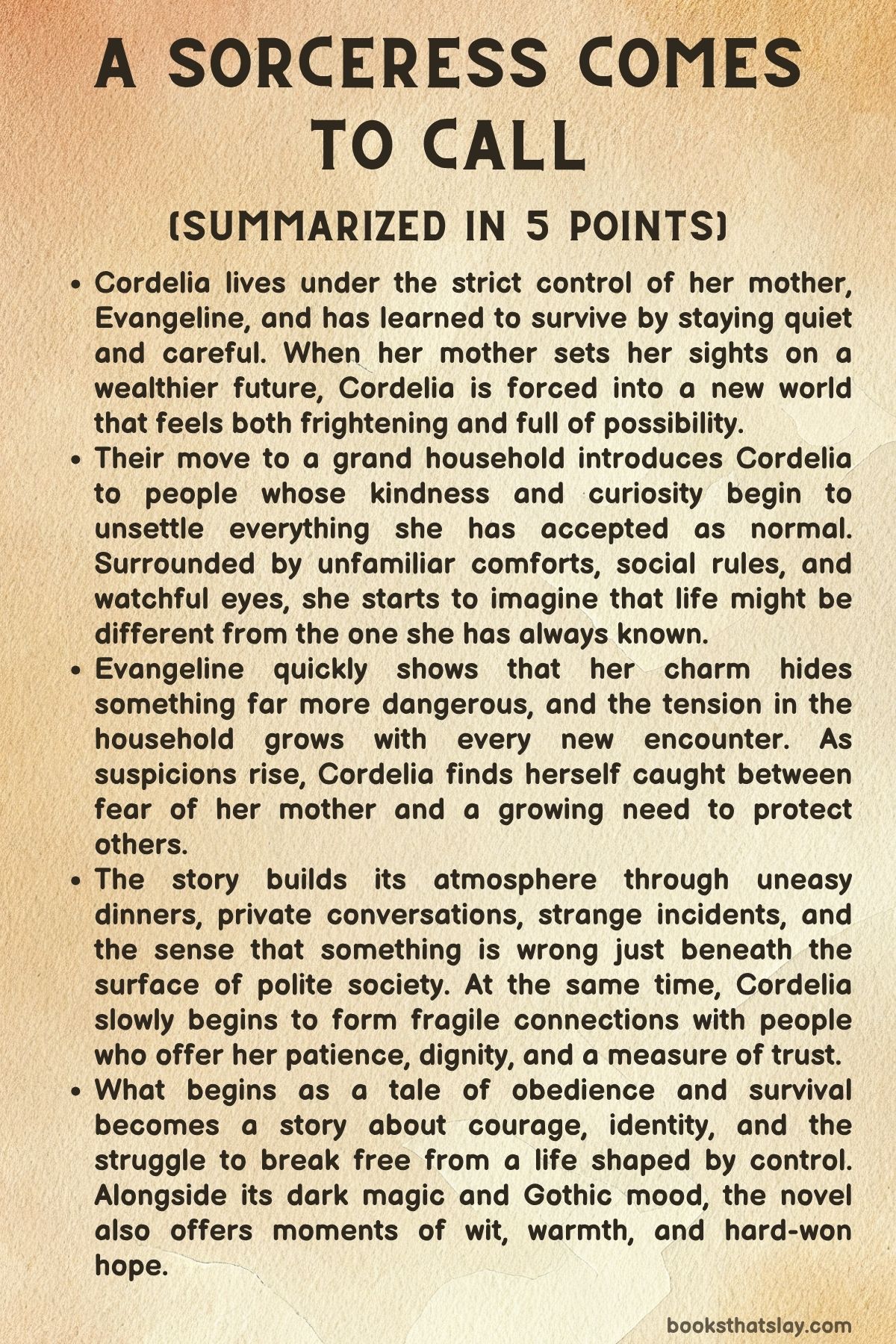
Summary
Cordelia lives in a state of constant fear under the authority of her mother, Evangeline. Evangeline can force obedience on her with sorcery, leaving Cordelia aware of everything that happens but unable to control her own body.
Even the smallest mistakes can bring punishment, so Cordelia survives by keeping quiet, apologizing quickly, and shrinking herself as much as possible. Her only real comfort comes from her horse, Falada, and from brief, awkward but sincere conversations with a local girl named Ellen.
Cordelia dreams of escape, but her life has taught her that wanting freedom is not the same as being able to reach it.
When Evangeline’s current source of support becomes inconvenient, she decides that marriage will provide a more secure future. She reveals to Cordelia that she is a sorceress and speaks openly about using marriage as a way to gain wealth and status.
Cordelia also learns that Falada is not simply a horse but a familiar tied to Evangeline’s magic, and worse, that he has been carrying her secrets back to her mother. This discovery leaves Cordelia even more isolated.
Soon Evangeline sets her sights on a new target, the wealthy Squire Samuel Chatham, who lives near the coast with his capable sister, Hester.
Hester senses trouble even before Evangeline fully enters her life. Older, intelligent, and used to reading danger beneath polite surfaces, Hester immediately distrusts the beautiful stranger who appears so fragile and so perfectly designed to attract her brother’s sympathy.
When Evangeline and Cordelia arrive at the Chatham household, Cordelia is overwhelmed by the household’s comfort, the privacy of separate rooms, and the kindness of servants who treat her as a person. Her maid, Alice, becomes one of the first people to offer her simple care without cruelty.
For the first time, Cordelia sleeps safely behind closed doors.
At the Chathams’ house, Cordelia’s fear does not vanish, but it is thrown into sharper contrast by the decency around her. Hester quickly notices that the girl is not vain, sly, or spoiled, but frightened, inexperienced, and deeply unsure of herself.
Cordelia has not been raised like a young lady despite Evangeline’s claims; she does not know social rules, common accomplishments, or even the ordinary boundaries of healthy family life. Hester begins teaching her practical things such as embroidery and conversation, all while quietly trying to understand what kind of power Evangeline holds over her.
Evangeline, meanwhile, works steadily on the Squire. She plays the role of a vulnerable woman in need of rescue while planning every detail of her advance.
Cordelia is expected to help by appearing sweet and marriageable, but social occasions are a torment for her. At formal dinners she struggles with unfamiliar customs, and whenever she disappoints her mother, Evangeline punishes her, sometimes by forcing obedience in public.
Hester eventually sees the terrible change that comes over Cordelia under the spell and begins to understand that something far worse than ordinary mistreatment is happening.
As more guests arrive at the Chatham estate, the atmosphere shifts. Among them are Lord Richard Evermore, Hester’s longtime beloved friend, the lively Imogene Strauss and her family, and the striking widow Penelope Green.
Penelope’s confidence and style immediately unsettle Evangeline, who sees another attractive woman as a threat to her plan. Cordelia, who has lived with fear for so long, recognizes her mother’s growing rage before anyone else fully understands it.
She also starts to see that Hester, Richard, Imogene, and the household staff may become something like allies, even if she is not yet brave enough to tell them everything.
Penelope’s presence changes the balance in the house. She is witty, self-possessed, and impossible for Evangeline to control through charm alone.
Evangeline becomes fixated on her, and soon an apparent attack takes place. Penelope’s maid is stabbed, Penelope seems to be holding the weapon, and then she falls from a balcony to her death.
To others it looks like madness or violence, but Cordelia knows what really happened: Evangeline tried to force Penelope to act against her will. Penelope resisted, and Evangeline killed her.
This death becomes the turning point. Burdened by guilt and panic, Cordelia finally tells Hester the truth: Evangeline is a sorceress who can command obedience.
Hester is slow to accept the full claim, but too many details now fit together, including the strange death, Cordelia’s fear, and earlier violence connected to Evangeline. Richard investigates Cordelia’s old village and confirms that the Parker family, once known to Cordelia, were drawn into disaster through Evangeline’s influence.
Ellen, however, has survived, and this small fact offers Cordelia a bit of hope.
The danger grows when Evangeline secures her engagement to the Squire. Hester and Richard need time, so they create a false plan of their own: Richard will pretend to court Cordelia.
Evangeline is delighted by the idea of her daughter marrying a wealthy man, and for a while the false engagement distracts her. During this period Cordelia begins hearing a voice in her head.
It is Penelope’s ghost, still present after death and able to reach Cordelia because of their connection to Evangeline’s magic. Penelope reveals that she fought Evangeline’s control and confirms key details of what happened.
With dry humor and unusual calm about her own death, she becomes an unexpected helper.
After the Squire and Evangeline marry, the group retreats to Richard’s estate to search for a way to stop her. They turn to old books, household lore, and desperate improvisation.
Tom, the loyal butler Evangeline dismisses from service, joins them. Their research uncovers a ritual involving wine, water, and salt that may strip a sorcerer of power.
They decide to test it first on Falada, whose unnatural nature is now impossible to ignore. Yet their first attempt fails.
Falada survives decapitation, crawls out of his grave, and continues stalking the grounds as a headless instrument of violence. The horror of Evangeline’s magic becomes even clearer: she does not merely command the living but can twist death itself.
Cordelia remains at the center of the struggle because Evangeline’s control over her is both the greatest danger and the clearest pathway inward. Determined to understand more, Cordelia secretly confronts Falada and is carried through the night to Evangeline, who is hiding nearby.
There Evangeline forces Cordelia into obedience again, compels her to injure herself, and drags out the group’s plans. Cordelia also learns more about her father, whom Evangeline killed after he rejected her.
This revelation strips away any remaining illusion that her mother can change.
The final confrontation comes when Evangeline uses Cordelia as a weapon against Richard and then tries to seize control of Hester as well. But by this point Cordelia is no longer completely alone.
Penelope speaks to her, helping her resist. Hester recognizes what is happening and fights back.
The others act quickly, knocking Evangeline unconscious and preparing the ritual once more under urgent, chaotic conditions. This time Penelope takes the place of wine, completing what was missing before.
Water, salt, and wine ring together, and the spell succeeds. Evangeline’s power is broken.
Even then, the danger is not finished. Falada turns on Evangeline and tramples her to death before fading away himself.
The end is violent, but it closes the long chain of domination she set in motion. In the aftermath, recovery is uneven but real.
Hester and Richard survive their injuries and finally move toward a shared life, though not in the conventional romantic pattern others expect. Cordelia is offered something better than a marriage bargain: adoption, protection, education, and the chance to decide her own future.
She visits Penelope’s grave, remembers her promise to live with style, and begins looking ahead. After a life shaped by coercion, she steps into the possibility of becoming herself.
Characters
Cordelia
Cordelia is the emotional center of A Sorceress Comes to Call, and her character is built with unusual care because her growth is not loud, sudden, or theatrical. At the beginning, she has been shaped by fear so completely that silence feels like the only safe form of existence.
She has learned to monitor her expressions, soften her words, and make herself small in order to survive her mother’s cruelty. What makes her so compelling is that she is not passive by nature.
She has been trained into stillness. The novel shows again and again that beneath the hesitation there is intelligence, moral clarity, and a stubborn instinct toward freedom.
She notices everything: shifts in tone, small hypocrisies, the danger in a room, the meaning of a glance, the feeling of a lie. Her watchfulness becomes one of her greatest strengths.
Cordelia’s development is convincing because it does not turn her into a different person. She remains shy, uncertain, and awkward for much of the story, but those qualities slowly stop being signs of helplessness.
They become part of a more thoughtful kind of courage. She learns to trust her own judgment after years of being taught that her mind and body belong to someone else.
Her resistance begins in small inward acts, then grows into speech, confession, and finally action. That movement from private endurance to moral choice gives the character real force.
She also carries one of the novel’s most painful burdens: the fear that she is tainted by proximity to evil. Because she has lived under her mother’s control for so long, she worries that she is somehow complicit in what has happened.
The story treats that fear with seriousness, but it also shows clearly that survival under abuse is not guilt. By the end, Cordelia’s most meaningful victory is not only that she escapes domination, but that she begins to imagine a self beyond it.
Evangeline
Evangeline is a striking antagonist because her menace comes not only from magic but from vanity, entitlement, and emotional hunger. She is not written as an abstract embodiment of evil.
She is petty, selfish, manipulative, hungry for admiration, and deeply convinced that other people exist to serve her desires. That recognizably human ugliness makes her more frightening.
Her sorcery gives form to traits that are already present in her character. She does not simply want comfort or security.
She wants possession, control, and triumph over those who resist her. Beauty becomes one of her tools, fragility becomes one of her performances, and motherhood becomes one of her most effective disguises.
What makes Evangeline especially effective as a character is that she understands social weakness and uses it expertly. She knows how men like the Squire want to see women, and she offers exactly that image back to them.
She knows that politeness can protect cruelty, that pretty helplessness can silence doubt, and that a household trained to avoid scandal can be slow to name danger. She is calculating without being cold in a simple way.
She enjoys injury. She enjoys humiliation.
She enjoys forcing others into positions where their goodness becomes a weakness she can exploit. Her treatment of Cordelia shows the full extent of this corruption.
She does not merely abuse power; she takes satisfaction in breaking down her daughter’s independence and then blaming the child for needing to be controlled.
At the same time, Evangeline is not grand in the manner of a mythic villain. She remains narrow in her imagination.
Her ambitions are material and social. She thinks in terms of access, marriage, reputation, and possession.
That limitation matters. It reveals that she does not seek transformation or wisdom, only dominance.
Even her magic feels like an extension of appetite. The novel gives her just enough history to show how resentment hardened into brutality, but it never invites excuses.
She is dangerous because she has chosen power over every human bond available to her.
Hester Chatham
Hester is one of the richest characters in the novel because she combines sharp intelligence, social experience, humor, loneliness, and moral resolve. She is older than many women usually placed at the center of such a story, and that gives her presence unusual weight.
She has spent years learning how to read people, how to manage a household, and how to survive disappointment without becoming bitter in a simple or predictable way. Her body is marked by pain, her future has narrowed in certain respects, and she knows very well what society thinks a woman of her age should accept.
Yet she remains observant, exacting, and capable of decisive action. She is not sentimental, which makes her kindness more meaningful when it appears.
Hester’s relationship with Cordelia is one of the strongest parts of the book because it is built on recognition rather than instant intimacy. She does not immediately understand the full truth, but she notices that the girl’s fear is real.
Her first instinct is not to flatter, rescue dramatically, or claim easy moral superiority. She watches, tests, teaches, and slowly commits herself.
That patience suits her character. She has the mind of someone who knows that evil often enters politely.
Once she recognizes the scale of the danger, however, she becomes fiercely protective. Her courage is not flashy.
It is practical, stubborn, and rooted in responsibility. She does not act because she wants to see herself as heroic.
She acts because someone must.
Hester’s personal life adds depth to her role in the larger conflict. Her history with Richard shows how love can exist beside fear, pride, self-denial, and an aching awareness of time.
She has denied herself certain forms of happiness because she believes she is protecting him and preserving her independence, yet this restraint has cost her dearly. That inward conflict keeps her from becoming merely the wise protector figure.
She is as vulnerable in her emotional life as she is formidable in judgment. By the end, Hester’s strength lies not only in helping defeat Evangeline, but in allowing herself to move toward connection without surrendering dignity.
Richard Evermore
Richard is written with restraint, which suits his character. He could easily have become a conventional noble rescuer, but the novel refuses that simplification.
He is decent, intelligent, and loyal, yet he is not equipped to solve the central problem alone. That limitation is important because it prevents him from overshadowing Cordelia and Hester.
His value lies in steadiness. He listens, investigates, supports plans he did not invent, and places his resources at the service of people he cares for.
He has courage, but not the arrogance to assume courage is enough.
His relationship with Hester is one of the book’s most affecting emotional threads. He clearly loves her, and that love has endured through years of changed circumstances, missed chances, and unspoken grief.
What is especially moving about him is that his affection does not turn possessive. He remains available without demanding resolution on his own terms.
He wants her, but he also respects the complexity of her refusals and the reality of her fears. That patience makes him more than simply admirable.
It makes him believable.
Richard also functions as a contrast to the men Evangeline manipulates. He is wealthy and socially powerful, yet he does not treat women as prizes, burdens, or decorative extensions of himself.
Because of that, he cannot be maneuvered in the same way. Evangeline misjudges him when she assumes that money and marriage are enough to define his motives.
He understands danger, though perhaps not as quickly as Hester, and once he does, he commits fully. Even his failures matter.
He cannot play every role the ritual requires, and he is vulnerable to attack. These moments keep him human and reinforce the larger idea that goodness is valuable, but never automatically sufficient.
Penelope Green
Penelope is one of the most vivid secondary characters because she enters with confidence, humor, and social ease that immediately alter the emotional atmosphere around her. She is attractive, poised, and stylish, but the novel never reduces her to those traits.
What matters more is the quality of her self-possession. She does not apologize for taking up space, and she has a way of meeting malice with wit instead of retreat.
That quality makes her a natural threat to Evangeline, whose power depends heavily on controlling how other people perceive a room. Penelope cannot be easily diminished, and that alone places her in danger.
Her role becomes even more interesting after death. As a ghost, she remains recognizably herself: amused, perceptive, practical, and unwilling to become melodramatic about her own tragedy.
This continuation of personality prevents her spectral presence from feeling like a mere plot device. Instead, it deepens the sense that style, intelligence, and will can persist even after physical destruction.
She becomes a witness who confirms what the living suspect but cannot prove. More than that, she becomes a strange kind of companion to Cordelia, one who offers support without judgment.
The contrast between Penelope’s composure and Cordelia’s fear creates a memorable dynamic.
Penelope also sharpens the novel’s understanding of femininity. She represents a form of womanhood rooted not in innocence or domestic submission but in confidence, taste, social skill, and freedom of manner.
Evangeline despises her in part because she embodies female power without dependence. Cordelia admires her because she suggests another way of being a woman in the world.
Even after her death, Penelope continues to shape the story through influence, memory, and the final act of aid that helps bring Evangeline down.
Alice
Alice might at first appear to be a supporting domestic figure, but she quickly becomes one of the moral anchors of the narrative. Her importance lies in the kind of care she offers.
She does not speak in grand declarations, yet she repeatedly protects Cordelia in small, concrete ways: giving her privacy, helping her dress, noticing signs of distress, and quietly making space for her to exist without fear. These actions matter because Cordelia has been deprived of ordinary gentleness for so long that even basic kindness feels almost overwhelming.
Alice restores to her a sense of bodily dignity and everyday safety.
What makes Alice particularly memorable is her combination of warmth and competence. She is not naïve about cruelty.
She recognizes the signs of abuse and is willing to say so plainly. At the same time, she does not turn Cordelia into a spectacle of pity.
She treats her with respect, humor, and practical concern. In that way, Alice helps interrupt the psychological isolation that abuse creates.
She becomes proof that other people can see what is happening and still choose to stand near.
Alice also represents the intelligence of servants within the household world of the novel. She notices things that the socially powerful overlook, and she understands that evil often hides behind class performance and polite surfaces.
Her courage is especially meaningful because she does not possess the status or authority that Hester or Richard can draw on. When she helps Cordelia, she takes real risks.
Her role in the climax confirms that care itself can become an active force against domination.
Imogene Strauss
Imogene brings energy, sharpness, and a welcome impatience with nonsense. She is socially adept, observant, and far less willing than some others to cushion reality in polite language.
This gives her an important function in the story. Where Hester is measured and strategic, Imogene is quicker to voice hard truths.
She sees danger, names it, and often pushes conversations toward the conclusions others hesitate to state. That frankness could have made her abrasive in a flat way, but the novel balances it with wit and loyalty.
She is not cruel for the sake of being clever. She is brisk because she recognizes that delay can be deadly.
Her conversations with Hester also reveal the depth of their friendship. Imogene is one of the few people who understands Hester well enough to read what lies beneath her composed exterior.
She sees the emotional tension with Richard, the strain of the situation, and the social risks surrounding Evangeline’s presence. Once she learns the truth about the sorcery, she adapts quickly.
She does not waste time protecting her worldview from disruption. Instead, she accepts what must be accepted and turns immediately toward survival and strategy.
Imogene’s role in the ritual and the later planning stages shows how useful she is as both thinker and actor. She is willing to contemplate harsh measures because she understands that sentimentality can protect monsters.
At the same time, she is not emptied of feeling. Her irritation with Cordelia for withholding information after Penelope’s death is not pettiness but grief mixed with fear.
She values the living, mourns the dead, and resists the temptation to make everything socially tidy when it plainly is not.
Samuel Chatham, the Squire
The Squire is not a foolish caricature, which makes his vulnerability more believable and more painful. He is hospitable, affectionate, and openhearted, but he is also exactly the sort of man someone like Evangeline can manipulate.
He is flattered by beauty, moved by apparent helplessness, and insufficiently suspicious of performances that align with his own fantasies of masculine protection. His weakness is not malice.
It is a sentimental blindness that allows him to become dangerous without intending harm.
The novel handles him carefully because he is not responsible in the same way Evangeline is, yet his choices still have consequences. He ignores warning signs, fails to understand his sister’s instincts quickly enough, and places others at risk by rushing toward marriage.
He is a useful portrait of how decent people can become instruments of damage when they choose comfort over discernment. He wants to see himself as generous and protective, and that desire makes him easier to deceive.
At the same time, the story does not abandon him to contempt. Once the truth emerges, he is more victim than architect.
His ignorance is genuine, and his relief at being free of Evangeline’s influence carries emotional force. He remains somewhat limited in understanding, but that too feels human.
Not everyone in a story of danger becomes insightful by the end. Some simply survive their own misjudgments and must live with what they nearly enabled.
Falada
Falada is one of the strangest and most unsettling figures in the novel because he exists at the edge of categories. He appears first as Cordelia’s horse and companion, then becomes something far more disturbing: familiar, spy, creature of magic, and eventually an almost deathless instrument of violence.
His importance lies in how he reflects the corruption of Evangeline’s power. He is not merely controlled by her; he is shaped into an extension of domination itself.
His betrayal of Cordelia’s confidences is one of the novel’s cruelest emotional turns because it poisons one of the few relationships in which she believed she had privacy.
At the same time, Falada cannot be reduced to a simple beast or object. He has malice, awareness, and a mocking quality that makes him feel horrifyingly active in the story.
Even after physical destruction, he continues to move through the world as something animated by unfinished power and appetite. His presence enlarges the book’s atmosphere of dread by showing that magic has consequences beyond individual acts of coercion.
It can deform the natural order and create beings that no longer fit within ordinary ideas of life and death.
Yet there is a faint trace of tragedy around him. By the end, there is a suggestion that his hatred for Evangeline is real and perhaps long-standing.
This does not redeem him, but it complicates him. He is both monster and creation, both accomplice and victim of the force that made him.
That complexity adds to the unease surrounding him and makes his final disappearance feel less like tidy closure and more like the end of something deeply wrong.
Tom Willard
Tom represents loyalty shaped by long service but not dulled into passivity. As butler, he understands households, patterns of behavior, and the hidden life of large homes better than most people around him.
He notices the way Evangeline isolates the Squire, the fear in Cordelia, and the practical vulnerabilities inside the house. His usefulness lies not only in devotion but in competence.
He is one of those characters whose steadiness makes collective action possible.
His relationship with Hester adds another layer to his role. There is history, trust, and mutual respect between them, and that foundation allows them to work together efficiently when crisis comes.
Tom is not dazzled by rank or thrown off by strange truths. Once sorcery enters the discussion, he adjusts with impressive calm because he is the sort of person who treats information as something to work with rather than something to dramatize.
That quality becomes especially valuable once the group begins searching for books, planning rituals, and managing immediate danger.
Tom also contributes to the novel’s interest in practical morality. He is capable of kindness, but he is also capable of harsh action when harsh action is needed.
He helps keep Evangeline unconscious, protects the household, and supports the others without demanding recognition. In another kind of story he might have remained a background servant, but here he is treated as a serious participant in the struggle, and that choice enriches the social world of the narrative.
Ellen Parker
Ellen appears less often than several others, but she matters greatly to the emotional structure of the novel. Early on, she offers Cordelia something almost unknown in her life: uncomplicated friendliness.
She talks to her without mockery, senses that something is wrong without pressing too hard, and gives the impression of a world outside Evangeline’s reach. For Cordelia, that matters enormously.
Ellen becomes associated with the possibility that normal affection, trust, and companionship may exist somewhere beyond fear.
Her significance increases through absence. After the violence connected to the Parker family becomes known, Cordelia fears that Ellen may be dead, and that fear sharpens her sense of what Evangeline destroys.
Ellen comes to represent not only friendship but also the ordinary life that abuse cuts off. The later discovery that she survived does more than provide relief.
It restores a thread between Cordelia’s past and future. It suggests that not everything touched by Evangeline has been erased.
Ellen also functions as an early intuitive witness. Even in their brief interactions, she seems to understand that Cordelia’s life is not normal.
Her reassurance carries more meaning because it comes before the larger household has fully recognized the truth. She is one of the first signs that Cordelia can, in fact, be seen.
Themes
Coercion, Consent, and the Theft of Selfhood
Control in this novel is never treated as a vague moral issue. It is physical, psychological, social, and magical all at once.
The obedience spells make that violation literal by separating awareness from agency. Cordelia remembers what happens while under command, yet cannot direct her own body.
That is what gives the theme such force. The book is not only interested in domination as external force, but in the horror of being made present for one’s own erasure.
Selfhood is not simply threatened; it is occupied. The body becomes visible proof that a person can be turned against her own will, her speech can be made false, and even her apparent behavior can no longer be trusted as an expression of inner intent.
What makes this theme especially rich is that coercion is never confined to sorcery. Magic dramatizes an abuse that is already present in family structure, gender expectations, class relations, and social performance.
Evangeline controls through fear long before spells are explained. She dictates how Cordelia speaks, moves, dresses, and feels about herself.
At the same time, the society around them contains more acceptable forms of control: daughters are trained for marriage, female behavior is monitored constantly, and reputation can damage a woman far more quickly than a man. The novel therefore places magical coercion inside a broader system of ordinary coercions.
This is one reason the story feels sharper than a simple fantasy struggle between good and evil. It recognizes that domination thrives where culture has already normalized unequal power.
Resistance, in that context, becomes more complex than rebellion alone. The recovery of selfhood begins with recognition.
Cordelia must first learn that what has happened to her is real, wrong, and visible to others. Her journey is not about becoming fearless in a conventional sense.
It is about reclaiming authorship over her own body, choices, and voice. Hester’s importance to this theme lies in the fact that she believes behavior can be interpreted rather than taken at surface value.
She sees that Cordelia’s silence is not emptiness but pressure. The final defeat of Evangeline matters because it breaks the machinery of domination, but the deeper triumph lies in Cordelia’s altered relation to herself.
She is no longer merely someone who endures what is done to her. She becomes someone who can mean, choose, refuse, and imagine a future not scripted by another will.
Motherhood, Possession, and the Corruption of Care
One of the most disturbing achievements of A Sorceress Comes to Call is the way it takes the language of maternal care and turns it inside out. Evangeline is Cordelia’s mother, but motherhood here is stripped of sentimentality and shown as a site where power can become ownership.
She does not nurture, guide, or protect. She possesses.
She treats her daughter as an extension of herself, a resource to be managed, displayed, and used in pursuit of comfort and status. The emotional violence of the novel comes in large part from this betrayal of what the maternal role is supposed to mean.
The person who should safeguard the child’s developing self instead works constantly to erase it.
This theme has unusual force because the book does not rely on simplistic reversal. Evangeline does not merely hate Cordelia.
At times she expresses something that resembles pride, intimacy, or even affection, but those feelings are inseparable from control. That is what makes her so destructive.
She can speak in the language of closeness while enacting domination. Her attention is never free of appetite.
Even moments that might appear tender are contaminated by threat, demand, or performance. The result is a portrait of abusive parenthood that understands how deeply confusing such relationships can be for the child inside them.
Cordelia is not only afraid of her mother; she has been formed by her, and untangling that bond is emotionally difficult even when the danger is obvious.
The theme becomes richer because the novel places this damaged version of motherhood beside healthier forms of female care. Hester offers discipline, teaching, and protection without trying to own Cordelia.
Alice provides bodily care without humiliation. Penelope, in her own unusual way, offers guidance without control.
These alternative relationships matter because they show that the story is not rejecting maternal or feminine authority. It is distinguishing care from possession.
Real care allows another person to become more fully herself. Possessive love cannot tolerate that growth.
By the end, the emotional world around Cordelia is transformed not because she has found a perfect replacement mother, but because she has entered a community where affection is no longer inseparable from fear. That difference allows the novel to imagine healing without denying damage.
Social Performance, Gender, and the Politics of Appearances
The social world of the novel is full of manners, invitations, clothing, drawing rooms, meals, gossip, and marriage arrangements, and none of these details are decorative. They form the stage on which power is negotiated.
Appearance matters because society has agreed that it matters. Evangeline understands this perfectly.
She knows how to dress fragility in elegance, how to convert beauty into credibility, and how to make men feel noble for wanting to protect her. Her manipulation works not simply because she lies well, but because the culture around her is eager to reward a familiar performance of feminine softness and dependence.
In that sense, the book offers a quiet but sharp analysis of how gendered expectations make deception easier for the right kind of person.
Cordelia’s awkwardness is equally revealing. She does not know how to perform the role expected of a young lady, and her failures expose how artificial those expectations really are.
At formal dinners, in conversations, in dress fittings, and in flirtation, she confronts rules that others treat as natural. The novel does not present social fluency as meaningless, but it does ask what kinds of value become visible or invisible within such a system.
Cordelia is honest, observant, and morally serious, yet these traits do not help her navigate a dining table full of coded gestures. Penelope, by contrast, is highly skilled in style and presentation, but the story respects that skill rather than mocking it.
She shows that performance can also be self-fashioned, intelligent, and liberating. The problem is not appearance itself.
The problem is a social order that confuses appearance with truth and often punishes women no matter how they appear.
Hester’s presence sharpens this theme further because she has long experience of how gender and age shape social power. She understands marriage markets, inheritance anxieties, propriety, gossip, and the narrow scripts offered to women.
Her refusal to be naïve about these structures makes her one of the few characters prepared to read beneath surfaces. The theme finally suggests that social performance is never innocent.
Clothes, manners, and charm can conceal violence, but they can also become tools of resistance, satire, and self-definition. What matters is who controls the performance and at what cost.
The novel’s world is one in which reading appearances accurately can save lives, while trusting them blindly can destroy them.
Chosen Kinship, Communal Protection, and the Rebuilding of Trust
The movement from isolation to collective care gives the novel much of its emotional depth. Cordelia begins the story almost entirely alone.
Even her moments of comfort are unstable, and every attempt at privacy is threatened by surveillance. Her life has taught her that dependence is dangerous because it invites control, yet complete solitude is another kind of trap.
What changes her fate is not the arrival of one heroic rescuer but the gradual formation of a network: Hester’s protective intelligence, Alice’s care, Richard’s loyalty, Imogene’s frankness, Tom’s competence, and even Penelope’s aid from beyond death. Together they create a structure of safety that no single person could provide.
This theme matters because it resists the fantasy that trauma can be healed through romance alone or through individual bravery alone. Community here is not sentimental.
The people around Cordelia disagree, grow irritated, hide things from one another, and work imperfectly under pressure. Trust is built through repeated acts, not declarations.
Hester teaches rather than overwhelms. Alice notices rather than pries.
Richard offers resources without assuming control. Imogene challenges when challenge is needed.
This cumulative pattern is what allows Cordelia to begin trusting not only others but also her own perceptions. Chosen kinship becomes a way of reorganizing reality after abuse.
It teaches her that care can be structured by respect rather than fear.
The theme also extends beyond emotional support into physical defense. Household space itself changes meaning as different people cooperate to interrupt isolation, guard doors, search libraries, prepare rituals, and share risk.
Protection becomes communal labor. Even the domestic sphere, often associated with vulnerability, is transformed into a site of organized resistance.
This matters especially in a story where evil enters through family and intimacy. The answer cannot simply be another private bond.
It must be a broader reimagining of belonging. By the end, Cordelia’s future is not secured by being transferred from one controlling household to another.
It opens because she is welcomed into a relational world where authority is distributed, affection is not coercive, and care does not require self-erasure. That is why the conclusion feels emotionally satisfying.
It offers not just rescue, but the beginning of trust rebuilt through chosen connection.