Married with Benefits Summary, Characters and Themes
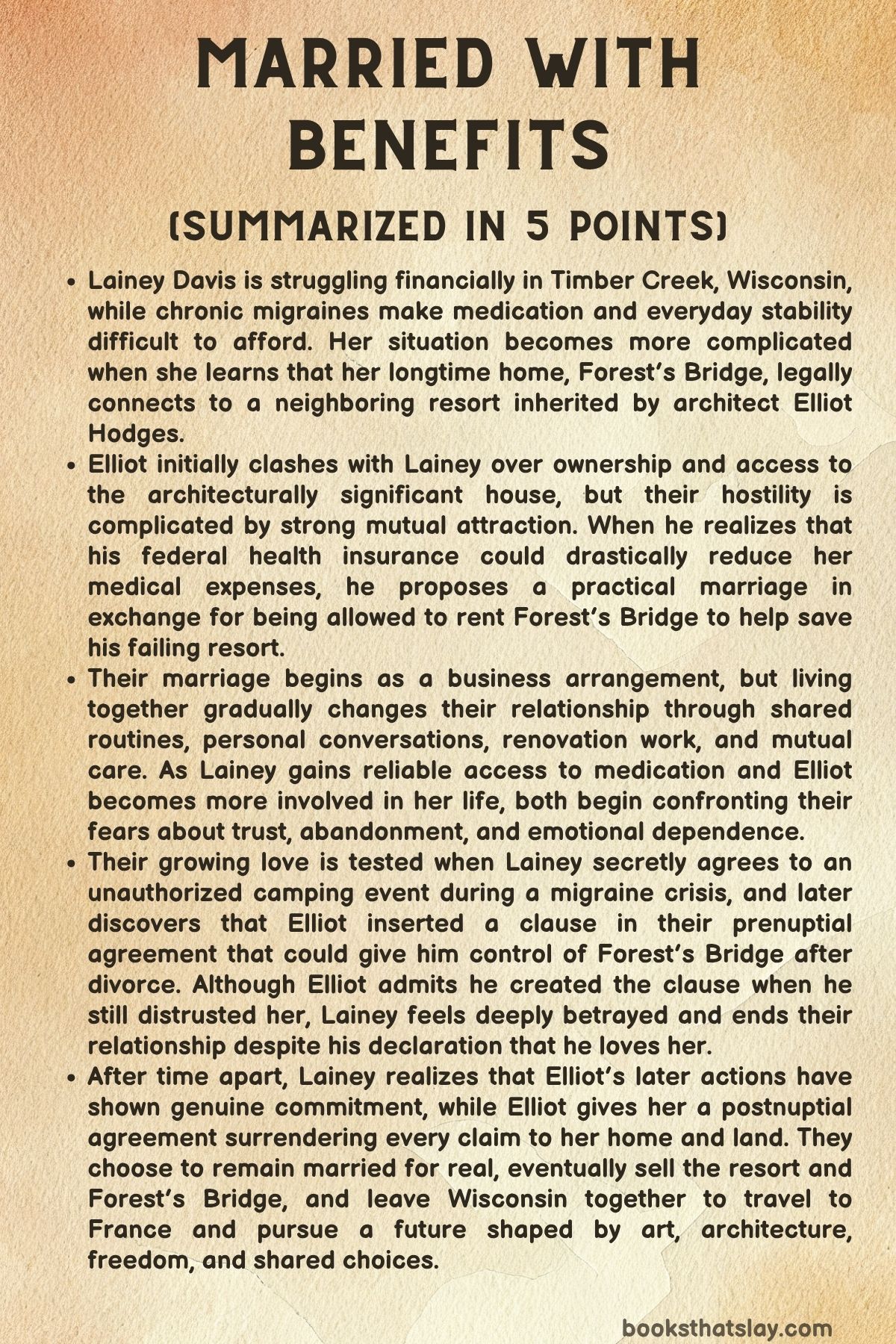
Married with Benefits by Ellie Palmer is a contemporary romantic comedy about two people who enter a marriage for practical reasons and gradually discover that the arrangement has become more real than either expected.
Set largely in the small Wisconsin town of Timber Creek, the novel follows Lainey Davis, an artist struggling with chronic migraines and financial insecurity, and Elliot Hodges, an architect trying to rescue a failing inherited resort. Their conflict over an architecturally significant house leads to a marriage of convenience involving health insurance, property, and money, but the relationship steadily becomes a study of trust, independence, vulnerability, ambition, and the difficult choice to rely on another person.
Summary
Lainey Davis lives in Timber Creek, Wisconsin, where she survives through rideshare driving, odd jobs, artistic work, and whatever income she can piece together. Chronic migraines shape nearly every part of her existence, forcing her to ration expensive medication and constantly calculate whether she can afford ordinary necessities.
During a rainy rideshare shift, she meets Elliot, an attractive stranger with whom she shares an immediate and surprisingly natural connection. Their conversation is flirtatious enough that both recognize the possibility of something more, but Lainey has learned not to expect much from visitors who eventually leave Timber Creek.
Her more urgent concern is the lakeside cabin where she lives with her grandmother, Gran. Lainey receives notice that they may have no legal right to remain there, and attorney Mark Sheffield discovers that the property records connect the land not to Lainey or Gran but to the neighboring Shore Thing resort.
Gran then reveals that the cabin has an extraordinary history. Legendary architect Vincent Groff designed it after having an affair with Gran, and the building is actually Forest’s Bridge, his long-lost final residential design.
Although the land around the house belongs to the Shore Thing, decades of continuous occupation and Lainey’s payment of property taxes appear to give her a strong adverse-possession claim to the building itself. What initially looks like total disaster suddenly gives her a real chance of keeping the only home she has ever known.
The situation becomes more complicated when the stranger from Lainey’s rideshare shift reappears. He is Elliot Hodges, nephew of the Shore Thing’s deceased owner and the man who has inherited the failing resort.
Elliot is also an architect who studied Vincent Groff extensively. To him, Forest’s Bridge is not simply Lainey’s eccentric home but an important architectural work, and he initially regards her as someone who has gained possession of something that should belong with his property.
Their attraction turns into hostility as they battle over the house. Elliot attempts to use inspections and negotiations to improve his position, while Lainey repeatedly frustrates his efforts through her knowledge of the town, her improvisational instincts, and her refusal to be intimidated.
Yet Elliot also begins revealing unexpected generosity. When Lainey cannot immediately pay for an extremely expensive migraine prescription, he covers the cost, even though she later repays him.
Their conflict gradually changes as each learns more about the other’s circumstances. Elliot desperately needs Forest’s Bridge because renting the famous house could generate enough money to repair the Shore Thing, while Lainey needs reliable medical coverage more urgently than almost anything else.
Lainey also explains how illness has restricted her life. She once dreamed of moving to France, where she has citizenship through her mother, but worsening migraines, financial problems, and a damaging past relationship caused her plans to disappear year after year.
Elliot eventually proposes an outrageous solution to both of their problems: marriage. As a federal employee, he has excellent health insurance that could dramatically reduce Lainey’s medical expenses, and in return she could allow him to rent Forest’s Bridge to tourists.
The proposal sounds absurd, but its practical benefits are difficult to ignore. Lainey realizes that regular access to preventive medication might give her something she has not had for years: the ability to make plans without assuming pain or medical costs will destroy them.
Late one night, she approaches Elliot and begins negotiating seriously. They decide to marry legally, place Lainey on his insurance plan, rent Forest’s Bridge during tourist season, and eventually allow Elliot to buy the house once his finances improve.
After the sale, Lainey could finally support Gran and leave Timber Creek, perhaps for France. The marriage would then end in divorce, allowing both of them to walk away with what they wanted.
Their wedding takes place almost immediately at Benihana with Isaac as witness and a hibachi chef who also performs inexpensive wedding ceremonies. Although the event is comic and rushed, Elliot gives Lainey an opportunity to back out, and she chooses to proceed after he promises not to punish her financially if she changes her mind.
They exchange simple wedding bands but deliberately avoid kissing because their marriage is supposed to remain strictly practical. The missing kiss nevertheless reveals how strongly both already want something their agreement does not permit.
To make their marriage appear legitimate for insurance purposes, Elliot moves into Forest’s Bridge. Sharing a home begins transforming their relationship more effectively than any romantic declaration could.
Elliot is deeply moved by Groff’s architecture and helps Lainey understand the artistic significance of a house she has always experienced simply as home. Lainey, in turn, introduces him to her artistic interests, unconventional methods, local relationships, and chaotic approach to everyday life.
Their habits are almost opposite. Elliot prefers organization, rules, careful planning, and predictability, while Lainey improvises, bends conventions, and trusts her ability to solve problems as they appear.
Despite these differences, domestic life becomes comfortable. They share meals, coffee, conversation, workspaces, jokes, errands, and increasingly personal information, while their supposed performance as a married couple begins resembling an actual partnership.
Most importantly, Elliot’s insurance allows Lainey to take her medication exactly as prescribed. Even with sufficient medicine available, however, she struggles to stop thinking as someone who might lose access at any moment.
Their adventures around the Shore Thing bring them closer. When Elliot needs to dispose responsibly of illegally small turtles left at the resort, Lainey introduces him to the strange social world of the Shell Station, where gambling and unofficial animal trading take place.
There Lainey encounters Tobin Collier, the man who may be her biological father. The meeting forces her to confront the history of a childhood in which adults repeatedly disappeared, disappointed her, or left her without reliable explanations.
Elliot challenges her tendency to invent excuses for people who have abandoned her. His response is important because Lainey has learned to protect herself not only by expecting very little but also by explaining away the failures of others before they can hurt her.
At the same time, Gran gives Elliot Vincent Groff’s old sketchbooks. He discovers that Forest’s Bridge was designed around an unfinished deck that should align visually with sunlight reflecting across the lake during the summer solstice.
Lainey and Elliot decide to complete the design together. Their partnership over the house becomes symbolic of their changing relationship, because the place that originally made them enemies now gives them a shared purpose.
While repairing one of the resort cabins, Elliot treats Lainey’s construction knowledge with genuine respect. His willingness to listen affects her deeply because she has spent years being dismissed, controlled, or underestimated.
They finally kiss, but both become frightened by what the kiss could do to their arrangement. They temporarily return to friendship, though it is increasingly obvious that neither can treat the relationship as purely practical.
Their emotional connection deepens when Elliot adopts an elderly rescue dog named Sir Waffle. Lainey recognizes that the frightened animal needs patience rather than pressure, and she and Elliot spend the night waiting with him until he feels safe enough to move.
During that night they discuss the experiences that shaped them. Elliot explains that he avoids hope partly because his father’s gambling addiction taught him to expect broken promises and disappointment.
Lainey tells him about Hayden, the older former boss who became her romantic partner and then increasingly controlling and emotionally abusive. Hayden isolated her, criticized her judgment, and damaged her confidence until she struggled to trust her own perceptions.
Elliot responds without blaming her for staying. Their emotional closeness becomes physical, and they eventually sleep together after admitting that their attraction can no longer be ignored.
What matters most afterward is the growing tenderness between them. Elliot cooks for her, remembers details about France, worries about whether she has eaten, and begins behaving like someone whose daily life naturally includes her.
When Lainey suffers a devastating migraine, Elliot cares for her through the attack and takes her to urgent care when she cannot stay hydrated. He reminds her that the entire purpose of their marriage was to free her from choosing between treatment and money.
During her recovery, Elliot finally admits that she has become central to his life. He thinks about her constantly, wants to make her laugh, finds excuses to touch her, and no longer considers their intimacy casual.
Lainey admits that she feels the same way. Their marriage shifts from a negotiated arrangement into a genuine romantic relationship, although the original agreement still creates uncertainty about what will happen when summer ends.
Together they finish the missing deck at Forest’s Bridge, and public interest in the rediscovered Groff house produces valuable bookings. Elliot begins moving closer to the financial position that would allow him to purchase the house, exactly as they originally planned.
Instead of feeling excited about being free, Lainey becomes frightened by the idea of leaving him. She now wants the marriage even though she continues thinking of its ending as something inevitable.
Their happiness is disrupted when several practical problems strike at once. Lainey’s car fails, renters damage Forest’s Bridge, a major booking must be canceled, her phone stops working, and her migraine medication becomes inaccessible because Elliot has accidentally left the refill in his truck while traveling.
Terrified and in severe pain, Lainey falls back on old survival habits. She agrees to allow Larry to organize a profitable but unauthorized summer-solstice camping event on the property, despite knowing Elliot previously rejected the idea because it could threaten their permits.
After recovering, she tries to cancel the arrangement without telling Elliot. Her secrecy reveals that although she has learned to depend on him emotionally, she still believes mistakes must be handled alone before anyone can discover them.
The attempt fails because Larry’s advertisement has already spread. Crowds arrive on the property, authorities intervene, and Elliot discovers that Lainey made the decision behind his back.
Their conflict exposes the fear beneath Lainey’s behavior. When several sources of security failed simultaneously, she became convinced that she once again had nobody to depend upon and reverted to the independent survival strategies that had protected her for years.
Elliot explains that shutting him out also hurts him. If she responds to fear by making unilateral decisions and hiding the consequences, then he becomes the person abandoned outside the relationship.
They reconcile and watch the completed architectural effect of Forest’s Bridge as the solstice light aligns with the deck and the lake. In that moment, Lainey fully accepts that she loves Elliot.
A more serious betrayal soon threatens them. Mark discovers language in their prenuptial agreement that could give Elliot ownership of Forest’s Bridge after divorce.
Lainey believes this proves Elliot manipulated her from the beginning. Elliot admits that he deliberately requested the clause because he distrusted her when their agreement began, fearing that she might eventually use the property against him.
He insists that he later abandoned any intention of relying on the clause, but he never told her it existed. For Lainey, the concealment destroys the trust he repeatedly demanded from her.
Elliot finally says that he loves her and would follow her wherever she goes, even if that means selling everything. Lainey cannot accept his explanation immediately and orders him to leave.
After the separation, conversations with Bree and Gran force Lainey to reconsider what being alone actually means. Gran argues that Lainey does not truly prefer isolation; she has simply become accustomed to needing little because so many people failed her.
Gran also points out that Elliot’s later behavior makes little sense if his goal was to steal the house. His original distrust was wrong, but it does not erase the many ways he eventually chose Lainey over property, profit, and convenience.
When Bree goes into labor, an unexpected rideshare request brings Elliot back into Lainey’s life. He takes them to the hospital and puts aside his own pain to help.
After the baby is born, Lainey realizes that she believes Elliot never intended to take Forest’s Bridge from her. She also recognizes that they share a similar difficulty with trust because both learned early that security could disappear without warning.
Elliot has waited outside the hospital and presents her with a postnuptial agreement surrendering every claim to Forest’s Bridge while also transferring additional surrounding land to her. The gesture gives Lainey the freedom to leave without depending on his promises.
Instead, she tells him she loves him and wants their relationship back. Elliot asks whether she will stay married to him for real, and she agrees.
By the end of tourist season, their future has changed again. Elliot realizes that owning and operating an inn is not the dream he imagined it would be, and he no longer wants to define success by forcing himself to continue simply because he once chose that path.
He decides that the Shore Thing and Forest’s Bridge can be sold. Rather than treating Lainey’s desire to travel as something belonging only to her, the couple begins imagining a shared future centered on art, architecture, discovery, and change.
Months later, Lainey and Elliot are at JFK waiting for a flight to France. The resort and Forest’s Bridge have been sold to Bree, Elliot has left his federal job, and Lainey finally has enough stability to leave Wisconsin without treating departure as an impossible fantasy.
Their relationship remains playful and imperfect, but its foundation has changed completely. What began as a practical contract has become a freely chosen marriage in which both people are willing to trust, change direction, accept care, and face an uncertain future together.
Characters
Lainey Davis
Lainey is the emotional center of the book, a resourceful woman whose humor, creativity, and apparent fearlessness conceal years of insecurity. She is capable of improvising her way through almost any practical problem, yet this competence has developed partly because she has learned to assume that dependable help may not arrive.
Her chronic migraines affect much more than her physical health. They limit her income, shape her daily calculations, delay her dreams, and teach her that even ordinary plans can collapse because of pain or the cost of medication.
Lainey therefore develops an intense attachment to self-sufficiency. She frequently presents independence as a preference, but the story gradually shows that it is also a defense against disappointment.
Her artistic personality reflects another side of her character. She sees possibility in discarded objects, strange situations, and unfinished work, suggesting that creativity is one of the few areas where uncertainty excites rather than frightens her.
Her greatest emotional flaw is not simply that she distrusts people. It is that when she feels threatened, she assumes she must solve the problem secretly before anyone realizes she needs help.
This pattern explains her behavior during the unauthorized camping crisis. Her mistake is serious, but the deeper issue is her inability to believe that love can survive her weakness, bad judgment, or dependence.
In Married with Benefits, Lainey’s development is therefore less about becoming independent and more about redefining independence. She learns that accepting support does not erase her autonomy and that being loved does not require her to become easy, uncomplicated, or permanently self-contained.
Her final decision to travel also changes meaning. France is no longer simply the place she hopes to escape to; it becomes part of a future she can choose without running from everyone who matters to her.
Elliot Hodges
Elliot initially appears to be Lainey’s opposite. He values organization, caution, rules, financial planning, clear agreements, and controlled outcomes, while Lainey seems most comfortable when inventing solutions in the middle of disorder.
His caution, however, has emotional roots. His father’s gambling addiction taught him that hope can become dangerous when it is attached to unreliable people, so Elliot protects himself by minimizing risk and keeping expectations under control.
The Shore Thing represents an unusual act of courage for him. By attempting to rebuild the inherited resort, he is trying to prove that he can choose a meaningful life rather than remain forever inside the security of his government architecture career.
His early distrust of Lainey is therefore consistent with his personality, even though it becomes his greatest mistake. The hidden clause in the prenuptial agreement shows that Elliot wants the appearance of mutual trust while secretly preserving protection for himself.
What makes him sympathetic is his capacity to change through behavior rather than merely through romantic declarations. He listens to Lainey’s construction knowledge, supports her art, learns her medical needs, cares for her during migraines, and eventually gives up every legal claim to the house so that remaining with him becomes completely voluntary.
Elliot also learns that changing one’s dream is not the same as failing. Once he discovers that running a resort makes him miserable, he stops treating persistence as a moral obligation and begins considering a life built around shared experience rather than ownership.
His love for Lainey ultimately requires him to surrender the control he once believed made him safe. By the end of Married with Benefits, he is willing to enter an uncertain future because the relationship matters more to him than guaranteeing a predictable outcome.
Gran
Gran is one of the strongest influences on Lainey because she combines eccentricity with emotional perception. Her history with Vincent Groff makes her directly responsible for Forest’s Bridge becoming part of Lainey’s life, yet her larger importance comes from the way she understands Lainey’s defenses.
She refuses to romanticize isolation as strength. When Lainey insists she is better off alone, Gran distinguishes between genuinely wanting solitude and merely becoming accustomed to being disappointed.
Gran also understands moral complexity more generously than Lainey does during moments of anger. She does not excuse Elliot’s hidden prenup clause, but she encourages Lainey to judge him by the full pattern of his behavior rather than allowing one betrayal to erase every later act of loyalty.
Her unconventional habits, including gambling and her complicated romantic history, prevent her from becoming a conventional voice of elderly wisdom. She is funny, unpredictable, and morally flexible, but her insight into relationships is often sharper than that of the younger characters.
Bree
Bree is Lainey’s closest friend and often functions as both supporter and critic. She loves Lainey enough to challenge choices that appear dangerous, especially when Elliot’s financial and practical power reminds her of Lainey’s damaging relationship with Hayden.
Her concern is not simple distrust of Elliot. She has seen how easily Lainey can rationalize unhealthy dynamics, so her suspicion reflects a desire to protect her friend from repeating old patterns.
Bree also has her own complicated relationship with supposedly practical choices. Her marriage to Colin gradually proves unstable because both recognize that pregnancy rather than a strong romantic foundation pushed them together.
This parallel prevents Bree from standing outside Lainey’s situation as someone with perfect judgment. Both women discover that relationships cannot remain emotionally neutral simply because they began for practical reasons.
Motherhood ultimately encourages Bree to reconsider her own future and ambitions. Her eventual ownership of the resort and Forest’s Bridge suggests that she too moves toward a life shaped by conscious choice rather than assumptions about what her marriage or family situation should require.
Isaac
Isaac provides much of the story’s comic unpredictability, but he also becomes an important part of the social connection between Lainey and Elliot. He appears early as an irritating acquaintance whose mishaps contribute to Lainey’s first meeting with Elliot, and his presence continues to introduce absurdity into serious situations.
His role as witness at the rushed wedding makes him part of the marriage from its beginning. Later, his strange friendship with Elliot, including their private lunches, shows how fully Elliot has entered Lainey’s local world.
Isaac also demonstrates that Elliot’s transformation does not occur only through romance. Elliot gradually forms friendships, habits, and attachments in Timber Creek that make him less isolated and less rigid than he initially appears.
Mark Sheffield
Mark is the lawyer whose work repeatedly affects Lainey’s security. His initial distrust of her, based partly on bizarre misunderstandings, makes their interactions comic, but he remains one of the people she turns to when legal problems become serious.
His investigation gives Lainey a possible claim to Forest’s Bridge through adverse possession, allowing the entire central conflict to develop. Later, his discovery of the prenup language becomes equally important because it exposes the concealed imbalance in Lainey and Elliot’s original agreement.
Mark therefore represents the legal reality beneath the couple’s emotional improvisations. Feelings may change, but contracts, titles, ownership, and written promises continue to matter.
His involvement also shows why trust cannot depend only on romantic intention. Elliot may no longer intend to enforce the clause, but Mark reveals that Lainey needs protection that exists in writing rather than only in Elliot’s private sense of fairness.
Tobin Collier
Tobin represents one of Lainey’s oldest unresolved wounds. As the leading possibility for her biological father, he occupies an uncertain position in her childhood because the adults around her never provided a stable explanation of responsibility or abandonment.
For years, Lainey responds by constructing excuses. She focuses on her mother’s refusal of a paternity test and the ambiguity of the circumstances rather than fully confronting the fact that Tobin still chose to disappear.
Her later confrontation with him marks an important change. She finally allows herself to be angry instead of doing the emotional labor of making abandonment understandable.
Tobin’s importance therefore extends beyond biological paternity. He represents Lainey’s habit of lowering expectations so completely that other people rarely have to answer for disappointing her.
Camille
Camille, Lainey’s mother, is largely defined by absence and unreliability. Even when she is not physically present, the uncertainty she created continues shaping Lainey’s expectations about attachment.
Her unstable relationship history also leaves Lainey with unresolved questions about Tobin and her biological father. The lack of clear answers forces Lainey to grow up around ambiguity that no child should have been responsible for interpreting.
Camille helps explain why Lainey often expects people to leave. Her mother’s inconsistency teaches her that affection does not necessarily produce reliability and that promises about future presence may mean very little.
The France connection complicates Camille’s role because something associated with her also becomes linked to Lainey’s dream of freedom. France carries both family history and the possibility of constructing an identity beyond the limitations Lainey inherited.
Hayden
Hayden never needs to dominate the present-day action because his influence remains active inside Lainey’s behavior. As her former boss and much older romantic partner, he initially made control resemble devotion before gradually undermining her confidence.
He isolated Lainey, criticized her choices, and trained her to question her own judgment. The resulting damage helps explain why she reacts so strongly to any relationship in which another person possesses financial, professional, or practical power.
Hayden is especially important when compared with Elliot. Both men can be opinionated and both sometimes challenge Lainey, but Elliot increasingly respects her competence, listens to her expertise, and tries to give her meaningful choices.
The distinction allows Lainey to learn that disagreement is not automatically control and care is not automatically manipulation. Her recovery requires rebuilding trust not only in another partner but also in her own ability to recognize the difference.
Caroline
Caroline is Elliot’s former fiancée and provides insight into his own difficulty with trust. He ended the engagement not because he proved that she had betrayed him but because suspicion itself convinced him that the relationship no longer had a secure foundation.
His story about Caroline reveals that distrust did not begin with Lainey. Elliot enters relationships prepared to withdraw when certainty disappears because uncertainty feels emotionally dangerous to him.
This history also makes his secret prenup clause more understandable, though not more acceptable. Elliot protects himself through hidden safeguards because he has difficulty believing that trust can survive vulnerability.
Caroline therefore functions less as a romantic rival than as evidence of the emotional pattern Elliot must change.
Vincent Groff
Vincent Groff is absent from the present action, yet his influence shapes the physical and emotional setting of the story. His relationship with Gran produces Forest’s Bridge, the building that first separates Lainey and Elliot and later becomes one of the strongest connections between them.
Groff also represents artistic intention that remains unfinished until later generations participate in it. The missing deck is not merely a construction detail but a reminder that creative work can wait for new people to understand and complete it.
His sketchbooks allow Elliot to approach the house not as an object to possess but as a design to interpret. Through that process, Lainey also begins seeing her familiar home differently.
Gil Hodges
Gil Hodges is Elliot’s deceased uncle and the source of the troubled inheritance that brings Elliot to Timber Creek. The Shore Thing, its debts, neglected cabins, and collection of illegally small turtles all suggest a man who left behind more complications than solutions.
Gil’s legacy gives Elliot both opportunity and burden. The resort represents the possibility of a new life, yet its poor condition immediately places him under financial pressure.
Because Gil is absent, Elliot cannot demand answers or assistance from the person whose decisions created the situation. This forces Elliot to decide whether inheriting someone else’s dream means he is obligated to make it succeed.
Brad Bauer
Brad Bauer, the local inspector, represents the peculiar power structures of Timber Creek. Elliot initially expects official procedure to support his position against Lainey, only to discover that local history and family grudges can matter more than formal expectations.
Brad’s response to Elliot’s complaint undermines Elliot’s confidence in rules as predictable instruments. Instead of punishing Lainey, the inspection creates new problems for the Shore Thing.
The episode is comic, but it also establishes that Elliot has entered a community whose relationships and history he does not understand. Lainey’s local knowledge becomes a form of power that cannot be replaced by professional credentials.
Larry
Larry becomes important because he offers Lainey money at exactly the moment when fear has weakened her judgment. His proposal to allow large numbers of visitors onto the property for the solstice event is financially tempting but carries serious regulatory risk.
Lainey initially supports Elliot’s refusal, which makes her later agreement especially revealing. Larry does not cause her deeper problem; he simply provides the opportunity for an old survival instinct to reappear.
His advertisement eventually turns a private mistake into a public disaster. Through him, the story demonstrates how decisions made under desperation can continue producing consequences after a person believes the problem has been corrected.
Colin
Colin is Bree’s husband and serves mainly as part of a parallel examination of marriage. He and Bree eventually recognize that pregnancy pushed them toward a commitment that may not have developed naturally otherwise.
Their failing marriage contrasts with Lainey and Elliot’s unusual success. Both relationships begin partly because of practical circumstances, but practical beginnings alone do not determine whether genuine intimacy will develop.
Colin’s role also helps Bree understand Lainey with greater humility. She cannot simply judge a marriage of convenience from the outside when her own supposedly conventional relationship has also been shaped by circumstance.
Chef Nemoto
Chef Nemoto contributes to the deliberately unromantic setting of Lainey and Elliot’s legal wedding. As a hibachi chef who also performs inexpensive ceremonies, he transforms what might traditionally be a solemn event into something rushed, comic, and strangely memorable.
His presence reinforces the gap between the legal meaning of the marriage and its emotional meaning. Lainey and Elliot can become spouses quickly and cheaply, but becoming genuine partners takes far longer.
The absurd ceremony also establishes an important contrast with Elliot’s later desire to choose Lainey again. The first wedding is based on urgency and calculation, while the relationship eventually develops into something both want without financial pressure.
Sir Waffle
Sir Waffle, the elderly rescue dog Elliot cannot bring himself to abandon, reveals a softer side of Elliot before he is fully prepared to describe it himself. His decision to bring home a difficult older dog rather than selecting an easier puppy shows that compassion can override his preference for order.
Waffle also becomes part of an important lesson about trust. Lainey understands that a frightened animal cannot be forced into feeling safe and suggests remaining nearby until he is ready.
The situation closely reflects her relationship with Elliot. Both humans carry experiences that make trust difficult, and neither can be argued or pressured into vulnerability.
Elodie
Elodie, Bree’s baby, enters the story near a crucial emotional turning point. Her birth temporarily places Lainey and Elliot in the same space after their separation and gives them a reason to cooperate without immediately resolving their conflict.
The hospital experience also gives Lainey time to reconsider what she believes about Elliot. Surrounded by change, responsibility, and new beginnings, she becomes more capable of imagining reconciliation without pretending the betrayal never occurred.
Elodie also influences Bree’s later choices, helping move her toward a more independent future.
Dot and Gene
Dot and Gene appear briefly near the end but support the novel’s final demonstration of Lainey and Elliot’s growth. When Elliot’s dishonest attempt to gain sympathy accidentally produces first-class upgrades, his guilt prevents him from comfortably enjoying the reward.
The couple ultimately gives the seats to Dot and Gene, an older pair traveling for their fiftieth anniversary. The gesture shows that Elliot has learned some of Lainey’s willingness to improvise while retaining his own sense of responsibility.
Their appearance also places a long-lasting marriage beside Lainey and Elliot at the moment they are beginning their own freely chosen future.
Themes
Trust and the Fear of Abandonment
Trust in Married with Benefits is treated less as a feeling than as a repeated decision made under conditions of uncertainty. Lainey and Elliot are attracted to each other quickly, but emotional closeness remains difficult because both have learned that depending on another person can lead to humiliation, disappointment, or abandonment.
Lainey protects herself through extreme self-reliance. Her mother’s inconsistency, the uncertainty surrounding Tobin, and Hayden’s emotional abuse teach her that needing someone gives that person an opportunity to fail her.
As a result, she does not merely avoid asking for help. She often hides problems until she believes she has already solved them, because revealing need before a solution exists feels dangerously exposed.
Elliot responds to fear differently. He relies on rules, planning, contracts, and private safeguards, attempting to reduce the possibility that someone else can surprise him.
His secret prenup clause becomes the clearest example of that instinct. Even while asking Lainey to trust him, he preserves protection against a betrayal she has not committed.
Their relationship can succeed only after both recognize that these defenses produce the very loneliness they are designed to prevent. Lainey’s secrecy leaves Elliot outside her emotional life, while Elliot’s hidden legal protection confirms Lainey’s fear that dependence can be used against her.
The final reconciliation does not require either character to become unquestioningly trusting. Instead, they create conditions in which trust can be chosen honestly, especially when Elliot removes his legal claim to the property and gives Lainey genuine freedom to leave.
Money, Healthcare, and Freedom
Money is never merely a background concern in the story because economic pressure determines what kinds of choices Lainey and Elliot are able to imagine. Lainey’s migraines create recurring medical costs that transform health care into a question of freedom rather than simple treatment.
Without affordable medication, she cannot reliably work, travel, plan, save, or pursue long-term ambitions. Her dream of France repeatedly disappears because every possibility must compete with the immediate necessity of paying for the next period of physical stability.
This makes the marriage arrangement ethically complicated. Elliot’s insurance offers Lainey something close to liberation, but accepting it also means tying her medical security to another person.
The relationship therefore exposes how easily financial dependence can affect emotional power. Lainey’s fear of becoming trapped is understandable because losing Elliot could initially mean losing affordable access to the medicine that allows her to function.
Elliot faces financial pressure of another kind. The Shore Thing is both a dream and a burden, forcing him to measure architecture, property, and ambition through mortgages, repairs, permits, and tourist income.
The difference in their economic backgrounds becomes especially visible when they react differently to large sums of money. What Elliot can describe as manageable may represent survival to Lainey.
The novel ultimately moves toward a broader definition of financial freedom. Security matters, but freedom also means being able to change plans, abandon an unsuitable dream, accept help without surrendering autonomy, and imagine a future that is not dictated entirely by scarcity.
Home, Art, and the Meaning of Belonging
Forest’s Bridge begins as a disputed asset, but its meaning changes depending on who is looking at it. For Lainey, the building is first and foremost home, the place where she grew up and the physical center of the life she has managed to preserve despite instability elsewhere.
For Elliot, it initially appears as an architectural treasure. His academic knowledge of Vincent Groff encourages him to see artistic importance where Lainey sees familiar rooms, old objects, and personal history.
Neither interpretation is complete by itself. Through Elliot, Lainey begins to understand that the house she has taken for granted possesses an artistic identity beyond her private memories, while Elliot gradually learns that historical importance does not erase the emotional ownership created by ordinary life.
The unfinished deck strengthens this connection between art and belonging. Groff’s design remains incomplete until Lainey and Elliot work together to understand and finish it, turning architectural restoration into a shared act rather than a contest over possession.
Lainey’s own artistic practice adds another dimension. She values making things that do not have to become profitable, which protects creativity from the constant financial demands surrounding the rest of her life.
By the ending, selling Forest’s Bridge does not mean that Lainey has lost her home. The story gradually separates belonging from ownership, showing that a place can matter enormously without becoming a permanent boundary around someone’s future.
Home eventually becomes connected less to a building than to the ability to leave freely while still knowing where emotional security exists.
Marriage, Choice, and Commitment
The central marriage begins as a contract in which both people expect to benefit financially. Lainey receives affordable health insurance, while Elliot gains access to a property capable of producing income for his struggling resort.
Their wedding therefore separates legal marriage from romantic commitment almost completely. They become spouses before they have learned how to live together, trust each other, manage conflict, or decide whether they even want a future beyond the terms of their agreement.
The story then reverses that order. Domestic routines, arguments, caregiving, shared work, sexual intimacy, disappointment, forgiveness, and ordinary companionship gradually create the emotional relationship that the ceremony did not.
This structure raises a larger question about what makes commitment meaningful. A legal promise can exist without emotional devotion, while genuine devotion can develop inside a relationship that began for reasons neither person would call romantic.
The hidden prenup clause demonstrates why intention alone is insufficient. Elliot may sincerely love Lainey later, but real commitment requires him to confront the unequal protection built into the original arrangement and remove it.
His postnuptial agreement becomes important because it transforms the meaning of Lainey’s decision. Once she can leave with her home and financial independence protected, remaining married becomes a genuine choice rather than the continuation of necessity.
Their final commitment therefore matters precisely because they are no longer trapped by the original bargain. They stay together after both have gained the practical freedom to walk away, turning marriage from a strategy for survival into a relationship they consciously choose.