Marry Me Not Summary, Characters and Themes
Marry Me Not by Gabrielle Sands is a contemporary arranged-marriage romance set inside two powerful crime families whose alliance depends on the marriage of Fabiana Messero and Cosimo Ferraro. What begins as a political arrangement between two reluctant strangers gradually becomes a story about trust, independence, family damage, and the difficult work of choosing love freely when duty has shaped nearly every major decision in their lives.
The novel balances romance with a succession struggle, an unsolved murder, and a dangerous family feud, while following two people who must learn that strength does not require emotional isolation. It’s the 2nd book of the House of Ferraro series.
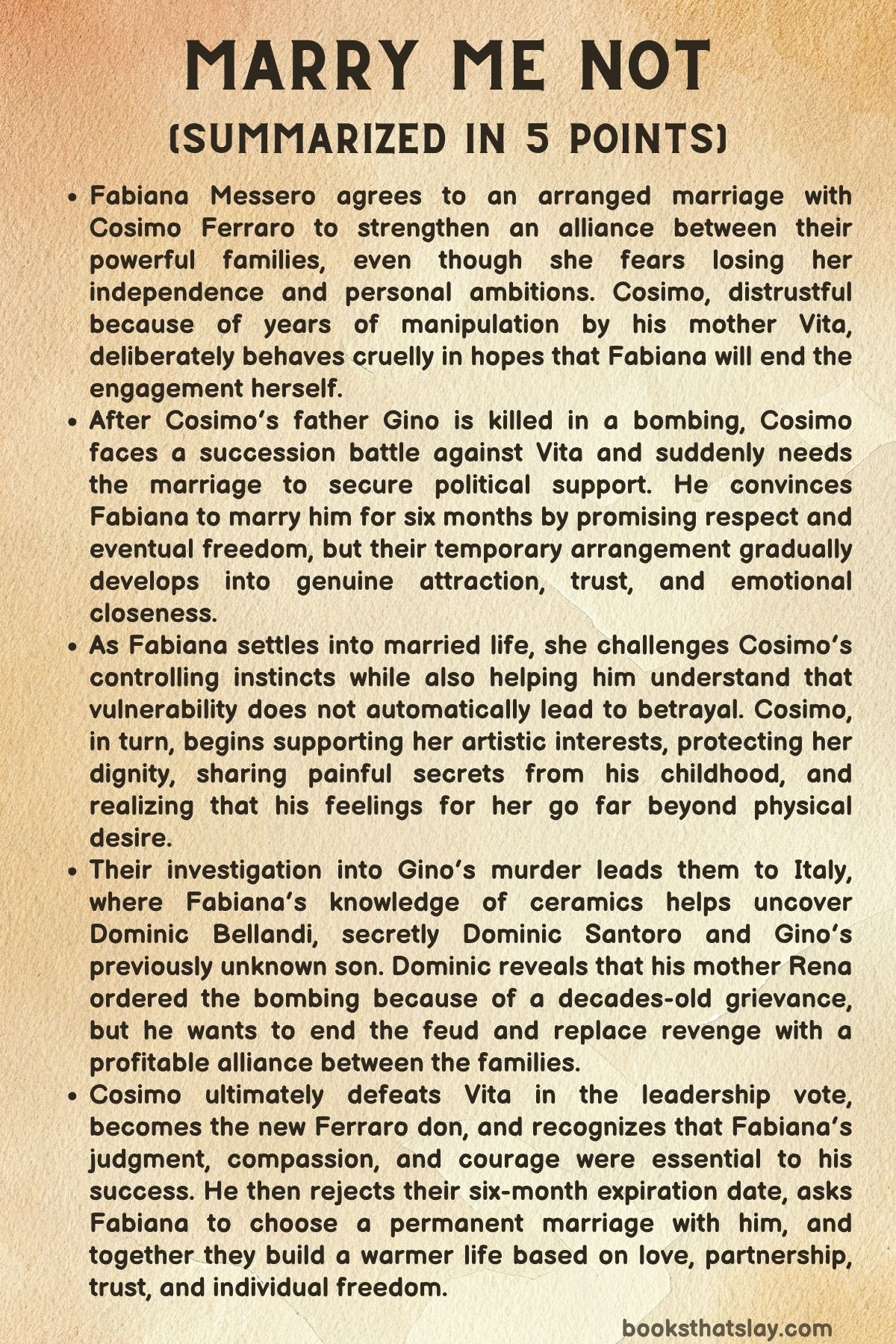
Summary
Fabiana Messero has returned to New York after losing her position with the United Nations under circumstances she has hidden from her family. She expects her professional life to end soon anyway because her brother Rafe has agreed to an arranged marriage between her and Cosimo Ferraro, eldest son of a powerful family that has recently become allied with the Messeros after years of hostility.
While supervising an exhibition of Rafe’s private art collection, Fabiana meets a rude stranger who mocks modern art and challenges everything she says about marriage and personal freedom. She soon discovers that the stranger is Cosimo himself, who already knew exactly who she was and has deliberately presented himself as arrogant, controlling, and impossible to like.
Cosimo has reasons for his hostility that Fabiana cannot yet understand. His mother, Vita, has spent years manipulating his relationships, bribing girlfriends to spy on him and teaching him that intimacy is simply another route through which someone can gain power over him.
Convinced that Fabiana may be another tool chosen by Vita, Cosimo decides to make the engagement so unpleasant that Fabiana will end it herself. He even sends Rosa Delgado, a con artist who has posed as his girlfriend for years, to investigate Fabiana’s life in Geneva.
Fabiana, however, continues trying to make the marriage work because she believes it is her responsibility to protect the alliance between their families. Her private doubts grow after Vita explains that a Ferraro wife should place her husband and family above her own ambitions, a philosophy that makes Fabiana fear that marriage will erase the independent person she has struggled to become.
Cosimo eventually discovers what happened in Geneva. Fabiana’s superior, Girarde, retaliated after she rejected his advances, denied previously approving a work-related benefit, and allowed both Fabiana and her colleague Mona to be dismissed during the resulting investigation.
Instead of sympathizing openly, Cosimo uses Fabiana’s insecurity against her because he realizes he is becoming protective of her and wants to stop that attachment before it grows stronger. His cruelty finally works, and Fabiana decides that she cannot marry him.
Before she can formally end the engagement, a bomb explodes during a Ferraro gathering and kills Gino Ferraro, Cosimo’s father. Cosimo is forced into leadership while grieving, but another problem immediately appears when the page of Gino’s will identifying his successor disappears.
Vita then reveals that she intends to challenge her own son for control of the family. Because marrying Fabiana would prove Cosimo’s commitment to the Messero alliance and strengthen his position before the capos, the marriage he once tried to destroy suddenly becomes politically essential.
Fabiana refuses when Cosimo first asks her to reconsider. He eventually offers a different arrangement: they will remain married for only six months, after which they will seek an annulment, leaving her effectively free from future arranged marriages.
Fabiana agrees only after Cosimo promises to treat her with respect. Their new agreement changes the tone of their relationship almost immediately because the pressure of pretending they are building a permanent marriage disappears, allowing curiosity, humor, attraction, and genuine regard to emerge.
As their wedding approaches, Cosimo becomes increasingly possessive and protective, while Fabiana begins noticing tenderness beneath his severe manner. During her bachelorette party, a drunken dare leads her to send Cosimo a provocative photograph, and the incident exposes how strongly he already reacts to the thought of her with another man.
On their wedding day, however, Fabiana receives a photograph suggesting that Cosimo continued seeing Rosa after becoming engaged. Cosimo finally reveals that Rosa was never his lover but an operative he trusted to protect himself from Vita’s schemes.
By sharing a secret that even his brothers do not know, Cosimo gives Fabiana the first serious proof that he is willing to trust her. Their ceremonial wedding kiss becomes unmistakably real, leaving both of them aware that the emotional rules of their six-month agreement are beginning to fail.
Marriage brings them into closer contact, and Fabiana slowly transforms Cosimo’s cold, minimalist house into a warmer home. Their attraction becomes harder to control, especially after Fabiana discovers his private sauna, yet their growing intimacy also produces conversations about loneliness, fear, ambition, and the lives each imagined before marriage.
At a Guggenheim gala, Fabiana suffers a humiliating wardrobe disaster when her dress becomes transparent and begins falling apart. Cosimo responds by secretly spending about one million dollars on a vintage replacement dress because he refuses to allow his wife to leave through a back entrance feeling ashamed.
That night also produces an important break in the investigation into Gino’s death. Fabiana’s knowledge of pottery identifies a donated ceramic piece as the work of Emilio Quaranta and connects it to Grottaglie, Italy, giving Cosimo a possible route to the elusive Santoro family he suspects of ordering the bombing.
Vita attempts to recruit Fabiana into her campaign against Cosimo, arguing that Cosimo might have a happier life if he surrendered leadership. Fabiana recognizes the manipulation and refuses, which deeply affects Cosimo because she chooses to support him without demanding anything in exchange.
Their emotional and physical restraint soon breaks down, but Cosimo initially stops short of fully consummating the marriage because he believes Fabiana may regret giving such an important first experience to a temporary husband. Fabiana objects to his assumption that he knows what is best for her, forcing Cosimo to confront his habit of disguising control as protection.
When they finally become intimate, the decisive issue for Fabiana is choice. She wants Cosimo and trusts him, while Cosimo realizes that if their relationship continues deepening, he may no longer be capable of giving her the freedom he originally promised.
Fabiana later persuades him to let her join his trip to Grottaglie. Traveling as supposed honeymooners brings them closer, and long conversations expose the roots of their emotional wounds.
Fabiana explains how her abusive father made her constantly question her own worth, while Cosimo reveals that Vita physically and emotionally abused him as a child, including burning him with cigarettes. He also admits that Gino eventually discovered evidence of the abuse but still failed to protect him adequately.
Their investigation reaches a crisis when Cosimo decides that the territory may be dangerous and orders Fabiana home. His fear causes him to reject her description of them as partners, reopening the very emotional distance they had nearly overcome.
Fabiana refuses to accept that pattern. She returns alone to a pottery workshop and uses patience rather than intimidation to gain the information Cosimo could not obtain.
The clue leads her to Dominic Bellandi, the scarred motorcyclist previously seen at Gino’s funeral. Dominic reveals that his American family name is Santoro, that his mother Rena ordered the bombing, and that he is also Gino Ferraro’s secret son.
Rena’s hatred began decades earlier after Gino refused to protect her family during a dangerous conflict, largely because Vita persuaded him not to interfere. Dominic rejects his mother’s desire for continuing revenge and offers Cosimo an alternative based on peace and economic cooperation.
When Cosimo temporarily believes Fabiana has been abducted, the fear of losing her finally destroys his remaining denial. After finding her safe with Dominic, he admits that his obsession and protectiveness have a simpler name: love.
Fabiana returns the confession. The marriage that began as a six-month political arrangement has already become emotionally permanent, even before either of them formally changes its terms.
Back in New York, Dominic meets Romolo and Alessio and proposes a major development project that could make peace between the Ferraros and Santoros more profitable than war. The plan gives Cosimo the political advantage he needs when the Ferraro capos finally gather to choose their new don.
Cosimo exposes Vita’s attempts to purchase loyalty through shares and board positions and then reveals Dominic’s identity and the history Vita concealed. By showing that her obsession with control helped create the conflict that eventually killed Gino, Cosimo destroys her argument that she represents greater stability.
The capos choose Cosimo. His victory, however, matters differently now because he no longer imagines leadership as a burden he must carry alone.
Fabiana and Cosimo return to the gallery where they first met, standing again before Bride’s Door. Cosimo tells Fabiana that marriage should never require her to surrender the parts of herself that matter, directly reversing the controlling attitude with which their relationship began.
When Fabiana reminds him that their agreement still has an expiration date, he proposes replacing six months with sixty years. He gives her a custom ring incorporating ceramic material and asks her to marry him because he chooses her rather than because their families demand it.
Fabiana accepts. Their marriage becomes permanent, and the home that once reflected Cosimo’s isolation gradually fills with Fabiana’s pottery, belongings, warmth, and creative ambitions.
Cosimo encourages her to pursue ceramics professionally and helps secure space for the business she dreams of building without deciding what that business must become. Vita loses her influence, negotiations with Dominic continue, and Fabiana and Cosimo begin imagining a future defined not by inherited obligations but by decisions they make together.
Characters
Fabiana Messero
In Marry Me Not, Fabiana begins as a woman who has learned to confuse compliance with responsibility, believing that sacrificing her professional independence and accepting an arranged marriage are reasonable prices for protecting the people she loves. Her apparent gentleness is therefore not passivity; she repeatedly chooses difficult forms of loyalty even while privately questioning whether anyone will offer her the same consideration.
Her dismissal from the UN is central to her insecurity because Girarde’s betrayal makes her wonder whether her instinct to trust people reflects goodness or foolishness. Cosimo initially aggravates that wound by calling her naive, but Fabiana ultimately refuses to solve the problem by becoming suspicious of everyone around her.
Her development depends on learning the difference between trust and unquestioning acceptance. This becomes especially clear with Dominic, whom she does not simply believe on instinct but evaluates through Gino’s sketchbook and other evidence before deciding that he deserves to be heard.
Fabiana also becomes increasingly assertive about personal agency. She challenges Cosimo when he tries to determine where she may travel, whom she may see, whether she should participate in the investigation, and even what sexual decisions she may someday regret.
Her artistic interests provide another important dimension to her identity. Pottery and art are not decorative hobbies added to her characterization; they represent the ambitions she suppressed because she assumed marriage would eventually make a serious independent career impossible.
By the end of the novel, Fabiana does not reject marriage in order to achieve freedom. She instead creates a marriage in which freedom, ambition, intimacy, and commitment can exist together, making her journey less about escaping duty than redefining what she is willing to owe other people.
Cosimo Ferraro
Cosimo is shaped by control long before he begins trying to control Fabiana. Vita’s manipulation and abuse teach him that vulnerability creates openings for exploitation, while Gino’s failure to protect him reinforces the belief that even people who love someone may choose convenience over intervention.
His early cruelty toward Fabiana is therefore defensive as well as strategic. He wants her to reject the marriage because he assumes that allowing a woman selected by Vita into his private life will inevitably give his mother another route through which to manipulate him.
Cosimo’s greatest contradiction is that he repeatedly demonstrates care while verbally denying emotional attachment. He protects Fabiana, corrects the injustice surrounding her dismissal, buys an absurdly expensive dress to preserve her dignity, lets her transform his home, shares secrets with her, and depends increasingly on her judgment while insisting that their relationship remains temporary.
His possessiveness can become troubling because his instinct is often to make decisions on Fabiana’s behalf and then describe those decisions as protection. The novel does not treat that habit as harmless; some of their most significant conflicts occur when Fabiana forces him to recognize that protecting a partner cannot mean removing that person’s right to choose.
Cosimo’s emotional growth becomes clearest when he learns to trust Fabiana rather than simply guard her. His eventual admission that they are partners represents a rejection of the destructive model of partnership he observed between his parents.
Leadership follows the same transformation. He becomes an effective don not by becoming colder but by accepting intelligence, compassion, negotiation, and Fabiana’s perspective as sources of strength rather than threats to his authority.
Vita Ferraro
Within Marry Me Not, Vita is the clearest embodiment of control presented as family duty. She is intelligent, politically capable, socially polished, and highly observant, but she repeatedly uses those strengths to manipulate the emotional weaknesses of the people around her.
Her abuse of Cosimo is especially important because it explains why he associates love with danger. Vita not only punishes him physically but also isolates her sons, interferes with their relationships, bribes romantic partners, and creates divisions that ensure nobody becomes strong enough to challenge her.
Her treatment of Fabiana follows a similar method. Vita first appears supportive, then defines marriage in terms that require Fabiana to limit her own expectations and eventually tries to recruit her against Cosimo by promising the very romantic future Fabiana secretly desires.
Vita’s campaign to become don reveals that power itself has become central to her sense of security. She is willing to distribute corporate positions and shares for political support, even when doing so may damage the legitimate business she claims to protect.
Her defeat is therefore more than Cosimo winning a vote. It marks the collapse of a family structure in which fear, secrecy, division, and emotional manipulation have repeatedly been mistaken for strength.
Gino Ferraro
Gino is a complicated paternal figure because his genuine warmth coexists with serious failures of courage. Fabiana experiences him as affectionate and thoughtful, particularly when he gives her his old sketchbook and speaks openly about Cosimo’s difficulties, showing a tenderness that contrasts sharply with the father she grew up fearing.
Yet Cosimo’s memories reveal the limits of that tenderness. Gino discovered evidence that Vita was abusing his son but did not respond with the decisive protection Cosimo needed, making him an example of how love without action can still leave lasting damage.
His relationship with Rena Santoro creates another moral complication. By refusing to help her family during a crisis, partly under Vita’s influence, he participates in the chain of decisions that eventually leads to decades of resentment and his own death.
The sketchbook becomes his most meaningful legacy because it quietly acknowledges Dominic as one of his sons. Even after death, Gino’s private record helps uncover the truth his family had failed to confront openly.
Rafe Messero
Rafe occupies a protective role in Fabiana’s life that is rooted in their abusive childhood. He absorbed much of their father’s cruelty in order to shield Fabiana and Elena, which explains why Fabiana experiences disappointing him as something much more serious than a normal disagreement between siblings.
His decision to support the arranged marriage is politically motivated, but the story does not portray him as indifferent to Fabiana’s welfare. Fabiana’s fear of asking him to cancel it comes primarily from her own sense of obligation rather than evidence that Rafe would deliberately trap her in misery.
Rafe also functions as an important political bridge between the Messeros and Ferraros. His continued support helps strengthen Cosimo’s claim to leadership and later assists the negotiations involving Dominic.
Dominic Bellandi / Santoro
Dominic enters the story surrounded by suspicion because he is first seen as the scarred stranger at Gino’s grave and later revealed as a member of the family suspected of ordering the bombing. His identity completely changes the political and emotional meaning of the Ferraro-Santoro conflict because he is not only Rena’s son but Gino’s eldest son as well.
Unlike Rena, Dominic does not define loyalty as continuing inherited revenge. He recognizes that the grievance shaping his mother’s life has produced enough destruction and proposes replacing violence with a business arrangement capable of benefiting both families.
His easygoing personality contrasts strongly with Cosimo’s discipline, yet he also possesses enough realism to understand that peace will survive only if people have practical reasons to preserve it. His introduction to Romolo and Alessio therefore creates the possibility of a new family relationship built on acknowledged history rather than concealed resentment.
Romolo Ferraro
Romolo is one of Cosimo’s brothers and one of the people most capable of challenging Cosimo without seriously threatening their bond. His teasing frequently exposes feelings Cosimo is trying to deny, particularly his jealousy and growing fixation on Fabiana.
His relationship with Mia also parallels the central romance because it crosses political and family divisions. Romolo is willing to act decisively when Mia is endangered by Carlos Morales, placing personal loyalty above the expectations surrounding their families.
Romolo’s support during the succession struggle is especially important because Vita spent years attempting to keep her sons separated. His loyalty to Cosimo therefore demonstrates that the brothers have begun overcoming one of their mother’s most damaging strategies.
Alessio Ferraro
Alessio is initially seen as another brother who enjoys provoking Cosimo, but he also provides practical political insight. His suggestion that Cosimo marry Fabiana immediately after Gino’s death identifies the marriage as a critical test of stability in the eyes of the capos.
His serious injuries in the bombing also give the feud a personal cost beyond Gino’s death. Like Romolo, Alessio eventually accepts the possibility of negotiating with Dominic despite having every emotional reason to reject a Santoro.
That willingness reflects a broader generational shift among the Ferraro brothers. They do not forget what happened, but they become capable of distinguishing justice and survival from endless retaliation.
Rosa Delgado
Rosa initially appears to threaten Fabiana because she seems to be Cosimo’s former or continuing lover. The truth is more interesting: she is a skilled con artist who works with Cosimo and has spent years pretending to be his girlfriend as protection against Vita’s attempts to infiltrate his private life.
Her arrangement with Cosimo reveals the depth of his distrust. He prefers a deliberately fabricated romantic relationship with clearly defined rules to the uncertainty of genuine intimacy.
Rosa is also valuable because she is competent rather than merely symbolic. She investigates Fabiana’s past, copies information when necessary, traces Fabiana’s phone in Italy, and repeatedly supplies intelligence Cosimo cannot obtain alone.
Mia Morales
Mia is one of Fabiana’s closest friends and acts as an important contrast to Fabiana’s instinct for caution. Her relationship with Romolo requires her to choose personal conviction despite believing that powerful outside forces may make the relationship impossible.
Her conflict with her father also links the romantic plot to the larger political struggle. By providing evidence that destroys Carlos Morales’s campaign after he attempts to imprison and control her, Mia demonstrates a willingness to resist family authority when that authority becomes abusive.
Her advice later encourages Fabiana to stop treating emotional self-protection as the safest possible choice. Because Mia has already accepted similar risks in her own relationship, her guidance carries personal rather than abstract authority.
Carlos Morales
Carlos represents respectable public ambition hiding coercive private behavior. His anti-mafia political campaign makes him an obvious enemy of the Ferraros, but his treatment of Mia demonstrates that his desire for control extends beyond electoral strategy.
Imprisoning his daughter to prevent her relationship with Romolo from damaging his campaign shows that image and ambition matter more to him than her autonomy. His downfall after Mia provides evidence of illegal campaign financing exposes the gap between the moral identity he publicly promotes and the choices he makes privately.
Nina
Nina is part of Fabiana’s trusted friendship circle and also Vita’s niece, giving her an interesting position between social worlds. Her friendship with Fabiana shows that personal bonds within these families do not always follow the political loyalties of older generations.
Her later meeting with Dominic creates a strong immediate reaction that suggests another relationship may grow across the very family division the older characters spent decades maintaining. Even in a secondary role, Nina contributes to the sense that the younger generation may refuse to inherit every feud handed to them.
Zo
Zo provides comic energy and encourages Fabiana to behave with greater spontaneity. The bachelorette-party dare involving the provocative photograph becomes particularly important because a joke from Zo pushes Fabiana and Cosimo into acknowledging a level of sexual jealousy and attraction they had been trying to regulate through formal rules.
Her friendship also gives Fabiana a space outside family obligations. Around Zo and the other women, Fabiana can discuss sex, marriage, fear, and frustration with people who respond to her as an individual rather than a Messero daughter whose behavior carries political consequences.
Cleo
Cleo appears mainly through her connection with Rafe and the wider Messero family, but she helps form the supportive environment surrounding Fabiana. Her participation in Fabiana’s bachelorette celebration places her among the women who offer Fabiana companionship independent of the political arrangement controlling her future.
Her presence also helps soften the Messero household compared with the abusive family environment Fabiana remembers from childhood. The adult family Fabiana now experiences is therefore not identical to the home in which she learned to fear authority.
Elena Messero
Elena, Fabiana’s twin sister, functions as a protective voice of caution before the wedding. Because she understands the world they were raised in, she knows that powerful men may behave differently once marriage gives them greater control over a woman.
Her warning forces Fabiana to evaluate Cosimo based on evidence rather than attraction alone. Fabiana’s decision to defend him becomes meaningful because it shows that she has begun distinguishing Cosimo’s difficult personality from the kind of abuse both sisters learned to recognize in childhood.
Rena Santoro
Rena is the emotional origin of the Ferraro-Santoro feud even though much of her history is revealed late in the story. Her relationship with Gino, his refusal to protect her family, and Vita’s role in influencing that refusal turn personal abandonment into a grievance that survives for decades.
Her decision to order the bombing demonstrates how completely that grievance has hardened into revenge. The tragedy of Rena’s position is not that her original anger lacked justification, but that she allows the injury to become a permanent framework through which later generations must continue suffering.
Dominic’s rejection of her strategy provides the essential contrast. Where Rena treats continued hostility as loyalty to the past, Dominic decides that ending the cycle may be a more responsible response to what happened.
Aunt Lisa
Lisa is Gino’s sister and the person whose access allows the explosive device into the Ferraro gathering. Her financial problems make her vulnerable to manipulation, and Dominic later explains that she believed she was transporting surveillance equipment rather than a bomb.
Her role shows how large criminal conflicts often depend on exploiting smaller private weaknesses. She is not presented as the true architect of Gino’s death, but her desperation creates the opening that Rena needs.
Anthony
Anthony, Cosimo’s cousin, is a designer whose experimental gown creates one of Fabiana’s most humiliating public moments. Fabiana chooses to trust his artistic ability despite Cosimo’s warning, only to have the dress become transparent and physically fall apart at the gala.
His role is brief but narratively useful because the disaster activates Fabiana’s fear that her judgment cannot be trusted. It also creates the circumstances in which Cosimo demonstrates that preserving Fabiana’s dignity matters to him more than his rigid financial principles.
Mona
Mona is Fabiana’s former colleague and one of the clearest examples of Fabiana’s tendency to assume responsibility for damage caused by someone else. After both women lose their jobs, Fabiana financially supports Mona because she feels guilty about consequences that actually resulted from Girarde’s retaliation.
Cosimo’s decision to arrange a new museum position for Mona is significant because it removes one of the burdens Fabiana has imposed on herself. Mona therefore helps reveal both Fabiana’s generosity and the unhealthy extent to which that generosity can become self-punishment.
Girarde
Girarde represents institutional abuse of power outside the criminal-family setting. After Fabiana rejects his advances, he protects himself by denying that he approved conduct that later becomes the basis for disciplinary action against her.
His behavior is particularly damaging because it attacks Fabiana’s confidence in her own judgment. The injustice leaves her wondering whether trust itself is a weakness, a question that later becomes central to her relationship with Cosimo.
Cosimo’s violent method of forcing Girarde to confess also illustrates a continuing moral difference between the couple. Fabiana values the restoration of her reputation but remains disturbed by the methods Cosimo considers acceptable.
Nunzio
Nunzio is the Grottaglie artisan who demonstrates why Fabiana’s social instincts matter to the investigation. She wins his cooperation not through threats but by sincerely discussing pottery, purchasing his work, and treating him as a person rather than merely a source of information.
His eventual decision to reveal Dominic’s name validates Fabiana’s belief that trust can produce information intimidation cannot obtain. Nunzio therefore becomes part of the story’s broader argument that empathy and practical intelligence are compatible rather than opposing qualities.
Salvatore
Salvatore, Nunzio’s brother, responds to Cosimo’s questioning with much greater hostility. His fear and aggression help Cosimo recognize that the local reluctance to discuss collectors may reflect the Santoros’ regional influence rather than ordinary professional discretion.
He also contributes to the conflict between Fabiana and Cosimo because their reactions to him are completely different. Cosimo sees a threat requiring stronger intimidation, while Fabiana sees fear that may be handled more successfully through patience.
Emilio Quaranta
Emilio Quaranta never becomes an active present-day figure, but his ceramics create the investigative trail that links the New York gala to Grottaglie and eventually to Dominic. His artistic legacy therefore becomes unexpectedly important to the central crime investigation.
His connection with Dominic’s past also reinforces the novel’s repeated use of art as a carrier of memory. Objects that initially appear decorative repeatedly preserve histories that people themselves have tried to suppress.
Peter
Peter is the intoxicated guest who grabs Fabiana during Gino’s wake. His behavior exists primarily to expose the intensity of Cosimo’s protective instinct, since Cosimo immediately injures him and issues an extreme warning about anyone touching Fabiana again.
The scene also captures Fabiana’s conflicting response to Cosimo’s world. She is disturbed by his readiness to use violence, yet part of her also recognizes the emotional significance of having someone react immediately when her boundaries are violated.
Fabiana and Rafe’s Father
Fabiana’s father remains an important influence even when he is absent from the present action. His abusive treatment of his children teaches Fabiana that affection may depend on perfect behavior and teaches Rafe to define love partly through protecting his siblings from harm.
The damage he causes continues through Fabiana’s adult insecurity. Her fear of making mistakes, disappointing Rafe, or being considered unsuitable reflects years of living under a parent for whom nobody could ever perform well enough.
Fabiana’s Mother
Fabiana’s mother is remembered primarily through moments of refuge rather than through direct action in the main plot. Cooking with her gave Fabiana temporary safety from her father’s judgment, which helps explain why domestic rituals can later represent comfort rather than confinement.
This memory also matters when Fabiana and Cosimo eventually create their own Friday-night cooking routine. An activity once associated with surviving an unsafe home becomes part of the stable home Fabiana consciously builds as an adult.
Themes
Trust Without Surrendering Judgment
Trust is treated as neither automatic virtue nor foolish weakness. In Marry Me Not, Fabiana begins with a natural willingness to believe people, but the retaliation she suffers at the UN convinces others, especially Cosimo, that her openness leaves her dangerously exposed.
Cosimo represents the opposite extreme. His history with Vita has taught him to assume that affection may hide manipulation, so he protects himself through surveillance, secrecy, false relationships, emotional distance, and constant attempts to control situations before anyone else can.
Neither position proves sustainable. Fabiana must accept that compassion does not remove the need for evidence, while Cosimo must recognize that suspicion cannot protect him without also making genuine intimacy impossible.
Dominic becomes the clearest test of Fabiana’s development. She listens to him because her instincts suggest he may be telling the truth, but she also checks what she hears against Gino’s sketchbook and notices evidence supporting his identity.
Her success demonstrates that discernment is not the opposite of trust. A person can remain generous without being careless, just as caution can exist without assuming universal betrayal.
Cosimo’s growth follows the same principle from the opposite direction. Every time he gives Fabiana meaningful trust, she responds with loyalty, practical insight, and respect for his vulnerability, gradually teaching him that allowing another person influence does not automatically mean surrendering control.
Love, Control, and Personal Agency
Control appears repeatedly in relationships that claim to be motivated by protection or love. Vita controls her children because she believes power guarantees security, Fabiana’s father controls his household through fear, Carlos controls Mia in order to protect his campaign, and Cosimo initially tries to control Fabiana because he believes restricting her choices will keep her safe.
The novel repeatedly distinguishes intention from effect. Cosimo may genuinely want to protect Fabiana when he tells her not to travel to Italy or decides she should save her first sexual experience for a future husband, but good intentions do not give him the right to make those decisions for her.
Fabiana’s response is crucial because she does not simply demand freedom from all responsibility. She wants partnership, which requires both people to consider each other’s fears while still respecting each other’s ability to choose.
Her confrontation with Cosimo in the sauna becomes a major shift because she forces him to recognize that putting her on a pedestal can become another form of denying her adulthood. Respect means accepting that she may knowingly choose risk, intimacy, ambition, or commitment even when he would make a different choice.
By the conclusion, Cosimo’s proposal has meaning because it reverses the original arrangement. The first marriage is negotiated by families; the second commitment is offered freely, and Fabiana’s acceptance matters precisely because refusal would also have been hers to give.
Breaking Inherited Cycles
Both central characters inherit damaging ideas about family long before they meet. Fabiana grows up believing that love may require enduring criticism and shrinking personal needs, while Cosimo learns that family loyalty can involve secrecy, intimidation, emotional manipulation, and silence in the face of abuse.
The Ferraro-Santoro feud expands that pattern beyond individual households. A decision made decades earlier by Gino and influenced by Vita becomes Rena’s reason for sustaining revenge, eventually leading to a bombing that kills one generation and nearly destroys another.
Dominic’s importance lies in his refusal to treat inherited anger as an obligation. He does not deny his mother’s suffering or excuse the choices that harmed the Santoros, but he recognizes that repeating those choices cannot repair them.
Cosimo makes a similar decision when he chooses negotiation rather than automatic retaliation. Becoming don could easily have confirmed the values he inherited, yet his first major achievement is creating the possibility of peace with a family he had been taught to see only as an enemy.
Fabiana and Cosimo also break the cycle privately. They refuse to reproduce the marriages modeled by their parents and instead build rules around honesty, voluntary commitment, personal ambition, and the right to challenge one another.
The story therefore treats family history as influential but not absolute. People may carry the damage of earlier generations, but they still decide whether that damage becomes an explanation for future behavior or a pattern they consciously stop repeating.
Identity, Belonging, and Making Room for the Self
Fabiana’s deepest fear about marriage is not simply that she will dislike her husband. She fears entering a life in which being a wife requires her to abandon the interests, ambitions, friendships, and private qualities that make her feel like herself.
That fear is connected to years of living under other people’s definitions. Her father taught her that worth depended on impossible standards, her secret identity in Geneva prevented romantic partners from knowing the complete person behind the name, and the arranged marriage initially appears to be another institution in which her role matters more than her individuality.
Art and pottery therefore become essential expressions of identity. They are activities Fabiana chooses because they give her pleasure and meaning rather than because they improve her usefulness to either family.
Cosimo’s home provides a visible measure of the same transformation. At first, its severe temperature, black dishes, empty spaces, and strict order reflect his belief that comfort creates weakness and that private life should remain tightly controlled.
Fabiana gradually fills that environment with ceramics, color, family gatherings, food, belongings, and ordinary disorder. The house does not cease to be Cosimo’s home when she changes it; it becomes a shared place capable of representing both people.
The final return to Bride’s Door completes this idea. Marriage becomes worthwhile only when neither person must disappear inside it, and lasting belonging comes from finding a relationship in which the self is not merely tolerated but given room to grow.