The MASH Up Summary, Characters and Themes
The MASH Up by Laura Marie Meyers is a contemporary romantic story built around a playful childhood fortune-telling game that unexpectedly becomes a doorway into an alternate life. At its center is Ruby Wynne, a cautious, highly organized woman whose carefully planned future collapses on her thirty-fifth birthday.
What begins as a strange magical experience gradually becomes a personal reckoning with fear, regret, love, friendship, and the choices Ruby has avoided for years. The story combines romantic comedy, alternate-reality fantasy, and emotional self-discovery while asking whether a secure life is necessarily the same thing as a satisfying one.
Summary
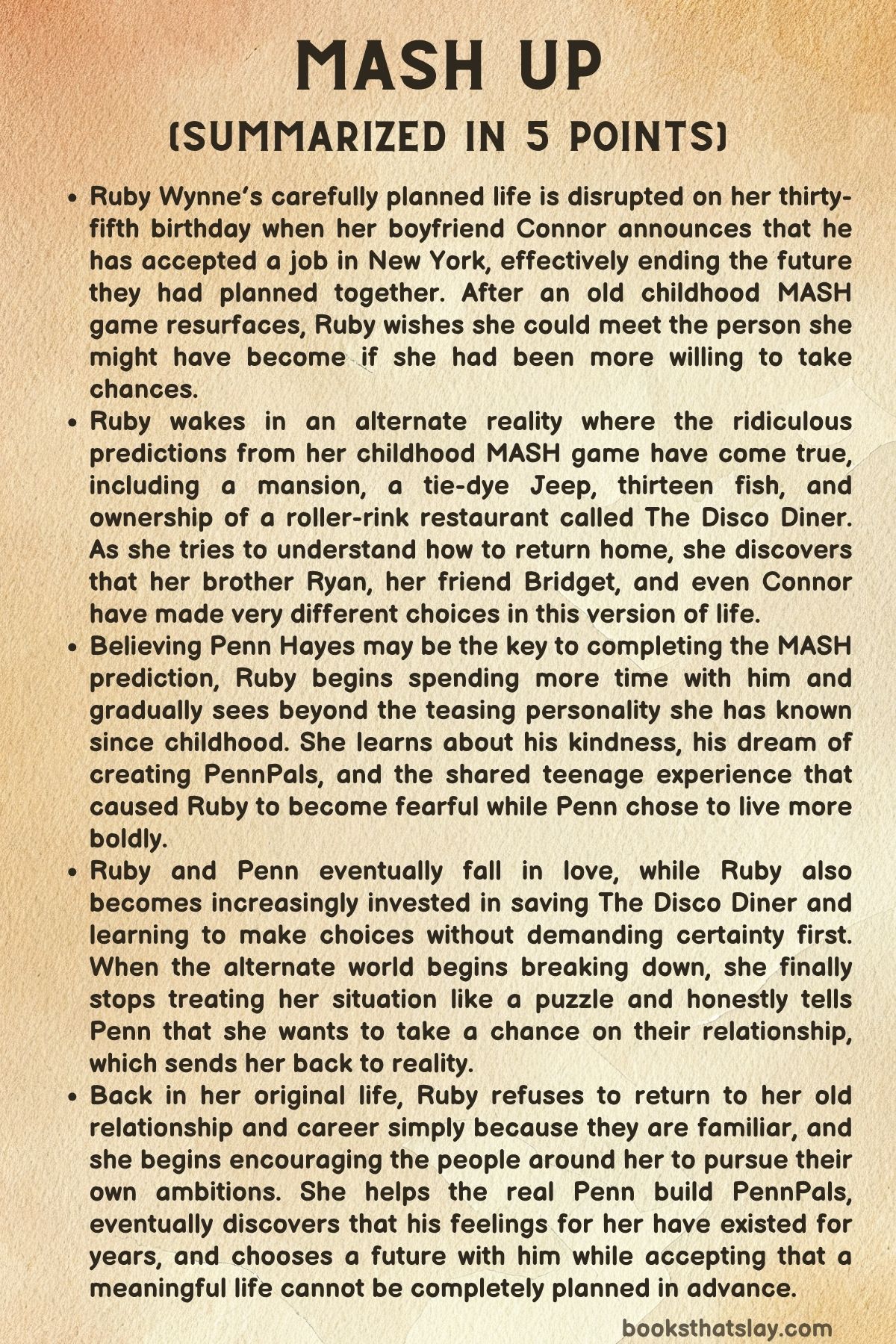
Ruby Wynne celebrates her thirty-fifth birthday at Curly’s, a local Lakeville bar chosen by her outgoing twin brother, Ryan. Ruby would have preferred something quieter and more predictable, but she arrives with her boyfriend and coworker, Connor Reynolds, while Ryan’s best friend Penn Hayes is also there, continuing the teasing relationship he and Ruby have maintained since childhood.
During the celebration, Ruby’s best friend Bridget produces an old MASH game from seventh grade. The childish prediction says Ruby will someday live in a mansion with two swimming pools, drive a tie-dye Jeep, own thirteen fish, run a roller-rink restaurant, and have Penn as her other half, an outcome everyone finds amusing except Ruby.
The evening becomes painful when Connor reveals that he has accepted a job in New York. Ruby had believed they shared a settled future involving his father’s accounting firm, marriage, and a life close to Lakeville, so Connor’s decision feels like the destruction of an agreement she believed was already secure.
Neither moving to New York nor attempting a long-distance relationship appeals to Ruby, and the couple quietly separates. Before leaving, Connor asks whether Ruby has dreams larger than the predictable future they planned together, forcing her to consider whether security has gradually replaced ambition in her life.
Later, staring at the ridiculous MASH predictions, Ruby remembers how easily her younger self imagined unusual possibilities without immediately calculating the risks. She makes a wish to understand the person she might have become had she remained more adventurous, then blows out her birthday candle.
Ruby awakens in an enormous, colorful mansion she does not recognize. Her appearance is slightly different, her surroundings are strange, and Penn arrives behaving as though her bizarre situation is completely normal.
Gradually, Ruby realizes that nearly every detail from the childhood MASH game has become real. She owns the mansion and two pools, drives the tie-dye Jeep, keeps thirteen fish, and owns The Disco Diner, a roller-skating restaurant that resembles the sort of dream a teenager might invent without worrying about practicality.
At first, Ruby assumes she is dreaming and enjoys the freedom of doing whatever she wants. When she sleeps and wakes in the same impossible world, however, she realizes the experience is not disappearing, and she begins searching for a way back to her actual life.
Alternate versions of the people Ruby knows reveal how different life might have been without some of her cautious choices. Ryan became a chef after pursuing an interest Ruby once discouraged because of his serious food allergies, while Bridget has lived differently because Ruby was not always present to advise her against uncertain decisions.
Bridget eventually notices that one MASH prediction remains incomplete: Penn is supposed to be Ruby’s other half, yet the two are not romantically involved. Ruby therefore begins wondering whether making Penn fall for her, or at least completing some form of romance with him, might satisfy the game and send her home.
Her new world also contains serious practical problems. The Disco Diner is imaginative and colorful but financially weak, and Ruby’s accounting instincts tell her that the business cannot continue indefinitely without major changes.
Penn, who has experience managing Curly’s, argues that survival requires more than cutting costs. He recommends events, better food, partnerships, a bar, and other ideas that initially frustrate Ruby because they depend on experimentation rather than certainty.
As they spend more time together, however, Ruby begins seeing qualities in Penn that she previously ignored. His apparently disorganized personality hides strong emotional intelligence, generosity, and a remarkable ability to notice what people need.
Their attraction also becomes increasingly difficult to dismiss. Grocery trips, diner work, skating, movie nights, teasing conversations, and quiet moments together transform their old antagonism into flirtation, while Ruby unsuccessfully tries to convince herself that seducing Penn is merely part of her plan to escape.
One major turning point comes when Ruby secretly follows Penn after assuming he is meeting another woman. Instead, she discovers that he regularly visits Earl, an elderly widower, bringing flowers and bread to preserve comforting memories of Earl’s late wife.
Penn eventually tells Ruby about PennPals, a community-service project he is trying to build. His idea is to connect people who need practical help, transportation, companionship, prescriptions, or household assistance with trustworthy members of the community, showing Ruby that his desire to help others is not casual generosity but a genuine calling.
At their childhood boathouse, Ruby and Penn finally discuss the event that shaped both of their adult personalities. Years earlier, Ryan experienced a life-threatening allergic reaction while they were together, and Ruby froze while Penn administered the EpiPen that helped save him.
Ruby has carried intense guilt ever since, becoming increasingly cautious because she believes terrible consequences can follow careless decisions. Penn reacted to the same experience in the opposite way, deciding that life is too short to postpone everything until conditions are perfectly safe.
Understanding this difference changes Ruby’s view of Penn and herself. Their emotional closeness soon becomes romantic, and after several near-kisses and increasingly intimate encounters, they finally kiss in Ruby’s turret room.
The kiss does not return Ruby to reality. Instead, it exposes a harder truth: she no longer wants Penn only because she hopes he can solve the MASH puzzle, because she has genuinely begun falling for him.
Ruby’s growing attachment is complicated by new evidence that her ordinary life may have limited the people around her. She discovers that Bridget is happily dating Ethan, someone Ruby had discouraged her from pursuing in reality, while Connor appears excited by the same New York opportunity that destroyed their original relationship.
Rather than viewing these differences as proof that she ruined everyone’s lives, Ruby slowly begins understanding that love does not give her the right to control other people’s decisions. Ryan, Bridget, and Connor may all need the freedom to make choices she would never make for them.
Ruby and Penn eventually begin openly dating and spend the night together. Their connection feels natural because years of shared history already exist beneath the teasing, but Ruby is terrified that Penn loves the alternate version of her rather than the woman who will eventually return to reality.
Meanwhile, elements of the MASH world begin failing. Ruby’s Jeep stops working, the thirteen fish die, one of her pools drains, and The Disco Diner loses electricity just before an important themed event, making Ruby fear that the alternate reality is collapsing.
Under pressure, Ruby hurts Penn by referring to their relationship as a bad decision and dismissing the diner as a foolish dream. Their argument leads Penn to reveal that he did not move into her mansion because of apartment repairs; he had financially overextended himself while trying to build PennPals and used helping Ruby as an excuse to spend more time with her.
Ruby encourages him not to abandon PennPals, even as she begins emotionally distancing herself. She worries that loving him more deeply will make their eventual separation unbearable and deliberately prevents him from completing what appears to be a declaration of love.
Her attention shifts toward rescuing The Disco Diner’s 2000s event despite the power outage. Instead of waiting for ideal conditions, Ruby and the people around her improvise with portable equipment, local support, volunteers, and creative solutions.
The event becomes a major success and brings in more revenue than the diner had earned during the previous several months. Ruby also rejects Rollerworld’s acquisition proposal because she realizes that preserving the diner’s unique identity matters more to her than choosing the financially safest option.
Eventually, Bridget advises Ruby to stop treating the magical world as another puzzle requiring the correct sequence of moves. Ruby searches for Penn and finally tells him what she actually wants instead of shaping her actions around the possibility of returning home.
She admits that fear has controlled too many of her choices and says she wants to take a chance on their relationship regardless of the result. At that moment, the diner’s power returns, and before Ruby can finish saying everything she feels, the alternate world disappears.
Ruby awakens in Penn’s real apartment shortly after her birthday accident, discovering that almost no time has passed. Ryan, Bridget, and Penn remember none of the alternate reality, leaving Ruby alone with memories of a relationship that, for everyone else, never happened.
Yet Ruby also notices unexpected similarities between the two worlds. Penn is already developing the idea that will become PennPals, and several people and circumstances from MASHland exist in altered forms, suggesting that the alternate world may have revealed genuine possibilities rather than inventing them.
Ruby returns to Chicago transformed by what she experienced. She resigns from accounting, refuses Connor’s attempt to restore their old relationship, encourages him to pursue New York, and begins dismantling the restrained life she once believed she needed.
She also apologizes to Ryan for allowing fear to influence the way she responded to his interest in cooking. Instead of managing his future, she encourages him to reconsider the ambitions he once abandoned.
Ruby later reconnects with Penn and offers to help him turn PennPals into a sustainable business. She applies her accounting skills to budgets, business planning, organization, promotion, and investment, finally discovering that practicality does not have to oppose creativity.
As they work together, attraction begins resurfacing between Ruby and the real Penn. She learns that his interest in her existed long before her alternate experience and eventually admits that her own feelings for him began during their teenage years, before guilt over Ryan’s allergic reaction caused her to push Penn away.
Bridget helps Ruby recognize that she is once again trying to predict every possible consequence before allowing herself to act. Ruby finally accepts that relationships cannot be made completely safe and that protecting herself from every painful possibility also prevents her from experiencing happiness.
At the PennPals launch celebration, Ruby first tells Ryan about her feelings for Penn. Ryan supports her and challenges her to consider the possibility that instead of everything going wrong, things might actually work out.
Outside the party, Penn reveals an old high-school list containing an unfinished goal to talk to Ruby about his feelings. Ruby confesses that she loves him, and Penn tells her he has loved her for years, allowing them to choose one another without demanding certainty about everything that comes afterward.
Nine months later, Ruby has built a life that combines the practicality of her former self with the imagination she rediscovered. PennPals is expanding, Ryan is traveling, Bridget and Ethan remain together, Ruby is building a career advising small businesses, and she and Penn have moved in together.
Ruby no longer needs the mansion, the tie-dye Jeep, or a literal recreation of her childhood predictions. The real lesson of the strange experience is that a meaningful life does not come from successfully predicting the future but from trusting herself enough to respond to whatever future arrives.
Characters
Ruby Wynne
Ruby is the emotional and psychological center of The MASH Up, and much of her development is built around the difference between responsibility and control. At the beginning of the book, she believes careful planning protects her from disappointment, so her job, relationship, home, and future have all been arranged around stability rather than uncertainty.
Her caution is not simply a personality trait. The incident in which Ryan nearly died from an allergic reaction created lasting guilt, and Ruby came to believe that her failure to anticipate danger made her partly responsible for what happened.
That guilt explains why she tries to protect Ryan, discourages Bridget from taking romantic risks, rejects unexpected career changes, and becomes uncomfortable whenever circumstances move beyond her control. Her greatest weakness therefore grows out of an understandable desire to keep herself and the people she loves safe.
MASHland forces Ruby to confront the cost of that approach. She sees alternate versions of Ryan, Bridget, Connor, and herself making choices she discouraged in reality, and many of them appear freer or happier because they were allowed to make those choices independently.
Her relationship with Penn becomes the most personal test of this transformation. Ruby initially tries to turn attraction into another problem she can solve, but genuine love eventually makes calculation impossible because Penn matters too much for any outcome to feel emotionally safe.
By the end, Ruby has not become reckless or abandoned her practical abilities. Instead, she learns to use those abilities without treating certainty as a requirement for action, allowing her to become a small-business consultant, support PennPals, encourage Ryan, and choose Penn without guarantees.
Penn Hayes
Penn initially appears to be Ruby’s opposite: spontaneous, teasing, unpredictable, and willing to make decisions without constructing an elaborate plan first. In The MASH Up, however, his apparent casualness gradually proves to be a surface impression that hides remarkable emotional commitment.
His strongest quality is attentiveness. Whether he is visiting Earl, remembering the names of Ruby’s fish, preparing food, caring for Ruby after she drinks too much, helping Mrs. Baker, supporting Ryan, or creating PennPals, Penn consistently notices other people and responds through action.
Like Ruby, Penn was shaped by Ryan’s teenage allergic reaction, but he drew the opposite conclusion from it. Where Ruby learned to fear preventable disaster, Penn learned that time is uncertain and that postponing meaningful choices may itself become a source of regret.
This difference makes him an important challenge to Ruby without turning him into a simplistic symbol of spontaneity. Penn also makes financial mistakes, overcommits himself, hides the truth about his living situation, and sometimes relies on optimism where stronger planning would help.
His relationship with Ruby works because they gradually correct rather than erase each other’s tendencies. Ruby gives structure to PennPals and helps Penn treat his caring instincts as a legitimate business, while Penn helps Ruby understand that planning should support a meaningful life rather than replace one.
Most importantly, Penn’s love for Ruby is not created by the alternate reality. The revelation of his old high-school list proves that his feelings existed long before either of them had the courage or emotional freedom to acknowledge them.
Ryan Wynne
Ryan serves as both Ruby’s twin brother and one of the clearest examples of how her fear affects other people. In reality, he works in technology, but in MASHland he becomes a chef after pursuing an interest in food that Ruby had previously discouraged because of his dangerous allergies.
His alternate career unsettles Ruby because she must acknowledge that her protective advice may also have limited him. Yet Ryan never treats Ruby as solely responsible for the direction of his life, which is essential to his characterization.
He understands that his choices belong to him, even when other people influence them. This maturity allows Ruby to apologize without turning their relationship into a story in which she must now take responsibility for fixing every decision she once questioned.
Ryan is also socially confident and adventurous in ways that contrast with Ruby’s preference for predictability. His spontaneous trip to Italy becomes another reminder that independence necessarily includes uncertainty.
As Ruby changes, her relationship with Ryan becomes healthier because she stops treating love as a duty to manage his safety. By the end, she can support his travels and ambitions while accepting that being his sister does not require removing every possible danger from his life.
Bridget
Bridget is Ruby’s closest female friend and often functions as the person who recognizes emotional truths before Ruby is prepared to accept them. Her decision to bring the old MASH paper to the birthday celebration starts the event that ultimately forces Ruby to reconsider the life she has constructed.
In the alternate world, Bridget remains loyal even when Ruby gives her an impossible explanation for her sudden confusion. Instead of abandoning her, she helps Ruby test theories, replay MASH, consider Penn’s role, and understand the differences between her two lives.
Bridget is also important because her own romantic life demonstrates the unintended effects of Ruby’s caution. In reality, Ruby discouraged her from dating Ethan because he was a coworker, while alternate Bridget ignored that warning and developed a happy relationship with him.
Her most valuable advice comes when Ruby continues trying to determine the correct rule for escaping MASHland and later tries to calculate whether dating Penn is too dangerous. Bridget repeatedly reminds her that love cannot be reduced to a sequence of safe moves.
She therefore acts as both comic support and emotional clarity. Her friendship gives Ruby a space where confusion can be admitted openly, while her willingness to challenge Ruby prevents loyalty from becoming passive agreement.
Connor Reynolds
Connor is not presented as a villain, which makes his role in Ruby’s development more effective. He and Ruby genuinely built a stable relationship around compatible expectations, but his decision to accept a New York opportunity reveals that the future they planned together no longer represents what he wants.
His question about whether Ruby has larger dreams becomes one of the most important challenges she receives. Although it hurts her immediately after the breakup, the question remains with her because it exposes how rarely she has asked what she actively desires beyond security.
The alternate reality further changes Ruby’s understanding of Connor. There he is simply her accountant, allowing her to see him without the emotional expectations created by their romantic history.
When alternate Connor considers the same New York opportunity with genuine enthusiasm, Ruby finally understands that his original decision was not necessarily a rejection of her. It was also an attempt to pursue something meaningful for himself.
His later effort to reconcile with Ruby shows how completely her priorities have changed. She no longer wants the old plan simply because it is familiar, and by encouraging Connor to take the job, she releases both of them from a future that once looked safe but no longer fits either person.
Theo
Theo is a supporting character whose relatively calm presence gives Ruby several useful perspectives on change. As an employee of The Disco Diner, he is close enough to observe its weaknesses without possessing Ruby’s emotional investment in proving that the business must survive in a particular form.
His discussion about the diner’s bad pizza becomes surprisingly meaningful because he treats an obvious problem simply: if something is not working, it can be changed. Ruby has spent much of her life assuming that familiarity deserves preservation, so Theo’s practical attitude indirectly challenges a much larger belief.
When Ruby later encounters him in reality, she learns that Theo left Hollywood because success in a particular place did not automatically make him feel connected to himself. His decision to return to people who knew him well parallels Ruby’s own search for a life that feels personally authentic rather than externally correct.
Theo also gives Ruby a final push toward Penn by pointing out how physically close Penn already is. His importance lies in his ability to reduce problems Ruby has made complicated into questions of honest preference and action.
Earl
Earl has relatively little page time, but he plays an important role in changing Ruby’s understanding of Penn. As an elderly widower who misses his late wife Martha, Earl receives regular visits from Penn, who brings flowers and homemade bread associated with the comfort of his marriage.
Through Earl, Ruby sees that Penn’s kindness exists when there is no social reward attached to it. He is not helping Earl to impress Ruby, build a reputation, or gain anything materially valuable.
Earl also helps establish the emotional foundation of PennPals. The service begins not as an abstract business concept but as an extension of the kind of practical companionship Penn is already providing to someone who needs it.
That connection allows Ruby to understand that Penn’s strongest skill is creating human connection through concrete acts. Earl therefore becomes evidence of the seriousness beneath Penn’s playful personality and helps Ruby reconsider assumptions she has carried about him for years.
Katie
Katie is initially important because Ruby mistakenly interprets her as a romantic threat. Seeing the redheaded woman near Penn intensifies Ruby’s jealousy, especially because Ruby has only recently begun acknowledging how strongly she wants him.
The misunderstanding reveals Ruby’s emotional investment before she is ready to describe it as love. Her instinct to follow Penn shows that her supposedly strategic seduction plan has already become personal.
Katie later becomes connected with PennPals because she wants to help with the project. When Ruby encounters her again in reality, she learns that Katie’s apparent competition with her concerns work rather than romance.
That revelation removes one of Ruby’s final imagined obstacles. Katie therefore functions less as an independent rival than as a reflection of Ruby’s insecurity, showing how fear can create threatening possibilities even when the actual situation is much simpler.
Mac Davis
Mac Davis represents one of the practical connections that helps creative ambitions become sustainable. In MASHland, he is associated with The Disco Diner as an investor, showing that Ruby’s unusual business idea required not only imagination but also someone willing to support its financial existence.
Later, when Ruby helps Penn establish PennPals in reality, she connects him with Mac as a potential investor. The parallel demonstrates how Ruby gradually learns to combine the two sides of herself that she once treated as incompatible.
She does not have to become Penn in order to support risk-taking. Instead, she can use planning, budgeting, professional contacts, and financial judgment to make bold ideas more achievable.
Mac therefore has a small but meaningful structural role in the story. His involvement shows that dreams become more durable when creativity is supported by resources, organization, and people who are willing to invest in possibilities before their success is guaranteed.
Sloane Bishop
Sloane Bishop represents the tempting version of success that asks Ruby to sacrifice individuality for security. As a representative of Rollerworld, Sloane offers to acquire The Disco Diner while employing Ruby as a creative director who could reproduce the concept elsewhere.
Financially, the offer is highly attractive because the diner is struggling. Earlier in the story, Ruby probably would have accepted because it reduces uncertainty and converts a risky independent business into a more stable professional arrangement.
Her rejection therefore marks an important change in judgment. Ruby is no longer evaluating every decision exclusively according to which option produces the greatest measurable security.
Sloane is not depicted as exploitative or malicious; the proposal may genuinely be sensible from a business perspective. Its significance lies in forcing Ruby to decide whether financial logic should automatically override attachment, identity, creativity, and instinct.
By refusing, Ruby proves to herself that she can understand the numbers completely and still choose something else.
Mrs. Baker
Mrs. Baker begins as someone Ruby remembers primarily as an irritable neighbor, but Penn’s relationship with her reveals how incomplete Ruby’s assumptions about people can be. His warmth toward Mrs. Baker demonstrates that he has formed meaningful connections throughout the community without drawing attention to them.
She later becomes part of the successful diner event, where Penn helps her outside, reinforcing the ordinary acts of service that define him. These moments matter because Ruby repeatedly discovers Penn’s character by watching how he treats people when romance is not the focus.
Mrs. Baker also becomes connected to Ruby’s changed life when Ruby eventually moves into her carriage house. The arrangement represents Ruby’s willingness to build a future gradually rather than waiting until she has recreated the complete stability she once depended upon.
Her presence therefore links community, transition, and Ruby’s growing comfort with temporary uncertainty.
Ethan
Ethan is mainly characterized through his relationship with Bridget, but that relationship carries important meaning for Ruby. In her original life, Ruby discouraged Bridget from dating him because they worked together and she considered the situation unnecessarily risky.
In MASHland, Bridget ignored that caution and became happily involved with Ethan. When Ruby returns to reality, she deliberately reverses her former advice and encourages Bridget to give the relationship a chance.
Ethan therefore represents one of the clearest examples of Ruby learning that other people should be allowed to evaluate their own risks. His importance comes less from his individual development than from what Bridget’s happiness with him teaches Ruby.
By the end, Bridget and Ethan remain together, validating neither recklessness nor certainty but the value of allowing a relationship to be attempted. Their romance quietly supports the larger argument that avoiding every possible complication can also mean avoiding experiences that might have become deeply rewarding.
Themes
Fear, Control, and the Illusion of Safety
Ruby’s need for control grows from a painful belief that careful decisions can prevent disaster. After Ryan’s allergic reaction, she begins treating uncertainty almost as a moral failure, as though being responsible means anticipating every possible danger before allowing herself or someone she loves to move forward.
The problem is that absolute safety is impossible, and her attempt to create it gradually restricts her life. She stays inside familiar professional and romantic structures, discourages Ryan’s culinary ambitions, questions Bridget’s workplace romance, and reacts strongly whenever circumstances disrupt her carefully constructed plans.
The MASH Up challenges this mindset by placing Ruby in a reality where control is largely useless. She cannot explain how she arrived, cannot reconstruct decades of alternate memories, cannot identify reliable rules for returning, and eventually cannot stop parts of the magical world from disappearing.
Her growth begins when she recognizes that planning is useful but cannot serve as protection from every emotional consequence. The successful diner event becomes an especially important lesson because the power remains out, the original plan cannot be followed, and yet improvisation produces better results than Ruby expected.
By the end, Ruby still values preparation, financial knowledge, and organization, but she stops demanding certainty before acting. Her new understanding is not that risks should be ignored; it is that a life designed solely to eliminate risk can become a different kind of loss.
Possibility, Choice, and the Lives That Might Have Been
The alternate world allows Ruby to confront the disturbing question of what might have happened if she had made different choices. Instead of presenting one alternate future as objectively superior, the story uses these differences to show how identity develops through countless decisions, influences, fears, and opportunities.
Ryan becoming a chef affects Ruby because she remembers discouraging his interest in cooking. Bridget’s relationship with Ethan has a similar effect, while Connor’s enthusiasm about New York helps Ruby understand that the choice that ended their relationship may also have represented an important opportunity for him.
Ruby’s own alternate life is equally complicated. MASHland Ruby appears more adventurous, colorful, experimental, and willing to follow unusual ambitions, but she also operates a struggling business and has not necessarily discovered a perfect version of adulthood.
That distinction prevents the alternate reality from becoming a simple fantasy about choosing the opposite path. Ruby does not need to copy the woman who created The Disco Diner, just as she does not need to reject every quality belonging to her original self.
Instead, she carries selected possibilities back with her. She leaves accounting but uses her financial knowledge as a consultant, adds color to her surroundings without needing an extravagant mansion, supports risk without becoming irresponsible, and builds a relationship with Penn in reality rather than mourning the one she lost.
The theme therefore treats unlived possibilities as sources of insight rather than instructions. Ruby cannot rewrite the past, but she can allow imagined alternatives to change what she chooses next.
Love as Trust Rather Than Certainty
Ruby initially approaches love with the same logic she applies to the rest of her life. Her long-term relationship with Connor is comforting partly because its future appears agreed upon, while her attraction to Penn is frightening because it introduces uncertainty into relationships that have connected their families and friends for decades.
Even in MASHland, Ruby attempts to transform romance into a solvable problem. She theorizes that Penn must become her other half, experiments with flirting, considers whether a kiss might satisfy the requirement, and repeatedly searches for signs that a specific action will return her home.
The more real her feelings become, however, the less useful that approach becomes. Loving Penn means accepting possibilities she cannot calculate: he might love another version of her, she might disappear, their relationship might fail in reality, or romantic disappointment might alter friendships that have existed since childhood.
Penn cannot eliminate those risks for her. What he offers instead is attention, affection, honesty, patience, and evidence that he is willing to choose her without knowing the outcome.
Ruby’s eventual declaration of love matters because she makes it after abandoning the attempt to guarantee success. Bridget’s reminder that love is not another game finally helps her understand that intimacy requires participation before certainty is available.
The final relationship therefore represents trust rather than prediction. Ruby does not choose Penn because she discovers proof that nothing will go wrong; she chooses him because the possibility of something meaningful has become worth the vulnerability required to pursue it.
Becoming Yourself Without Rejecting Who You Were
Ruby’s development is not a transformation from a dull person into an adventurous one. The story repeatedly shows that the qualities she possessed before MASHland, including intelligence, organization, loyalty, financial discipline, and careful observation, remain valuable after she begins changing.
Her difficulty comes from allowing those qualities to dominate every decision. She has gradually narrowed herself until practicality becomes almost synonymous with identity, leaving little space for curiosity, color, experimentation, or ambitions that cannot immediately be justified.
MASHland exposes another possible Ruby, but that woman is not presented as someone she must completely become. The alternate Ruby has taken impressive risks, traveled, created a strange business, and lived boldly, yet she has also made financially questionable decisions and built a restaurant that requires serious intervention.
The resolution comes when Ruby begins combining both versions rather than choosing between them. Her work with PennPals is especially important because she uses the precise financial and organizational skills associated with her former career to support an unconventional project built around human connection.
Her later consulting career continues this balance. She can work with numbers without returning to the life she left, just as she can embrace brighter clothes, spontaneous decisions, romance, and travel without abandoning judgment.
The result is a broader identity rather than a replacement identity. Ruby becomes more fully herself because she stops treating personality as a choice between safety and freedom and begins allowing seemingly opposite qualities to exist together.