Most Ardently Yours Summary, Characters and Themes
Most Ardently Yours by Freya Sampson is a contemporary romantic fantasy that takes the familiar appeal of Jane Austen and turns it into a story about grief, self-worth, creativity, and the difference between loving an ideal and building a real life.
Zoe Knight has spent years finding comfort in romance novels while quietly abandoning many of her own hopes. When an impossible encounter brings Mr. Darcy out of Pride and Prejudice and into modern London, Zoe initially believes she has been handed the perfect man. What follows forces her to reconsider love, friendship, loss, and the kind of happy ending she truly needs.
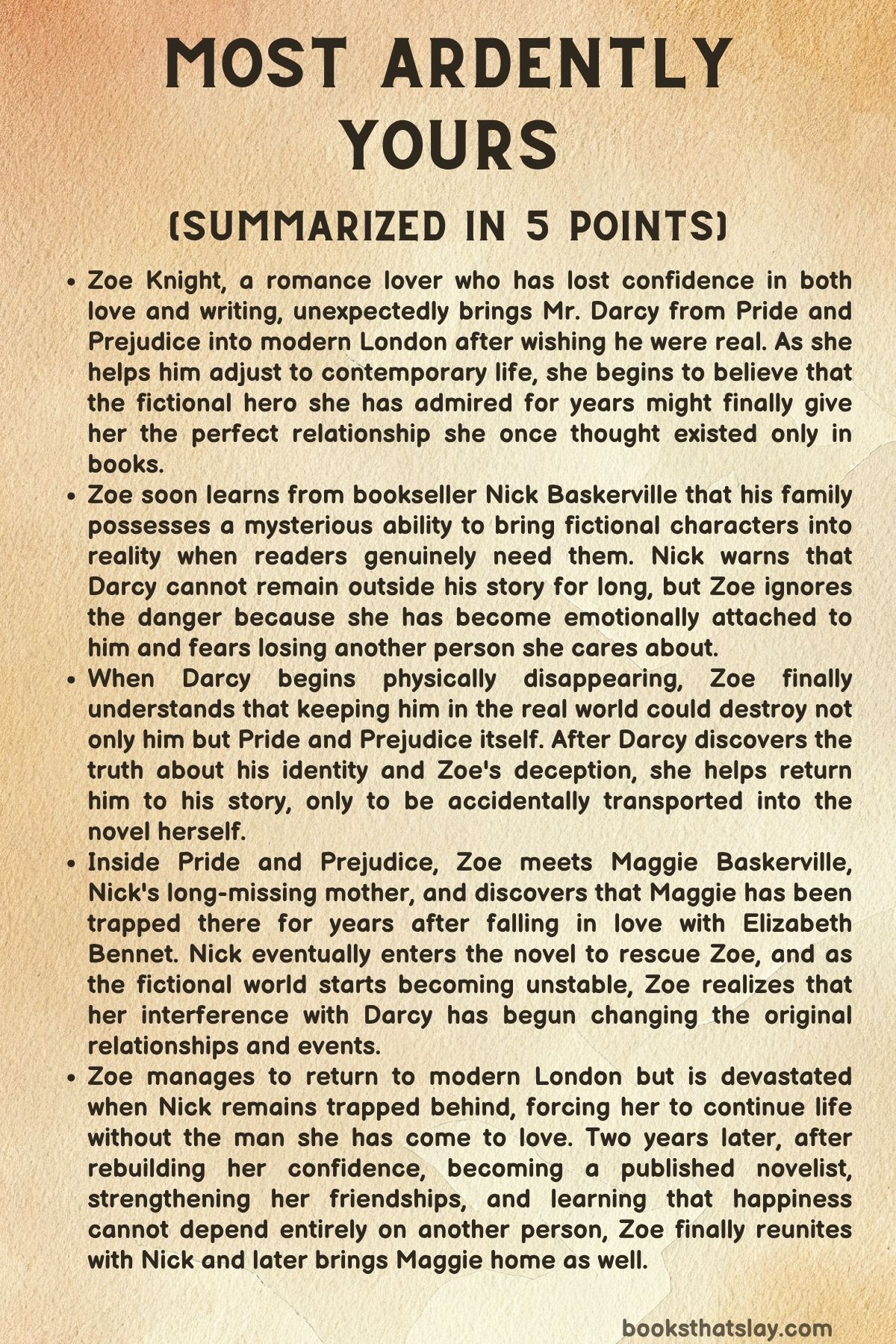
Summary
Zoe Knight is a devoted romance reader living in London, though her own life looks very different from the happy endings she enjoys in books. She works at Cake Expectations, a literary-themed café, has abandoned her dream of becoming a novelist, and carries lasting emotional wounds from the death of her mother, the abandonment of her father, and her former boyfriend Crispin Carter’s destruction of her confidence.
During a rainstorm, Zoe takes shelter inside Baskerville Books, a shop she normally avoids because its displays seem designed for readers who look down on romance fiction. There she meets the owner, Nick Baskerville, whose open contempt for romance novels immediately irritates her.
Their disagreement becomes personal when Zoe discovers an old copy of Pride and Prejudice. Nick refuses to sell it and reacts strangely when she handles it, so an angry Zoe impulsively steals the book and leaves.
That night, after drinks with her best friend Bianca, Zoe reads the stolen novel while travelling home. Mr. Darcy has always meant more to her than an ordinary fictional crush because Pride and Prejudice connects her to memories of her late mother, and in a moment of loneliness she wishes that Darcy could be real.
The next day, while working at the café dressed as Elizabeth Bennet, Zoe meets a man wearing Regency clothing who appears completely confused by modern London. He calls himself Fitzwilliam Darcy, speaks of Pemberley, Georgiana, Bingley, Netherfield, and Elizabeth Bennet, and possesses knowledge that perfectly matches the point in the novel Zoe had been reading.
Zoe initially thinks he is experiencing some kind of mental crisis, but repeated questioning makes that explanation increasingly impossible. Darcy knows details that an impersonator should not know, remembers nothing beyond the exact point where Zoe stopped reading, and claims to have appeared in London at approximately the same time she wished for him.
Unable to explain what has happened, Zoe takes Darcy home. She tells him that he has somehow travelled through time rather than admitting that he is a fictional character, partly because she fears the truth would destroy his understanding of himself.
Darcy’s adjustment to modern life provides both comedy and companionship. Showers, television, takeaway food, women’s legal rights, modern relationships, and reality television astonish him, yet he gradually responds with curiosity rather than simple disapproval.
Zoe returns to Baskerville Books because she suspects Nick knows something about the mysterious copy. He reveals that the book belonged to his mother, Maggie, and urges Zoe to destroy it, but he refuses to give her a complete explanation.
As Zoe investigates, she discovers that Maggie once promoted romance novels and ran a secretive book club connected to the shop. Maggie believed stories could help readers survive grief and recognize that they deserved love, an idea that strongly resembles Zoe’s own experience of finding comfort after her mother’s death.
Meanwhile, Darcy becomes an important presence in Zoe’s daily life. He listens without mocking her, condemns the way Crispin treated her, encourages her to begin writing again, and makes her feel comfortable enough to imagine a fuller future.
Mrs. Atallah, Zoe’s eccentric landlady, also grows fond of Darcy and accepts his strange behaviour as harmless. Their expanding household gives Zoe something she has lacked for years: companionship that does not demand that she prove her worth.
Zoe’s feelings toward Darcy gradually shift from fascination into the belief that she may be falling in love with him. Bianca, unaware of Darcy’s real identity, encourages Zoe to stop assuming everyone she loves will eventually leave and to admit what she wants.
Yet warning signs remain. Zoe feels deep emotional affection for Darcy but surprisingly little physical attraction, while her continuing arguments with Nick carry a tension she refuses to examine.
At Bianca and Steve’s engagement party, Zoe brings Darcy under the invented identity of “Will.” Nick unexpectedly attends because he knows Steve from university, and the moment he sees Darcy he immediately understands what Zoe has done.
Nick finally reveals the truth about his family. Generations of Baskerville women have possessed a magical ability to read fictional characters into reality when a reader sincerely needs the qualities that character represents.
Maggie had summoned Darcy before, and the family established strict rules because fictional characters cannot safely remain outside their stories for long. Zoe has broken virtually every rule without knowing they existed, but she refuses to return Darcy because she has begun imagining a future with him.
Trying to prove that their relationship is genuine, Zoe kisses Darcy in front of Nick. The kiss is awkward rather than transformative, but Zoe convinces herself that her expectations are simply too high.
She soon takes Darcy to Bath in an effort to avoid Nick. Unfortunately, their visit coincides with the Jane Austen Festival, making it increasingly difficult to hide the truth from Darcy when he encounters hundreds of modern people celebrating the author who created him.
Forced to share a hotel bed, Zoe and Darcy attempt greater physical intimacy. Although the experience improves after some awkwardness, Zoe finally admits to herself that she loves what Darcy has represented throughout her life more than she romantically loves the actual man now beside her.
Darcy also confesses how deeply he misses Georgiana and his own world. Before Zoe can tell him the complete truth, however, two of his fingers disappear.
Terrified, Zoe rushes him back toward London and seeks Nick’s help. Nick explains that characters who remain too long in reality begin fading and can disappear completely.
The consequences may extend beyond Darcy himself. Nick tells Zoe about a fictional character whose disappearance caused his entire novel to vanish from existence and collective memory, meaning Darcy’s destruction could erase Pride and Prejudice and everyone inside it.
Before Zoe can return him, Darcy discovers the stolen novel and learns the truth. Furious at Zoe’s deception, he runs away and tries to reach the locations he associates with his own life.
Zoe eventually finds him at King’s Cross, already missing an arm. She admits that she kept the truth from him because Darcy had comforted her through grief and abandonment for much of her life, but she also accepts that her motives do not excuse depriving him of the choice to return home.
When Darcy learns that his disappearance could destroy Georgiana, Elizabeth, Bingley, and everyone else in his world, his anger gives way to determination. Zoe takes him back to Baskerville Books and reads the relevant passage while sincerely wishing him home.
The magic succeeds in returning Darcy, but it also pulls Zoe into Pride and Prejudice. She awakens at Netherfield, meets Elizabeth Bennet, and discovers that Darcy has no memory of their time together because fictional characters normally forget everything that happens when they leave their stories.
Zoe desperately tries to make Darcy remember. By repeating lines and interfering with familiar scenes, however, she accidentally begins altering the novel itself.
Darcy eventually shows flashes of recognition, but Zoe is pulled aside by a mysterious woman who turns out to be Maggie Baskerville. Far from being dead, Maggie has been trapped inside Pride and Prejudice for eight years after accidentally reading herself into the novel.
Maggie explains that she fell in love with Elizabeth Bennet after repeatedly summoning her for advice. Because Elizabeth forgot their relationship each time she returned to the book, Maggie eventually wished to remain with her and became trapped inside the fictional world.
Her disappearance explains Nick’s hostility toward romance. He believed stories had taken his mother away and spent years grieving without knowing which book contained her.
Maggie has survived through repeated cycles of the novel, but the current version is becoming unstable because Darcy’s returning memories of Zoe are affecting his relationship with Elizabeth. Other characters also begin behaving differently, threatening the structure that keeps the story intact.
At the Netherfield Ball, the instability becomes obvious. Darcy’s attention drifts toward Zoe, Bingley’s feelings shift away from Jane, and established events begin changing.
Then Nick unexpectedly appears. His great-aunt Matilda has used the remaining Baskerville magic to send him into the novel because he is determined to find Zoe.
Nick is reunited with Maggie, and the three attempt to devise an escape. He suggests that Zoe, as a writer, might create a new passage describing them safely back in London and then use that writing as the basis for the magic.
Zoe initially cannot do it because Crispin’s old criticism still controls the way she judges every sentence she writes. Nick challenges that voice, reminding her that she does not need to sound like someone else and that she once loved writing before another person convinced her to stop.
As the fictional world becomes increasingly unstable, Zoe also realizes they cannot simply leave without repairing the damage. She tells Darcy that his strange memories of modern London are real and encourages him to return his attention to Elizabeth and help Bingley follow the course his life originally took.
Zoe then writes again, drawing inspiration from the people she genuinely loves rather than trying to imitate supposedly superior writers. Her confidence returns because she finally treats her own voice as something worth hearing.
During this period, Zoe and Nick also acknowledge their attraction. Their first kiss confirms what Zoe’s relationship with Darcy lacked: a physical and emotional connection grounded in two imperfect people who know and challenge each other.
Nick admits that he once loved romance novels himself. His hostility was a response to Maggie’s disappearance rather than evidence that he truly believed love stories were worthless.
When Zoe finally reads the escape passage, she can create a vivid connection between herself, Nick, and Baskerville Books, but she cannot form a strong enough image of Maggie in modern London. Maggie therefore insists that Zoe and Nick leave without her.
Zoe wakes on the floor of Baskerville Books and initially assumes Nick has returned too. She slowly discovers that he has remained inside the novel with Maggie, sacrificing his own safety after entering the story to rescue Zoe.
The loss devastates her. For weeks Zoe attempts to bring Nick and Maggie back, but nothing works.
Her friends help her survive without allowing grief to become her entire life. Mrs. Atallah teaches her an especially important distinction: loving someone does not mean needing that person in order to exist or have meaning.
Zoe gradually rebuilds herself. She returns to work, strengthens her friendships, allows herself to remember her mother with happiness rather than only pain, and finally begins writing a new novel.
Two years later, she has completed the manuscript, found an agent, secured a publishing deal, and developed a wider circle of friends. The former Baskerville Books premises have become Cupid Books, a romance bookshop, and the store hosts the launch of Zoe’s debut novel.
Her novel begins with a woman running into a bookshop during a rainstorm and arguing with a bookseller who supposedly hates romance. While reading aloud, Zoe accepts that Nick may never return and realizes that her life can still be meaningful, successful, and happy without him.
At that exact moment, she looks across the shop and sees Nick standing behind the counter.
After their reunion, Nick explains Maggie’s theory that his family’s magical ability may have transferred to Zoe at the moment he fell in love with her. Zoe finally understands why her earlier attempts to bring him home failed.
She had been trying to summon Nick because she believed she needed him to become happy. Once she built a meaningful life for herself and accepted that her happiness did not depend on his return, Nick became the person capable of answering a genuine need rather than filling an emptiness she had refused to face.
Zoe then uses the same understanding to bring Maggie home. Because Cupid Books is struggling and Jing genuinely needs an experienced romance bookseller, Zoe wishes for Maggie’s help and successfully summons her.
Maggie and Nick are reunited, while Zoe and Nick finally have the chance to build a future together. Zoe receives a romantic happy ending, but it comes only after she learns that love should add to a life she values rather than serve as the single thing that gives that life value.
Characters
Zoe Knight
Zoe is the emotional and psychological centre of Most Ardently Yours, and nearly every supernatural event in the book reflects a struggle already taking place inside her. At the beginning, she appears independent and functional, but much of that independence is defensive: she has organized her life around avoiding the possibility of fresh disappointment.
Her mother’s early death and her father’s abandonment taught Zoe that people she loves can disappear, while Crispin’s treatment taught her that trust can also result in humiliation. These experiences explain why she finds fictional relationships safer, because books can be reread and fictional heroes cannot deliberately walk away from her.
Her attachment to Darcy therefore represents far more than romantic fantasy. He embodies loyalty, honour, emotional steadiness, and the memory of the mother who first gave Pride and Prejudice meaning for her.
The arrival of the real Darcy initially appears to confirm Zoe’s belief that the safest imaginable love would be love with someone whose character she already knows. Yet living with him gradually exposes the difference between knowing a written character and sharing a life with an autonomous human being.
Zoe’s dishonesty toward Darcy is one of her most important flaws. She repeatedly tells herself she is protecting him, but she is also protecting herself from the possibility that informed choice would make him leave.
That pattern connects directly to her abandonment fears. She would rather manage the truth than risk giving someone the freedom to walk away from her, and the consequences force her to recognize that love without genuine choice becomes possessive.
Her journey as a writer mirrors her emotional development. Crispin persuaded her that her voice was inadequate, so abandoning fiction became another way of avoiding judgment and failure.
Darcy and later Nick encourage her to write, but Zoe’s eventual success matters because neither man writes the book for her or gives her talent she did not possess. She has to recover authority over her own imagination and accept that rejection, imperfection, and revision are part of being a writer rather than evidence that she should stop.
By the end, Zoe’s understanding of happiness has changed profoundly. She still values romance, but she no longer expects another person to rescue her from an incomplete life.
Nick Baskerville
Nick initially appears to be Zoe’s ideological opposite in Most Ardently Yours. He mocks romance fiction, rejects happy-ever-afters, and behaves with enough hostility that Zoe quickly decides he represents the kind of literary arrogance she despises.
His later history transforms that first impression. Nick does not hate romance because he lacks feeling; he hates it because romance and the Baskerville family’s magic have become inseparable from the disappearance of his mother.
For years, he has lived with uncertainty about Maggie’s fate and the belief that she may have voluntarily chosen a fictional relationship over her own son. His bitterness is therefore grief disguised as contempt.
Nick and Zoe share an important weakness: both allow old pain to determine their assumptions about other people. Zoe assumes Nick’s dislike of romance reveals misogyny and emotional coldness, while Nick assumes romance stories encourage forms of hope that can become destructive.
Their arguments work because each repeatedly challenges the other’s defensive beliefs. Beneath Nick’s sarcasm, Zoe gradually discovers loyalty, humour, compassion, and an instinct to protect people even when doing so costs him personally.
His decision to enter Pride and Prejudice to rescue Zoe establishes the depth of his commitment more convincingly than any declaration could. He knowingly risks becoming trapped inside the same world that took Maggie from him because leaving Zoe there is unacceptable to him.
Nick’s encouragement of Zoe’s writing is equally significant. Unlike Crispin, he does not require her to become a different kind of writer; he tells her to trust the voice she already possesses.
His romance with Zoe succeeds because it develops between two people who see each other’s flaws. Nick is not an ideal brought to life but an imperfect partner whose emotional history, humour, fear, attraction, and loyalty make him compatible with the person Zoe is becoming.
Fitzwilliam Darcy
Darcy serves simultaneously as a beloved literary figure, a source of comedy, a moral challenge, and a catalyst for Zoe’s growth. His appearance gives Zoe the fantasy she has carried for years, but the reality of living with him immediately complicates that fantasy.
His unfamiliarity with modern society produces many humorous situations, yet his reactions reveal a willingness to reconsider assumptions. Although initially astonished by modern gender equality, he is pleased by the freedom women possess and immediately imagines how much Georgiana might benefit from such opportunities.
Darcy also offers Zoe emotional validation at a moment when she has stopped giving it to herself. His rejection of Crispin’s behaviour and his encouragement of Zoe’s writing help expose how thoroughly she has internalized another person’s judgment.
At the same time, Darcy’s presence demonstrates why admiration for a fictional character cannot automatically become romantic compatibility. Zoe feels safe with him and loves what he represents, but their lack of natural physical chemistry becomes increasingly impossible to ignore.
His anger after discovering the truth is essential to his characterization. He refuses to exist merely as Zoe’s ideal and demands recognition as someone with relationships, obligations, preferences, and the right to understand his own circumstances.
Even after learning that his identity may be fictional, Darcy’s concern turns quickly toward Georgiana and the other people who could disappear with him. That response reinforces the loyalty Zoe admired in him while also proving that the qualities she loves do not mean he belongs to her.
Maggie Baskerville
Maggie represents both the generosity and the danger contained within the Baskerville gift. She believes passionately that stories can help real people understand their value, and she uses romance characters not to create artificial relationships for readers but to offer guidance during moments of genuine emotional need.
Her own experience shows how easily that helpful purpose can become distorted. After repeatedly summoning Elizabeth Bennet, Maggie falls in love with her and eventually wishes herself into the novel, choosing proximity to Elizabeth even though Elizabeth repeatedly forgets their relationship.
Her eight years inside Pride and Prejudice force her to experience the limitations of the fantasy she once pursued. She can remain near beloved fictional characters, but she cannot build an ordinary reciprocal history with them because each reset erases what they shared.
Maggie’s greatest emotional wound is therefore not simply being trapped. She also knows that her disappearance devastated Nick, and her reunion with him forces her to confront the personal cost of choices made while she was lonely.
By encouraging Zoe to leave without her when the fictional world begins collapsing, Maggie demonstrates growth beyond the self-focused desire that originally trapped her. She refuses to let Nick and Zoe sacrifice their futures merely because she has already lost years of her own.
Bianca
Bianca is Zoe’s closest friend and one of the strongest representatives of dependable real-world love in the story. She knows Zoe’s habits, history, romantic obsessions, and insecurities, yet she remains willing to challenge her rather than simply agreeing with her choices.
Her practical perspective often counters Zoe’s tendency to treat fictional ideas as emotional certainties. Bianca can enjoy romance while still recognizing that real relationships require vulnerability, communication, and the possibility of disappointment.
Her hurt after learning how much Zoe concealed from her is important because it proves that Zoe’s fear-based secrecy harms relationships beyond romance. Zoe has been so focused on preventing abandonment that she has failed to notice how withholding trust can make loyal people feel excluded.
Bianca nevertheless participates in the search for Darcy and later supports Zoe through Nick’s disappearance. Her loyalty demonstrates the kind of love Zoe already possesses long before she finds a romantic partner.
Mrs. Atallah
Mrs. Atallah begins as Zoe’s eccentric landlady but gradually becomes one of the wisest emotional voices in the book. Her humour, directness, curiosity, and willingness to accept Darcy into her home create a warmth that contrasts with Zoe’s initially isolated lifestyle.
Her friendship with Darcy also reveals her own loneliness. Rather than presenting loneliness as something experienced only by young single people, the novel uses Mrs. Atallah to show that grief and the desire for companionship can remain powerful at every stage of life.
Her most important contribution comes after Nick is lost. Drawing from the death of her husband Charbel, she explains that loving someone deeply does not mean that one’s life must become impossible without that person.
This distinction becomes essential to Zoe’s development. Mrs. Atallah helps her understand that survival after loss does not reduce the reality of love; it proves that a person can carry love while continuing to build a meaningful life.
Crispin Carter
Crispin functions as the clearest human example of how emotional manipulation can damage another person’s sense of identity. While Zoe supported his writing ambitions, he gradually convinced her that her own work lacked quality and that she was somehow incapable of producing convincing romance.
His later success intensifies the damage because it appears to validate his judgment. Zoe sees his publishing career as proof that he possessed the authority to decide who counted as a real writer.
What makes Crispin especially damaging is that his influence continues long after the relationship ends. He no longer needs to criticize Zoe directly because she has absorbed his voice and reproduces his judgments inside her own mind.
Zoe’s eventual return to writing is therefore a rejection of Crispin’s authority over her imagination. His importance decreases as she learns that another person’s success does not make his assessment of her permanently true.
Elizabeth Bennet
Elizabeth Bennet becomes more than the heroine whom Zoe expects Darcy to love. Once Zoe enters Pride and Prejudice, Elizabeth becomes a person whom Zoe must respect rather than an obstacle standing between herself and a fictional ideal.
Zoe’s attempt to steal Elizabeth’s familiar lines in order to trigger Darcy’s memory exposes an uncomfortable selfishness. She momentarily treats Elizabeth as secondary because she is so desperate to recover the version of Darcy who knew her.
Her immediate remorse marks an important shift. Zoe recognizes that believing herself entitled to Darcy does not justify silencing or displacing another woman.
Elizabeth also reflects Maggie’s inability to turn repeated fictional encounters into a permanent relationship. Because she forgets Maggie after each reset, her character demonstrates one of the central limitations of bringing fictional people into real emotional relationships.
Ava Baskerville
Ava is the historical figure who turns the Baskerville family’s strange power into a system intended to help other people. After losing her husband during the Second World War, she understands personally how books can offer support when reality becomes difficult to bear.
Her decision to use fictional characters in carefully controlled circumstances establishes the ethical foundation later generations are supposed to follow. The rules concerning time limits, secrecy, physical contact, and controlled locations are not arbitrary restrictions but protections created after experience revealed how dangerous the magic could become.
Ava’s history also connects grief to generosity. Instead of allowing loss to close her relationship with the world, she builds a bookshop designed to help other readers find hope.
Enzo
Enzo initially appears to be a comic secondary figure because of his claims of psychic sensitivity. His willingness to take unusual possibilities seriously, however, makes him one of the few people capable of giving Zoe an explanation that extends beyond ordinary logic.
His theory about openings between different worlds gives Zoe an early framework for understanding Darcy’s presence. Although his ideas are incomplete, he helps move her investigation beyond the assumption that Darcy must simply be an impersonator.
Enzo also contributes to the story’s atmosphere of community. Zoe’s eventual transformation depends partly on recognizing that the people around her have more to offer than she notices while she remains emotionally withdrawn.
Steve
Steve is Bianca’s partner and later husband, and his role provides a comparatively stable example of romantic commitment. His relationship with Bianca lacks supernatural drama, yet it demonstrates the ordinary trust and companionship Zoe has difficulty believing can be enough.
His friendship with Nick also challenges Zoe’s early judgment of the bookseller. Steve remembers Nick as a decent and respectful person, forcing Zoe to confront the possibility that her first interpretation of him was incomplete.
Jing
Jing appears later in Zoe’s life as part of the future she creates after accepting that Nick may never return. By helping run Cupid Books with her girlfriend, she becomes connected to the transformation of the old Baskerville Books premises into a new space devoted to romance.
Her presence is significant because Zoe’s life does not freeze during Nick’s absence. She forms new relationships, supports new people, and participates in a community that exists independently of whether the man she loves returns.
Jing’s financial struggle also creates the genuine need that finally allows Zoe to summon Maggie. She therefore becomes part of the final proof that the magic responds most successfully when it serves another person’s real need rather than an attempt to complete oneself.
Georgiana Darcy
Georgiana never becomes physically central to Zoe’s modern life, yet she is crucial to understanding Darcy. His affection for his sister demonstrates the responsibility and loyalty that made Zoe admire him long before his arrival in London.
When Darcy learns that his disappearance could erase Georgiana, his own romantic confusion becomes secondary. His immediate determination to protect her shows that his deepest identity is tied to care, obligation, and family rather than merely being someone’s romantic hero.
Georgiana also reminds Zoe that Darcy has a life that does not revolve around her. Recognizing that fact helps Zoe move from possession toward genuine concern for his well-being.
Mr. Wickham
Mr. Wickham, Zoe’s cat, provides recurring humour through the absurdity of sharing a name with one of Darcy’s least favourite people. Darcy’s outrage at the name turns a small domestic detail into a comic meeting between Zoe’s ordinary London life and his fictional history.
The cat also contributes to the sense of home Zoe gradually develops. By the time she is trapped inside Pride and Prejudice, missing Mr. Wickham becomes part of missing the ordinary life she once considered inadequate.
Jane Bennet and Charles Bingley
Jane and Bingley are important less as individually developed modern characters than as indicators of the stability of the fictional world. Their expected attraction forms part of the narrative structure Zoe and Maggie understand must remain intact.
When Bingley’s attention begins drifting toward Kitty, the change signals that Zoe’s presence has consequences extending far beyond her own relationship with Darcy. Their disrupted romance helps Zoe understand that entering another story does not give her permission to reshape the lives already contained within it.
George Wickham
George Wickham’s appearance inside the novel gives Zoe the unusual experience of meeting a character while already knowing his future behaviour. Rather than being charmed by him, she sees him through the knowledge of the harm he will later cause.
His presence reinforces the danger of Zoe assuming that familiarity with a novel gives her complete authority over its characters. Knowing someone’s written future is not the same as having the right to manipulate the world in which that future occurs.
Matilda Baskerville
Matilda represents the remaining link to the Baskerville family’s older magical tradition. Although she occupies little space in the action, her ability to send Nick into Pride and Prejudice proves that the family’s power has not disappeared completely.
Her intervention is also what makes Nick’s act of love possible. Without her, he could search for Zoe only from outside the novel; through Matilda, he receives the chance to risk himself directly for her.
Themes
Self-Worth and the Difference Between Love and Completion
Zoe begins Most Ardently Yours with an idea of happiness that she claims not to believe in while secretly organizing much of her emotional life around it. She insists that happy endings belong in fiction, yet her attachment to Darcy reveals how strongly she still wants an ideal person to provide the security she has never felt in reality.
Her experience with Darcy gradually exposes the problem with that expectation. He can be kind, loyal, intelligent, and emotionally comforting without automatically being the person with whom Zoe should build a romantic life.
The same lesson becomes much harder after Zoe falls in love with Nick. When Nick remains trapped inside Pride and Prejudice, Zoe initially feels as though losing him has also removed the possibility of happiness.
Mrs. Atallah challenges that belief by separating love from dependence. A person can be deeply loved without becoming the sole structure supporting another person’s identity.
Zoe’s two years without Nick become the real test of this idea. She grieves him, continues trying to rescue him, and still refuses to let his absence become an excuse for abandoning herself again.
By writing a novel, building friendships, tolerating rejection, joining a creative community, and allowing herself to experience joy, Zoe constructs a life that already has value before Nick returns. His eventual reappearance therefore changes the meaning of the romantic ending: he does not arrive to make her whole but to share the life she has learned to value on her own.
Fictional Ideals Versus Real Relationships
Darcy’s arrival allows the story to examine what happens when a romantic ideal is removed from the controlled environment of fiction. Zoe believes she knows him completely because she has read his story many times, but the living Darcy immediately becomes more complicated than the role she has assigned him.
Her emotional affection for him is genuine, yet genuine affection does not guarantee romantic compatibility. The awkwardness of their physical relationship becomes important because Zoe keeps expecting desire to appear simply because the narrative in her head says Darcy should be her perfect man.
Nick presents the opposite experience. Zoe begins with almost no idealized expectations of him and instead forms an opinion based on conflict, sarcasm, and misunderstanding.
As she learns his history, she has to revise that opinion repeatedly. Attraction grows alongside knowledge rather than preceding it, and their relationship develops because they gradually see one another more accurately.
The novel does not argue that fictional romance is worthless. Darcy’s influence on Zoe is profound, and the stories she loves have helped her survive experiences that might otherwise have left her completely isolated.
Instead, fiction becomes valuable when it helps readers recognize possibilities rather than dictates the exact form their lives should take. Zoe can carry Darcy’s loyalty, Austen’s romance, and the emotional lessons of books with her without needing reality to reproduce a fictional relationship exactly.
Grief, Abandonment, and the Fear of Losing People
Loss shapes the decisions of nearly every central character. Zoe loses her mother young, experiences abandonment by her father, and later has Crispin leave after years in which she devoted herself to supporting his ambitions.
Those experiences make disappearance feel inevitable. Instead of trusting people and accepting that relationships always contain uncertainty, Zoe often tries to protect herself by limiting what she risks.
Nick responds to Maggie’s disappearance in a parallel way. Because he cannot find her or understand why she vanished, he turns his grief into anger toward the books and romantic beliefs he associates with losing her.
Maggie herself makes a destructive decision after loneliness and romantic disappointment. Her desire to remain near Elizabeth becomes powerful enough that she sacrifices the ordinary world without fully understanding the effect her disappearance will have on Nick.
These stories show several responses to grief: withdrawal, bitterness, fantasy, control, persistence, and eventual acceptance. None of the characters can undo the losses that shaped them, but they can decide whether those losses continue controlling every relationship that follows.
Zoe’s eventual willingness to remember her mother joyfully is therefore as significant as finding romantic love. She learns that memory does not have to function only as evidence of something taken away; it can also remain part of a life that continues expanding.
Creativity, Voice, and the Courage to Try Again
Writing functions as one of the clearest measures of Zoe’s changing relationship with herself. At the beginning, she has allowed Crispin’s opinion to become the final authority on whether her imagination deserves expression.
The damage extends beyond professional ambition. By giving up writing, Zoe also abandons a way of understanding her experiences and creating possibilities beyond the limits of her immediate life.
Darcy first encourages her to question the idea that early work must already resemble a polished published novel. His advice restores the simple concept that improvement requires practice rather than proof of perfection.
Nick later pushes the lesson further by telling Zoe to stop trying to imitate writers she believes are more legitimate. Her inability to write the escape passage disappears only when she begins using the people, emotions, places, humour, and experiences that actually belong to her.
The eventual publishing success matters because it follows rejection rather than replacing it. Zoe submits her work, receives refusals, continues, finds an agent, and ultimately builds a career through persistence.
Her creative recovery therefore becomes inseparable from emotional independence. Writing again means accepting that her voice may be judged and rejected while refusing to let judgment determine whether she is permitted to use it.
By the time she reads from her debut novel, Zoe is no longer writing to prove Crispin wrong or to secure Nick’s return. She writes because storytelling has become part of the life she consciously chooses, making creativity itself one of the strongest expressions of her regained self-belief.