Merry Ever After Summary, Characters and Themes
Merry Ever After by Tessa Bailey is a small-town holiday romance centered on timing, trust, and the chance to build a new kind of family when life has already become complicated. Tessa Bailey sets the story in a Texas town where ordinary places—a thrift shop, a farm, a modest apartment—become the backdrop for a relationship that feels both unexpected and deeply grounding.
At its core, the book follows a single mother who has learned to rely on herself and a quiet, hardworking farmer whose feelings become serious almost immediately. Their connection begins with awkwardness and desire, then grows into something steady, tender, and lasting. This short, swoon-worthy story is part of the Under the Mistletoe collection and delivers all the holiday warmth and charm.
Summary
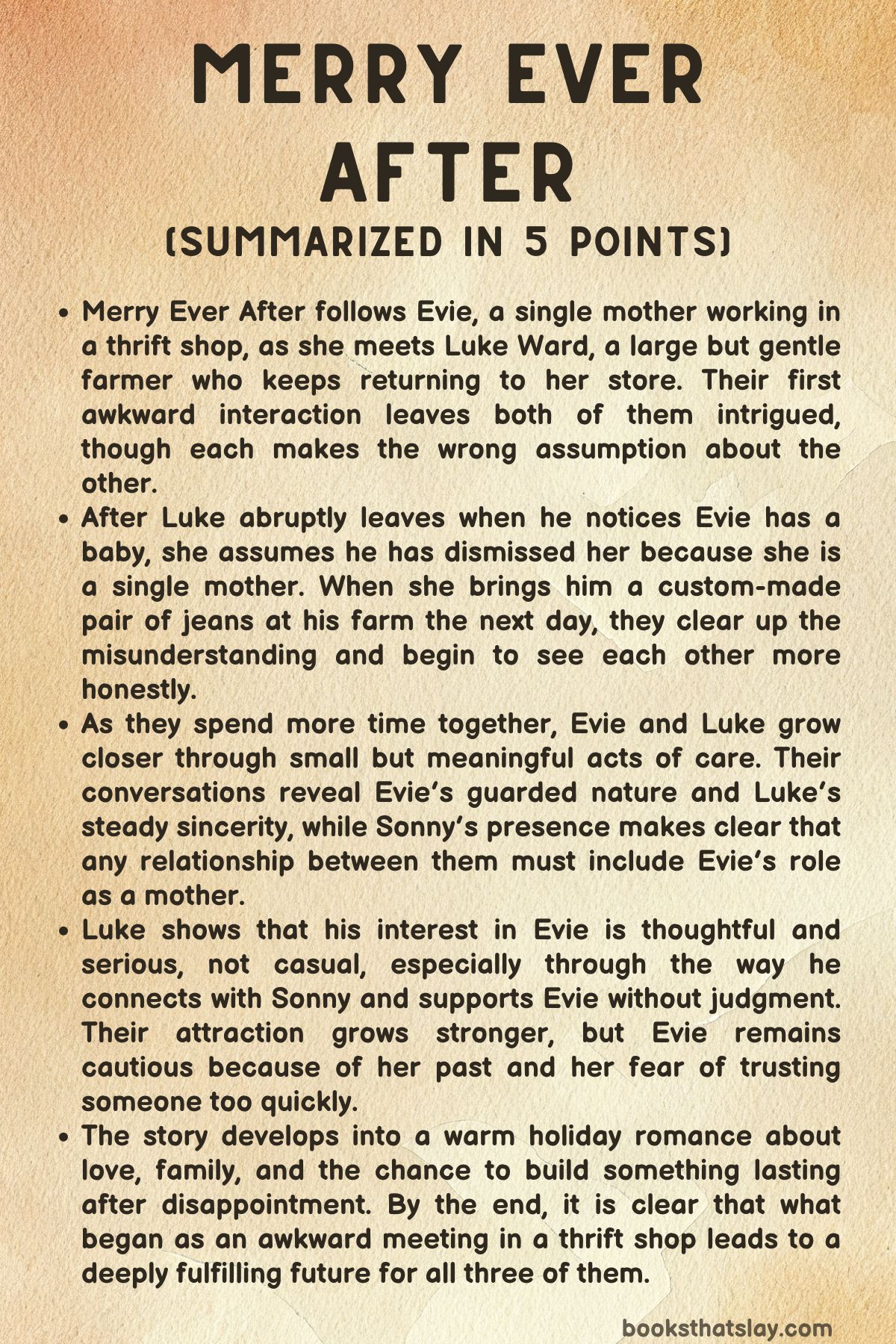
The story begins with Evie working in a thrift shop in a small Texas town while raising her baby son, Sonny. Her life is built around survival, routine, and responsibility.
She does not have much room for mistakes, and she has trained herself not to expect very much from love. Among the store’s regular visitors is Luke Ward, a huge farmer whose size makes it nearly impossible for him to find secondhand jeans that fit.
He keeps returning to the shop anyway, partly because he needs clothes and partly because he is drawn to Evie. On one visit, while trying on a pair of jeans, he accidentally rips them.
Instead of brushing it off, he insists on paying for them, showing Evie that beneath his rough exterior he is considerate and almost painfully polite.
Evie notices Luke’s gentleness right away. Though his appearance is imposing, his behavior is cautious, respectful, and shy.
There is obvious attraction between them, but Evie keeps it at a distance in her own mind. As a single mother trying to rebuild her life, she believes romance is risky and unreliable.
Still, something about Luke unsettles her in a way she cannot ignore. When he prepares to leave, she makes an impulsive offer to sew him a custom pair of jeans herself.
The gesture is practical, but it also creates a personal link between them. Their exchange grows warmer and more natural, and Luke finally asks her name.
That moment opens a small door between them, but it abruptly closes when Sonny begins crying in the back of the shop. Luke realizes Evie has a baby and leaves quickly.
Evie interprets his sudden exit as judgment. She assumes he has seen her life, decided it is too complicated, and walked away.
Hurt and angry, she decides she will still make the jeans, partly out of pride and partly because she wants to prove she does not need anyone’s approval.
The following morning, Evie arrives at Luke’s farm carrying Sonny and the finished jeans. Luke is completely caught off guard.
He spent the night convinced Evie must already belong to someone and feeling guilty for wanting her. Her appearance at his home forces both of them to confront the misunderstanding.
Evie tells him directly that she came because she refuses to be dismissed or underestimated for being a single mother. Luke quickly explains that he never looked down on her or Sonny.
He only assumed she was with someone else and felt he had no right to interfere. This honesty clears the tension between them almost immediately.
Luke invites her inside so he can try on the jeans. Because Evie’s boots have caused painful blisters, he notices her discomfort and gently takes care of her feet, cleaning and bandaging them.
The act is intimate without being possessive, and it shifts the mood between them. Their conversation becomes easier and more revealing.
Evie talks about what brought her to town in the first place: a happy childhood memory tied to a giant ant statue and a road trip with her mother. Her reasons are unusual and personal, and Luke becomes even more fascinated by her.
He begins to see that she is imaginative, stubborn, and carrying far more than she lets on.
As they spend time together, the attraction becomes more intense. Evie tries to frame any future possibility in limited terms.
If she ever became involved with someone, she says, it would have to be casual. She wants something temporary, something she can control, because commitment has already failed her once before.
Luke reacts strongly to that idea. He makes it clear that he is not interested in being treated as some brief convenience.
His feelings are already serious, even if he barely knows how to express them. When he puts on the jeans and they fit, the moment becomes charged with desire.
They kiss, and the chemistry between them becomes undeniable.
Their growing intimacy is interrupted by Sonny’s crying, which immediately draws Evie back to the reality of her responsibilities. Her child must always come first.
Luke’s response matters deeply: he tells her without hesitation that she and Sonny come together. He does not see Sonny as a burden or an obstacle.
For Evie, that changes everything. It is not just attraction anymore; it is the first sign that Luke might actually understand the shape of her life.
Because her feet are injured, Luke drives her back to town. As she leaves him, Evie realizes that although he threatens the guarded balance she has built, he may not be the kind of risk that ends in disappointment.
On Christmas Eve, Luke takes another step toward her by bringing a bicycle to her apartment above the thrift shop. It has a baby seat attached to the back, making it both thoughtful and useful.
The gift shows how closely he has paid attention to her daily life. Evie is touched by the care behind it, even if she does not fully know how to respond.
She invites him in for dinner, and the evening becomes one of the most important parts of their relationship. Luke holds Sonny with complete ease, and Evie sees how naturally he fits into the space of her home.
He is comfortable, capable, and unafraid. His confidence with Sonny comes from years of helping raise his younger siblings, and that experience makes him feel even more real and dependable to her.
During dinner, they speak more openly than before. Evie shares the painful story of Sonny’s father, who abandoned her when she became pregnant.
She explains how determined she is to be a force of goodness and safety in her son’s life. Luke does not respond with pity.
Instead, he answers with admiration and warmth, treating her choices as signs of strength. The more time he spends in her apartment, caring for Sonny and sitting at her table, the more he seems to belong there.
What started as attraction now begins to look like the outline of a home.
Later that night, after Luke puts Sonny to bed, he and Evie finally sleep together. Evie had hoped their physical connection might release some of the tension without changing anything larger, but the experience only makes her feel more exposed.
Luke is not distant or casual afterward. Everything he says and does makes it clear that he wants something lasting.
He does not pressure her, though. Instead, he promises that he will wait for her to come to him.
He knows she is frightened, and he refuses to turn that fear into a reason to rush her. He wants more than a single night, but he is willing to let her set the pace.
A week passes with no word from Evie. Luke becomes miserable, convinced that he moved too fast and scared her away by speaking too openly about his feelings.
On New Year’s Day, he is lost in regret and uncertainty, replaying everything in his mind. Then Evie appears at his farm on the bicycle he gave her, with Sonny in the baby seat.
She has brought Luke a handmade baby sling designed to fit his large frame. The gift is meaningful because it shows trust.
She is not only accepting Luke’s place in her own life; she is giving him a place in Sonny’s life too.
Luke is overwhelmed by what the sling represents. He places Sonny inside it and kisses Evie, assuring her that she and Sonny belong at his home whenever they want to be there, even for good.
Evie finally admits that the idea of forever became less frightening during the time she spent away from him. Distance did not weaken what she felt.
Instead, it made her realize that Luke offered the kind of steady love she had stopped believing in. Together, the three of them walk into the house hand in hand, no longer circling the possibility of a future but stepping directly into it.
The epilogue jumps ahead seven years and shows the full result of that choice. Evie and Luke are married and have built a happy family.
Sonny is older and helps on the farm, and they also have a daughter named June. Evie has turned her skill with upcycled clothing into a successful business, and Luke supported that dream fully, even buying the thrift shop for her as a wedding gift.
Their home is loving, secure, and full of mutual pride. Evie reflects on the strange path that brought her to that town and to Luke.
What once seemed like a random stop in life became the beginning of everything she now treasures: a partner who never flinched from her reality, children growing up surrounded by care, and a future stronger than anything she once dared to expect.
Characters
Evie
Evie is written as a woman trying to hold together dignity, independence, and vulnerability at the same time. She is raising Sonny alone, working at a thrift shop, and building a life that depends on discipline rather than hope.
That background shapes nearly every choice she makes. She is not cynical in a loud or bitter way, but she has clearly trained herself to expect disappointment, especially from men and from anything that looks too close to emotional dependence.
Because of that, she often frames her desires in practical terms. She tells herself that if she wants anything with Luke, it should be temporary and physical, because that feels safer than admitting she wants care, stability, and partnership.
Her emotional guardedness is one of her defining traits, not because she lacks feeling, but because she feels so deeply that she has become protective of her inner life.
At the same time, Evie is not passive or defeated. She has pride, initiative, and a sharp instinct for self-protection.
When she thinks Luke has judged her for being a single mother, she does not collapse into self-pity. Instead, she channels her hurt into action by making the jeans and bringing them to his farm herself.
That gesture reveals a lot about her character. She wants to be seen accurately, and she refuses to let someone else’s possible assumptions define her worth.
She is determined to prove that motherhood has not reduced her identity or capability. This makes her a particularly strong romantic heroine, because her strength is rooted in lived responsibility rather than swagger.
She is practical, hardworking, and creative, and these qualities later grow into a successful business, showing that her talent and ambition were always present.
Evie is also deeply loving, though her love is filtered through caution. Sonny is clearly the center of her life, and every emotional risk she takes is measured against his needs.
That does not make her cold; it makes her careful. She understands that romance is not just about her own heart anymore.
Anyone she lets close must also be safe for her child. This is why Luke’s response to Sonny matters so much.
Evie is not waiting for someone to rescue her. She is waiting, even if unconsciously, for proof that love will not ask her to divide herself.
Her journey is therefore less about learning to love and more about learning to trust that love does not have to threaten what she has built. By the end, her happiness feels earned because she has not abandoned her caution blindly.
She has allowed herself to believe in permanence only after seeing that Luke’s devotion is consistent, practical, and wide enough to include both her and her son.
Luke Ward
Luke is introduced through a contrast between appearance and nature. He is physically huge, rough around the edges, and initially intimidating, but the book quickly reveals that his essential qualities are gentleness, awkward sincerity, and emotional seriousness.
He is shy rather than slick, and this matters because it keeps him from feeling like a conventional romantic hero who knows exactly how to charm his way into a woman’s life. Instead, he seems almost overwhelmed by the depth of his own feelings.
He keeps returning to the thrift shop under the simple pretense of needing jeans, which suggests that his attraction to Evie begins in quiet longing rather than bold pursuit. He is a man who feels deeply and means what he says, even when saying it leaves him exposed.
One of Luke’s strongest traits is the speed with which he understands emotional responsibility. While Evie tries to keep things defined as casual, Luke cannot reduce his feelings into something convenient.
He is not interested in being a temporary escape, and his refusal to accept that role reveals his integrity. He does not manipulate Evie, pressure her, or play games with ambiguity.
Instead, he speaks with a kind of blunt honesty that comes from knowing his own mind. That honesty becomes especially powerful in his response to Sonny.
Rather than treating the child as an obstacle or a complication, he immediately makes it clear that mother and son belong together in his eyes. This moment defines him better than any romantic declaration could.
He is not merely attracted to Evie; he is already imagining what it means to care for the full reality of her life.
Luke’s tenderness is repeatedly expressed through action. He helps bandage Evie’s feet, notices practical things she needs, buys her a bicycle with a baby seat, holds Sonny comfortably, and later treasures the baby sling she makes for him.
These actions show that his love is observant and useful. He does not perform grand emotion in abstract language alone; he pays attention to daily life.
The gift choices in particular suggest a man who expresses devotion by making someone’s world easier and more secure. His background helping to raise younger siblings also explains why he steps naturally into domestic and caretaking spaces.
He is not frightened by dependence, noise, or family responsibility. In fact, these seem to bring out his best qualities.
At a deeper level, Luke represents emotional certainty. He falls hard, accepts it, and remains steady even when Evie pulls away.
His misery during the week she disappears reveals that he is vulnerable, but not weak. He doubts himself, worries that he has frightened her, and suffers in her absence, yet he does not try to force a resolution.
He waits. That patience shows maturity.
By the epilogue, his devotion has translated into a life built through commitment, work, and generosity. He is proud of Evie’s success, devoted to their children, and fully rooted in the family they made together.
His role in the story is not just that of a romantic partner, but of a man whose steadiness creates the emotional safety Evie has been missing.
Sonny
Though Sonny is still a baby for most of the main story, he is one of the most important presences in the narrative because he shapes both the emotional stakes and the moral test of the romance. He is not written as a background prop placed in the story only to make Evie seem sympathetic.
Instead, he is central to how both leads reveal themselves. Every important turn in the relationship passes through him in some way.
His crying interrupts the couple’s first charged moment. His existence is the reason Evie hesitates to trust.
Luke’s treatment of him becomes the clearest evidence of Luke’s character. Sonny therefore functions as an emotional truth-teller.
Around him, neither adult can pretend. Evie must show how protective she is, and Luke must show whether his care is genuine or superficial.
Sonny also represents Evie’s deepest sense of purpose. Through him, the story makes clear that her life is no longer organized around romance, fantasy, or self-discovery alone.
She wants to be a source of goodness and safety for her child, and that desire gives her choices seriousness. Because of Sonny, love has consequences.
This makes the eventual relationship more meaningful, because Luke does not merely win Evie’s affection; he earns a place in the structure of her life as a mother. Sonny is therefore part of the story’s emotional measure of trust.
When Evie gives Luke the handmade sling designed for his body, she is not just offering a sweet gift. She is symbolically inviting him into the role of caregiver.
Sonny is at the center of that gesture.
In the epilogue, Sonny’s growth into a child old enough to help on the farm confirms that the family bond endured over time. He is no longer simply the baby who prompted difficult choices; he has become part of a stable, loving household.
His presence in that future gives the ending weight because it shows that the promises made early in the relationship were fulfilled in practice. Luke did not simply accept Sonny in theory.
He helped raise him.
June
June appears only in the epilogue, but she has an important symbolic role. She represents the future that Evie once believed would be too risky to imagine.
Her presence shows that the life built by Evie and Luke did not stop at survival or romantic union. It expanded into a fuller family shaped by security, affection, and permanence.
Because the main body of the story is so focused on whether Evie can trust love without losing herself or jeopardizing Sonny’s wellbeing, June becomes evidence that trust led not to damage, but to abundance.
She also helps define the emotional atmosphere of the ending. A daughter growing up alongside Sonny on the farm suggests that the household is not just functional, but warm and settled.
June’s role is small in direct narrative terms, yet meaningful in thematic terms. She stands for continuity, renewal, and the ordinary happiness that the earlier version of Evie may have thought was unavailable to her.
Through June, the epilogue confirms that the couple’s bond did not fade after the first rush of attraction. It became the foundation for a larger family life.
Sonny’s Father
Though he never appears directly in the events, Sonny’s father remains important as a shaping force in Evie’s emotional life. His abandonment during pregnancy explains much of Evie’s reluctance to trust romance or believe in lasting commitment.
He is less a developed character than a shadow cast over the beginning of the story, but that shadow matters because it helps define what Evie fears most: not simply heartbreak, but being left to carry love’s consequences alone. His absence has taught her that desire can quickly become instability, and that lesson is one she carries into her connection with Luke.
What makes this figure effective is precisely that he is not given much space or redemption. He exists in the story mainly as evidence of a past wound and a failed standard of responsibility.
Luke’s behavior gains force because it stands in direct contrast to this unseen man. Where the father left, Luke stays.
Where the father abandoned responsibility, Luke welcomes it. Where the earlier relationship produced pain and caution, the new one offers steadiness and inclusion.
Even as an offstage figure, Sonny’s father helps define the emotional difference between Evie’s past and future.
Evie’s Mother
Evie’s mother is only mentioned briefly through the childhood memory of a road trip and the giant ant statue, yet that memory gives her subtle significance. She seems to be tied to one of the warm formative experiences that brought Evie to this town in the first place.
In that sense, she is connected to nostalgia, movement, and the older emotional landscape from which Evie’s adult life grew. The memory suggests that Evie carries traces of wonder and sentiment beneath her guarded exterior.
She did not emerge as a cautious, self-contained person without having once believed in adventure and meaningful moments.
This small reference also gives Evie a deeper emotional history. It reminds the reader that her identity is not defined only by hardship, single motherhood, or romantic disappointment.
She has a past filled with remembered feeling, and that past quietly influences her choices. The town itself is linked to maternal memory, which gives extra resonance to the fact that Evie ends up building her own family there.
Her mother’s role may be brief, but she helps create a sense of emotional continuity between Evie’s past as a daughter and her present as a mother.
Themes
Love as Safety Rather Than Risk
What gives the central relationship its emotional force is the way love is presented not as excitement alone, but as a form of safety that gradually replaces fear. Evie does not enter this connection from a place of openness.
She has already been abandoned once, and that experience has shaped the rules by which she now lives. She believes survival depends on restraint, caution, and emotional distance.
For her, attraction can be tolerated only if it remains temporary and controlled. She tries to define any possible involvement in physical terms because that feels easier to manage than hope.
Hope carries the danger of disappointment, and disappointment is something she cannot afford when a child depends on her. This is why the relationship matters beyond romance.
It becomes a test of whether affection can exist without instability.
Luke changes that equation because he never treats Evie’s vulnerability as a weakness to be exploited. He does not mock her caution, nor does he try to force instant trust.
Instead, he responds with steadiness. His care for her blistered feet, his thoughtful gift of the bicycle, and his calm comfort with Sonny all show that his feelings are expressed through reliability.
He does not simply desire Evie; he creates an environment in which she can begin to feel protected. That distinction is important.
The emotional turning point is not only physical intimacy, but the realization that being wanted by him does not place her in danger. His presence starts to feel like shelter rather than disruption.
The story also makes clear that love becomes believable when it proves itself through patience. Luke wants a future almost immediately, yet he does not punish Evie when she hesitates.
He tells her he will wait for her to come to him, which turns love into an act of respect instead of possession. That patience is what allows Evie to reconsider her fear of permanence.
By the time she returns to him after their separation, the idea of forever no longer seems like a trap. It seems like peace.
In that sense, the relationship argues that real love is not measured by intensity alone, but by the ability to make another person feel emotionally secure enough to imagine a future again.
Motherhood and the Refusal to Be Reduced
Motherhood shapes nearly every choice Evie makes, and one of the strongest ideas in the story is that being a single mother does not make her lesser, damaged, or undesirable. From the beginning, she is carrying the weight of practical responsibility while also carrying the social judgment that often attaches itself to women in her position.
She assumes that once Luke sees Sonny, his interest will disappear. That assumption reveals how deeply she has internalized the expectation that motherhood changes how others value her.
She has learned to brace for rejection before it even arrives. Her hurt reaction is not only about Luke leaving in the moment; it comes from a larger history in which she has had to defend both her dignity and her worth.
What makes this theme powerful is that the narrative never separates Evie’s identity as a woman from her identity as a mother. Sonny is not presented as an obstacle to romance or as a complication that must be managed out of sight.
He is central to the life she is building. Evie’s first loyalty belongs to him, and the story respects that without turning her into someone who exists only through sacrifice.
She is protective, hardworking, and determined, but she is also attractive, funny, and emotionally complex. Her motherhood adds to her character rather than limiting it.
This matters because it rejects a shallow romantic framework in which a woman must become less burdened to become lovable.
Luke’s response strengthens this theme because he understands immediately that Evie and Sonny are inseparable. His statement that they are a package deal is not framed as reluctant acceptance.
It is direct and wholehearted. He does not speak as though he is nobly tolerating a difficult reality.
He is simply telling the truth of what he wants. That difference changes the emotional landscape for Evie.
She is no longer being asked to divide herself into acceptable and inconvenient parts. She can be fully seen.
The later gift of the baby sling makes this even clearer, because her trust in him grows enough that she imagines him physically carrying her son. That gesture symbolizes more than affection.
It reflects her belief that he can share responsibility, not merely share pleasure.
By the end, motherhood is not something that kept Evie from happiness. It is part of the very path that led her there.
The family she builds does not erase her earlier struggles, but it proves that those struggles never reduced her value in the first place.
Home as Something Built Through Care
Another major concern in the story is the meaning of home. Home is not treated as a fixed place that one simply inherits.
It is something created through care, trust, labor, and emotional acceptance. At first, both main characters have fragments of home rather than its full reality.
Evie has made a functioning life for herself above the thrift shop, but it is still marked by fragility. It is a place of effort and endurance more than ease.
She is keeping life together through determination, yet there is a sense that everything depends on her constant vigilance. Luke, by contrast, has the stable physical setting of the farm, but stability alone does not equal emotional fullness.
His world has structure, space, and usefulness, yet it lacks the intimate connection that would make it feel complete.
Their growing relationship gradually transforms these separate spaces into the beginnings of a shared home. This happens through domestic details rather than grand declarations.
Luke enters Evie’s apartment, eats dinner with her, holds Sonny, and moves through her small household with a natural ease that surprises her. These scenes matter because they show how belonging begins.
He does not arrive like a visitor waiting to be impressed. He participates.
Likewise, when Evie comes to his farm, the setting becomes more than land and labor. It becomes a place where she can imagine herself and her child being welcomed, not merely accommodated.
The emotional function of these spaces changes as their trust deepens.
Gifts in the story also reinforce this theme. The bicycle with the baby seat is not luxurious in a flashy way.
Its value lies in usefulness and attention. It says that Luke has noticed the shape of Evie’s daily life and wants to make it easier.
Her return gift, the custom baby sling for his large body, carries the same meaning. It is not just affectionate; it imagines him in the routines of care.
These exchanges show that home is built when people start shaping their lives around each other’s needs.
The epilogue completes this idea by showing the long-term result: the farm, the children, the thriving business, and the continued partnership all form a home made jointly rather than stumbled into by luck. The lasting satisfaction of the ending comes from the fact that this home was not handed to them whole.
It was assembled through steady acts of love, work, and mutual trust.
Seeing Beyond Appearances and First Assumptions
Much of the emotional movement in the story depends on mistaken impressions and the gradual correction of those impressions. This creates a larger theme about the danger of judging lives too quickly, whether by outward appearance, social role, or a single moment of misunderstanding.
Luke’s physical presence makes him easy to misread. He is enormous, rough-looking, and connected to farm labor, so at first glance he could be taken for someone blunt or intimidating.
Yet he is deeply shy, considerate, and emotionally serious. His gentleness is not visible on the surface; it has to be discovered through behavior.
The story uses that contrast to show how outward signs often conceal the truth of a person’s character.
Evie is also misread, though in a different way. To an outsider, she might look like a struggling young mother working in a small thrift shop and simply trying to get by.
What the story reveals instead is her creativity, discipline, resilience, and emotional intelligence. Her skill in making clothes, her determination to stand on her own feet, and her refusal to let hardship define her all challenge any simplistic reading of her circumstances.
She is not a figure to be pitied. She is someone rebuilding a life with enormous strength.
Luke sees that quickly, which is one reason his affection feels substantial rather than shallow.
The early misunderstanding around Sonny brings this theme into focus. Evie assumes Luke left because he judged her for having a child.
Luke assumes Evie must already belong to someone else. Neither assumption is malicious, but both reveal how people often fill gaps in knowledge with fear.
The issue is not just poor communication. It is the habit of expecting rejection, disapproval, or unavailability because those expectations feel safer than uncertainty.
Once the misunderstanding is cleared, their relationship can move forward because both begin responding to reality rather than projection.
This theme continues throughout the story in the contrast between casual language and serious feeling. Evie tries to frame the relationship as temporary, but Luke sees more clearly what is developing between them.
His refusal to accept being treated as a passing distraction is another rejection of false appearances. He understands that what exists between them cannot honestly be reduced to convenience.
By the end, the entire arc depends on the movement from assumption to recognition. People are not what they first seem, and happiness becomes possible only when both characters allow themselves to see and be seen clearly.