Never Keep Summary, Characters and Themes
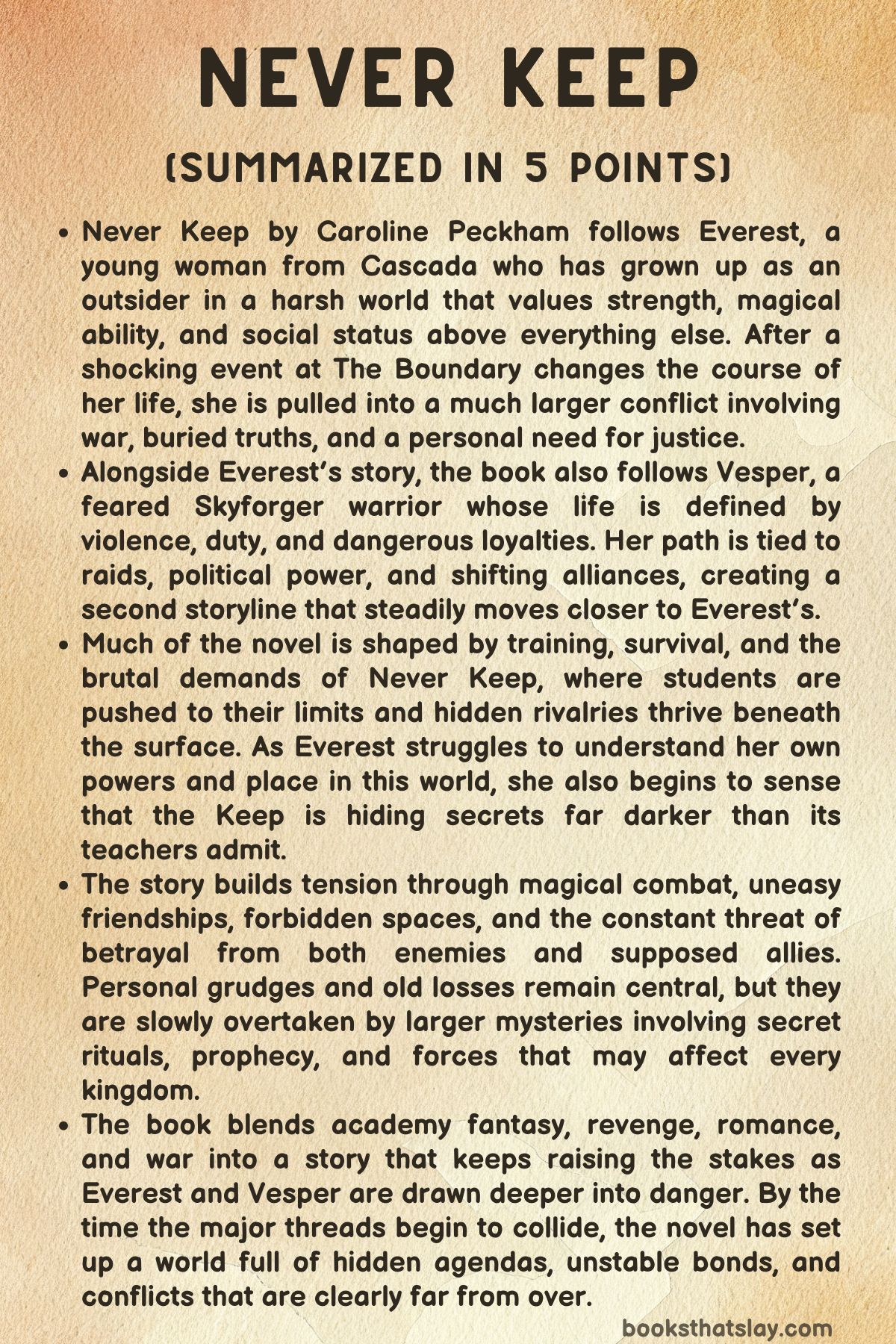
Never Keep by Caroline Peckham and Susanne Valenti is a fantasy novel built around war, revenge, hidden power, and dangerous loyalties. Its story moves between brutal kingdoms shaped by elemental magic, where young fighters are trained to survive in a world that rewards strength and punishes weakness.
At the center are two young women marked by pain, ambition, and secrets larger than they understand. As the novel unfolds, battles between nations mix with personal vendettas, forbidden bonds, buried truths, and ancient forces that have been hidden for far too long. The result is a story driven by conflict, shifting identity, and the steady uncovering of a much darker design beneath the surface. It’s the first book of the Sins of the Zodiac series, set in the same universe as Zodiac Academy.
Summary
The story begins with Everest, a mistreated young woman living in the water kingdom of Cascada. She has grown up as an outcast, mocked and abused by her half-brother Ransom and dismissed by her powerful father because she has not yet Awakened or Emerged into an Order form.
Even so, she dreams of proving herself worthy of Never Keep and becoming a warrior. One night, while being hunted by Ransom and his friends, she is driven to The Boundary, the magical barrier said to kill anyone who touches it.
During the confrontation, Ransom destroys the everflame her mother gave her and then shoves her into the barrier, expecting her to die. Instead, Everest passes through unharmed and tumbles into the Crux, a frozen wasteland beyond the border.
There, she sees a sky island descending over Castelorain as the Skyforgers launch an attack.
The narrative also follows Vesper, a feared Skyforger known as the Sky Witch. Serving Prince Dragor, she joins Dalia and Moraine in an assault on Castelorain.
Vesper is ruthless, powerful, and highly skilled in blood magic and Ether. During the strike on The Forge, she and her companions cut through defenders and descend into its lower levels, where they discover Ford, a Basilisk shifter who has been kept alive and tortured for his venom.
Their mission becomes more complicated when Cayde Avior appears, having also been sent by Dragor. Though Vesper dislikes his interference, they are forced to work together.
As they attempt to escape, masked enemies appear. At first Vesper assumes they are Raincarvers, but she soon realizes they are Flamebringers.
An explosive device is thrown into the corridor, and Cayde partially shifts into his Drake form to shield her from the blast, saving her life.
At the same time, Everest climbs out of the Crux after surviving an attack by a monstrous half-metal creature. Using the dead beast’s claws as climbing tools, she reaches the top and discovers that The Boundary can be crossed safely from either side.
The old terror surrounding it was a lie. She runs back into town and meets her friend Harlon, who tells her that the Sky Witch is heading toward The Forge, where Everest’s mother is working.
Everest rushes there, only to arrive as two disguised Flamebringers ignite stores of Basilisk venom. The resulting explosion is catastrophic.
Her mother throws herself over Everest and seals them in ice to save her, taking the full force of the blast herself. Before dying, she tells Everest to find those responsible and never rest until they pay.
Harlon rescues Everest from the wreckage, but the loss transforms her grief into a fixed and furious need for revenge.
After Vesper escapes with Ford, she returns to the Skyforger stronghold and faces Prince Dragor. Moraine has been injured, and Vesper admits she broke protocol in order to save her.
Dragor makes it clear that Ford mattered more than Moraine and warns Vesper not to rely on beauty or Succubus gifts. Their tense exchange is interrupted when Stonebreakers attack Ironwraith with harpoons.
Vesper joins the defense and realizes the enemy is pulling the sky island toward an ambush. She reaches Dragor and warns him, and he orders Ironwraith brought down where it stands rather than dragged deeper into danger.
After the crash, he leads forces into the wilds to fight the monstrous creatures there, while Vesper remains bound to his service and influence.
Meanwhile, Everest spots the two Flamebringers fleeing the ruined town and recognizes one as her mother’s killer. With Harlon’s help, she arms herself and pursues them.
They catch up near The Boundary as chaos unfolds overhead and Ironwraith is dragged from the sky. Harlon fights one of the masked men while Everest attacks the other with her mother’s sword, but her enemy easily blocks and outmatches her.
The struggle is interrupted by the larger conflict as the Skyforgers tear away a piece of land from Cascada. Everest and Harlon barely escape through her father’s water magic, but when she returns to him and tells him what happened, he strikes her, blames her for her mother’s death, and declares her worthless.
Humbled and furious, Everest clings even harder to the vow that she will someday take her mother’s killer’s heart.
Time passes. Everest spends months training in secret beyond The Boundary, hardening herself and forging a special dagger for the man she intends to kill.
She and Harlon prepare to leave for Never Keep, where new acolytes are sent to be trained. Their friendship hints at deeper feeling, but both remain focused on survival and the future.
Everest carries her grief, her rage, and her mother’s final words with her as she enters this next stage of life.
At Never Keep, Everest and the strange companion Galomp enter a hidden tunnel after a mysterious gate opens on its own. Following a scream, they witness a horrifying secret ritual beneath the Keep.
Reapers in gold cloaks gather around a glass altar where a supposedly dead Stonebreaker lies carved with runes and bleeding. A dark force gathers above him as they chant.
Galomp pulls Everest away before they are discovered, and with the help of a glowing blue lizard, they escape back into the Keep. But when Everest later tries to tell others what she saw, she is mocked and attacked in the courtyard.
During this assault, her Order finally Emerges, and she transforms into a white, spotted leopard-like beast. The form shocks everyone, especially Everest, who still does not understand what kind of creature she truly is.
Life at Never Keep grows harsher. Another thread of the story follows Vesper during an intense period of training with Dalia and Moraine as the three learn to strengthen their magic and master aerial combat.
Vesper improves her air magic, learns to fly, and continues struggling with illusion magic because of an injured left hand. She remains haunted by the ritual chamber and by students who have vanished or died under suspicious circumstances.
Her relationship with Cayde becomes increasingly charged, especially as her ties to Prince Dragor grow more painful. When she learns Dragor will marry the Collingsdale heir, she is devastated.
Cayde later finds her, confesses jealousy, and the two nearly begin a relationship, though he ultimately stops because her life is still bound to Dragor.
Everest, still focused on revenge, overhears news of Kaiser Brimtheon, the man she believes killed her mother. She infiltrates a masked party to get close to him and tries to stab him in private, but he already knows who she is.
He overpowers her, and during the struggle a strange force seems to pass from her into him. He throws her from a window, but she escapes in leopard form.
This failed attempt deepens the danger around her and hints that her powers are stranger than simple vengeance or shapeshifting.
Everything escalates when Vampires attack Never Keep. In the explosion that tears through the Heliacal Courtyard, Vesper, Everest, Dalia, Moraine, and Cayde are thrown together.
They fight side by side, and in a desperate moment Vesper unexpectedly merges her power with Everest’s to reinforce a failing shield. The group flees through hidden Reaper passages and reaches the archway chamber Vesper discovered earlier, where portals to distant lands can be opened with special glittering grit.
While trying to use one of the gateways to reach Harlon, they are pursued by Vampires. Vesper sends Everest through a portal and stays behind to fight.
Everest arrives in a silver cavern where she finds Harlon chained with other acolytes beneath a dark entity feeding on them. A Reaper captures and whips her, calling the force above them the Void, but Everest unleashes a mysterious power that destroys his control.
Kaiser arrives, kills the Reaper, and declares that Everest herself carries the true power of the Void, a weapon tied to prophecy. He then binds her to him with Nightfire, making her his Fearsire so that she belongs to him, cannot kill him, and must obey his possession.
He forces her away from Harlon despite her desperate resistance.
Back in the archway chamber, Vesper and the others manage to kill most of the Vampires, but the victory becomes a disaster. Cayde betrays them, murders Moraine and Dalia, and reveals that he is actually a Stonebreaker agent named Dragor who used Vesper’s longing and trust to gain access to the portals.
Destroyed by grief and betrayal, Vesper fights him and finally throws herself through an archway, carrying only her need for vengeance into whatever comes next.
Characters
Everest
Everest stands at the emotional center of the story as a girl shaped by rejection, grief, fury, and stubborn endurance. At the beginning, she is an outsider in her own homeland, looked down on for being un-Awakened and treated as lesser by her father and half-brother.
That early position defines much of her character: she is never allowed comfort, so she learns to survive through willpower. Even before she gains greater abilities, she is already marked by nerve, adaptability, and refusal to break.
Her passage through The Boundary is the clearest early sign that she does not fit within the rules others accept. What should kill her instead reveals that she is tied to truths hidden from everyone else.
That makes her not only unusual, but threatening to the lies that structure her world.
Her mother’s death hardens what was once youthful determination into obsession. From that point onward, Everest is driven by vengeance with almost religious intensity.
She does not simply mourn; she turns grief into purpose, shaping her body, magic, and choices around the eventual killing of the Flamebringer responsible. This gives her great force, but it also narrows her vision.
Again and again, she rushes toward danger because revenge matters more to her than caution, which makes her brave but also easy to manipulate. Her enemies can predict her because they understand that her pain governs her.
Even so, the story does not reduce her to rage alone. Her loyalty to Harlon, attachment to her mother’s memory, and instinctive concern for hidden truths beneath Never Keep show that her anger comes from deep feeling rather than emptiness.
At Never Keep, Everest becomes even more complex. She is no longer just the wronged daughter seeking justice; she is someone confronted with mysteries about her Order, her strange dark power, and her possible place in prophecy.
Her emergence into a leopard-like form reflects her own uncertainty: she finally becomes more powerful, yet does not understand what she is. That confusion mirrors her larger condition throughout the story.
She is always discovering that the world is broader, darker, and more deceptive than she believed. Her encounters with the Reapers, Kaiser, and the Void push her from a revenge story into something much larger, where her body and soul become contested ground.
By the end, Everest remains fierce and defiant, but she is also deeply trapped, burdened by grief, prophecy, coercion, and the fear that her own power may connect her to something monstrous.
Vesper
Vesper is introduced as a feared Skyforger warrior, and at first she appears almost like Everest’s opposite: disciplined where Everest is impulsive, ruthless where Everest is raw, already powerful where Everest is only beginning. She is defined by skill, composure, and an ability to function inside violence without hesitation.
Blood magic, Ether, air combat, and battlefield leadership all mark her as someone who has been shaped into a weapon. Yet from the beginning, her toughness is not simple strength.
It is the product of a brutal world that rewards control and punishes vulnerability. She has learned to survive by becoming dangerous before anyone can use weakness against her.
Her relationship with power is one of the most interesting parts of her character. She serves Prince Dragor with a devotion that mixes fear, ambition, desire, and emotional dependency.
She wants his approval and responds intensely to his attention, but their bond is never safe or equal. He treats her as useful, desirable, and disposable all at once, which leaves her constantly performing strength while inwardly craving security.
This tension gives Vesper much of her emotional depth. She is not merely a cold killer; she is someone caught in a system where affection, authority, and possession are blurred together.
Her sharp reactions to Cayde also come from this unstable emotional ground. She resents him, depends on him at moments, desires him in complicated ways, and later is utterly destroyed by his betrayal.
What humanizes Vesper most is her loyalty to Dalia and Moraine. She may be savage in battle, but she repeatedly risks herself for them, even when it means angering Dragor or compromising missions.
Those choices show that beneath her harsh exterior, she still values personal bonds more than the ideology of perfect obedience. Her compassion does not appear in tender speeches; it appears in action, sacrifice, and instinct.
That is why the deaths of Moraine and Dalia are so devastating. Their loss strips away the remaining structure holding her together.
By the time she is betrayed and hurled into grief, Vesper has been transformed from a formidable soldier into a tragic figure driven by heartbreak and vengeance. She becomes one of the clearest examples of how war consumes identity, turning love, loyalty, and longing into wounds that can never fully close.
Harlon
Harlon functions as one of the story’s strongest moral anchors. In a world full of cruelty, ambition, and betrayal, he consistently offers Everest loyalty without condescension.
He sees her clearly even when others dismiss her, and he never treats her as weak simply because she has less status or less recognized power. From the earliest moments, he is the person who responds to her pain with action.
He helps her during battle, steadies her after her mother’s death, encourages her to stand firm, and joins her in dangerous pursuits even when her choices are reckless. His support gives Everest emotional continuity at moments when she might otherwise collapse completely.
What makes Harlon more than a simple loyal friend is the way his care coexists with strength and intelligence. He is not passive, gentle background comfort; he is a capable warrior with judgment, courage, and his own presence in battle.
When Everest falls into revenge-fueled tunnel vision, he often serves as the practical voice trying to keep her alive without diminishing the seriousness of her pain. He understands her urges because he respects the force of her grief, but he still tries to ground her in strategy.
That balance makes him emotionally mature compared with many of the other characters, whose relationships are driven by power struggles or hidden motives.
There are also clear hints of deeper feeling between him and Everest, and those hints matter because they remain restrained. Their connection is shaped by trust built over time, shared danger, and mutual understanding rather than dramatic declaration.
That restraint gives Harlon’s character quiet depth. He does not push himself into Everest’s wounds or demand that his care be recognized romantically.
Instead, he simply remains present. This makes his later capture especially painful, because he is not only important to Everest’s survival but central to her emotional world.
His imprisonment places him in the position of the endangered beloved figure, yet he never feels helpless in a weakly written way. Even bound and suffering, he still tries to protect Everest by urging her to run.
That final detail preserves his dignity and courage.
Cayde
Cayde is initially written as a disruptive and magnetic figure, someone who repeatedly enters moments of danger and changes their outcome. He saves Vesper more than once, irritates her constantly, and carries the kind of charm that makes him difficult to dismiss even when he is unwelcome.
His presence introduces instability because he never feels fully readable. He is useful, attractive, and capable, but also intrusive and vaguely threatening.
That uncertainty is what gives him narrative force. Characters and readers alike are never allowed to settle into a fixed understanding of him.
His dynamic with Vesper is especially layered. On the surface, he is the man who gets under her skin, tests her defenses, and exposes emotional vulnerability she would rather deny.
Their chemistry is sharpened by conflict, jealousy, rescue, and competition. He becomes important precisely because he breaches the guarded emotional structure she has built around herself.
When he seems to want her fully and differently than Dragor does, he offers the possibility of a bond based on desire and personal choice rather than hierarchy. That possibility makes him dangerous in an emotional sense long before he is revealed as dangerous in a literal one.
The betrayal completely reshapes his character and shows that the earlier ambiguity was deliberate. When he murders Moraine and Dalia and reveals himself as a Stonebreaker agent named Dragor, his entire role becomes that of a manipulator who weaponized intimacy and trust for strategic gain.
What makes this twist effective is not only the violence of the reveal, but the personal cruelty attached to it. He does not merely betray a military secret; he mocks Vesper’s longing for love and proves that he understood exactly how to exploit it.
In doing so, he becomes one of the story’s most devastating villains. At the same time, the fact that he maintained the false self so convincingly suggests intelligence, patience, and emotional precision.
He is not chaotic evil; he is calculated betrayal in human form.
Dalia
Dalia is fierce, volatile, and unapologetically aggressive, bringing a dangerous energy to every scene she enters. Her use of fire, even when it is risky, reflects a personality that does not naturally submit to caution.
She seems to meet the world with attack rather than hesitation, and that trait makes her both valuable and hazardous. In battle, she is an asset because she acts decisively, but outside of battle the same intensity gives her a sharp, often ruthless edge.
She belongs fully to the harsh environment around her and is not softened for likability.
Yet Dalia is far more than a brutal fighter. Her loyalty to Vesper and Moraine gives her emotional substance.
The bond among the three women is one of the strongest group dynamics in the story, and Dalia’s place within it shows that her violence is not emptiness but commitment. She is the kind of person who will act first to defend those she considers hers.
That is seen most clearly in her final moments, when she throws herself into mortal danger after Moraine is killed. Her instinct is not self-preservation but protection, and that makes her death far more tragic than if she were merely a reckless warrior.
Dalia also contributes to the atmosphere of female solidarity that runs through Vesper’s sections. In a setting where men often dominate through hierarchy, possession, or brutality, Dalia’s presence helps create a counter-space built on chosen allegiance.
She may be harsh, competitive, and even merciless, but her connection to her companions is real. Because of that, she leaves the impression of someone who lived at full intensity and died in the same way, as a fighter whose deepest truth was loyalty.
Moraine
Moraine is the quieter part of the trio, but that does not make her less important. Her significance comes from the way she completes the emotional and tactical balance among Vesper, Dalia, and herself.
Where Dalia burns hot and Vesper carries sharp internal tension, Moraine often feels like the stabilizing presence, the companion whose value is understood most clearly when she is endangered. Her broken wing and the risk Vesper takes to save her show just how central she is to the group’s emotional structure.
Moraine is someone worth breaking protocol for, and that fact alone reveals her importance.
She is also useful for revealing Vesper’s inner life. Vesper’s willingness to endanger a mission for Moraine’s sake proves that loyalty still governs her more than pure military obedience.
Moraine becomes the person through whom Vesper’s humanity is made visible. Because of that, Moraine’s injury and eventual death are not just plot events; they are emotional pressure points exposing what Vesper values most.
The grief that follows is intensified precisely because Moraine is not treated as expendable by those around her.
Her death is one of the cruelest in the story because it destroys the sense that the trio might endure together despite the brutality around them. Moraine represents continuity, trust, and shared survival.
When she is murdered by the man Vesper trusted, that loss becomes symbolic as well as personal. It marks the collapse of fellowship and leaves Vesper isolated in the ruins of her emotional world.
Prince Dragor
Prince Dragor is a commanding and deeply unsettling figure whose authority shapes much of Vesper’s storyline. He is powerful, strategic, and completely accustomed to obedience.
His leadership is not warm or noble; it is cold, exacting, and possessive. He values results above individual suffering and makes clear that people under him exist to serve larger goals.
Even when he is impressed or attentive, there is menace inside that attention. He is the kind of ruler who can inspire devotion while also maintaining fear, which makes him especially effective within a militarized society.
His interactions with Vesper reveal his most disturbing traits. He notices her body, beauty, injuries, and choices with an intimacy that is never separate from control.
He does not simply command her as a soldier; he also exerts emotional and sexual dominance, creating a relationship in which praise, punishment, desire, and power are tightly entangled. That makes him dangerous not only politically but psychologically.
He keeps Vesper in a state of longing and uncertainty, which strengthens his hold over her.
At the same time, Dragor is not incompetent or ornamental. He reacts decisively during the Stonebreaker attack, understands strategic danger quickly, and is capable of brutal but effective choices.
This makes him more than a predatory authority figure; he is genuinely formidable. The story uses him to show how charisma and domination can coexist.
He is powerful enough to look like protection from one angle and oppression from another, which is exactly why characters can be drawn toward him even when he harms them.
Everest’s Mother
Everest’s mother occupies limited page time but enormous emotional weight. She is the source of Everest’s most sustaining early love, the giver of the everflame, and the voice behind the belief that outsiders can forge remarkable paths.
In a brutal world, she represents tenderness without weakness. Her love is practical, protective, and quietly defiant, offering Everest a way of understanding herself that resists the contempt of others.
Because Everest is otherwise surrounded by judgment, her mother’s faith becomes foundational to her identity.
Her death defines much of what follows. She does not die passively; she chooses to protect Everest in the most absolute way possible, freezing them in ice and taking the full force of the burning venom herself.
This act confirms her character in a single terrible moment. She is self-sacrificing, courageous, and entirely devoted to her daughter.
Her dying command that Everest must make the killers pay transforms maternal love into legacy. After that, she continues to live inside Everest’s mind not merely as memory, but as instruction, wound, and purpose.
She also represents a possible alternative inheritance for Everest. Alongside vengeance, Everest carries her mother’s resilience, ingenuity, and refusal to accept the world’s claims at face value.
The emotional tragedy is that this gentler inheritance is repeatedly overshadowed by pain. Even so, the mother remains one of the most important presences in the story because she shapes Everest long after death.
Ransom
Ransom is one of the clearest early embodiments of the cruelty built into Everest’s world. As her half-brother, he should represent family, but instead he is a persecutor who reinforces her exclusion.
His mockery, violence, and willingness to use Everest as a test subject against The Boundary show a chilling lack of empathy. He is not simply a bully acting alone; he is someone already molded into the values of a brutal society, one that prizes strength and despises weakness.
In that sense, he is both individual antagonist and social symptom.
His importance lies less in later complexity and more in what he reveals at the beginning. Through him, the story shows that Everest’s suffering did not begin with grand political conflict.
It began at home, in a family structure where love and protection were absent. Ransom’s violence helps explain why Everest is so hard, suspicious, and determined to prove herself.
He is one of the first forces that teaches her the world will destroy her if given the chance.
Even though he occupies less space than later antagonists, he leaves a strong impression because his betrayal is intimate. He is not an enemy from another kingdom.
He is blood. That detail makes his cruelty especially significant and helps establish the emotional severity of the story from the start.
Everest’s Father
Everest’s father is another key figure in the emotional architecture of her pain. He embodies patriarchal contempt in its most personal form.
Rather than mourning with Everest after her mother’s death, he blames and strikes her, treating tragedy as another occasion to declare her worthless. His response shows that he values strength, utility, and status over love or fairness.
In his eyes, Everest is not a daughter to protect but a disappointment to punish.
This treatment matters because it deepens the story’s portrait of Everest’s isolation. She is not only attacked by enemies and rivals; she is denied tenderness within her own family.
Her father’s cruelty helps explain why she internalizes blame even when she has suffered catastrophic loss. It also sharpens the significance of the few people who do stand by her, especially Harlon and her mother.
Against such a father, loyalty from others becomes precious.
He does not need great nuance to be effective. His role is to show how systems of power reproduce themselves inside the household.
He is the domestic face of the same ruthless value system that fuels war, hierarchy, and exclusion across the wider world.
Galomp
Galomp brings a very different energy into the story. He is odd, unpredictable, and at times comic in manner, yet he proves unexpectedly loyal and useful.
His presence softens the tone of some scenes without making them trivial. He follows the heroine into dangerous spaces, helps her escape hidden passages, and later supports her during public humiliation and combat.
Because others often treat him as ridiculous or marginal, his loyalty stands out even more sharply. He is one of the few companions whose support is not mixed with competition, lust, or manipulation.
What makes Galomp memorable is the tension between appearance and function. He can seem foolish, nervous, or eccentric, but he repeatedly contributes in meaningful ways.
He understands more than people assume and adapts quickly in strange situations. This gives him the quality of the underestimated outsider, someone whose value is visible only to those willing to look past surface impressions.
He also serves an emotional purpose. In a narrative crowded with predatory power and violent ambition, Galomp offers companionship without domination.
That makes him a quietly important character, especially during the heroine’s uncertain transition into new powers and hidden knowledge.
Alina
Alina represents social cruelty in institutional form. Unlike the openly murderous enemies on battlefields, she operates through humiliation, mockery, and group aggression.
Her attack in the Heliacal Courtyard shows how hostility at Never Keep is not limited to warfare or politics; it also lives in peer dynamics, especially in the way difference is punished. By breaking through mental shields and forcing truth out into public ridicule, Alina weaponizes shame as effectively as others weaponize blades or magic.
Her character is useful because she shows how isolation is maintained communally. The heroine is not merely threatened by a few major villains; she is also made vulnerable by the crowd’s eagerness to laugh, dismiss, and join in cruelty.
Alina becomes the face of that collective contempt. She turns revelation into spectacle and pain into entertainment.
Even so, Alina’s attack unintentionally triggers transformation. The pressure she exerts helps bring about the heroine’s Emergence.
In that way, she fits a familiar but effective role: the persecutor whose cruelty forces hidden power into the open. She is not sympathetic, but she is structurally important.
Kaiser Brimtheon
Kaiser is one of the story’s most menacing and psychologically controlling figures. He begins as the target of Everest’s vengeance, the man she believes killed her mother, but he quickly becomes much more than an object of revenge.
He is observant, difficult to deceive, and able to seize control of situations even when others think they are acting against him. At the masked party, he lets Everest believe she has some initiative before revealing that he already understood who she was.
That moment defines him well: he prefers to dominate through knowledge, composure, and timing.
What makes Kaiser especially frightening is the mixture of personal threat and mythic significance surrounding him. He is not only dangerous in combat or sexuality; he is tied to prophecy, possession, and the hidden structure of power around the Void.
When he identifies Everest as carrying a power that can nullify Reaper magic, he shifts from predator to claimant. The Fearsire bond he forces on her is one of the darkest acts in the book because it strips away bodily and spiritual autonomy.
He does not simply want to kill or defeat her; he wants to own her, define her, and bind her future to his.
At the same time, Kaiser is not flatly written as a brute. He is intelligent, strategic, and genuinely shaken by what he discovers in Everest.
His certainty wavers in the face of her strange power, which gives their conflict energy beyond simple hunter and prey. He sees her as both weapon and threat, and that double vision makes him all the more dangerous.
He is the kind of character who expands the scale of the story because his interests reach beyond private revenge into destiny, control, and the hidden laws of the world.
Ford
Ford, the tortured Basilisk shifter rescued from The Forge, has relatively little direct characterization, yet he plays an important symbolic role. His condition reveals the cruelty of the systems around him: he has been kept alive only to have his venom harvested, reduced from person to resource.
This makes him an embodiment of what war and power structures do to vulnerable bodies. He matters because his suffering exposes hidden atrocity.
His rescue also helps illuminate the values of those around him. Vesper’s mission becomes more morally complicated through him, and Dragor’s insistence that Ford mattered more than Moraine shows how people are ranked according to utility.
Ford is thus both victim and measure. Other characters reveal themselves by how they treat him.
Even in weakness, he contributes to the atmosphere of buried truths, exploitation, and bodily violation that runs through the story. He reminds the reader that beneath battles and rivalries lies a deeper world of systematic cruelty.
North Brimtheon
North appears less often than Kaiser, but he still serves a distinct purpose. He is one of the Flamebringers Everest hunts near The Boundary, and later he is associated with the masked party that gives Everest access to Kaiser.
In both cases, he functions as a connector between public threat and hidden vice. He helps move violence from battlefield or vengeance plot into spaces of secrecy and elite indulgence.
His earlier duel with Harlon also helps define him as a capable opponent rather than a mere follower. Even when not at the emotional center of events, he contributes to the sense that Everest’s enemies are part of a larger network, not isolated villains.
He carries the menace of the world beyond her immediate reach and helps sustain the pressure surrounding Kaiser’s orbit.
Themes
Vengeance as Identity and Destiny
Revenge shapes the emotional core of the story by turning pain into purpose, but it also shows how a single wound can begin to define an entire life. Everest’s path is driven first by humiliation, then by grief, and finally by a hardened commitment to kill the man responsible for her mother’s death.
What begins as a daughter’s raw response to loss slowly becomes the structure around which her whole identity is built. She does not merely remember what happened at The Forge; she organizes herself around it.
She trains in secret, forges a dagger meant for her enemy, and measures her own strength by whether she is moving closer to that future act of revenge. Her mother’s dying command becomes more than a final wish.
It becomes law inside Everest’s mind, pushing her forward even when everything else in her life has collapsed.
The same pattern appears again in Vesper’s storyline, though it takes a different form. She begins as someone already shaped by violence, loyalty, and ruthless discipline, but betrayal transforms her in a deeper way.
After the deaths of Moraine and Dalia, and the revelation that Cayde has manipulated her, her fury becomes intensely personal. In both storylines, revenge is not treated as a simple emotion that flares up and fades.
It is shown as something that can reorganize memory, desire, and self-worth. Both women are pushed into a state where love, trust, and hope are narrowed by the need to answer blood with blood.
What makes the theme powerful is that revenge is never presented as clean or noble. It gives direction, but it also makes Everest predictable, as her enemy openly tells her.
It sharpens resolve, yet it can blind a person to danger, manipulation, and the possibility of another future. The story keeps returning to the idea that vengeance can keep someone alive through unbearable grief, while at the same time trapping them inside the very wound they are trying to avenge.
Power, Worth, and the Cruel Logic of Hierarchy
The world of the story is built on brutal systems that decide who matters and who does not. Strength, magical ability, bloodline, and usefulness determine status, and anyone who falls short is treated as disposable.
Everest’s early life embodies this cruelty. Because she has not yet Emerged and does not fit the expectations of her father or her society, she is mocked, hunted, and devalued.
Her half-brother is praised because he already fits the mold of a warrior, while she is treated as a failure before she has even had the chance to prove herself. This establishes a world where worth is not based on character or courage, but on visible power and immediate utility.
That same cold structure governs Vesper’s side of the narrative. Prince Dragor values results above loyalty, suffering, or sacrifice.
Moraine’s injury matters less than the success of the mission. Ford’s recovery is treated as strategically important, while an individual warrior’s pain is secondary.
Even Vesper, for all her skill and fearsome reputation, remains subject to judgment, discipline, and possession. Her beauty and Succubus gifts are not sources of freedom; they are things others try to define and control.
The powerful are always assessed according to what they can deliver, and the vulnerable are given even less mercy.
Never Keep itself extends this idea into the realm of training and survival. Students are pushed, attacked, mocked, and discarded within a culture that admires endurance but has little compassion.
Emerging into one’s Order should be a moment of personal revelation, yet even that becomes tangled in status, ridicule, and uncertainty. The Reapers, meanwhile, embody the most sinister expression of hierarchy: secret authority that hides behind ritual, fear, and lies.
They decide who is sacrificed, who is silenced, and who is allowed to know the truth.
The story’s vision of hierarchy is not only social but psychological. Characters internalize these values and begin to judge themselves by the same merciless standards.
Everest accepts blame after her mother’s death because she has been taught to see failure as proof of worthlessness. This makes the theme especially sharp.
Oppression is not only enforced from above; it enters the mind and begins speaking in the victim’s own voice.
Trust, Betrayal, and the Cost of Emotional Vulnerability
The story repeatedly shows that intimacy is dangerous because every bond carries the risk of exploitation. Characters long for loyalty, comfort, and closeness, but the world around them rewards suspicion and punishes dependence.
Vesper’s arc is especially important here. She moves through life as a guarded and deadly figure, yet beneath that hardness is a hunger to be chosen, valued, and loved.
Her connection with Cayde seems to open the possibility that she can be more than a weapon in someone else’s war. That possibility is shattered in the cruelest way when he murders Moraine and Dalia and reveals that his intimacy was part of a calculated deception.
The betrayal works not only because he kills those she loves, but because he proves that the feelings she trusted could be used as an entry point for destruction.
Everest’s experiences echo this pattern in a different register. Harlon is one of the few people who consistently stands beside her, and that bond becomes precious precisely because almost every other relationship in her life is shaped by contempt, domination, or violence.
Her father offers no safety. Her brother offers only cruelty.
Kaiser turns fascination and prophecy into ownership, binding her soul to his through force. Even when she seeks justice for her mother, she is met with manipulation and coercion.
The result is a world where emotional openness is never simple. To care deeply is to become vulnerable to loss, betrayal, and control.
This theme also appears in the contrast between chosen bonds and imposed bonds. The friendships among Vesper, Dalia, and Moraine feel earned through shared danger and mutual understanding.
Everest’s attachment to Harlon grows from loyalty, memory, and trust. By contrast, the bond Kaiser imposes is a violation disguised as destiny.
He claims her through magical force, overriding consent and turning connection into captivity. This distinction matters because the story is not cynical about all relationships.
It does not suggest that attachment itself is weakness. Instead, it shows that in a violent world, real trust becomes sacred precisely because false trust can be fatal.
The emotional damage left by betrayal deepens the story’s conflict. Once trust is broken, revenge intensifies, grief deepens, and every future bond becomes harder to believe in.
Vulnerability is shown as necessary for human connection, yet the narrative insists that it comes with a cost few characters can safely afford.
Forbidden Truth, Hidden Power, and the Fear of What Lies Beyond the Known World
One of the strongest themes in the story is the idea that institutions maintain power by hiding truth, and that crossing into forbidden knowledge changes a person forever. Everest’s passage through The Boundary is the first major example.
She discovers that the terrifying stories surrounding it are false, or at least deliberately misleading. The barrier does not kill her; instead, it reveals that the limits imposed on her world are not as absolute as everyone believes.
This discovery is more than a physical crossing. It is the beginning of a wider pattern in which supposedly fixed truths collapse under direct experience.
The wilds beyond the border, the floating kingdoms, the shifting territories of war, and the later revelations at Never Keep all suggest that official stories exist to control movement, knowledge, and imagination.
That pattern becomes darker inside the hidden spaces beneath the Keep. Vesper witnesses rituals the Reapers have concealed, including the survival of someone thought dead and the use of sinister forces that no one openly acknowledges.
Later, Everest finds Harlon and other acolytes chained beneath a chamber dominated by a horrifying presence linked to the Void. These scenes transform secrecy from a mere political tool into something spiritual and monstrous.
Hidden knowledge is not simply a matter of conspiracy. It is tied to sacrifice, forbidden magic, and forces that can alter fate itself.
The theme becomes even more compelling because hidden truth is tied to hidden selfhood. Everest’s strange emergence, her unexplained resistance, and Kaiser’s certainty that she carries the power of the Void all suggest that the greatest mystery is not only what the Reapers are doing, but what she is.
Vesper’s blood pact, her strange connection with Everest, and the secret of the archways likewise show that the characters themselves carry powers and meanings that exceed what they have been taught. Discovery therefore becomes both external and internal.
To uncover the truth about the world is also to confront terrifying truths about the self.
The story treats knowledge as both liberation and danger. Learning the truth can expose lies, open paths, and reveal weapons powerful enough to change wars.
At the same time, it attracts enemies, destroys innocence, and places unbearable burdens on those who see too much. Secrets are not hidden merely because they are shameful.
They are hidden because they can reorder power itself. In that sense, the search for truth becomes one of the most dangerous acts in the entire narrative.