Mia by Leslie Bazzett Summary, Characters and Themes
Mia by Leslie Bazzett is a psychological novel about motherhood, identity, desire, and the dangerous attraction of being understood by another person. Set primarily in San Miguel, Mexico, the story follows Sally, an American wife and mother whose apparently secure life changes after she befriends Louise, an enigmatic older woman.
What begins as an intoxicating friendship gradually becomes a relationship built on deception, emotional dependence, and competing ideas of family. As Sally adopts the identity Louise creates for her, she risks losing the husband and children who have given her life stability. The novel examines how unresolved childhood experiences can shape adult relationships and how the stories people tell about themselves can become dangerous when they replace reality.
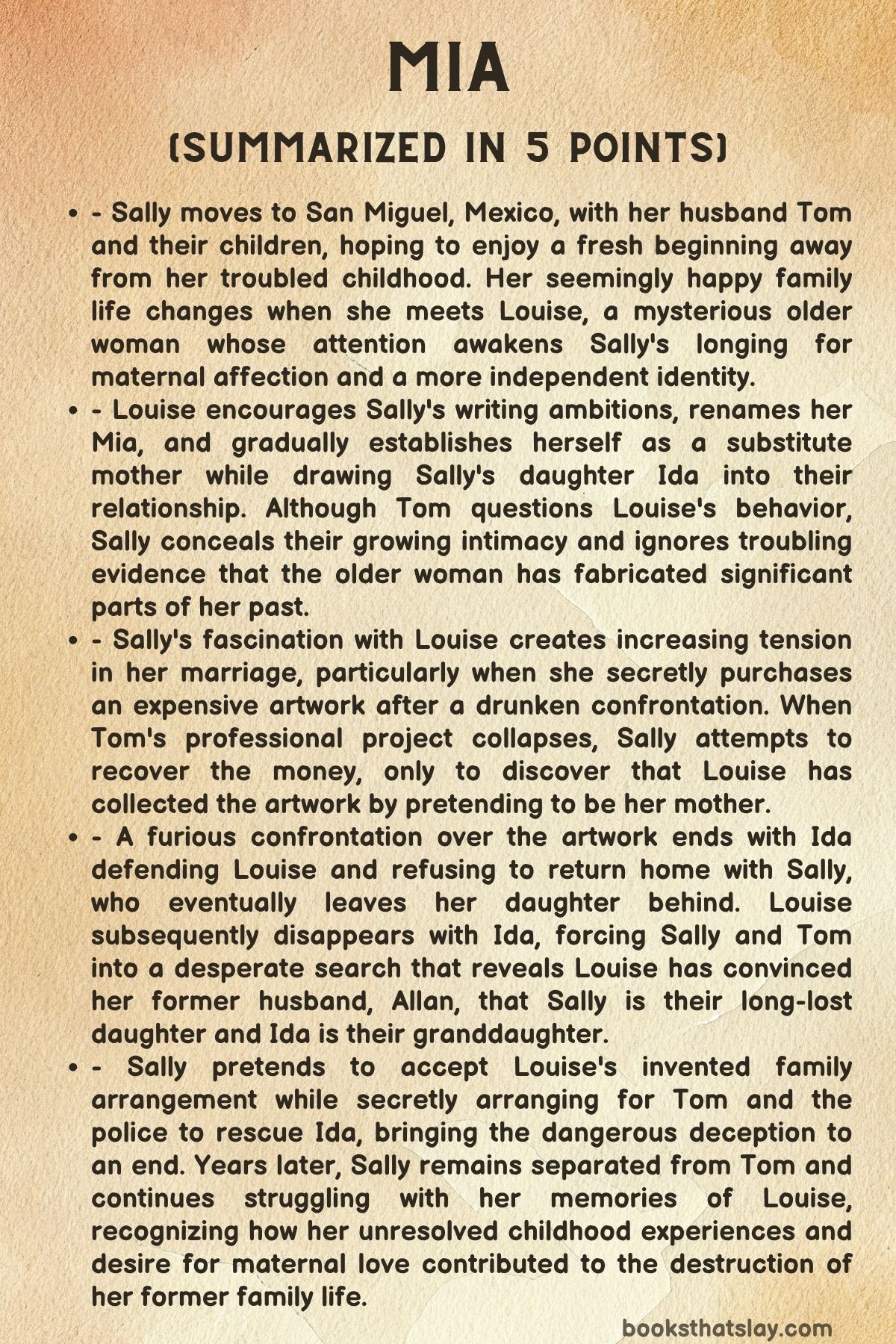
Summary
Years after the events that changed her family, Sally wakes alone in her Minneapolis apartment after dreaming about Louise. In the dream, the older woman appears younger and physically restored, wearing Sally’s silver bracelet and carrying a mysterious package.
When Louise buys orange roses for her daughter, Sally experiences a brief moment of happiness before remembering everything that happened between them. Her feelings turn into hatred, revealing that the relationship continues to occupy her thoughts long after their separation.
The story then returns to the period when Sally, her husband Tom, and their children, Ida and Henry, arrive in San Miguel, Mexico.
Tom is supervising an ambitious residential development for wealthy retirees, and the family occupies a beautiful house overlooking the town. Sally believes the move offers an opportunity to reinvent herself and escape the painful memories of her childhood.
Her early life was marked by instability, neglect, and her mother’s destructive relationships. After her mother abandoned her, Sally developed an intense need for security and eventually found it in Tom.
Their marriage appears loving and comfortable, but Sally privately struggles with sexual shame and emotional dependence. She loves Tom deeply while sometimes experiencing physical intimacy as threatening or degrading.
One afternoon, Sally notices an elegant older woman outside her children’s school. The stranger’s damaged face, silver hair, and commanding presence immediately attract her attention.
Sally later follows the woman through a market, becoming so distracted that she temporarily loses Ida. Although she finds her daughter unharmed, the incident demonstrates how powerfully the stranger has already captured her imagination.
When Tom returns briefly to Minneapolis for business, Sally finally meets the woman, who introduces herself as Louise Nieman.
Louise is witty, sophisticated, and apparently connected to an extraordinary artistic past. She claims to have lived among celebrated writers and artists in Mexico and describes her marriage to a painter named Allan.
Sally becomes fascinated by Louise’s unconventional life and the attention she receives from her.
During their first extended conversation, Louise notices Sally’s silver bracelet and claims it belonged to her before being stolen. Without investigating the claim, Sally gives it to her.
Louise responds by promising Sally a gift. Soon afterward, she presents her with a leather notebook and encourages her to become a writer.
The gift is particularly meaningful because Louise treats Sally’s creative ambitions as something real rather than an uncertain aspiration.
Their friendship develops through excursions, conversations, and visits to Louise’s house. Sally discovers Louise’s scarred body, hears mysterious accounts of her past, and experiences the older woman’s fierce protection when a man behaves threateningly toward her.
Louise gradually becomes the maternal figure Sally has spent her life wanting. She also challenges Sally’s carefully constructed identity as an agreeable wife and devoted mother.
During their conversations, Louise suggests that Sally’s name does not suit her. She eventually begins calling her Mia, offering a new identity associated with creativity, freedom, and emotional intensity.
Sally finds this transformation exciting. Although she continues loving Tom and her children, she begins concealing her meetings with Louise and increasingly divides her existence into separate lives.
The secrecy becomes more complicated when Louise starts interacting with Ida and Henry.
Ida is particularly attracted to Louise’s independence and unconventional attitudes. Already struggling with expectations surrounding femininity, she finds in Louise an adult who appears to understand her resistance to traditional rules.
Louise encourages Ida’s individuality, and Sally initially welcomes their connection.
However, disturbing details begin emerging.
At Louise’s house, Sally discovers a photograph of herself and Tom taken before she officially met the older woman. She realizes Louise’s interest may have been deliberate rather than accidental.
Instead of confronting the discovery, Sally rationalizes it.
At one of Louise’s parties, Sally is introduced to an artistic social circle and encouraged to describe herself as a writer. She improvises a story that impresses the guests, giving her a thrilling sense that she might genuinely possess literary talent.
Then she discovers that Louise has been telling people Sally is her daughter.
The deception shocks her, yet she secretly enjoys the possibility of belonging to Louise as family. Rather than correcting the misunderstanding, she begins participating in it.
Their relationship consequently moves beyond friendship into an invented mother-daughter bond.
As Louise becomes increasingly involved in the household, Tom grows suspicious. He questions her stories, notices inconsistencies involving the bracelet, and worries about her influence over Sally.
He also suggests that Sally’s attachment may be connected to her unresolved relationship with her mother.
Sally reacts angrily because she wants to believe her connection with Louise is exceptional rather than a repetition of an old emotional need.
Meanwhile, Louise offers to care for Ida after school so Sally can concentrate on writing.
Sally accepts despite Tom’s objections. The arrangement gives her more freedom while allowing Louise to establish an increasingly powerful relationship with the child.
When Louise cuts Ida’s hair extremely short without consulting either parent, Sally lies to Tom and claims responsibility.
The haircut intensifies Tom’s concern because Ida now physically resembles Louise. Sally recognizes the resemblance but continues defending the arrangement.
She is also becoming more deeply involved in Louise’s mysterious personal life.
A man Sally has seen fighting and kissing Louise repeatedly appears near them. Louise refuses to explain their relationship and sometimes seems to use Sally to provoke him.
Sally gradually understands that she has become involved in a drama whose history she does not know.
Her creative ambitions nevertheless develop. After unsuccessful attempts to write charming fiction, she produces a disturbing childhood recollection that Louise enthusiastically praises.
The experience gives Sally genuine artistic confidence, but it also strengthens her dependence on Louise’s approval.
Meanwhile, Sally becomes fascinated by an erotic print by Fernando Navarro, an artist associated with Louise’s past.
The artwork reflects Sally’s complicated feelings about sexuality, shame, and freedom.
Eventually, Bill Barnes, the owner of the house Sally’s family occupies, reveals troubling information about Louise.
He remembers her relationship with Allan and describes a violent incident during which Allan threw Louise from the house’s balcony. The fall apparently caused her permanent injuries.
Bill also contradicts Louise’s claim that Allan died in Mexico, explaining that he subsequently moved to Italy.
Sally realizes that substantial parts of Louise’s history are unreliable.
She begins recognizing similarities between Louise and her own mother, particularly their relationships with destructive men and their tendency to transform suffering into romantic mythology.
Nevertheless, Sally cannot immediately abandon the friendship.
Before a family holiday at the coast, she visits Louise and confronts her about the contradictions.
Their conversation becomes hostile as they drink heavily. Louise attacks Sally’s privileged existence, while Sally mocks Louise’s poverty and inability to purchase an expensive Navarro artwork.
Louise kisses Sally during the confrontation, but Sally experiences the contact with revulsion.
Her memories of the evening subsequently become fragmented.
The next morning, Sally discovers that while intoxicated she used Tom’s credit card to purchase Navarro’s print for fifteen thousand dollars.
The expenditure is financially reckless and motivated partly by her desire to prove herself superior to Louise.
During the family’s beach holiday, however, Sally experiences a remarkable period of happiness.
Away from Louise, domestic help, and social obligations, she reconnects with Tom and the children. Their simple routines create an intimacy that had become obscured by the elaborate life they maintained in San Miguel.
Her sexual relationship with Tom also becomes more natural and satisfying.
Sally begins imagining that she can restore her marriage, abandon Louise, and leave the entire episode behind.
Yet the Navarro purchase remains unresolved.
After the holiday, Bill unexpectedly dies, threatening the financing of Tom’s development.
Tom must return to Minneapolis to meet investors, and Sally finally confesses that she secretly purchased the artwork.
He is devastated by her dishonesty, particularly because the family may soon face serious financial uncertainty.
Sally promises to return the print, but her attempts to negotiate with the gallery fail.
Soon afterward, Tom informs her that the development has collapsed.
When Sally visits the mail collection office to refuse the artwork, she discovers that Louise has already collected it by identifying herself as Sally’s mother.
Sally drives furiously to Louise’s house, where she finds the Navarro hanging on the wall.
Louise insists that the artwork is a gift and announces that she has found a house where she and Sally might live together.
Sally demands the print and declares that her family is leaving Mexico.
Their confrontation becomes physical, and Ida witnesses Sally’s anger toward Louise.
Instead of supporting her mother, Ida defends Louise and reveals that she calls her Nonna.
When Sally orders Ida home, the girl refuses.
Overwhelmed by rejection, Sally leaves without her daughter.
She spends the afternoon with Henry, seeking reassurance in his uncomplicated affection. Returning home, she discovers Tom has arrived and is furious that Ida has been left with Louise.
Sally finally returns to retrieve her daughter, but Louise’s house is empty.
The Navarro, Allan’s painting, and numerous possessions have disappeared. Sally finds only her silver bracelet and a note addressed to Mia.
Realizing Louise has taken Ida, Sally is overcome by terror.
The police initially question whether a kidnapping has occurred because Ida frequently stayed with Louise voluntarily.
Their investigation also reveals the false mother-daughter identity Sally allowed Louise to establish.
Tom finally understands the extent of Sally’s deception and reacts with devastation and rage.
Sally remembers the mysterious man associated with Louise and begins searching for him. Following fragments of earlier conversations, she reaches La Cieneguita, where local women direct her toward a painter’s house.
There she encounters the man, who introduces an astonishing revelation.
He is Allan, Louise’s supposedly dead husband.
Louise has told him that Sally is their long-lost daughter and that Ida is his granddaughter. Allan, who calls Louise Carol, believes the invented family history.
Recognizing an opportunity to recover Ida, Sally pretends to be Mia.
She secretly contacts Tom and asks him to bring the police.
When Louise returns with Ida, Sally discovers that her daughter has embraced the invented family. Ida wants to remain with Nonna and Grandpa Allan.
Sally conceals her terror and continues performing the role Louise created for her.
During dinner preparations, she tells Louise she loves her, maintaining the deception until help arrives.
When police finally enter, Louise’s lies begin collapsing. Allan realizes he has been manipulated, and a violent confrontation erupts between them.
Ida escapes through the door and runs into the fields.
Sally pursues her but falls. Tom continues the chase and eventually catches their daughter, carrying her back as she struggles.
Ida has been rescued, but Sally experiences the reunion as the ending of the family life she knew.
Years later, Sally and Tom are separated, and their nearly adult children divide their time between them.
Henry remains affectionate, while Ida is private, independent, and difficult for Sally to understand.
When Ida unexpectedly admits that she still dreams about Mexico and remembers loving their life there, Sally feels relieved that the experience did not destroy every happy memory.
Sally continues writing and reflects on the dangers of language that beautifies or conceals reality.
Her recurring dreams about Louise demonstrate that the imagined identity of Mia remains emotionally powerful.
She must live with the knowledge that her longing for maternal love allowed another woman to enter her family, transform its relationships, and permanently alter their lives.
Characters
Sally / Mia
Sally is the protagonist of Mia, and her psychological development forms the center of the novel. She is an intelligent, affectionate, and emotionally conflicted woman whose apparent domestic happiness conceals unresolved childhood experiences.
Her relationship with her mother has profoundly shaped her understanding of attachment. Having experienced neglect, instability, and abandonment, she approaches intimacy with a contradictory mixture of longing and resistance.
She desperately wants to be loved without conditions, yet she becomes angry when others recognize her vulnerability. This tension explains why she can seek protection from Tom while resenting his attempts to understand her.
Her marriage provides the stability she lacked as a child. Nevertheless, she occasionally experiences the security of domestic life as a restriction on her individuality.
Louise enters her life at precisely this point of dissatisfaction.
Sally is attracted to the older woman’s sophistication, authority, and ability to recognize possibilities she has not acknowledged in herself. The name Mia becomes a symbolic alternative to the identity she has constructed around marriage and motherhood.
Her greatest weakness is not simply that she trusts Louise. It is that she repeatedly chooses emotionally satisfying interpretations over evidence that would require painful decisions.
She ignores suspicious photographs, accepts contradictory stories, and conceals increasingly serious developments from Tom.
Her dishonesty gradually becomes habitual, allowing her to maintain different identities without immediately confronting their incompatibility.
At the same time, Sally possesses genuine creative potential. Her strongest writing emerges when she stops beautifying experience and begins acknowledging uncomfortable truths.
Her relationship with Ida exposes another contradiction. Sally wants her daughter to develop independently but becomes terrified when that independence threatens their attachment.
The kidnapping forces her to confront the consequences of confusing emotional freedom with the absence of responsibility.
By the novel’s conclusion, Sally has lost her marriage and the uncomplicated family identity she once possessed. Her continued writing suggests that she is attempting to understand her experiences without transforming them into another comforting fiction.
Louise Nieman / Carol
Louise is the most disruptive character in Mia, functioning simultaneously as mentor, substitute mother, artistic influence, and manipulator.
Her appearance immediately establishes her as someone who has survived extraordinary experiences. Her scars, damaged leg, and commanding manner make her seem both vulnerable and formidable.
She possesses remarkable social intelligence. Through storytelling, flattery, humor, and carefully selected disclosures, she identifies what other people want and presents herself as capable of providing it.
With Sally, she offers the maternal recognition and creative encouragement that have been missing from her life.
With Ida, she provides an alternative to conventional expectations surrounding childhood and femininity.
With Allan, she constructs a fantasy of recovered parenthood and family reunion.
Louise’s history contains genuine suffering. Allan’s violence permanently injured her, and her accounts of childhood hardship suggest a life marked by instability.
However, the novel does not present suffering as justification for her subsequent actions.
She repeatedly misrepresents her history, appropriates Sally’s possessions, and establishes relationships through invented identities.
Her claim that Sally is her daughter initially appears emotionally symbolic, but eventually becomes the foundation of an elaborate deception involving an actual child.
Louise also uses material objects to establish emotional obligations. The notebook, bracelet, photographs, and Navarro print all become symbols through which she strengthens or asserts her relationships.
Her attitude toward Sally alternates between admiration and contempt.
She encourages Sally’s artistic ambitions while humiliating her for being a wealthy, conventional housewife. This instability keeps Sally seeking renewed approval.
Her relationship with Allan is similarly complicated by unresolved attachment and violence.
By presenting Sally as their lost daughter, Louise attempts to reconstruct a family that never existed.
Her defining characteristic is her determination to make other people inhabit the stories she creates. Ultimately, that determination makes her incapable of respecting the boundaries separating affection, desire, and possession.
Tom
Tom is Sally’s husband and represents the stability against which the extraordinary events of Mia unfold.
He is affectionate, hardworking, and deeply invested in providing his family with a secure and comfortable life.
His architectural project in San Miguel offers the family financial opportunity and an experience abroad. He approaches the move primarily through professional responsibility and domestic happiness.
Tom’s relationship with Sally is based on genuine affection, but he does not fully understand the contradictions within her emotional life.
He believes that their marriage has provided a reliable foundation from which she can move beyond her childhood.
When Louise enters the family, Tom recognizes troubling behavior before Sally is willing to acknowledge it.
He questions Louise’s stories, challenges Sally’s dishonesty, and becomes increasingly concerned about Ida spending time alone with the older woman.
His suspicions demonstrate an awareness of practical boundaries that Sally temporarily abandons.
However, Tom is not presented as incapable of error.
His reaction to Ida’s haircut includes a prejudiced remark that Sally rightly challenges. His discomfort reveals the conventional expectations he sometimes brings to fatherhood.
He also occasionally mistakes Sally’s declarations of love and sexual openness for evidence that their relationship is becoming stronger, unaware of the secrets she is concealing.
The collapse of his professional project exposes his vulnerability.
When Sally reveals the expensive artwork purchase, he recognizes that their shared financial security has been endangered without his knowledge.
His emotional breakdown after Ida’s disappearance reveals the immense suffering beneath his ordinarily controlled manner.
During the rescue, his determination to retrieve Ida becomes the clearest expression of his paternal devotion.
His eventual separation from Sally demonstrates that love and commitment cannot automatically repair the damage caused by prolonged deception.
Ida
Ida is Sally and Tom’s daughter and one of the novel’s most psychologically significant characters.
From the beginning, she displays independence, curiosity, and resistance to expectations imposed on girls.
She dislikes conventional feminine presentation and wants greater freedom to determine her appearance and behavior.
These qualities make Louise particularly attractive to her.
Unlike many adults, Louise does not expect Ida to become agreeable or traditionally feminine. She recognizes the girl’s assertiveness and encourages her individuality.
Ida gradually begins imitating Louise’s mannerisms and attitudes.
Her decision to adopt the name Nonna for Louise reveals how deeply the older woman has entered her emotional world.
The haircut becomes an important expression of Ida’s developing identity. Although she enjoys her new appearance, the circumstances expose Louise’s willingness to exercise parental authority without permission.
Ida’s relationship with Sally is complicated by their similar need for independence.
Sally admires her daughter’s strength but sometimes interprets it as emotional rejection.
The tragedy is that Sally’s desire to give Ida freedom contributes to a situation in which another adult gains excessive influence over her.
When Ida refuses to leave Louise, Sally experiences the decision as evidence that her daughter no longer loves her.
Yet Ida is a child responding to an adult who has carefully cultivated her loyalty.
Her resistance during the rescue demonstrates the emotional confusion produced by Louise’s deception.
In the later timeline, Ida remains independent and private. Her admission that she still treasures memories of Mexico suggests that she has retained meaningful experiences without necessarily sharing her mother’s interpretation of them.
Henry
Henry provides an important contrast to Ida in Mia.
He is affectionate, playful, and more accommodating toward adults. His relative ease makes him a source of comfort for Sally, particularly when her relationship with Ida becomes difficult.
Henry responds enthusiastically to the family’s adventures in Mexico.
His curiosity appears in his fascination with insects, markets, costumes, and imaginative games.
At the same time, he displays sensitivity that distinguishes him from Louise’s harder attitudes.
When Louise kills a cricket, Henry becomes upset, demonstrating an instinctive concern for vulnerable creatures.
He also struggles when Ida exercises excessive authority during their beach games.
His relationship with María reveals the possessiveness children can develop toward familiar caregivers. Seeing her with her own daughter unsettles him because he has not fully understood that her affection extends beyond his family.
After Ida’s disappearance, Henry becomes an important reminder that the crisis affects more than the immediately endangered child.
He witnesses Tom’s emotional collapse and depends on Sally to provide reassurance.
His continued affection toward Sally in adulthood suggests a relationship that has survived the family’s disruption.
Nevertheless, the novel avoids presenting him merely as compensation for Sally’s difficulties with Ida. Sally’s efforts to resist demanding proof of his love acknowledge that Henry must also be allowed an independent emotional life.
María
María works as the family’s maid and cook in San Miguel.
Although she occupies a supporting role, her presence is essential to the novel’s examination of motherhood, privilege, and domestic responsibility.
María possesses extensive practical knowledge and considerable experience caring for children.
She has worked since childhood and has raised a large family of her own.
Sally’s children admire her knowledge of animals, household remedies, and ordinary survival.
Her competence makes Sally’s privileged life appear effortless.
However, Sally initially fails to recognize the extent to which her comfort depends upon María’s labor.
The contrast becomes particularly apparent when Sally encounters María outside work and sees her with one of her own daughters.
Sally realizes she knows surprisingly little about the woman who manages her household.
María’s existence challenges Sally’s romantic ideas about traditional domestic life.
For Sally, homemaking can become an aesthetic or emotional choice. For María, labor is tied to economic necessity and family responsibility.
Her invitation to her grandson Kevin’s baptism also suggests a relationship that extends beyond employment, although the economic differences between the families remain significant.
María ultimately represents a form of practical care that receives far less dramatic attention than Louise’s performances of maternal intimacy.
Allan Nieman / Allan Pearlman
Allan is Louise’s former husband and an important figure in both her past and the novel’s final crisis.
For much of the story, he exists primarily through Louise’s stories.
She presents him as a deceased artist whose memory explains her possessions, artistic associations, and emotional history.
Bill Barnes eventually reveals that Allan survived their separation and was responsible for the violent incident that permanently injured Louise.
This information radically changes Sally’s interpretation of the older woman’s life.
When Allan finally appears, he is living as a painter in La Cieneguita.
He believes Louise has returned with extraordinary news: the discovery of their long-lost daughter.
His willingness to accept Sally as Mia illustrates how powerfully an emotionally satisfying story can influence judgment.
He responds to Sally with affection and excitement, unaware that she is performing a role to protect Ida.
However, his earlier violence remains a disturbing part of his characterization.
Sally becomes especially frightened when she sees him handling a large knife during dinner preparations.
Once he discovers Louise’s deception, his anger again becomes physical.
Allan therefore embodies the dangerous relationship between romantic longing, emotional manipulation, and violence.
His presence demonstrates that Louise’s invented histories affect not only Sally’s family but also people from her own past.
Fabiola
Fabiola is a woman Sally encounters in San Miguel and later meets within Louise’s social circle.
Her early kindness, particularly when she helps Sally get the children to school, introduces an alternative model of female solidarity.
Unlike the competitive or threatening relationships Sally remembers from childhood, Fabiola initially offers assistance without demanding emotional submission.
Her friendship also contributes to Sally’s growing sense of belonging in Mexico.
During an excursion to the hot springs, their relationship becomes physically intimate when they unexpectedly kiss.
The encounter challenges Sally’s established understanding of her sexuality.
Fabiola does not insist that the kiss must fundamentally redefine their relationship, allowing Sally to experience it without immediate explanation.
Nevertheless, Sally conceals the incident from Tom, making it another part of her increasingly divided existence.
Fabiola also participates in Louise’s social circle, where the invented mother-daughter relationship circulates.
Her character consequently represents both the possibilities of uncomplicated companionship and the secrecy that develops when Sally refuses to integrate different aspects of her life.
Bill Barnes
Bill Barnes owns the beautiful house occupied by Sally and Tom in San Miguel.
He also possesses firsthand knowledge of the artistic community Louise describes.
His significance increases when he provides information contradicting Louise’s account of her past.
Bill remembers Allan, Nuria, Fernando Navarro, and the violent incident that resulted in Louise’s injuries.
His testimony provides Sally with a more reliable historical account than the romanticized version she has accepted.
The discovery also gives the family’s house a darker significance.
What Sally experienced as a beautiful domestic sanctuary was previously the setting of severe violence.
Bill’s unexpected death subsequently causes the financial collapse of Tom’s development.
His character therefore connects the novel’s emotional revelations with the practical economic crisis that forces Sally’s secrets into the open.
Fernando Navarro
Fernando Navarro is an artist associated with Louise’s earlier life in San Miguel.
Although he does not participate directly in the central action, his artwork becomes increasingly important to Sally.
His sexually disturbing print, As Apes Do, attracts her because it reflects conflicts surrounding desire, shame, and bodily experience.
She repeatedly studies the image, finding it simultaneously repellent and fascinating.
Her eventual purchase of the artwork transforms a private psychological obsession into a major financial betrayal.
The print also becomes an object of rivalry between Sally and Louise.
Louise believes she has a stronger claim to Navarro’s artistic legacy, while Sally uses her wealth to acquire something Louise cannot afford.
When Louise takes possession of the print, the conflict between artistic desire and material ownership becomes explicit.
Navarro’s symbolic importance lies in the way his artwork exposes desires that Sally cannot easily acknowledge through ordinary domestic language.
Nuria
Nuria belongs to the artistic circle that shaped Louise’s early life in Mexico.
She appears primarily through recollections, photographs, and stories rather than through direct participation in the main events.
Her association with Louise, Allan, and Navarro contributes to the atmosphere of artistic freedom that initially attracts Sally.
Sally also incorporates fragments of these histories into her own improvised fiction.
Nuria therefore helps establish the connection between artistic creativity and the transformation of actual experiences into invented narratives.
However, because readers encounter her mainly through other people’s accounts, her independent personality remains less clearly established.
Her significance rests partly in the uncertainty surrounding the past Louise describes.
Hector
Hector is a member of Louise’s artistic social circle who responds enthusiastically to Sally’s supposed identity as a writer.
When Sally improvises a story at Louise’s party, Hector expresses interest in reading her manuscript.
His reaction gives Sally a powerful sense of artistic legitimacy.
For someone who has struggled to believe in her own creative ability, his interest suggests that she might belong within a sophisticated intellectual community.
However, Sally has not yet produced the substantial work implied by her performance.
Hector therefore helps expose the distinction between appearing to be an artist and undertaking the sustained labor of artistic creation.
His presence also demonstrates how Louise’s introductions and declarations influence the way others perceive Sally.
Pedro and Carmen
Pedro and Carmen belong to the social circle Louise introduces to Sally.
Although their individual histories receive limited attention, their presence helps establish the community that makes Sally’s alternative identity socially convincing.
Within this environment, Sally is accepted as Mia and associated with Louise’s artistic life.
The group’s apparent acceptance encourages Sally to continue performing a role that does not correspond to her actual family history.
Their collective significance lies in demonstrating how a private fiction can acquire social legitimacy when enough people accept and repeat it.
José Luis
José Luis is a local acquaintance whose conversations contribute to Sally’s growing attachment to San Miguel.
Sally initially experiences their interactions as evidence that she has moved beyond being a temporary foreign visitor.
Her improved Spanish and increasing familiarity with the town make these encounters especially meaningful.
Near the end of the novel, she learns that José Luis’s wife, whom he faithfully reads to, is in a coma.
The discovery exposes how little Sally actually understands about people whose lives she has interpreted through brief encounters.
His character reveals the limitations of Sally’s romanticized sense of belonging.
He also offers a quieter example of devotion that contrasts with the theatrical declarations and invented relationships surrounding Louise.
Officer Díaz
Officer Díaz becomes involved after Ida disappears.
His initial skepticism reflects the unusual circumstances surrounding the case.
Louise has regularly cared for Ida, and numerous acquaintances believe she is Sally’s mother.
Consequently, the situation initially resembles a complicated family disagreement rather than an obvious kidnapping.
As the investigation develops, Díaz discovers the false identities surrounding Sally and Louise.
His questions force concealed aspects of Sally’s life into the open.
His involvement also marks the moment when the relationship’s emotional consequences become a matter of immediate child safety.
Ana
Ana is a pregnant teenager who helps Sally locate Allan’s house in La Cieneguita.
She works for the painter and knows where he lives.
Her appearance occurs when Sally is almost overwhelmed by fear for Ida.
Although Sally experiences the delay in obtaining help as unbearable, Ana eventually guides her toward the house.
Her simple reassurance that Sally can now bring her daughter home becomes emotionally significant.
Ana represents practical assistance at a moment when elaborate stories and emotional declarations have become useless.
Unlike Louise, she helps Sally without attempting to claim a place in her family.
Sally’s Mother
Sally’s unnamed mother is one of the novel’s most influential characters despite her absence from the central events.
Her unstable relationships, neglect, and eventual abandonment establish the emotional patterns Sally carries into adulthood.
She repeatedly places her romantic attachments above her daughter’s need for security.
Sally’s childhood experiences consequently associate sexuality with competition, humiliation, and the threat of abandonment.
Her mother also attempts to involve Sally in manipulating Damian, a married doctor with whom she has a relationship.
When Sally refuses to write a message designed to draw him back, her mother reacts violently.
The incident helps establish Sally’s early understanding that language can be used to control other people.
Her eventual abandonment leaves Sally determined never to depend upon another woman in the same way.
Yet this determination does not eliminate her desire for maternal affection.
Louise’s arrival reveals how powerfully the original relationship continues to shape Sally’s decisions.
The recurring nightmares in which Sally attacks her mother demonstrate that anger has not freed her from the past.
Her mother’s psychological presence also influences Sally’s own parenting, particularly her fear of demanding affection from Ida and Henry.
Sally’s Father
Sally’s father provides an alternative household after her mother’s relationships collapse.
Although his role is less extensively developed, his presence is important to Sally’s history of adaptation.
After moving into his care, Sally learns to adjust her behavior to meet the expectations of the adults around her.
This pattern eventually influences her relationship with Tom.
She becomes skilled at presenting herself as agreeable, attractive, and undemanding.
Her father therefore contributes to the development of the identity she later begins questioning in Mexico.
His significance lies less in direct conflict than in the habits of accommodation Sally carries into adulthood.
Damian
Damian is a married doctor involved with Sally’s mother during her childhood.
His presence temporarily creates the impression of a stable family arrangement.
For Sally, the relationship offers the possibility that her mother might finally establish a secure domestic life.
When Damian returns to his wife, however, the arrangement collapses.
Sally’s mother attempts to use her daughter to preserve the relationship, demanding that Sally write him an emotionally persuasive message.
Sally refuses, protecting her ability to distinguish her own feelings from the role her mother wants her to perform.
Damian’s departure consequently becomes another experience of disrupted attachment.
His character also demonstrates how Sally’s childhood was repeatedly shaped by adult relationships over which she had no control.
Louise’s Visiting Artist Friend
The visiting artist whom Louise repeatedly asks Sally to accommodate is significant because of the demands surrounding his anticipated arrival.
Louise expects Sally to offer her beautiful home for his benefit, despite Sally’s discomfort and Tom’s possible objections.
The request exposes Louise’s growing assumption that Sally’s material resources are available to her.
It also intensifies the conflict between Sally’s established domestic obligations and the artistic identity Louise encourages.
The artist’s individual personality is less important than the pressure his proposed visit places on Sally’s ability to establish boundaries.
Themes
The Search for Maternal Love and the Repetition of Childhood Trauma
Childhood abandonment shapes Sally’s emotional life long after she has established a seemingly secure family of her own.
Her mother’s inconsistent affection taught her to associate love with uncertainty, competition, and the possibility of being rejected without warning.
As an adult, Sally attempts to protect herself through marriage, financial comfort, and a carefully maintained domestic identity.
However, these achievements do not eliminate her longing for the maternal recognition she never received.
Louise becomes compelling because she offers precisely this missing form of affection.
She admires Sally, recognizes her creative ambitions, defends her against threatening behavior, and eventually claims her as a daughter.
The relationship allows Sally to experience an imagined version of the childhood bond she wanted.
Yet Louise’s affection is inseparable from manipulation and emotional instability.
Her alternating praise and criticism recreate the uncertainty that shaped Sally’s relationship with her mother.
Sally consequently becomes involved in a familiar pattern while believing she is experiencing something entirely new.
The repetition becomes especially damaging when Ida develops her own attachment to Louise.
Sally discovers that her unresolved maternal needs are no longer confined to her private emotional life. They are influencing the conditions under which her daughter develops relationships.
In Mia, the connection between childhood and adulthood is neither simple nor predetermined.
Sally’s experiences help explain her vulnerability, but they do not eliminate her responsibility for the choices she makes.
The novel’s later scenes suggest that understanding inherited emotional patterns requires more than recognizing their origins.
Sally must confront her own tendency to seek reassurance from her children and learn that maternal love cannot depend upon possessing another person’s affection.
Identity, Storytelling, and the Seductive Power of Fiction
Sally’s identity has always involved an element of conscious construction.
As a child, she learns to adjust herself to changing households and adult expectations. As a wife, she creates a version of herself organized around beauty, loyalty, and domestic competence.
Mexico offers another opportunity for reinvention.
Louise encourages Sally to become a writer, introduces her to an artistic community, and gives her the name Mia.
These changes initially appear liberating because they allow Sally to imagine a self not defined entirely by marriage and motherhood.
However, the new identity increasingly depends upon accepting Louise’s interpretation of reality.
The false mother-daughter relationship demonstrates how easily a story can acquire practical consequences.
What begins as an emotionally satisfying fiction becomes accepted by acquaintances, influences family relationships, and eventually enables Louise to collect Sally’s expensive artwork.
The deception reaches its most dangerous expression when Allan accepts Sally as his long-lost daughter.
His emotional investment in the invented family illustrates how powerful a desired narrative can become.
Storytelling also carries a more constructive possibility.
Sally’s early attempts at fiction fail when she concentrates on producing something attractive or impressive.
Her writing becomes more convincing when she begins acknowledging disturbing experiences without transforming them into reassuring images.
This distinction separates creativity from self-deception.
The novel does not suggest that imagination is inherently destructive. Rather, it examines the danger of allowing emotionally satisfying stories to replace the evidence of lived experience.
By the conclusion of Mia, Sally’s relationship with language has changed.
She recognizes that beautiful expression can conceal uncomfortable truths, and her writing becomes an attempt to confront rather than disguise the reality of her past.
Motherhood, Possession, and the Independence of Children
Motherhood in the novel is defined by a tension between attachment and autonomy.
Sally loves Ida and Henry intensely, yet her childhood has left her unusually sensitive to the possibility that people she loves might withdraw their affection.
Her fear becomes particularly visible in her relationship with Ida.
Ida is independent, resistant to conventional expectations, and increasingly unwilling to organize her behavior around parental approval.
Sally admires these qualities but also experiences them as evidence of emotional distance.
Louise exploits this vulnerability by offering Ida a relationship built around admiration for her unconventional personality.
The older woman’s influence raises difficult questions about the boundaries between supporting a child’s independence and assuming authority that belongs to the parents.
Sally initially interprets Ida’s attachment to Louise as an expression of individuality.
However, the haircut, secret intimacy, and eventual disappearance demonstrate that encouraging independence cannot mean abandoning responsibility for a child’s safety.
The novel also examines the temptation to treat children as emotional possessions.
After Ida rejects her, Sally turns toward Henry and desperately wants reassurance that he will always love her.
Her recognition of this impulse becomes an important moment of self-awareness.
She remembers how oppressive her own mother’s emotional demands felt and attempts to resist reproducing them.
The later relationship between Sally and her nearly adult children suggests that motherhood must accommodate forms of separation that parents cannot control.
Ida’s memories of Mexico are not identical to Sally’s, and Sally cannot dictate how her daughter understands their shared past.
The possibility of healthier maternal love emerges when Sally begins accepting that her children possess emotional lives independent of her needs.
Class, Privilege, and the Illusion of Belonging
San Miguel offers Sally the opportunity to imagine a life liberated from the pressures and expectations she associates with the United States.
She is attracted to the town’s artistic history, communal life, markets, and domestic traditions.
Her growing familiarity with the place encourages her to believe that she has moved beyond the position of a wealthy foreign visitor.
However, the novel repeatedly exposes the privileges supporting this sense of belonging.
Sally occupies a beautiful house, enjoys financial security, and depends upon María’s labor to maintain her household.
The freedom she experiences is partly made possible by circumstances unavailable to many of the people whose lives she admires.
Louise recognizes this contradiction and criticizes Sally for romanticizing traditional domestic work.
For Sally, cooking, childcare, and household management can become meaningful alternatives to professional ambition.
For María, similar activities are inseparable from employment, economic necessity, and responsibility toward her own family.
Sally’s encounter with María outside work exposes another limitation of her perspective.
She discovers that she has treated a woman central to her domestic happiness as though she exists primarily within Sally’s household.
Tom’s development introduces a broader conflict.
The luxury construction project provides the family’s income while transforming the neighborhood Louise considers her home.
Sally sympathizes with Louise’s criticism but continues benefiting from the very economic arrangements being condemned.
Her desire to remain permanently in Mexico is similarly contradictory.
She imagines authentic belonging while wanting to preserve beautiful surroundings, domestic assistance, artistic distinction, and material comfort.
The collapse of Tom’s project eventually reveals how dependent her imagined freedom has been upon financial stability.
Through these contradictions, the novel examines the difference between appreciating a place and assuming that one’s attachment to it confers an uncomplicated right to belong.
Sally’s final recognition that she understood far less about San Miguel’s inhabitants than she believed challenges the romantic assumptions that originally shaped her experience.


