(Mostly) Human Resources Summary, Characters and Themes
(Mostly) Human Resources by Grace Viall is a paranormal fantasy romance that combines workplace rivalry, supernatural investigation, Appalachian folklore, and dark humor.
The novel follows Alexys Keane, a Human Resources manager at Entity, an organization responsible for investigating and managing supernatural creatures. When one of her employees disappears in the Appalachian Mountains, Alexys abandons the safety of her office to find him. Her search forces her to cooperate with Nic Dyre, an irritatingly brilliant researcher whose fascination with monsters repeatedly creates problems. As their investigation uncovers ancient magic, dangerous bargains, and horrifying secrets, Alexys must confront her fears, her father’s legacy, and her changing feelings toward Nic. It’s the 1st book of the Entity Case Files series.
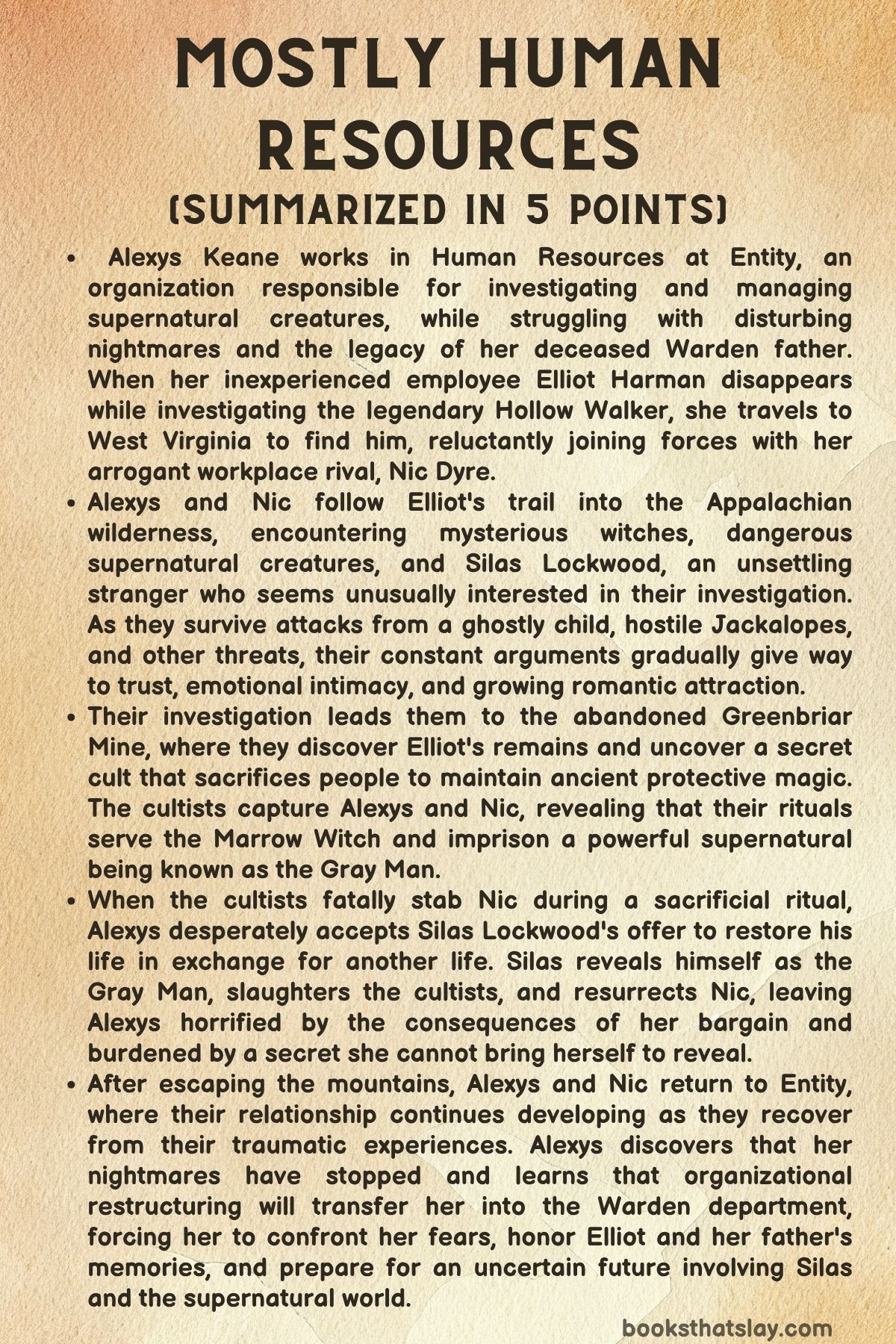
Summary
Alexys Keane has built her career around managing supernatural dangers without confronting them personally. As the Human Resources manager for Entity’s District 13, covering Kentucky, Virginia, and West Virginia, she supervises Wardens who investigate creatures ranging from Jackalopes to potentially lethal cryptids.
Her responsibilities include assigning investigations, enforcing safety procedures, and managing employees whose enthusiasm frequently exceeds their judgment. Among them is Elliot Harman, a relatively inexperienced Warden preparing for a mandatory field evaluation.
Alexys’s professional ambitions extend beyond her current position. She hopes to advance within Human Resources, particularly because rumors suggest that her supervisor, Kristin, may eventually transfer to another office.
Her ambitions are complicated by Nic Dyre, the head of Research and Cataloging. His intelligence, arrogance, and habit of correcting her have made him her workplace nemesis.
When new company procedures require closer coordination between their departments, Alexys reluctantly approaches Nic to prepare Elliot’s evaluation. She selects a relatively safe Silver Giant investigation, hoping to complete the assignment without unnecessary danger.
Nic, however, has another interest.
For years, he has been fascinated by the Hollow Walker, a mysterious Appalachian creature classified as an unconfirmed singularity. Reports suggest that it may be a unique being rather than a member of an identifiable species.
Because Elliot’s evaluation takes place near territory associated with the creature, Nic adds information about the Hollow Walker to the assignment. His academic enthusiasm encourages Elliot to investigate unusual reports independently.
Meanwhile, Alexys is experiencing increasingly disturbing nightmares. One particularly frightening dream shows a bloody message announcing Elliot’s death, followed by a warning that Alexys herself will be next.
She has secretly asked researcher Zachary Hornsby to investigate her dreams, but Entity’s expensive official services prevent her from pursuing the matter properly. She also fears that Nic would become fascinated by her condition if he discovered it.
When Elliot stops responding to messages, her nightmare begins to seem dangerously relevant.
Alexys travels to Charleston for the scheduled evaluation and discovers that Elliot has disappeared. His hotel room contains an elaborate collection of newspaper clippings, photographs, maps, and notes concerning the Hollow Walker and a mountain community called Mercyhill.
Nic arrives independently, having learned that Elliot was pursuing the creature. Alexys blames him for encouraging the investigation, while Nic insists that his knowledge is essential to finding their missing colleague.
Their disagreement intensifies when circumstances force them to share a hotel room.
During this period, Alexys repeatedly encounters Silas Lockwood, an elegant, mysterious stranger who knows far more about her than he should. His unnatural coldness and cryptic warnings suggest that he is connected to the supernatural activity surrounding Mercyhill.
Silas also approaches Nic and introduces him to ancient Appalachian beings known as the Dark Mother and the Marrow Witch.
According to his account, the Hollow Walker originated from a supernatural attempt to borrow the Dark Mother’s creative power. The resulting creature exists in a disturbing condition between life and death.
Determined to find Elliot, Alexys takes Nic’s rental car and travels to Mercyhill alone.
A local cashier directs her toward Nanny Opal, an elderly woman associated with traditional mountain witchcraft. At Opal’s isolated house, Alexys discovers Elliot’s vehicle but learns that he entered the forest after hearing the Hollow Walker’s distinctive whistle.
Opal warns that Elliot was dangerously unprepared for what he encountered.
Despite her limited wilderness experience, Alexys enters the forest alone. She encounters Silas again, who reveals that he has an interest in her success but refuses to explain his intentions.
Later, she meets Waylan, a seemingly innocent boy who offers to guide her through the woods.
Waylan eventually leads her to an abandoned house, where his appearance changes dramatically. Alexys realizes that he is a Haint, a ghost trapped in a repetitive pattern connected to his death.
When the boy becomes violent, she flees. Silas unexpectedly rescues her by helping her cross running water, which the spirit cannot pass.
Alexys eventually returns to Opal’s house and finds that Nic has finally arrived.
Their reunion begins with another argument, but their shared concern for Elliot gradually overcomes their hostility. Nic explains that his research points toward Greenbriar Mine, an abandoned location associated with the Hollow Walker.
They agree to search together.
Their journey exposes Alexys to the realities of fieldwork. Nic’s knowledge of navigation, wildlife, supernatural behavior, and survival repeatedly proves useful, while Alexys contributes determination and an understanding of Elliot’s decisions.
Their arguments gradually become playful, revealing an attraction neither is comfortable acknowledging.
When a storm forces them to shelter inside a cave, they begin discussing their personal histories. Alexys reveals that her father, Michael Keane, died while serving as an Entity Warden.
His death shaped her career and her mother’s distrust of the organization. Although Alexys has always admired his courage, she deliberately chose a position that would keep her away from the dangers he faced.
Nic begins to understand the pressure she places on herself.
Their relationship grows more intimate as he treats her injuries, offers reassurance, and encourages her to accept help. Nevertheless, Alexys continues hiding her nightmares.
Nic already knows more than she realizes.
After speaking with Zach, he secretly obtained her nightmare records. While watching her sleep, he discovers a tiny supernatural spider responsible for producing her disturbing dreams.
His scientific curiosity initially prevents him from intervening immediately. Later, he captures the creature without telling Alexys.
Although removing it protects her from further nightmares, his secrecy reveals an uncomfortable conflict between his responsibility toward her and his desire to make an extraordinary discovery.
The search continues when a group of Jackalopes imitates Elliot’s voice. Alexys realizes that the creatures may have encountered him and proposes finding Waylan again.
During daylight, the ghost is friendly and remembers meeting a man carrying an Entity backpack. He guides Alexys and Nic toward Mill Creek, where Elliot apparently continued his investigation.
Their cooperation becomes increasingly comfortable.
Nic admits that he never disliked Alexys and struggled to communicate with her outside their professional disagreements. Alexys acknowledges that she once wanted to become his friend but assumed he hated her.
Their conversation begins dismantling years of unnecessary hostility.
Near Mill Creek, the pair finally encounter the Hollow Walker.
The enormous creature possesses exposed bones, decaying flesh, antlers, moss, and empty eye sockets. Its haunting whistle comes from wind passing through its skeletal structure.
Although it approaches them, it does not attack.
Alexys and Nic follow its trail to Greenbriar Mine, believing Elliot may have gone there.
Inside, they discover a chamber containing mutilated human remains. When Nic finds Elliot’s marked backpack among the bodies, Alexys is devastated.
She blames herself for failing to protect him.
Their grief is interrupted by the arrival of black-cloaked cultists led by a woman named Agnes.
The cultists reveal that the Hollow Walker supplies victims for supernatural sacrifices. Their arrangement with the Marrow Witch maintains protective magic over the surrounding community while imprisoning another powerful being.
Alexys realizes that Opal may have known far more about Elliot’s fate than she admitted.
Before Alexys and Nic can escape, the cultists capture them.
Nic awakens restrained on a bloodstained altar. Recognizing that the cult intends to kill them, he offers himself as a sacrifice if the cultists will release Alexys.
When she regains consciousness, Alexys makes the same offer in reverse.
Their desperate attempts to protect each other expose the depth of their feelings.
Agnes ultimately chooses Nic and stabs him through the chest with an obsidian dagger.
As Alexys watches him dying, Silas offers to save him in exchange for a bargain. Desperate to keep Nic alive, she agrees.
The agreement releases Silas’s power.
He reveals himself as the Gray Man, the supernatural being whom the cult’s sacrifices were intended to imprison. His bargain with Alexys overrides the magic maintaining his confinement.
The price of restoring Nic’s life is paid through the deaths of the cultists.
Silas kills Agnes and the others despite Alexys’s horrified attempts to stop him. Although she is relieved that their captors can no longer harm them, she realizes that her decision has enabled a slaughter.
Silas eventually restores Nic to life, leaving only a pale scar where the dagger entered his chest.
Overwhelmed by relief, Alexys kisses him.
She does not tell him the full terms of her bargain.
The pair escape the mine and return to Opal’s property, where an Entity recovery operation has unexpectedly arrived. Medical personnel treat their injuries, while Opal has disappeared.
Alexys conceals Nic’s temporary death and Silas’s involvement in his resurrection.
Back home, Alexys struggles with the aftermath of Elliot’s death and the supernatural horrors she witnessed. Seeking reassurance, she visits Nic, whose presence has become a source of comfort.
He gives her one of her father’s original Warden journals, allowing her to reconnect with Michael through his own writing.
Meanwhile, Nic investigates the spider he captured. Research suggests that it is a Dreamweaver, a creature believed extinct and capable of influencing dreams.
Alexys’s nightmares stop, but she remains unaware of his discovery.
When she returns to work, her debriefing produces another unexpected development.
Entity is restructuring its departments, and Alexys’s Human Resources position is being eliminated. Rather than dismissing her, the organization transfers her into the Warden department.
Her new supervisor, Delaney Rourke, is a Reaper who recognizes Alexys’s ability to function under extraordinary field conditions.
Alexys’s assignment places her in Elliot’s former territory.
Initially, she is overwhelmed by the prospect of following her father’s dangerous career and returning to the region where Elliot died.
A message left by Silas, however, reminds her that the events in West Virginia are not truly finished.
Alexys eventually resolves to become a capable Warden, honoring both Elliot and Michael while preparing to confront the mysteries still surrounding Mercyhill.
When she tells Nic about the transfer, he promises that his research team will support her.
Their feelings remain unresolved but increasingly undeniable.
The novel closes with Alexys facing an uncertain future as a Warden, her growing relationship with Nic, and the consequences of a supernatural bargain that has released the Gray Man.
Characters
Alexys Keane
Alexys Keane is the central protagonist of (Mostly) Human Resources, whose development transforms the novel from a workplace comedy into a story about courage, responsibility, grief, and personal reinvention.
As a Human Resources manager at Entity, Alexys initially defines herself through organization, professional competence, and strict adherence to safety procedures. She understands the dangers Wardens encounter and believes that preventing unnecessary risks is one of her most important responsibilities.
Her determination to follow regulations is connected to her family history.
Her father died while serving as a Warden, leaving Alexys with an enduring admiration for his courage and an equally powerful fear of repeating his fate. Choosing an administrative career allows her to remain connected to his profession without exposing herself to the same dangers.
Nevertheless, Alexys is not naturally passive.
When Elliot disappears, her concern overrides her usual respect for institutional boundaries. She enters an unfamiliar mountain wilderness despite knowing that she lacks the training and experience required for such an investigation.
Her decisions reveal both admirable loyalty and dangerous impulsiveness.
Alexys repeatedly refuses assistance because she believes responsibility means solving problems independently. Her secrecy regarding her nightmares, determination to find Elliot alone, and reluctance to report her difficulties demonstrate how deeply she fears being perceived as incapable.
Her relationship with Nic challenges this belief.
Although she initially interprets his intelligence and confidence as arrogance, she gradually learns that accepting his expertise does not diminish her own abilities. Their growing closeness teaches her that trust requires vulnerability rather than constant self-sufficiency.
Elliot’s death becomes her greatest emotional crisis.
She interprets his fate as evidence that she has failed as a manager, even though he independently violated instructions. This tendency toward excessive self-blame nearly leads her to surrender her own life during the cult’s ritual.
Her bargain with Silas introduces a more difficult moral conflict.
By agreeing to save Nic, Alexys enables the deaths of the cultists and helps release a dangerous supernatural being. Her actions are understandable within the circumstances, but the consequences prevent her from treating survival as a simple victory.
By the end of (Mostly) Human Resources, Alexys has become someone capable of confronting dangers she once avoided.
Her transfer into the Warden department does not eliminate her fears, but it changes her relationship with them. She begins recognizing that courage involves acting despite uncertainty while accepting the support of people who care about her.
Nic Dyre
Nic Dyre is the head of Entity’s Research and Cataloging department and Alexys’s principal romantic interest. His character combines extraordinary intellectual curiosity with emotional awkwardness, ambition, and an occasionally troubling disregard for professional boundaries.
At the beginning of the novel, Nic appears arrogant and difficult.
His habit of correcting Alexys, challenging her conclusions, and treating research as more important than administrative procedure makes him an especially frustrating colleague. His intelligence is considerable, but his communication skills frequently prevent others from recognizing his intentions.
His fascination with the Hollow Walker reveals both his greatest strength and his greatest weakness.
Nic possesses an exceptional capacity for scientific investigation and a willingness to question established classifications. However, his enthusiasm for discovering an undocumented creature encourages Elliot to pursue a dangerous investigation.
This mistake follows Nic throughout the novel.
His decision to travel to West Virginia initially reflects his desire to find the Hollow Walker, but his priorities gradually change as he becomes concerned about Elliot and Alexys.
The wilderness allows his more compassionate qualities to emerge.
He prepares survival equipment, treats Alexys’s injuries, comforts her after frightening encounters, and demonstrates patience toward Waylan. These actions reveal someone considerably more considerate than his workplace behavior suggests.
His developing feelings for Alexys also expose his insecurities.
Nic is accustomed to using knowledge as a source of confidence, but romantic attachment introduces uncertainty that cannot be resolved through research. He becomes increasingly conscious of his shortcomings and worries that his ambitions make him unworthy of her trust.
His handling of the Dreamweaver is especially revealing.
Although he ultimately removes the creature responsible for Alexys’s nightmares, he secretly studies her condition and withholds important information. His actions demonstrate that genuine affection does not immediately eliminate his tendency to prioritize discovery.
The confrontation with the cult forces him to reassess his values.
When he offers his life in exchange for Alexys’s freedom, he demonstrates that her survival has become more important to him than professional achievement.
In (Mostly) Human Resources, Nic’s development concerns the movement from detached observation toward emotional involvement.
His willingness to protect Alexys and support her new career reflects meaningful growth, although his unresolved secrecy concerning the Dreamweaver indicates that he still has important lessons to learn about honesty.
Elliot Harman
Elliot Harman is a young Entity Warden whose disappearance initiates the central investigation.
He is enthusiastic, curious, and eager to establish himself professionally. His relative inexperience, however, makes him vulnerable to situations that require greater caution.
Elliot’s interest in the Hollow Walker demonstrates his ambition.
Encouraged by Nic’s research, he begins investigating unusual reports around Mercyhill despite being assigned a comparatively safe field evaluation. His decision to pursue the creature without informing Alexys violates the procedures designed to protect him.
Nevertheless, Elliot is not portrayed simply as foolish.
His concern about Entity’s expensive services suggests that he genuinely cares about people who need supernatural assistance. His eagerness to investigate also reflects the curiosity and determination expected of successful Wardens.
His death gives the novel its central emotional weight.
For Alexys, losing Elliot means confronting the limitations of her authority and the painful reality that she cannot control every decision her employees make.
The discovery of his backpack inside Greenbriar Mine confirms that the investigation has become a tragedy rather than a rescue.
Although Elliot disappears relatively early, his influence continues through Alexys’s guilt, Nic’s remorse, and the eventual restructuring of Entity.
His former territory becomes Alexys’s new assignment, ensuring that his memory remains connected to her future.
Silas Lockwood
Silas Lockwood is among the most mysterious and morally unsettling characters in (Mostly) Human Resources.
Initially introduced as an impeccably dressed stranger, he possesses an unsettling combination of courtesy, charm, supernatural knowledge, and apparent omniscience.
His repeated appearances suggest that he is deliberately directing Alexys toward a particular outcome.
Silas knows her name, understands her investigation, and offers warnings that seem to anticipate events. His unnatural coldness and unusual familiarity with Appalachian magic indicate that he is not an ordinary human being.
His interactions with Alexys are carefully calculated.
He rescues her from Waylan, but his assistance creates uncertainty rather than reassurance. He repeatedly suggests that he wants her to succeed without explaining what success means to him.
His true identity emerges during the sacrifice at Greenbriar Mine.
As the Gray Man, Silas is the powerful supernatural being whose imprisonment has been maintained through the cult’s rituals.
His bargain with Alexys allows him to overcome those protections.
The arrangement exposes his manipulative intelligence. By waiting until Nic is dying, Silas creates circumstances in which Alexys is unlikely to consider the wider consequences of accepting his help.
His subsequent violence reveals the danger behind his charming presentation.
Although he restores Nic’s life, he kills the cultists as payment and refuses Alexys’s attempts to intervene.
Silas therefore embodies the uncertainty surrounding supernatural bargains.
He can perform actions that appear helpful while pursuing objectives that place others in terrible danger. His continued interest in Alexys suggests that their relationship will remain consequential beyond the events of the novel.
Nanny Opal
Nanny Opal is an elderly Appalachian witch whose apparent helpfulness conceals troubling connections to the supernatural forces operating around Mercyhill.
She possesses extensive knowledge of local folklore, magical practices, and the Hollow Walker. Unlike Entity’s researchers, she approaches supernatural phenomena through inherited traditions rather than scientific classification.
Her knowledge initially makes her an essential resource.
She confirms that Elliot visited her home, identifies the Hollow Walker’s whistle, and explains that certain supernatural dangers are older than Entity’s institutional understanding.
However, her warnings are accompanied by suspicious omissions.
She knows that Elliot entered the forest, understands the creature’s danger, and nevertheless provides Alexys with directions toward the same territory.
Her use of human bones in divination and protective magic becomes especially unsettling after the discovery of the cult.
The novel leaves important questions about her precise involvement unresolved.
Alexys suspects that Opal knowingly directed Elliot toward the circumstances that caused his death, but the available account does not establish every detail of her participation.
Her disappearance before Entity’s recovery operation deepens these suspicions.
Opal represents the ambiguous relationship between inherited knowledge and moral responsibility. Her understanding of ancient supernatural systems may offer protection, but her apparent acceptance of their dangers makes her difficult to trust.
Waylan
Waylan is a young Haint whose supernatural existence combines childhood innocence with the consequences of an unresolved death.
When Alexys first encounters him, he appears to be an ordinary boy wandering through the forest. His oversized clothing, curiosity, and fascination with roly-polies make him seem harmless.
His transformation after nightfall exposes the tragedy beneath that appearance.
Waylan is trapped in a repeated attempt to return home, a journey associated with the circumstances of his death. When the pattern fails, his confusion becomes supernatural rage.
His attack on Alexys demonstrates that a sympathetic origin does not make a creature harmless.
Nevertheless, Waylan is not presented as deliberately malicious in the ordinary human sense.
During daylight, he becomes friendly again and provides crucial information about Elliot’s movements.
His developing friendship with Nic also reveals his capacity for trust and companionship.
Waylan contributes to the novel’s rejection of simplistic distinctions between monsters and victims. His frightening behavior emerges from suffering, while his ordinary interactions preserve the recognizable personality of a child.
Agnes
Agnes is a member of the cult operating around Greenbriar Mine and becomes its principal representative during Alexys and Nic’s captivity.
She accepts the sacrificial system as necessary to preserve the supernatural protections surrounding her community.
Her beliefs demonstrate how inherited obligations can become a justification for cruelty.
Rather than questioning the deaths required by the ritual, Agnes treats victims as resources that maintain collective security.
Her behavior toward Nic and Alexys is particularly disturbing.
She refuses to guarantee Alexys’s release even when Nic offers to sacrifice himself voluntarily. She also suggests that additional deaths could strengthen the protective magic.
Her decision to stab Nic exposes the violence at the center of the cult’s ideology.
Agnes’s eventual death at Silas’s hands creates an uncomfortable moral reversal. Although she is responsible for terrible actions, her execution becomes part of an even larger supernatural catastrophe.
Her character demonstrates how people can normalize cruelty when they believe it serves a supposedly necessary purpose.
Natalie
Natalie is Alexys’s close friend and fellow Human Resources employee at Entity.
She provides a sense of emotional stability within a workplace defined by unpredictable supernatural incidents and complicated professional responsibilities.
Their friendship is characterized by humor, familiarity, and practical support.
Natalie listens when Alexys describes her nightmares, helps investigate Elliot’s disappearance, and provides information about Mercyhill.
Her contributions are particularly important because she offers assistance without demanding control over Alexys’s decisions.
When Alexys returns from West Virginia, Natalie immediately recognizes that her friend has endured something traumatic.
Rather than pressuring her for explanations, she makes it clear that support remains available whenever Alexys is ready to talk.
Natalie also represents the professional community Alexys fears losing.
While their careers take different directions following Entity’s restructuring, the friendship provides continuity during Alexys’s transition into fieldwork.
Zachary Hornsby
Zachary Hornsby is a researcher in Entity’s Research and Cataloging department who investigates Alexys’s nightmares unofficially.
His willingness to help her demonstrates compassion within an organization where formal assistance can be prohibitively expensive.
Zach understands that Alexys cannot easily afford an official investigation.
However, his decision to conceal the research creates complications when the supernatural danger becomes more serious.
His relationship with Nic also places him in a difficult position.
When Nic pressures him for information, Zach eventually reveals the existence of Alexys’s nightmare investigation.
This disclosure allows Nic to recognize the danger surrounding her, but it also compromises the privacy Zach had agreed to protect.
Zach’s character illustrates the challenges of balancing confidentiality, personal loyalty, and professional responsibility.
Michael Keane
Michael Keane is Alexys’s deceased father and a former Entity Warden whose influence extends throughout the novel.
Although he appears primarily through memories and his surviving journal, he remains central to Alexys’s identity.
His courage inspired her to join Entity, while his death encouraged her to avoid fieldwork.
This contradiction shapes much of her professional life.
Michael’s familiar saying, “Can’t never could,” provides encouragement when Alexys doubts her ability to continue.
His legacy also contributes to her excessive fear of failure.
She believes that losing Elliot might dishonor her father’s memory, even though Michael’s example does not necessarily require her to assume responsibility for every tragedy.
Nic’s gift of Michael’s journal allows Alexys to reconnect with him through something more personal than institutional recognition.
By the end of the novel, Michael’s influence becomes a source of strength rather than merely a reminder of loss.
Carol Keane
Carol Keane is Alexys’s mother, whose relationship with Entity is defined by the death of her husband.
She wants Alexys to leave the organization, move closer to family, and pursue a safer life.
Her concerns arise from personal experience rather than simple opposition to her daughter’s ambitions.
However, her anxiety creates distance between them.
Alexys conceals her nightmares and later struggles to discuss the events in West Virginia because she knows that such revelations would reinforce Carol’s fears.
Their relationship demonstrates how grief can produce different responses within the same family.
Where Alexys seeks connection with Michael through his profession, Carol associates that profession with irreversible loss.
Kristin
Kristin is Alexys’s Human Resources supervisor and an important representative of Entity’s organizational culture.
Her cheerful manner and occasional professional disorganization contrast with Alexys’s methodical approach.
Nevertheless, Kristin recognizes Alexys’s abilities.
During the debriefing, she acknowledges the seriousness of Alexys’s procedural violations while also recognizing that the circumstances were extraordinary.
Her handling of the restructuring reveals the limits of managerial authority within Entity.
Although Alexys initially assumes that she is being dismissed, Kristin explains that her demonstrated abilities have created another employment opportunity.
Her character provides a comparatively humane presence within an organization whose decisions can otherwise appear impersonal.
Delaney Rourke
Delaney Rourke is a Reaper reassigned as a Warden Team Leader during Entity’s restructuring.
Her arrival introduces a more demanding phase of Alexys’s professional life.
Unlike Kristin, Rourke presents herself with direct, authoritative confidence.
She explains that Alexys’s Human Resources position is disappearing and that her survival during the West Virginia investigation has qualified her for a field assignment.
Rourke’s decision to place Alexys in Elliot’s former territory creates an immediate emotional challenge.
Although she is introduced relatively late, her role establishes the conditions for Alexys’s future development.
She represents the institutional expectation that Alexys will transform her accidental field experience into professional competence.
Charlotte
Charlotte is a London-based researcher and former romantic partner of Nic.
Her role is relatively limited, but she contributes important information concerning the mysterious creature responsible for Alexys’s nightmares.
When Nic contacts her, Charlotte investigates records unavailable through ordinary Entity resources.
Her research identifies the possible existence of a Dreamweaver, an arachnid supernatural creature believed extinct.
Charlotte therefore expands the investigation beyond its immediate Appalachian setting.
Her assistance also reveals Nic’s professional network and the value of collaboration when institutional databases contain incomplete information.
Themes
Responsibility, Guilt, and the Limits of Control
Alexys’s professional identity is built around protecting other people, but her experience in West Virginia exposes the difference between accepting responsibility and believing that every outcome is personally controllable.
As a Human Resources manager, she creates procedures intended to prevent inexperienced Wardens from entering dangerous situations. These rules are not arbitrary obstacles to her employees’ ambitions; they represent an organized response to the genuine risks of supernatural investigation.
Elliot’s disappearance transforms her understanding of those responsibilities.
Although he independently pursues the Hollow Walker against instructions, Alexys interprets his fate as evidence of her own inadequacy. She repeatedly imagines what she could have done differently, overlooking the fact that she could not supervise every decision he made.
Her guilt becomes especially destructive after the discovery of his remains.
Rather than acknowledging the limits of her influence, she considers herself directly responsible for his death. This conviction contributes to her willingness to sacrifice herself when the cult captures her and Nic.
Nic experiences a related conflict.
His enthusiasm encouraged Elliot’s investigation, and he recognizes that his pursuit of scientific discovery contributed to the circumstances surrounding the tragedy.
Unlike Alexys, however, Nic gradually learns to distinguish regret from the belief that punishment can reverse past mistakes.
Their contrasting responses make (Mostly) Human Resources a study of how responsibility can become psychologically harmful when separated from realistic expectations.
The novel does not suggest that professional accountability is unnecessary. Instead, it demonstrates that accountability requires recognizing individual choices, institutional limitations, and circumstances beyond anyone’s control.
Alexys’s eventual transfer into fieldwork offers a different response to guilt.
Rather than remaining trapped in self-recrimination, she begins using her experience to prepare for future responsibilities. Her determination to honor Elliot becomes more constructive when she directs it toward becoming a capable Warden.
The theme ultimately concerns the possibility of learning from tragedy without allowing it to define every subsequent decision.
Trust, Vulnerability, and the Development of Love
Alexys and Nic begin their relationship with years of accumulated misunderstanding.
Their workplace disagreements conceal an underlying compatibility that neither recognizes because both interpret the other’s behavior through assumptions established long before the novel begins.
Alexys views Nic as arrogant and dismissive.
Nic finds her intellectually stimulating but struggles to express interest without turning their interactions into competitive exchanges.
Their forced partnership removes the familiar structures that have maintained this distance.
In the wilderness, professional status matters less than practical cooperation. Alexys needs Nic’s knowledge of supernatural creatures, while Nic benefits from her determination, understanding of Elliot, and willingness to act under pressure.
Their growing trust develops through repeated experiences rather than a single romantic revelation.
Nic helps Alexys survive dangerous encounters, treats her injuries, and offers comfort when she fears Elliot is dead. Alexys gradually recognizes his patience, humor, and compassion, particularly through his interactions with Waylan.
These experiences challenge their previous assumptions.
The romance also examines the difficulty of accepting emotional support.
Alexys frequently resists help because she fears appearing incapable. Nic, meanwhile, is uncomfortable expressing affection directly and often retreats into scientific analysis or sarcasm.
Their relationship develops when they begin acknowledging these defenses.
However, the novel does not present emotional closeness as an immediate solution to dishonesty.
Nic secretly studies Alexys’s nightmares and captures the Dreamweaver without telling her. Alexys similarly conceals the full terms of her bargain with Silas.
Their secrets establish an important distinction between caring for someone and trusting that person with difficult truths.
In (Mostly) Human Resources, romantic attachment becomes meaningful because it changes how both characters understand themselves.
Nic discovers that human connection matters more to him than professional recognition, while Alexys learns that independence does not require emotional isolation.
Their relationship remains unfinished at the conclusion, suggesting that lasting intimacy will depend on honesty as much as affection.
The Moral Ambiguity of Monsters and Humanity
The supernatural creatures encountered throughout the novel repeatedly challenge conventional assumptions about good and evil.
Although Entity organizes its investigations through classifications and procedures, these systems cannot fully explain the moral complexity of the beings Alexys encounters.
Waylan provides one of the clearest examples.
His transformation into a dangerous spirit initially makes him appear monstrous. Yet his behavior originates from the tragedy of his death and his inability to escape a repeated journey home.
During daylight, he remains capable of curiosity, friendship, and kindness.
His existence demonstrates that a creature can be dangerous without possessing the deliberate cruelty associated with human wrongdoing.
The Hollow Walker presents a different ambiguity.
Its enormous skeletal body and association with violent death make it terrifying, but its first direct encounter with Alexys and Nic does not result in an attack.
The creature’s history suggests that its existence emerged from supernatural manipulation rather than an ordinary natural process.
Its relationship with the cult further complicates the question of agency.
The cultists, by contrast, possess recognizable human motivations. They justify sacrificing outsiders through the belief that their actions protect their families and preserve the community.
Their ordinary appearance makes their cruelty especially disturbing.
Agnes treats murder as an inherited obligation, showing how people can normalize violence when they believe it serves a collective purpose.
Silas introduces another variation.
His rescue of Alexys and resurrection of Nic might ordinarily identify him as a benefactor. However, his manipulation of their circumstances and willingness to slaughter the cultists reveal motives that cannot be understood through those helpful actions alone.
Alexys’s reaction to his violence is significant.
She initially experiences satisfaction at Agnes’s death but quickly recognizes the horror of what she has enabled.
The distinction between victim, monster, protector, and perpetrator becomes increasingly unstable.
The novel suggests that moral judgment requires examining actions, intentions, circumstances, and consequences rather than relying on appearances or supernatural classifications.
Courage, Identity, and the Burden of Family Legacy
Alexys’s understanding of courage is inseparable from the memory of her father.
Michael Keane’s death during a Warden assignment left her with a powerful admiration for his profession and a lasting fear of its dangers.
Her decision to work in Human Resources represents an attempt to preserve both feelings.
She can contribute to Entity’s mission while avoiding the fieldwork that took her father’s life.
This arrangement initially allows her to maintain a stable identity.
She understands herself as a competent administrator whose contribution lies in organization, judgment, and employee protection rather than physical confrontation.
Elliot’s disappearance challenges that distinction.
Alexys enters the Appalachian wilderness without the practical skills required to navigate it safely. Her fear is genuine, and her mistakes repeatedly place her in danger.
Nevertheless, she continues searching because her concern for Elliot outweighs her desire for personal security.
Her father’s motto becomes an important source of encouragement.
Rather than making her fearless, his words remind her that fear does not necessarily determine what she is capable of accomplishing.
Her relationship with Nic further changes her understanding of bravery.
Initially, she believes courage requires facing danger independently. Their partnership teaches her that preparedness, cooperation, and accepting assistance can be equally important expressions of strength.
The discovery of Elliot’s death brings the legacy of Michael into sharper focus.
Alexys fears that her inability to save Elliot proves she has failed to live up to her father’s example.
Nic challenges this interpretation by recognizing her determination and reminding her that Michael would have been proud of her efforts.
The eventual transfer into the Warden department completes an important transformation.
Alexys is compelled to reconsider the professional future she had carefully constructed around avoiding fieldwork.
Although the reassignment is involuntary, she chooses to approach it as an opportunity to develop rather than immediately abandoning Entity.
Her decision does not erase the trauma surrounding Elliot or the uncertainty created by Silas.
Instead, it establishes a new relationship with her family’s history.
Alexys begins to recognize that honoring Michael does not require reproducing his exact life or interpreting his death as a prediction of her own.
Her emerging identity as a Warden combines the organizational judgment developed in Human Resources with the practical courage she discovered in West Virginia.
The novel presents courage not as the absence of fear but as the continuing effort to act responsibly when certainty and safety are unavailable.