Missing Sam Summary, Characters and Themes
Missing Sam by Thrity Umrigar is a contemporary suspense novel set in Cleveland Heights that follows a married couple whose private conflict becomes public spectacle. Samantha “Sam” O’Malley disappears after leaving for a morning run, and her wife, Aliya “Ali,” is left to navigate fear, guilt, and a fast-moving wave of suspicion.
As the search drags on, police scrutiny, social-media outrage, and workplace politics grind Ali down. When Sam returns, survival is only the beginning: the two women must face trauma, damaged trust, and the question of what it takes to rebuild a life that has been broken in plain sight.
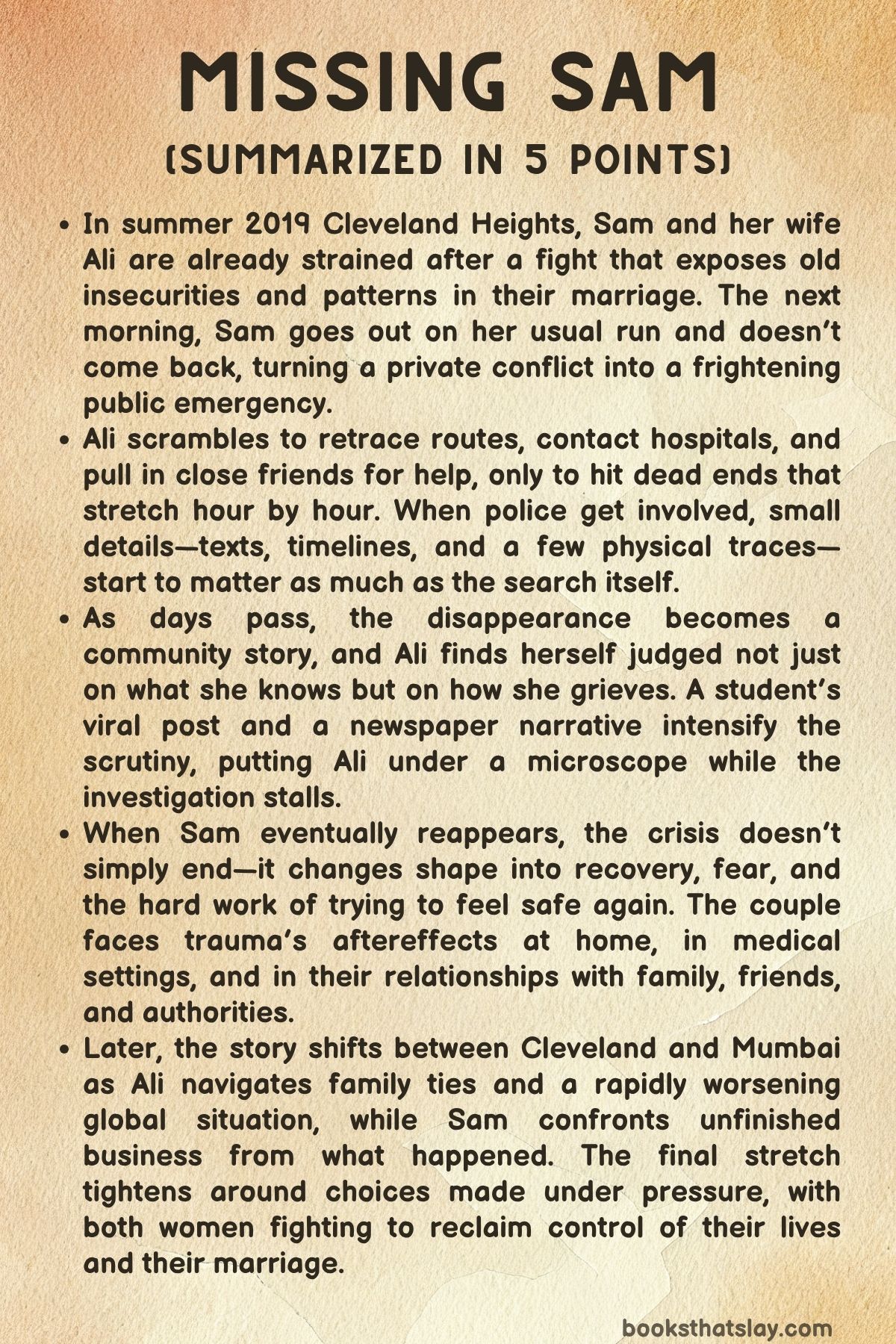
Summary
Samantha “Sam” O’Malley and her wife, Aliya “Ali,” start July 2019 at odds. After a party, Sam believes Ali paid too much attention to their friend Jan, and the argument follows them home.
The neighborhood is dealing with a power outage, and the darkness in the house matches the mood between them. Sam refuses to join Ali upstairs and sleeps in the guest room.
Even when they are under the same roof, they keep fighting through sharp text messages, repeating a pattern both of them recognize too well.
The next morning, Sam leaves early for her run without waking Ali. She wants space and a clear head before friends arrive for the July Fourth holiday.
Out on the quiet streets, she notices a few unsettling details and feels on edge. Near the route by Lower Shaker Lake, a white SUV moves in a way that catches her attention.
Distracted, she trips on a raised, uneven section of sidewalk that she usually avoids. She falls hard.
Ali wakes to find Sam gone and decides to stay home to handle chores before their guests arrive. As the morning passes, she checks the clock more often.
By nine, Sam still isn’t back. Ali realizes Sam’s phone was left behind in the guest room, which makes it harder to reach her and harder to explain the absence.
She tries calling places Sam might stop, like the Stone Oven bakery, but no one has seen her. Ali’s worry shifts rapidly between anger and dread: part of her wonders if Sam is trying to punish her, but a louder part imagines Sam hurt somewhere with no way to call for help.
Ali calls their friend Nathan and then begins searching on her own, driving Sam’s usual route and calling nearby hospitals. No emergency room has a patient matching Sam’s name.
She walks the lake path, scanning for any sign of an accident. Hours later, she returns home with nothing.
She is forced to tell their visiting friends, Sally and Maureen (“Mo”), that she can’t pick them up as planned.
Sally and Mo arrive by cab and step straight into the crisis. They help Ali repeat calls to hospitals, contact neighbors, and reach out to Sam’s workplace.
Still nothing. That evening, the three of them try to act as if Sam could come through the door at any moment.
They drink wine, make food, and keep listening for a car in the driveway. When Sam doesn’t return, Ali checks their shared credit card for activity.
There is none, which makes her fear worse: no purchases means no routine stops and no sign Sam is moving around freely.
By Tuesday, Ali can no longer tell herself this is a normal marital blowup. She calls the police.
The first officer who arrives is skeptical, pressing Ali on the timeline and on why she waited. A detective, Mike Herrington, takes over and asks detailed questions about Sam’s habits, her running route, and anyone who might have had conflict with her.
Ali remembers a tense interaction with a laborer who worked on their garden beds, a man who became angry about scheduling and money and used a slur. Herrington treats the detail seriously, collects basic evidence from the home, and looks through Sam’s phone and journal.
The journal includes Sam’s suspicions about Jan and a line about wanting to disappear, which adds another troubling angle to the investigation.
Ali tries to keep moving forward, but her choices become fuel for other people’s judgment. She goes with friends to a holiday concert at Blossom to avoid staying trapped in the house, and during the event Sam’s graduate student Candace Brickman corners her, hungry for information.
Ali refuses to talk. Later, she realizes Candace took a photo.
The next day, Candace posts the photo online, contrasting Ali smiling at the concert with a flattering picture of Sam and accusing Ali of acting normal while her wife is missing. Candace urges strangers to send her tips and frames herself as the person who truly cares.
The post spreads quickly. When Ali privately demands Candace remove it, Candace reposts Ali’s message to paint Ali as cold and defensive.
The situation becomes an online mob, with arguments in the comments and people building stories from scraps of rumor.
Ali also recognizes that Sam’s estranged parents may not even know Sam is missing. She calls them and learns how complicated their family has become, including her father’s cognitive decline and her mother’s exhaustion.
The call adds grief of a different kind: even in crisis, Sam’s relationship with her parents remains fragile.
Herrington eventually finds the first physical trace of Sam: a small blood spot on Stratford Road and strands of red hair caught under the lip of a raised sidewalk slab. A K-9 track supports the idea that Sam ran that way.
The evidence suggests a fall and a head injury, and the lack of more blood makes an attack less likely, though nothing is certain. Ali recognizes the exact uneven slab near a large brick house and is overwhelmed by how small the evidence is compared to the size of her fear.
Despite Herrington’s warning not to publicize the location, Ali goes there herself and confronts the homeowners. They claim they were away and already spoke to police, and their dismissive tone enrages her.
The confrontation goes nowhere, and Ali leaves feeling both ashamed and powerless.
As the investigation continues, one early suspicion is eliminated: the laborer’s alibi checks out through footage and work records. The case stalls.
Meanwhile, the public narrative gets uglier. Online, Ali becomes a target of racist and conspiracy-laced accusations.
A reporter from The Plain Dealer calls and pushes the idea that Ali’s behavior is suspicious: she waited to contact police, she went out in public, she argued with Sam at the party. Ali refuses to perform the kind of grief the world demands and hangs up, then calls her father, Irfan (“Abba”), desperate for support.
The newspaper runs a front-page story that amplifies the suspicion, quoting colleagues and neighbors and promoting a vigil organized by Candace. Abba arrives in Cleveland and is furious, insisting Ali must defend herself out loud.
Herrington returns with a new pressure point: police recovered the text messages Ali deleted from Sam’s phone on the day the report was made. Ali admits she erased them in panic, afraid the fight would make her look guilty.
Herrington warns her that half-truths only hurt the search.
Trying to regain control, Ali meets with the reporter and announces a $25,000 reward. The resulting article includes a sarcastic remark Ali makes under pressure, which is printed in a way that makes her look flippant.
Tips arrive in a flood, many worthless, some malicious, including a hoax designed to exploit the reward. Ali’s work suffers too as clients cancel projects, uneasy about the attention around her.
Weeks pass. Ali’s home becomes a hollow place.
She cycles through anger, dread, and longing, and finds brief human connection in unexpected places, including a mosque where she meets Tasneem, a woman who offers simple companionship without demands. Still, nothing changes the central fact: Sam is gone.
Then, on August 21, Sam returns home alive, but not whole. She is exhausted, in pain, and haunted by what happened.
She has spent weeks held in a small space, and ordinary life now feels unsafe. Even medical care is hard.
At a chiropractor appointment, panic takes over when she feels out of control, and she lashes out, ashamed afterward. Detective Herrington keeps pressing for details, but Sam remembers little about her captor because she was blindfolded.
One small slip reveals how physically close her captor must have been, and Ali is shaken by what that implies.
Sam tries to move forward in small steps—cooking a meal, visiting family—but trauma keeps interrupting the attempt at normal life. Their visits to both Ali’s family and Sam’s parents show different kinds of strain: Ali’s relationship with her father begins to thaw, while Sam confronts the decline of her own father and the burden her mother carries.
The couple also struggles privately. Sam avoids therapy and lies about it, choosing numbness over retelling the story.
When Ali discovers the lie, they promise each other there will be no more secrets, even though both of them know how hard that promise will be to keep.
The narrative later shifts to Ali traveling to Mumbai with Abba and Yasmin for a family wedding during the early days of Covid-19 news. In the crowded intensity of Bhendi Bazaar and the wedding preparations, Ali sees parts of her father that rarely show at home and is reminded how many forms family can take.
She also learns a disturbing secret from Kabir, a relative facing an arranged marriage while hiding that he is gay. The trip is filled with affection, pressure, and growing worry as shutdown rumors spread.
Back in Cleveland, Sam has a confrontation with Candace, who tries to claim ownership over Sam’s trauma for her own work. Sam draws a clear boundary and defends Ali, reminding herself who her marriage is with and who it is not with.
As travel restrictions tighten, Abba urges Ali to leave Mumbai immediately. Ali struggles to get out, bouncing through airports and rerouted flights.
At the same time, a break finally happens in Cleveland: Sam recognizes a man connected to her captivity and traces him to a house with a white SUV. When she goes there, the man attacks her and forces her inside.
Ali, stuck in traffic on the phone with Sam, contacts Detective Herrington with the name and location.
Sam fights back, manages to injure the attacker, and escapes into the street. Police arrive and take the man down.
Herrington calls Ali, and Ali hears Sam’s voice—alive, shaken, and certain they finally have him. The man’s identity turns out to be false, a stolen name, but the immediate threat is over.
After a brutal journey back through international connections, Ali returns to Cleveland. Sam waits for her at home, determined that with the attacker caught, they can begin the long work of rebuilding their life together.
Characters
Samantha “Sam” O’Malley
In Missing Sam, Sam is the gravitational center of the story: a respected professor and a disciplined runner whose outward competence masks an interior life shaped by old wounds. In her marriage, she often experiences love through the lens of threat—reading Ali’s warmth toward others as abandonment, and responding with jealousy that she frames as self-protection.
The early fight shows how quickly Sam’s fear becomes accusation, yet it also reveals her self-awareness: she recognizes their conflicts as “scripted,” suggesting she can name the pattern even when she cannot stop it. After her disappearance and return, Sam’s character shifts from sharp, controlling vigilance into a traumatized vigilance—her need for control becomes physical, immediate, and survival-based.
Her panic during treatment, her refusal to engage fully with police, and her avoidance of therapy expose a woman who cannot bear being looked at, questioned, or handled—because those acts echo captivity. At the same time, Sam’s insistence on cutting her hair, her attempt to cook again, and her fierce boundary-setting with Candace show a stubborn will to reclaim authorship of her own story, even when reclaiming it hurts.
Aliya “Ali”
Ali is drawn as both caretaker and lightning rod: capable, organized, and publicly legible in a way that makes her easy for others to judge when Sam vanishes. She begins as the “reasonable” spouse in the argument—pushing back against Sam’s jealousy and naming it as controlling—but the narrative steadily complicates that impression by showing Ali’s reflex to manage appearances.
Her decision to delete texts is not simply panic; it reveals a deeper fear of being misread and punished by institutions, neighbors, and the internet, a fear that becomes tragically self-fulfilling. Ali’s grief does not look like stillness; it looks like motion—cleaning, calling, driving routes, making plans, clinging to normal outings, and later bargaining with herself that she will change if Sam comes back.
As the public backlash grows, Ali becomes a study in isolation: she is left defending not only her innocence but her right to grieve in her own way. When Sam returns, Ali’s devotion turns into a different challenge—learning how to support without surveilling, how to be helpful without taking over, and how to rebuild intimacy without demanding proof that everything is “normal” again.
This makes Ali one of the most emotionally complex figures in Missing Sam, because her love is sincere even when her fear leads her into mistakes.
Jan
Jan functions less as a fully present character and more as a catalyst for what is already unstable between Sam and Ali. Sam’s fixation on Jan’s flirtation highlights how jealousy in this relationship is rarely about a single incident; it is about Sam’s fear of being replaced and Ali’s frustration at living under suspicion.
Jan’s importance is symbolic: she represents the social world that Ali moves through with ease and that Sam experiences as a stage where humiliation is always possible. Even when Jan is off-page, she remains present as the trigger that exposes the couple’s deeper conflict—whether love can exist without constant reassurance, and whether reassurance can be offered without resentment.
Sally
Sally becomes one of the story’s emotional first responders: practical, loyal, and quick to step into crisis management when Sam is missing. Her presence gives Ali a stabilizing witness—someone who can see both Ali’s fear and her messy choices without collapsing the situation into a simple verdict.
Sally also embodies the impulse to fight back publicly; by defending Ali in Candace’s comment section, she turns care into combat, revealing how easily loyalty can escalate a situation that already feeds on attention. Through Sally, the narrative shows a painful truth: advocacy in the public square often hardens into performance, and performance can eclipse the person everyone claims to be helping.
Maureen “Mo”
Mo operates as the blunt truth-teller in Ali’s orbit, the friend who recognizes how dangerous half-truths become once police and public opinion enter the room. She pushes Ali to stop minimizing, to stop shaping narratives, and to face facts—especially the fact that credibility is fragile when a loved one is missing.
Mo’s steadiness isn’t cold; it is protective in a different key than comfort, insisting that survival requires clarity. She also functions as a mirror for Ali’s spiraling anxiety: when Mo insists on boundaries, it underscores how quickly Ali’s mind races toward worst-case scenarios and self-incriminations.
Nathan
Nathan is Ali’s anchor to ordinary life and a reminder that solidarity can be quiet rather than theatrical. He helps with logistics, accompanies Ali in public spaces where she feels scrutinized, and later becomes a companion during small attempts at normalcy like a documentary outing.
His response to the teen’s homophobic insult—restraining rather than escalating—positions him as someone who understands both rage and consequence. Nathan’s role highlights how minority stress accumulates: Ali is not only grieving Sam but also absorbing constant social hostility, and Nathan is one of the few people who can stand beside her without turning her into either a villain or a symbol.
Detective Mike Herrington
Herrington is portrayed as competent, controlled, and steadily human—an investigator who understands both evidence and the volatile psychology of grief. He brings tangible anchors to a situation ruled by rumor: hair under a sidewalk lip, a blood spot, K-9 tracking, alibi verification.
At the same time, he is not a savior; his work is limited by holiday absences, scarce sightings, and the randomness of circumstance. Herrington also becomes a pressure point in Ali and Sam’s marriage after Sam returns—his necessary questions feel invasive to a survivor, and Ali’s desire to cooperate feels, to Sam, like betrayal.
Through him, the story shows the double bind of investigation: truth-seeking can retraumatize, but silence can also trap people inside fear.
Patrol Officer Brian Woods
Woods represents the first institutional filter Ali must pass through—skeptical, procedural, and primed to doubt a narrative that feels incomplete. His posture forces Ali to confront how her own secrecy reads from the outside, and it introduces the story’s theme that perception often becomes a substitute for proof.
Woods is not painted as monstrous; he is a functionary of suspicion, demonstrating how quickly a distressed spouse can become a suspect when emotion, timeline gaps, and social bias intersect.
Candace Brickman
Candace is the most combustible character in the social ecosystem around Sam’s disappearance: ambitious, performative, and hungry to be central to a tragedy that is not hers. Her public post weaponizes moral certainty—framing Ali’s imperfect grief as guilt—and it exposes how quickly social media turns missing-person anguish into content, clout, and community theater.
Candace’s later confrontation with Sam reveals something even more unsettling: she believes proximity to trauma grants ownership of it, calling it “their” collective experience. Sam’s rejection of her is therefore not just professional discipline; it is a survivor refusing to be converted into someone else’s narrative fuel.
Jenny Burns
Jenny, as a reporter, embodies the story’s critique of institutional storytelling: her questions are pointed, her framing is consequential, and her incentives align more with conflict than nuance. She presses Ali for a digestible explanation—why no police call immediately, why concerts and breweries, why deleted texts—because ambiguity doesn’t sell.
Even when Ali attempts to reclaim the narrative by offering a reward, Jenny’s inclusion of the sarcastic “washing my hair” remark shows how media can immortalize a moment of defensive exhaustion and turn it into character evidence. Jenny is not only an antagonist; she is a mechanism, illustrating how modern public life converts private suffering into public verdicts.
Ramon Garcia (Ramos/Ramon)
Ramon is introduced as a plausible suspect because he sits at the intersection of fear, prejudice, and circumstance: an angry labor dispute, a slur, and the convenient storyline of the “threatening outsider.” The investigation clearing him exposes how quickly communities reach for a satisfying explanation—especially one that aligns with bias—when randomness is unbearable. Ramon’s role underscores a moral discomfort in the narrative: Ali’s desperation to help police is genuine, yet the lead she provides also shows how easily a marginalized person can be pulled into suspicion because they were angry and poor at the wrong time.
Tasneem
Tasneem arrives as an unexpected tenderness—someone who recognizes Ali from the news but chooses companionship rather than judgment. Her invitation to chai and food gives Ali a rare experience of being seen without being prosecuted by curiosity.
Tasneem also opens a window into Ali’s identity beyond crisis: Ali can speak about being gay as both difficulty and joy, not only as a headline-shaped controversy. In that sense, Tasneem functions as a small bridge back to humanity, suggesting that healing sometimes begins with ordinary kindness from a near-stranger.
Eric
Eric, the teenager who throws a homophobic insult, is less a developed individual than a flashpoint revealing Ali’s accumulated rage. Ali’s shove is not simply about one slur; it is a release of weeks of surveillance, suspicion, and dehumanization.
The moment exposes how grief and social hostility can fuse into volatility, and how quickly a person can become someone they don’t recognize when they have been treated as guilty for too long.
Dr. Michael Salinger
Dr. Salinger represents a collision between professional routine and trauma reality. His treatment posture—standard, confident, hands-on—becomes unbearable for Sam because trauma has rewired her sense of safety around touch, visibility, and control.
His angry exit reads as a failure of imagination: he interprets Sam’s panic as an affront rather than a symptom. Yet his presence also underscores how survivors can be failed by ordinary interactions, not only by extraordinary violence.
Sara Salinger
Sara is the compassionate counterweight in the clinic: she does what trauma-informed care looks like in practice—offering water, patience, dignity, and an absence of penalty. Her refusal to charge is not just generosity; it is recognition that Sam’s reaction is not misbehavior but pain.
Sara’s brief role carries emotional weight because it shows how healing often depends on small, humane choices that restore agency.
Irfan “Abba”
Abba is a force of blunt love—protective, prideful, and deeply attuned to how public narratives can destroy a person. His insistence that Ali proclaim her innocence reflects both cultural survival instincts and personal history with discrimination.
Yet Abba is not only a shield; he is also a mirror that pushes Ali toward honesty, understanding that concealment breeds suspicion. Abba’s gift of a spiritual book and the comfort it brings Ali reveal his deeper character: beneath the sternness is a father who knows that endurance sometimes requires surrender, prayer, and humility.
Yasmin
Yasmin is practical, socially fluent, and rooted in family obligation, offering a contrasting model of steadiness to Ali’s unraveling. Her refusal to leave Mumbai before Kabir’s wedding highlights how duty can outweigh fear, even when danger is real.
Yasmin’s role also expands the story’s emotional geography: she is part of the family fabric that Ali has joined, and her choices show the complexity of belonging—how love can be expressed as staying put when others insist you flee.
Joe O’Malley
Joe’s dementia and later clearer signs of Parkinson’s complicate the idea of “home” for Sam. His illness makes him unpredictable—sometimes affectionate, sometimes suspicious, sometimes cruel—and his inability to consistently recognize Sam turns their estrangement into something more tragic than simply a feud.
Joe embodies a painful truth for Sam: even if she returns physically, she cannot return to the version of family she once had, because that family is slipping away in real time.
Emily O’Malley
Emily is drawn with quiet weariness—someone who has lived through conflict, aging, and caregiving until her identity is partially consumed by managing Joe. Her apology to Ali matters because it signals a thaw, but it is not a magical repair; it is the beginning of a different relationship shaped by necessity and humility.
When Emily invites Ali to call her “Mom,” the gesture carries enormous emotional significance: it suggests that catastrophe has forced open a door that pride kept shut.
Annie Fitzgerald
Annie appears as a professional contact who becomes part of Ali’s early search net. Her inclusion emphasizes how quickly a disappearance spreads through institutional channels and how colleagues become both resources and potential judges.
Even without extended presence, Annie functions as a reminder that Sam’s identity is not only domestic; she belongs to a wider professional world that will later feed rumor, suspicion, and pressure back onto Ali.
Lucy
Lucy, as a neighbor contact, represents the community layer of the crisis—the immediate social environment that can either support or scrutinize. In a story where neighborhood absence, especially holiday travel, becomes an investigative obstacle, the neighbor figure symbolizes the limits of communal knowledge: people live close enough to see you, but not close enough to truly know you.
Kabir
Kabir is written as charming, constrained, and quietly desperate—a man performing the expected script of masculinity and marriage while hiding his sexuality. His request that Aliya take him to America is less a casual dream than a survival fantasy, revealing how trapped he feels by family expectations and social danger.
Yet Kabir’s refusal to postpone the wedding, and his insistence he has “no real choice,” exposes the moral pain of constraint: he is both victim and potential perpetrator of harm if he proceeds to marry Mumtaz under false pretenses. Kabir’s character forces the story to hold two truths at once—his fear is real, and so is the damage his silence can cause.
Nasreen
Nasreen functions as the vibrant, affectionate matriarchal presence in Mumbai—warm, insistent, and socially expansive. Her home is porous to community, neighbors, and vendors, contrasting sharply with Aliya’s isolated Cleveland house during Sam’s disappearance.
Nasreen’s easy banter with Abba reveals sides of him Aliya rarely sees, suggesting that family identity is contextual: people become different versions of themselves depending on where they stand and who surrounds them.
Fatima
Fatima’s excitement for Kabir’s wedding and her warm hosting energy highlight the innocence and momentum of family celebration—momentum that can become oppressive when someone within it is trapped. She embodies the communal joy that makes questioning the marriage feel like sacrilege, which is precisely why Kabir’s secret is so heavy.
Fatima’s role reinforces how family events can be both loving and coercive without anyone intending harm.
Mumtaz
Mumtaz appears as hopeful and unguarded, which makes her one of the story’s quiet tragedies. She is positioned as the person most at risk of being collateral damage in Kabir’s conflict between selfhood and obligation.
Her presence sharpens the ethical stakes: secrecy is not only personal protection; it can become betrayal when another person’s future is built on the lie.
Joseph
Joseph, Kabir’s boyfriend, is mostly off-page, but his significance is profound: he represents Kabir’s real life, the truth that exists in private even when public life demands an opposite performance. Joseph’s relative absence also mirrors the broader theme of invisibility—how queer relationships can be treated as optional or erasable in environments shaped by fear.
Themes
Love Under Pressure and the Work of Repair
The marriage at the center of Missing Sam is shown as something that doesn’t break in one dramatic moment, but erodes through repetition: familiar fights, familiar accusations, familiar defenses. The argument after the party is not only about flirting; it becomes a proxy for deeper fears—fear of being dismissed, fear of being replaced, fear of being controlled, fear of becoming like the parents who caused old damage.
When Ali throws “you’re not your father” at Sam, it lands because it frames Sam’s jealousy as inherited harm rather than a present emotion; when Sam calls Ali’s behavior “gaslighting,” it frames Ali’s looseness with boundaries as a moral failing rather than a mismatch in temperament. Their conflict shows how easily partners can start treating each other as opponents who must be proven wrong, instead of allies solving a shared problem.
After Sam disappears, the relationship shifts into a different kind of test: not whether they can win an argument, but whether they can survive uncertainty without turning on each other. Ali’s panic is inseparable from guilt; she keeps replaying the last fight because it is easier to focus on what she did wrong than to accept that she cannot control what has happened.
Once Sam returns, love does not automatically feel safe again. Sam’s body is home, but her mind is still on that bathroom floor, still scanning for danger, still needing control over who touches her and when.
Ali wants closeness as proof that things are improving; Sam experiences closeness as a situation where she might lose control. Even their attempts at normal intimacy show the gap—Sam performs “fine” to protect Ali from more pain, while Ali stays quiet about what she suspects because she fears pushing Sam away.
Repair, in this story, is not sentimental. It is practical and often humiliating: accepting that therapy is hard, admitting lies about attending sessions, allowing a partner to help in ways that don’t match pride, and facing the uncomfortable truth that love can coexist with resentment.
The later moments that carry hope are not grand declarations. They are scenes of consent, patience, and chosen gentleness: Ali cutting Sam’s hair the way Sam wants it cut, Irfan sitting near Sam while she can’t sleep, Sam choosing to confront Candace and defend Ali, and Ali promising change without demanding immediate forgiveness.
The theme suggests that commitment is not proven by intensity, but by the daily decision to stop hiding behind familiar patterns and instead act with care even when care feels unrewarded.
Public Judgment, Performative Compassion, and the Violence of Narratives
From the moment Sam is missing, strangers begin writing a story about Ali, and that story matters more than facts. The theme is not simply “social media is bad,” but that public attention creates incentives: outrage spreads faster than uncertainty, and suspicion is more entertaining than patience.
Candace’s post is a turning point because it converts a private emergency into a public trial, with Ali placed into the role of villain and Sam into the role of symbol. Candace claims moral urgency—“some of us care”—while using the situation to elevate herself as the center of information and emotion.
Even when Ali responds privately, the private message becomes content, and the content becomes proof of Ali’s supposed character. The platform rewards escalation, not accuracy.
The traditional media then amplifies what the crowd has already decided to believe. The newspaper framing, the selective quotes, and the choice of emphasis turn Ali’s imperfect decisions into implied guilt.
The theme exposes how grief is policed: Ali is expected to behave according to a narrow script—call police immediately, stay home, appear visibly broken, never laugh, never attend an event, never try to function. When she violates that script by going to Blossom or trying to keep plans, the public reads it as evidence that she does not care, rather than a coping strategy.
The same logic punishes complexity. Ali can be panicked and exhausted and still make bad choices, like deleting texts; the public turns that into a clean moral conclusion.
Layered into this is the racism and xenophobia that attach themselves to a convenient target. Ali becomes vulnerable not only because she is the spouse, but because people can project onto her: conspiracy theories about burying Sam in a garden bed, insinuations about being an extremist, and casual suspicion shaped by her identity.
The theme shows how certain bodies are treated as inherently suspicious, and how quickly “investigation” becomes a socially acceptable cover for prejudice. The harm is concrete: clients cancel work, harassment intensifies, acquaintances turn cold, and Ali’s daily life is shrunk by fear and shame.
What makes this theme especially sharp is that some of the loudest voices claim empathy for Sam while actively hurting both women. Candace’s poem project tries to claim shared trauma, as if proximity grants ownership.
The vigil is framed as concern, yet it doubles as a stage for blaming Ali. Even the leak of police details suggests an ecosystem where attention is traded and reputations are collateral.
Against this, the story offers smaller, quieter forms of decency—people who help without performing, like the Bennetts choosing Ali for support, or the bakery owner offering comfort without questions. The theme argues that public narratives often erase truth, and that the hunger to judge can become its own kind of cruelty.
Identity, Belonging, and the Costs of Living Outside Approval
The story treats identity as something lived in daily negotiations, not a label. Being gay is not presented as a single struggle overcome once, but as a continual exposure to risk—risk of insult in public, risk of being misunderstood by institutions, risk of becoming a spectacle when something goes wrong.
Ali’s encounter with the teenager who throws a slur shows how quickly her body becomes a target, and how anger can feel like self-defense. Yet even that moment of confrontation does not resolve anything; it leaves behind the awareness that safety is fragile and often conditional on who is watching.
Family adds another layer. Sam’s relationship with her parents is marked by estrangement and conditional acceptance, and her father’s illness complicates the old injury rather than erasing it.
When he briefly recognizes her with warmth and then turns cruel again, it shows how love and rejection can exist in the same room, sometimes in the same minute. Sam’s mother’s exhaustion and tentative invitation for Ali to be called “Mom” points toward reconciliation, but not the easy kind.
It is reconciliation under strain, shaped by caregiving burdens and years of damage. For Ali, her bond with Abba carries its own tension: affection mixed with expectation, support mixed with pressure about what is “proper,” and a fear of embarrassing the family even when she is in pain.
The Mumbai sections emphasize that Ali belongs and doesn’t belong at the same time—she is connected by language, food, and history, yet she experiences the city as overwhelming and is reminded that her life in America has changed her.
Religion and community appear as possible shelter, but never as automatic comfort. Ali’s decision to enter a mosque in Cleveland happens during loneliness and public hostility; she is seeking steadiness, not a performance of faith.
The conversation and companionship she finds suggest that belonging can be built through kindness rather than sameness, and that identity can hold contradictions: Ali can be Muslim by heritage, estranged from practice, queer, and still drawn to prayer as a way to survive. The book treats that pull respectfully, as a human need for grounding when the world becomes unrecognizable.
Kabir’s confession in Mumbai adds an international mirror to Ali and Sam’s life. His fear is not abstract; it is shaped by social pressure, family duty, and the threat of hostility around him.
His wish to escape to America is both naive and heartbreaking, because it assumes geography can solve what culture and fear enforce. His arranged marriage plan reveals a darker cost: when identity is denied room to exist, people may choose harm as the least bad option, even if it destroys someone else’s future.
In parallel, Ali and Sam face their own version of forced narratives—how others insist on defining their marriage, their grief, and their morality. The theme ultimately shows belonging as something continually negotiated across family, nation, faith, and sexuality, with moments of tenderness arriving not through universal acceptance, but through a few people choosing to see them clearly.
Trauma, Control, and the Body as a Record of What Happened
Sam’s disappearance is not treated as a plot device that ends once she returns; it becomes a long-term condition that reorganizes her body and mind. The pain in her neck, back, and hip is a physical reminder that time kept moving while she was trapped in a space where time had no meaning.
Her startle responses, nightmares, and inability to sleep in a bed show that safety is no longer a simple fact. Home, once ordinary, becomes complicated: doors, blinds, strangers, even a routine appointment can trigger panic because her nervous system learned that danger can arrive without warning.
Control becomes the central need that trauma creates. Sam’s reaction at the chiropractor’s office is not about the doctor’s intentions; it is about position and vulnerability.
Lying face down removes her ability to see and anticipate, and that loss of control replicates the conditions of her captivity. Her anger is immediate because fear is immediate.
Shame follows because survivors often judge themselves for reactions that their bodies produce faster than thought. The scene also shows how trauma can damage relationships indirectly: Ali wants to help, but help can feel like surveillance, and support can feel like pressure.
When Ali monitors emails and conversations with the detective, she believes she is protecting Sam; Sam experiences it as an invasion at a time when her privacy and agency already feel stolen. Their conflict after Herrington’s visit captures a painful truth: even love can feel threatening when control has been taken away.
The theme also examines avoidance as a survival strategy that eventually backfires. Sam lies about therapy not because she is careless, but because she cannot tolerate speaking the horror aloud.
The support group, meant to help, becomes another setting where she feels forced to relive what she wants to outrun. Her panic attack while running errands shows trauma’s unpredictability: it does not wait for quiet moments, it interrupts groceries, birthdays, movies, sex.
Even intimacy becomes a site where the body remembers. Sam’s choice to initiate sex as a “gift” suggests she is trying to reclaim normal marriage roles, yet her need to end it quickly and her faked orgasm show how performance can replace desire when a person is terrified of disappointing someone they love.
Ali’s silence afterward reflects her own fear—that naming the truth might push Sam farther away.
At the same time, trauma in this story is not only damage; it also creates a different kind of clarity about what must change. Sam cutting her hair short is an act of reclaiming visibility on her own terms, a way of deciding how men will see her, or not see her.
Her recognition of the attacker’s details later, and her fierce confrontation with Candace, show a survivor refusing to be turned into an object owned by others’ narratives. The final sense of forward motion is earned through action: Sam fights back, escapes, and insists on rebuilding.
The theme presents healing as uneven and often ugly, but also possible when control is returned, truth is spoken, and both partners accept that recovery is not a straight path and not a performance for anyone watching.