Murder Takes a Vacation Summary, Characters and Themes
Murder Takes a Vacation by Laura Lippman is a mystery about Muriel Blossom, a sixty-eight-year-old widow whose first major international holiday becomes connected to stolen art, hidden gemstones and murder.
Initially uncertain about travelling without her late husband, Muriel gradually discovers that age, grief and other people’s assumptions do not have to determine the rest of her life. The book combines an art-theft investigation with an exploration of friendship, body image, loneliness and independence. As Muriel moves from London to Paris and along the Seine, she must decide whom she can trust while rediscovering abilities and desires she had suppressed for years.
Summary
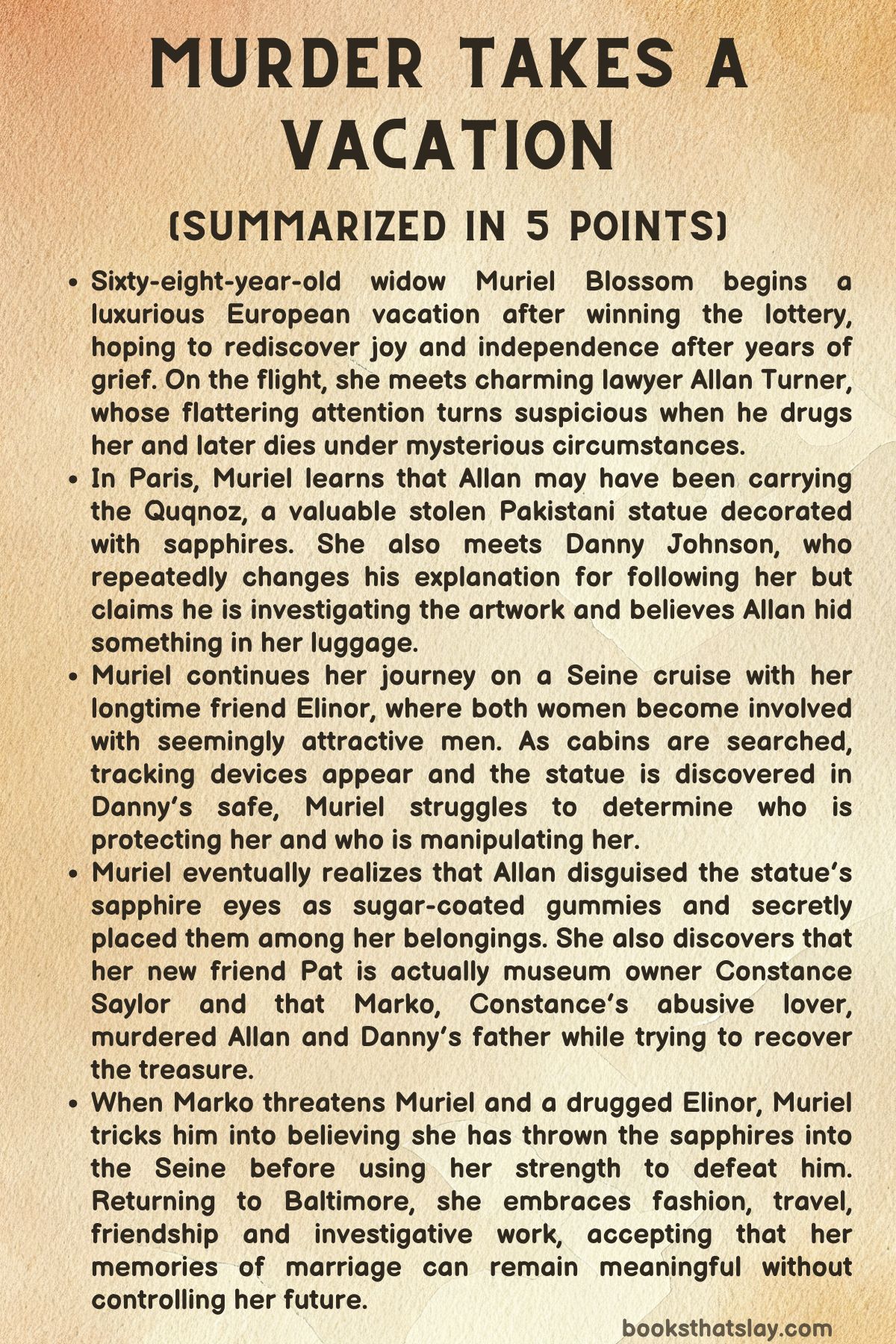
Sixty-eight-year-old Muriel Blossom begins her first international vacation by flying from Baltimore to London, where she plans to continue to Paris and then take a Seine cruise with her longtime friend Elinor. Widowed for ten years, Muriel remains strongly attached to the memory of her husband, Harold, and feels uncertain about beginning a new stage of life without him.
An unexpected business-class upgrade places Muriel beside Allan Turner, a polished silver-haired lawyer who immediately treats her with flattering attention. Because Muriel has grown accustomed to feeling overlooked due to her age and size, she enjoys being noticed by a charming man who appears interested in her stories, appearance and charm bracelet.
Allan guides Muriel through the airport, introduces her to the lounge and sits beside her during the overnight flight. He sets the small watch on her bracelet to Paris time and gives her what he claims is a melatonin gummy, after which she falls into an unusually deep sleep.
When Muriel awakens at Heathrow, Allan tells her that a weather delay has caused her to miss her connection to Paris. Although she suspects there may still be time, she accepts his judgment and allows him to arrange a room at the St. Pancras Hotel and a Eurostar ticket for the following day.
Allan spends the afternoon showing her London, taking her to famous attractions, expensive shops and an elegant restaurant. Muriel enjoys the attention but occasionally resents the way he assumes that she is inexperienced and unable to manage without him.
During dinner, Allan admits that the gummy was cannabis rather than melatonin. Muriel is disturbed that he gave her a drug without permission, yet Allan apologizes so convincingly that she allows herself to believe his actions came from concern rather than manipulation.
Later, Allan accompanies Muriel to her hotel room, where they kiss passionately. Although nothing further happens, the experience awakens romantic and physical feelings she had believed ended with Harold’s death.
The next morning, Muriel travels to Paris while thinking happily about Allan. She also reflects on the surprising circumstances that made the luxurious trip possible: shortly before leaving Baltimore, she found an abandoned lottery ticket worth $8.75 million.
Muriel attempted to locate the ticket’s original owner before claiming the prize anonymously. She used part of the money to help her daughter and granddaughters, purchased a new apartment and planned the expensive holiday, although her former employer, private investigator Tess Monaghan, warned her that sudden wealth could attract dishonest people.
In Paris, Muriel notices a stylish younger man watching her on the Eurostar and later sees him at her restaurant. When she confronts him, he introduces himself as Danny Johnson, an American stylist with connections to Baltimore.
Danny’s confident and irritating manner makes Muriel suspicious, but she agrees to dine with him. Their evening is interrupted when police officers arrive at her hotel and inform her that Allan has died after falling from a Paris balcony, even though he had claimed that he would remain in London.
Allan’s final message includes Muriel’s photograph, name and location, together with the words, “A very nice lady, she has your eyes.” Danny claims to be Muriel’s son so that he can remain with her during the questioning, but his unexplained involvement makes her increasingly uncertain about his motives.
The following day, Danny takes Muriel to Cece, a Parisian designer who creates luxurious clothing for larger women. Cece bluntly tells Muriel that her conservative hairstyle and clothing seem designed to make her harmless, respectable and easy to overlook.
Muriel is initially offended, but trying on a platinum wig and a dramatic caftan changes the way she sees herself. She purchases bright shoes, jewellery, sunglasses and other items that allow her to occupy space without apologizing for it.
Danny explains that clothing communicates the identity a person wishes to present. Muriel tells him about her past surveillance work for Tess, while Danny describes his mother, whose fatal eating disorder reflected her desire to make herself physically smaller.
Upon returning to her hotel, Muriel discovers that someone has carefully searched her room. Her clothes, shoes and toiletries have been examined or dismantled, but no money or jewellery has been stolen, suggesting that the intruder wanted a particular hidden object.
Muriel continues exploring Paris and visits an exhibition pairing Claude Monet with Joan Mitchell. Mitchell’s bold work affects her deeply because it represents a woman who refused to diminish herself or seek permission to exist confidently.
She begins questioning how much of her personality she suppressed during her marriage. Harold disliked her interest in punk and New Wave music, so she gradually replaced those passions with interests he considered more respectable.
After leaving the exhibition, Muriel realizes that she is being followed. Drawing upon her surveillance experience, she enters a crowded demonstration, removes her recognizable accessories and disappears among the protesters.
Elinor soon arrives in Paris, but Muriel conceals Allan’s death, the hotel search and the man who followed her. Their conversation reveals both the strength of their sixty-year friendship and the difference between Elinor’s energetic search for another husband and Muriel’s uncertainty about romance.
That night, a man disguised as a hotel bellman asks Muriel to leave her suitcase in the hallway. Muriel refuses and secretly follows him to a café, where she sees him meeting the man who followed her and then Danny.
Muriel overhears a reference to a suitcase and concludes that Danny is involved in the attempts to search her belongings. The next morning, however, he reveals that he arranged for Elinor to spend the day at a spa so that he could speak privately with Muriel.
Danny claims that he is an FBI agent investigating stolen art. Allan had been carrying the Quqnoz, a valuable Pakistani statue shaped like a phoenix and decorated with sapphires, and Danny had arranged a false London purchase in the hope of recovering it.
Instead of attending the meeting, Allan spent the day with Muriel and then travelled to Paris, where he died. Danny believes Allan may have hidden the statue or some part of it in Muriel’s luggage, although he denies searching her hotel room.
Muriel and Elinor board the MS Solitaire for their Seine cruise, hoping to escape the danger. Muriel is annoyed to discover that Danny has booked passage on the same ship, apparently to continue watching her.
Danny introduces Muriel to Paul Paterakis, a widower from Pennsylvania whose warmth and manners remind her of Harold. Muriel feels attracted to him, while Elinor becomes interested in Marko, a handsome traveller who claims to be accompanying his disabled sister.
Muriel also befriends Patience “Pat” Siemen, a wealthy and physically frail older woman travelling in a nearby cabin. Pat is witty, perceptive and direct, and she encourages Muriel to see herself as the central figure in her own life rather than a supporting character in someone else’s.
During a private outing to Vétheuil, Danny insists on accompanying Muriel. After someone attempts to steal her purse, she demands proof of his identity, and he changes his story by claiming that he is a freelance investigator employed by an insurance company.
Muriel finds a GPS tracker hidden in her purse but does not tell Danny. Instead, she contacts Tess, who researches the Quqnoz and discovers that it once belonged to Constance Saylor, the owner of a struggling private museum that burned down in 2009.
The museum’s handyman, Daniyal Hassan, supposedly set the fire, while the statue was believed destroyed. However, the absence of its sapphires from the ruins caused investigators to suspect that the Quqnoz had been removed before the fire.
Hassan recently died in a gas explosion, while Constance supposedly drowned years earlier in Lake Lugano. Tess warns Muriel that the people watching her may also know about her lottery winnings.
Muriel’s relationships aboard the ship become increasingly complicated. Paul behaves romantically toward her at Giverny but suddenly disappears after becoming ill, while Marko’s relationship with Elinor grows more intimate.
Muriel is also repeatedly judged because of her size. When a guide discourages her from making a difficult climb, she allows embarrassment to stop her, but she later regrets letting another person decide what she can physically accomplish.
Someone searches Muriel and Elinor’s cabin, carefully replacing most items in an attempt to conceal the intrusion. Muriel moves Danny’s tracker into Pat’s tote bag, hoping to misdirect him and observe how he responds.
The plan leads Danny into Pat’s cabin, where he is accused of stealing her expensive pink ring. A search of Danny’s room uncovers the ring, Swiss currency and the missing Quqnoz locked inside his safe.
Although Danny insists that the evidence was planted, the authorities remove him from the ship. Muriel concludes that his investigation may have been a dishonest story invented to hide his own thefts.
Paul later telephones from Paris and explains that severe food poisoning caused his sudden disappearance. He invites Muriel to dinner in his hotel suite when the ship returns, restoring her hope that a genuine romantic relationship may still be possible.
A delay prevents the ship from reaching Paris as planned, and the passengers instead visit La Roche-Guyon. When the guide again implies that Muriel is physically incapable, she responds by climbing 255 steps and proving to herself that she no longer needs to accept other people’s limitations.
That evening, a mentalist’s performance causes Muriel to reconsider Allan’s final message. She realizes that “eyes” referred to the Quqnoz’s sapphire eyes and that sapphires can be pink or salmon coloured.
The crusty gummies Allan gave her were not ordinary sweets or drugs but gemstones coated in sugar. Allan had secretly transferred the statue’s sapphires to Muriel, relying on her trusting nature and innocent appearance to carry them through customs.
Before Muriel can act, Pat enters with champagne, followed by Marko and a drugged Elinor. Muriel realizes that Pat is actually Constance Saylor, who faked her drowning, and that Marko is her accomplice rather than her brother.
Marko draws a gun and demands the sapphires. Muriel pretends that the stones are still inside her pillbox and throws its contents into the Seine, sacrificing sentimental earrings connected to Harold to make the deception convincing.
When Marko leans over the balcony, Muriel uses her body weight to push him into the river. She also defends herself against Constance until the authorities arrive and take control of the situation.
Danny returns and reveals that he truly is an FBI agent, although his investigation was unauthorized. Daniyal Hassan was his father, and Danny was personally determined to uncover the truth about the statue, the museum fire and Hassan’s death.
Muriel then reveals that she kept the real sapphires in her pocket. Her quick thinking saves both herself and Elinor while preserving the evidence needed to expose the larger criminal scheme.
At the hospital, Constance explains that Marko was her much younger lover. He persuaded her to burn the failing museum for insurance money, while Hassan started the fire and Allan managed the legal and financial arrangements.
When the insurer questioned whether the Quqnoz had truly been destroyed, Marko convinced Constance to fake her death. He then gained control of their Swiss accounts and gradually spent most of the money.
Years later, Hassan attempted to sell the statue. Marko killed both Hassan and Allan while trying to recover it, manipulated Elinor to gain access to Muriel’s cabin and planted the statue, cash and ring in Danny’s room.
Constance admits that Marko abused her but continues to insist that he loved her. Muriel encourages her to cooperate with the authorities and recover the intelligent, lively identity she displayed while pretending to be Pat.
Muriel secretly records the conversation for Danny but withholds Constance’s most private and humiliating confessions. She gives him the information needed to investigate his father’s death without surrendering every vulnerable detail entrusted to her.
Two months later, Muriel is living independently in her new Baltimore apartment. She attends films, visits restaurants alone, studies French, accepts surveillance work from Tess and plans another European journey.
Muriel remains in contact with Paul but no longer feels that romance must define her future. Danny, reassigned to a desk job after being disciplined for his unauthorized investigation, plans to move to Baltimore, and the two decide to become friends.
Muriel finally asks Danny to open a fortune-cookie charm Harold gave her and read the message inside. Before hearing the words, she understands that she no longer needs a final judgment about whether her marriage was perfect or whether her past mistakes cancelled the love she shared with Harold.
Her memories remain important, but they no longer control her decisions. Muriel ends the story prepared to build a life shaped by curiosity, independence, friendship, pleasure and her own understanding of who she wishes to become.
Characters
The characters in Murder Takes a Vacation are connected by questions of trust, visibility, regret and reinvention. Each person either encourages Muriel to claim greater control over her life or attempts to exploit the qualities that once made her seem harmless.
Muriel Blossom
At the center of Murder Takes a Vacation, Muriel Blossom begins as a loving but uncertain widow who has spent ten years measuring her present life against her marriage to Harold. She is intelligent and observant, yet grief, routine and social judgment have caused her to underestimate both her abilities and her right to seek pleasure.
Muriel’s trusting nature is not the same as foolishness. She initially believes Allan because she wants his attention to be sincere, but once inconsistencies appear, her former investigative instincts return and allow her to detect surveillance, evade followers and recognize manipulated evidence.
Her relationship with her body is central to her development. Years of being judged because of her size have taught her to dress quietly, avoid difficult situations and accept the possibility that others will decide what she can do.
Through Cece’s clothing, Joan Mitchell’s art and the challenges of the journey, Muriel begins to understand that becoming invisible was partly a defensive strategy. She gradually chooses brighter clothes, physical challenges and public confidence, not because her body has changed but because her understanding of it has.
Muriel also confronts the moral complexity of her marriage. She loved Harold deeply, but she recognizes that she abandoned interests for him and remained burdened by guilt over an affair, making her memories a mixture of devotion, compromise and regret.
Her final victory comes through judgment rather than force alone. She recognizes the sapphires, protects Elinor, defeats Marko and decides how much of Constance’s confession Danny truly needs, showing that compassion can exist alongside courage and practical intelligence.
Danny Johnson
Danny is introduced as an intrusive younger man whose polished appearance, shifting explanations and repeated interference make him difficult to trust. His tendency to arrange Muriel’s movements without permission often resembles the controlling behaviour he claims to be protecting her from.
His false identities deepen that uncertainty. He presents himself first as a stylist, then as an FBI agent, then as an insurance investigator, creating the impression that every truth he offers may conceal another motive.
Danny’s interest in Muriel is partly professional because Allan used her to transport the sapphires. However, his attention gradually becomes more personal as he recognizes her intelligence, courage and loneliness.
His investigation is driven by grief over his father, Daniyal Hassan. Because official procedures have failed to satisfy him, Danny conducts an unauthorized operation that places both himself and Muriel in danger.
The planted evidence against him shows the consequences of his secrecy. Since Muriel cannot distinguish his genuine claims from his manipulations, she is prepared to believe that he is a thief when the statue and stolen ring appear in his room.
Danny ultimately becomes a companion rather than a saviour. His friendship with Muriel rests on the recognition that neither of them should expect one person to provide every form of emotional support.
Elinor
Elinor is Muriel’s oldest friend and represents a more openly adventurous response to widowhood. Having already experienced several marriages, she remains interested in romance and approaches travel with confidence, appetite and social ease.
Her confidence, however, hides insecurities of its own. Elinor admits that thinness has long felt like her greatest achievement, revealing how deeply appearance has shaped her identity even though her experience differs from Muriel’s.
Elinor does not initially understand how painful casual discussions of dieting can be for Muriel. Their honest conversation strengthens the friendship because Elinor listens rather than dismissing Muriel’s experience.
Her attraction to Marko exposes her vulnerability. Like Muriel with Allan, she wants to believe that late-life romantic attention can be sincere, making her susceptible to someone who uses affection as an investigative tool.
Elinor is neither foolish nor shallow. Her mistake demonstrates that intelligence and experience cannot completely protect a lonely person from emotional manipulation, especially when the manipulator offers exactly the kind of attention that person desires.
Allan Turner
Allan appears courteous, sophisticated and protective, but his generosity is inseparable from calculation. He studies Muriel carefully, recognizes that she is flattered by male attention and uses that knowledge to gain access to her belongings and physical space.
Giving Muriel cannabis without her consent reveals his willingness to control her while describing that control as care. His apology succeeds because he understands how strongly she wants to believe that the romantic encounter has meaning.
Allan is also a morally compromised participant in the museum fraud. He handled legal and financial matters for Constance and later attempted to move the Quqnoz and its sapphires without being caught.
His final message shows both calculation and possible concern. By identifying Muriel and referring indirectly to the gemstones, he leaves a clue that eventually helps expose the truth, although doing so also places her in danger.
Allan’s brief relationship with Muriel remains emotionally important because it reawakens desires she had suppressed. Even though his motives were dishonest, Muriel’s renewed sense of attraction and possibility is real.
Constance Saylor and Patience Siemen
Constance first appears under the identity of Patience “Pat” Siemen, an elegant older woman whose humour and directness make her an appealing companion. As Pat, she gives Muriel valuable advice about independence, spending money meaningfully and becoming the main figure in her own life.
This false identity is more than a disguise. Pat represents the lively and perceptive self that Constance might have become had she not surrendered her judgment to Marko.
Constance is responsible for serious wrongdoing, including insurance fraud, the destruction of her museum and years of deception. Yet she is also trapped within an abusive relationship that has distorted her understanding of loyalty and love.
Her insistence that Marko loves her reveals the psychological power he continues to hold. Even after he has depleted her money, manipulated her and used violence against her, she protects the emotional story that allowed her to remain with him.
Muriel’s response combines accountability with compassion. She urges Constance to assist the authorities but also protects the most humiliating parts of her confession, acknowledging that wrongdoing does not eliminate a person’s dignity.
Marko
Marko is charming, attractive and socially skilled, using these qualities to conceal cruelty and greed. He studies emotional weaknesses and offers people carefully tailored attention, treating intimacy as a method of gaining access and control.
His relationship with Constance is exploitative from the beginning. He encourages the museum fire, persuades her to fake her death and takes control of her money while maintaining power through emotional and physical abuse.
Marko uses Elinor in a similar manner. He presents himself as an interested romantic companion but searches her cabin and drugs her once she is no longer useful as a willing source of access.
His murders of Hassan and Allan show that his greed has removed nearly every moral boundary. He considers objects, money and people valuable only when they can serve his plans.
Marko’s defeat carries symbolic importance because Muriel uses the body others have mocked as a source of strength. The quality society taught her to regard as a weakness becomes the means by which she protects herself and Elinor.
Paul Paterakis
Paul represents the possibility of romance without immediate danger or manipulation. His warmth, traditional manners and comfortable conversation remind Muriel of Harold while also allowing her to imagine a relationship that belongs to her present life.
His unexplained disappearance makes him suspicious because it occurs while Muriel is surrounded by deception. Danny’s warnings further encourage her to wonder whether Paul is another man attempting to use her.
The explanation that he suffered food poisoning restores his credibility, but the cancelled dinner prevents the relationship from reaching a simple romantic conclusion. This uncertainty is important because Muriel no longer needs a new partner to validate her future.
Paul remains part of her life after the journey, yet she is unsure whether she wants love, companionship or friendship. Her ability to tolerate that uncertainty shows how far she has moved from believing that happiness requires a clearly defined romantic outcome.
Harold Blossom
Harold is dead before the story begins, but his influence remains present in Muriel’s habits, memories and decisions. She remembers genuine affection and companionship, making him an important source of emotional security even in his absence.
At the same time, Muriel gradually recognizes the compromises within their marriage. Harold discouraged her interest in music, and she adapted herself to his preferences until parts of her identity became difficult to recover.
Muriel’s past affair complicates her memories further. She has carried guilt for decades and fears that one mistake may have invalidated the love and loyalty that defined much of the marriage.
The unopened message in Harold’s charm becomes a symbol of her need for judgment. By deciding that she no longer requires its verdict, Muriel accepts that a marriage can contain love, disappointment, forgiveness and imperfection without being reduced to one final answer.
Tess Monaghan
Tess functions as Muriel’s practical connection to her former investigative life. Although she remains outside the main action, her research provides essential information about Constance, the museum fire, Hassan and the Quqnoz.
She understands Muriel’s abilities but also recognizes her vulnerability. Her warning about the dangers of sudden wealth proves accurate because the lottery prize makes Muriel potentially attractive to opportunists.
Tess’s presence reminds Muriel that retirement and widowhood have not erased her professional competence. By the end, Muriel is again completing surveillance work for her, turning skills once treated as part of the past into part of her independent future.
Cece
Cece is blunt, creative and unwilling to support Muriel’s habit of hiding behind safe clothing. Her criticism initially seems harsh, but it forces Muriel to confront the possibility that her appearance has become a form of self-erasure.
The transformation Cece offers is not about making Muriel thinner or younger. Instead, she designs clothing that treats Muriel’s body as worthy of colour, luxury, attention and deliberate presentation.
Cece helps Muriel separate visibility from shame. The new clothes become external signs of an internal decision to stop arranging her life around other people’s comfort.
Daniyal Hassan
Daniyal Hassan never appears directly, yet his fate motivates much of the investigation. As the handyman blamed for the museum fire, he carries public responsibility for a crime created by several wealthier and more powerful people.
His later attempt to sell the Quqnoz suggests that he retained the statue after the fire, although the exact balance between his participation and exploitation remains morally complicated. He was involved in criminal activity, but Marko ultimately treated him as disposable.
Hassan’s murder transforms Danny’s investigation from a professional case into a personal search for truth. Recovering the statue becomes inseparable from restoring a fuller account of his father’s life and death.
Themes
Visibility, Age and the Right to Occupy Space
In Murder Takes a Vacation, visibility is presented as both a social privilege and a personal risk. Muriel has spent years being overlooked because she is older and larger, yet that same invisibility allows Allan and Marko to treat her as a convenient carrier who will not attract official suspicion.
Muriel has partly cooperated with this erasure by choosing modest clothes, avoiding attention and accepting assumptions about what she can physically or socially accomplish. These choices protected her from ridicule, but they also reduced her willingness to pursue pleasure, adventure and recognition.
Cece’s clothing and Joan Mitchell’s paintings challenge Muriel to see visibility differently. Bright colours, expensive shoes and bold art become signs of a woman refusing to apologize for taking up physical, emotional or creative space.
The difficult climbs offer a further test of this idea. When Muriel first accepts a guide’s judgment, she feels ashamed and excluded, but later she climbs 255 steps specifically because she will no longer allow another person to define her limits.
Her confrontation with Marko completes the transformation. The body treated throughout her life as a problem becomes a source of force, stability and survival, allowing her to protect herself and Elinor.
Visibility therefore becomes a form of self-recognition rather than a demand for approval. Muriel no longer needs to be admired by everyone, but she refuses to participate in her own disappearance.
Grief, Memory and Life After Marriage
Muriel’s grief is not shown as a feeling that simply fades with time. Ten years after Harold’s death, she still organizes much of her identity around their marriage and worries that enjoying travel, music, fashion or another man might betray him.
Her memories initially emphasize comfort and devotion. Harold represents familiarity, shared history and a version of adulthood in which Muriel understood her responsibilities and place.
As the journey continues, she allows more complicated memories to surface. Harold discouraged interests that mattered to her, while Muriel’s affair created guilt that she never fully resolved.
These discoveries do not turn the marriage into a failure. Instead, they allow Muriel to replace an idealized memory with a more honest one that contains affection, compromise, disappointment, forgiveness and uncertainty.
Allan and Paul each test her belief that romantic desire ended with Harold. Allan’s attention is dishonest, but Muriel’s response to it proves that her emotional and physical needs remain alive.
The unopened fortune-cookie message represents Muriel’s search for a final judgment about her past. When she realizes that she no longer needs to know whether Harold’s last hidden words offer approval or condemnation, she releases herself from the belief that her future must be authorized by her marriage.
Grief remains part of her, but it ceases to function as a boundary. Remembering Harold and building an independent life become compatible rather than opposing choices.
Trust, Deception and Emotional Manipulation
Nearly every important relationship contains uncertainty about intention. Allan disguises control as protection, Danny disguises investigation as friendship, Marko disguises exploitation as romance and Constance disguises herself as Pat.
These deceptions succeed because they are designed around emotional needs. Allan offers Muriel admiration, Marko offers Elinor excitement and Constance romantic devotion, while Danny presents himself as the person capable of explaining the danger.
The book distinguishes secrecy from pure malice by examining why each person lies. Marko lies to gain money and power, while Danny lies because grief and impatience have convinced him that unauthorized action is justified.
Muriel’s growth depends on developing judgment without becoming completely distrustful. She learns to examine behaviour, test explanations and preserve evidence, but she does not decide that every relationship is a trap.
Her friendship with Danny becomes possible only after his identities and motives are exposed. Trust is rebuilt not through perfect innocence but through greater honesty about grief, failure and personal need.
Muriel’s treatment of Constance’s recorded confession further complicates the theme. She values truth and accountability, yet she recognizes that possessing someone’s private pain does not automatically give her the right to expose all of it.
Trust therefore requires boundaries as well as openness. Genuine care respects consent, while manipulation removes another person’s ability to make informed choices.
Independence, Friendship and Reinvention
Muriel initially treats the vacation as a temporary break from a life that has lost much of its structure. Her daughter’s family is moving away, Harold is gone and she is unsure what purpose remains for her in Baltimore.
The journey gradually becomes evidence that identity can be reconstructed at any age. Muriel experiments with clothing, travels alone, studies art, returns to investigative work and begins learning French.
Romance is part of this new life but not its foundation. Allan, Paul and even the memory of Harold help her examine what she wants, yet she eventually rejects the idea that one partner must provide meaning, companionship and emotional completeness.
Her friendship with Elinor also becomes more mature. Their honest discussion of weight and thinness allows them to acknowledge experiences that decades of friendship had not fully revealed.
Danny offers another form of companionship based on shared curiosity, humour and imperfect understanding. Their decision to become friends recognizes that people can hold different roles in a life without one relationship replacing every other connection.
Money supports Muriel’s reinvention, but wealth alone does not create it. The lottery prize gives her access to travel, clothing and comfort, while courage determines whether she will use those opportunities to become more fully herself.
By the end, independence does not mean isolation. It means choosing relationships freely, enjoying solitude without shame and refusing to make another person the sole author of one’s future.