My Forever Girl Summary, Characters and Themes
My Forever Girl by Laura Pavlov is a contemporary friends-to-lovers romance set between Paris, Blue Sky Bay, and New York. It follows lifelong best friends Gracie Reynolds and Cutler Heart as Gracie returns from a damaging relationship and temporarily moves into Cutler’s home.
Their reunion becomes a season of professional renewal, emotional honesty, and gradually changing intimacy. The novel combines small-town warmth, family relationships, humor, and romantic tension with deeper concerns about abandonment, self-worth, career independence, and the fear of choosing love after disappointment. At its center is the question of whether two people can risk changing a treasured friendship to claim the life they have quietly wanted all along.
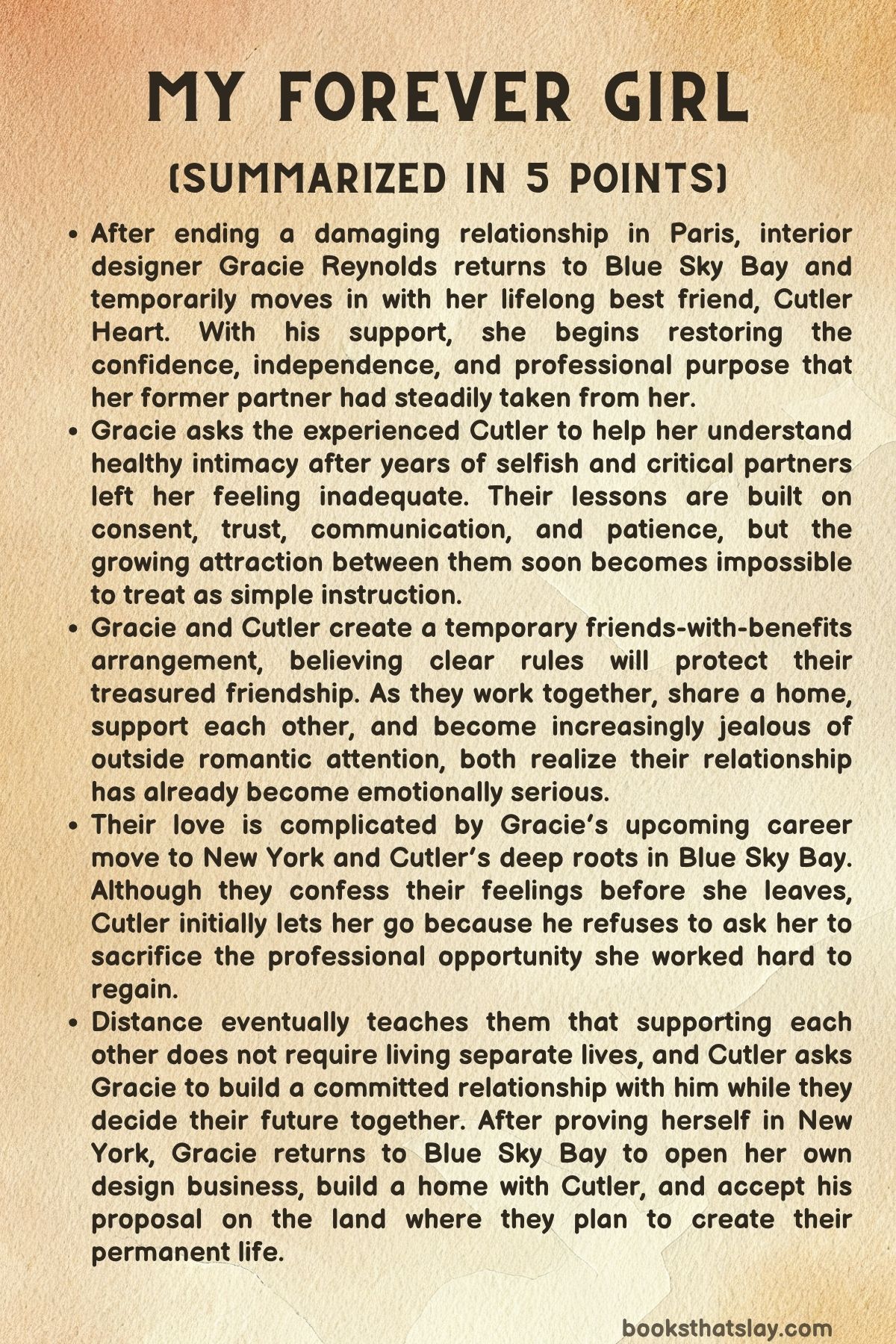
Summary
Cutler Heart prepares to travel from Blue Sky Bay to Paris to help his lifelong best friend, Gracie Reynolds, return home after ending her relationship with Gabriel Laurent. Cutler and Gracie have been inseparable since childhood, speaking almost every day and remaining emotionally closer to each other than to anyone they have dated.
Gracie is ashamed that her life in Paris has collapsed. She left a respected design job, her apartment, and her independence because Gabriel promised to support her career, but he instead expected her to assist him while abandoning her own professional ambitions.
Gabriel also cheated on Gracie and attempted to blame her for his behavior. When he visits her apartment and tries to manipulate her into staying, Gracie refuses to accept responsibility for his choices and confronts him for isolating her, weakening her confidence, and making her financially dependent.
Cutler arrives and immediately notices that Gracie appears exhausted and has lost weight. His anger toward Gabriel is intense, but he concentrates on reassuring Gracie that she is not responsible for the failure of a relationship built on broken promises.
Before leaving Paris, Gracie tells Cutler that she is finished searching for a permanent partner. She wants to explore casual dating and asks him to teach her how to separate physical attraction from emotional commitment.
Her request becomes more personal when she explains that Gabriel criticized her sexual experience and made her feel inadequate. Because Cutler has a reputation for being confident and attentive, she asks him to help her understand what satisfying intimacy should feel like.
Back in Blue Sky Bay, Gracie moves into Cutler’s lakeside home, a place she helped design and already knows well. Familiar routines, shared meals, childhood memories, and Cutler’s open affection quickly help her feel more secure.
Gracie also begins working with Cutler’s construction and architecture company. Her talent for interior design returns as she manages clients, chooses materials, coordinates projects, and helps overwhelmed homeowners make practical decisions.
Cutler is proud of her work and treats her as an equal professional partner. His respect contrasts sharply with Gabriel’s behavior because Cutler never expects Gracie to reduce herself, surrender her ambitions, or exist mainly to support him.
Their conversations about intimacy become increasingly charged. Gracie admits that none of her former partners made a genuine effort to understand her pleasure, while Cutler explains that trust, communication, patience, and mutual attention are essential parts of a healthy sexual relationship.
During one lesson, Cutler demonstrates how an attentive partner can read physical reactions while still seeking clear consent. His touch produces an intense response from Gracie, forcing both of them to recognize that their attraction is no longer theoretical.
Cutler also becomes jealous when men such as Dirk and Justin show interest in her. Although he claims to be protective, his discomfort reveals that he does not want Gracie exploring casual relationships with anyone else.
Gracie experiences similar jealousy when women from Cutler’s past approach him. Neither is comfortable imagining the other with someone else, even though both continue describing their connection as friendship.
Their emotional bond deepens during a boat trip when Cutler discusses his biological mother, Tara. She abandoned him during childhood and continues contacting him when she needs money, leaving him with a lasting desire for approval from someone who repeatedly disappoints him.
Gracie admits that she also concealed her unhappiness in Paris because she wanted to protect Cutler from worrying. They recognize that both of them broke their lifelong promise of complete honesty by hiding their pain from one another.
On the boat, Gracie asks Cutler to give her a safe, limited experience of physical intimacy. He carefully confirms her consent and focuses on her comfort, giving her the first satisfying experience she has shared with another person.
The encounter changes the emotional atmosphere between them. Gracie feels confident rather than ashamed, while Cutler realizes that being trusted by her carries more emotional weight than any casual relationship he has experienced.
They create a temporary friends-with-benefits arrangement with written rules. Gracie believes clear limits will prevent emotional complications, while Cutler accepts the agreement even though he already senses that his feelings cannot be contained by a contract.
Their first romantic kiss occurs while they are swimming together in the lake. The familiarity of their friendship makes the kiss feel natural, but the intensity behind it confirms that they are crossing into a relationship neither can easily reverse.
Spending a day caring for Brody’s young daughter, Clover, gives Cutler an unexpected image of a possible future. Gracie’s warmth with the child makes him imagine marriage and family, dreams he abandoned after childhood experiences taught him that love could disappear.
Cutler’s cousin Melody, a therapist, identifies the fear beneath his history of casual relationships. Tara’s abandonment and Emerson’s battle with cancer convinced him that emotional distance was safer than loving someone he might lose.
As Cutler begins confronting those fears, his physical relationship with Gracie grows more serious. They become exclusive, remove the rule against intercourse, and discover that their intimacy feels like a natural extension of their emotional connection rather than a temporary experiment.
Their everyday life begins to resemble a committed partnership. They work together, host friends, sleep in the same bed, care for Clover, support each other’s careers, and spend most of their free time together.
Gracie’s parents, Cage and Presley, and Cutler’s parents, Nash and Emerson, visit Blue Sky Bay. Both families have been close for years, and their easy connection shows how naturally Gracie and Cutler already belong within each other’s lives.
Complications arise when their mothers invite Britani Langford to dinner as a potential match for Cutler. Britani openly pursues him, but Cutler firmly rejects her and admits that he is already involved with someone, although he does not reveal Gracie’s identity.
The incident forces Gracie to admit that she is in love with Cutler. Unlike Gabriel, Cutler supports her work, respects her independence, values her judgment, and never asks her to reduce herself for his comfort.
Cutler reaches the same conclusion but initially decides not to confess. Because Gracie has accepted a major job in New York, he believes loving her means supporting the opportunity rather than asking her to remain in Blue Sky Bay.
Their friends challenge this approach. They argue that supporting Gracie does not require Cutler to hide his feelings or decide on her behalf that a relationship is impossible.
Gracie also begins questioning whether New York is the only valid expression of professional success. Her work in Blue Sky Bay has restored her confidence, earned public praise, and shown her that she and Cutler form an exceptional professional team.
Shortly before her departure, Gracie and Cutler finally confess their love. Cutler admits that he has loved her in different ways throughout their lives, while Gracie acknowledges that their temporary arrangement became the most important romantic relationship she has ever experienced.
The confession does not remove the problem of distance. Cutler’s company and family are based in Blue Sky Bay, while Gracie believes she must honor her commitment to the New York job and prove that she can rebuild the career damaged by Paris.
They adopt an abandoned bulldog named Meatball before Gracie leaves. The dog provides humor and companionship, but his presence also gives Gracie another glimpse of the domestic life she wants with Cutler.
On her final day, Cutler shows her a piece of land he is considering buying. He presents it as a possible investment, though privately he imagines building a permanent home there with Gracie.
Their airport farewell becomes painful because both fear that distance will eventually lead one of them to another relationship. Gracie leaves for New York determined to give her career an honest chance, while Cutler returns to an empty home that no longer feels complete.
After several difficult weeks, Cutler asks his friends and relatives for advice. They remind him that his business can adapt, expand, or move, while losing Gracie because he refused to act would be far harder to repair.
Cutler travels to New York with Meatball and tells Gracie that he no longer wants undefined friendship. He wants them to become an official couple, remain exclusive, and make future decisions together rather than treating separation as unavoidable.
Gracie accepts, relieved that she does not have to choose immediately between love and career. Cutler makes it clear that he is willing to relocate, restructure his company, or maintain a long-distance relationship because her ambitions matter as much as his own.
Their families celebrate the relationship, having long suspected that Cutler and Gracie belonged together. Nash reminds Cutler that a business can be rebuilt in many places, while a rare and life-changing love should not be discarded.
The long-distance relationship succeeds through visits, calls, honesty, and shared planning. Gracie thrives professionally in New York, completes major projects, earns praise from Johnny, and proves that she can succeed without depending on anyone else.
Cutler also begins setting healthier boundaries with Tara. Rather than giving her money that may support destructive behavior, he sends groceries and accepts that her choices do not determine his value.
After almost five months, Gracie realizes that professional success has clarified what she wants rather than replacing it. She decides to leave her New York position, open her own design business in Blue Sky Bay, and create a life with Cutler from a position of confidence rather than fear.
Cutler reveals that he purchased the land he once showed her. Gracie will design their future home, and Cutler will build it, combining their personal relationship with the professional partnership that has always made them stronger.
Soon after Gracie returns permanently, Cutler leads her to the property along a candlelit path. A large floral heart recreates the small childhood heart marked with their initials, symbolizing the promise that has followed them from childhood into adulthood.
Cutler proposes, telling Gracie that she has been his closest friend, safest person, and greatest love. She accepts, and their families and friends gather to celebrate a future that began long before either of them understood what their bond would become.
Characters
Gracie Reynolds
Gracie is the central figure of My Forever Girl, and her emotional journey begins with the painful recognition that she surrendered too much of herself for a relationship. Her time with Gabriel damaged her finances, career, confidence, and trust in her own judgment, leaving her ashamed of choices that were made in good faith.
Her return to Blue Sky Bay becomes a process of recovering the identity she possessed before Paris. She gradually remembers that she is creative, organized, professionally capable, and able to guide clients with both confidence and compassion.
Gracie’s request for intimacy lessons reflects more than curiosity. She wants to replace Gabriel’s cruel judgments with honest knowledge about her own body, needs, boundaries, and capacity for pleasure.
Her cautious rules reveal that she is still afraid of losing control. By calling her relationship with Cutler temporary, she tries to protect both her friendship and her renewed independence from another romantic disappointment.
Gracie’s greatest development occurs when she understands that choosing love does not require choosing dependence. She succeeds in New York, proves her professional ability, and only then returns to Blue Sky Bay because it represents the life she genuinely wants.
Her decision is therefore not a retreat from ambition. It is a confident choice to create her own business, work beside a respectful partner, and define success according to fulfillment rather than geography or outside expectations.
Cutler Heart
Cutler serves as the emotional center of My Forever Girl, even though he initially presents himself as relaxed, confident, and satisfied with casual relationships. Beneath that exterior is a man whose romantic choices have been shaped by abandonment and fear.
Tara’s departure taught Cutler that love could vanish without warning. Emerson’s illness later showed him that even reliable love could be taken away, leading him to avoid relationships that might expose him to similar pain.
His devotion to Gracie contradicts his belief that he is unable to commit. He travels across the world for her, provides her with a permanent place in his home, protects her confidence, supports her career, and remains emotionally available whenever she needs him.
Cutler’s jealousy is one of the first signs that his feelings have moved beyond friendship. His irritation with Dirk, Justin, and the idea of Gracie dating other men reveals a possessiveness he cannot explain through ordinary protectiveness.
His approach to intimacy is defined by consent, attention, humor, and patience. Rather than treating Gracie as inexperienced or inadequate, he shows her that a loving partner should make her feel safe enough to communicate without embarrassment.
Cutler’s most important development is his decision to stop confusing love with passive sacrifice. He learns that supporting Gracie’s independence does not require hiding his wishes, and he becomes willing to move, wait, compromise, and openly ask for a shared future.
Gabriel Laurent
Gabriel represents manipulation disguised as romance. He persuades Gracie to leave her career and home by promising to support her ambitions, but once she relocates, he turns her into an unpaid assistant and prevents her from building an independent life.
His affair is followed by blame, insults, and attempts to weaken Gracie’s confidence. By attacking her age, experience, and desirability, he tries to make her believe that his betrayal resulted from her failures rather than his selfishness.
Gabriel’s narrative role is important because his behavior creates a clear contrast with Cutler. One man demands sacrifice and dependency, while the other encourages Gracie to remain fully herself.
Melody
Melody is Cutler’s cousin, friend, and emotional challenger. Her training as a therapist allows her to recognize the connection between his childhood losses and his avoidance of serious romantic relationships.
She refuses to accept Cutler’s claim that he is naturally unsuited for marriage or parenthood. Instead, she points to his loyalty, generosity, family devotion, and lifelong commitment to Gracie as evidence that he is already capable of lasting love.
Melody also brings humor and energy to the story. Her blunt observations force both Gracie and Cutler to confront truths they would prefer to leave unnamed.
Tara
Tara is Cutler’s biological mother and the source of his deepest emotional wound. Her abandonment leaves him with a persistent desire to earn love from someone who repeatedly approaches him only when she needs financial help.
Cutler understands intellectually that Tara uses him, but the neglected child within him continues hoping that generosity will finally produce affection. This conflict explains why setting boundaries with her is so difficult.
His eventual refusal to provide unrestricted money marks genuine growth. By sending practical help without enabling her behavior, he accepts that compassion does not require allowing continued emotional exploitation.
Emerson
Emerson is the woman who truly raises Cutler and provides the maternal love Tara failed to offer. Her presence proves that parenthood is defined by care, consistency, protection, and choice rather than biology alone.
Her experience with cancer also contributes indirectly to Cutler’s fear of commitment. Loving her deeply and nearly losing her taught him that emotional attachment carries the possibility of devastating grief.
Emerson’s joy over Cutler and Gracie’s relationship reflects her long understanding of their bond. She sees Gracie not as an outsider but as someone who has always belonged within the Heart family.
Nash Heart
Nash provides Cutler with a stable model of fatherhood, partnership, and practical wisdom. His response to the possibility of Cutler moving demonstrates that he values his son’s happiness more than business convenience.
He recognizes that companies and careers can be reorganized, while a rare relationship may never be replaced. His advice helps Cutler stop treating location as an insurmountable barrier.
Cage Reynolds
Cage is Gracie’s protective but trusting father. He is grateful to Cutler for helping his daughter recover, yet his trust comes from knowing Cutler’s character rather than seeing Gracie as incapable of protecting herself.
When Cutler asks for his blessing to propose, Cage responds enthusiastically. His approval reflects his confidence that Cutler will support Gracie’s identity and ambitions rather than control them.
Presley Reynolds
Presley offers Gracie steady parental encouragement throughout her return from Paris and transition to New York. She believes in her daughter’s ability to rebuild and does not encourage her to abandon professional opportunities simply because they involve difficulty.
Her excitement about Gracie and Cutler suggests that she has long understood the depth of their attachment. At times, however, her enthusiasm for matchmaking creates comic complications, particularly during the dinner involving Britani.
Johnny
Johnny is Gracie’s employer, mentor, and trusted friend. He recognizes her professional talent and offers her the New York position as an opportunity to restore the career she sacrificed in Paris.
He also understands that her hesitation is emotional rather than professional. Instead of pressuring her to choose the company, he supports whatever decision allows her to live honestly.
When Gracie eventually resigns, Johnny sees that she is not running away from New York. She has proved herself there and is now choosing Blue Sky Bay from confidence, making his acceptance an important confirmation of her growth.
Brody
Brody is one of Cutler’s closest friends and a devoted single father to Clover. His life provides Cutler with a visible example of how parenthood can become a source of purpose rather than merely a source of fear.
Brody also helps Cutler confront his love for Gracie. He recognizes that Cutler’s lifelong emotional devotion has always been stronger than his temporary romantic relationships.
Bass Bennett
Bass is a chef and one of the warmest members of Cutler’s friendship group. He welcomes Gracie home without hesitation and openly acknowledges how unhappy Cutler became during her absence.
His observations help Gracie understand that her move to Paris affected Cutler far more deeply than he admitted. Bass also contributes to the sense that Blue Sky Bay is a community where personal relationships are noticed and valued.
Phoenix
Phoenix contributes humor, loyalty, and practical support to the friendship group. He helps transport Meatball to New York, turning Cutler’s serious romantic visit into a memorable reunion.
Like the other friends, he sees the truth about Cutler and Gracie before they fully admit it. His teasing is balanced by a willingness to help when Cutler faces an emotional crisis.
Cannon
Cannon is part of Cutler’s close circle and contributes to the lively group scenes surrounding game nights, construction work, and social gatherings. His presence reinforces the strength of Cutler’s chosen family.
Although he is not central to the romance, he helps create the communal environment that Gracie comes to recognize as home. His loyalty becomes especially visible when the friends arrive to help complete her design project.
Tatum
Tatum is one of Gracie’s closest friends in Blue Sky Bay and becomes an honest sounding board for her changing feelings. She quickly recognizes that Gracie’s arrangement with Cutler is emotionally serious, regardless of the temporary language surrounding it.
Rather than allowing Gracie to treat New York and Cutler as mutually exclusive choices, Tatum challenges the assumption that no alternative exists. Her perspective encourages Gracie to question rules that were created out of fear.
Jovi
Jovi is another member of Gracie’s supportive social circle. Her farewell gathering and later conversations help show that Gracie is rebuilding friendships and creating emotional stability beyond her relationship with Cutler.
Gracie’s attempts to advise Jovi also expose the contradiction in her own life. She can recognize what others need while remaining uncertain about how to define her relationship with the man she loves.
Clover
Clover is Brody’s young daughter and one of the story’s most effective symbols of family possibility. Her immediate affection for Gracie creates a relaxed situation in which Gracie and Cutler naturally function like parents.
The day they spend caring for her challenges Cutler’s belief that family life would be too frightening or difficult. Instead, he discovers that responsibility can feel joyful when shared with someone he trusts.
Dirk Roberts
Dirk is a subcontractor who pursues Gracie and initially provokes Cutler’s jealousy. His dismissive attitude toward a female client’s concerns soon reveals that he is not the respectful, attentive man Gracie now wants.
His brief role shows the improvement in Gracie’s judgment. She no longer interprets male attention as sufficient evidence of compatibility.
Sydney
Sydney represents Cutler’s former pattern of casual relationships. She is available to resume their arrangement, but Cutler discovers that he has no interest in returning to emotionally detached intimacy.
Gracie’s jealousy toward Sydney also forces her to recognize that her own feelings have changed. Sydney therefore functions less as a romantic threat than as evidence that Cutler’s old life no longer satisfies him.
Britani Langford
Britani is an exaggerated and comic romantic obstacle. Her aggressive pursuit of Cutler, repeated use of the wrong name, and assumption that he must want her create an uncomfortable family dinner.
Cutler’s firm rejection makes his loyalty to Gracie unmistakable. The incident also gives Gracie an opportunity to defend both families and demonstrate how completely she belongs among them.
Shana Peterson
Shana is a design client whose uncertainty allows Gracie’s professional strengths to become visible. Gracie listens carefully, reduces overwhelming choices, and helps her identify a style that reflects her family’s actual needs.
The completed Peterson project confirms that Gracie can create successful work outside a large city. Shana’s gratitude helps Gracie understand that Blue Sky Bay can support both her personal happiness and professional ambition.
Bridger and Emilia
Bridger and Emilia are members of Cutler’s extended family and participants in the supportive environment surrounding his business. Bridger recognizes early that Cutler and Gracie may not be suited to living far apart.
Emilia’s pride in Gracie’s published design feature shows how readily the Heart family celebrates her achievements. Their treatment of her reinforces the idea that she has already been accepted as family.
Meatball
Meatball is an abandoned bulldog who becomes an important part of Gracie and Cutler’s shared life. His immediate attachment to Cutler reveals Cutler’s natural tenderness and capacity for responsibility.
The dog also provides companionship after Gracie moves away, softening the loneliness of Cutler’s home. His near-drowning, swimming lesson, costume, and journey to New York introduce humor while strengthening the couple’s sense of having created a small family.
Other Supporting Characters
Maribel and Collette help establish how often Gracie spoke about Cutler while living in Paris, while Justin becomes another unsuitable romantic possibility whose attention produces jealousy rather than genuine interest. Stanley gives Gracie valuable perspective on Blue Sky Bay by suggesting that people who give the town part of their heart never entirely recover it.
Tripp helps Gracie view New York as a new beginning during her painful flight, while William’s disrespect at the Peterson project allows Cutler to support Gracie without taking away her authority. Grant and Jana Langford intensify the disastrous matchmaking dinner, and Gracie’s former partners Bowie and Carter help explain why she entered adulthood with limited confidence about intimacy.
Themes
Friendship, Love, and Emotional Risk
In My Forever Girl, romantic love does not replace friendship but grows from years of trust, shared history, emotional safety, and daily loyalty. Gracie and Cutler already know each other’s families, fears, habits, ambitions, and childhood memories before they ever acknowledge physical attraction.
That foundation gives their romance unusual strength, but it also increases the danger they believe they face. Losing a casual partner would be painful, yet losing the person who has been central to their lives since childhood seems impossible to survive.
Their written arrangement reflects an attempt to receive the benefits of intimacy without accepting its emotional consequences. By declaring the relationship temporary, they hope rules can preserve the past while allowing them to explore feelings that have already changed the future.
The story rejects the belief that emotional safety comes from avoiding difficult choices. Gracie and Cutler suffer most when they conceal their love, make decisions on each other’s behalf, or pretend that separation will restore an earlier version of their friendship.
Their eventual commitment requires accepting uncertainty rather than eliminating it. They cannot guarantee that distance, career changes, family responsibilities, or loss will never hurt them, but they can choose honesty and partnership instead of allowing fear to decide their lives.
Reclaiming Identity After Emotional Control
Gracie’s recovery is not limited to ending a harmful relationship. She must rebuild the parts of herself that Gabriel gradually weakened, including her professional confidence, financial independence, sexual self-respect, and faith in her own decisions.
Gabriel’s control depends on making Gracie believe that sacrifice proves love. He encourages her to leave her job and home, blocks her attempt to establish a career in Paris, uses her labor for his benefit, and later blames her when he betrays her.
Returning to Blue Sky Bay allows Gracie to see that trusting the wrong person does not make her foolish or incapable. Her work with clients reminds her that she possesses judgment, creativity, leadership, and the ability to transform uncertainty into practical solutions.
Her physical relationship with Cutler also contributes to this recovery because it is based on communication rather than criticism. He does not define what she should want, and he never treats her lack of experience as a flaw.
The New York period completes her restoration because Gracie succeeds away from Cutler’s immediate protection. Her eventual return is meaningful precisely because she no longer needs Blue Sky Bay as a place to hide; she chooses it after proving that she can build an independent life elsewhere.
Abandonment, Fear, and the Choice to Commit
Cutler’s resistance to commitment is rooted in childhood experience rather than a lack of emotional depth. Tara’s abandonment teaches him that a parent can leave, while Emerson’s illness teaches him that even a devoted parent can be lost.
These experiences lead Cutler to select relationships that demand little emotional vulnerability. Casual dating appears safe because it allows him to leave before another person becomes essential to his happiness.
His relationship with Gracie exposes the limits of that strategy. She has always been essential to him, meaning that avoiding a romantic label never truly protected him from the possibility of losing her.
Melody and Cutler’s friends force him to recognize that fear has been controlling decisions he describes as personal preference. His supposed independence is partly a method of preventing anyone from gaining enough importance to hurt him.
Commitment becomes possible when Cutler stops treating vulnerability as weakness. His boundary with Tara, willingness to discuss relocation, and decision to propose all show that he has accepted love cannot be made risk-free.
Rather than guaranteeing that no loss will occur, commitment gives him the courage to build a meaningful life despite that possibility. He chooses the chance of future pain over the certainty of an emotionally limited existence.
Home, Ambition, and Equal Partnership
The contrast between Paris, New York, and Blue Sky Bay raises questions about what makes a place feel like home. Paris becomes associated with isolation because Gracie’s ambitions are suppressed there, while New York represents professional proof, independence, and possibility.
Blue Sky Bay initially appears to be a temporary place of recovery. As Gracie works, reconnects with friends, participates in community events, and builds a life with Cutler, it becomes clear that the town offers more than comfort.
The novel does not present career ambition and romantic fulfillment as opposing forces. Gracie’s time in New York is necessary because she needs to know that returning to Blue Sky Bay is her own decision rather than a sacrifice demanded by a man.
Cutler’s willingness to relocate further separates his love from Gabriel’s control. He is prepared to reorganize his company and leave his familiar environment because he considers Gracie’s professional needs equal to his own.
Gracie ultimately returns because she wants to establish her own business, work beside Cutler, remain close to both families, and participate in the community that gives her life meaning. Her choice expands her ambitions rather than erasing them.
Their plan to design and build a home together becomes a symbol of equal partnership. Gracie creates the vision, Cutler constructs it, and neither person’s work or desires are treated as more valuable than the other’s.