Nero by S.J. Tilly Summary, Characters and Themes
Nero by SJ Tilly is a dark, high-stakes romance set against a modern criminal underworld. Payton Vawdrey is a quiet Minneapolis barista carrying the long shadow of past abuse and a life built on keeping her head down.
Nero is the opposite: a disciplined, dangerous leader who runs a powerful organization called The Alliance. When Nero appears in Payton’s apartment during a storm, what should be a single terrifying encounter becomes the start of an obsession that pulls Payton into his orbit. Their connection grows fast, marked by control, protection, fear, and desire—while enemies close in.
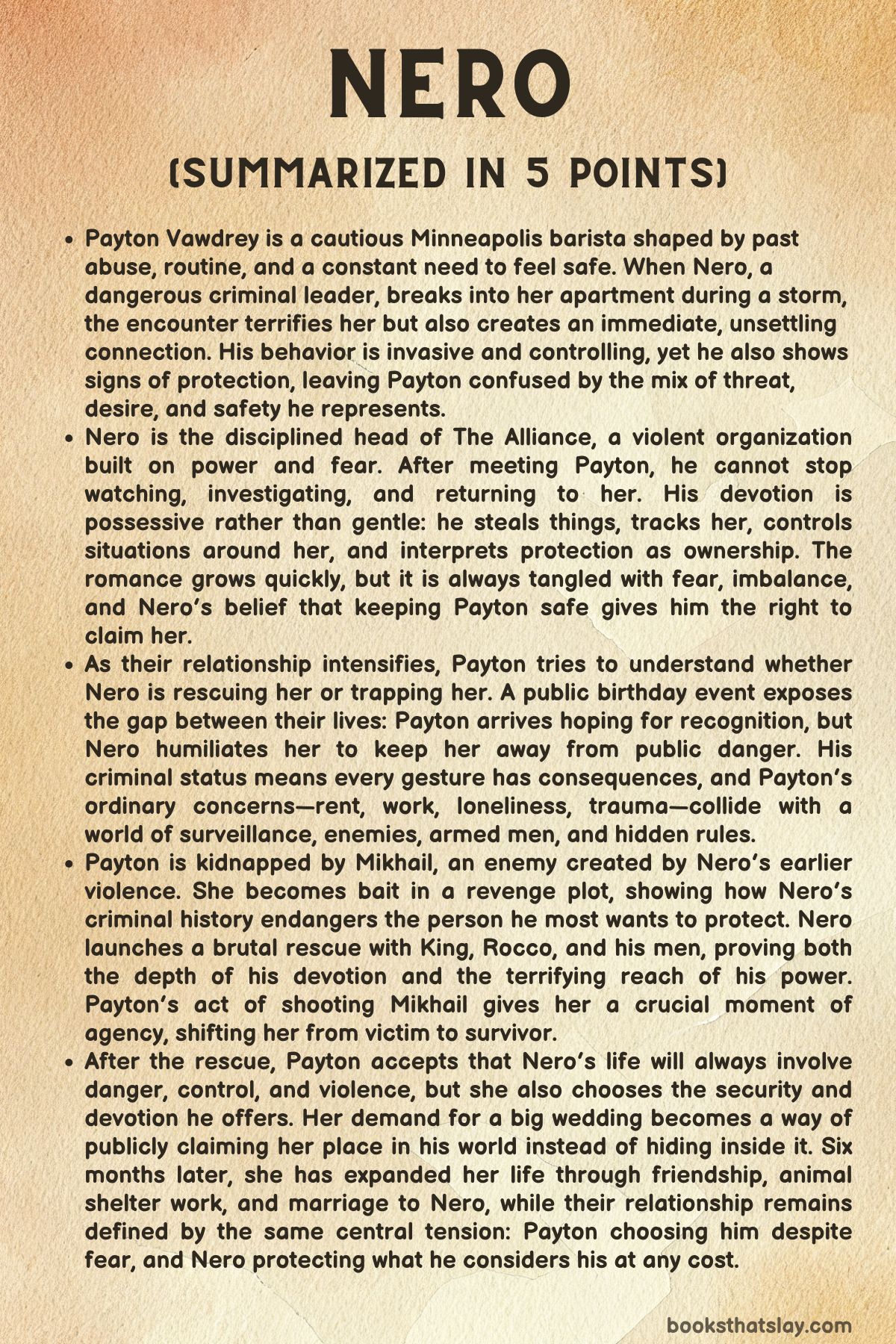
Summary
Payton Vawdrey spends a stormy night alone in her small Minneapolis apartment, trying to calm herself with an old movie and the comfort of familiar sounds. The weather makes her uneasy, stirring memories she works hard to keep buried.
When she notices movement near her balcony door, she expects nothing more than wind and shadows—until a man is suddenly standing inside her home.
He enters with startling ease and an unbothered confidence that terrifies her more than shouting would. He’s tall, sharply dressed, and carries himself like he belongs anywhere he chooses.
Police sirens pass outside, suggesting he’s running from something, and Payton catches a glimpse of a gun under his jacket. Still, he doesn’t point it at her or threaten her directly.
Instead, he sits beside her on the couch, watches the movie, and eats her popcorn, calmly giving orders in a tone that makes her body respond even while her mind is panicking.
Payton refuses to give her name, but the stranger stays, studying her reactions and enjoying the control he holds simply by existing in her space. Exhaustion and shock overwhelm her, and she falls asleep beside him—something that later horrifies her once she understands how easily fear can numb a person into stillness.
The man is Nero, and his perspective reveals a colder truth: he knows he shouldn’t be there, and he knows she shouldn’t feel safe with him. Yet he can’t leave.
He notices how little Payton owns, how clean and carefully arranged her life is, and how different her world feels from his. He searches her apartment, learns her full name from her mail, and takes a small bottle of her rose-scented body wash, drawn to the idea of carrying something that is unmistakably hers.
Before he leaves, Payton wakes from a nightmare about Arthur, a man connected to her past abuse. Nero sees her fear and presses for the name, then offers a deal: she won’t report him, and he won’t tell Arthur he found her.
Nero leaves with a final show of dominance—taking a pair of her underwear from a laundry basket—then watches through the peephole as she locks the door, as if he wants to confirm she’ll obey his warning. Payton later notices he actually secured her balcony better than she had, barricading the track and locking things down.
The contradiction unsettles her: he invaded her home, but also acted like her protector.
Outside, Nero calls his partner, King, to pick him up. Their relationship is built on power and shared history; together they run The Alliance, a criminal organization they built through violence, strategy, and control.
Nero tries to dismiss Payton as irrelevant, but the moment King asks questions, Nero’s reaction gives him away. When Payton mentions Arthur, Nero’s response is immediate and lethal: Arthur is marked for death.
The next morning, Payton goes to work at Twin’s Café, trying to pretend her life hasn’t been cracked open. In her shower she finds cash left behind—payment for what Nero took.
It makes her feel confused, angry, and disturbingly seen. She forces herself through a shift, clinging to small interactions with regular customers as proof that normal life still exists.
But she also starts noticing shadows and suited figures at the edge of her day, leaving her unsure whether Nero is nearby or whether anxiety has sharpened her imagination into paranoia.
Nero, meanwhile, returns to his usual brutality with his crew, issuing threats and collecting debts. Yet in private he can’t stop thinking about Payton.
He fixates on her scent and the softness of her life compared to his. What began as a strange pause in his night turns into obsession, and he starts investigating her—her finances, her family, her routines—collecting details as if knowing her life gives him ownership.
Payton tries to move on. Nearly a week later, she goes to the mall to replace the body wash Nero stole.
She considers buying a different scent, hoping it will cut the invisible thread between them, but she chooses the same one. Part of her fears him; another part feels the pull of being wanted by someone who seems unstoppable.
She buys matching lotion too, unsettled by the thought that they might be using the same scent at the same time.
Weeks later, Nero can’t resist seeing her again. King drives him near the café, openly mocking him for stalking a woman who should be far outside their world.
King walks into the café first, ordering coffee and casually extracting information from Payton—her favorite drink, her name—then makes sure she knows he knows it. Payton watches him leave in a blacked-out SUV and realizes with a sick drop in her stomach that someone is likely watching from inside.
Nero clings to the small proof of connection: the drink Payton likes, the handwriting on the cup, the fact that her hands made something meant for him even if she didn’t know it. Payton’s own life worsens.
A bad customer interaction triggers memories of being blamed and trapped. A hard commute ends with her falling in slush, scraped and humiliated.
Then she finds a rent increase notice that threatens her ability to survive. The future she’s been quietly building feels like it’s being taken from her without permission.
Across the street, Nero watches her cry through binoculars from an empty apartment. He tells himself to stay away, but when Payton leaves her balcony door open, he reads it as consent—or at least as a signal she wants him back.
That night he climbs onto her balcony and enters again, locking the door behind him.
This time, Payton is terrified, but she also knows she left the door open on purpose. In her bedroom, she finds Nero waiting.
He gives her one clear chance to refuse him, insisting it’s the only time he will allow “no” without consequence. Payton chooses to stay.
He finally gives her his name—Nero—and their relationship turns physical. Nero realizes she is inexperienced, and his response shifts into possessive certainty.
Payton is overwhelmed by intensity and fear and wanting all at once, and Nero makes it clear he intends to keep her, not just visit.
Nero later hosts a formal birthday event that functions as both celebration and display of power. He hates the public performance but understands the rules of reputation.
Payton receives an invitation and arrives alone, spending money she can’t spare to look like she belongs among the wealthy and dangerous. Heavy security and men wearing Nero’s name make it clear this isn’t a normal party—it’s a controlled territory.
Payton finally spots Nero in the crowd and feels relief—until she sees him with a glamorous woman pressed close. When Payton looks to him for acknowledgment, Nero meets her eyes and then deliberately ignores her.
He touches the other woman in a way that reads as intimate, making Payton feel foolish and disposable. Old shame from her past rushes back, and she flees the party, drinking more than she should and trying to escape without drawing attention.
From Nero’s perspective, the cruelty is calculated. He recognizes Payton immediately and panics at the risk of her being seen with him publicly.
He believes the safest way to protect her is to hurt her fast enough that she leaves on her own. He orders King to find her and remove her quietly, using a private nickname tied to her favorite drink, implying that Payton has already become part of their inner language.
Payton manages to evade King in the chaos and makes it out of the building, slipping, falling, and running barefoot once she kicks off her heels. Back in her apartment, she breaks down and begins packing to leave the state, convinced she has to disappear before Nero’s world destroys her.
The cash Nero has left behind feels like proof that she’s being bought, whether she agreed to it or not.
Before midnight, Nero arrives at her apartment and takes control. He confronts her fear, her attempt to flee, and the question she can’t stop asking: why did he appear with another woman?
Nero insists it was an arrangement for appearances and protection, not betrayal, and he makes it clear he intends to keep Payton close—on his terms. Payton is terrified of him and of what she feels, trapped between wanting safety and wanting him.
The danger escalates when Payton is kidnapped and used as bait in a feud tied to Nero’s past. She is bound, injured, and transported to a house where she learns she’s been taken to lure Nero into a kill zone.
Inside, she’s confronted by Mikhail, a cruel enemy who wants Nero dead, and Nikki, a furious woman connected to the conflict. Payton tries to survive by staying quiet and pretending weakness, but she is violently exposed and treated like a tool in someone else’s revenge.
Nero tracks Payton through a hidden tracker he placed on her, then flies a newly acquired plane at extreme speed to reach her before it’s too late. He calls in a federal contact to clear a stretch of road for a narrow window, revealing the reach of his influence.
With Rocco, King, and armed men, Nero storms the property. King brings heavy weaponry to breach the gate, and Nero’s team pushes through the house with lethal precision.
Nero’s command is simple: no one touches Payton, and everyone else is a target.
Inside, Mikhail drags Payton in front of him as a shield and kills Nikki when she panics and tries to run. Nero arrives and drops his weapons to stop Mikhail from shooting Payton.
In the chaos, Payton finds a gun and fires, hitting Mikhail and giving Nero the opening to finish him. Nero frees Payton, carries her out, and orders the house destroyed, cutting off loose ends.
Back home, doctors examine Payton, confirming she’s bruised and shaken but not broken. Nero is also wounded, but he hides it as long as he can, focusing on Payton’s safety.
Payton blames herself for the violence around her, but Nero admits the feud is his, rooted in choices he made long ago—killing Mikhail’s family and sparing Mikhail as a child, a mercy that grew into vengeance.
In the aftermath, Payton makes a surprising demand: she wants a big wedding. It’s partly a claim, partly a shield—something public and unmissable that defines her place in Nero’s world.
Nero agrees, and when Payton accepts his proposal, it feels inevitable to her, as if the moment Nero entered her apartment, the direction of her life changed and there was never truly another ending.
Six months later, Payton is preparing for her wedding with Aspen, who has become a close friend. With Nero’s money and protection, Payton expands her work with local animal shelters, turning her compassion into something lasting.
The wedding takes place in their gardens, extravagant and symbolic, with Payton in a dramatic gown and red shoes chosen with intention. Nero watches her approach as if the ceremony is the only thing in the world that matters.
Afterward, they take a trip to the Grand Canyon, traveling with security, still living with the reality that Nero’s life comes with constant risk. Even there, away from Minneapolis, their dynamic remains the same: Payton choosing him despite fear, and Nero holding her as both obsession and responsibility—determined that what is his will stay protected, no matter the cost.
Characters
Payton Vawdrey
Payton is introduced as someone who has learned to survive by staying small, quiet, and vigilant, yet she also craves comfort—nostalgia, routine, and the fragile safety of her modest apartment. Her history with abuse (Arthur’s violence and her mother’s complicity) has trained her nervous system to freeze, to anticipate danger, and to doubt her own perceptions, which is why her reactions often swing between hyper-alert fear and dissociative numbness.
Payton’s arc is a push-and-pull between agency and conditioning: she wants to choose something for herself, but she’s also drawn to intensity because it feels familiar, even when it’s harmful. What makes her compelling is the way she quietly resists—testing boundaries, observing details, trying to reclaim control in small ways—until those small choices accumulate into real defiance.
By the end, her desire for a “big wedding” and her work expanding animal shelters signal a deeper transformation: she’s no longer bargaining for mere survival, she’s asserting a life that reflects her values, her tenderness, and her need to build something safe and lasting.
Nero
Nero is a man built out of contradiction: outwardly controlled, polished, and decisive, inwardly driven by obsession, possessiveness, and a strict personal logic that he mistakes for protection. As a leader of The Alliance, he operates with ruthless clarity—people are assets, threats, or expendable obstacles—yet Payton disrupts that categorization by triggering a rare impulse in him: not just desire, but attachment.
He interprets his fixation as inevitability and his dominance as caretaking, which becomes the core tension of his character; when he claims he’s keeping Payton safe, he often means he’s keeping her contained. His past violence and scars suggest a life where love and brutality were never separate, so tenderness shows up in distorted forms—locking doors, leaving money, planting trackers, orchestrating humiliation as “protection,” and escalating force in the name of control.
His growth isn’t a clean moral redemption; it’s an adjustment of priorities. He remains dangerous, but the story frames his devotion as something that can be directed toward building a world where Payton is secured, cherished, and publicly claimed—even if the methods reflect the same hard-edged worldview that made him powerful.
King
King functions as Nero’s mirror and pressure valve: he’s pragmatic, socially agile, and bluntly amused by Nero’s loss of control. Where Nero runs on fixation and force, King runs on reading rooms, managing risk, and translating the emotional mess into operational decisions.
His teasing isn’t just comic relief—it’s a way of keeping Nero honest by naming what Nero refuses to admit, particularly the shift from casual predation to personal attachment. King also highlights the moral ecosystem of The Alliance: he isn’t presented as “better,” just differently calibrated, someone who can treat stalking as logistics and violence as a tool while still recognizing when Nero is spiraling.
When danger peaks, King’s willingness to act decisively reinforces his role as a stabilizing partner—loyal, capable, and unromantic about what it takes to win.
Arthur
Arthur is less a fully drawn on-page presence and more the defining shadow over Payton’s inner life. He represents the original template of coercion and fear—someone who used physical dominance and degradation to make Payton feel powerless, and whose cruelty was made worse by the fact that no one reliably protected her.
The key psychological function Arthur serves is contrast: he is the past violence that broke Payton’s sense of safety, which makes Nero’s “I won’t hurt you” feel both alluring and suspect, because Nero’s dominance can echo the same dynamics under a different story. Arthur’s importance is not in what he does in the present, but in how his legacy shapes Payton’s thresholds for danger, intimacy, trust, and self-worth.
Payton’s Mother
Payton’s mother is a wound that never fully scabs over—a figure whose failure to protect becomes as traumatic as the abuser’s actions. Her presence in Payton’s memories suggests complicity, minimization, and emotional abandonment, which teaches Payton that pain is something to endure alone and that seeking help can be useless or punished.
This betrayal shapes Payton’s adult coping: she measures safety by predictability, expects blame, and struggles to believe she deserves rescue without strings attached. In Nero, the mother’s role explains why Payton is so easily pulled into harmful dynamics: when your earliest model of “care” comes with neglect and blame, even controlling attention can feel like devotion.
Mikhail
Mikhail is the story’s embodiment of rivalry turned personal, the kind of enemy forged by generational violence and unfinished brutality. His polished politeness reads as performance—he uses manners to disguise cruelty and to position himself as reasonable while treating people as leverage.
The revelation that Nero killed Mikhail’s family and spared him as a child frames Mikhail as the consequence Nero tried to ignore: a living remainder of past atrocities that matured into vengeance. Mikhail functions as both external antagonist and moral reckoning; his plot forces the narrative to confront the cost of Nero’s empire-building and demonstrates that the violence Nero wields doesn’t stay contained—it multiplies, returns, and targets what Nero values most.
Nikki
Nikki is a grim illustration of what proximity to power can do to someone already shaped by trauma and rage. Her nearly shaved head and volatile energy suggest both punishment and self-erasure, as if her identity has been stripped down to raw grievance.
She aligns with Mikhail not because he’s safer, but because anger offers her purpose, and cruelty offers her a sense of control she may not have had. Her death is abrupt and transactional, emphasizing how disposable people become inside these violent hierarchies—especially those who mistake attachment to an unstable leader for protection.
Nikki’s presence in Nero underscores a thematic warning: devotion in this world is dangerous when it’s built on fear, dependency, or revenge.
Rocco
Rocco appears as a competent operational figure—someone who executes Nero’s will under pressure and helps translate obsession into action. He represents the machinery that makes Nero’s dominance possible: logistics, coordination, and the quiet competence of people who normalize extreme measures.
Rocco’s role is less about personal depth and more about reinforcing scale; Nero isn’t a lone wolf acting on impulse, he’s a leader whose desires can mobilize systems, contacts, and violence with frightening speed.
Carlton
Carlton acts as a brief glimpse of an alternate life for Payton—one rooted in everyday friendliness, safe social rituals, and choices that don’t require fear. His casual invitation and respectful handshake matter because they show Payton testing her own boundaries in ordinary ways, trying to prove to herself that not every interaction carries threat.
Carlton’s importance is symbolic: he represents the normal world Payton could belong to, and his presence quietly highlights how far Nero’s gravitational pull drags her away from that simplicity.
Aspen
Aspen becomes the emotional counterweight to the isolating intensity of Payton and Nero’s relationship. As a friend during the wedding preparations, she represents chosen family—support that isn’t transactional, coercive, or fear-based.
Her involvement in Payton’s shelter work also reinforces Payton’s soft power: Payton’s future isn’t only about being protected by Nero, it’s also about building community and purpose. Aspen functions as proof that Payton’s world can expand beyond a single man’s control, even if that expansion is funded by his money.
Robert
Robert’s role is tied to Payton’s fear of collateral damage and the way Nero’s conflicts spill into innocent lives. Payton’s concern for him signals that she doesn’t become hardened by proximity to violence; she continues to care, to worry, and to measure outcomes by human cost.
When Nero confirms Robert is alive, it’s positioned as a moment of relief and restoration—an assurance that Payton’s attachments won’t always be used to punish her. Robert helps ground the narrative’s stakes in something personal and non-criminal: the survival of people Payton loves.
Toto
Toto operates as a small but meaningful emblem of comfort, innocence, and home. The dog’s presence in moments of reunion and celebration reinforces the story’s attempt to domesticate danger—to suggest that even a violent world can be reshaped into something tender within the boundaries Nero controls.
In Nero, Toto isn’t just a pet; Toto is a signal of the life Payton wants—warmth, loyalty, uncomplicated affection—and a reminder of what Nero is trying to build around her, however imperfectly.
Themes
Consent, Control, and the Cost of Safety
From the first night in Payton’s apartment, power is established as something Nero assumes rather than negotiates. He enters without permission, positions his body where he wants, touches her thigh as a directive, and frames calmness as something she owes him.
That pattern continues even when he claims he will not hurt her: the promise is presented as a fact he declares, not a reassurance she chooses to accept. What makes the dynamic tense is that “safety” is repeatedly offered in the same package as control.
When Nero secures the balcony door, barricades it, and later installs a tracker in her jewelry, those actions can be described as protection, yet they also reduce Payton’s freedom while keeping her dependent on his unseen decisions. The story keeps returning to that trade: the more danger surrounds Payton because of Nero’s world, the more Nero argues—through actions, not speeches—that control is justified.
Payton’s agency is complicated rather than absent. Her choice to leave the balcony door open is one of the clearest moments where she tries to steer the relationship on her own terms, even if it comes from loneliness, fear, and confusion.
Later, when Nero gives her “one chance” to refuse, the boundary is framed as narrow and time-limited, which reveals another layer of control: even consent is placed inside a structure he designs. The birthday event is a harsh example of how he manages her behavior through emotional force—hurting her publicly to make her leave—again choosing outcomes over her dignity.
Yet the book also shows Payton pushing back in ways that matter: she questions him, tries to flee, and ultimately acts decisively during the hostage scene by shooting Mikhail. That moment is not only self-defense; it is a reversal of the pattern where others decide what happens to her body.
In Nero, the tension isn’t simply about dominance in romance; it’s about how “protection” can become a rationale for ownership, and how a person learns to separate care from control when both arrive wearing the same face.
Trauma, Triggers, and Rebuilding a Sense of Self
Payton’s past is not treated as distant background; it shapes her physiology in real time. The storm, the sudden presence of a man in her doorway, and the feeling of being watched all activate the same internal alarms that were conditioned by earlier violence.
Her body freezes, her voice disappears, and thought narrows into survival. That response is not framed as weakness; it is shown as learned protection that persists even when the immediate moment changes.
The nightmares of Arthur choking her while her mother stands by sharpen the theme: the deepest injury is not only the abuse but the betrayal of a caregiver who refused to intervene. That betrayal echoes later when Payton is humiliated at the party and the familiar shame hits with full force.
The social setting changes—wealth, music, security—but her nervous system reads the same message: you are small, you are exposed, and you can be discarded.
The book also tracks how trauma can distort desire. Payton’s unwanted physical reaction after finding Nero’s money is upsetting precisely because it collides with fear; she cannot neatly separate attraction from threat.
Her decision to buy the same rose-scented body wash is similarly layered. On the surface it’s a practical purchase, yet it carries the hope that a shared scent might create connection and predictability—two things trauma often steals.
Even the hundred-dollar bill functions as a symbol of contamination and survival at once: it is help, it is a reminder of violation, and it is something she chooses to carry anyway because she needs to keep moving forward.
Recovery in Nero is portrayed less as healing through distance and more as rebuilding through altered circumstances: new resources, new boundaries, and new control over outcomes. That can be uncomfortable because Nero is both a trigger and a stabilizer.
Still, Payton’s arc shows her trying to reclaim authorship over her life: working through public embarrassment, considering escape, taking decisive action when held hostage, and later channeling her new position into expanding animal shelters. The shelters matter thematically because they externalize what she is doing internally—creating places where vulnerable beings are protected without being punished for needing safety.
The story suggests that restoration of self is not a single breakthrough; it is a series of choices that slowly replace helplessness with capability, even when fear remains present in the room.
Obsession, Possession, and the Moral Shape of Devotion
Nero’s fixation is introduced as sensory and quickly becomes behavioral. The stolen underwear, the unplugged phone, the mail search, the background checks, the surveillance from across the street, and the insistence on knowing who hurt her are not random acts; they form a portrait of attention that refuses limits.
He doesn’t simply want Payton—he wants access, information, proximity, and the right to intervene. The rose-scented body wash becomes a concrete example of how his desire operates: he takes something ordinary that belongs to her and turns it into a private ritual that keeps her “present” even when she is absent.
That is intimacy without permission, and the book repeatedly asks the reader to sit with how easily obsession can masquerade as devotion when the obsessed person has power.
At the same time, Nero’s obsession is framed as inseparable from violence and strategy. His world trains him to solve problems through domination: debts are collected through threats, rivals are eliminated, parties are staged for optics, and a federal contact is pressured to clear roads.
When Payton is taken, the rescue is executed with military precision and extreme force, culminating in Nero ordering the house burned. In his moral system, love does not soften violence; it redirects it.
“No one touches Payton and everyone else dies” captures the central contradiction: the tenderness he offers her is built on a willingness to erase others. That is why his protection is never neutral.
It is effective, but it expands danger around her because enemies understand what she represents: leverage.
The book complicates the theme further by giving Payton moments of genuine pull toward him. She feels a thrill at shared scent, chooses to meet him sexually, and ultimately asks for a wedding—an act that can be read as desire, security-seeking, or both.
Nero’s possessiveness is not hidden from her; it is part of the offer. The party scene illustrates the ugliest side of obsession: Nero is willing to break her to “keep her safe,” treating her emotions as acceptable collateral.
Later, his apologies after the rescue sound sincere, yet they exist beside the reality that his old feud created the crisis in the first place. In Nero, devotion is not presented as pure; it is presented as a force that can protect, consume, and justify harm all at once.
The theme lands in the uneasy question the story keeps raising: if someone can destroy the world for you, what parts of you get destroyed in the bargain?
Image, Status, and the Divide Between Public Performance and Private Truth
Nearly every major turning point is shaped by what must be seen and what must be hidden. Nero hosts a formal event where respectability is staged—security jackets with his name, curated guests, controlled interactions—because power is not only exercised through violence but also through image.
The party is a public marketplace of alliances, and that requires Nero to look untouchable, predictable, and unavailable in specific ways. Payton’s arrival exposes how brutal that divide can be.
She spends money she cannot afford on clothing and tries to “belong,” yet the environment immediately labels her as an anomaly: arriving alone, lacking context, not fitting the expected pattern of who gets access to the room. Her discomfort is not only insecurity; it is a signal that public worlds have entry rules, and she does not know them.
Nero’s decision to ignore her and touch another woman is a calculated performance. He treats Payton’s feelings as expendable because the audience matters more than the moment.
The theme here is not simply jealousy; it is how public narratives can force private cruelty. Nero believes that making Payton leave is safer than being seen claiming her, so he performs distance.
Payton interprets the performance as rejection and humiliation because she has no access to the private reason behind it. That mismatch shows how image becomes a weapon: the same gesture can be strategy to one person and emotional harm to the other.
Even King’s role highlights the machinery of performance. He can enter the café as a “customer,” gather information, and leave a message through money and familiarity, turning ordinary spaces into stages where power speaks in coded signals.
Payton’s life, by contrast, begins in small private realities: a modest apartment, routine work shifts, bus rides in bad weather, anxiety over rent increases. The distance between those worlds is not only financial; it is epistemic.
Payton does not know the rules of Nero’s public sphere, and Nero cannot fully participate in her private sphere without contaminating it with surveillance and threat. The pendant tracker is the clearest example: it keeps her “safe” in Nero’s logic, but it also means her private movements are never fully private.
The wedding and later travel suggest a partial integration—garden ceremony, security nearby, philanthropic projects—yet the theme does not disappear. Even on vacation, the presence of protection signals that their life is still managed by visibility and risk.
Nero uses the contrast between public performance and private truth to show how relationships change when one partner’s identity is built on being watched, feared, and obeyed, and how the other partner must decide what it means to be loved in a world where love is also a public liability.