Now Then by Morgan Radford Summary, Characters and Themes
Now Then by Morgan Radford is a multigenerational historical novel about mothers, daughters, lost children, political violence, racial identity, and the difficult choices that shape a life.
Moving between revolutionary Cuba and the United States from the 1950s to the early 2000s, the story follows Lily Walker as she discovers that her mother, Marisol, once possessed ambitions and endured losses that were never discussed at home. Their parallel experiences with education, love, motherhood, and grief reveal how silence can protect a family while also keeping its members apart. The novel ultimately asks whether truth can restore what history, fear, and separation have taken away.
Summary
In September 1991, Liliana “Lily” Walker arrives at Harvard with her parents, Marisol and Kem, after a long drive from their modest North Carolina home. Surrounded by wealth and confidence, Lily immediately feels out of place as the Black daughter of a Cuban immigrant mother and a working-class Appalachian father whose sacrifices have made her education possible.
Her roommate, Hana Kang, comes from a prosperous Korean American family and appears comfortable in the privileged environment Lily finds intimidating. After Lily’s parents leave, she opens a letter from Marisol and learns that her mother once attended university in Cuba, a revelation that challenges Lily’s belief that the woman who cleans houses has always lived without professional ambitions.
Marisol explains that immigrants often protect their children by hiding the most painful parts of their histories. Through a series of letters, she begins describing her arrival in Havana in 1956, when she defied her father’s belief that women should remain at home and entered a boarding house for female university students.
There, Marisol befriended Mirta, another young woman rejected by her family for pursuing an education. Marisol hoped to become a journalist and obtained informal work at Radio Reloj, where she reported on university activity and learned how political unrest was changing Cuba under President Fulgencio Batista.
At Harvard, Lily gradually becomes close to Hana and Hana’s boyfriend, Chris, a Black soccer player who understands some of the racial pressures Lily faces. She also meets Vikram Desai, a British Indian postdoctoral fellow whose intelligence, warmth, and interest in her ambitions make her feel recognized in ways she rarely experienced while growing up in the American South.
Vikram and Lily begin spending time together, discussing journalism, racial identity, South Africa, family duty, and the expectations placed upon children of immigrants. Their affection grows, but Vikram remains uncertain about opposing his Gujarati family’s plans for his future, while Lily fears becoming another woman he desires privately but refuses to choose publicly.
In Havana, Marisol becomes involved with José Antonio Echeverría, the charismatic leader of the Directorio Revolucionario. She is drawn to his political purpose and his belief that young people can end Batista’s dictatorship, although she gradually realizes that José is also using her access to Radio Reloj for a planned attack on the government.
The university closes as protests intensify, leaving Marisol without the education she came to Havana to obtain. Her love for José and desire to participate in Cuba’s future lead her deeper into the revolutionary movement, even though Mirta remains frightened by its increasing acceptance of violence.
On March 13, 1957, José’s forces attack the presidential palace while Marisol helps seize Radio Reloj. José announces that Batista has been killed, but the claim is false, the broadcast is interrupted, and the revolutionary operation collapses before its objectives are achieved.
Military forces surround José, Marisol, Mirta, and their companions as they attempt to reach the university. José charges the soldiers and is killed, while Mirta and other revolutionaries are beaten or executed and Marisol is captured.
Marisol is imprisoned in El Castillo del Príncipe, where a soldier named Silva repeatedly assaults her. The experience separates her emotionally from her body and destroys the romantic image of revolution that had encouraged her to believe political sacrifice would inevitably produce justice.
Months later, a nun working as a nurse discovers that Marisol is pregnant. The pregnancy temporarily protects her because the soldiers want the child preserved, but Marisol overhears that they intend to kill her once the baby has been delivered.
She gives birth to a premature boy and immediately wants to protect him, although she cannot determine whether José or Silva is his father. The nun, Sister María Inés Zayas, explains that the infant is too weak to escape but promises to care for him while Marisol flees through an unsecured hospital exit.
Before leaving, Marisol cuts a lock of the baby’s hair and notices a V-shaped mark beneath his ear. Sister María Inés gives her a Saint Nicholas medallion, and Marisol escapes while hearing her newborn son crying behind her.
Marisol reaches her family in Camagüey and discovers that officials have already declared her dead. Her father arranges passage on a workers’ vessel bound for the United States, forcing her to leave Cuba, her family, and any immediate possibility of recovering her child.
On the vessel, a Black American railroad worker named Kem notices Marisol’s condition and offers assistance without demanding explanations. He helps her reach North Carolina, where she finds work as a domestic servant and discovers that American society classifies her as Black regardless of the more complex racial identity she knew in Cuba.
Kem’s patience and respect gradually help Marisol rebuild her life. They marry, and although Marisol initially refuses to have children because she believes she failed her first son, she eventually becomes pregnant with Lily and chooses motherhood within a relationship defined by safety and consent.
At Harvard, Lily receives an internship connected to South Africa and becomes increasingly involved in racial-justice issues following the acquittal of the officers who beat Rodney King. Chris shares his experience of being assaulted and jailed by police despite being innocent, strengthening Lily’s understanding of the dangers faced by Black men.
Vikram leaves Harvard when his father becomes seriously ill, departing without giving Lily a clear promise about their relationship. He eventually returns, and the two openly begin a romance, but their connection remains burdened by his family’s expectation that he marry a Gujarati woman and assume responsibility for the family business.
Lily ends the relationship before Vikram returns to England because she fears he will never oppose his parents for her. Vikram interprets her decision as proof that she values professional ambition more than emotional vulnerability, and both allow pride and fear to prevent them from expressing what they truly want.
Five years later, Lily and Vikram meet again at the London wedding of Hana and Chris. Their unresolved affection leads them to spend the night together, and Lily returns to New York believing they have received another opportunity to build the life they once abandoned.
Soon afterward, Lily discovers that she is pregnant. Before she can tell Vikram, he announces that his family has arranged his marriage to Radhika and that he intends to accept it because his dying father wants the family’s future secured.
Lily ends all contact without revealing the pregnancy and travels to Los Angeles to cover the civil trial of O. J. Simpson. An older driver named Virgil helps her understand the child as part of a long family inheritance of survival, leading Lily to decide that she will raise the baby regardless of Vikram’s absence.
During the trial, Lily experiences severe pain and suffers a miscarriage. She keeps the loss largely private, blaming herself for traveling, working, and believing that her relationship with Vikram might finally become permanent.
Further tragedy follows when Hana dies of cancer after concealing her illness from most of the people closest to her. In a final letter, Hana asks Lily to help Chris survive his grief and explains that genuine love gives people the freedom to continue living rather than trapping them permanently beside what they have lost.
Lily returns to North Carolina and tells Marisol about both Hana’s death and the miscarriage. When Lily declares that Marisol cannot understand losing a best friend or a child, Marisol finally reveals José’s death, Mirta’s murder, her imprisonment, the assaults, the birth of her son, and the escape that separated her from him.
The revelation changes Lily’s understanding of her mother’s emotional reserve, fear, and insistence on education. Instead of allowing the family’s grief to remain private, Lily decides to use her experience as a journalist to search for the half brother Marisol was forced to leave in Cuba.
Lily travels to Havana with Chris, who joins the search because helping her gives him a purpose after Hana’s death. They contact Marisol’s brother Mateo, who believed his sister had died and has spent decades wondering whether the child she may have delivered survived.
Their research leads them to records concerning the Merici Academy and Sister María Inés Zayas, the nun who once assisted vulnerable women and children. They then see a government official named Osvaldo Vidal Zayas Jr. on television and notice his resemblance to Marisol, his age, and the Saint Nicholas medallion around his neck.
Further investigation reveals that Osvaldo was adopted by Emilia Zayas, the sister of María Inés. Historical records suggest that the nun rescued a malnourished infant born to a political prisoner and arranged for Emilia to raise him.
Marisol confirms María Inés’s identity after seeing an old photograph. She finally tells Kem the full truth, ending decades of secrecy within their marriage and allowing him to understand the loss that has always remained present in their family.
Lily secretly meets Osvaldo, who has long known that he was adopted but never learned his birth mother’s name. He accepts the evidence that Marisol is his mother and understands that she left him because escape was the only way either of them could survive.
Lily later arranges a reunion in Miami. When Marisol sees Osvaldo’s green eyes, curls, and V-shaped mark, she recognizes José in him and realizes that her son was conceived through the relationship she chose rather than through the violence inflicted upon her in prison.
The recovery of Osvaldo restores Marisol’s connection to her younger self, Cuba, and the child she never stopped mourning. Lily also becomes closer to Chris during the search, although both initially feel that loving each other might betray Hana’s memory.
Years later, Lily returns to London as a successful author and journalist whose work examines civil rights and political contradictions across the Americas. Chris, now coaching women’s football, tells her that Hana’s love can continue through the lives they build rather than requiring them to remain alone.
Vikram unexpectedly attends Lily’s lecture and asks for another chance. During dinner, he explains that he eventually left his family’s business and pursued filmmaking, while Lily tells him about the pregnancy and miscarriage he never knew occurred.
Vikram grieves the lost child and wants Lily to return to him, but their meeting forces her to distinguish between the intensity of an unfinished youthful romance and the steadier love she has developed with Chris. She ultimately chooses Chris, whose commitment is consistent, public, and rooted in the woman she has become.
Two years later, Lily is married to Chris and pregnant with their daughter. Determined not to repeat the silence that separated previous generations, she plans to tell the child the complete family history and teach her that love depends on freedom, courage, self-respect, and the willingness to choose another person openly.
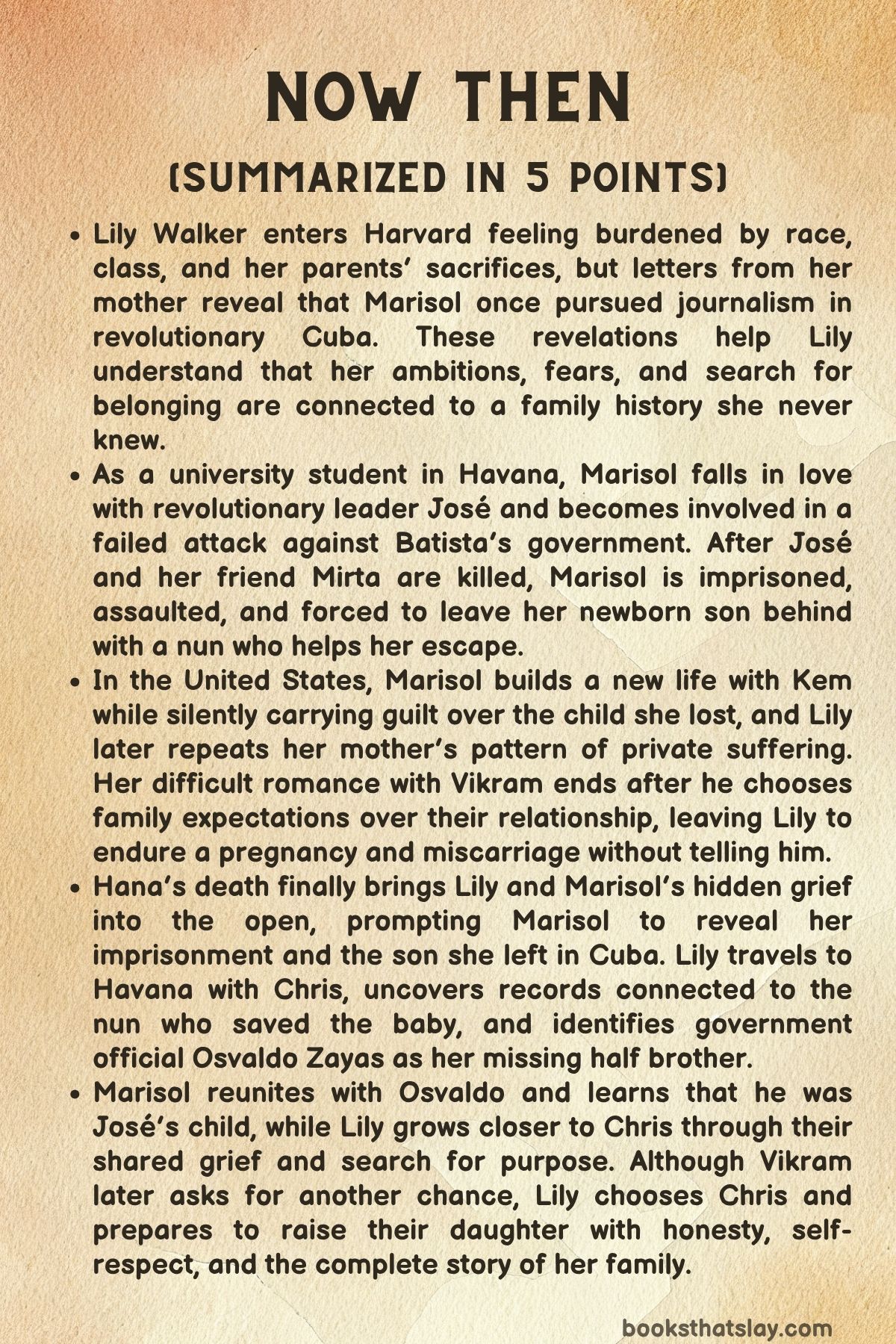
Characters
Liliana “Lily” Walker
In Now Then, Lily develops from an uncertain Harvard freshman into a journalist capable of confronting political systems, family secrets, and her own emotional defenses. Her early insecurity comes from the combined pressures of race, class, and responsibility, since she views academic success as a debt she must repay to parents who sacrificed nearly everything for her education.
Lily’s ambition is genuine, but it also becomes a shield against rejection. She repeatedly convinces herself that independence will hurt less than asking another person to choose her, which contributes to the collapse of her early relationship with Vikram.
Her later experiences force her to reconsider the difference between survival and emotional avoidance. The miscarriage, Hana’s death, and Marisol’s confession teach her that grief cannot be controlled through achievement or silence.
Lily’s decision to search for Osvaldo shows the strongest expression of her character. She transforms journalism from a means of professional advancement into a method of restoring family history, challenging political secrecy, and giving her mother evidence that survival did not make her a failed parent.
Her final choice of Chris confirms her emotional growth. Instead of selecting the romance associated with youth and possibility, she accepts a relationship based on friendship, consistency, shared loss, and the courage to remain present.
Marisol Soto Walker
Marisol is the historical and emotional foundation of Now Then, carrying within her life the consequences of dictatorship, revolution, sexual violence, migration, racial reclassification, and forced separation from a child. Her guarded behavior initially makes her appear practical and emotionally distant, but the story gradually reveals that silence has been her primary survival strategy.
As a young woman, Marisol is courageous, intellectually ambitious, and determined to escape the limitations imposed by her father. Her dream of journalism shows that Lily’s professional calling is not an isolated achievement but the continuation of an aspiration political violence denied to the previous generation.
Her relationship with José represents both love and danger. She chooses him freely and shares his hopes for a democratic Cuba, yet his secrecy and willingness to accept violence place her in circumstances whose consequences she must endure alone.
Motherhood becomes inseparable from guilt after Marisol leaves her premature son with María Inés. Although escape saves her life and gives the baby a chance to survive, she interprets the decision as abandonment and spends years believing she has lost the moral right to raise another child.
Her relationship with Kem allows her to experience patience and bodily safety, but she still cannot fully communicate her history. Only after Lily reveals her own losses does Marisol understand that silence is no longer protecting her daughter and that shared grief may create closeness rather than destruction.
Vikram Desai
Vikram is intelligent, affectionate, curious, and capable of understanding many of Lily’s intellectual ambitions. His conversations with her provide a space in which she can discuss journalism, politics, identity, and family expectations without minimizing herself.
His central weakness is the distance between private feeling and public choice. He loves Lily but repeatedly delays acting on that love because doing so would require confronting his parents, rejecting cultural expectations, and accepting uncertainty.
Vikram’s family pressures are real rather than imaginary. His father’s illness, the family business, immigrant sacrifice, and expectations surrounding marriage all create powerful obligations, but Vikram uses those obligations to avoid responsibility for his own decisions.
His limited understanding of anti-Black racism also damages the relationship. Although he experiences cultural otherness as a British Indian man, he initially fails to recognize that Lily cannot separate her romantic life from a racial identity that influences how institutions, families, and strangers judge her.
By the time he returns years later, Vikram has built a life closer to the one he wanted and can finally admit that fear determined his choices. His regret is sincere, yet his growth arrives too late to erase the years in which Lily had to rebuild herself without him.
Chris
Chris initially appears as Hana’s confident boyfriend, but his experiences reveal a man deeply affected by racism, loyalty, and the search for a secure sense of home. His account of being beaten and jailed by police shows that athletic success, education, and proximity to whiteness cannot protect him from racial violence.
His relationship with Hana is based on admiration, partnership, and endurance. Her death destroys the future he expected, leaving him uncertain whether continuing to live fully would honor or betray her.
Helping Lily in Cuba gives Chris a task that requires both practical effort and emotional courage. He protects her during the investigation without controlling her, and his steady assistance helps reconnect Marisol with Osvaldo.
Chris’s eventual love for Lily grows from friendship and shared grief rather than sudden idealization. He understands her history, respects the woman she has become, and does not ask her to hide any part of her identity.
His strongest quality is consistency. Unlike Vikram, Chris does not separate affection from commitment, and his marriage to Lily demonstrates the security created when love is expressed through repeated choices rather than uncertain promises.
Hana Kang
Hana is Lily’s first true source of belonging at Harvard. Her confidence, humor, and openness help Lily participate in campus life rather than treating college only as a test she must survive.
Although Hana comes from greater wealth, she does not reduce Lily to her poverty or insecurity. She creates space for Lily, introduces her to friends, encourages her romantic confidence, and remains emotionally present even when Lily withdraws.
Her relationship with Chris demonstrates the type of public and durable commitment Lily desires. Their marriage survives distance, professional demands, and cultural differences because both partners are willing to shape their lives around each other.
Hana’s decision to conceal her cancer is loving but also controlling. She wishes to protect others from watching her decline, yet the secrecy denies them the opportunity to accompany her through illness and leaves Lily and Chris shocked by the suddenness of her death.
Her final letter becomes the moral inheritance she leaves behind. By defining love as freedom, she gives Lily and Chris permission to continue living, changing, and eventually loving each other without treating their happiness as a rejection of her memory.
Kem Walker
Kem is defined by gentleness, patience, and respect for boundaries. When he meets Marisol aboard the workers’ vessel, he recognizes her distress but does not demand a story, physical closeness, or gratitude in exchange for helping her.
His behavior contrasts with the men who previously controlled Marisol’s movements and body. He offers protection without possession, allowing trust to develop gradually rather than expecting immediate emotional access.
As Marisol’s husband, Kem accepts that parts of her past remain unavailable to him. Although this restraint protects her for many years, it also means that he cannot fully understand the grief shaping their marriage and her approach to motherhood.
His response to Marisol’s later pregnancy demonstrates his respect for her autonomy. He does not assume that she must continue the pregnancy or that his desire for a child should determine her decision.
Kem’s love is expressed through reliable acts rather than dramatic declarations. His presence gives Marisol the safety needed to build a second life, and his willingness to listen when she finally speaks confirms that the truth does not diminish his commitment.
José Antonio Echeverría
José is a charismatic revolutionary whose confidence gives Marisol a sense of purpose during a period of political instability. He represents the attraction of collective action, especially for young people who believe history can be changed through courage and sacrifice.
His love for Marisol appears genuine, and their relationship allows her to exercise choices her father attempted to deny her. Nevertheless, José also incorporates her into a violent political plan without fully explaining the risks or intentions involved.
His decision to announce Batista’s death and his willingness to support assassination reveal a widening distance between his democratic ideals and his methods. Marisol discovers that devotion to a cause does not prevent a leader from manipulating those closest to him.
José’s final charge toward Batista’s soldiers may be understood as bravery, despair, political martyrdom, or an effort to protect Marisol. Whatever his motive, his death leaves her to bear the physical and emotional consequences of a failed operation.
Through José, the story questions romantic versions of revolution. His ideals survive in public memory, but Marisol’s imprisonment shows the private cost imposed on those who remain after celebrated revolutionaries die.
Mirta
Mirta becomes Marisol’s closest friend because both young women have sacrificed family approval for education. Their friendship gives them emotional support within a city where they are poor, isolated, and vulnerable.
Unlike Marisol, Mirta remains openly fearful of violence and political confrontation. Her hesitation does not make her cowardly; instead, it reflects an accurate understanding of how easily young people can be sacrificed by movements that promise a transformed future.
Marisol persuades Mirta to continue participating by arguing that returning home would destroy the independence they sought. This makes Mirta’s death especially painful because she enters the final operation partly through loyalty to her friend.
Her murder by Batista’s soldiers demonstrates the brutality directed at women who become associated with political resistance. She receives no heroic final speech or public recognition, yet her loss remains one of the central wounds Marisol carries across decades.
Osvaldo Vidal Zayas Jr.
Osvaldo is the living connection between Marisol’s revolutionary past and Lily’s search for family truth. Raised within a powerful Cuban household, he grows up with material and political status but without a clear understanding of his biological origins.
His adoptive father directs him toward government service, limiting his freedom in ways that resemble the family pressures experienced by Lily and Vikram. His position is further complicated by his concealed sexuality and fear of state surveillance.
When Lily approaches him, Osvaldo does not immediately reject the possibility that Marisol is his mother. The adoption details, family resemblance, medallion, and history of María Inés confirm fragments of information he has carried since adolescence.
His statement that his survival proves Marisol made the correct decision becomes essential to her healing. It releases her from the belief that escape was equivalent to abandonment and allows mother and son to begin a relationship without denying the decades taken from them.
Mateo Soto
Mateo is Marisol’s younger brother and one of the few surviving links to her life before exile. He remembers the condition in which she returned from prison and has spent decades regretting that he lacked the age, information, and power to search for her possible child.
His career as a history professor reflects his desire to understand the forces that shattered his family. He even studies the faces of his students, wondering whether one of them might be the child Marisol left behind.
Mateo responds to Lily not merely as a researcher but as an uncle discovering a family branch he believed had disappeared. His hospitality restores personal warmth to a search dominated by records, death certificates, and institutional secrecy.
His knowledge of Cuban history helps Lily connect María Inés, the orphan network, and Osvaldo’s adoption. Through Mateo, family memory and formal scholarship work together to recover a truth neither could establish alone.
Eric
Eric is Lily’s childhood friend and one of the few people who consistently challenges her emotional evasions. His decision to live openly as a gay man despite his family’s hostility allows him to recognize the damage caused by secrecy and conditional acceptance.
He encourages Lily to demand a love that can exist publicly. His warning that anyone unwilling to love her loudly does not deserve her directly addresses the racial shame and concealment she has experienced in earlier relationships.
Eric also supports Lily during her pregnancy and miscarriage without attempting to make decisions for her. His promise that they will face the future together gives her a form of chosen family when she feels abandoned by Vikram.
Later, he questions whether Lily’s reunion with Vikram is based on present compatibility or nostalgia for the young woman she once was. His honesty helps prevent friendship from becoming simple agreement and makes him an important voice of emotional clarity.
Sister María Inés Zayas
María Inés acts within an environment where formal institutions have become instruments of violence. As a nun and nurse, she uses the limited authority available to her to examine Marisol, protect her pregnancy, assist during childbirth, and create an opportunity for escape.
Her choices require great personal risk. By deceiving soldiers and arranging care for the infant, she resists the regime through practical compassion rather than public political leadership.
The Saint Nicholas medallion becomes a visible link among Marisol, Osvaldo, and the hidden network that saved vulnerable children. It later helps Lily identify the family connection that official records attempted to obscure.
María Inés cannot return Marisol’s son to her, but she ensures that he survives and is placed with her sister. Her actions prove that individual mercy can preserve a future even when larger political movements fail to protect the innocent.
Silva
Silva represents the use of institutional power for personal cruelty. His violence against Marisol is enabled by a prison system in which political detainees are treated as bodies without rights, witnesses, or social value.
He assumes that Marisol’s child belongs to him and worries more about explaining the pregnancy to his wife than about the harm he has caused. This response reveals his complete refusal to recognize Marisol as a person with autonomy or emotional reality.
His religious concern for the infant is equally hypocritical. He accepts that the baby should be preserved while participating in a plan to murder the mother after delivery.
Silva’s presence prevents the story from presenting political violence only through battles and public speeches. He shows how dictatorship enters private spaces and uses sexual terror to punish, silence, and dehumanize women.
Virgil
Virgil appears briefly but influences one of Lily’s most important decisions. His family history of migration, railroad labor, racial struggle, and survival helps her understand that identity is inherited through remembered sacrifice as much as through property or wealth.
He encourages Lily to see her pregnancy not only as a professional threat but as part of a continuing family story. His perspective gives her the courage to choose the child without waiting for Vikram’s support.
Virgil does not dismiss Lily’s fear of single motherhood or career discrimination. Instead, he places those fears within a larger history of people who created futures under conditions they did not choose.
His guidance also prepares Lily to understand Marisol differently. Both women eventually learn that motherhood may begin in crisis but still involve conscious love, responsibility, and hope.
Aditi and Samir Desai
Aditi and Samir embody the pressures immigrant parents may place upon children when sacrifice becomes an argument for obedience. They expect Vikram to preserve the family business, cultural continuity, and social standing because they view those achievements as the result of years of difficult labor.
Samir interprets Vikram’s desire for a different career as ingratitude. His illness increases the emotional pressure because Vikram fears that rejecting the family plan will become a final act of disloyalty toward a dying father.
Aditi is more emotionally attentive, encouraging Vikram to complete his fellowship, but she also participates in the effort to arrange a suitable marriage. Her care therefore exists beside expectations that limit his freedom.
Their demands explain Vikram’s fear but do not remove his responsibility. The story uses them to show how parental sacrifice can inspire gratitude while also becoming a means of directing an adult child’s work, marriage, and identity.
Radhika
Radhika represents the culturally approved future available to Vikram. She offers familiarity, family acceptance, and a life that would require fewer conflicts than a relationship with Lily.
Although Vikram initially treats marriage to her as an unavoidable duty, Radhika ultimately refuses to complete the arrangement. By leaving him at the altar, she demonstrates that she also possesses desires beyond the role selected for her.
Her choice forces Vikram to confront the emptiness of a life built entirely around compliance. It also contributes to his eventual decision to leave the family business and pursue filmmaking.
Radhika is therefore more than Lily’s romantic rival. Her refusal exposes the instability of arrangements that depend upon both participants suppressing their individual ambitions for the comfort of their families.
Themes
Silence, Memory, and Inherited Trauma
Silence initially functions as protection in Now Then, especially for Marisol, who believes that describing prison, rape, and the loss of her son would burden Lily and threaten the stability of the life she built with Kem. Yet the same silence prevents Lily from understanding her mother’s fear, emotional reserve, and intense commitment to her education.
Marisol’s hidden past does not disappear simply because it remains unspoken. It influences her marriage, her refusal to have children for many years, her cautious parenting, and her inability to comfort Lily through romantic loss with the directness Lily needs.
Lily repeats this pattern when she conceals her pregnancy and miscarriage from Vikram and most of her family. Like Marisol, she assumes that private suffering can be controlled more safely than a truth shared with people who might misunderstand, judge, or abandon her.
The letters between mother and daughter begin weakening this inherited secrecy because writing allows both women to express what spoken conversation cannot yet contain. Marisol’s eventual confession changes trauma from an isolated burden into a history that Lily can witness, investigate, and carry without being destroyed by it.
Recovery therefore depends not on forgetting painful history but on giving it language. Once the family speaks openly, grief becomes a source of connection, and the next generation can inherit knowledge rather than unexplained fear.
Love as Choice, Freedom, and Public Commitment
Love is repeatedly tested by the difference between private feeling and sustained action. Lily and Vikram possess intellectual compatibility and powerful attraction, but their relationship fails because affection is not supported by timely courage, honest communication, or a shared willingness to confront family expectations.
Vikram’s secrecy confirms Lily’s fear that she can be desired without being publicly chosen. His claim that he loves her cannot compensate for his decision to marry Radhika, particularly because he asks Lily to accept emotional closeness without receiving commitment.
Hana offers a different understanding when she describes love as freedom. Her farewell does not ask Chris and Lily to preserve her memory by remaining emotionally frozen; she asks them to continue living in ways that honor the confidence and belonging she gave them.
Kem expresses this principle through patience, allowing Marisol to decide what she can share and whether she wants another child. Chris later combines freedom with consistency, loving Lily without demanding that she deny Hana, Vikram, the miscarriage, or any other part of her history.
The final marriage is therefore not presented as a perfect escape from grief. It represents an adult form of commitment in which both people know the other’s losses and still choose to build a future together openly.
Race, Class, and the Question of Belonging
Lily enters Harvard believing that admission does not guarantee acceptance. Wealthier students possess not only money but also the confidence to request opportunities, challenge decisions, and recover from mistakes without fearing that one failure will confirm they never belonged.
Her working-class background makes every expense visible, while her Black and Cuban identities complicate how others categorize her. She must repeatedly explain that Cuban heritage does not remove her from the racial dangers facing Black Americans.
Marisol experiences a related transformation after migration. In Cuba, her identity exists within a more complicated system of color and culture, but the American South classifies her as Black and restricts her employment accordingly.
Chris’s police assault demonstrates that education, athletic success, and white family connections cannot erase the vulnerability attached to Blackness. Lily’s professional experiences show a less visible version of the same structure, since white colleagues are presumed competent while she is expected to express gratitude and continually justify her position.
The novel also examines prejudice within immigrant communities through Vikram’s family, whose attitudes toward African and Caribbean people influence his understanding of Lily. Belonging is finally created not by elite institutions or racial categories but through relationships in which individuals are fully seen and allowed to claim every part of their history.
History, Revolution, and Personal Consequences
Political movements are often remembered through leaders, victories, and public declarations, while the suffering of ordinary participants receives less attention. Marisol initially believes journalism and revolution will allow her to help shape a democratic Cuba, but the failed attack leaves her imprisoned while the male leaders become martyrs or historical symbols.
José’s courage cannot be separated from his deception. He speaks of freedom while withholding the full nature of the plan from Marisol and accepting methods that place her life at risk without informed consent.
The eventual defeat of Batista does not restore what Marisol lost. Castro’s victory changes the government, yet José, Mirta, her education, her family unity, and the years with her son remain unrecoverable.
Lily’s later work examines similar contradictions by considering how revolutionary governments may oppose colonial power while reproducing repression within their own borders. Her journalism refuses simple categories in which political figures must be treated as either complete heroes or complete villains.
The search for Osvaldo gives historical investigation an intimate purpose. Records, photographs, broadcasts, personal memories, and family resemblance reveal that history is not merely a sequence of national events; it lives inside bodies, relationships, silences, and decisions whose effects continue long after governments change.