One of the Family Summary, Characters and Themes
One of the Family by Mark Edwards is a psychological thriller that explores the dangerous consequences of family loyalty, hidden wrongdoing, and the pursuit of wealth.
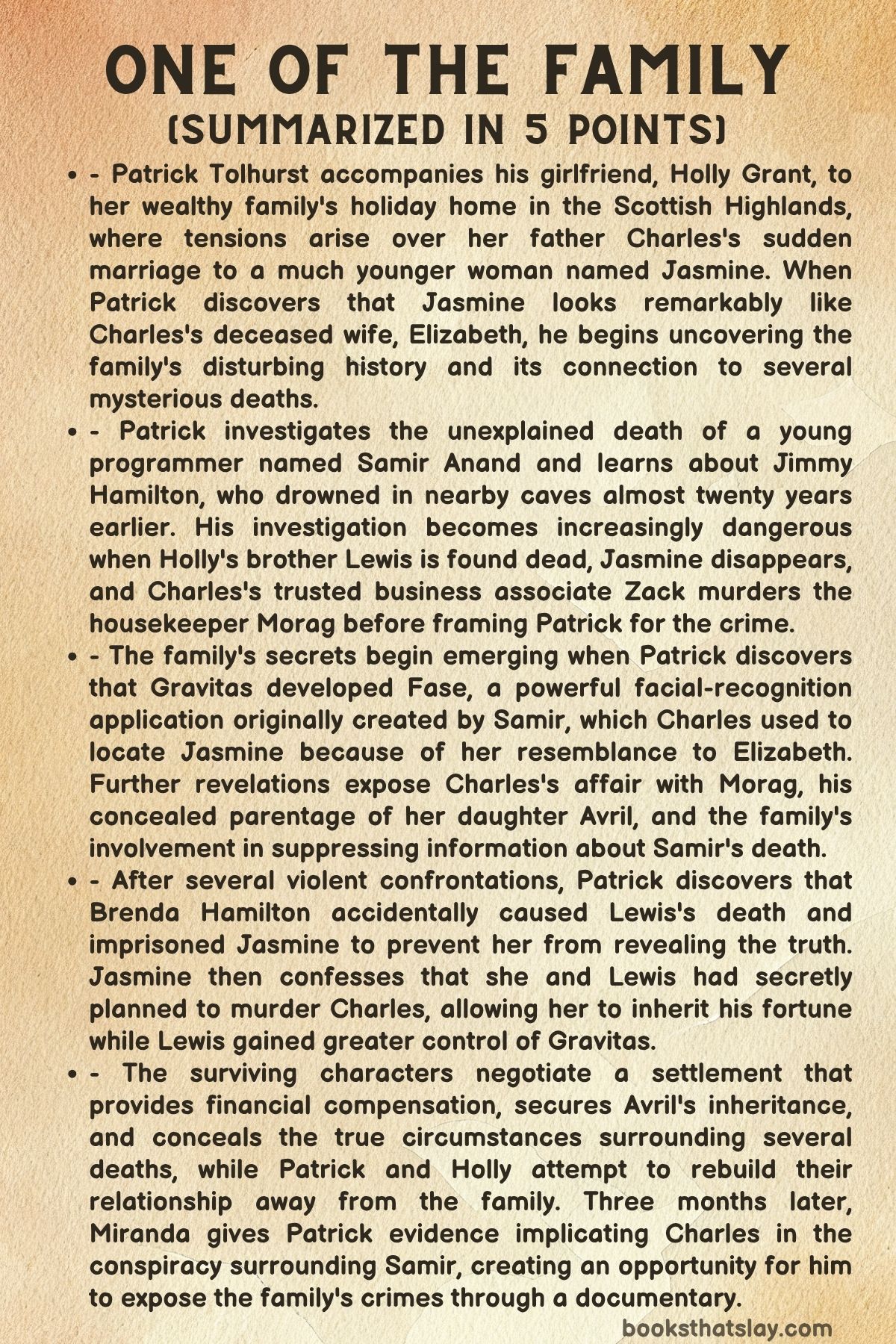
Set primarily in an isolated Scottish Highland village, the novel follows Patrick Tolhurst as he meets his girlfriend’s wealthy family during a holiday gathering. What begins as an uncomfortable introduction develops into a series of mysterious deaths, unexpected revelations, and violent confrontations. At the centre of the story is a powerful technology entrepreneur whose determination to protect his reputation has influenced generations of his family. Through Patrick’s investigation, the novel examines how privilege, manipulation, and long-buried secrets can transform ordinary relationships into dangerous alliances.
Summary
In December 2025, Patrick Tolhurst travels with his girlfriend, Holly Grant, to her family’s holiday home in Applecross, Scotland. They have been together for nine months, and Patrick hopes to make a favourable impression on her wealthy relatives.
Holly’s father, Charles Grant, founded the successful technology company Gravitas. His considerable fortune makes Patrick, who works as a takeaway delivery driver while pursuing documentary filmmaking, conscious of their different backgrounds.
The gathering is particularly tense because Charles has announced his engagement to Jasmine, a thirty-four-year-old American woman. Holly and her siblings, Miranda and Lewis, are uncomfortable with their sixty-one-year-old father’s decision to remarry.
Upon arriving, Patrick meets Morag Hamilton, the family’s longtime housekeeper. Her uncomfortable interactions with Holly suggest that their shared childhood conceals unresolved tensions.
At the local Bay Inn, Morag’s mother, Brenda, tells Patrick about Samir Anand, a young Englishman whose body was discovered in the nearby hills the previous January. Samir died from hypothermia, but nobody can explain how he reached the isolated peninsula.
Patrick immediately recognizes the mystery’s potential as a documentary subject. Brenda also mentions an earlier death near the caves, but becomes distressed when he asks for details.
When Charles arrives with Jasmine, the family experiences another shock. Jasmine looks remarkably similar to Charles’s deceased wife, Elizabeth, who died of cancer eighteen years earlier.
Holly and Miranda discover that Charles ordered Elizabeth’s photographs removed before Jasmine’s arrival. Examining an old portrait confirms that Jasmine resembles Elizabeth almost exactly as she appeared at thirty-four.
Charles refuses to explain the coincidence. His daughters increasingly fear that their father is attempting to replace their mother.
Meanwhile, Patrick investigates Samir’s death. Local police officer Susan Williams confirms that another young man died near the same caves in 2006, although she refuses to discuss the Grant family’s possible involvement.
The family tensions intensify during a games night. Miranda accuses Jasmine of pursuing Charles for his fortune, while Lewis expresses resentment about his father’s preference for Miranda’s husband, Zack.
Jasmine subsequently discovers a live adder inside her handbag. Although she suspects Miranda, Patrick cannot determine who placed it there.
The next day, Jasmine reveals that she and Charles secretly married in Las Vegas on Christmas Eve. They also intend to have children, despite Charles having undergone a vasectomy years earlier.
Miranda fears that additional heirs will threaten the family’s inheritance. Patrick overhears Lewis promising to prevent Jasmine from taking control of the fortune.
Lewis then insists on taking Jasmine to the caves to see the Serpent Stone, a carving associated with good fortune for prospective brides.
Holly finally tells Patrick about the tragedy that occurred there in 2006. She, Lewis, Morag and Morag’s brother Jimmy spent New Year’s Eve drinking and taking drugs inside the caves.
Jimmy subsequently drowned in an underground pool. The circumstances remained uncertain, and Brenda never forgave the Grants.
Convinced that Lewis intends to murder Jasmine and disguise her death as another accident, Patrick rushes to the caves.
Inside, he discovers Jasmine’s abandoned belongings and a submerged body. He enters the freezing water, only to discover that the dead person is Lewis.
Jasmine has disappeared.
Holly rescues Patrick from the caves, and Susan begins investigating. Charles returns from a hunting trip and immediately attempts to control the information surrounding his son’s death.
Patrick explains his suspicions about Lewis, but the family remains divided over what happened.
Another secret emerges when Miranda examines Zack’s laptop. Gravitas has developed Fase, an advanced facial-recognition application capable of identifying individuals and assembling extensive information about their lives.
The software can also identify people who closely resemble a particular person.
Charles used this capability to locate Jasmine after scanning Elizabeth’s photograph. He subsequently arranged to meet Jasmine in Miami, concealing how he discovered her.
Holly condemns the technology’s invasive potential, while Charles insists that his eventual affection for Jasmine is genuine.
Patrick continues investigating Samir Anand. A podcaster named Emma Fox reveals that Samir was a gifted programmer whose disappearance began after he visited a garage in Coventry.
She also received an anonymous message suggesting that powerful people were responsible for Samir’s death.
Patrick learns another disturbing family secret from Brenda: Morag received £3,000 every month from the Grants because Lewis was supposedly the father of her daughter, Avril.
The payments were disguised as housekeeping expenses.
Morag subsequently takes Patrick towards the caves and the abandoned manor house that Charles once intended to transform into an arts centre.
During their journey, she explains that Jimmy’s death followed a disastrous teenage celebration. Holly accidentally took a sleeping tablet instead of ecstasy and left the caves, while Morag departed with Lewis.
Jimmy was apparently left alone.
At a nearby hikers’ shelter, Zack suddenly appears carrying a rifle. Patrick assumes he intends to threaten him, but Zack unexpectedly shoots Morag dead.
He then throws the weapon to Patrick and escapes, deliberately leaving him looking responsible.
Susan arrives and arrests Patrick. During their subsequent journey, however, her vehicle crashes after she swerves to avoid a white stag.
Patrick escapes custody and returns to Applecross, determined to expose Zack.
He persuades Holly and Miranda to accompany him to the abandoned manor house. There, they discover evidence that Samir once stayed inside, including his missing signet ring and a note bearing Lewis’s name.
Patrick reveals Zack’s murder of Morag to Holly. Although initially shocked, she agrees to help him.
Their investigation becomes increasingly dangerous when Zack discovers their movements and pursues them.
At the Grant residence, Avril confronts Zack with a rifle and shoots him in the shoulder. She reveals that she personally witnessed Zack bringing Samir to the manor house.
Under pressure, Zack admits murdering Morag and begins explaining Samir’s connection to Gravitas.
Samir originally developed Fase while collaborating with Lewis. Zack discovered the project and persuaded Samir to transfer his work to the company.
Charles then acquired control of the technology by offering Lewis additional company shares.
Samir became alarmed when he discovered the application’s potential for surveillance and exploitation. He threatened to expose the project, creating a serious problem for Charles and Zack.
Before Zack can fully explain Samir’s death, Charles enters with another rifle.
Charles attempts to regain control of the situation and threatens Patrick and Avril. During the confrontation, Avril shoots Zack in the chest, killing him.
Charles then prepares to eliminate Avril, insisting that she is not truly part of his family.
Holly intervenes with a devastating revelation.
Avril is not Lewis’s daughter. She is Charles’s daughter.
Nineteen years earlier, Charles had an affair with seventeen-year-old Morag while Elizabeth was dying.
Holly witnessed Charles kissing Morag outside the manor house on the night Jimmy died. She also saw Jimmy approaching the area and suspected that he discovered their relationship.
She has consequently wondered for years whether Charles killed Jimmy to conceal the affair.
Charles denies involvement in Jimmy’s death but admits that he fathered Avril.
His attempt to protect the family collapses into violence. Avril escapes towards the Bay Inn, with Charles pursuing her.
Patrick follows and reaches the pub, where Brenda shelters Avril.
While attempting to enter the building, Patrick discovers Jasmine tied to a chair in the cellar.
Jasmine explains that Brenda confronted Lewis at the caves, mistakenly believing him responsible for intimidating Morag over Samir’s death.
During the confrontation, Brenda struck Lewis with her rifle, causing him to fall into the underground pool.
She then abducted Jasmine to prevent her from exposing what happened.
Patrick realizes that his suspicions about Lewis were mistaken. However, Jasmine reveals that she has been concealing an entirely different conspiracy.
Before Charles met her, Lewis approached Jasmine in Miami and told her about Fase.
He explained how Charles had located her because of her resemblance to Elizabeth. Lewis and Jasmine then began a sexual relationship and devised a plan to exploit his father’s attraction.
Jasmine agreed to seduce and marry Charles. Their eventual intention was to murder him at the caves, allowing Jasmine to inherit part of his fortune while Lewis gained control of Gravitas.
The mysterious telephone conversation Patrick overheard was Lewis discussing their conspiracy.
Brenda’s intervention destroyed the original plan.
With the police approaching, Jasmine proposes an alternative to exposing every crime.
She suggests that the survivors negotiate an agreement protecting their financial interests while preventing further destruction.
Charles agrees to provide Avril with property, financial security and an inheritance. He also promises to complete the abandoned arts centre in Morag’s memory.
Jasmine receives a substantial divorce settlement, and Charles agrees to discontinue Fase.
In exchange, the group accepts a fabricated account of the deaths. Zack will be blamed for murdering Samir and Morag, while Charles will claim that he killed Zack in self-defence.
Lewis’s death will be treated as an accident, and Brenda’s involvement will remain concealed.
Patrick reluctantly accepts the arrangement after insisting that Samir’s parents receive compensation.
He refuses money for himself.
Holly decides to sell her Gravitas shares and distance herself from her father. Despite everything that has happened, Patrick still loves her, and they agree to build a future together.
Three months later, Miranda unexpectedly summons Patrick to Applecross.
She reveals that she has discovered documentary evidence on Zack’s laptop implicating Charles in the circumstances surrounding Samir’s death and the efforts to suppress Fase’s origins.
Miranda has already sent the evidence to the police and Samir’s parents.
She encourages Patrick to make his documentary and expose the entire affair, including Lewis and Jasmine’s conspiracy.
Patrick realizes that the agreement protecting the Grant family is finally collapsing.
The novel concludes with him contemplating the documentary that could reveal the truth, even as that decision threatens the fragile peace he and Holly have established.
Characters
Patrick Tolhurst
Patrick Tolhurst serves as the principal viewpoint character in One of the Family, allowing readers to experience the Grant family’s world through someone unfamiliar with its wealth, history and complicated loyalties. His relatively modest background makes him particularly sensitive to the differences between his own life and Holly’s privileged upbringing.
Although Patrick earns his living delivering takeaway food, he is also an ambitious documentary filmmaker. His previous investigation into a missing musician establishes his interest in unresolved mysteries and his determination to uncover concealed truths.
These qualities become central to his character when he learns about Samir Anand’s unexplained death. Rather than accepting the official explanation, Patrick searches for connections between Samir, the Grants and the earlier tragedy involving Jimmy Hamilton.
His curiosity demonstrates courage and intellectual independence, but it also exposes his tendency to form conclusions before gathering sufficient evidence.
His conviction that Lewis intends to murder Jasmine is ultimately mistaken. Nevertheless, his decision to enter the dangerous caves reveals a genuine willingness to risk his life for another person.
Patrick’s relationship with Holly creates a persistent conflict between his personal loyalties and his commitment to truth. He wants her family’s acceptance, particularly Charles’s approval, but increasingly recognizes that their reputation depends on concealing serious wrongdoing.
His experiences gradually transform him from an anxious outsider into someone prepared to confront powerful individuals.
Even after being framed for Morag’s murder, arrested and pursued, Patrick continues investigating rather than abandoning those in danger.
His greatest moral compromise occurs when he accepts the negotiated settlement that conceals the family’s crimes.
Although he secures compensation for Samir’s parents and refuses personal payment, he recognizes that financial restitution cannot replace accountability.
By the conclusion, Patrick’s opportunity to create a documentary brings him back to the principles that originally motivated his investigation. His development centres on learning that personal affection and a desire for acceptance must not completely determine his understanding of justice.
Holly Grant
Holly Grant is one of the most psychologically conflicted characters in One of the Family. Her warmth, affection and apparent independence initially make her seem separate from the manipulative behaviour of her wealthy relatives.
However, her gradual revelations demonstrate how deeply she has been shaped by her childhood and her mother’s death.
Elizabeth’s prolonged illness left Holly struggling with grief and guilt. Her subsequent years abroad represented an attempt to escape the emotional demands of a household dominated by illness, family expectations and unresolved resentment.
Her relationship with Patrick offers the possibility of establishing an identity outside the Grant family.
Yet she continues protecting her relatives through silence, particularly when Patrick begins questioning the circumstances of Jimmy Hamilton’s death.
Holly’s concealment is not simply an attempt to protect wealth. She is also honouring what she understands as her mother’s final wish that the family remain united.
Her knowledge of Charles’s affair with Morag places her in an especially difficult position.
Having witnessed their relationship and Jimmy’s subsequent movements, she has long suspected that her father may have been responsible for Jimmy’s death. Nevertheless, she has never openly challenged him.
This silence becomes increasingly difficult to sustain when Charles threatens Avril.
Holly finally rejects her father’s definition of family loyalty, revealing Avril’s true parentage and physically intervening to prevent further violence.
Her decision represents a significant change in her relationship with Charles.
Rather than continuing to protect him because he is her father, she recognizes that genuine loyalty sometimes requires resisting a family member’s destructive behaviour.
Her eventual decision to sell her Gravitas shares demonstrates her desire to establish financial and emotional independence.
Although she initially agrees to the settlement concealing the crimes, her willingness to confront Charles suggests that she is no longer prepared to accept his authority without question.
Charles Grant
Charles Grant is the central source of power and corruption in One of the Family. As the wealthy founder of Gravitas, he has constructed a life in which money, professional influence and personal authority allow him to control the circumstances surrounding his family.
His success encourages him to believe that difficult situations can be resolved through negotiation, concealment or financial compensation.
Charles presents himself as a devoted family patriarch, but his understanding of devotion is inseparable from his desire to preserve his reputation.
His affair with seventeen-year-old Morag while Elizabeth was dying reveals a profound contradiction between his public image and private conduct.
Rather than openly acknowledging Avril as his daughter, he arranges regular payments through a misleading financial arrangement.
This decision allows him to fulfil certain material responsibilities while avoiding the social consequences of his actions.
His relationship with Jasmine demonstrates another aspect of his controlling personality.
By using Fase to locate a woman who resembles Elizabeth, Charles transforms an apparently spontaneous romantic encounter into the result of calculated technological surveillance.
Although he insists that he genuinely loves Jasmine, he withholds information that would allow her to understand the circumstances of their meeting.
Charles’s treatment of his children similarly reveals his authoritarian tendencies.
He dismisses Lewis’s ambitions, favours Zack’s business abilities and expects his daughters to accept decisions made without their involvement.
His willingness to frame Patrick and threaten Avril demonstrates how far he will go when his established methods of control fail.
Nevertheless, Charles is not presented merely as someone indifferent to family relationships. His grief over Elizabeth, excitement about Jasmine and desire for another child indicate genuine emotional needs.
The central contradiction is that he repeatedly treats other people’s autonomy as less important than satisfying those needs.
His eventual agreement to compensate the survivors does not necessarily demonstrate moral transformation. The settlement also offers him another opportunity to preserve his position and prevent public scrutiny.
Jasmine
Jasmine initially appears as an outsider struggling to gain acceptance within a hostile family. Her American background, younger age and extraordinary resemblance to Elizabeth make her an immediate target of suspicion.
Her warmth towards Patrick encourages readers to question Miranda’s assumption that she is interested only in Charles’s wealth.
Jasmine’s childhood poverty and her father’s abandonment provide important context for her financial ambitions. Her later difficulties paying her mother’s medical expenses make Lewis’s proposal particularly attractive.
However, her apparent innocence conceals a sophisticated capacity for manipulation.
She knew about Fase before meeting Charles and deliberately entered their relationship after Lewis explained how she could exploit his father’s attraction.
Her willingness to participate in a murder conspiracy establishes that her interest in financial security has developed into a readiness to sacrifice another person’s life.
At the same time, Jasmine demonstrates considerable adaptability.
When Brenda accidentally kills Lewis and imprisons her, Jasmine survives a situation that destroys the original conspiracy.
After escaping, she quickly recognizes that the surviving participants have conflicting interests and significant reasons to avoid further investigation.
She uses this understanding to negotiate a settlement.
Her ability to persuade Charles and the others reveals intelligence, emotional control and an awareness of how financial incentives influence behaviour.
Jasmine’s character also complicates the distinction between victim and perpetrator.
Charles manipulates her through secret surveillance, while she deliberately manipulates him through a relationship constructed around his memories of Elizabeth.
Their marriage is consequently built upon mutual deception.
By the conclusion, Jasmine secures the financial independence she originally sought without facing public accountability for the planned murder.
Her departure leaves unresolved questions about whether her apparent affection for Charles ever developed beyond the practical advantages of their relationship.
Lewis Grant
Lewis Grant is among the most tragic figures in One of the Family, although the eventual revelation of his conspiracy complicates any straightforward sympathy for him. His charm, humour and affectionate relationship with Holly initially distinguish him from Miranda’s hostility and Charles’s commanding presence.
His dissatisfaction emerges from a lifetime of struggling to satisfy his father’s expectations.
Charles originally intended Lewis to participate in the family business, but Lewis’s creative interests and inconsistent professional performance made him a disappointment.
His dismissal from Gravitas and subsequent financial difficulties further damaged his self-esteem.
Lewis’s relationship with Morag also reveals his tendency to avoid responsibility.
Although he was involved with her during their youth, the family’s later arrangement concerning Avril allowed him to occupy the position of her supposed father without establishing a meaningful parental relationship.
His treatment of Morag and Avril reflects the distance between his charm and his ability to accept difficult obligations.
Nevertheless, Lewis demonstrates genuine technological and commercial initiative when he recognizes Samir Anand’s abilities.
He understands the potential of Fase and secretly finances its development, hoping to establish his independence from Charles.
His decision to surrender control of the project in exchange for additional shares shows how thoroughly his ambitions remain tied to the family fortune.
His partnership with Jasmine represents the culmination of his resentment.
Instead of competing with Charles through legitimate business achievements, Lewis develops a conspiracy to murder him and seize greater control of Gravitas.
The plan reveals how his desire for recognition has developed into destructive entitlement.
His accidental death is especially significant because Patrick initially believes he intended to murder Jasmine.
The eventual revelation reverses this assumption without absolving Lewis of wrongdoing.
His fate demonstrates the consequences of allowing resentment and financial ambition to determine increasingly dangerous decisions.
Miranda Grant
Miranda Grant represents the rigid, defensive expression of family loyalty in the novel. As the eldest sibling, she has assumed responsibility for protecting the family’s established identity, particularly the memory of her mother.
Her devotion to Elizabeth became especially intense during the final stages of her illness.
While Holly and Lewis sought temporary escape from the emotional demands of their household, Miranda remained close to their dying mother.
This experience contributed to her enduring resentment towards her siblings.
Miranda’s hostility towards Jasmine therefore reflects more than concern about inheritance.
She interprets her father’s remarriage, especially to a woman resembling Elizabeth, as an attempt to erase her mother’s place within the family.
Her relationship with Zack introduces another contradiction.
Although she demands transparency from her relatives, she repeatedly accepts her husband’s secrecy because acknowledging his dishonesty would threaten her marriage.
Her discovery of Fase exposes how extensively Zack and Charles have manipulated her.
Nevertheless, Miranda initially resists believing Patrick’s accusations against Zack.
Her eventual cooperation with the family settlement suggests that her desire to preserve the Grant name remains powerful even after her husband’s death.
The epilogue reveals a decisive change.
By sending Zack’s laptop to the police and providing evidence to Samir’s parents, Miranda undermines the agreement that protected Charles.
Her motives remain complicated, however.
She is angry about Charles’s betrayal of Elizabeth and his decision to recognize Avril financially, suggesting that her pursuit of accountability is partly influenced by personal resentment.
Miranda consequently illustrates how someone can expose genuine wrongdoing while remaining motivated by unresolved grievances.
Zack
Zack is a central antagonist whose professional ambition develops into lethal criminality. His position as Charles’s trusted business associate allows him to exercise considerable influence within Gravitas and the Grant household.
Although married to Miranda, he repeatedly prioritizes Charles’s approval over his wife’s emotional needs.
His discovery of Samir Anand’s collaboration with Lewis presents him with an opportunity to strengthen his professional position.
By persuading Samir to abandon Lewis, Zack secures the technology that could transform Gravitas’s commercial prospects.
However, his conduct changes dramatically when Samir begins questioning the intended applications of Fase.
Zack regards the young programmer’s objections as a threat to the company’s financial future.
His subsequent involvement in concealing Samir’s death demonstrates his willingness to treat human life as expendable when professional interests are threatened.
His murder of Morag further exposes his calculated brutality.
Instead of merely threatening her into silence, Zack kills her and deliberately leaves Patrick holding the rifle.
The act reveals both his preparedness for violence and his confidence that circumstantial evidence can be manipulated.
His conduct towards Avril demonstrates similar opportunism.
When she confronts him, Zack offers money and shares in Gravitas, assuming that financial compensation will persuade her to surrender.
His inability to recognize the limits of this strategy contributes to his death.
Through Zack, the novel examines the danger of ambition divorced from ethical responsibility.
His intelligence and business skills become instruments of exploitation because he consistently places personal advancement above the lives of others.
Morag Hamilton
Morag Hamilton embodies the long-term consequences of the Grants’ unequal relationship with the Applecross community.
As a teenager, she dreamed of becoming a writer and escaping the limited opportunities of her hometown. Her friendship with Holly and Lewis exposed her to a world of wealth and possibility that remained largely inaccessible to her.
Her relationship with Charles transformed those differences into a deeply personal injustice.
At seventeen, Morag became involved with a powerful older man whose wife was terminally ill.
Her subsequent pregnancy resulted in an arrangement that provided financial support while concealing Charles’s responsibility.
Although the payments helped Morag raise Avril, they also reinforced her dependence on the Grant family.
Her brother Jimmy’s death intensified the emotional consequences of their relationship.
Morag continued carrying guilt over leaving Jimmy alone in the caves, while her family remained suspicious of the Grants.
Her decision to conceal Avril’s knowledge about Samir reveals how economic insecurity can encourage silence even when someone suspects serious wrongdoing.
Morag fears losing the payments on which her household depends.
Her eventual attempt to help Patrick investigate the mystery exposes her to Zack’s violence.
Although she appears to be protecting herself by arranging a meeting with Zack, she fatally underestimates his willingness to kill.
Morag’s death demonstrates that the family’s power is sustained partly through the vulnerability of people whose financial circumstances leave them with fewer choices.
Avril Hamilton
Avril Hamilton is initially presented as Morag’s outspoken teenage daughter, whose hostility towards Lewis suggests an unresolved family grievance.
The belief that Lewis is her father explains her resentment towards his absence and the Grants’ unequal treatment of her household.
The revelation that Charles is her actual father transforms her position within the family.
She is not a distant relative dependent on Charles’s generosity, but one of his children.
Avril’s anger consequently reflects the injustice of being denied the opportunities enjoyed by Holly, Miranda and Lewis.
Her confrontation with Zack demonstrates courage and determination, although her willingness to use a rifle also reveals the dangerous effects of grief.
After learning that he murdered Morag, Avril refuses to accept his financial offers as substitutes for accountability.
Her decision to shoot him ultimately ends his life, complicating her position as both a victim of the family’s conduct and a participant in its violence.
Avril subsequently demands more than personal compensation.
She insists that Charles complete the abandoned arts centre and honour Morag’s memory, demonstrating concern for the wider community.
Her actions suggest that she understands the Grants’ obligations in terms extending beyond inheritance.
Although the negotiated settlement provides her with financial security, it cannot restore her mother or erase the years of concealed parentage.
Her character emphasizes the difference between receiving money and receiving recognition.
Brenda Hamilton
Brenda Hamilton is driven by grief, resentment and a fierce desire to protect her surviving family.
As the owner of the Bay Inn, she has watched the Grants exercise enormous influence over Applecross while remaining insulated from the consequences of their decisions.
Jimmy’s death profoundly shapes her hostility towards them.
Her belief that the family concealed information about his drowning leaves her unable to accept the official account of the tragedy.
When Morag becomes frightened about Samir’s death, Brenda assumes that Lewis is responsible.
Her decision to confront him at the caves results in his accidental death.
Rather than reporting the incident, Brenda abducts Jasmine and keeps her imprisoned.
This decision transforms her from a grieving mother seeking answers into someone who perpetuates the very secrecy she condemns.
Her conduct demonstrates how prolonged resentment can undermine moral judgment.
Although she believes she is protecting Morag, her actions expose Jasmine to serious danger and prevent the truth about Lewis from emerging.
The subsequent revelation that Charles fathered Avril and may have concealed information about Jimmy intensifies Brenda’s understanding of the family’s past.
Nevertheless, the settlement ultimately protects her from the legal consequences of Lewis’s death.
Her character illustrates the danger of allowing grief to become an unquestioned justification for harmful actions.
Elizabeth Grant
Elizabeth Grant exerts considerable influence over the narrative despite having died eighteen years before its principal events.
Her prolonged illness created the emotional conditions that shaped Holly, Miranda and Lewis.
Each child responded differently to her approaching death, producing resentments that continued long after she was gone.
Elizabeth’s request that her daughters protect Charles and maintain family unity becomes particularly consequential.
Although her intention appears to have been preserving emotional support within the household, her instructions are later interpreted as a reason to conceal wrongdoing.
Her knowledge of Charles’s infidelities further complicates her character.
Rather than openly dismantling the family structure, she apparently chose to preserve it despite his betrayals.
This decision reflects both her attachment to her children and the pressures associated with maintaining the Grant family’s public identity.
Charles’s deliberate search for a woman resembling Elizabeth demonstrates his inability to separate his present desires from her memory.
Meanwhile, Miranda’s devotion to Elizabeth becomes a source of resentment towards Jasmine and Avril.
Elizabeth therefore remains a powerful symbolic presence throughout the novel.
Her legacy illustrates how the wishes of a deceased family member can acquire meanings that extend far beyond their original intentions.
Samir Anand
Samir Anand is the young programmer whose mysterious death initiates Patrick’s investigation into Gravitas.
His exceptional technological abilities allow him to develop Fase, an application with extraordinary facial-recognition capabilities.
Initially, Samir recognizes the technology’s potential to help identify criminals and locate missing people.
However, he becomes increasingly disturbed when he discovers that Gravitas intends to pursue applications involving extensive surveillance and invasive personal profiling.
His objections establish him as someone who recognizes the ethical implications of his work.
Unlike Charles and Zack, Samir does not regard commercial success as sufficient justification for every possible use of the technology.
His threat to expose the project places him in direct conflict with powerful individuals who have substantial financial interests in preserving secrecy.
His death, and the subsequent discovery of his belongings at the abandoned manor house, reveal the connection between corporate ambition and criminal concealment.
Although Samir is absent from the principal action, his fate shapes the entire investigation.
His character represents the vulnerability of talented individuals whose intellectual contributions can be exploited by organizations possessing greater financial and institutional power.
Jimmy Hamilton
Jimmy Hamilton is Morag’s younger brother and Holly’s teenage romantic interest.
His musical ambitions, creativity and friendly personality make him an important figure in the earlier events surrounding the Grant family.
He dreams of becoming a successful musician, offering a contrast to the restrictive opportunities available in Applecross.
His relationship with Holly also represents a possible connection between two families divided by wealth.
Their New Year’s Eve celebration initially appears to offer an escape from the difficulties surrounding Elizabeth’s illness.
However, Jimmy’s discovery of Charles and Morag’s relationship places him near a secret with potentially devastating consequences.
His subsequent death in the caves becomes the foundation of the community’s resentment towards the Grants.
Although the circumstances remain unresolved, Holly suspects that Charles may have killed him to prevent exposure of the affair.
Jimmy’s death also permanently changes Morag and Brenda.
Morag carries guilt over leaving him alone, while Brenda becomes consumed by suspicion and anger.
His character demonstrates how an unexplained tragedy can continue shaping relationships across generations.
Susan Williams
Susan Williams is the local police officer responsible for investigating the suspicious events around Applecross.
Her familiarity with the community allows her to recognize the complicated history between the Grants and the Hamiltons.
However, she remains cautious when Patrick attempts to connect Samir’s death with the family’s secrets.
Her scepticism reflects her professional responsibility to distinguish evidence from speculation.
This becomes especially important after Morag is murdered.
Although Patrick insists that Zack framed him, Susan recognizes that the physical evidence points towards Patrick.
Her decision to arrest him demonstrates the conflict between his personal certainty and the standards required in a criminal investigation.
The subsequent car crash allows Patrick to escape, complicating her efforts to establish what happened.
Susan’s character provides a contrast to the increasingly emotional and self-interested conduct of the other characters.
Even though she does not immediately uncover the full conspiracy, her insistence on evidence emphasizes the importance of an independent investigation.
Emma Fox
Emma Fox is a podcaster whose investigation into Samir Anand’s death provides Patrick with essential information.
Her research establishes Samir’s technological abilities, his unexplained disappearance and the existence of an anonymous witness who suspects a cover-up.
She also informs Patrick about Samir’s missing signet ring, allowing him to recognize the significance of the evidence discovered at the abandoned manor house.
Although Emma does not participate directly in the confrontations at Applecross, her work demonstrates the value of independent investigation.
Her willingness to pursue unresolved questions creates a source of information outside the influence of Gravitas.
Emma’s role also reinforces Patrick’s professional identity.
Through their exchange, the novel establishes how documentary filmmaking and investigative journalism can challenge official explanations and preserve evidence that powerful individuals would prefer to suppress.
Themes
Family Loyalty and the Concealment of Wrongdoing
Family loyalty becomes dangerous when protecting relatives is treated as more important than acknowledging their actions. In One of the Family, the Grants repeatedly interpret affection as an obligation to maintain silence, even when that silence allows serious wrongdoing to continue.
Elizabeth’s final request that her children protect one another provides the emotional foundation for this behaviour. Although her wishes appear rooted in concern for the family’s future, Charles and his children gradually transform them into a justification for concealment.
Holly’s silence about Charles’s affair with Morag demonstrates this conflict. She knows that her father betrayed Elizabeth and suspects that Jimmy may have discovered the relationship before his death.
Nevertheless, she avoids exposing Charles because doing so would threaten the family structure her mother wanted preserved.
Charles takes this understanding of loyalty considerably further. He assumes that his authority as patriarch gives him the right to control information, manipulate evidence and determine which family members deserve protection.
His willingness to threaten Avril reveals the limitations of his professed devotion. He considers her expendable because acknowledging her would endanger the identity he has constructed.
Miranda’s behaviour introduces another dimension to the theme. Her eventual decision to expose Charles demonstrates how loyalty can collapse when betrayal becomes impossible to ignore.
However, her motives also include resentment over Elizabeth and Avril, showing that the decision to reveal wrongdoing need not arise from purely altruistic intentions.
The novel ultimately distinguishes emotional attachment from unquestioning obedience. Holly’s decision to resist Charles suggests that protecting a family sometimes requires confronting the people who have harmed it.
Wealth, Class Inequality and Institutional Power
Money determines far more than material comfort in One of the Family. It influences whose experiences are believed, whose suffering receives compensation and whose wrongdoing can be concealed.
Patrick’s discomfort upon entering the Grant residence establishes the enormous social distance between his life and Holly’s. Although Holly works an ordinary job, her inherited wealth provides security that Patrick has never possessed.
Morag’s relationship with the Grants demonstrates the more troubling consequences of this inequality.
As a teenager, she dreams of becoming a writer and escaping Applecross, but her opportunities remain constrained by her circumstances. Her relationship with Charles subsequently creates a financial dependence that continues into adulthood.
The monthly payments disguised as housekeeping expenses allow Charles to avoid publicly acknowledging Avril.
Although the arrangement provides essential financial support, it also makes Morag reluctant to expose information that could threaten her livelihood.
Her decision to conceal Avril’s knowledge about Samir illustrates how economic insecurity can silence witnesses.
Charles and Zack repeatedly assume that financial incentives can resolve almost any difficulty.
Zack attempts to persuade Avril to surrender by offering money and shares, while Charles uses his fortune to negotiate arrangements that protect him from public scrutiny.
Even the final settlement follows this pattern.
Avril receives financial security, Jasmine receives a divorce payment and Samir’s parents receive compensation, but the initial agreement also conceals several crimes.
The abandoned arts centre reinforces the broader social consequences of concentrated wealth. Charles promises the community opportunities and investment, only to withdraw when the project no longer serves his interests.
The novel therefore presents wealth as a source of influence that can distort accountability, particularly when economically vulnerable people depend on those responsible for their suffering.
Technology, Surveillance and the Ethics of Innovation
Fase transforms the novel’s central mystery into an examination of the responsibilities accompanying technological innovation.
The application’s ability to identify individuals, assemble personal information and locate near-identical faces creates possibilities that extend far beyond ordinary facial recognition.
Samir initially imagines applications that could help locate missing people and identify dangerous individuals.
However, his objections emerge when he recognizes how the same capabilities could facilitate stalking, invasive surveillance and manipulation.
This distinction demonstrates that technological usefulness does not automatically justify unrestricted deployment.
Charles’s relationship with Jasmine provides a personal example of the danger.
By using Elizabeth’s photograph to locate a woman who closely resembles her, he converts intimate romantic choices into an exercise in data-driven selection.
Jasmine’s lack of knowledge about the original search prevents her from understanding the circumstances of their apparent chance encounter.
The revelation that Lewis approached her first introduces another level of exploitation.
He uses confidential information about Fase and his father’s emotional vulnerabilities to construct a conspiracy designed around Charles’s desires.
Technology consequently becomes a means of controlling relationships rather than simply identifying information.
Gravitas’s commercial ambitions intensify the problem. Zack regards Samir’s ethical objections as obstacles to a valuable business opportunity, while Charles emphasizes profitability and potential security benefits.
Their conduct illustrates the danger of separating technological development from meaningful accountability.
The ending leaves this concern unresolved.
Although Charles promises to discontinue Fase, Miranda doubts that he has abandoned its potential, suggesting that a private agreement cannot guarantee responsible technological governance.
Grief, Guilt and the Persistence of the Past
Elizabeth’s illness and Jimmy’s death establish emotional conflicts that remain unresolved for nearly two decades.
Rather than diminishing with time, these experiences become embedded in the characters’ identities and influence decisions made in the present.
Charles’s pursuit of Jasmine demonstrates his inability to establish a healthy relationship with Elizabeth’s memory.
His deliberate search for a woman resembling his deceased wife suggests that he wants to recreate something lost rather than fully accept its absence.
Miranda experiences grief differently.
Her devotion to Elizabeth becomes inseparable from resentment towards Holly and Lewis, whom she believes abandoned their mother during her final illness.
Her hostility towards Jasmine reflects the fear that Charles’s remarriage will diminish Elizabeth’s importance.
Holly carries another form of guilt.
Her departure from the family home represents an attempt to escape overwhelming grief, but her memories of the night Jimmy died continue troubling her.
She knows more about Charles’s relationship with Morag than she has ever admitted, making her silence an enduring emotional burden.
Morag and Brenda remain similarly trapped by Jimmy’s death.
Morag blames herself for leaving her brother alone, while Brenda directs her unresolved anger towards the Grants.
Brenda’s eventual confrontation with Lewis demonstrates how grief can become destructive when suspicion replaces reliable evidence.
The repeated return to the caves emphasizes the characters’ inability to escape their shared history.
The location becomes associated with separate tragedies, each connected to earlier acts of concealment.
By the conclusion, the possibility of exposing the truth offers an alternative to continuing this cycle.
Patrick’s prospective documentary cannot reverse the deaths or eliminate the survivors’ grief, but it creates the possibility of acknowledging what happened rather than allowing the past to remain controlled by secrecy.