One Shattered Crown Summary, Characters and Themes
One Shattered Crown by Rebecca Zanetti is a romantic suspense novel built around four powerful families whose social-media empires secretly rely on crystal energy.
At its center are Ella Rendale, a brilliant hacker determined to reclaim the company stolen from her, and Justice Beathach, a dangerous enforcer whose distrust of Ella gradually becomes something far more personal. Their conflict unfolds amid corporate sabotage, mysterious cyberattacks, attempted assassinations, family betrayals, and an unusual technology that connects computers, crystals, and human energy. Beneath the conspiracies and power struggles, the story follows two fiercely independent people learning that trust, loyalty, and love can become strengths rather than weaknesses. It’s the 3rd book of the Grimm Bargains series.
Summary
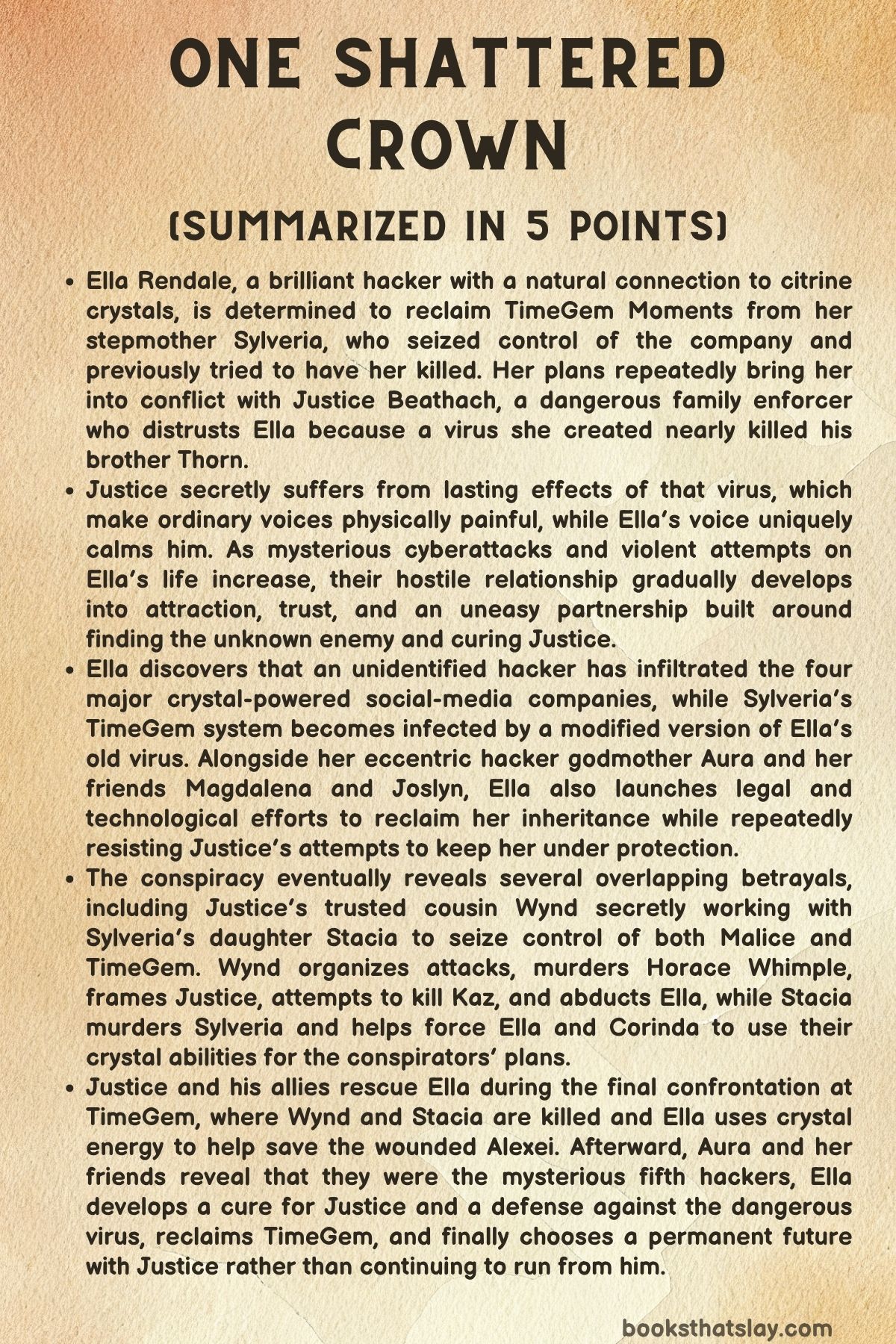
Ella Rendale attends the wedding reception of her friends Alana and Thorn Beathach while quietly pursuing a far more dangerous objective. Though she was born to inherit TimeGem Moments, her stepmother Sylveria controls the company, has replaced its natural citrine-based system with diamonds, and has already tried to have Ella killed.
Ella intends to reclaim TimeGem, and the wedding gives her access to Aquarius Social’s systems through Wesley Whisper, a talented programmer she has been dating. Her efforts are complicated by Justice Beathach, Thorn’s feared brother and protector, who distrusts Ella because a virus she previously created nearly killed Thorn.
Justice has his own reason for staying close to her. While trying to save Thorn from the crystal-based virus, he absorbed part of its corruption, leaving him painfully sensitive to ordinary human voices; strangely, Ella’s voice soothes rather than harms him.
Ella successfully infiltrates Aquarius during the reception and escapes Justice, but what she discovers inside the network is more alarming than expected. An unknown hacker has created a hidden digital pathway through Aquarius toward TimeGem, using an artificial imitation of crystal resonance sophisticated enough to escape ordinary detection.
Justice tracks Ella to a late-night diner and confronts her about the intrusion. Their exchanges reveal the strange balance developing between them: she is always looking for an escape route, while he is increasingly determined to control the risks surrounding her, yet their hostility is accompanied by undeniable attraction.
Soon afterward, Ella is attacked at one of her safe houses by a professional assailant. She fights back fiercely but is badly injured, and after several unknown men enter the conflict she awakens in a private hospital with Sylveria, who claims responsibility for saving her despite having previously ordered her death.
Justice storms through Sylveria’s security and removes Ella from the hospital himself. Neither he nor Sylveria appears responsible for the latest attack, confirming that an additional enemy is operating around them, and Justice becomes convinced that Ella’s hacking activity is somehow connected to the escalating violence.
Their relationship grows more complicated when armed men ambush Justice’s vehicle and demand that he surrender Ella. Justice is shot while protecting her, but Ella still uses the confusion to escape because remaining free has become almost instinctive for her.
She reaches Cinderfalls Community Home, where her godmother Aura lives with Magdalena and Joslyn. The three seemingly harmless older women are actually highly capable hackers and investigators who have already discovered the same mysterious fifth digital signature moving through all four major crystal-powered social-media companies.
Their investigation confirms that someone is studying not merely TimeGem but the entire crystal-based technological system. Ella also reveals another side of herself by risking her safety to rescue an abused dog, whom she renames Leo, and Justice eventually finds her during the rescue.
When the dog’s abusive owner restrains Ella, Justice kills him without hesitation. Ella is disturbed by his ruthlessness, but she also recognizes that his violence is governed by a very simple personal code: once someone he considers his responsibility is harmed, he responds absolutely.
Ella bargains with Justice, offering forty-eight hours of hacking assistance if he helps save Leo. They bring the dog into their increasingly shared life, and Ella begins seeing private aspects of Justice that contradict his public reputation, including his affection for books, his ability to cook, his attachment to home, and his capacity for quiet care.
Their practical disagreement centers on the dangerous virus Ella originally created. Justice wants her to recreate it so Malice Media can defend itself, while Ella believes such technology should be destroyed because it can move beyond computer systems, infect crystals, and ultimately harm human beings.
Before that dispute can be settled, a missile destroys Justice’s penthouse. He gets Ella and Leo out through hidden escape routes and takes them to an underground technological facility, proving that their enemy is willing to use military-level force against them.
Ella remains unwilling to surrender the virus or her independence and again tries to flee. Justice catches her, and their confrontation finally breaks through the emotional distance both have maintained, turning their attraction into a physical relationship neither of them can continue dismissing as temporary.
Justice then reveals the truth about his condition. Because he tried to draw the corrupted crystal energy out of Thorn, ordinary voices now injure him physically, and Ella realizes that her past actions caused consequences she never intended.
She sincerely apologizes and agrees to search for a cure. Justice, in turn, promises that he no longer intends to kill her, and their relationship begins shifting away from bargains and threats toward trust.
Ella is allowed into Malice Media’s protected server center, where she examines its massive garnet and discovers that the crystal itself appears healthy. When Kaz’s harsh voice hurts Justice, Ella quietly protects him by convincing Kaz to speak more gently without exposing Justice’s weakness, an act that affects Justice deeply because he is unaccustomed to being protected by anyone except Thorn.
Justice later offers Ella a major alliance: if she helps cure him and investigate the attacks, he will use his resources to help her reclaim TimeGem from Sylveria. Ella wants his help but still refuses to give him control of the virus, fearing loyalty to Malice could eventually cause him to weaponize it.
Meanwhile, the four major family leaders begin comparing evidence of the mysterious fifth hacker. Justice meets Alexei Sokolov, Mathias Beaumont, and Sylveria, warns Sylveria publicly to leave Ella alone, and declares Ella under his protection, making his personal attachment politically significant.
Ella continues planning to retake TimeGem with Aura, Magdalena, Joslyn, and Rosalie. She authorizes a legal challenge to her father’s will and prepares a technological takeover, but Sylveria anticipates part of the plan by monitoring Rosalie and abducts Ella.
At TimeGem headquarters, Ella discovers that the company’s central diamonds have become infected by a modified form of her old virus. More frighteningly, Sylveria herself appears able to transmit the infection into fresh stones, proving the corruption can reside within a human crystal-charger.
Sylveria also kidnaps Wesley and locks him with Ella inside the server chamber, threatening to remove their oxygen unless Ella repairs the system. Ella clears the active corruption from the network but deliberately refuses to restore Sylveria’s diamond infrastructure, hoping to force TimeGem back toward citrine.
When Justice discovers where Ella is being held, he goes after her. Aura and her friends independently prepare an armed rescue of their own, forcing Justice to prevent the enthusiastic older women from charging directly into TimeGem with military weapons.
Ella eventually connects with a large citrine and restores enough power to the system to survive. Justice breaks into the facility, confronts Sylveria, rescues Ella and Wesley, and helps Ella leave with both the charged citrine and her family’s damaged crown.
The confrontation pushes Ella and Justice toward a clearer understanding of what they want. Justice admits that he no longer sees their relationship as temporary, while Ella says that staying with him would require more than protection and desire; she wants honesty, romance, enjoyment, tenderness, and genuine partnership.
Just as they begin accepting a future together, Justice is framed for the murder of Sylveria’s boyfriend Horace Whimple. Horace’s body is discovered on Justice’s property, and investigators reveal that he secretly owned ten percent of TimeGem, making the killing part of the larger struggle over the company.
The conspiracy intensifies when Sylveria herself is found murdered inside Malice Media while its surveillance system is mysteriously disabled. Ella is sent away with Justice’s trusted cousin and lieutenant Wynd, only to discover that Wynd is one of the people behind the attacks.
Wynd has secretly joined forces with Sylveria’s daughter Stacia, his lover. Their goal is to remove Justice, Thorn, Sylveria, Ella, and anyone else standing between them and control of Malice and TimeGem, allowing them to rule both family lines and eventually produce heirs capable of charging multiple types of crystals.
Stacia murdered Sylveria because her mother intended to favor Corinda, while Wynd arranged several of the attacks, killed Horace, planted evidence against Justice, and attempted to murder Kaz. Sylveria herself had independently encouraged violence against rival families, meaning several overlapping conspiracies had created the appearance of a single coordinated enemy.
Ella and Corinda are held inside TimeGem while Wynd and Stacia force Ella to charge the citrine. Justice discovers Wynd’s betrayal after finding Bronco wounded, Wesley trying to help, and Kaz barely alive after surviving an attempted execution.
Justice tracks Ella to TimeGem and attacks with Alexei’s assistance while Aura, Magdalena, and Joslyn provide support outside. During the confrontation, Justice kills Wynd, Alexei kills Stacia after being shot, and Ella uses crystal energy drawn through herself, Justice, and Alexei’s affinity to stabilize Alexei long enough for medical treatment.
The aftermath produces one last surprise. Aura, Magdalena, and Joslyn admit that they created the altered virus that weakened TimeGem’s diamonds, hoping to make Sylveria dependent on Ella rather than kill her, and they also reveal themselves as the mysterious fifth digital player that had been roaming through the four companies.
Their interference was partly protective and partly an outrageous attempt to influence Ella’s romantic life by placing Justice in her path. What appeared to be an unknown corporate challenger therefore turns out to have originated partly with three older hackers who believed they knew what kind of partner Ella needed.
Ella realizes the same complementary energy that helped save Alexei might cure Justice. Eventually Ella, Justice, and Thorn combine their respective crystal energies, removing the damaging effects of the virus from Justice, while Ella develops a countermeasure and shares it with the major families.
Ella finally assumes control of TimeGem Moments and grows closer to Corinda, while the relationships among the four powerful families begin settling into a new balance. Most importantly, Ella stops treating escape as her only form of freedom and chooses a permanent life with Justice, Leo, her friends, and the unconventional family she has built around herself.
Characters
Ella Rendale
Ella is the emotional and intellectual center of One Shattered Crown, a woman whose brilliance is inseparable from her fierce need for independence. Her hacking ability, understanding of crystal technology, and instinctive talent for finding weaknesses in supposedly secure systems make her capable of challenging corporations protected by money, violence, and family power.
Her greatest strength is also one of her deepest vulnerabilities: she has survived by refusing to depend fully on anyone. Safe houses, hidden vehicles, disguises, escape routes, digital tricks, and carefully separated relationships are not simply clever habits; they reveal a worldview in which dependence creates danger and remaining untraceable means remaining alive.
Ella’s repeated escapes from Justice therefore carry more significance than simple stubbornness. Even after he repeatedly protects her, she continues running because accepting his protection would mean surrendering the emotional structure that has allowed her to survive Sylveria’s betrayal and the loss of her inheritance.
At the same time, Ella is deeply compassionate. Her willingness to risk capture for an abused dog shows that beneath her sarcasm and strategic thinking lies a person who cannot ignore suffering merely because helping is inconvenient or dangerous.
Her relationship with Wesley demonstrates the limits of safety and similarity. Wesley is intelligent, attractive, technologically skilled, and comparatively predictable, yet Ella eventually recognizes that compatibility on paper cannot replace the intensity, challenge, trust, and emotional recognition she experiences with Justice.
Her development is completed not when she becomes less independent but when she redefines independence. By the end, staying with Justice is not surrender because she consciously negotiates what partnership must mean, insists on honesty and tenderness, and chooses permanence rather than having it imposed upon her.
Justice Beathach
Justice initially appears in One Shattered Crown as the embodiment of controlled danger. He is physically formidable, professionally ruthless, deeply loyal to his family, and accustomed to solving threats through surveillance, intimidation, force, and, when he considers it necessary, killing.
His morality is severe but not random. Justice does not enjoy cruelty for its own sake; instead, he operates according to a highly personal code in which loyalty must be absolute, betrayal deserves decisive punishment, and anyone who harms those under his protection loses any expectation of mercy.
His treatment of Ella exposes both the strengths and dangers of that worldview. He repeatedly tries to confine or control her because he genuinely believes that protection gives him authority, yet Ella forces him to confront the difference between keeping someone physically safe and respecting that person’s autonomy.
Justice’s hidden illness also changes how he is understood. The man who presents himself as nearly invulnerable is suffering continuously from a condition he acquired while trying to save Thorn, revealing that beneath his dominance lies a capacity for extraordinary self-sacrifice.
His emotional isolation is rooted in childhood experiences that taught him love could be exploited. That history explains why he initially treats his growing attachment to Ella as a weakness to control rather than a relationship to embrace.
Ella gradually teaches Justice that vulnerability does not automatically destroy power. When she quietly protects him from Kaz’s voice, searches for a cure, and demands emotional honesty rather than simply accepting his protection, she offers him a kind of partnership he has never known how to build.
By the conclusion, Justice remains possessive, dangerous, competitive, and uncompromising, but his conception of love has changed. He no longer sees Ella merely as someone to guard or keep; he accepts that she needs access to his emotional life and that true commitment requires giving as well as protecting.
Sylveria Rendale
Sylveria is driven by control, status, and the conviction that power belongs to whoever can hold it most effectively. Her takeover of TimeGem and her willingness to eliminate Ella reveal a woman who has transformed family relationships into corporate strategy.
She also represents the older generation’s mistake of assuming legal possession and managerial authority are the same as rightful belonging. Sylveria can control TimeGem’s boardrooms and diamonds, but she cannot reproduce Ella’s natural relationship with citrine or erase the inheritance that gives Ella a deeper connection to the company.
Her treatment of her daughters is equally revealing. Corinda and Stacia exist within a family structure built around competition and utility, and Sylveria’s decision to privilege one daughter over another ultimately contributes to the resentment that leads Stacia to murder her.
Sylveria is formidable because she is rarely sentimental about the means she uses. Kidnapping, blackmail, attempted murder, corporate manipulation, and engineered conflict all become acceptable once they serve her objective.
Yet her downfall comes partly from her inability to recognize how many people her methods have alienated. She spends so much time treating relationships as instruments that she fails to see the alliances forming around Ella and the rebellion developing inside her own family.
Wesley Whisper
Wesley represents the life Ella might have chosen if compatibility, safety, and shared interests were enough. He is talented, intelligent, professionally ambitious, and genuinely interested in Ella, making him far more than a disposable romantic obstacle.
His relationship with Ella is undermined not by a serious moral failure but by the absence of the deeper connection she eventually discovers elsewhere. They understand each other’s technical ambitions so well that they can already see how those ambitions might turn them into competitors once Ella regains TimeGem.
Wesley’s repeated efforts to rescue Ella also demonstrate loyalty and courage. Even when injured, outmatched, and convinced she is being held against her will, he continues trying to help because he sincerely believes she is in danger.
His difficulty accepting Ella’s choice of Justice makes him frustrating at times, but it also humanizes him. He sees behavior from Justice that would reasonably alarm an outsider and struggles to understand why Ella experiences the relationship differently.
By the time the truth emerges, Wesley proves capable of acting honorably even after romantic rejection. His attempt to help Bronco during Wynd’s betrayal and his willingness to cooperate during the crisis allow him to leave the romantic triangle with dignity intact.
Aura
Aura is Ella’s godmother and one of the strongest examples of unconventional family in the story. Her age and eccentric manner make her easy for outsiders to underestimate, yet she is an experienced hacker, investigator, strategist, and fiercely protective guardian.
Her devotion to Ella is absolute. She monitors threats, erases surveillance evidence, provides safe shelter, supports Ella’s campaign against TimeGem, and is willing to carry serious weapons into a rescue operation when Ella is kidnapped.
Aura’s methods are frequently outrageous, particularly when she and her friends admit that their hacking helped trigger the wider crisis. Nevertheless, her actions come from a genuine conviction that Ella deserves protection, happiness, and people who will stand beside her.
She also provides a comic counterweight to the darker violence surrounding the major families. Her willingness to treat hacking, matchmaking, and heavily armed rescue missions as equally reasonable projects gives the story some of its most distinctive humor.
Magdalena
Magdalena, often called Mags, forms part of the formidable trio surrounding Aura. She shares Aura’s technical skill, investigative ability, and willingness to operate far outside conventional rules.
Her importance lies less in an individual personal conflict than in what she represents collectively with Aura and Joslyn. Together they demonstrate that age does not make someone irrelevant, harmless, or technologically incapable, and their enemies repeatedly misjudge them because of superficial assumptions.
Mags also contributes to Ella’s sense of belonging. She is part of a chosen household where Ella can arrive injured, hunted, or uncertain and still be treated as someone worth defending without conditions.
Joslyn
Joslyn completes the trio of older hackers whose apparent harmlessness conceals extraordinary capability. Like Aura and Mags, she participates in surveillance, digital intrusion, rescue planning, and the manipulation of powerful corporate families.
Her presence strengthens one of the story’s recurring contrasts between appearance and actual power. People who look socially insignificant may possess access and knowledge that supposedly untouchable executives lack.
Joslyn’s loyalty to Ella also helps expand the meaning of family beyond blood. The security Ella receives from these women is emotional as well as practical, giving her a refuge from the manipulative relationships surrounding her inheritance.
Corinda Rendale
Corinda initially appears closely associated with Sylveria and therefore with the forces keeping Ella from TimeGem. Her position becomes more complicated as the conflict develops and she begins suffering directly from the infected crystal system.
Unlike Stacia, Corinda is not revealed as the architect of a hidden rebellion. Instead, she becomes another victim of the ruthless family structure Sylveria helped create and is eventually imprisoned and exploited by her own sister.
Her forced role as a crystal charger strips away much of the privilege that previously separated her from Ella. By the final confrontation, Ella does not treat Corinda merely as an enemy but as someone who must also be saved.
Their growing closeness afterward suggests the possibility of rebuilding a damaged family relationship without pretending the past never happened. Corinda’s survival therefore carries the possibility of reconciliation alongside the political rebuilding of TimeGem.
Stacia Rendale
Stacia is one of the story’s most effective hidden antagonists because she benefits from being underestimated. She allows others to see her as the less significant younger daughter while privately developing the programming knowledge and ambition necessary to challenge both her mother and the other families.
Her relationship with Wynd grows from shared resentment. Both feel overshadowed by relatives treated as more important, and together they convert that resentment into a plan based on murder, kidnapping, corporate seizure, forced crystal charging, and dynastic ambition.
Stacia’s murder of Sylveria reveals the extreme endpoint of a family system in which affection has been replaced by competition. Rather than seeking recognition from her mother, she ultimately decides that eliminating her is the most efficient route to power.
Her plans for Corinda are especially revealing because they show that Stacia has become even more ruthless than the mother she hates. She is willing to reduce her own sister to a permanent biological resource in service of her ambitions.
Wynd
Wynd’s betrayal carries unusual weight because he is not an obvious outsider. He is Justice’s cousin, trusted lieutenant, and member of the same extended family structure, which gives him access to people, systems, and secure locations that external enemies could never easily reach.
His resentment comes from believing that he has spent his life serving men who received status he deserved. Rather than confronting that grievance openly, he turns it into a hidden campaign designed to remove Justice and Thorn and place himself at the head of their family power.
Wynd is particularly dangerous because he understands Justice’s security from the inside. The attacks, planted evidence, disabled surveillance, attempted murder of Kaz, and abduction of Ella succeed precisely because Justice has trusted him.
His death at Justice’s hands therefore functions as more than the defeat of an enemy. It is the destruction of a family bond that Justice believed unquestionable, forcing him to confront betrayal from the very circle he has spent his life protecting.
Thorn Beathach
Thorn is central to Justice’s motivations even though much of the immediate conflict occurs while he is away. The earlier virus attack nearly killed him, and Justice’s attempt to save him caused the condition that shapes much of the present story.
His relationship with Justice reveals the depth of the brothers’ loyalty. Justice repeatedly conceals the seriousness of events because he wants Thorn to enjoy his honeymoon and refuses to allow the crisis to pull his brother away from his new life.
Thorn also acts as an emotional mirror for Justice. He recognizes Justice’s feelings for Ella earlier than Justice is willing to admit them and later supports his brother without hesitation when Justice announces that Ella will remain in his life.
Rosalie
Rosalie is one of Ella’s closest friends and an important source of legal, emotional, and political support. She takes Ella’s claim to TimeGem seriously and prepares the legal challenge necessary to attack the will, trust arrangements, and transfer of ownership.
Her concern for Ella never becomes passive. She offers protection through Alexei’s resources, intervenes when Ella appears vulnerable, and even responds effectively during the armed attack outside the police station.
Rosalie also helps Ella think through possible motives behind Sylveria’s actions. Her suspicion that Sylveria might manufacture conflict between rival families shows that she understands the political danger surrounding Ella as well as the personal one.
Alexei Sokolov
Alexei is a powerful rival whose relationship with Justice moves repeatedly between threat and cooperation. Because the major families operate within an unstable balance, he treats unexplained violence as possible evidence of aggression from Justice until circumstances force them to reconsider.
He is highly protective of Rosalie, and that loyalty eventually gives him common ground with Justice. Both men understand what it means to treat the safety of someone they love as non-negotiable.
Alexei’s decision to help rescue Ella demonstrates that alliances can emerge from personal loyalty even where corporate rivalry remains. His near-fatal shooting also becomes crucial to Ella’s understanding of crystal energy, since saving him helps her develop the theory later used to cure Justice.
Kaz
Kaz is Justice’s trusted technology specialist and an essential contrast to Ella. Both are extremely capable with computer systems, but Kaz serves the defensive interests of Malice while Ella naturally looks for the pathways through which secure systems can be breached.
His reaction to Ella’s presence in Malice’s server center shows how extraordinary Justice’s trust in her has become. Allowing an outsider with Ella’s abilities into such a protected environment violates the security principles Kaz normally enforces.
Kaz’s survival after Wynd shoots and buries him is also one of the strongest demonstrations of resilience among the supporting characters. His return provides undeniable confirmation that the threat comes from inside Justice’s organization.
Leo
Leo begins as an abused dog whom Ella refuses to abandon despite the danger surrounding her. His rescue reveals Ella’s instinctive compassion and provides one of the first situations in which she and Justice cooperate around something neither corporate nor strategic.
Leo quickly becomes part of their developing household. Justice’s willingness to pay for his care and accept him into his home helps Ella see that the intimidating enforcer possesses a capacity for domestic attachment she had not expected.
The tracking device placed in Leo also becomes practically important when Justice follows him to Cinderfalls. Beyond that plot function, Leo symbolizes the stable home Ella slowly allows herself to want.
Alana
Alana is one of Ella’s closest friends and part of the younger generation reshaping the alliances among the major families. Her marriage to Thorn connects Aquarius and Malice and creates the social setting in which Ella and Justice’s conflict intensifies.
Although she remains outside much of the central action, Alana represents friendship that survives corporate competition. By the end, she stands beside Ella and Rosalie as one of the women now occupying influential positions around the platforms their families helped build.
Fergus
Fergus serves Justice as both a trusted associate and legal representative. His presence helps demonstrate that Justice’s power depends not only on violence but also on an organized network capable of navigating legitimate businesses, criminal interests, and legal pressure.
When Justice is questioned over Horace’s murder, Fergus provides the professional protection necessary to prevent the police investigation from becoming another uncontrolled threat. His loyalty places him among the dependable figures who contrast with Wynd’s betrayal.
Bronco
Bronco is one of Justice’s reliable men and becomes an important victim of Wynd’s treachery. His shooting in Malice’s secret garage makes the internal betrayal immediately visible and confirms that Wynd is willing to kill longtime associates to complete his plan.
His survival also emphasizes the cost of the conspiracy beyond the central romantic pair. People throughout Justice’s organization are harmed because someone within the family decides personal ambition is worth destroying existing loyalties.
Horace Whimple
Horace Whimple is Sylveria’s longtime boyfriend whose disappearance initially appears secondary to the larger conflict. His murder becomes much more significant when police reveal that he secretly owned ten percent of TimeGem.
That ownership stake gives his death a corporate motive and allows the conspirators to make Justice appear responsible for eliminating someone who stood between Ella and greater control of the company. His body being planted on Justice’s property shows how carefully the frame-up has been constructed.
Mathias Beaumont
Mathias Beaumont represents another branch of the power structure surrounding the four major social-media families. His participation in the leaders’ meeting shows that the mysterious digital attacks have become serious enough to force rivals into information sharing.
He also understands the political implications of Justice’s interest in Ella. When Justice publicly claims responsibility for protecting her, Mathias immediately recognizes that personal relationships among the heirs could rearrange the balance between the companies.
Detectives Caldwell and Ashner
Caldwell and Ashner represent the legal pressure closing around Justice while the conspirators manipulate evidence against him. They cannot simply accept his denials once a murder victim is discovered on his land and another body appears inside his company.
Their investigation gives the conspiracy additional danger because Justice cannot solve every problem through private force. The presence of law enforcement forces him to operate while knowing that a carefully manufactured public case could destroy him even if he survives the physical attacks.
Saveliy
Saveliy appears only indirectly near the conclusion, but his possible arranged marriage to Corinda shows that the political relationships among the powerful families continue evolving after the primary conflict ends. His connection to Alexei’s family suggests that personal partnerships may continue reshaping corporate alliances in the future.
His presence also emphasizes how differently Corinda’s future may develop after escaping Sylveria and Stacia’s control. Rather than existing merely as an asset inside her mother’s plans, she now has the possibility of making choices within a changing family order.
Themes
Freedom, Control, and the Meaning of Choice
Freedom in One Shattered Crown is not presented simply as the ability to escape confinement. Ella begins the story treating mobility, secrecy, and self-reliance as the clearest signs of freedom because experience has taught her that people who gain control over her circumstances may also gain the power to destroy her.
Justice challenges that belief in a deeply uncomfortable way because his instinct is to protect through control. He locks doors, tracks movements, removes weapons, limits access to technology, and repeatedly decides that his ability to keep Ella alive justifies restricting her choices.
The conflict becomes meaningful because neither position is treated as completely sufficient. Ella’s constant escapes expose her to danger and sometimes become less about rational survival than about proving that nobody can make her stay, while Justice’s protective instincts often cross into behavior that denies the autonomy of the person he claims to value.
Their relationship can become permanent only once staying becomes Ella’s decision. She does not accept love by surrendering her independence; instead, she defines the conditions under which commitment will still allow her to remain fully herself.
Justice must make a corresponding adjustment by recognizing that love cannot be reduced to possession. The story ultimately distinguishes being held from choosing to remain, suggesting that genuine security has value only when it leaves room for agency.
Trust as a Form of Vulnerability
Nearly every major relationship is shaped by the danger of trusting someone. Ella has been betrayed by a stepmother who should have been family, while Justice has built his identity around loyalty because childhood experience taught him how easily emotional attachments can be exploited.
Both therefore approach trust indirectly. Ella hides information, maintains safe houses, plans escape routes, and separates parts of her life, while Justice relies on surveillance, physical control, and rigid loyalty structures that allow him to reduce uncertainty.
The irony is that secrecy cannot protect either of them completely. Ella needs allies to reclaim TimeGem, and Justice’s most devastating threat ultimately comes from Wynd, a cousin and trusted lieutenant who already possesses access that no outsider could have gained.
Small acts of protection become more important than dramatic declarations. Ella’s decision to shield Justice’s medical weakness from Kaz, Justice’s repeated willingness to place himself between Ella and gunfire, Wesley’s attempt to help Bronco, and Thorn’s unconditional support of his brother all demonstrate trust through action.
The story does not suggest that trusting others guarantees safety. Instead, it presents vulnerability as unavoidable once people choose meaningful relationships, while arguing that the answer to betrayal is not permanent isolation but learning whose actions justify confidence.
Family by Blood and Family by Choice
Blood relationships in the story are frequently sources of obligation, conflict, inheritance, and betrayal. Sylveria’s household is shaped by competition, unequal treatment, and control, while Wynd’s resentment toward Justice and Thorn shows that shared ancestry can intensify entitlement rather than guarantee loyalty.
Stacia and Wynd represent the darkest version of family ambition. Both believe proximity to power has entitled them to more than they received, and both become willing to murder relatives and exploit siblings in order to create the family hierarchy they think should exist.
Against this stands Ella’s chosen family. Aura, Magdalena, Joslyn, Alana, Rosalie, Leo, and eventually Justice provide forms of support that are not based primarily on inheritance, corporate position, or biological obligation.
These relationships are imperfect and sometimes absurd. Aura and her friends invade networks, manipulate events, and make decisions on Ella’s behalf that are hardly conventional expressions of affection, yet their loyalty remains centered on her survival and happiness rather than on using her abilities for personal advancement.
Justice experiences a similar distinction when Wynd betrays him while Thorn remains completely loyal. The contrast makes clear that blood may create a connection, but character determines whether that connection deserves trust.
By the conclusion, Ella’s sense of home comes from a mixed community of friends, relatives, former rivals, animals, and allies. Family therefore becomes something built through repeated acts of loyalty rather than something guaranteed by a surname.
Power, Inheritance, and Legitimate Leadership
The struggle over TimeGem asks what actually makes someone entitled to lead. Sylveria possesses legal and managerial control, but Ella has the inherited citrine affinity, technical knowledge, emotional attachment, and original vision that connect her more naturally to the company’s foundations.
The conflict therefore separates possession from legitimacy. A person may control contracts, boards, money, security, or infrastructure without necessarily being the person best suited to preserve what an institution was meant to become.
Similar questions appear within Malice. Wynd believes his blood relationship to Justice and Thorn means he deserves greater authority, but his response to feeling overlooked is to sabotage his own organization, murder allies, and cooperate in attacks that endanger the very family whose leadership he claims to deserve.
Justice’s authority is imperfect and often harsh, yet it rests on responsibility as well as strength. He repeatedly risks his body for the people he protects, takes responsibility when crises occur, and treats leadership as an obligation to act rather than simply a privilege to possess.
Ella ultimately earns control of TimeGem through more than inheritance. She understands its technology, recognizes the danger of the virus, protects even people who have stood against her, develops a countermeasure, and chooses to share that protection with rival families.
The story therefore presents legitimate power as a combination of ability, responsibility, and stewardship. Authority becomes meaningful when the person holding it protects the larger community rather than treating people and institutions merely as resources to control.