Of Venom and Vengeance Summary, Characters and Themes
Of Venom and Vengeance by Mikayla Bridge is a fantasy novel about inheritance, revenge, corrupted power, and the difficult work of choosing a life that is not dictated by family history.
Its two central figures, Inna Pallo and Rylan, begin on opposing sides of a violent legacy: she is heir to a feared magical empire, while he has spent years preparing to destroy it. Their conflict leads them toward forbidden family secrets, exploited magical creatures, buried histories, and an ancient god whose existence may change everything they understand about power. Beneath its adventure and romance, the book asks whether people can reject the systems that created them.
Summary
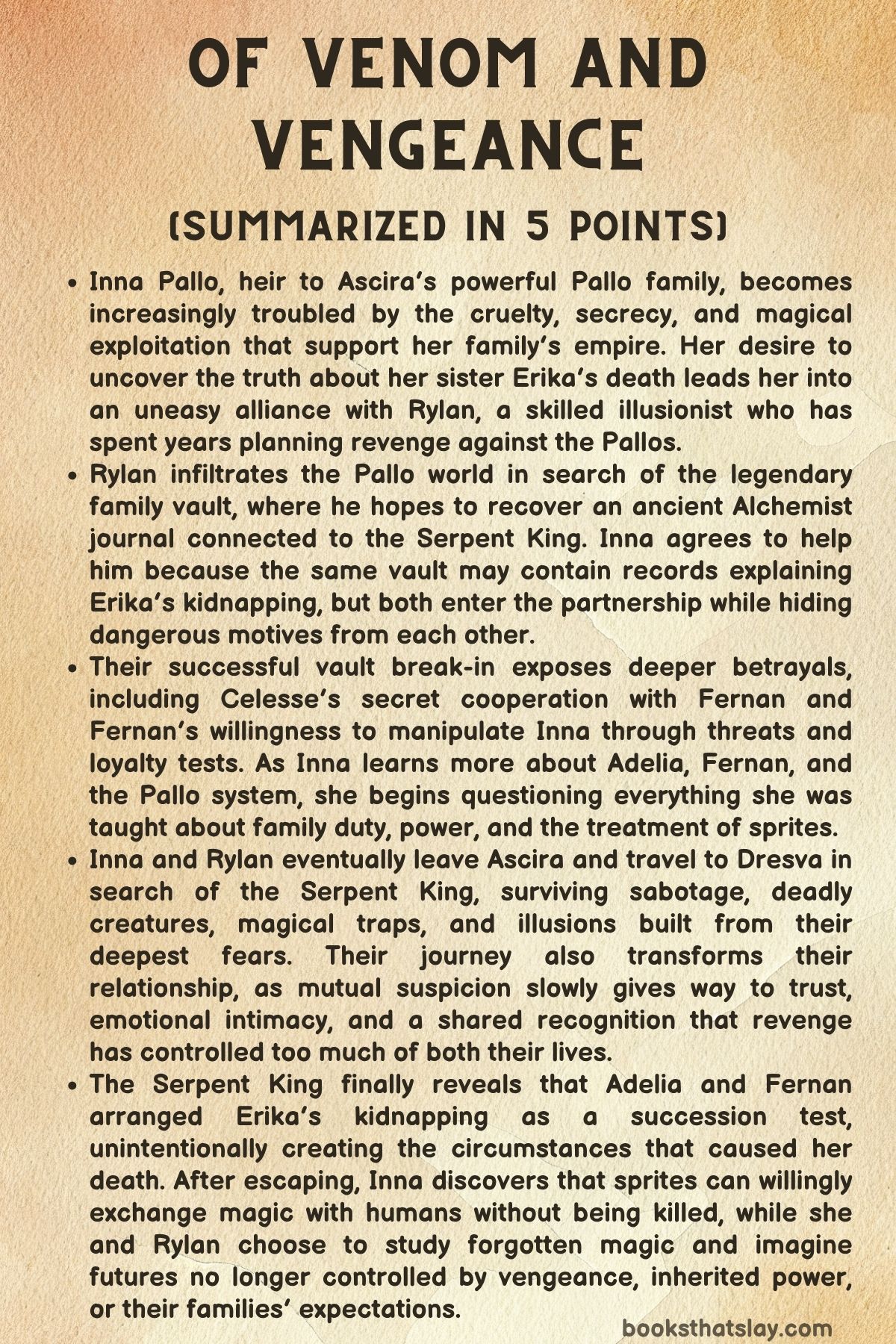
Inna Pallo has recently become heir to one of Ascira’s most powerful families following the death of her older sister, Erika. Her mother, Adelia, expects competence, obedience, and ruthlessness, and Inna has learned to hide fear or uncertainty beneath the confident image expected of a Pallo.
The Pallos have built enormous wealth from sprites, magical creatures whose abilities can be siphoned and sold. Inna understands the danger of sprites better than most citizens because the family hides a horrifying truth: starving sprites can enter human bodies, feed internally, and leave their victims crystallized from within.
While Inna struggles to prove herself, Rylan secretly enters the Pallos’ Horizon Club. His illusion magic allows him to alter his appearance with remarkable precision, and he has spent years preparing to infiltrate the Pallo organization because Adelia destroyed his biological family.
Rylan’s immediate goal is the legendary Pallo Vault, which contains ancient documents and family secrets. Inside it lies a journal written by Alchemist Celian Flint, one of four journals containing pieces of a riddle that supposedly leads to the Serpent King, an ancient being believed capable of granting extraordinary power.
During his infiltration, Rylan encounters Inna without recognizing her. She pretends to be an ordinary employee before exposing his deception, and their confrontation quickly becomes physical.
Inna realizes that Rylan is not after ordinary riches. Once she connects his interest in restricted blueprints to the Pallo Vault, the balance between them changes, because she has reasons of her own for wanting access to the family’s hidden records.
Three years earlier, Inna and Erika were kidnapped. Erika died during their attempt to escape, while Adelia and Inna’s uncle Fernan later killed the kidnappers before Inna could learn who had hired them.
Inna has never accepted the unanswered questions surrounding Erika’s death. Rylan therefore offers her a partnership: she helps him reach the vault, and he helps her obtain the files that may explain what really happened to her sister.
Celesse, Inna’s former lover and longtime family guard, becomes involved as well. She knows Inna well enough to recognize that grief has made her willing to take terrible risks, yet she also understands that stopping Inna outright may only drive her deeper into danger.
As the three prepare for the heist, Inna’s relationship with her family becomes increasingly troubling. Adelia subjects her to violent tests intended to prepare her for leadership, while Fernan appears warmer and more protective but still teaches her that Pallo survival depends upon intimidation, secrecy, and control.
Inna has spent years interpreting such treatment as necessary discipline. Celesse challenges that belief, arguing that Adelia’s cruelty has harmed her rather than strengthened her.
Rylan meanwhile reveals that the four Alchemist journals contain a riddle pointing toward the Serpent King. He hopes the ancient being will give him enough power to destroy the Pallos and ensure that no one can ever destroy another family as his was destroyed.
What he does not reveal is that he has considered using Inna as an offering. His hatred of the Pallos remains powerful enough that, at first, he can imagine sacrificing her if that is the cost of reaching his goal.
The vault heist forces all three characters into direct dependence on one another. Ancient traps test their knowledge of sprites, Pallo blood, riddles, illusion magic, and magical history, while Inna begins discovering evidence that humans may once have interacted with sprites very differently.
Murals beneath the Horizon appear to show people willingly feeding sprites and receiving magic in return. This contradicts the Pallo system, which assumes that magical power must be extracted through imprisonment, injury, and death.
The group eventually reaches the vault. Inna takes Erika’s file, Rylan steals Celian Flint’s journal and confidential coroner reports, and Celesse takes money, but their success is short-lived.
Fernan is waiting when they emerge. Celesse had already told him about the plan because she feared Adelia would discover it and respond even more violently, while Fernan intentionally allowed the break-in to continue so that he could study the vault’s weaknesses and learn what everyone wanted.
Inna experiences Celesse’s decision as betrayal. Fernan then makes the situation worse by demanding that Inna kill Rylan if she wants him to conceal the break-in from Adelia.
Erika’s stolen file provides little immediate closure. It reveals that Erika had undergone a severe succession program and had been subjected to increasingly dangerous assignments, but the final task is blacked out and the circumstances surrounding the kidnapping remain absent.
Unable to find the answer through family records, Inna chooses another possibility. If the Serpent King truly possesses extraordinary knowledge, perhaps he can tell her who caused Erika’s death.
She therefore rejoins Rylan. Together they decode the four journals and determine that the path to the Serpent King requires several forms of sprite magic, an offering, a journey into Dresva’s Wailing Wilds, and something described as the blood of Beloved.
Their partnership gradually becomes more personal. Rylan challenges Inna’s assumption that the Pallo way of using sprites is normal, while Inna exposes contradictions in his belief that acquiring overwhelming power will somehow end the abuse of power.
Rylan also begins seeing that Inna is not simply the privileged heir he imagined. She has wealth and status, but her family has conditioned her through fear, punishment, secrecy, and impossible expectations.
Inna eventually learns more about Celesse’s position as well. Adelia had forced Celesse to report on Inna for years by using knowledge of Celesse’s past as leverage, meaning that Celesse’s apparent loyalty to the Pallo system was itself created through coercion.
The bond between Inna and Rylan strengthens as each begins revealing hidden parts of the past. Rylan admits that his illusion magic frightened his adoptive family when he was young, while Inna admits that she increasingly fears Adelia and Fernan.
Their emotional closeness becomes romantic, but important secrets remain. Inna eventually discovers that Rylan is not merely descended from Celian Flint: he is the surviving heir of the Farring family, which Adelia massacred years earlier.
Fernan knows this too. His own role becomes increasingly sinister as Rylan discovers evidence that Fernan has been killing people connected to political interests, while Inna realizes that the uncle she once trusted is capable of treating affection as another instrument of control.
The conflict finally becomes public when Ascira’s council attacks the Horizon. Adelia is arrested, and Celesse is badly injured.
Fernan demands that Inna abandon Celesse during the escape because carrying her could endanger them. Inna refuses and saves Celesse instead, making one of her clearest decisions against the family mentality that taught her people are expendable when they become inconvenient.
Inna and Rylan decide to leave immediately for Dresva. During the journey, they confess more of their betrayals: Rylan admits that he gave the hidden coroner reports to councillor Stephas Rowman, likely providing evidence that helped justify the assault on the Pallos, while Inna admits that Fernan ordered her to murder Rylan.
Their departure nearly ends in death when their airship is sabotaged. Inna suspects Fernan, and she and Rylan survive only by sharing a single parachute, using sprite magic to redirect their fall, and fighting their way ashore after being attacked by a massive sea creature.
Once in Dresva, their relationship becomes openly intimate. For perhaps the first time, both characters begin imagining futures not built entirely around vengeance.
They enter the Wailing Wilds and eventually locate the entrance to the Serpent King’s underground domain. There, magical traps attack them through personalized illusions.
Inna is forced to confront an apparent choice between Erika and Rylan. Instead of accepting the test, she realizes that much of her life has been governed by people or memories telling her what she must choose, so she refuses the false choice altogether.
Rylan’s illusions show him repeatedly killing Inna, forcing him to face his original willingness to sacrifice her. He finally accepts that no power is worth purchasing with her life.
Together they reach the Serpent King. Rylan learns that the famous promise of a wish was never truly made by the god; Celian Flint created that expectation because he believed anyone capable of surviving the journey might earn the Serpent King’s attention.
When given the chance to ask a question, Rylan asks what power could protect the people he loves. The Serpent King tells him that his Alchemist ancestry could unlock forgotten forms of magic but refuses to simply give him such abilities.
Inna asks the question that has controlled her life: who killed Erika? The answer destroys the final version of her family history she had still been protecting.
Adelia and Fernan themselves arranged Erika’s kidnapping as a succession test. They hired criminals to frighten and torture her so they could determine whether she would protect family secrets, but Inna unexpectedly became involved and Erika was fatally wounded while protecting her.
The revelation offers Inna truth without comfort. Erika was not merely taken from the Pallos by an outside enemy; she died because the Pallo system turned cruelty into a measure of worth.
The Serpent King then attacks Inna and Rylan. During their attempt to escape, Inna tests the idea suggested by the ancient murals and willingly allows a sprite to feed from her blood.
Instead of dying, she receives an extraordinary amount of magic in return. The discovery proves that humans and sprites can exchange blood and magical power voluntarily, making the violent foundation of the Pallo industry unnecessary.
Inna and Rylan escape, although Rylan has secretly been poisoned by the Serpent King. When the venom finally overwhelms him, Inna interprets a passage in Flint’s journal and uses venom from three Dresvan serpent species as an antidote.
Rylan survives after several terrifying days. During his recovery, Inna begins accepting that Erika’s death may never provide the kind of closure she once imagined and that her future does not have to consist of reclaiming her family’s empire.
Meanwhile, Adelia is convicted and sentenced to life imprisonment, Celesse escapes Ascira to build an independent life, and Fernan remains free. Adelia later admits in a letter that Erika’s kidnapping was indeed a test and that she had always known Inna did not truly want to become the next Pallo leader.
Two months later, Inna and Rylan remain beneath Dresva studying forgotten forms of magic. Rather than seeking absolute control, they begin documenting what they learn while trying not to repeat the possessiveness and exploitation that destroyed both of their families.
Inna develops a voluntary relationship with sprites, while Rylan explores the lost techniques connected to his Farring and Alchemist ancestry. They know that Ascira, Celesse, Fernan, Adelia, and the consequences of the Pallo collapse still await them, but for now they choose exploration, companionship, and discovery over revenge.
Characters
Inna Pallo
Inna is the emotional centre of Of Venom and Vengeance, and much of her character development depends on the gradual destruction of the identity her family created for her. At the beginning, she believes that becoming a worthy Pallo requires tolerating fear, humiliation, violence, and impossible standards without complaint.
Her need for Adelia’s approval is especially revealing because even tiny signs of praise have enormous emotional power over her. She has learned to reinterpret mistreatment as evidence that she is being prepared for greatness, which allows the family system to survive inside her even when Adelia is not physically present.
Erika’s death gives this conditioning an additional force. Inna believes that discovering who caused the kidnapping will bring meaning to her sister’s death, and the search becomes so important that she repeatedly places herself in danger and accepts increasingly disturbing assignments.
Her grief is therefore not passive sadness. It has become an organizing principle for her identity, influencing her relationship with Adelia, Fernan, Celesse, Rylan, and even the future she imagines for herself.
Inna’s changing attitude toward sprites mirrors her changing understanding of her family. She begins by participating in a system of magical exploitation because she has been taught that its practices are natural, necessary, and economically justified.
Once she learns that humans may receive stronger magic through voluntary exchange, she confronts an uncomfortable fact: much of the violence supporting Pallo power was never necessary. Her final experiments with freely shared magic represent an ethical break from the inheritance she was expected to defend.
Her relationship with Rylan also contributes to her independence because he refuses to treat her as fragile. Although his own motives are dangerous and deceptive, he generally allows Inna to make her own decisions rather than claiming the right to protect her by controlling her choices.
By the end, Inna has not become perfectly healed or morally certain. What changes is that she begins making decisions because they belong to her, which is a far greater transformation than simply rejecting the title of heiress.
Rylan
Rylan begins Of Venom and Vengeance as a man who has converted grief into a long-term project. The destruction of his biological family gives him a clear enemy, and he organizes years of training, research, deception, and isolation around the idea that destroying the Pallos will prevent similar suffering.
His illusion magic reflects his emotional habits. Rylan survives by controlling what others see, disguising himself physically while also hiding vulnerability, fear, affection, and uncertainty.
The connection between illusion and identity becomes particularly important because Rylan has spent so long constructing versions of himself that genuine attachment feels dangerous. He assumes that love creates weaknesses an enemy can exploit, so his original solution is to become powerful enough that nobody he cares about can ever be harmed.
That reasoning contains the same temptation that corrupted the families he despises. Inna recognizes the contradiction and challenges him to consider whether acquiring overwhelming power to prevent tyranny might simply create another tyrant.
His intended sacrifice of Inna is therefore central to his moral development. Early in the story, he can justify her death because he sees her primarily as a Pallo, an extension of the family responsible for his loss.
Once Inna becomes an individual rather than a symbol, that logic collapses. The Serpent King’s trials force Rylan to watch imagined versions of her death until he understands that his vengeance is no longer worth the cost he once accepted.
His romance with Inna does not simply soften him. It forces him to reconsider isolation, forgiveness, family, and his assumption that protecting people requires possessing enough power to control every possible danger.
By the end, Rylan chooses investigation rather than domination. His interest in rediscovering Alchemist and Farring magic remains strong, but he has become far more aware that knowledge becomes dangerous when treated as private entitlement.
Celesse
Celesse initially appears to occupy the position of loyal guard, former lover, and protective friend, but her character becomes more complicated as the extent of Adelia’s control emerges. Her apparent betrayal of the vault plan is painful precisely because her loyalty to Inna has always seemed more personal than political.
The later revelation that Adelia has effectively forced her to inform on Inna reframes much of Celesse’s behaviour. She is not simply choosing the Pallo family over the woman she loves; she has spent years attempting to survive inside a system that holds her own past against her.
Her killing of her abusive father becomes the secret through which Adelia controls her. By covering up the death and then demanding information in exchange, Adelia transforms rescue into ownership, making Celesse another person whose freedom depends on remaining useful.
Celesse’s protectiveness toward Inna also carries genuine tension. She loves Inna and understands the danger surrounding her, but her attempts to decide what risks Inna should be allowed to take sometimes reproduce the controlling behaviour both women have suffered from elsewhere.
That is one reason Inna is temporarily drawn toward Rylan as an ally. Celesse wants to save Inna from dangerous choices, while Inna increasingly needs the right to make those choices herself.
Celesse’s eventual escape becomes significant because she builds the independent life that she repeatedly urged Inna to imagine. Her surviving affection shows that their relationship does not need to return to romance in order to remain meaningful.
Adelia Pallo
Adelia is frightening because her cruelty is rarely meaningless. She believes she is preparing heirs to survive an environment where weakness can destroy an entire family, and that belief allows her to transform abuse into training and murder into strategy.
Her treatment of Inna reveals a woman who has accepted inherited brutality so completely that she struggles to recognize alternatives. She repeats the methods used by previous generations while convincing herself that suffering produces strength.
Yet Adelia is not emotionally empty. Her memories of Inna as a child, her reaction during the attack on the Horizon, and her later letter reveal genuine maternal attachment.
That affection does not excuse what she has done. Instead, it makes her more disturbing because the book shows how someone can love another person while still causing terrible damage through the beliefs they refuse to question.
Her role in Erika’s death exposes the final consequence of this worldview. A supposedly controlled succession test becomes fatal because Adelia and Fernan have normalized extreme danger to such an extent that even kidnapping and torture can be treated as legitimate tools of evaluation.
Her claim that she would have allowed Inna to leave is especially tragic. Inna has spent years believing that escape was impossible because Adelia’s entire system taught obedience through implication, punishment, and fear.
Adelia therefore represents more than an individual antagonist. She demonstrates how inherited systems can continue because each generation convinces itself that cruelty is simply responsibility performed without sentiment.
Fernan Pallo
Fernan initially appears to be the safer member of the Pallo family. He jokes with Inna, protects her from embarrassment, teaches her, and provides the affection that Adelia rarely expresses directly.
That warmth gives his later behaviour greater force. Fernan understands how loyalty works emotionally, and he gradually reveals that he sees relationships through the language of usefulness, obligation, and control.
His demand that Inna kill Rylan demonstrates how quickly affection becomes conditional when family authority is threatened. Instead of helping her navigate conflict, he turns secrecy about the vault break-in into leverage.
His willingness to abandon the badly injured Celesse provides an even clearer measure of his values. People matter while they are useful to the family’s survival; once they become liabilities, they can be discarded.
Fernan also embodies the political reach of Pallo violence. His assassinations and dealings with council interests reveal that the supposed conflict between criminal power and official authority is far less simple than public narratives suggest.
The most disturbing aspect of Fernan is that he frequently understands what he is doing. Unlike characters who excuse themselves through ignorance, he can describe the logic of loyalty and violence with remarkable clarity.
His attempted destruction of Inna’s airship finally removes any remaining distinction between protective uncle and dangerous enforcer. When Inna stops behaving as an extension of the family, Fernan becomes willing to eliminate her.
Erika Pallo
Erika is dead before the central events unfold, yet she influences nearly every important decision Inna makes. Her absence functions almost like a character because Inna constantly measures the present against memories of her sister.
For much of the book, Erika represents an idealized combination of love, competence, and unfinished possibility. Inna remembers her as the sister she could not save and as the rightful heir whose place she has been forced to occupy.
The eventual discovery of Erika’s succession training changes that image. She was not simply the gifted older daughter who naturally fit the Pallo role; she too had been subjected to dangerous tests designed to convert obedience and endurance into proof of worth.
Her death becomes the clearest indictment of that system. Adelia and Fernan did not intend to kill her, but they created the circumstances in which death became possible because they considered terror and torture acceptable educational tools.
Erika also shapes Inna’s psychological conflict in the Serpent King’s tunnels. The illusion that asks her to choose Erika over Rylan is powerful because it turns grief into a demand for permanent loyalty to the dead.
Inna’s refusal to make that choice marks an important shift. Loving Erika no longer has to mean surrendering the rest of her life to the circumstances of Erika’s death.
Marrick Ames
Marrick begins as a compromised Horizon employee whom Rylan pressures into assisting with the infiltration. His illegal debts make him vulnerable, and Rylan uses that vulnerability despite his desire to believe that his vengeance is directed only at the Pallos.
Marrick therefore exposes one of Rylan’s early moral contradictions. Rylan condemns the Pallos for destroying lives through power, yet his own plan pushes an ordinary employee into potentially fatal danger.
Once Adelia discovers the security interference, Marrick’s fear becomes desperation. He sees himself as disposable to both sides: threatened by the Pallos and abandoned by the man whose plan created the danger.
His attack on Inna is unjustifiable, but it also shows how systems of intimidation redirect suffering. Marrick cannot realistically attack Adelia, so his terror and anger turn toward the person he associates with Pallo power.
His death is equally important for Inna. Her trauma takes control during the struggle, and she continues stabbing him after the immediate threat has ended.
That moment prevents the story from presenting Inna’s growth as morally clean. She is capable of becoming dangerous herself, especially when fear, memory, and inherited violence combine.
Stephas Rowman
Stephas represents the ambiguity of institutional opposition to the Pallos. He helps Rylan enter Ascira and requests the secret coroner reports, apparently positioning himself as someone willing to expose dangerous Pallo practices.
Those reports genuinely matter because they document deaths caused by sprites and the organized effort to keep those deaths hidden. Providing them to the council therefore contributes to the collapse of an abusive system.
Yet the broader story repeatedly warns against assuming that the council is morally pure simply because it opposes the Pallos. Fernan’s connections to political killings suggest that official authority has benefited from the same violence it publicly condemns.
Stephas consequently occupies a deliberately uncertain position. His cooperation with Rylan can be read as courageous opposition, strategic opportunism, or some combination of both.
His role supports one of the novel’s larger ideas: institutions often present conflicts as battles between lawful and criminal power when the reality may involve years of cooperation, mutual benefit, secrecy, and selective outrage.
The Serpent King
The Serpent King functions less like a conventional villain and more like an embodiment of dangerous power without human morality. Rylan and Inna spend much of the story treating him as a possible solution because each assumes that enough knowledge or power might repair an unbearable past.
Their encounter destroys that fantasy. He does not exist to reward courage, deliver justice, resurrect the dead, or provide emotional closure.
The revelation that Celian Flint created the legend of the wish is especially important. Rylan has shaped years of his life around an expectation that the god never actually promised to fulfil.
The Serpent King nevertheless gives both protagonists information that changes them. He reveals the possibilities hidden in Rylan’s ancestry and tells Inna the truth about Erika’s death, but knowledge arrives without kindness or guidance.
His cruelty toward Inna also exposes the limits of revenge as a goal. After learning the truth she wanted, she does not feel restored because information cannot reverse Erika’s death or restore the years shaped by grief.
Finally, the Serpent King represents the danger of assuming that extraordinary power must belong to someone. The eventual direction of Inna and Rylan’s lives suggests a different possibility: knowledge can be studied, shared, limited, and sometimes deliberately left unused.
Themes
Inherited Power and the Choice to Break from It
Power in Of Venom and Vengeance is repeatedly inherited before it is consciously chosen. Inna receives the Pallo name, wealth, political influence, criminal authority, and expectations created generations before her birth, while Rylan inherits both Farring ancestry and a magical legacy connected to the Alchemists.
Neither inheritance is neutral. Each comes with a story about what the inheritor supposedly owes the dead, and both protagonists initially allow those stories to define their futures.
Inna believes she must become the heir Erika was meant to be, while Rylan believes surviving the destruction of the Farrings obligates him to punish the Pallos. Their identities therefore begin as responses to historical injury rather than freely chosen directions.
The danger appears when inheritance becomes justification. Adelia continues brutal succession traditions because previous generations taught her that cruelty creates strong leaders, while Rylan initially considers acquiring overwhelming power because his family once lacked enough power to survive.
The story gradually challenges the assumption that inherited suffering creates an obligation to reproduce inherited systems. Inna does not honour Erika by becoming another Adelia, and Rylan does not honour his murdered family by creating another monopoly over dangerous magic.
Their later decision to study ancient magic without claiming complete ownership offers a different response to inheritance. They can acknowledge where they came from without allowing the dead to dictate everything they become.
Grief, Revenge, and the Failure of Closure
Grief shapes both protagonists so deeply that revenge initially feels like a form of purpose. Inna searches relentlessly for the person responsible for Erika’s death, while Rylan spends years preparing to destroy the family responsible for the massacre of his biological relatives.
Both believe, in different ways, that completing these quests will produce an ending. If Inna learns the truth and Rylan becomes powerful enough to punish the Pallos, then perhaps the past will finally become manageable.
Instead, each discovery creates new moral complications. Inna eventually learns exactly how Erika died, but the answer does not restore her sister, erase guilt, or return the years spent chasing explanations.
The identity of those responsible makes closure even less accessible because Adelia and Fernan genuinely loved Erika while also creating the circumstances that killed her. Grief therefore cannot be simplified into innocent victim and distant villain.
Rylan faces a parallel collapse in his revenge narrative. His developing attachment to Inna forces him to distinguish between a family as an institution and the individuals born inside it.
The magical trials make this conflict literal by forcing both characters to confront the people they might sacrifice to remain loyal to the dead. Their eventual movement toward discovery rather than retaliation suggests that grief may remain permanent without being allowed to govern every future decision.
Control, Abuse, and the Language of Protection
Many abusive relationships in the story survive because control is presented as protection. Adelia describes brutal training as preparation, Fernan describes coercion as loyalty, and Celesse sometimes limits Inna’s choices because she genuinely believes danger should be prevented.
This creates a difficult distinction between caring about someone and claiming authority over that person. The book repeatedly shows that loving motives do not automatically make controlling actions harmless.
Adelia may sincerely want Inna to survive, but withholding information, forcing violent tests, using fear, and setting impossible expectations gradually teach Inna that her own desires are unreliable. Even the theoretical possibility that Adelia would have permitted her to leave becomes meaningless because Inna has been trained to believe that asking is itself unacceptable.
Celesse offers a more sympathetic version of the same problem. Her instinct to protect Inna comes from love and experience, yet Inna eventually recognizes that she cannot become independent if every dangerous decision is overruled by someone who claims to know what is best for her.
This is why autonomy becomes so important to Inna’s development. Her transformation is not simply a movement from bad decisions to good ones.
She gains the right to make uncertain choices herself, accept consequences, reject false alternatives, and decide what risks belong to her. Freedom is presented not as guaranteed safety but as ownership of one’s own decisions.
Exploitation, Knowledge, and Ethical Magic
The treatment of sprites provides the story’s clearest examination of exploitation. Ascira has built an entire magical economy around the assumption that sprites must be captured, sedated, killed, or forcibly drained so that humans can use their abilities.
Because the system is profitable and familiar, its violence becomes ordinary. Jewellery, entertainment, medicine, gambling, weapons, and luxury products all depend upon practices that most people rarely question.
The concealed danger of sprite feeding further demonstrates how economic power controls knowledge. The Pallos do not merely exploit sprites; they also hide human deaths that might undermine the legitimacy of their businesses.
Inna’s discovery of voluntary magical exchange changes the ethical problem completely. When she offers her blood willingly, the sprite receives nourishment and returns magic more powerful than anything obtained through forced extraction.
That moment reveals that exploitation was not unavoidable. It was a chosen system preserved because coercion gave powerful families control over both creatures and magical knowledge.
The ending does not suggest that discovering a better method automatically solves everything. Inna and Rylan recognize that even knowledge capable of improving the world can become destructive if hoarded or weaponized.
Their decision to document ancient powers while refusing to exploit every discovery introduces an ethics of restraint. The question is no longer simply whether magic can be obtained, but whether possession creates the right to use, monopolize, or control it.