Onyx Storm Summary, Characters and Themes
Onyx Storm by Rebecca Yarros is a high-stakes fantasy novel set in a war-torn world where dragon riders, gryphon fliers, and dark magic users clash for survival.
It continues Violet Sorrengail’s journey as she faces political betrayal, ancient secrets, and the terrifying rise of the venin. At its heart, the story explores loyalty, sacrifice, and the cost of power. As Violet searches for a cure for the venin transformation that threatens the man she loves, she uncovers hidden histories, forgotten dragon lineages, and truths about herself that could reshape their world. The novel blends battlefield strategy, romance, and mythic lore into a sweeping continuation of the Empyrean saga.
Summary
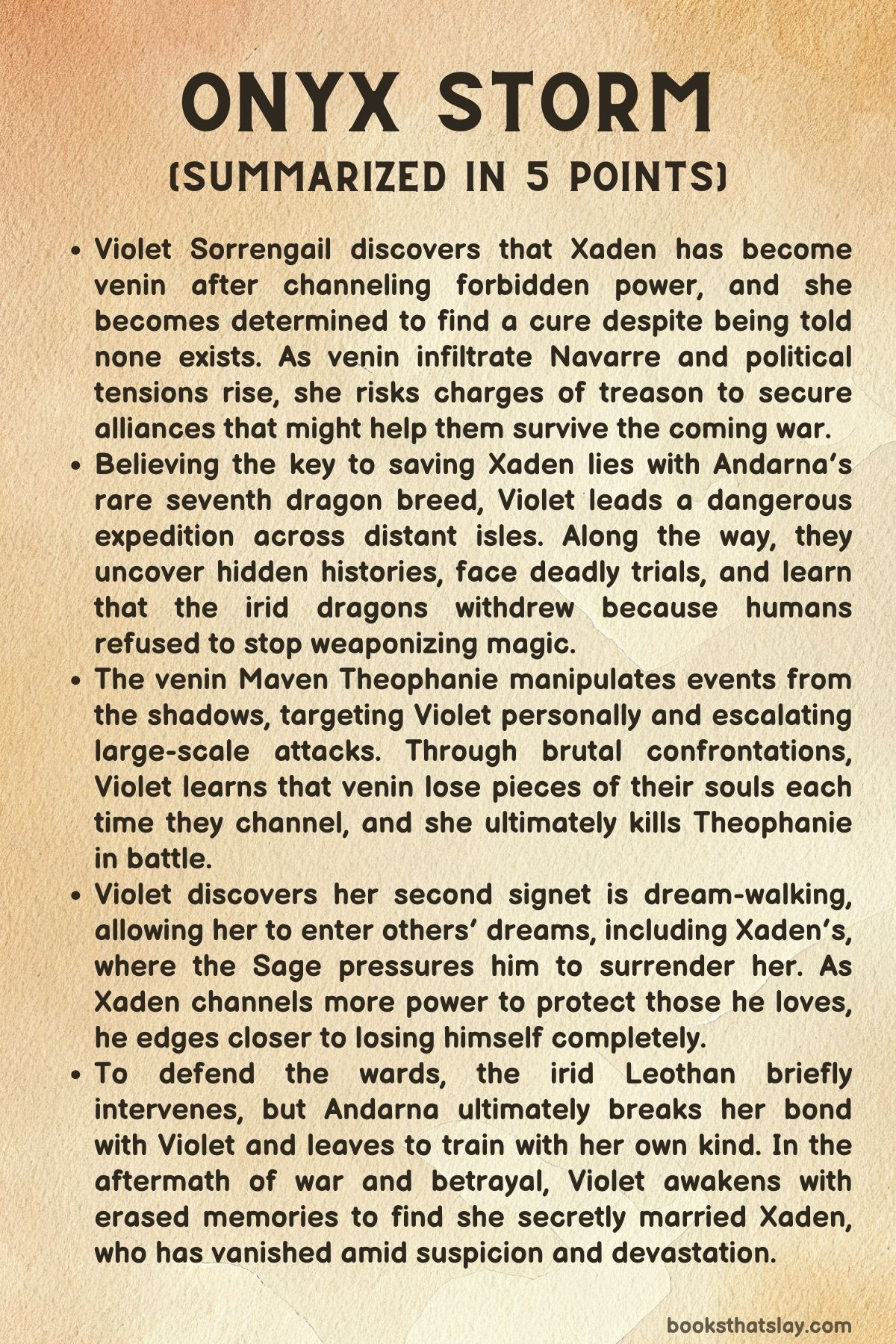
The story opens with Violet confronting the reality that Xaden has become venin after channeling forbidden power to save his people. Though he lacks the usual red-rimmed eyes and has not channeled again, the danger remains. Their dragons believe he is beyond saving, but Violet refuses to accept that. Her hope lies with Andarna, who belongs to a rare seventh dragon breed known as the irids. Violet believes that if she can find the rest of Andarna’s kind, she might discover how to reverse venin transformation.
Venin infiltrate Basgiath disguised as scribes, murdering and draining victims inside the keep. Violet and her friends fight them off, but the attack proves that the enemy is evolving. Among the intruders is a silver-haired venin woman named Theophanie, who escapes. Political tension intensifies as Violet pushes for an alliance between Navarre’s riders and Poromiel’s gryphon fliers. When leadership refuses to modify the wards to allow fliers to wield lesser magic within Navarre, Violet secretly alters the wardstone with help from her allies. She is charged with treason, but a newly signed accord grants her pardon. Her actions secure tentative cooperation between the kingdoms.
Violet embarks on a mission to find the irids, accompanied by a chosen squad that includes riders, fliers, her siblings Mira and Brennan, Dain, Ridoc, and Prince Halden. Along the way, Theophanie repeatedly manipulates events, killing civilians and taunting Violet with hints that she could provide answers about venin. During one confrontation, Theophanie reveals that irids are dragons of peace who withdrew from the Continent centuries ago. She also suggests that Xaden will eventually surrender fully to venin nature.
The search leads Violet’s team across dangerous isles where magic behaves unpredictably. On Deverelli, magic fades almost entirely, easing Xaden’s cravings but isolating dragons from one another. There, Violet meets Narelle Anselm, a merchant who safeguarded her father’s hidden research. Her father anticipated her journey and designed tests to ensure she was ready to inherit his work. His writings reveal that past rebellions failed because promises involving dragons were broken. He directs Violet toward deeper truths about the relationship between magic and the wards.
On another isle, political negotiations turn deadly when a ruling triumvirate attempts to poison Violet’s squad. Violet outmaneuvers them by preemptively poisoning their hosts and bargaining for antidotes. The journey continues through cultures that demand trials of strength or wisdom before granting audiences. In Zehyllna, a public ritual results in the sudden death of Trager, one of the gryphon fliers, reinforcing the cost of every alliance.
Eventually, Violet discovers a hidden cluster of islands where irid dragons have concealed themselves using camouflage abilities similar to Andarna’s. The irids communicate telepathically with Violet and interrogate Andarna about her choices. They condemn humans for continuing to weaponize magic and declare there is no cure for venin; each time a venin channels, part of their soul is permanently destroyed. Only one irid, Leothan, shows sympathy.
When Xaden arrives, the irids react with fury upon recognizing him as venin. They refuse any alliance. Leothan later agrees to activate the Areian wardstone to help defend against an imminent attack, but he insists Andarna must leave with him to learn her people’s ways. Andarna ultimately chooses to break her bond with Violet and depart. Violet survives the separation, defying the belief that no rider can live after losing a dragon bond, though the loss devastates her.
Meanwhile, venin forces escalate their assaults. Theophanie, revealed as a powerful Maven with storm-wielding abilities, orchestrates large-scale attacks. Violet discovers her second signet: dream-walking. She can enter others’ dreams, including Xaden’s, where the Sage Berwyn pressures him to deliver Violet to the venin. These visions reveal that the venin seek both Violet and Xaden for reasons tied to prophecy and power.
In a brutal battle at Draithus, Theophanie captures Mira and chains her dragon. Violet faces an impossible choice between multiple strategic priorities. Choosing to eliminate Theophanie, she confronts her amid chaos. Aaric’s precognitive signet manifests, enabling him to foresee key moments and provide Violet with a ceremonial dagger forged from temple stone that venin cannot cross. With Andarna briefly returning to shield her invisibly, Violet stabs Theophanie and kills her.
The larger threat remains. Berwyn survives and manipulates events from the shadows. Xaden, desperate to save his dragon Sgaeyl from capture, channels massive amounts of power from the earth, destroying venin and wyvern alike. Each surge strips away more of his humanity. He stops only when he realizes he is close to losing the part of himself that loves Violet.
After the battle, Violet experiences a missing span of twelve hours. She awakens at Riorson House wearing an emerald ring and finds a note blessing her marriage to Xaden. Another note from him tells her not to look for him and claims that “it is hers now,” possibly referring to Tyrrendor. Imogen confirms that she erased Violet’s memories at Violet’s own request. During those lost hours, multiple riders and elders were killed, dragons slain, and dragon eggs stolen. Suspicion falls on Xaden.
The novel closes with uncertainty. Violet has lost Andarna, learned there is no cure for venin, and discovered her own prophetic ties to dark power. Xaden has disappeared, his fate ambiguous. War looms larger than ever, the wards are weakening, and internal betrayal threatens their defenses. Violet stands at the center of converging destinies, determined to fight for her people and for the man she refuses to abandon, even as the cost of that loyalty grows steeper.
Characters
Violet Sorrengail
In Onyx Storm, Violet Sorrengail stands at the emotional and strategic center of the war. She is no longer simply the fragile scribe-turned-rider struggling to survive; she has become a commander who makes decisions that carry political and mortal consequences.
Her defining trait is relentless devotion. Whether altering wardstones, defying the Senarium, or bargaining with foreign rulers, she acts from a belief that knowledge and courage can shift the course of fate. Yet her strength is inseparable from vulnerability. Violet lives with chronic pain, grief over her mother, and the devastating loss of Andarna’s bond.
Her refusal to abandon Xaden, even after learning there is no cure for venin, reveals both her greatest virtue and her most dangerous flaw. The emergence of her second signet—dream-walking—expands her power into psychological territory, positioning her not just as a battlefield force but as a bridge between minds. By the end, she carries prophecy, political authority, and emotional trauma, embodying both hope and looming catastrophe.
Xaden Riorson
Xaden’s arc is defined by erosion. As a shadow wielder and Duke of Tyrrendor, he balances leadership with secrecy, but venin transformation threatens to strip away his identity piece by piece. His struggle is not only against the enemy but against himself.
He imposes strict limits, withdrawing physically and emotionally to prevent harming Violet, yet repeatedly risks his soul to protect Sgaeyl and those he loves. His second signet grows stronger, suggesting depth he barely understands. Xaden’s love for Violet anchors him, serving as both salvation and vulnerability. When he channels massively to save Sgaeyl, he recognizes that the next fragment he might lose is the part capable of love.
His disappearance and the erased memories surrounding their marriage suggest sacrifice and calculated desperation. Xaden embodies the central question of the novel: how much of oneself can be lost before redemption becomes impossible.
Andarna
Andarna’s journey is one of identity and autonomy. As an irid, she represents a forgotten philosophy of magic rooted in peace rather than warfare. Unlike Tairn, she grows up alongside Violet, making their bond deeply personal. Her choice to develop a scorpiontail, defying her kind’s expectations, signals independence. The irids judge Violet harshly, accusing her of weaponizing Andarna, yet Andarna claims that choice proudly.
When Leothan offers her a return to her people, the decision becomes a test of maturity. Breaking the bond devastates Violet but affirms Andarna’s agency. She is no longer the hatchling shaped by circumstance but a dragon choosing her own path. Her departure reframes the narrative’s understanding of magic, suggesting that true balance requires restraint humans have not yet achieved.
Tairn
Tairn functions as Violet’s steadfast pillar. Ancient, powerful, and blunt, he provides emotional stability when human alliances fracture. His bond with Violet deepens after Andarna’s departure, sustaining her life and reinforcing their partnership. Tairn’s perspective often tempers Violet’s impulsiveness, yet he never undermines her autonomy. His injury during battle and silent endurance of pain reflect the dragons’ broader sacrifices. Through Tairn, the narrative highlights loyalty that is not blind but chosen repeatedly in crisis.
Theophanie
Theophanie is the embodiment of ideological corruption. Once connected to Dunne’s temple, she represents a fall from faith into fanaticism. As a Maven and storm wielder, her power rivals Violet’s, creating a mirrored dynamic between them. She manipulates, taunts, and orchestrates large-scale devastation with chilling calm. Her fixation on Violet is strategic and philosophical; she sees potential kinship in power. Theophanie’s death is not merely the elimination of an enemy but the culmination of a rivalry built on opposing visions of strength. Where Violet seeks preservation, Theophanie seeks dominion.
Berwyn
Berwyn operates as the shadow architect behind venin expansion. Unlike Theophanie’s overt cruelty, he manipulates through prophecy and psychological pressure. His influence over Xaden underscores the systemic nature of venin corruption. He understands that control over key figures yields greater outcomes than brute force. Berwyn’s survival and continued maneuvering ensure that the war transcends individual battles. He is patient, calculating, and disturbingly intimate in his understanding of Xaden’s vulnerabilities.
Mira Sorrengail
Mira balances pragmatism with fierce loyalty. As Violet’s sister, she often challenges decisions that seem reckless, yet she stands beside Violet in nearly every crisis. Her discovery of clues about Violet’s childhood dedication reveals investigative depth beyond battlefield competence. Mira’s near execution by Theophanie and subsequent survival reinforce her resilience. She represents grounded strength, someone capable of skepticism without abandoning family.
Brennan Sorrengail
Brennan embodies strategic intellect. As a healer and tactician, he forces Violet to confront hard truths about leadership, including the necessity of prioritization in war. His attempt to heal Xaden and his role in saving Mira highlight both his limits and his value. Brennan often acts as a moral counterweight, pushing Violet to see consequences beyond emotional impulse. His presence reinforces the Sorrengail siblings as a triad of differing strengths.
Ridoc
Ridoc evolves from comic relief into moral anchor. His demand that Violet set boundaries with Xaden signals maturation and protective loyalty. On the battlefield, his ice manipulation reaches terrifying potency, demonstrating growth in confidence and skill. Ridoc’s refusal to blindly accept Violet’s choices adds tension but also stability. He loves his friends enough to confront them.
Dain Aetos
Dain’s role is complicated by legacy and redemption. As the son of a powerful general, he exists under scrutiny and suspicion. His willingness to help Violet retrieve her father’s research marks a shift toward trust. In battle, his shielding ability remains crucial. Dain often stands between institutional obedience and personal loyalty, reflecting the broader conflict between Navarre’s rigid hierarchy and the riders’ evolving alliances.
Aaric Graycastle
Aaric’s concealed royal identity and emerging precognitive signet place him in a pivotal strategic role. His foresight directly enables Theophanie’s defeat, proving that insight can rival raw power. Aaric challenges assumptions about privilege by choosing the riders’ path. His understanding of ancient names and histories adds intellectual depth to the group’s mission. He symbolizes a new kind of leadership shaped by foresight rather than dominance.
Imogen Cardulo
Imogen’s memory-wiping signet becomes one of the story’s most ethically complex tools. She protects secrets that preserve fragile hope, including erasing Violet’s own memories at her request. Her grief over Quinn and awakening of a possible second signet reveal emotional layers beneath her controlled exterior. Imogen embodies sacrifice carried quietly.
Garrick Tavis
Garrick’s distance-wielding ability expands the tactical landscape of battle. Loyal to Xaden, he often acts as intermediary and reinforcement. His near burnout and kidnapping underscore the toll of constant conflict. Garrick’s steadiness contrasts with Xaden’s volatility, highlighting different forms of strength within the rebellion.
Queen Maraya and Viscount Tecarus
Queen Maraya represents diplomatic hope, supporting alliances before her death destabilizes Poromiel. Viscount Tecarus, pragmatic and politically astute, adapts quickly to shifting power. Together they illustrate the fragile balance between cooperation and opportunism in wartime politics.
King Courtlyn and the Isle Leaders
Courtlyn and the isle rulers introduce moral ambiguity. Their demands for dragon eggs and manipulative hospitality expose how neutrality can mask exploitation. They reflect societies shaped by different relationships to magic, challenging Violet’s assumptions about universal priorities.
Leothan
Leothan stands as the irids’ reluctant bridge to humanity. Though critical of Violet, he aids in restoring the wards and offers Andarna guidance. His presence suggests that reconciliation between dragons and humans is possible but conditional. He represents ancient wisdom tempered by cautious hope.
Themes
Love as Defiance and Moral Anchor
Romantic love in Onyx Storm is not presented as softness or distraction; it is framed as resistance against corruption and fatalism. Violet’s commitment to Xaden after his transformation into venin becomes an act of rebellion against the narrative that venin are irredeemable.
The irids insist that each act of channeling erodes the soul beyond repair, and even Xaden believes that he is on a countdown toward losing himself. Yet Violet refuses to define him solely by what he has done. Her love functions as a stabilizing force, one that Xaden consciously clings to when he feels pieces of himself slipping away. When he channels to save Sgaeyl, he stops not because the power is exhausted but because he senses he is close to losing the part of himself that loves Violet. Love becomes the last intact boundary of his identity.
At the same time, this devotion carries danger.
Ridoc challenges Violet to define a line that cannot be crossed, forcing her to consider whether unconditional loyalty might enable catastrophe. The relationship therefore becomes a site of moral tension rather than blind romance. Violet’s refusal to abandon Xaden is courageous, but it also isolates her and places her at odds with political leadership and even her friends.
Their eventual secret marriage and the deliberate erasure of her memory complicate the theme further. Love here demands sacrifice, secrecy, and the willingness to bear consequences without recognition. Instead of portraying romance as an escape from war, the novel positions it as the one force that resists dehumanization. In a world where magic strips away conscience and institutions trade lives for strategy, love becomes the last assertion of personal choice and humanity.
Power, Corruption, and the Cost of Magic
Magic in Onyx Storm is never neutral. Every form of power in the story carries a visible and invisible cost. The venin represent the extreme consequence of unrestrained channeling, drawing directly from the earth and sacrificing fragments of their souls.
The irids’ refusal to intervene is grounded in the belief that humans cannot be trusted with magic without turning it into a weapon. This indictment applies not only to venin but also to riders and political leaders who manipulate wards and alliances for strategic gain. Even Violet’s lightning, which often saves lives, contributes to the militarization of the world the irids condemn.
Xaden’s struggle illustrates corruption as a gradual erosion rather than an immediate transformation. He does not wake up monstrous; he becomes someone who must constantly measure his control.
The amber shift in his eyes symbolizes the permanence of change, suggesting that consequences remain even when restraint is exercised. His choice to channel in Draithus, though justified in the moment, reinforces the irids’ assertion that each use chips away at identity. The novel refuses to offer a simple cure, insisting instead that some damage cannot be undone.
Institutional power is equally suspect. The Senarium manipulates laws to maintain authority, General Melgren relies on prophetic certainty to justify inaction, and Panchek’s betrayal reveals how ambition invites alliance with darkness. Power is shown to be seductive not only because it grants strength but because it promises control in a chaotic world.
Violet’s development challenges this seduction. Her second signet, dream-walking, places her inside others’ most vulnerable states, reminding her that power can expose rather than dominate. The narrative suggests that magic itself is not evil; what corrupts is the willingness to prioritize dominance over conscience. In that sense, the true battleground is not the sky or the wards but the integrity of the individual wielding power.
Identity, Choice, and Self-Determination
Questions of identity surface repeatedly as characters confront destinies that appear prewritten. Violet’s childhood dedication at Dunne’s temple, hidden from her memory and possibly interrupted because of a prophecy, casts doubt on whether her path was ever fully her own. The revelation that a priestess foresaw a heart that would “do the wrong thing for the right reason” destabilizes her understanding of herself. Rather than passively accepting prophecy, Violet continues to assert her autonomy through action.
She chooses to alter the wards, to search for the irids, to fight Theophanie, and to stand beside Xaden despite predictions of darkness.
Andarna’s departure sharpens this theme. Unlike most dragons, she chooses her tail, her identity, and eventually her separation. The irids condemn Violet for shaping Andarna into a weapon, yet Andarna insists she chose that role.
The conflict centers on whether guidance equals coercion. By encouraging Andarna to leave with Leothan, Violet affirms that love does not entitle her to possession. This act redefines strength as the willingness to relinquish control.
Aaric’s precognitive signet complicates ideas of fate. If he can see potential futures, does that fix outcomes or create alternatives?
The success of their plan against Theophanie depends on acting outside General Melgren’s predicted path, suggesting that prophecy reflects only one possibility. Even Xaden’s venin transformation becomes a test of choice.
Though he is altered, he still decides whether to channel, whom to protect, and when to stop. Identity in the novel is not static; it is negotiated repeatedly between circumstance and will. Characters are shaped by history, prophecy, and power, yet the narrative insists that choice remains the defining element. In a world obsessed with lineage and destiny, self-determination emerges as a radical act.
Loyalty, Betrayal, and the Fragility of Institutions
Trust fractures repeatedly throughout Onyx Storm, revealing how fragile political and personal alliances truly are. The war against the venin demands unity, yet leadership often undermines that necessity through pride and secrecy.
Violet’s treason in altering the wards exposes how rigid institutions resist adaptation even when survival depends on cooperation. Her punishment is avoided only through technical timing, underscoring how justice is shaped by political convenience rather than moral clarity.
Betrayal operates on multiple levels. Panchek’s alliance with Berwyn demonstrates that fear and ambition can corrode loyalty from within.
The infiltration of cities like Suniva shows that external threats thrive when internal weaknesses are exploited. Even Halden’s self-serving negotiations endanger lives, revealing how royal entitlement conflicts with collective survival. The theft of dragon eggs and the murder of riders deepen the sense that no system is secure.
Personal loyalty is equally tested. Ridoc demands transparency from Violet, arguing that secrets meant to protect can instead create vulnerability. Imogen’s erasure of Violet’s memories illustrates loyalty taken to its extreme; she honors Violet’s request but in doing so removes Violet’s agency over her own past.
The secret marriage between Violet and Xaden symbolizes a commitment that exists outside institutional approval, contrasting personal allegiance with political legitimacy.
The dragons’ bonds complicate the theme further. Riders are taught that losing a dragon means death, yet Violet survives Andarna’s departure, challenging foundational beliefs.
Loyalty between dragon and rider is portrayed as sacred, yet it is not immune to strain, as seen in Sgaeyl’s uncertainty about Xaden. Institutions promise protection through structure, but the novel repeatedly shows that survival depends more on chosen loyalties than formal hierarchies. In the end, trust is not granted by title or law but earned through sacrifice and accountability.