Our Noble Selves Summary, Characters and Themes
Our Noble Selves by Kate Atkinson is a historical novel set in postwar Britain during the preparations for the 1951 Festival of Britain.
Combining mystery, dark comedy, political intrigue, and personal drama, the book follows Harry Flynn, a former war correspondent struggling to rebuild his life after surviving Japanese imprisonment during the Second World War. His seemingly ordinary administrative job leads him into a complicated investigation involving a missing Frenchwoman, wartime betrayals, and influential individuals determined to protect their secrets. Against the backdrop of a nation celebrating its recovery, the novel examines trauma, political hypocrisy, moral responsibility, and the possibility of finding love and belonging after devastating experiences.
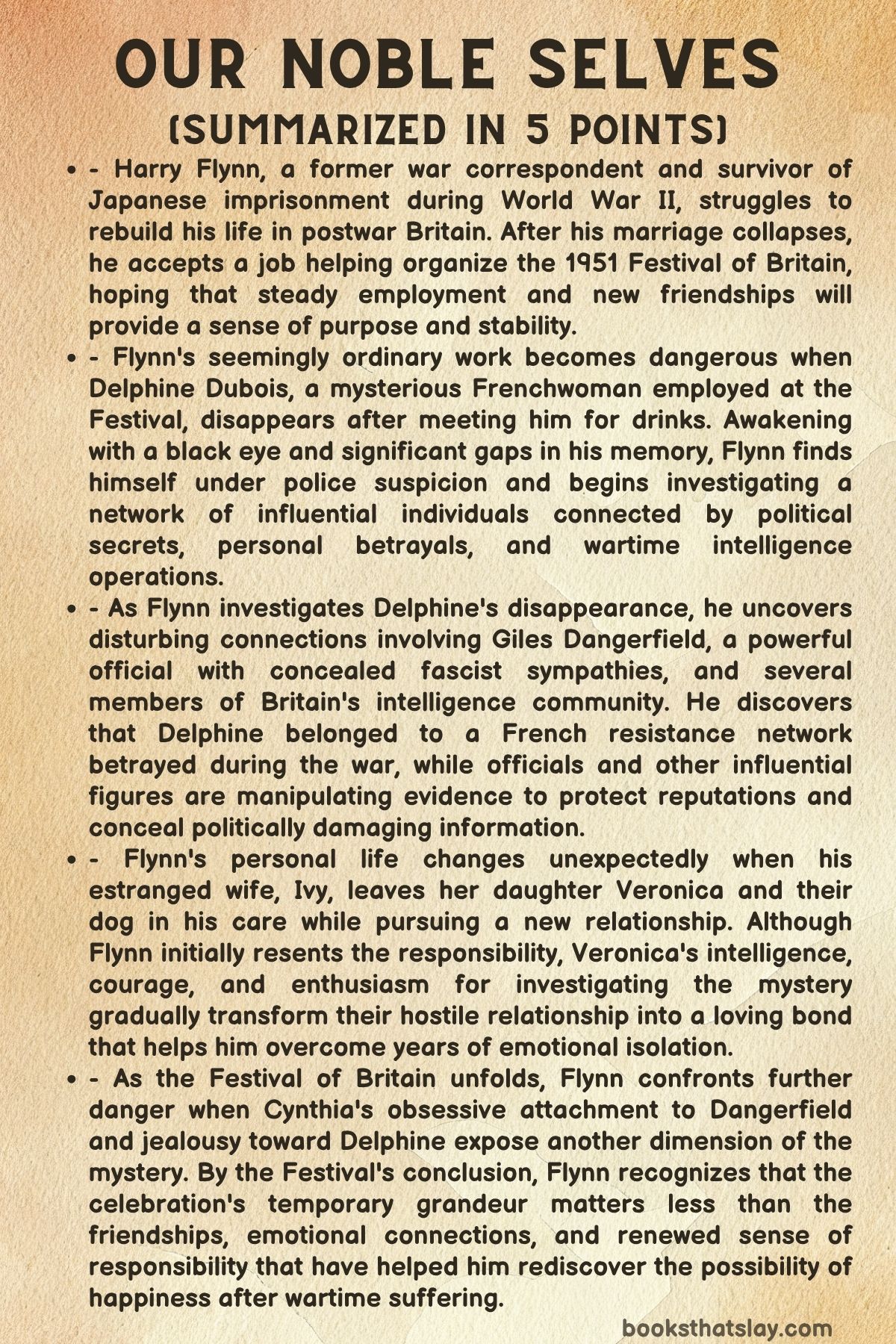
Summary
In 1949, Harry Flynn is sitting quietly in London’s St. James’s Park when he unexpectedly encounters Gerald Barry, his former editor at the News Chronicle. Barry is astonished to discover that Flynn is alive, having believed him dead since the Second World War. Flynn had travelled to Singapore as a journalist in 1941, only to be captured by the Japanese following the British surrender. His imprisonment, including his experiences on the notorious Burma Railway, has left him physically weakened and emotionally disconnected from ordinary life.
Following his return to England, Flynn attempts to rebuild his life by marrying Ivy Shears, a war widow with a daughter named Veronica and a terrier called Mrs. Betty. However, the marriage quickly becomes unbearable because of Ivy’s demanding personality, Veronica’s hostility, and Flynn’s inability to adjust to family responsibilities. He eventually abandons the household and finds employment in a modest printing establishment.
Barry offers Flynn a fresh opportunity by recruiting him for the Festival of Britain, a national exhibition planned for 1951 to celebrate British achievements and encourage optimism after years of war and deprivation. Flynn accepts, hoping that purposeful work might offer an escape from his troubled memories.
By 1951, Flynn is working in the Festival offices at Savoy Court alongside several unconventional colleagues. Alistair Badgley, known as Badger, is a wealthy and amiable gentleman with a mysterious wartime background. Hywel Evans-Jones, called Evans, is a disillusioned veteran of the Arctic convoys whose experiences have destroyed his religious faith and damaged his personal life.
Their young assistant, Terence, usually called the Boy, brings energy and mischief to the office. The department is nominally supervised by Jeremy Denholm, a former actor whose relaxed management style allows considerable confusion.
Flynn’s responsibilities include examining thousands of poems, organizing exhibitions of eccentric inventions, assisting with historical pageants, and managing various domestic displays. Many assignments seem absurd, yet the Festival’s ambitious plans reflect Britain’s determination to present itself as a forward-looking nation.
The arrival of Maud Ogilvie, an elderly Scottish woman transferred from Typography, introduces much-needed order. Her intelligence, efficiency, and unexpectedly sharp humor gradually earn Flynn’s respect.
Maud’s appointment has been arranged by Giles Dangerfield, an increasingly influential Festival official with political ambitions and powerful connections. Dangerfield’s authoritarian personality immediately unsettles Flynn, while Badger’s uncomfortable reaction to his name suggests an undisclosed wartime connection.
Flynn soon becomes acquainted with Delphine Dubois, a Frenchwoman employed in the Festival’s Homes and Gardens department. When she unexpectedly invites him for a drink at the Lamb and Flag, he assumes that she is interested in a romantic encounter.
Instead, their meeting becomes increasingly strange. Delphine describes herself as an exile, appears frightened, and offers incomplete explanations about troubling events in her past.
Flynn drinks heavily and awakens the following morning with a black eye, a severe headache, and significant gaps in his memory. He remembers helping Delphine into a taxi but cannot explain what happened afterward.
His concern deepens when Delphine fails to return to work. Although he insists that he has done nothing wrong, the missing hours leave him unable to establish exactly what happened.
Meanwhile, Flynn becomes involved in organizing a competition to select an official Festival cake. This assignment introduces him to Mitzi Blinkhorn, a flamboyant television cook, and her husband Archie, a sociable retired military officer.
The Blinkhorns move within influential social circles and maintain close connections with Dangerfield. Flynn notices that Dangerfield takes an unusual interest in Mitzi’s professional success, suggesting that apparently innocent Festival activities may serve private purposes.
During dinner at the Blinkhorns’ home, Flynn encounters Cynthia, a young woman whose emotional intensity and hostility make him uncomfortable. Conversations also expose disturbing connections between members of this fashionable society and the British fascist movement of the prewar years.
Another important figure enters Flynn’s life when he meets Lydia Fairchild, an attractive woman whom Badger knows from childhood. Flynn and Lydia develop a physical relationship, but her emotional independence and connections to British intelligence prevent him from understanding her true intentions.
Lydia discusses wartime intelligence failures, particularly the betrayal of resistance organizations in occupied France. Her remarks suggest that respected British officials may have participated in actions that resulted in numerous deaths.
At the same time, Flynn discovers another secret involving Mitzi. His neighbor Leonora Kane, a former prostitute, recognizes her from a newspaper photograph and reveals that the celebrated television personality was formerly known as Ada Clegg and worked in a brothel.
This discovery exposes how thoroughly Mitzi has reconstructed her identity to secure wealth, respectability, and public admiration.
As Festival preparations intensify, Dangerfield becomes increasingly authoritarian. He speaks proudly about Britain’s imperial achievements and insists upon unquestioning respect for established authority.
His behavior reinforces Flynn’s suspicion that Dangerfield’s political beliefs remain dangerously close to the extremist sympathies associated with his earlier life.
Flynn’s involvement in the mystery becomes more dangerous when Archie asks him to retrieve compromising photographs from a flat in Half Moon Street. Archie claims that he is being blackmailed and provides a key to the property.
Inside the flat, Flynn notices clothing, neglected flowers, and other indications that its occupant has disappeared unexpectedly. He begins to suspect that the flat belongs to Delphine and that Archie’s explanation conceals something far more serious.
A mysterious man named Arthur Stamp takes the photographs from Flynn. When Flynn subsequently confronts Archie, the latter reacts angrily and accuses him of retaining the pictures.
The confrontation convinces Flynn that Archie knows considerably more about Delphine than he has admitted. Flynn begins considering the possibility that she has been murdered.
His already complicated circumstances become stranger when Ivy unexpectedly arrives with Veronica and Mrs. Betty. She announces that she intends to travel to France with her fiancé, Gerald Lister, and leaves her daughter and the dog in Flynn’s care.
Flynn initially resents the responsibility, particularly because he believes his relationship with Veronica has always been antagonistic. However, living together gradually changes his understanding of the girl.
Veronica demonstrates intelligence, independence, and remarkable resourcefulness. She befriends his neighbors, learns chess, and develops an enthusiastic interest in the mystery surrounding Delphine.
When detectives Vigo and Tapper begin questioning Flynn, his inability to account for the missing hours makes him a serious suspect. The detectives challenge his statements, and Flynn becomes increasingly convinced that someone has deliberately arranged evidence against him.
He returns to the Lamb and Flag with Veronica and confronts the landlord, Gammage. Under pressure, Gammage admits that a man with a distinctive facial scar offered him money to provide false testimony about Flynn.
The man has connections to Oswald Mosley’s fascist movement, strengthening Flynn’s suspicions that Delphine’s disappearance involves a wider political conspiracy.
Veronica’s alarming decision to produce a gun during the confrontation demonstrates both her courage and her recklessness. Although Flynn is horrified, he recognizes that her assistance has helped expose an attempt to frame him.
As the danger increases, Flynn asks Lydia to look after Veronica temporarily. Lydia reluctantly agrees, and Veronica enjoys discovering aspects of sophisticated London life previously unavailable to her.
Flynn continues investigating despite Lydia’s warnings that certain matters should be left alone. Maud’s unexplained absence from the Festival offices also makes him suspicious, particularly because she seems unusually knowledgeable about intelligence affairs.
When Maud returns, Flynn increasingly questions whether her seemingly ordinary identity conceals a much more significant role.
A decisive breakthrough occurs when Flynn revisits the Half Moon Street flat and learns that Delphine had been involved with a man named Giles. He realizes that her lover was not Archie Blinkhorn but Giles Dangerfield.
Badger subsequently admits that he discovered Delphine dead from a gunshot wound. Further revelations establish that she belonged to a French resistance network connected with British intelligence during the war.
Dangerfield had participated in operations involving that network but betrayed its members while maintaining sympathies toward fascist ideology. Delphine’s death consequently appears connected to attempts to conceal his wartime treachery.
Nevertheless, the disappearance of her body and the precise circumstances of her murder remain unresolved.
Flynn’s discoveries place him in greater danger. When detectives Vigo and Tapper arrest him, intervention from powerful figures eventually secures his release.
Maud meets him outside the police station and reveals further indications of her involvement in intelligence operations. A pistol concealed in her handbag confirms that her harmless appearance disguises considerable experience and authority.
She warns Flynn that pursuing the affair could have serious consequences. He gradually realizes that government officials have been manipulating evidence and individuals in an effort to suppress dangerous political networks without exposing embarrassing wartime secrets.
The Festival finally opens amid elaborate celebrations and royal appearances. Flynn takes Veronica through the attractions, observing the culmination of months of preparation.
However, behind the public optimism, the intelligence operation surrounding Dangerfield continues. Lydia and others explain that the authorities are determined to prevent fascist organizations from regaining influence, even if that requires morally questionable tactics.
A destructive explosion involving one of the Festival’s domestic displays further demonstrates that the danger has not completely passed.
Meanwhile, Flynn’s attachment to Veronica becomes increasingly important. During a historical pageant, he reflects on how unexpectedly their relationship has developed.
He realizes that he loves the girl and that accepting responsibility for her has given his life a significance absent since his return from captivity. His emotional recovery begins to depend not upon forgetting the past but upon allowing himself to care about another person.
The mystery nevertheless produces one final confrontation. Cynthia’s intense attachment to Dangerfield and hostility toward Delphine suggest that jealousy may have contributed to the Frenchwoman’s murder.
At the Festival’s Pleasure Gardens, Cynthia becomes a direct threat to Flynn and Veronica, pursuing them through the attractions. Their attempt to escape exposes how personal obsession and political secrecy have combined to create continuing danger.
As the Festival approaches its conclusion, Flynn reflects on the strange sequence of events that began with Barry’s offer of employment. The national celebration has provided him with friendships, responsibilities, and a renewed connection to ordinary life.
On the Festival’s final evening, he dances with Maud Ogilvie while contemplating the disappearance of the structures and attractions that once seemed to symbolize Britain’s future.
The Festival’s temporary buildings will be dismantled, but its influence upon Flynn will endure. Through Veronica, his colleagues, and the experiences they have shared, he has begun recovering his capacity for affection, belonging, and responsibility.
The novel closes by contrasting the temporary grandeur of public celebrations with the lasting consequences of private choices, suggesting that genuine renewal begins through human relationships rather than patriotic spectacle.
Characters
Harry Flynn
Harry Flynn is the central character of Our Noble Selves, a former journalist whose attempt to rebuild his life forms the emotional foundation of the novel. His experiences as a Japanese prisoner of war have left him physically weakened, psychologically damaged, and deeply uncertain about his place in civilian society.
His apparent indifference toward ordinary responsibilities conceals a profound fear of emotional attachment. Having survived circumstances in which human life appeared fragile and unpredictable, Flynn has convinced himself that remaining detached is the safest way to avoid further suffering.
His unsuccessful marriage to Ivy demonstrates how severely the war has affected his ability to establish intimate relationships. Although he hopes that domestic stability might restore some sense of normality, he discovers that marriage cannot automatically overcome unresolved trauma.
Flynn’s employment at the Festival represents an attempt to regain purpose without placing excessive emotional demands upon himself. His apparently trivial administrative responsibilities gradually reconnect him with colleagues whose eccentric personalities and wartime experiences challenge his isolation.
His former career as a crime reporter becomes important when Delphine disappears. Flynn’s investigative instincts, skepticism toward authority, and determination to identify inconsistencies enable him to recognize the conspiracy developing around him.
Nevertheless, his investigation also reveals his vulnerabilities. His memory loss makes him susceptible to manipulation, while his willingness to involve himself in dangerous situations sometimes exceeds his ability to protect himself.
His relationship with Veronica produces his greatest transformation. Initially regarding her as an unwanted obligation, he slowly discovers affection for her intelligence, independence, and difficult personality.
Through caring for Veronica, Flynn begins accepting that love necessarily involves responsibility and the possibility of loss. His development illustrates how recovery from suffering may emerge through renewed participation in life rather than complete freedom from painful memories.
Veronica Shears
Veronica Shears is one of the most memorable figures in Our Noble Selves, combining youthful defiance, sharp intelligence, and an impressive ability to adapt to unfamiliar circumstances. As Ivy’s daughter and Flynn’s stepdaughter, she initially appears to embody everything he finds exhausting about domestic life.
Her argumentative behavior reflects a strong desire for independence and recognition. Beneath her confrontational manner, however, she possesses considerable curiosity and an instinctive understanding of how adults conceal their intentions.
When Ivy leaves Veronica in Flynn’s care, their relationship changes because they are forced to encounter one another without the constant presence of her mother. Their disagreements continue, but they gradually develop mutual respect.
Veronica’s enthusiasm for detective fiction makes her particularly interested in Delphine’s disappearance. She approaches the investigation with directness and imagination, sometimes recognizing possibilities that Flynn overlooks.
Her willingness to confront Gammage demonstrates exceptional courage but also reveals the dangers of youthful overconfidence. Producing a firearm during the encounter shows that her resourcefulness is not always accompanied by an understanding of consequences.
Veronica also displays a remarkable ability to establish relationships with people outside conventional family structures. Her friendships with Flynn’s neighbors and her experiences with Lydia reveal a child eager to discover a larger and more interesting world.
For Flynn, Veronica becomes an unexpected source of emotional renewal. By the novel’s conclusion, she has transformed from an unwanted responsibility into someone whose happiness and safety matter profoundly to him.
Maud Ogilvie
Maud Ogilvie is an elderly Scottish woman whose apparently conventional appearance conceals intelligence, experience, and considerable personal authority. Her introduction into the Festival offices initially suggests that she is simply an efficient administrator assigned to restore order.
She quickly distinguishes herself through practical competence, dry humor, and an ability to understand complicated situations without attracting unnecessary attention. Her organizational skills contrast sharply with the confusion surrounding Flynn’s department.
Maud’s relationship with Flynn develops through ordinary interactions that gradually reveal their mutual respect. Their dinner at Luigi’s demonstrates that her personal history is considerably more adventurous than he had imagined.
Her experiences in government service and wartime administration suggest that she has operated within institutions where discretion and secrecy are essential. Her observations frequently indicate knowledge extending beyond her official responsibilities.
As the mystery progresses, Maud’s unexplained absences and connections with influential officials become increasingly suspicious. Her possession of a pistol and her involvement in Flynn’s release from police custody confirm that she occupies a more significant position within intelligence affairs.
Maud represents the moral complexity of institutions that claim to protect national security. Although she appears concerned about Flynn’s welfare, she also participates in a system prepared to conceal evidence and manipulate individuals.
Her relationship with Flynn remains affectionate but complicated by secrecy. Their final dance suggests mutual understanding without requiring either character to resolve every contradiction between personal loyalty and professional duty.
Alistair Badgley (Badger)
Alistair Badgley, commonly known as Badger, is a wealthy and outwardly cheerful gentleman whose amiable personality conceals a difficult wartime history. His relaxed attitude toward Festival responsibilities initially makes him seem like an eccentric figure included primarily for comic entertainment.
However, his discomfort whenever Giles Dangerfield is mentioned suggests that their relationship involves unresolved experiences. His refusal to discuss certain wartime activities gradually becomes an important element of the central mystery.
Badger’s connections with intelligence operations in occupied France reveal that he participated in dangerous decisions involving resistance agents. The knowledge that some of those individuals never returned places a serious moral burden beneath his cheerful exterior.
His eventual admission that he found Delphine dead demonstrates the extent of his involvement in the affair. His secrecy reflects not simply obedience to official regulations but also the difficulty of confronting actions and failures from the past.
Badger illustrates how privilege and social charm can disguise emotional suffering. Although his circumstances differ considerably from Flynn’s, both men remain affected by experiences they cannot easily explain to others.
His character also exposes the limitations of wartime heroism as a simple moral category. Service to one’s country does not necessarily prevent guilt, compromised decisions, or lasting uncertainty about personal responsibility.
Giles Dangerfield
Giles Dangerfield serves as a central antagonistic figure in Our Noble Selves, representing the persistence of authoritarian ideas beneath the respectable surface of postwar British society. His political ambitions, influential connections, and commanding personality enable him to exercise authority over individuals who know relatively little about his past.
Dangerfield believes strongly in hierarchy, national prestige, and imperial greatness. His speeches about British achievement reveal an understanding of patriotism closely associated with obedience and established social privilege.
His inability to tolerate criticism exposes the insecurity behind his confident public personality. When Maud and Evans challenge his assumptions, his reaction suggests that he views disagreement as a personal threat rather than a legitimate expression of independent judgment.
The revelations concerning wartime intelligence operations expose a far more disturbing aspect of his character. His betrayal of resistance personnel while maintaining fascist sympathies demonstrates the dangerous consequences of placing ideological loyalty above human life.
His relationship with Delphine becomes especially significant because it connects his political history with his private conduct. Her disappearance threatens to expose the contradictions between his cultivated public respectability and his past actions.
Dangerfield represents the possibility that dangerous political beliefs can survive historical defeat by adopting respectable appearances. His character challenges the assumption that victory over fascism automatically eliminates its supporters from influential institutions.
Delphine Dubois
Delphine Dubois is a Frenchwoman whose disappearance provides the central mystery of the novel. Initially introduced as an employee in the Festival’s Homes and Gardens department, she gradually emerges as someone whose personal history is connected to wartime resistance operations and political betrayal.
Her nervous behavior during her meeting with Flynn suggests that she is living under considerable psychological pressure. Her description of herself as an exile conveys displacement and the difficulty of escaping experiences that continue to shape her life.
Delphine’s participation in a French resistance network places her among individuals who risked their lives opposing Nazi occupation. Her subsequent connection with Dangerfield reveals the complicated relationship between political loyalty, personal intimacy, and betrayal.
Her disappearance also exposes how easily vulnerable individuals can become secondary considerations within powerful institutions. Those investigating her fate must confront officials more concerned with political consequences than transparent justice.
Although Delphine is absent for much of the novel, her experiences influence nearly every important stage of the mystery. Her fate gradually exposes the concealed moral failures of people who have successfully preserved respectable public identities.
Through Delphine, the novel emphasizes that wartime violence does not necessarily end when official hostilities cease. Its consequences continue through private relationships, suppressed evidence, and the lives of those who survive.
Lydia Fairchild
Lydia Fairchild is an attractive, independent, and socially confident woman whose relationship with Flynn combines romantic attraction with political ambiguity. Her connections with the Security Services make her an important source of information about the intelligence operations surrounding Dangerfield.
Her apparent freedom from conventional expectations distinguishes her from several other female characters. She controls the terms of her intimacy with Flynn and refuses to offer emotional assurances simply because he desires them.
Lydia’s knowledge of wartime resistance networks suggests that she understands the dangerous realities concealed beneath official accounts of patriotic service. Her conversations provide Flynn with essential clues while also revealing how carefully she controls information.
Her willingness to care for Veronica demonstrates that she is capable of responsibility, even when the situation initially inconveniences her. Veronica’s fascination with Lydia’s lifestyle also suggests that Lydia represents an alternative model of adult womanhood.
However, Lydia’s involvement with intelligence authorities complicates her moral position. She recognizes the questionable behavior of powerful institutions but remains willing to defend secrecy when she considers it necessary.
Her relationship with Flynn ultimately reflects the limitations of intimacy when trust is incomplete. Although attraction exists between them, their different loyalties prevent their connection from becoming a straightforward romantic partnership.
Archie Blinkhorn
Archie Blinkhorn is a retired military officer whose sociability, apparent generosity, and influential friendships conceal a manipulative personality. His comfortable position within fashionable society allows him to move among individuals whose political and personal interests overlap.
His marriage to Mitzi appears sustained partly by mutual ambition and a shared desire for social security. Although Archie enjoys presenting himself as charming and accommodating, his behavior frequently suggests entitlement and opportunism.
His request that Flynn retrieve compromising photographs demonstrates his willingness to exploit another person’s apparent harmlessness. He presents the assignment as a personal favor while withholding information that could expose Flynn to considerable danger.
Archie’s angry response when the photographs disappear reveals a more threatening personality beneath his convivial manner. His connections to Delphine and Dangerfield suggest that he understands much more about the conspiracy than he initially admits.
Archie illustrates how respectable social positions can provide protection for morally questionable behavior. His military background and fashionable acquaintances encourage others to trust him without carefully examining his intentions.
Mitzi Blinkhorn
Mitzi Blinkhorn is a flamboyant television cook whose public success depends upon a carefully constructed personal identity. Her theatrical manner, concern with etiquette, and determination to preserve appearances make her both comic and socially revealing.
Her earlier existence as Ada Clegg, a woman who worked in a brothel, represents a past she has successfully concealed from fashionable society. Her transformation into a celebrated public personality demonstrates remarkable ambition and adaptability.
However, the effort required to maintain her new identity also creates vulnerability. Exposure could threaten her career, marriage, and position among influential acquaintances.
Mitzi’s behavior suggests that respectability is not simply a matter of personal conduct but a status granted or withheld according to class expectations and public reputation. Her anxiety about appearances reflects her awareness of how easily social acceptance can disappear.
Her connection with Dangerfield and the Festival cake competition further illustrates how professional opportunities may depend upon private influence. Beneath her comic excesses lies a woman determined to protect the security she has created.
Cynthia
Cynthia is a psychologically troubled young woman whose intense attachment to Giles Dangerfield places her near the center of the mystery surrounding Delphine’s death. Her early appearances reveal hostility, emotional instability, and an unsettling preoccupation with the relationships of those around her.
Her jealousy toward Delphine introduces a personal motive into what initially appears to be a political conspiracy. This creates a complication in Flynn’s investigation because ideological betrayal and private obsession become difficult to separate.
Cynthia’s behavior at the Pleasure Gardens demonstrates how dangerous her emotions have become. Her pursuit of Flynn and Veronica turns private resentment into a direct threat against innocent people.
She represents the destructive consequences of possessive attachment when emotional dependency overwhelms moral judgment. Her character also demonstrates that political conspiracies may provide opportunities for personal violence that cannot be explained solely through ideology.
Ivy Shears
Ivy Shears is Flynn’s estranged wife and Veronica’s mother. Her relationship with Flynn reveals the difficulty of building a stable domestic life when individuals enter marriage with incompatible expectations and unresolved emotional difficulties.
Ivy expects marriage to provide practical support, security, and clearly defined responsibilities. Flynn, however, is psychologically unprepared for the demands of becoming a husband and stepfather.
Her decision to leave Veronica with Flynn while travelling with Gerald Lister reveals a pragmatic and sometimes inconsiderate approach to family arrangements. She assumes that Flynn’s previous marriage to her creates continuing obligations toward the child.
Although Ivy can appear demanding and self-interested, her desire for financial security reflects the uncertainties of postwar life. Her plans to remarry and move to South Africa suggest that she regards personal advancement as a necessary form of survival.
Ironically, her decision to leave Veronica with Flynn creates the circumstances that enable their relationship to develop. What initially appears to be an unwanted imposition eventually becomes one of the most positive developments in his life.
Hywel Evans-Jones (Evans)
Hywel Evans-Jones is a Welsh veteran whose service in the Arctic convoys has profoundly affected his understanding of humanity, faith, and national identity. His experiences have destroyed his religious convictions and contributed to the collapse of his family life.
Evans’s melancholy personality contrasts with the enthusiasm surrounding the Festival of Britain. While officials celebrate national greatness and technological achievement, he remains conscious of the suffering and destruction concealed beneath patriotic language.
His willingness to challenge Dangerfield’s assumptions reveals intellectual independence and a refusal to accept authority without examination. His skepticism provides an important counterbalance to the Festival’s optimistic rhetoric.
Although he often appears gloomy, Evans contributes a perspective grounded in experience rather than public performance. His presence demonstrates that the emotional consequences of war differ considerably among survivors.
Through Evans, the novel questions whether national celebrations can adequately acknowledge the sacrifices upon which postwar recovery depends.
Terence (the Boy)
Terence, generally called the Boy, brings youthful energy, opportunism, and humor to the Festival offices. His mischievous behavior and interest in earning money frequently frustrate his older colleagues, but his enthusiasm also makes him an entertaining presence.
Unlike Flynn, Badger, and Evans, the Boy is not defined by direct experiences of wartime suffering. His character consequently represents a generation approaching the future with fewer personal memories of the conflict.
His interactions with Veronica reveal similarities in their curiosity, independence, and willingness to challenge adult expectations. Their exchanges suggest that youthful imagination may survive even within a society preoccupied with painful memories.
The Boy’s enthusiastic response to Denholm’s theatrical performance also demonstrates his capacity for loyalty and uncomplicated enjoyment. His character provides a valuable contrast to the secrecy, cynicism, and emotional exhaustion of the older generation.
Jeremy Denholm
Jeremy Denholm is the former actor who supervises Flynn’s department at the Festival. His relaxed approach to administration makes him an unusual manager within an organization supposedly dedicated to efficiency and national achievement.
Denholm often appears more interested in performance and entertainment than in establishing strict procedures. His personality helps create the comic atmosphere surrounding the department’s peculiar assignments.
His contrast with Dangerfield is particularly revealing. Whereas Dangerfield regards authority as an instrument of discipline and control, Denholm exercises it with considerably less seriousness.
His eventual return to theatrical performance suggests that his genuine interests lie outside bureaucratic management. Denholm represents the possibility that creativity, humor, and personal enjoyment may contribute more to human happiness than rigid institutional ambition.
Gerald Barry
Gerald Barry is Flynn’s former newspaper editor and the person responsible for drawing him back into meaningful professional life. His astonishment at discovering Flynn alive demonstrates how thoroughly the war has disrupted personal histories and relationships.
By offering Flynn employment with the Festival, Barry provides an opportunity that becomes far more important than either initially expects. His intervention gives Flynn an alternative to the isolation and routine of his printing job.
Although Barry occupies a relatively limited position in the narrative, his contribution is structurally essential. Without his recognition of Flynn and his willingness to help, the protagonist’s path toward renewed purpose might never begin.
Barry also represents the value of professional relationships that survive enormous historical disruption. His practical assistance becomes an example of how ordinary kindness can influence another person’s future.
Leonora Kane
Leonora Kane is Flynn’s neighbor, a former prostitute whose experiences provide an unconventional perspective on respectable British society. Her recognition of Mitzi Blinkhorn reveals a concealed history that fashionable acquaintances would never suspect.
Her knowledge challenges the assumption that social position accurately reflects a person’s moral character. Having lived outside conventional respectability, Leonora possesses insights unavailable to individuals who unquestioningly accept public appearances.
Her mysterious absence following an arrest also suggests that vulnerable members of society can become entangled in systems of authority without possessing the influence necessary to protect themselves.
Leonora’s character contributes to the novel’s criticism of class-based judgments and social hypocrisy. She demonstrates that understanding human behavior often requires listening to people whom respectable society prefers to ignore.
Gerald Lister
Gerald Lister is Ivy’s fiancé, a successful garage owner and former bomber pilot whose financial stability makes him an attractive prospective husband. His relationship with Ivy represents her determination to establish a more prosperous life after her unsuccessful marriage to Flynn.
Veronica’s observation that Gerald rewards her with money for pleasant behavior reveals the transactional quality of some of his interactions. His approach contrasts with the affection that gradually develops between Veronica and Flynn.
Although Gerald is not extensively explored, his character provides an alternative model of paternal responsibility based upon material provision and behavioral incentives. His planned move to South Africa also reflects the continuing influence of Britain’s overseas connections upon private ambitions.
Arthur Stamp
Arthur Stamp is the mysterious man who takes possession of the photographs Flynn attempts to retrieve from the Half Moon Street flat. His appearance introduces another layer of uncertainty into an already complicated affair.
His intervention demonstrates that several individuals possess competing interests in controlling potentially damaging evidence. By removing the photographs, he prevents Flynn from establishing exactly what they reveal.
Arthur’s limited visibility contributes to the atmosphere of surveillance and manipulation surrounding the investigation. He represents the shadowy individuals who operate between private wrongdoing and organized political secrecy.
Detectives Vigo and Tapper
Detectives Vigo and Tapper are the police officers responsible for questioning Flynn about Delphine’s disappearance. Their investigation places considerable pressure upon him because he cannot provide a complete account of his final meeting with her.
The detectives challenge Flynn’s explanations and examine inconsistencies that could implicate him in a serious crime. Their methods remind him of the techniques he encountered during his previous career as a crime reporter.
Their involvement also illustrates how ordinary police investigations can be complicated by powerful institutions operating beyond public scrutiny. Although they appear to be pursuing a conventional criminal inquiry, the wider intelligence conspiracy influences the evidence available to them.
Vigo and Tapper therefore represent the uncertain relationship between law enforcement, political authority, and the pursuit of justice.
Jocasta Hunt
Jocasta Hunt is Giles Dangerfield’s wealthy wife, whose social position and financial resources support his political ambitions. Although she remains largely in the background, her influence helps explain how Dangerfield maintains access to powerful institutions.
Her marriage illustrates the importance of wealth and established connections within Britain’s political and social hierarchy. Dangerfield’s authority does not depend solely upon personal ability but is strengthened by the advantages associated with his wife’s position.
Jocasta consequently represents the social structures that allow ambitious individuals to preserve influence despite questionable personal histories. Her significance lies primarily in the privileges and connections surrounding Dangerfield’s public career.
Mrs. Betty
Mrs. Betty is the terrier originally belonging to Ivy’s household who becomes an important presence in Flynn and Veronica’s domestic life. Her inclusion provides warmth and humor within a story frequently dominated by suffering and political deception.
Flynn’s regret at leaving the dog behind after abandoning Ivy suggests that his apparent emotional indifference has never been complete. His affection for Mrs. Betty reveals a capacity for attachment that he finds more difficult to express toward other people.
When Veronica and the dog return to his care, they gradually transform his isolated existence into something resembling a family. Mrs. Betty symbolizes the ordinary domestic companionship that Flynn begins to appreciate as his emotional recovery progresses.
Themes
The Lasting Psychological Consequences of War
The psychological damage caused by the Second World War shapes the lives of several characters in Our Noble Selves. Rather than presenting victory as an uncomplicated conclusion to suffering, the novel explores how wartime experiences continue influencing individuals long after peace has officially returned.
Harry Flynn’s imprisonment by the Japanese has left him physically weakened and emotionally isolated. His difficulty maintaining a marriage and accepting family responsibilities demonstrates how survival does not necessarily restore a person’s ability to participate comfortably in ordinary life.
His emotional detachment functions as a form of self-protection. Having encountered extreme cruelty and uncertainty, Flynn attempts to avoid situations in which he might again experience helplessness or loss.
Badger and Evans provide contrasting examples of the same broader problem. Badger conceals the moral burdens of intelligence work beneath an amiable personality, while Evans expresses his suffering through religious disillusionment and skepticism toward patriotic optimism.
The experiences of Delphine and other resistance personnel introduce an additional dimension of wartime trauma. Their suffering has been intensified by betrayal, suggesting that violence committed through supposed allies may leave especially enduring consequences.
Through these different experiences, the novel rejects the assumption that recovery follows a predictable or uniform path. Some individuals become withdrawn, others cynical, while still others attempt to reconstruct identities that conceal their experiences.
Flynn’s developing affection for Veronica offers a cautious possibility of renewal. He does not recover by forgetting what happened but by discovering that meaningful relationships remain possible despite the emotional risks they involve.
National Identity, Patriotism, and Political Hypocrisy
The Festival of Britain provides an elaborate setting for examining the difference between a nation’s public ideals and its concealed political realities. The celebration promises technological progress, cultural achievement, and collective renewal, yet the events surrounding Flynn expose disturbing contradictions beneath this optimistic image.
The Festival’s exhibitions, historical pageants, and patriotic displays present British identity through carefully selected representations of national greatness. Their emphasis on achievement often leaves little room for acknowledging imperial exploitation, political extremism, or the moral failures associated with wartime intelligence operations.
Giles Dangerfield embodies these contradictions. His speeches celebrate hierarchy, tradition, and imperial authority, while his concealed fascist sympathies reveal the danger of defining patriotism through unquestioning obedience.
His involvement in the betrayal of resistance personnel further undermines the distinction between respectable public service and ideological treachery. The fact that he retains access to influential circles suggests that social position can protect individuals from accountability.
The intelligence authorities also occupy a morally ambiguous position. Their desire to suppress extremist political networks may be defensible, but their willingness to manipulate evidence and conceal wrongdoing raises difficult questions about the limits of state power.
In Our Noble Selves, national celebration therefore exists alongside a darker examination of institutional behavior. The Festival’s grand achievements cannot erase the private suffering and political misconduct that remain hidden from public view.
The novel ultimately suggests that genuine national renewal requires more than attractive exhibitions and optimistic speeches. It also demands a willingness to confront uncomfortable historical truths and recognize the difference between loyalty to a country and obedience to powerful individuals.
Identity, Respectability, and the Concealment of Truth
Personal identity throughout the novel is repeatedly shaped by secrecy, reinvention, and the expectations of respectable society. Many characters maintain public personalities that conceal experiences or beliefs considered dangerous, shameful, or politically inconvenient.
Mitzi Blinkhorn offers a particularly revealing example. Her transformation from Ada Clegg, a woman associated with prostitution, into a celebrated television cook demonstrates the extent to which social identity can be reconstructed through appearance, performance, and influential relationships.
Her success exposes the artificial nature of class-based respectability. The qualities that earn her public admiration are not necessarily connected with moral integrity but with her ability to present herself according to society’s expectations.
Maud Ogilvie represents a different form of concealed identity. Her appearance as a conventional elderly administrator disguises extensive knowledge of intelligence operations and a willingness to participate in dangerous activities.
Lydia Fairchild similarly controls how much of herself she reveals. Her attractiveness and social confidence encourage certain assumptions, while her intelligence connections demonstrate that she operates within a far more complicated world.
Dangerfield’s respectable public identity conceals the most destructive contradiction. His political ambitions and patriotic speeches obscure his involvement in wartime betrayal and his continuing association with extremist ideas.
Flynn’s investigation gradually becomes an examination of these constructed identities. His ability to uncover the truth depends upon questioning appearances and recognizing that social status rarely provides reliable evidence of personal character.
The novel suggests that concealment can arise from different motives, including fear, ambition, professional duty, and the desire for survival. Nevertheless, it repeatedly demonstrates that secrets become dangerous when protecting reputation matters more than acknowledging responsibility.
Love, Responsibility, and the Possibility of Renewal
Flynn’s relationship with Veronica provides the novel’s clearest exploration of emotional recovery through love and responsibility. His initial resistance to caring for her reflects a broader reluctance to form attachments after experiences that have made vulnerability seem dangerous.
His failed marriage to Ivy has reinforced his belief that domestic relationships produce conflict rather than comfort. Consequently, Veronica’s unexpected arrival appears to threaten the fragile independence he has established.
Their relationship initially develops through arguments, misunderstandings, and competing expectations. Flynn regards Veronica as difficult and unreasonable, while she sees him as an unreliable adult who previously abandoned her household.
Gradually, however, their shared experiences begin challenging these assumptions. Veronica’s intelligence and enthusiasm for investigating Delphine’s disappearance reveal qualities Flynn had failed to appreciate.
Her curiosity also encourages him to become more involved in ordinary life. Their sightseeing excursions, conversations, and encounters with neighbors create opportunities for companionship outside the dangers of the investigation.
Flynn’s concern for Veronica’s safety becomes especially significant. His decision to seek Lydia’s assistance demonstrates that he has begun placing another person’s welfare above his preference for independence.
The realization that he loves Veronica marks a fundamental change in his understanding of responsibility. Rather than experiencing care as an unwanted burden, he begins recognizing it as a source of meaning.
Their relationship also challenges conventional definitions of family. Although Flynn is not Veronica’s biological father, the affection that develops between them becomes more important than the formal circumstances of their connection.
The Festival’s eventual dismantling reinforces this perspective. Public monuments and celebrations may disappear, but the relationships formed during their existence can continue shaping individual lives.
Through Flynn’s transformation, the novel presents renewal as an imperfect but achievable process. Healing does not require the complete disappearance of painful memories; it becomes possible when individuals accept the uncertainty of affection and choose to remain connected to others.