Angels and Demons Summary, Characters and Themes
Angels and Demons is Dan Brown’s fast-moving thriller about Robert Langdon, a Harvard symbologist pulled into a crisis involving science, faith, murder, and an ancient secret society. Set mainly in CERN and Vatican City, the book mixes religious history, art, codes, and modern technology into a race against time.
At its center is a stolen antimatter device that could destroy the Vatican during a papal conclave. Langdon and scientist Vittoria Vetra must follow hidden clues across Rome while uncovering who is really behind the attack.
Summary
Angels and Demons begins when Robert Langdon, a Harvard professor known for his expertise in religious symbolism, is awakened by an urgent call from Maximilian Kohler, the director of CERN in Switzerland. Kohler asks for his help with a confidential matter and sends him a disturbing image: a murdered scientist branded with the word Illuminati.
Langdon is shocked because the symbol is an ambigram, readable both right side up and upside down, and appears to confirm the return of an old brotherhood thought to have disappeared long ago.
Langdon travels to CERN, where he meets Kohler and learns that the dead man is Leonardo Vetra, a physicist and Catholic priest. Vetra had been working with his adopted daughter, Vittoria, on a revolutionary scientific project.
They had created antimatter, a substance with extraordinary energy potential but also extreme destructive power if mishandled. The killer has removed Vetra’s eye to bypass a retina scanner and steal a canister of antimatter.
The stolen canister has a limited battery life; when the battery dies, the antimatter will collide with matter and cause a massive explosion.
The situation becomes worse when the canister is found on a stolen security camera feed inside Vatican City. The Vatican is preparing for a conclave after the death of the Pope, and the world’s cardinals are gathered there to elect his successor.
Langdon and Vittoria fly to Rome, where they are taken to the Swiss Guard. At first, Commander Olivetti doubts their claims, but a call from the assassin confirms the threat.
The caller says he serves the Illuminati and has kidnapped the four cardinals most likely to become Pope. He promises to murder them one by one at different locations in Rome before the antimatter destroys the Vatican at midnight.
Langdon realizes that the murders are connected to an old Illuminati path hidden in art and architecture. Galileo, he believes, left clues that lead through Rome by way of four symbolic markers tied to earth, air, fire, and water.
These markers point to churches known as the Altars of Science. With Vittoria’s help, Langdon searches the Vatican archives and finds the clue that begins the path.
Their first guess leads them to the Pantheon, but they soon realize the clue actually points to the Chigi Chapel in Santa Maria del Popolo.
At the chapel, they find the first kidnapped cardinal dead, suffocated with dirt and branded with the word earth. This confirms that the killer is following the ancient symbolic path.
Langdon identifies the next marker through Bernini’s artwork and follows it to St. Peter’s Square. There, amid a crowd, the second cardinal is killed.
He has been stabbed through the lungs and branded with the word air. Meanwhile, the BBC receives anonymous tips and begins broadcasting footage of the killings, turning the Vatican crisis into a worldwide spectacle.
Back inside the Vatican, the Camerlengo, Carlo Ventresca, tries to steady the Church and the watching public. He is young, charismatic, and deeply religious.
When reports suggest that the late Pope may have been murdered with an overdose of Heparin, Vittoria and the Camerlengo examine the Pope’s body and confirm signs of poisoning. The crisis now includes not only the antimatter threat and the murdered cardinals, but also the possible assassination of the Pope.
Langdon continues tracing the path and discovers that the third site is Santa Maria della Vittoria, linked to Bernini’s sculpture of Saint Teresa. He and Vittoria arrive too late to stop the killer from setting a cardinal on fire.
Olivetti is killed, Vittoria is captured, and Langdon narrowly survives after being trapped beneath a sarcophagus. After firefighters rescue him, he follows the next clue alone, realizing that the final location must be the Fountain of the Four Rivers in Piazza Navona.
At the fountain, Langdon confronts the assassin, who brings the final cardinal, Cardinal Baggia, bound in chains. The assassin throws Baggia into the water.
Langdon fights to save him but cannot prevent his death. The cardinal is branded with the word water.
During the struggle, Langdon survives by breathing through an air tube hidden in the fountain and tricks the assassin into thinking he has drowned.
Langdon then works out the location of the Illuminati lair: Castel Sant’Angelo, the Castle of the Angel. He reaches the fortress and finds Vittoria, who has been tied up by the assassin.
The assassin intends to assault and kill her, but Langdon interrupts him. After a violent fight, Vittoria frees herself, and together she and Langdon force the assassin over a balcony to his death.
They learn that the secret passage from the castle leads back into the Vatican and that the so-called Illuminati leader may be about to reach the Camerlengo.
At the Vatican, Kohler has arrived from CERN with information from Leonardo Vetra’s journal. He meets privately with the Camerlengo, but when Langdon, Vittoria, and Swiss Guards rush in, it appears that Kohler has attacked him and branded him.
The Camerlengo accuses Rocher of being Illuminati, and Rocher is shot. Before Kohler dies, he gives Langdon a small camcorder and tells him to give it to the media.
The Camerlengo then seems to experience a divine revelation. He rushes beneath St. Peter’s Basilica and finds the antimatter canister hidden at St. Peter’s tomb.
With only minutes remaining, he carries it out and boards a helicopter. Langdon joins him, planning to help dispose of the canister.
As the helicopter rises high above Rome, the Camerlengo reveals that he never intended Langdon to survive. He parachutes away, leaving Langdon trapped with the antimatter.
Langdon escapes by using the helicopter’s windshield tarp as an improvised parachute and lands in the Tiber River. The canister explodes high in the sky, sparing the Vatican.
The Camerlengo lands on the roof of St. Peter’s Basilica, and the crowd sees him as a miracle worker.
The truth emerges when Langdon returns and plays Kohler’s camcorder for the cardinals. The footage shows that the Camerlengo himself arranged the entire crisis.
He had Leonardo Vetra killed, stole the antimatter, hired the assassin, caused the deaths of the four cardinals, and branded himself. He also murdered the Pope.
His motive was religious extremism: he believed Vetra’s attempt to unite science and faith diminished God, and he wanted to create a public miracle that would restore the Church’s authority.
A final revelation destroys him. The Camerlengo had killed the Pope because he believed the Pope had broken his vow of chastity by fathering a child.
Cardinal Mortati explains that the child was conceived through medical science and that the Pope had remained chaste. The child was the Camerlengo himself.
Faced with the truth that he murdered his own father and caused the night’s horrors, the Camerlengo sets himself on fire.
Afterward, Mortati becomes the new Pope. The Church quietly manages the public version of events, and Langdon is asked to keep the deeper truth secret.
As a gesture of thanks, he receives the Illuminati diamond brand. The story ends with Langdon and Vittoria together in a hotel, having survived a night of violence, deception, faith, science, and hidden history.
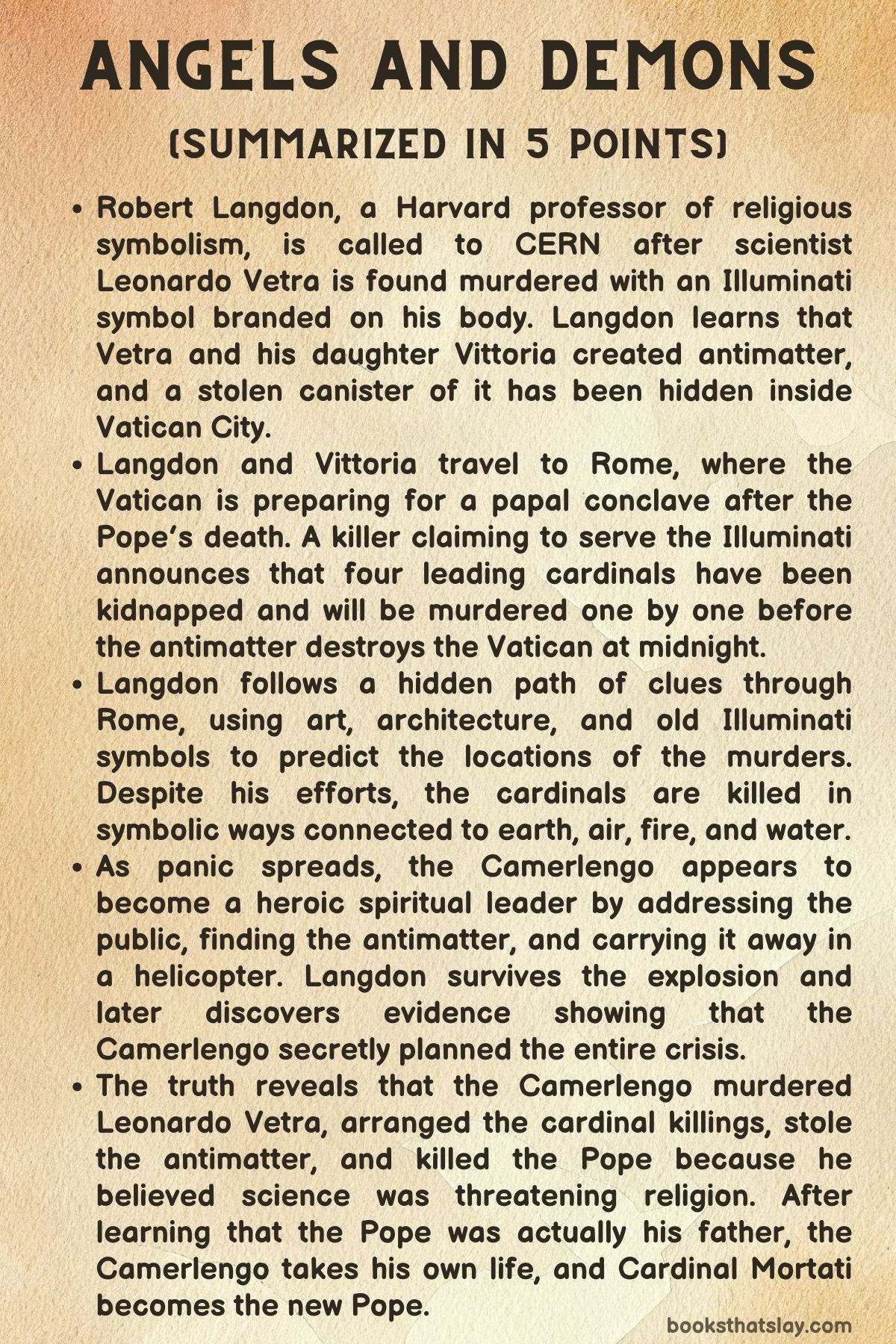
Characters
Robert Langdon
Robert Langdon is the central intellectual force of Angels and Demons, and his role in the book is built around observation, interpretation, and endurance. As a Harvard professor of religious iconography, he enters the story not as a soldier or detective but as a scholar whose knowledge becomes urgently practical.
His ability to read symbols, art, architecture, and historical clues turns him into the person most capable of following the Illuminati trail across Rome. Langdon is often skeptical, but he is not closed-minded.
He begins by treating the Illuminati as a historical subject, yet the events force him to reconsider what he thinks he knows. His claustrophobia and fear of confinement also make him more human, especially when he is trapped in dangerous spaces and must fight panic as much as external enemies.
Langdon’s courage is not presented as effortless bravery; he is afraid often, but he acts anyway. His bond with Vittoria also brings out a more emotional side of him, showing that his intelligence is matched by loyalty, compassion, and a deep moral instinct.
Vittoria Vetra
Vittoria Vetra is one of the strongest and most active figures in the story. She is a scientist, a thinker, a daughter, and a survivor.
Her grief over Leonardo Vetra’s murder drives much of her urgency, but she is never reduced to sorrow alone. She understands the power and danger of antimatter better than anyone else, and her scientific knowledge gives her a vital role in the race to save the Vatican.
Vittoria also represents the possibility that science and spirituality can coexist. Her father raised her to see wonder in both natural law and faith, and she carries that balance throughout the book.
She is physically capable, emotionally resilient, and intellectually sharp, often challenging the assumptions of the men around her. Her confrontation with the Hassassin also shows her refusal to remain helpless even when she is placed in extreme danger.
Vittoria’s character brings energy, moral clarity, and personal stakes to the book, especially because the stolen antimatter is tied directly to her own research and her father’s dream.
Leonardo Vetra
Leonardo Vetra is dead for most of the novel, yet his presence shapes nearly every major event. He is both a Catholic priest and a physicist, and that combination makes him central to the book’s conflict between religion and science.
Leonardo’s goal is not to destroy faith but to strengthen it through scientific discovery. His work with antimatter is meant to show that scientific explanations of creation do not have to erase belief in God.
This makes him a threat to people who see science and religion as enemies. His murder is shocking not only because of its brutality, but because it destroys a man who was trying to build a bridge between opposing worlds.
As Vittoria’s adoptive father, he is also shown as loving, patient, and inspiring. He takes in an orphaned child and teaches her to see the universe with curiosity and reverence.
Leonardo’s character stands for hope, reconciliation, and the dangerous cost of ideas that challenge rigid thinking.
Maximilian Kohler
Maximilian Kohler is a complex figure whose cold exterior hides deep personal pain. As the director of CERN, he values science, discipline, and institutional control.
He initially seems detached, even harsh, especially in his concern for CERN’s reputation after Leonardo’s murder and the theft of antimatter. Yet his distrust of religion is not shallow arrogance; it comes from childhood trauma.
His parents’ refusal to seek proper medical treatment because of religious belief left him permanently disabled, shaping his hostility toward faith-based authority. Kohler’s bitterness makes him suspicious of religious institutions, but it also drives him to uncover the truth.
He is not the villain the story briefly makes him appear to be. His final act, recording the Camerlengo’s confession, becomes crucial in exposing the real crime.
Kohler’s role in Angels and Demons shows how personal suffering can harden a person, but also how a commitment to truth can survive beneath anger and resentment.
Carlo Ventresca, the Camerlengo
Carlo Ventresca is one of the most dramatic and morally unstable characters in the book. At first, he appears noble, calm, and spiritually powerful.
His speeches inspire the frightened public, and his actions seem selfless as he guides the Church through crisis. He presents himself as a man of faith chosen for a sacred purpose.
However, the truth reveals a far darker character. Ventresca’s devotion has become fanaticism.
He believes that preserving religious faith justifies murder, deception, and terror. His hatred of Leonardo Vetra’s discovery comes from his belief that science cannot be allowed to explain divine mystery.
The most tragic part of his character is that his actions are rooted in a distorted love for the Church and a false sense of divine mission. When he learns that the Pope he murdered was actually his father, his entire moral structure collapses.
Ventresca is not simply evil; he is a warning about what happens when certainty, grief, religious pride, and power combine without humility.
The Hassassin
The Hassassin is the physical agent of terror in the story. He carries out the murders, kidnappings, and threats that drive the race against time.
His character is marked by cruelty, misogyny, pride, and a hunger for violence. He believes he is serving an ancient cause, but much of his behavior reveals personal sadism rather than ideological commitment.
He enjoys the fear he creates and treats his victims as objects. His attitude toward women, especially Vittoria, exposes a deeply corrupt and dehumanizing worldview.
As a villain, he functions as the visible face of the conspiracy, while the true architect remains hidden until later. He is dangerous because he combines obedience with pleasure in brutality.
Unlike Langdon, who uses knowledge to protect life, the Hassassin uses secrecy, symbols, and violence to spread fear. His defeat by Langdon and Vittoria is important because it allows both intellect and resistance to overcome raw aggression.
Cardinal Saverio Mortati
Cardinal Mortati is a figure of wisdom, restraint, and moral seriousness. As the cardinal responsible for overseeing the papal election, he begins as a guardian of tradition and procedure.
He is deeply aware of the responsibility placed on him and wants the conclave to unfold with dignity. As the crisis grows, Mortati becomes increasingly important because he remains thoughtful even when others are swept up by fear, awe, or anger.
His later explanation about the Pope’s child reveals that he knows painful truths but handles them with discretion and compassion. Mortati’s response to the Camerlengo’s apparent miracle is also significant.
While many cardinals rush toward adoration, Mortati urges caution, showing his respect for faith without surrendering reason. By the end, his elevation to Pope feels fitting because he represents balance, humility, and steadiness.
He is not flashy or theatrical, but the book presents him as the kind of leader who can guide the Church after chaos.
Commander Olivetti
Commander Olivetti is defined by discipline, suspicion, and duty. As head of the Swiss Guard, he is trained to protect the Vatican, and his first instinct is to reject anything that sounds irrational or impossible.
This makes him frustrating at first, especially when he doubts Langdon and Vittoria despite the urgency of the antimatter threat. However, his skepticism is also part of his role.
He is responsible for security during one of the most important events in the Catholic world, and he cannot afford to accept every alarming claim without proof. Once the danger becomes undeniable, Olivetti acts decisively.
He helps Langdon and Vittoria pursue the Illuminati clues and puts himself directly in harm’s way. His death at the hands of the Hassassin shows the cost of the conspiracy and removes one of the Vatican’s strongest protectors.
Olivetti is not emotionally expressive, but his loyalty to duty is clear.
Captain Rocher
Captain Rocher is one of the book’s most misunderstood characters. For much of the story, his behavior appears suspicious, especially when he delays certain actions and seems to act against the Camerlengo’s safety.
This makes him an effective red herring. The reader is encouraged to see him as a possible traitor, especially after the Camerlengo accuses him of being Illuminati.
In reality, Rocher has been trying to respond to information given to him by Kohler and may have understood more than others realized. His death is therefore especially unjust.
He is killed before he can fully explain himself, becoming another victim of the Camerlengo’s manipulation. Rocher’s character shows how quickly truth can be buried when fear controls a situation.
He also reflects one of the book’s recurring concerns: appearances are often misleading, and authority can be weaponized by someone who knows how to perform innocence.
Lieutenant Chartrand
Lieutenant Chartrand represents innocence, loyalty, and the perspective of someone still learning how to judge power. As a younger Swiss Guard, he often reacts with awe toward the Camerlengo and anxiety toward the unfolding crisis.
He is dutiful but not hardened. His respect for the Camerlengo makes him vulnerable to manipulation, yet his conscience and instincts remain active.
When he hears Langdon and Vittoria trapped behind the hidden passage door, he chooses action rather than blind obedience. This moment shows his courage and his ability to think beyond orders.
Chartrand’s role may be smaller than Langdon’s or Vittoria’s, but he helps reveal how ordinary people inside institutions respond when trust is tested. He is not corrupt or power-hungry; he wants to do what is right, even when he does not fully understand the larger plot.
Gunther Glick
Gunther Glick is used to examine ambition, media sensationalism, and the hunger for career-making news. At first, he treats the crisis less as a tragedy than as an opportunity.
He is thrilled by the possibility of breaking a historic story, even when that story involves murder and mass danger. His eagerness makes him morally questionable, but he is not portrayed as purely malicious.
He is insecure, ambitious, and desperate to be taken seriously as a journalist. His reporting helps spread the Illuminati threat to the world, which serves both public awareness and the villain’s plan.
Glick’s character shows how media can expose truth while also feeding panic, distortion, and spectacle. By the end, he becomes part of the official public version of events, proving how easily a complicated reality can be simplified into a dramatic story for mass consumption.
Chinita Macri
Chinita Macri is more grounded and professional than Glick. As a camera operator, she is brave, observant, and often more sensible than her colleague.
She follows dangerous leads, captures critical footage, and shows strong instincts under pressure. Macri does not chase fame in the same breathless way Glick does, and she often challenges his exaggerations.
Her role is important because the camera becomes a powerful instrument in the book. Through her work, private violence becomes public knowledge, and the Vatican’s crisis becomes a global event.
She also represents the ethical tension of journalism: recording events can inform the world, but it can also turn suffering into spectacle. Macri’s presence adds intelligence and balance to the media subplot.
Cardinal Baggia
Cardinal Baggia is the most important of the kidnapped cardinals because he is the leading candidate for Pope and because Langdon comes closest to saving him. His death at the fountain is one of the book’s most painful moments because he briefly seems recoverable.
Baggia’s faith remains strong even in terror, and his final moments are marked by spiritual acceptance rather than hatred. He is not developed as fully as Langdon, Vittoria, or the Camerlengo, but he matters symbolically.
He represents the future the Church might have had if the conclave had proceeded normally. His murder is not only the killing of a man but an attack on continuity, leadership, and hope.
The fact that he is branded with water completes the killer’s ritual and brings Langdon to the final stage of the search.
Cardinal Lamasse, Cardinal Guidera, and Cardinal Edner
Cardinal Lamasse, Cardinal Guidera, and Cardinal Edner are less individually developed than Baggia, but they serve an important function in the story’s structure and emotional pressure. Each one becomes part of the symbolic sequence of murders tied to the elements.
Their deaths are staged not only to kill them but to send a message to the Church and the world. Through them, the villain turns human lives into theatrical symbols.
This makes their deaths especially cruel: they are not treated as people by the conspiracy, but as tools in a performance meant to terrify the Vatican and resurrect fear of the Illuminati. Their absence also destabilizes the conclave, forcing the Church into uncertainty at the very moment it needs leadership.
Together, they show the human cost of ideology when symbolism becomes more important than life.
The Late Pope
The late Pope is physically absent for most of the book, but his memory becomes central to the final revelation. At first, he appears to be another victim in a larger anti-Church conspiracy.
Later, the truth about his relationship with science and with the Camerlengo changes the meaning of the entire plot. He believed that science could serve life without violating faith, as shown by the secret of his child’s conception.
His chastity remained intact, but his unwillingness or inability to explain the truth in time led to fatal misunderstanding. As a father, mentor, and religious leader, he represents a gentler form of faith than the Camerlengo’s rigid extremism.
The tragedy is that the Camerlengo sees him as corrupt when he is actually an example of compassion, sacrifice, and openness to modern knowledge.
Sylvie Baudeloque
Sylvie Baudeloque, Kohler’s secretary at CERN, gives the story another view of the crisis from outside Rome. She is loyal to Kohler but also personally shaken by the events because of her Catholic faith.
Through her, the book shows how the Vatican crisis affects people beyond the immediate action. At CERN, many scientists react with excitement over the attention surrounding antimatter, but Sylvie feels the religious and emotional weight of what is happening.
Her perspective highlights the divide between scientific ambition and spiritual concern. She is not a major driver of the plot, but she helps show CERN as a place filled with different beliefs, not a single cold institution.
Janus
Janus is the hidden identity used to control the conspiracy, and the name functions as a mask before the truth is known. The figure of Janus seems to represent the Illuminati leader, giving the Hassassin instructions and shaping the attacks against the Vatican.
In reality, this identity is part of the Camerlengo’s deception. The name is fitting because Janus is associated with duality, and the character behind it lives a double role: public savior and secret criminal.
As Janus, the Camerlengo creates an enemy that appears ancient, powerful, and external. This false identity allows him to frighten the Church, manipulate the media, and direct suspicion away from himself.
The Janus persona is one of the clearest examples in Angels and Demons of how symbols can be used not only to reveal truth but to manufacture lies.
Themes
Science, Faith, and the Struggle for Meaning
The conflict between science and faith drives Angels and Demons from the first major revelation about Leonardo Vetra’s work. The book does not treat science as simply anti-religious or religion as simply anti-intellectual.
Instead, it places different models of belief against one another. Leonardo and Vittoria see scientific discovery as a way to deepen wonder.
Their antimatter research is dangerous, but its original purpose is not destruction; it is meant to suggest that creation can be understood through both physics and spirituality. The Camerlengo rejects this possibility because he believes mystery must remain untouched for faith to survive.
This makes the central conflict less about science versus religion and more about fear versus openness. Langdon often stands between both worlds, interpreting religious symbols with scholarly distance while gradually witnessing the emotional power faith holds for others.
The book suggests that science becomes dangerous when separated from moral responsibility, but religion becomes dangerous when it refuses humility. The most destructive characters are not those who ask questions, but those who believe they already possess absolute answers.
The Power and Danger of Symbols
Symbols control the movement of the story, but they also control the characters’ fears, beliefs, and decisions. The Illuminati brands, the ambigrams, Bernini’s sculptures, the churches, the obelisks, and the elemental markers all turn Rome into a coded landscape.
Langdon’s skill lies in understanding that symbols preserve history, but the book also shows that symbols can be manipulated. The supposed return of the Illuminati terrifies the Vatican because the symbol carries centuries of meaning.
The assassin and the Camerlengo exploit that fear, using old signs to create the illusion of an ancient revenge plot. This makes symbols powerful but morally neutral.
They can guide Langdon toward truth, but they can also be used to stage murder, spread panic, and create false certainty. The public sees the Camerlengo’s survival as a miracle because it looks symbolic, even though it is part of a constructed performance.
The book repeatedly asks whether people understand what they are seeing or simply react to the meaning they have been taught to attach to it.
Ambition, Authority, and Manipulation
Authority in the story is constantly tested, especially when leaders use trust to shape reality for others. The Camerlengo’s power comes not from official rank alone but from performance.
He speaks with conviction, appears humble, and seems spiritually fearless, which makes people want to believe him. His manipulation succeeds because he understands what the Church, the cardinals, the media, and the public need in a moment of fear.
He gives them an enemy, a crisis, and then a miracle. Kohler, Olivetti, Rocher, and Mortati all hold authority too, but they use it differently.
Kohler seeks evidence, Olivetti protects procedure, Rocher acts under suspicion, and Mortati values restraint. The contrast shows that authority can protect people when guided by truth, but it can become catastrophic when joined with ego and certainty.
Glick’s media ambition adds another layer, showing how public attention can be manipulated by anyone who knows how to feed it dramatic images. The story warns that people in crisis often trust confidence before truth, and that makes them vulnerable to those who perform righteousness.
The Cost of Extremism
Extremism in the book is shown as the point where belief loses compassion. The Hassassin’s violence is obvious and physical, but the Camerlengo’s extremism is more dangerous because it hides behind piety.
He believes he is saving the Church, yet he murders innocent people, kills his mentor, endangers thousands, and turns faith into a weapon. His tragedy is that he sees himself as obedient to God while committing acts that destroy the values he claims to defend.
Kohler also carries the scars of another kind of extremism: the religious rigidity of his parents, whose refusal to accept medical help changed his life permanently. These examples show how any belief system can become cruel when it refuses doubt, empathy, or accountability.
The murdered cardinals, Leonardo Vetra, and the late Pope all become victims of people who cannot tolerate complexity. The book’s final revelations make this theme even sharper because the Camerlengo’s actions are based on misunderstanding as much as fanaticism.
His certainty kills before truth has a chance to speak.