Out of the Loop Summary, Characters and Themes
Out of the Loop by Katie Siegel is a mystery-romance with a clever time-loop setup and a sharp emotional center. The story follows Amie Teller, a woman who has spent more than seven hundred days reliving the same date, only to emerge into a world that suddenly has consequences again.
What begins as a strange escape from repetition turns into a murder investigation when her difficult neighbor is found dead. The book blends amateur sleuthing, second-chance love, anxiety after trauma, and the uneasy question of whether Amie’s loop had a purpose.
Summary
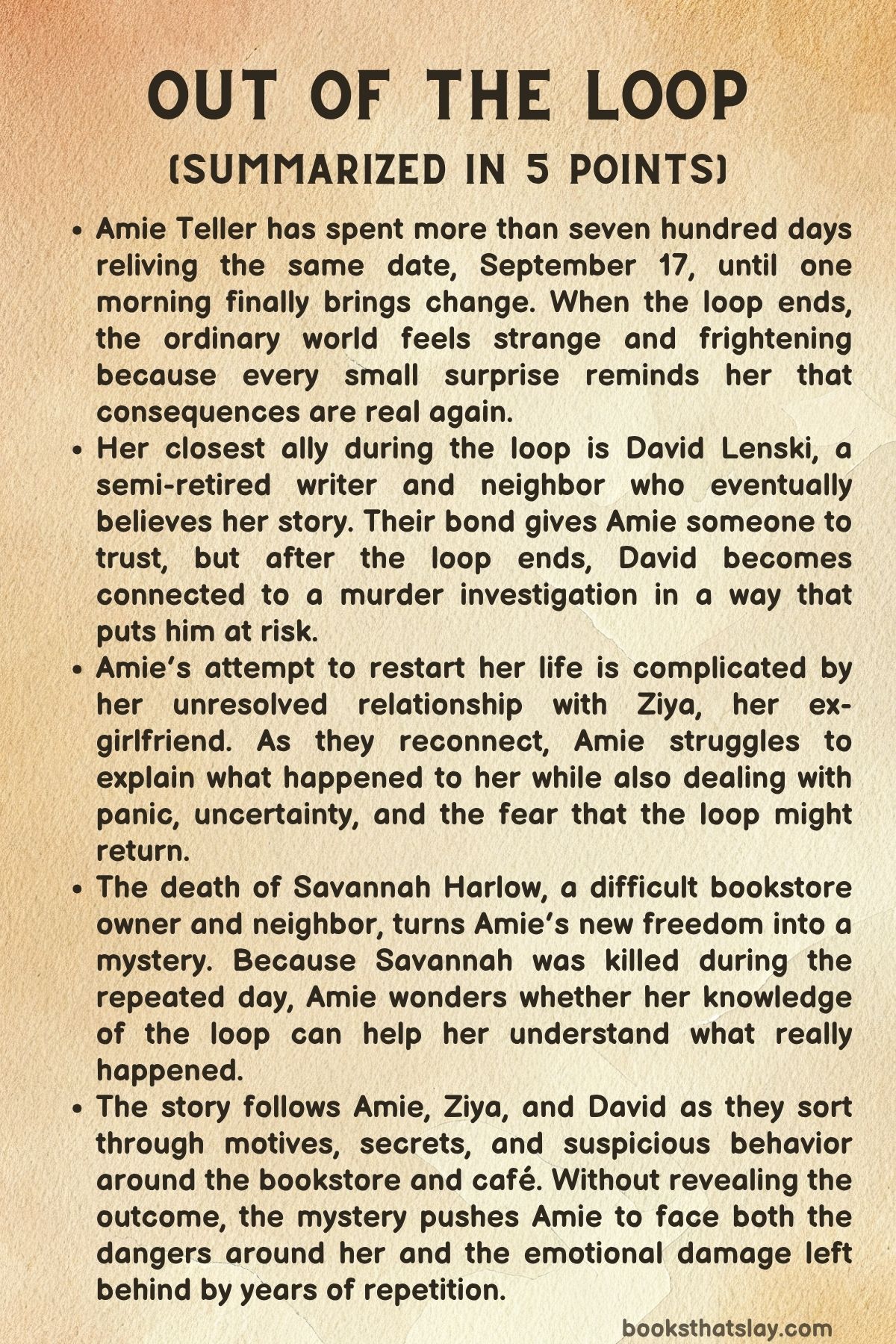
Amie Teller has spent more than two years trapped in the same day: September 17. Every morning resets everything.
The same people say the same things, the same small accidents happen, the same café runs out of blueberry bagels, and no choice seems to matter for long because the day always begins again. Over time, Amie learns every detail of the repeated Monday.
She knows when arguments will happen, when drinks will spill, when neighbors will appear, and how to move through the day with a strange kind of control.
At first, she resists accepting what is happening. By the fifteenth repeat, she can no longer deny it.
Her life has become one endless loop, and no one else remembers any of it. Desperate for help, she turns to her neighbor David Lenski, a semi-retired writer who fills his apartment with complicated Rube Goldberg machines.
David is skeptical until Amie proves she knows what will happen next in one of his contraptions. Once he believes her, he gives her a phrase she can use on future versions of him: “Tell Genevieve I said hi.” From then on, David becomes the one person Amie can convince quickly, even though he forgets her every time the day resets.
During the loop, Amie changes. She learns the repeated pattern of the day so well that she can prevent minor disasters and redirect people before they make things worse.
She stops David from confronting Savannah Harlow, the unpleasant owner of Shelf Starter bookstore and Amie’s upstairs neighbor. She helps Raina, Shelf Starter’s manager, avoid problems.
She knows how to manage the day’s little crises, even if none of it lasts. Her repeated life becomes both prison and practice.
Then, one morning, the loop ends.
Amie wakes to a day that is not September 17. The signs are small but undeniable.
Dirty clothes remain where she left them. A tow truck is outside.
Rain falls for the first time in what feels like years. Most important, Amie receives a new text from Ziya, her ex-girlfriend.
During the loop, Amie had canceled a dinner with Ziya because she believed there would be no consequences. Now Ziya is asking whether Amie feels better and if they should reschedule.
Freedom should feel like relief, but Amie is terrified. After so long in a world where everything repeated, ordinary change feels dangerous.
She tries to begin with something simple: going to Eons Café for the blueberry bagel she could never get during the loop. Even that becomes overwhelming.
A bicyclist startles her, strangers ask questions she cannot answer naturally, a truck splashes her with water, and police tape near the café leaves her shaken.
Inside Eons, Amie finally gets the bagel. She also learns that Savannah Harlow has been found dead in the bookstore.
The death may be murder. Savannah was harsh, controlling, and widely disliked, but the news still shocks Amie.
Because Savannah died during the time period Amie kept reliving, Amie wonders whether the loop had a purpose. Was she supposed to stop Savannah’s murder?
Did she miss the one thing that mattered?
Amie tries to rebuild normal life. Her planner, useless during the loop, suddenly matters again.
She drafts and redrafts a reply to Ziya. When Ziya suggests meeting that night, Amie panics and asks David for advice.
David encourages her to choose a different restaurant rather than recreate a date shaped by loop memories. Amie also tells him about Savannah’s death and her fear that she failed some cosmic assignment.
David admits it is possible, but he also points out that if the universe wanted her to solve a murder, it gave her almost no guidance.
Amie meets Ziya for dinner. The evening shows how fragile Amie has become.
Ziya nearly gets hit by a car, and Amie is badly shaken because danger is no longer temporary. During dinner, a loud argument nearby triggers a panic attack.
Ziya helps her outside with patience and care. Before they can settle what the night means for them, David calls to say he may be arrested.
Ziya drives Amie to David’s apartment, where police officers are questioning him about an argument he had with Savannah the previous day. Someone told the police about the confrontation, making David a possible suspect.
After the officers leave, Amie and Ziya discover that David secretly wrote bestselling mystery novels. Ziya already knew this but had promised to keep it private.
She thinks David’s background makes him useful to the investigation, but he refuses to play detective.
Later, Amie brings Ziya to her apartment for boxed mac and cheese. Their conversation turns personal.
Ziya admits the breakup has been hard for her too. Amie finally tells her the truth: she was trapped in a time loop.
Ziya does not fully believe it, but she listens. When Amie says she is afraid of waking up back on September 17, Ziya stays the night.
The next morning proves the loop is still over. Amie and Ziya go to Eons together and learn more about Savannah’s death.
Savannah was killed in Shelf Starter on Monday night, during the loop. Jess, the barista, suggests that Madeline, the owner of Eons, had a motive.
Madeline wanted to buy Savannah’s struggling bookstore and expand the café. Amie decides she cannot ignore the murder, especially with David under suspicion.
Ziya joins her, and they enter Shelf Starter to begin looking for answers.
Amie, Ziya, and David start tracing the events around Savannah’s final night. At the grocery store, Amie questions Winston, the flower counter employee.
Savannah had been furious during the loop because a regular flower delivery failed to arrive. Winston explains that the order was canceled, restored for the next morning, and then changed again so flowers would be delivered to Shelf Starter at seven that evening.
Amie realizes the altered delivery may have been used to lure Savannah back to the bookstore, where the killer was waiting.
Suspicion shifts from person to person. Raina had access to the bookstore and seemed tied to its future.
At a rooftop bar, Amie and Ziya talk to her during a bachelorette party. Raina says Savannah left her to close early and that police only asked routine questions.
She also reveals that Madeline had wanted to buy Shelf Starter, but Savannah’s husband, Andrew, reacted badly when Madeline approached him.
Raina also claims Savannah was blackmailing Benny, the Harlows’ landlord. According to Raina, Savannah found photos proving Benny cheated on his girlfriend and used them to force him to lower rent for the third floor.
Benny now has a motive. Soon after, Amie receives anonymous photos showing Benny entering her apartment.
Inside, she finds a note warning her to stop investigating.
Another suspect appears: Jonathan Oakland, a wealthy businessman who wanted Shelf Starter. Amie remembers hearing him on a podcast mocking a woman who clearly sounded like Savannah and admitting he gave her bad business advice.
Madeline later reveals that Savannah had sold Shelf Starter to her before dying, while Oakland had tried to buy it anyway. Oakland admits he lied to Andrew, making Andrew suspect Madeline.
Andrew confronts Madeline and is accidentally injured, adding more chaos to the case.
At the fall festival, Amie finally notices the pattern she had missed. During the loop, Raina’s behavior changed depending on whether Amie stopped David from arguing with Savannah.
Amie realizes Raina deliberately arranged the conflict so David could later look guilty. Raina understands that Amie has figured it out and threatens her with a pocketknife, forcing her onto the Ferris wheel.
There, Raina confesses. She killed Savannah after Savannah laughed at her dream of buying the bookstore.
Raina also admits that she, not Savannah, blackmailed Benny. She used Benny, David, Madeline, and Oakland as distractions, spreading suspicion in every direction while hiding her own role.
She demands that Amie blame David or let her escape.
Amie refuses. She grabs the knife, cutting her hand, and jumps from the Ferris wheel into the lake below.
David and Ziya rush to help her. In choosing action despite fear, Amie breaks from the helplessness the loop taught her.
The mystery is solved, but the deeper change is Amie’s: after years of repetition, she steps into a future that is uncertain, frightening, and finally real.
Characters
Amie Teller
Amie Teller is the central character of Out of the Loop, and her journey is shaped by the emotional damage of living the same day for more than seven hundred days. At first, the time loop makes her feel trapped, frightened, and powerless, but over time it also changes the way she understands control.
She learns the repeated patterns of the day so well that she can predict accidents, conversations, arguments, and even minor inconveniences. This gives her a strange kind of confidence, but it also makes ordinary life after the loop terrifying.
Once time begins moving forward again, Amie is no longer protected by repetition. Rain, traffic, police tape, strangers, and even casual questions feel overwhelming because they belong to a world she can no longer rehearse.
Her character is especially compelling because the book does not present her as instantly healed once the loop ends. Instead, Amie carries the psychological weight of those repeated days into the present.
Her panic during dinner with Ziya shows how deeply the loop has affected her ability to handle unpredictability. She wants to return to normal, but she has forgotten how normal life works when every action has a consequence.
Her planner, once useless during the loop, becomes a symbol of her attempt to rebuild a future. Amie is thoughtful, anxious, observant, and often self-doubting, but she also becomes brave when it matters.
Her decision to investigate Savannah’s murder comes from guilt, curiosity, loyalty to David, and a fear that the loop may have existed for a reason.
Amie’s greatest growth appears in the way she moves from avoidance to action. During the loop, she cancels dinner with Ziya because she believes nothing will last.
After the loop, she has to face the emotional consequences of that habit. She also has to stop treating people as predictable parts of a repeated day and begin seeing them as people with secrets, motives, and pain.
By the end of the story, her confrontation with Raina shows how far she has come. She is still afraid, but she chooses risk over surrender.
Her jump from the Ferris wheel is both a desperate escape and a powerful rejection of Raina’s attempt to control the truth. Amie’s character represents survival after emotional stasis, and her arc is about learning how to live when life finally starts moving again.
Ziya
Ziya is Amie’s ex-girlfriend and one of the most emotionally grounding figures in the book. Her first text after the loop ends is important because it proves to Amie that time has truly changed.
Ziya represents the life Amie abandoned during the repeated September 17, but she is not simply a symbol of the past. She is a full character with her own hurt, patience, confusion, and lingering affection.
Her willingness to meet Amie again shows that she still cares, but her pain also reveals that Amie’s choices during the loop affected someone outside Amie’s private suffering once time resumed.
Ziya’s strength lies in her steadiness. During dinner, when Amie panics, Ziya does not mock her or demand an explanation.
She helps her outside and responds with calm concern. This shows that although their relationship is strained, Ziya still understands Amie deeply.
When Amie finally tells her about the time loop, Ziya does not fully believe it, but she listens. That response is important because it shows emotional maturity.
Ziya does not need to accept every impossible detail immediately in order to care about the fear behind Amie’s confession. Her decision to stay the night because Amie is afraid of waking up back in the loop shows compassion without making her seem naïve.
Ziya also brings energy and intelligence to the murder investigation. She encourages David to use his mystery-writing mind, helps Amie question suspects, and joins her in uncomfortable situations such as the rooftop bar encounter with Raina.
Her presence helps pull Amie back into connection with other people. She is not merely a love interest; she is a reminder that love requires honesty, accountability, and trust.
Through Ziya, the story explores whether a relationship can survive emotional disappearance, trauma, and uncertainty. Her role is essential because she gives Amie both comfort and challenge.
She supports Amie, but she also forces her to face the fact that actions matter now.
David Lenski
David Lenski is Amie’s neighbor, mentor, friend, and one of the warmest figures in Out of the Loop. He is introduced as a semi-retired writer who spends his time creating elaborate Rube Goldberg machines, and that detail immediately reveals his personality.
David is inventive, eccentric, patient, and deeply interested in cause and effect. His machines mirror the structure of the story itself, where small actions lead to unexpected consequences.
When Amie first tells him about the loop, he is skeptical, but once she proves her knowledge, he becomes one of the few people she can rely on. His code phrase, “Tell Genevieve I said hi,” creates continuity between repeated versions of himself and gives Amie a practical anchor inside an impossible situation.
David’s importance comes from the way he gives Amie companionship during isolation. The loop could have made her completely alone, but David becomes someone she can return to again and again.
He listens to her theories, offers advice, and helps her think through the emotional and practical problems of time beginning again. After the loop ends, he continues to support her, especially when she panics over Ziya and Savannah’s death.
His humor and calm intelligence balance Amie’s anxiety. Yet David is not just a comforting figure; he is also vulnerable.
His argument with Savannah makes him a suspect, and his secret career as a bestselling mystery novelist adds another layer to his character.
David’s refusal to investigate at first is revealing. Although he has the mind of a mystery writer, he does not want to become part of a real murder case, especially one that could implicate him.
This makes him more human. He is clever, but not reckless; curious, but aware of danger.
His eventual involvement shows loyalty to Amie and a desire to clear his own name. David’s relationship with Amie is one of the emotional foundations of the story.
He helps her survive repetition, and after the loop ends, he helps her face uncertainty. His character represents wisdom, companionship, and the strange comfort that can come from someone believing the unbelievable.
Savannah Harlow
Savannah Harlow is the murder victim, but she remains an active force in the story even after her death. She is presented as unpleasant, difficult, and intimidating, both as the owner of Shelf Starter and as Amie’s upstairs neighbor.
Her conflicts with others create the web of motives that drives the mystery. Savannah’s harshness affects nearly everyone around her: David argues with her, Madeline wants to buy her bookstore, Raina feels belittled by her, Benny becomes connected to blackmail, and Jonathan Oakland tries to manipulate the future of her business.
Because so many people have reasons to resent her, her death becomes both a crime and a revelation of hidden tensions in the community.
Savannah’s character is morally complicated because the book does not need her to be likable in order for her death to matter. She can be rude, cruel, and controlling, but she is still a person whose murder must be solved.
Her presence exposes how easily people justify hostility toward someone difficult. The investigation slowly reveals that Savannah’s business, relationships, and reputation were tangled in resentment and ambition.
She becomes a mirror for other characters’ desires. Madeline sees opportunity in the bookstore, Raina sees a dream being denied, Oakland sees a business target, and David sees a source of irritation.
Savannah’s personality helps create the conditions for suspicion, but it does not explain or excuse what happens to her.
Her most important role is in relation to Raina. When Savannah laughs at Raina’s dream of buying the bookstore, that cruelty becomes the emotional spark behind the murder.
Savannah’s flaw is that she underestimates how deeply she wounds people. She uses sharpness as power, but that power makes her enemies.
Even in death, she controls the story because the truth about her final movements, her business sale, and her relationships must be uncovered before the mystery can be solved. Savannah is not a sympathetic victim in a simple sense, but she is an essential character because her life reveals the darker ambitions of others.
Raina
Raina is one of the most deceptive and important characters in the book. At first, she appears to be Shelf Starter’s manager, a stressed employee caught in the chaos surrounding Savannah.
Her presence at the grocery store, her connection to the bookstore, and her emotional reaction when questioned make her seem suspicious but also possibly vulnerable. She seems like someone who has been pushed around by Savannah and trapped in a future she cannot control.
This makes the final revelation effective because Raina’s apparent helplessness hides calculation, resentment, and ambition.
Raina’s motive is rooted in humiliation and frustrated desire. She wants to buy the bookstore, but Savannah laughs at that dream.
For Raina, this is not just a business disappointment; it is a personal rejection of her worth. Her crime shows how resentment can become dangerous when mixed with planning.
She manipulates the flower delivery to lure Savannah back to the shop, arranges events so David becomes a suspect, and uses Benny, Madeline, and Oakland as distractions. This makes her more than an impulsive killer.
She is strategic, observant, and willing to exploit the weaknesses of others.
What makes Raina especially threatening is that she understands stories. She knows how to create a believable version of events by giving people motives and placing suspicion where it will be most useful.
Her confrontation with Amie on the Ferris wheel reveals her true nature. She is desperate, but she is also cold enough to threaten Amie with a knife and demand that Amie blame David.
Raina becomes a dark reflection of Amie. Both women understand patterns and timing, but Amie uses that knowledge to protect people, while Raina uses it to manipulate them.
Raina’s character shows how ambition without empathy can turn into violence.
Madeline
Madeline is the owner of Eons Café and a significant suspect because of her interest in expanding into Savannah’s bookstore space. She represents the ordinary business pressures beneath the cozy surface of the neighborhood.
At first, the idea that she may have wanted Savannah dead seems plausible because she had a clear motive: Shelf Starter was struggling, and Madeline wanted the space. Her desire to grow Eons places her in conflict with Savannah and makes her part of the mystery’s network of suspicion.
However, Madeline’s role becomes more complicated when it is revealed that Savannah had already sold the bookstore to her before dying. This changes the meaning of Madeline’s motive.
Instead of needing Savannah gone in order to acquire the store, Madeline had already achieved what she wanted legally. Her character helps demonstrate how partial information can distort suspicion.
From the outside, her ambition looks incriminating, but the truth shows that ambition alone does not make someone a murderer. She is practical and business-minded, but not necessarily cruel.
Madeline also functions as a contrast to characters like Raina and Oakland. She wants the bookstore space, but she does not appear to rely on elaborate manipulation to get it.
Her involvement in Andrew’s confrontation shows how lies told by others can create real harm. When Oakland deceives Andrew and makes him suspect Madeline, Madeline becomes caught in a conflict she did not fully create.
Her character adds realism to the mystery because she shows how innocent or semi-innocent people can still be pulled into suspicion when money, property, and grief are involved.
Andrew Harlow
Andrew Harlow is connected to Savannah through family and grief, and his role is shaped by confusion, anger, and manipulation. After Savannah’s death, he becomes vulnerable to false information, especially when Jonathan Oakland lies to him and makes him suspect Madeline.
Andrew’s reaction shows how grief can make people desperate for someone to blame. He does not have the calm distance of an investigator; he is emotionally involved, and that makes him easier to mislead.
His confrontation with Madeline is important because it shows the consequences of suspicion spreading without truth. Andrew acts on incomplete information and ends up injuring himself, turning a false lead into a dangerous real-world event.
He is not presented as a mastermind or villain, but as someone whose pain is redirected by another person’s manipulation. This makes him a sympathetic but flawed character.
His anger is understandable, yet his actions show how quickly grief can become reckless when it is fueled by lies.
Andrew’s role also deepens the mystery by showing that Savannah’s death affects more than the immediate suspects. For Amie, Savannah may have been unpleasant and frightening; for Andrew, she is someone whose death leaves emotional wreckage.
His presence reminds the reader that a murder investigation is not just a puzzle. It is also a crisis for the people left behind.
Andrew’s character brings that human cost into the story.
Benny
Benny is the Harlows’ landlord and one of the characters used as a distraction in the murder investigation. His connection to the blackmail subplot initially makes him look suspicious.
Raina claims that Savannah had photos proving Benny cheated on his girlfriend and that Savannah used those photos to force him to lower rent. This creates a believable motive: Benny might have wanted Savannah dead to protect himself from exposure and pressure.
However, Benny’s role is largely defined by being manipulated. David doubts that Benny is clever enough to plan the flower-delivery trick, and that doubt proves important.
Benny may be morally flawed, especially because of the cheating and his vulnerability to blackmail, but the evidence does not fit him as the main planner. His entry into Amie’s apartment and the threatening note raise the stakes, yet the larger truth reveals that he is part of Raina’s misdirection rather than the central criminal intelligence behind the murder.
Benny’s character shows how guilt in one area can make someone look guilty in another. Because he has secrets, he becomes easy to suspect and easy to use.
Raina understands this and turns his weakness into part of her cover. Benny is not innocent in every sense, but he is not the true architect of Savannah’s death.
His role adds texture to the mystery by showing that many people have something to hide, even if only one person committed the murder.
Jonathan Oakland
Jonathan Oakland is a wealthy businessman whose interest in Shelf Starter makes him another major suspect. He represents arrogance, entitlement, and the kind of power that tries to shape other people’s lives through money and manipulation.
Amie remembers hearing him on a podcast mocking a “Susannah” who clearly resembles Savannah and admitting that he gave her bad business advice. This makes him seem predatory and dishonest, especially because he appears willing to undermine Savannah’s business prospects for his own benefit.
Oakland’s desire to buy Shelf Starter gives him a strong connection to the central conflict. Even after Savannah sells the store to Madeline, he tries to acquire it anyway, showing that he is not used to accepting refusal.
His lie to Andrew is particularly revealing. By making Andrew suspect Madeline, Oakland creates chaos that serves his interests and shifts attention away from himself.
He may not be the murderer, but he is still morally corrupt. His behavior proves that a person can be dangerous without being the killer.
As a character, Oakland broadens the book’s view of motive. Not every threat comes from personal hatred; some come from greed, pride, and business ambition.
He treats the bookstore as an asset rather than a place with emotional meaning for the people around it. This makes him an effective suspect and a useful contrast to Raina.
Oakland has power and money, while Raina has proximity and resentment. Both manipulate others, but Raina’s emotional motive ultimately proves more explosive.
Jess
Jess, the barista at Eons Café, plays a smaller but useful role in the investigation. Jess helps Amie and Ziya learn more about the circumstances surrounding Savannah’s death and suggests that Madeline may have had a motive because she wanted to buy the bookstore.
This makes Jess a source of local knowledge, the kind of character who hears rumors, observes tensions, and helps connect everyday neighborhood life to the murder mystery.
Jess’s importance lies in how ordinary they seem compared with the more dramatic suspects. They are not presented as someone with a grand hidden scheme, but as a person who understands the social environment around Eons and Shelf Starter.
Their comments help Amie begin thinking like an investigator after the loop ends. Jess also shows how information spreads in a neighborhood.
In a small community, people notice business rivalries, personality clashes, and strange behavior, even if they do not always understand the full meaning of what they have seen.
As a supporting character, Jess helps move the plot from shock into investigation. Through Jess, Amie receives one of the first clear theories about motive.
That theory may not reveal the killer, but it opens the path toward examining the people connected to Savannah’s bookstore. Jess’s role is modest, but the character helps make the setting feel socially alive.
Winston
Winston works at the grocery store flower counter, and his role is important because he provides key information about the altered flower delivery. At first, he might seem like a minor employee caught in Savannah’s anger over a flower-order problem.
However, his explanation reveals that the order was canceled, restored, and then changed so that flowers would be delivered to Shelf Starter at seven in the evening. This detail becomes crucial because it suggests that Savannah may have been lured back to the bookstore.
Winston’s character is useful because he brings the investigation from emotional suspicion into practical evidence. His information helps Amie and David understand that Savannah’s movements were likely shaped by someone else’s plan.
He also clarifies that the police came to him rather than the other way around, which helps Amie evaluate whether he was responsible for tipping them off about David. In a mystery, characters like Winston matter because they hold small pieces of truth that change the direction of the investigation.
Winston is not deeply developed emotionally, but he is important structurally. He shows how ordinary workers can become accidental witnesses to a larger crime.
His flower-counter role seems minor, yet the delivery timing becomes one of the clearest signs of premeditation. Through Winston, Out of the Loop demonstrates how a seemingly small logistical change can reveal the shape of a murder plan.
Genevieve
Genevieve does not appear as actively as the other characters, but her name carries emotional and practical significance through David’s code phrase, “Tell Genevieve I said hi.” The phrase allows Amie to convince new versions of David that she has already earned his trust in previous loops. Because of that, Genevieve becomes part of the mechanism that helps Amie survive the repeated day.
Her name acts like a bridge between versions of David who cannot remember Amie and Amie, who remembers everything.
Even though Genevieve remains mostly in the background, the use of her name suggests that David has a private emotional life beyond what Amie immediately sees. The phrase feels personal, not random, which makes David’s trust in Amie feel more intimate and human.
Genevieve’s importance is therefore indirect. She helps establish David’s credibility, his history, and the emotional weight behind the code he gives Amie.
As a background figure, Genevieve also reflects one of the story’s major ideas: memory gives meaning to relationships. David cannot remember each loop, but the code phrase gives Amie a way to restore connection.
Genevieve’s name becomes a small but meaningful token of continuity inside a world where continuity has been broken.
Themes
Recovery After Emotional Stagnation
Out of the Loop presents recovery not as a clean return to normal life, but as an unsettling process filled with fear, confusion, and small acts of courage. Amie spends more than seven hundred days in a world without lasting consequences, so when time finally moves forward, ordinary life feels threatening rather than freeing.
Rain, dirty clothes, traffic, strangers, police tape, and even a long-awaited blueberry bagel become signs that she must live again in a world she cannot control. Her panic shows how deeply the loop has shaped her mind: repetition has protected her from change, but it has also weakened her ability to face uncertainty.
Recovery begins when she stops trying to manage everything through patterns and starts accepting help from David and Ziya. Her progress is not dramatic at first; it appears in moments like answering Ziya’s message, going to dinner, investigating Savannah’s death, and admitting fear.
The theme shows that healing is not simply leaving the past behind, but learning how to move forward while still carrying its effects.
The Fear and Necessity of Consequences
Amie’s time loop removes consequences, allowing her to cancel plans, avoid difficult emotions, and live without worrying about what tomorrow will bring. Once the loop ends, consequences return all at once, and this becomes one of the central pressures of the story.
Her canceled dinner with Ziya now matters, Savannah’s death cannot be undone, David’s argument can make him a suspect, and Amie’s own choices can place people in danger. This shift forces her to understand that consequences are not only punishments; they are also what give actions meaning.
During the loop, Amie can help people, stop small accidents, and predict events, but nothing lasts. Afterward, every decision has weight.
Her investigation into Savannah’s murder grows from this realization. She cannot reset the day, so protecting David, supporting Ziya, and confronting Raina require real risk.
The theme suggests that a meaningful life depends on consequence, even when consequence brings fear, guilt, and uncertainty.
Love, Trust, and Vulnerability
Amie and Ziya’s relationship gives the story its emotional center because it tests whether love can survive silence, fear, and emotional distance. Amie’s time loop isolates her from Ziya, but the deeper problem is that Amie has learned to avoid vulnerability.
She cancels dinner because she thinks nothing will matter, yet when time resumes, that choice has emotional cost. Ziya’s return forces Amie to face the pain she has caused and the fear that she may not be believed.
Their dinner shows the strain between them: Amie wants connection but struggles to act naturally, while Ziya responds with patience during Amie’s panic. When Amie finally admits that she was trapped in a loop, the importance lies less in whether Ziya fully believes her and more in the fact that Ziya listens.
In Out of the Loop, trust is rebuilt through honesty, care, and presence. Love is shown not as an easy solution, but as a relationship that requires truth even when the truth sounds impossible.
Control, Mystery, and Moral Responsibility
Amie’s repeated day teaches her to read the world as a fixed pattern. She knows when drinks will spill, when arguments will happen, and how to prevent small disasters.
After the loop ends, Savannah’s murder breaks that sense of control. Amie tries to understand whether the loop had a purpose, especially whether she was meant to stop the killing, but the story resists giving her a simple answer.
David’s comment that the universe gave poor instructions is important because it challenges the idea that suffering always arrives with a clear mission. Amie still chooses responsibility, not because she is certain she was chosen, but because someone has died and someone she loves may be blamed.
The murder mystery expands this theme by showing how people manipulate appearances: Raina uses David, Benny, Madeline, and Oakland as distractions to hide her own guilt. Amie’s final confrontation with Raina proves that responsibility is not the same as control.
She cannot master every outcome, but she can act with courage when truth and safety are at stake.