Petty in Pink Summary, Characters and Themes
Petty in Pink by LJ Shen is a contemporary romance about unexpected love, second chances, and learning to trust again after emotional damage. The story follows Layla Schmidt, a preschool teacher whose quiet life is disrupted when she comes face-to-face with Connor, the abusive ex who once broke her confidence and left her with lasting fear.
Her closest support comes from Grant Gerwig, a longtime friend and casual partner whose steady care becomes something deeper after an unplanned pregnancy changes both their lives. The book blends romance, family, humor, pain, and healing as Layla learns that love can be safe, loyal, and freely chosen.
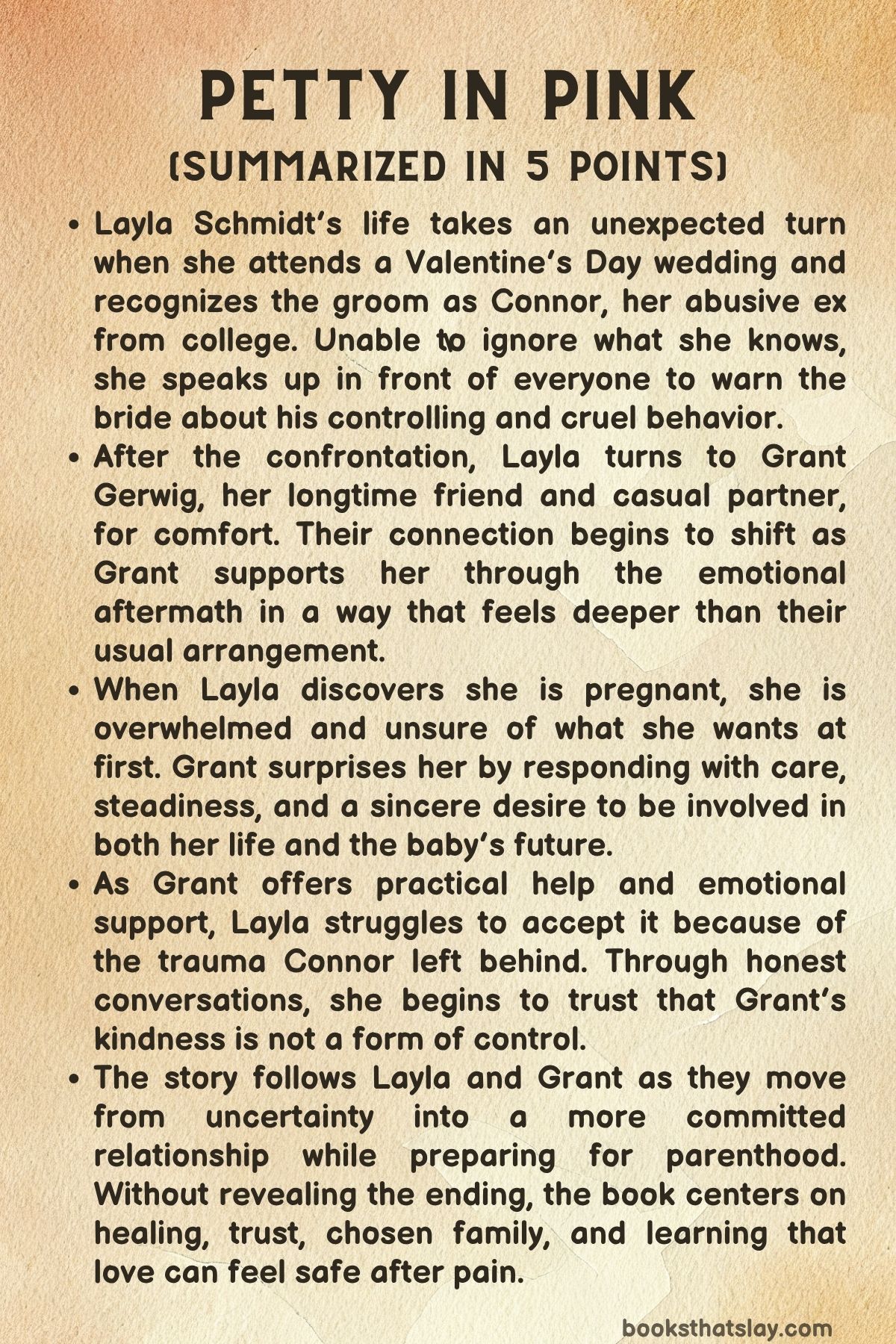
Summary
Layla Schmidt goes to a Valentine’s Day wedding more out of duty than excitement. The bride, Kellianne, is her new teaching assistant, and Layla feels she should show support even though they are not especially close.
What begins as a polite obligation becomes a painful shock when Layla sees the groom and realizes he is not simply Cornelius Fergus Smith III, the man Kellianne is marrying. He is Connor, Layla’s ex-boyfriend from college, a man who once controlled, humiliated, and deeply hurt her.
Seeing Connor standing at the altar brings back memories Layla has tried hard to bury. She notices other women at the wedding who also seem connected to him and begins to understand that Connor may have lied to more than one woman at the same time.
The realization makes her angry, not only for herself, but also for Kellianne, who is about to marry someone Layla knows can be cruel and manipulative. When the officiant asks whether anyone objects to the marriage, Layla cannot stay silent.
She stands up and warns Kellianne in front of everyone that Connor is controlling, unfaithful, dishonest, and abusive.
Connor tries to make Layla look unstable and bitter, reducing her warning to the behavior of a jealous ex. Layla leaves the ceremony shaken, but she knows she has done the one thing she could do: she told the truth.
Afterward, she calls Grant Gerwig, a longtime friend and casual hookup connected to her wider circle through Maddie and Chase. Grant is an oncologist and is on a Valentine’s date with Jessica, a colleague, when Layla reaches out.
Without hesitation, he leaves the date and goes to get her.
Grant takes Layla home, makes sure she eats, and tries to care for her without pushing too hard. He senses that the wedding has reopened something serious, but Layla refuses to explain exactly what Connor did.
Grant offers comfort in the way he knows best: by staying close, paying attention, and letting her lean on him. Their relationship has always been casual, but that night feels different.
The emotional weight between them shifts their connection into more intimate territory, and they sleep together without a condom because Layla is on birth control.
Five weeks later, Layla discovers she is pregnant. The news terrifies her.
She has never planned on having children, and the pregnancy forces her to think about her past, her future, and her complicated feelings for Grant. She goes to Maddie, who helps her sort through the panic without judgment.
At first, Layla insists she does not want the baby, but after spending time near Maddie’s young son, Ronan, something changes. Seeing the warmth and chaos of real family life makes Layla realize she does want this child.
When Layla tells Grant about the pregnancy, she expects distance, anger, or a practical offer of money. Instead, Grant surprises her with steady support.
He promises he will be there emotionally and financially, and in his shock he even blurts out a marriage proposal before trying to pass it off as a joke. Layla is not ready for that kind of commitment, but Grant’s reaction tells her he is not planning to abandon her.
At their first ultrasound, they hear the baby’s heartbeat and learn the due date is November 7. The moment affects them both, though Layla’s insecurity flares when Grant receives a message from Jessica.
Grant wants to be near Layla and involved in the pregnancy, but there is one major complication: he has accepted a dream job at the Mayo Clinic in Minnesota. He offers Layla his spacious New York apartment so she will have a safe and comfortable place to live instead of returning to her parents’ home.
Layla resists because Connor once used housing, money, and dependency as tools of control. She fears accepting help will place her under someone else’s power again.
Grant works to show her that his support has no hidden price and no demand attached. He wants to help because he cares.
Layla eventually agrees to move into Grant’s apartment, but her doubts return when she sees Jessica there. Jealousy and old fear make her wonder whether Grant is keeping emotional doors open elsewhere.
This confrontation leads to a necessary conversation. Grant explains that Jessica is only a colleague and that Layla has misunderstood the situation.
Layla, in turn, begins to admit how badly Connor damaged her ability to trust romantic partners. She is not simply jealous; she is scared of being fooled again.
At last, Layla tells Grant the full truth about Connor. In college, Connor isolated her from others, criticized her, controlled her choices, cheated on her, and locked her out when she did not behave as he wanted.
When Layla became pregnant back then, Connor pressured her to have an abortion. His family became involved too, using money, status, and intimidation to push her toward the outcome they wanted.
The stress became unbearable, and Layla miscarried. The loss required medical intervention and left emotional wounds she has never fully healed.
Grant listens and comforts her. Instead of treating her past as baggage, he treats it as something she survived.
He makes it clear that he loves her and wants to be part of her life, not as another man trying to control her, but as someone willing to stand beside her. Layla and Grant agree not to see anyone else and decide to let their relationship grow at a pace Layla can handle.
From there, the casual arrangement between them turns into something more committed and tender.
As Layla settles into Grant’s apartment, they begin preparing for the baby together. Their relationship develops through everyday moments rather than grand promises.
Grant shows up. Layla learns to let him.
They face doctor appointments, living arrangements, fears, and future plans while slowly building trust. Layla still struggles with the idea that love might come without punishment or control, but Grant’s consistency helps her believe it is possible.
Kellianne later comes back into Layla’s life devastated and ashamed. She admits that Layla’s warning at the wedding was right.
Connor treated her badly almost immediately after the ceremony, cheated on her, and pushed her to quit her job. What Kellianne once saw as public humiliation now looks like a rescue attempt.
Her experience confirms what Layla already knew: Connor’s cruelty was not a misunderstanding or isolated mistake, but part of a pattern.
Meanwhile, Grant faces his own decision about the Mayo Clinic job. He initially gives up the opportunity because he cannot stand the thought of being away from Layla and their baby.
Layla panics, afraid he is sacrificing his dream and will someday resent her. Grant explains that he is not giving up his life for her; he is choosing the life he wants, and that life includes her and their child.
Eventually, they find a way for both love and ambition to survive: they move to Minnesota together so Grant can pursue his career while remaining with his family.
After their son, Georgie, is born, Layla’s life looks nothing like she expected. What began with fear, a ruined wedding, and an unplanned pregnancy has become a stable home with a man who loves her and a child she adores.
Grant later plans a special evening at Plummer House and proposes in a deeply personal way, using Layla’s favorite advice column, Dear Desiree. The gesture shows that he knows her, listens to her, and values the parts of her life that matter most.
Layla accepts his proposal. Her acceptance is not only a yes to marriage, but also a yes to the future she once believed was impossible.
She has moved from survival into trust, from fear into partnership, and from isolation into family. Petty in Pink ends with Layla recognizing that love does not have to trap or diminish her.
With Grant and Georgie, she finds a life built on choice, respect, and safety.
Characters
Layla Schmidt
Layla Schmidt is the emotional center of Petty in Pink, and her character is shaped by the contrast between her outward compassion and her inward fear. As a preschool teacher, she is naturally nurturing, patient, and protective, but her past relationship with Connor has left her deeply cautious about trust, dependence, and emotional vulnerability.
Her decision to stand up at Kellianne’s wedding shows courage, but it also reveals how unresolved her trauma still is. She does not interrupt the ceremony out of pettiness alone; she does it because she recognizes the pattern of harm and cannot watch another woman walk blindly into the same control and cruelty she experienced.
Layla’s pregnancy forces her to confront the parts of herself she has kept guarded. At first, she insists she does not want a child, but this reaction comes from fear rather than lack of love.
Her earlier pregnancy with Connor ended in pain, coercion, and loss, so becoming pregnant again reopens old wounds. Her eventual decision to keep the baby shows growth because she begins choosing from desire rather than fear.
She wants the child, but more importantly, she begins to believe that her future does not have to repeat her past.
Her relationship with Grant reveals both her longing for safety and her difficulty accepting it. When Grant offers help, she initially sees it through the lens of Connor’s manipulation, assuming that generosity must come with hidden control.
This makes her suspicious, jealous, and defensive at times, especially around Jessica or Grant’s apartment. However, these reactions are not presented as simple insecurity; they are the behavior of someone who has learned that love can be used as leverage.
Layla’s development comes from slowly learning that support can be freely given and that intimacy does not have to mean surrendering her independence.
By the end of the book, Layla becomes a woman who can accept love without losing herself. Her acceptance of Grant’s proposal is not just a romantic conclusion; it marks her emotional recovery from the belief that commitment will always lead to control.
She begins the story shaken by an abusive past and afraid of repeating it, but she ends it with a family, a partner, and a renewed sense of agency. Layla’s arc is ultimately about reclaiming trust, motherhood, and love on her own terms.
Grant Gerwig
Grant Gerwig is one of the most emotionally steady characters in the book, though his role is more complex than simply being the supportive love interest. As an oncologist, he is used to responsibility, pressure, and difficult emotional situations, and those qualities carry into the way he treats Layla.
When she calls him after the wedding, he leaves his Valentine’s date to care for her, showing that his bond with Layla is already deeper than casual friendship or physical attraction. His instinct is to show up, provide comfort, and make her feel safe without forcing answers from her before she is ready.
Grant’s reaction to Layla’s pregnancy reveals his sincerity. Instead of distancing himself or treating the baby as an inconvenience, he immediately offers emotional and financial support.
His impulsive almost-proposal exposes feelings he has not fully admitted, but it also shows that he is already thinking in terms of permanence. He does not view fatherhood as a burden or Layla as a problem to solve.
Instead, he sees the pregnancy as a life-changing event that he wants to face with her.
What makes Grant important is that he must learn how to love Layla without overwhelming her. His generosity, especially offering his apartment, could easily resemble control from Layla’s perspective because of what Connor did to her.
Grant’s strength lies in his willingness to explain, reassure, and adjust rather than become defensive. He respects her fears even when they frustrate him.
His love is not possessive; it is patient, protective, and rooted in choice.
Grant’s career conflict adds depth to his character. His dream job at the Mayo Clinic represents ambition, achievement, and the future he imagined for himself before fatherhood and love changed his priorities.
His decision not to take the job at first shows how strongly he values Layla and the baby, but the later move to Minnesota suggests that the relationship becomes balanced rather than one-sided sacrifice. Grant’s arc is about realizing that love and ambition do not have to destroy each other when both partners choose the same life together.
Connor / Cornelius Fergus Smith III
Connor, also known as Cornelius Fergus Smith III, functions as the main symbol of manipulation, emotional abuse, and false respectability in Petty in Pink. His polished name and wedding setting create the appearance of stability and social approval, but Layla’s reaction reveals the ugliness beneath that surface.
He is not merely an unpleasant ex-boyfriend; he is someone who used control, criticism, isolation, cheating, and coercion to weaken Layla’s confidence and autonomy.
His behavior toward Layla in college shows a deeply abusive pattern. He isolated her from support, criticized her, betrayed her, locked her out, and pressured her during a vulnerable pregnancy.
His cruelty becomes even more disturbing because his family supported or enabled his control through intimidation and money. This makes Connor’s abuse feel systemic rather than accidental.
He does not act alone as a flawed boyfriend; he represents a world where status and family power are used to silence and pressure women.
At the wedding, Connor’s response to Layla’s objection is revealing. Instead of showing remorse or fear of the truth, he dismisses her as a bitter ex.
This tactic is central to his character: he survives by discrediting the women he hurts. His charm depends on controlling the public story, and Layla’s interruption threatens that control.
The presence of other exes at the wedding further suggests that Layla’s experience was not isolated. Connor repeats patterns, moving from one woman to another while maintaining the appearance of innocence.
Connor’s treatment of Kellianne after the wedding confirms Layla’s warning. He cheats, controls, and pressures her in ways that mirror his past behavior.
This makes him less of a traditional romantic rival and more of a destructive force whose exposure is necessary for the women around him to begin healing. His character is important because he shows what Layla is escaping from and what Grant is clearly contrasted against.
Through Connor, the story explores how abuse can hide behind charm, wealth, and social approval.
Kellianne
Kellianne begins the story as someone Layla barely knows but still feels responsible for protecting. As Layla’s new teaching assistant and Connor’s bride, she appears at first to be innocent, hopeful, and unaware of the danger she is entering.
Her wedding places her in a moment that should be joyful, but Layla’s objection turns that moment into a confrontation with truths she is not yet ready to accept. Kellianne’s initial inability to believe Layla is understandable because Connor has likely shaped the version of himself that she sees.
Her character becomes more meaningful when she later returns devastated. By then, Connor’s behavior has stripped away the illusion of romance.
He has treated her badly, cheated on her, and pushed her to quit her job, proving that Layla’s warning was not jealousy or bitterness but an attempt to save her. Kellianne’s return gives emotional weight to Layla’s choice at the wedding.
Even though the warning does not immediately stop the harm, it plants a truth that Kellianne can later recognize.
Kellianne also reflects how abuse often depends on disbelief. She is not foolish for marrying Connor; she is deceived by someone skilled at appearing trustworthy.
Her role shows that victims may reject warnings at first because accepting them would mean dismantling the life they thought they were entering. When she finally understands Connor’s nature, her pain becomes part of the story’s broader pattern of women realizing they were manipulated.
In relation to Layla, Kellianne helps complete an important emotional circle. Layla once suffered in silence, but now she becomes the person who speaks out for someone else.
Kellianne’s eventual understanding validates Layla’s courage and shows that truth can matter even when it is not accepted immediately. She is a secondary character, but her presence strengthens the book’s themes of warning, recognition, and survival.
Maddie
Maddie is Layla’s close friend and one of the key emotional anchors in the book. She provides the kind of stable, nonjudgmental support that Layla needs when she discovers she is pregnant.
Rather than pushing Layla toward a decision, Maddie helps her process her fear and confusion. This makes Maddie an important contrast to Connor and his family, who once tried to control Layla’s pregnancy through pressure and intimidation.
Maddie’s role as a mother also affects Layla’s transformation. When Layla sees Maddie’s son Ronan, she begins to imagine motherhood not as a trap or a repetition of trauma, but as something tender and possible.
Maddie does not persuade Layla through argument; her life quietly shows Layla what loving parenthood can look like. This moment helps Layla move from panic to desire, allowing her to recognize that she wants the baby.
As a friend, Maddie represents emotional safety. She is part of the support system that Layla lacked during her relationship with Connor.
Her presence reminds the reader that healing does not happen only through romance; friendship is also essential. Maddie gives Layla space to be scared, contradictory, and vulnerable without judging her.
Maddie’s importance lies in her steadiness. She does not dominate the plot, but she helps Layla make one of the most important decisions of her life from a place of care rather than fear.
In that sense, Maddie is a quiet but powerful force in Layla’s recovery.
Chase
Chase has a smaller role, but he helps establish the social world that connects Layla and Grant. Through Maddie and Chase, Layla and Grant share a wider circle of friendship, which makes their relationship feel rooted in history rather than sudden attraction.
Chase’s presence supports the idea that Grant is not a stranger entering Layla’s life, but someone already connected to her through familiar and trusted people.
Although Chase is not central to the emotional conflict, he contributes to the sense of community around Layla. This matters because one of Connor’s most damaging tactics was isolation.
Characters like Chase, even in the background, help show that Layla’s current life contains healthier relationships and social bonds than the one Connor tried to build around her.
Chase also indirectly strengthens Maddie’s role. Their family life, especially through Ronan, becomes part of the environment that helps Layla reconsider motherhood.
He represents stability and ordinary domestic happiness, which contrasts sharply with the fear and control associated with Connor. His presence may be understated, but it helps create the emotional setting in which Layla can imagine a safer future.
Jessica
Jessica is important because she brings Layla’s jealousy and insecurity to the surface. As Grant’s colleague and Valentine’s date, she initially seems like a potential romantic threat, especially because Layla’s relationship with Grant has not yet been clearly defined.
Her text during the ultrasound and her appearance at Grant’s apartment trigger Layla’s fear that she is being deceived or replaced. These reactions reveal how deeply Connor’s betrayal affected Layla’s ability to trust.
However, Jessica’s role is less about creating a true love triangle and more about exposing unresolved emotional wounds. Grant explains that Jessica is only a colleague, and this clarification pushes Layla into a more honest conversation about Connor.
In that way, Jessica becomes a catalyst. Her presence forces Layla and Grant to address the unclear boundaries between them and to admit that their connection has become more serious than either had openly acknowledged.
Jessica also highlights Grant’s emotional position. He is technically free at the beginning of the story, but his actions show that his loyalty is already with Layla.
Leaving a date to comfort Layla and later reassuring her about Jessica makes clear that Grant’s heart is not divided. Jessica therefore helps reveal Grant’s priorities without needing to become an antagonist.
As a character, Jessica is more functional than deeply developed, but her purpose is significant. She exposes Layla’s fear of betrayal and helps move the central relationship toward honesty, exclusivity, and emotional commitment.
Ronan
Ronan, Maddie’s son, plays a small but emotionally important role in Petty in Pink. He represents the innocent, loving reality of motherhood that Layla has been afraid to imagine for herself.
When Layla sees him, her understanding of pregnancy begins to shift. The baby inside her stops being only a source of panic and becomes a possible child, a real future, and a form of love she might actually want.
Ronan’s importance comes from what he awakens in Layla. Because her previous pregnancy was tied to Connor’s cruelty and ended in trauma, Layla initially associates pregnancy with fear, pressure, and loss.
Ronan helps interrupt that association. He gives her a living image of childhood as warmth rather than danger.
He also strengthens Maddie’s influence in the story. Through Ronan, Maddie’s motherhood becomes tangible to Layla.
The decision to keep the baby is still Layla’s own, but Ronan helps her see that motherhood can be chosen with love rather than endured through fear. His character is therefore symbolic, representing hope, innocence, and the possibility of a healed future.
Georgie
Georgie, Layla and Grant’s son, represents the fulfillment of the emotional journey that begins with fear and uncertainty. Before his birth, the pregnancy forces Layla and Grant to redefine their relationship, confront the past, and decide what kind of future they want.
After his birth, Georgie becomes proof that the relationship has grown into a family.
His presence also gives Layla a form of healing that does not erase her past but transforms its meaning. Her earlier pregnancy with Connor ended in pain, coercion, and miscarriage.
Georgie’s birth does not undo that loss, but it allows Layla to experience motherhood in a loving and supported environment. He becomes a symbol of life after trauma.
For Grant, Georgie confirms his commitment not only to Layla but to fatherhood. His choices about career, location, and partnership all become tied to the family he wants to build.
Georgie is not just the result of an accidental pregnancy; he is the child both parents eventually choose emotionally and practically.
As a character, Georgie is more symbolic than active, but his significance is central. He represents new beginnings, trust, and the family Layla never believed she would have.
Through him, the story’s emotional movement from damage to security becomes complete.
Themes
Healing from Emotional Abuse
Layla’s response to seeing Connor again shows how deeply past abuse can shape the present. His appearance at the wedding is not just an awkward reunion; it brings back the fear, humiliation, and powerlessness she once endured.
Her public objection becomes a turning point because she refuses to protect the comfort of an abuser at the cost of another woman’s safety. In Petty in Pink, healing is shown as uneven and difficult rather than instant.
Layla still struggles to trust help, especially when Grant offers her his apartment, because Connor once used money, housing, and emotional pressure to control her. Her fear is not irrational; it is the result of having love turned into a weapon before.
By slowly telling Grant the truth, Layla begins to separate her past from her present. The theme becomes powerful because her recovery is not only about escaping Connor, but also about learning that support can exist without control, love can exist without punishment, and vulnerability does not always lead to harm.
Trust and Emotional Vulnerability
Trust becomes one of Layla’s hardest challenges because betrayal has taught her to expect hidden motives. Her jealousy over Jessica is not only romantic insecurity; it comes from Connor’s cheating and manipulation, which left her alert to signs of abandonment.
Grant’s role in this theme is important because he does not demand immediate openness from her. He gives her food, shelter, patience, and emotional steadiness, but he also waits until she is ready to explain the pain she has carried.
Their relationship changes because both of them move beyond the safety of casual intimacy and begin facing the emotional risks of commitment. Grant’s support during the pregnancy shows Layla that trust can be built through repeated actions, not dramatic promises alone.
Each honest conversation becomes a step toward safety. The theme suggests that vulnerability is not weakness; it is a difficult act of courage, especially for someone who has been punished for being open before.
Layla’s gradual trust in Grant marks her return to emotional freedom.
Choice, Control, and Independence
Layla’s pregnancy forces her to face the difference between pressure and choice. In college, Connor and his family tried to control her body, her future, and her decisions, turning pregnancy into a crisis ruled by fear.
In the present, Grant’s reaction is the opposite: he offers support but does not try to command her life. This contrast makes independence a central theme.
Layla’s decision to keep the baby matters because it belongs to her. At the same time, her hesitation to accept Grant’s apartment shows that independence is complicated after abuse.
She wants help, but she fears help may become a trap. Grant must prove that generosity does not mean ownership.
The story treats autonomy not as isolation, but as the ability to accept love without losing oneself. Layla’s growth comes from recognizing that choosing a family with Grant does not erase her independence.
Instead, it allows her to build a future where her voice, comfort, and consent matter.
Love, Family, and Second Chances
Love develops through care, patience, and daily commitment rather than perfect timing. Layla and Grant begin with a casual arrangement, yet the pregnancy forces both of them to confront feelings that were already present beneath the surface.
Grant’s decision to stay close, support Layla, and later choose a shared life with her shows that family is created through responsibility as much as romance. The accidental pregnancy does not magically solve their problems; it brings hidden fears into the open and makes honesty necessary.
In Petty in Pink, family becomes a second chance for Layla, not because motherhood erases her trauma, but because it gives her a future no longer shaped by Connor’s cruelty. Grant’s proposal through Dear Desiree also reflects how well he understands her inner world.
By the end, Layla’s acceptance of love is not naive. It is earned through truth, healing, and trust.
The theme shows that second chances are not about forgetting pain, but about building something stronger after it.