Pieces of the Night Summary, Characters and Themes
Pieces of the Night by Jennifer Hartmann is a contemporary romance about broken people finding a reason to stay, sing, and heal. It begins with a frightening accident in the middle of a Vermont snowstorm and slowly turns into a story about music, trauma, friendship, fame, illness, and love that refuses to disappear.
Annalise Adams and Chase Rhodes meet under chaotic circumstances, but their connection grows from survival into something life-changing. The novel follows two people carrying old wounds as they learn that love is not always clean or easy, but it can still be brave, patient, and deeply human.
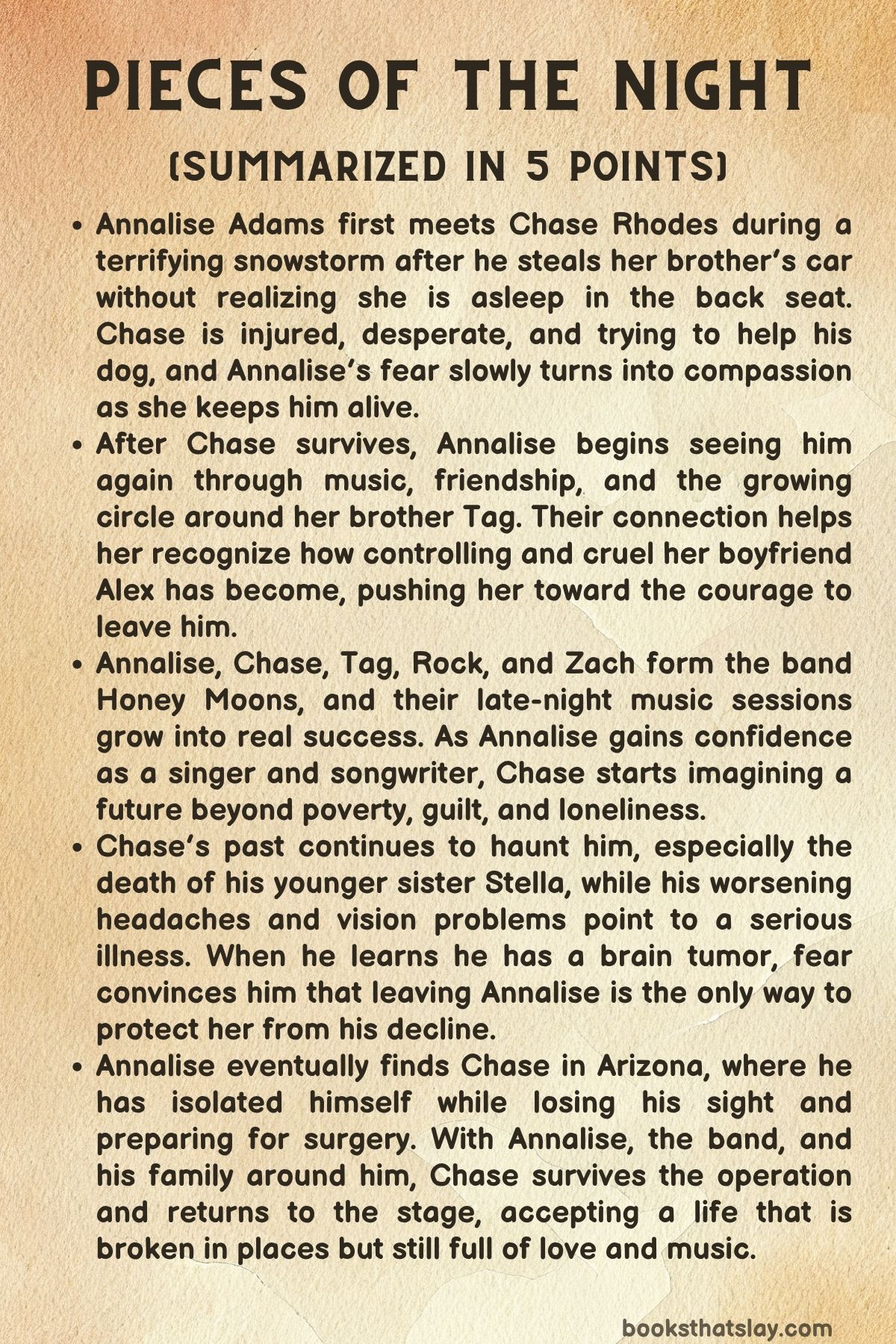
Summary
Annalise Adams begins the story in a bad place emotionally and physically. She is drunk at a bar in Vermont during a snowstorm, trying to escape the tension of her life for a few hours.
Her brother Tag comes to pick her up, worried about her and irritated by the situation, while her boyfriend Alex is angry that she has stayed out so late before an early shift at the restaurant where she works. Annalise’s relationship with Alex already carries the signs of control and resentment.
He expects obedience, makes her feel guilty, and treats her choices like personal offenses. Tag, seeing her intoxicated and emotional, takes away her phone so she will stop texting Alex and making things worse.
On the way home, Tag stops at a gas station and leaves Annalise asleep in the back seat of the car. At the same time, Chase Rhodes enters the gas station in a desperate state.
He is poor, hungry, and trying to steal a can of dog food for his dog, Toaster. The clerk catches him and shoots him in the thigh.
Bleeding and panicked, Chase runs outside and steals Tag’s car without realizing Annalise is sleeping inside. What begins as a desperate act becomes something much more dangerous when Annalise wakes up in the middle of the blizzard and finds a bleeding stranger behind the wheel.
At first, Annalise believes she has been kidnapped. Chase is terrified too, but he quickly explains that he did not know she was in the car and never meant to hurt her.
He refuses to go to the hospital because he is afraid of getting arrested. Annalise, still shaken, realizes that he is badly injured and may die if she does nothing.
As the storm worsens and Chase starts fading, she keeps him talking, tries to understand where he lives, and helps guide the car when he becomes too weak to drive properly. The frightening night forces them into a strange partnership built on survival rather than trust.
When they finally reach Chase’s house, Annalise drags him inside, tends to his wound as best she can, and finds Toaster, the dog Chase was trying to feed. She gives the dog food, cleans up what she can, and calls Alex for help.
She also contacts Tag and convinces him not to press charges. Tag is furious, but Annalise sees that Chase is not a violent criminal.
He is a frightened man who made a desperate mistake. Alex arrives angry and controlling, more concerned with blaming and scolding than with helping.
Eventually Annalise calls an ambulance, and Chase is taken away for surgery. Before she leaves, she writes him a note: “All the best songs have bridges / The strongest ones don’t burn.”
Chase survives. When he returns home after surgery, he finds that his dog has been cared for and his house has been cleaned.
He understands that Annalise kept her promise. Later, Annalise comes back to his house with an injured bird she rescued from the diner, not expecting to find him alive and standing there.
Their reunion is awkward but sincere. Chase apologizes for the terror he caused, and Annalise accepts that his intentions were never cruel.
She invites him to hear her brother Tag play music at a café, planting the first seed of a connection that will grow through songs, guitars, and late-night honesty.
Months pass before Chase shows up at the café. There he meets Kenna, Annalise’s best friend, and eventually Tag.
Tag is naturally distrustful of the man who stole his car with his sister inside, but music opens a door between them. Chase builds guitars, Tag performs, and Annalise writes lyrics and poetry.
The three begin to form a rhythm together, and Chase keeps returning. Around him, Annalise starts to remember parts of herself that Alex has tried to shrink.
She wants to write, sing, and create. Chase notices her talent and encourages it without trying to control it.
Annalise’s life with Alex grows increasingly painful. He is jealous of Chase, cruel at the restaurant, and skilled at making Annalise feel responsible for his anger.
Because they share a long past, Annalise struggles to leave him. She mistakes history for obligation and guilt for loyalty.
But as she spends more time with Chase, Tag, Kenna, and their neighbor Rock, she begins to see what support actually looks like. The group starts having midnight music sessions where Chase plays, Tag performs, Rock joins in, and Annalise writes.
These sessions become a form of emotional shelter, giving everyone a place to be honest.
The music slowly becomes something serious. Chase’s guitar work, Tag’s performance ability, Rock’s energy, Zach’s bass playing, and Annalise’s lyrics come together in a band called Honey Moons.
Annalise’s attraction to Chase grows, but she remains trapped in the emotional remains of her relationship with Alex. After moments of public humiliation, private pain, and repeated confrontations, she finally ends things with Alex.
This decision is not simple for her, but it marks an important change. She chooses herself, her voice, and a future that is not ruled by fear.
Honey Moons begins to gain attention. Chase completes a beautiful custom guitar, and the band performs at The Soundproof.
A video of Annalise singing while Chase plays spreads online, bringing them unexpected recognition. A manager named Crowley takes interest in them, and larger opportunities begin to appear.
The band starts moving from small performances toward a real career. For Annalise, success is tied to confidence.
She becomes more willing to stand in front of people and let them hear her. For Chase, success offers proof that he can build something meaningful instead of merely surviving day to day.
As Annalise and Chase grow closer romantically, Chase’s past becomes harder to ignore. He is haunted by the death of his younger sister Stella.
Her memory is connected to water, music, and the song “Hallelujah,” and her loss has shaped his entire life. Chase carries guilt, grief, and fear inside him.
He loves Annalise, but he is terrified of becoming a source of harm. At the same time, he begins having severe headaches and migraines.
Instead of telling the truth about how bad they are, he hides the symptoms and keeps pushing forward.
The band’s rise becomes intense. They tour, play larger shows, sign deals, and attract fans.
Chase sells guitars and starts imagining a future that once seemed impossible. Annalise grows stronger as both a singer and songwriter.
Yet the pressure of touring, the emotional strain of fame, and Chase’s declining health begin to create cracks. He takes pills and drinks to keep performing, becoming reckless and distant at times.
His love for Annalise is real, but his fear is just as powerful. He wants her close while also believing she would be safer without him.
During the tour, Annalise and Chase become physically involved, deepening their relationship, but Chase’s unresolved trauma keeps returning. Then Tag nearly dies from an overdose or a terrifying hotel-room incident that shakes everyone.
The band keeps going, but the emotional cost is rising. Chase’s symptoms worsen until he collapses onstage during a performance, losing vision and consciousness.
At first, doctors describe it as a complex migraine with fainting, but the truth is more serious. Chase eventually learns he has a brain tumor that is affecting his sight and mind.
The diagnosis pushes Chase into fear and shame. After an intense night with Annalise, he dissociates and sees bruises on her body.
He becomes convinced that he has hurt her or that he will become dangerous to her. Whether his fear is based on confusion, illness, or trauma, it overwhelms him.
Instead of trusting Annalise with the truth, he disappears. He empties his house, takes Toaster, and leaves without giving her a real explanation.
To him, leaving feels like protection. To Annalise, it feels like abandonment.
For six months, Annalise is devastated. Honey Moons continues to exist, but Chase’s absence leaves a deep wound in the band and in her life.
She cannot simply move on because what they shared was not casual or unfinished in her heart. She keeps searching emotionally, even as people around her urge her to let go.
Eventually Tag reveals that he saw Chase and has an address. Annalise follows the lead to Arizona, where Chase has been living in an isolated cabin near his parents.
When Annalise confronts Chase, she sees the truth of his condition. His vision is failing, and he is not the same man who left.
He tells her he disappeared because he could not bear to make her watch him decline. He believed leaving would spare her pain.
Annalise refuses that explanation. She stays, sings to him, and makes it clear that love does not only belong to healthy, easy moments.
Chase breaks down and admits how little he can see. His fear finally meets her refusal to abandon him.
Tag, Kenna, Rock, and Zach arrive at the cabin, turning Chase’s isolation into a temporary home filled with music, humor, care, and familiar chaos. The band begins to reconnect.
Their presence helps Chase face surgery and the possibility that he may lose even more of himself. Annalise also speaks with Chase’s mother, who shares more about Stella and helps her understand the grief that has shaped him.
Chase prepares for surgery to remove the tumor, carrying both fear and hope into the operating room.
During surgery, Chase dreams of Stella. In that dreamlike space, he finally reaches a point of release.
Stella’s memory will always be part of him, but he no longer has to live as though dying with her is the only proof of love. When he wakes, Annalise is there.
He has survived. The moment does not erase the pain, the illness, or the damage caused by his disappearance, but it gives them another chance.
Six months later, Chase is back onstage with Honey Moons. His vision has not fully returned.
He sees the world in fragments, or “pieces,” but those pieces are enough for him to live, love, and play. Annalise remains beside him, not as someone who saved him by force, but as someone who stayed when he stopped believing he deserved it.
The band is together, Toaster is safe, and Chase no longer stands apart from the people who love him. The story closes with music, survival, and a life that is imperfect but still beautiful.
Characters
Annalise Adams
Annalise Adams is the emotional center of the book, a woman whose journey begins in confusion, guilt, and emotional exhaustion but gradually moves toward courage and self-possession. At the start, she is trapped in a relationship with Alex that has taught her to second-guess herself.
She is not weak, but she has been worn down by control, history, and the belief that leaving someone means betraying the past they shared. Her first encounter with Chase is terrifying, yet it also reveals her instinctive compassion.
Even when she has every reason to think of him only as a threat, she sees his desperation, helps him survive, and protects him from harsher consequences. Annalise’s kindness is not passive; it is active, risky, and often stronger than the fear around her.
Her growth is closely tied to music. Through lyrics, poetry, and singing, Annalise finds a voice that Alex tried to minimize.
Chase’s presence does not create her talent, but it helps her recognize it. As Honey Moons takes shape, she moves from being someone who watches others perform to someone willing to stand before an audience and be heard.
Her romance with Chase is powerful because it is rooted not only in attraction, but in recognition. She sees his pain, and he sees her buried strength.
In Pieces of the Night, Annalise becomes a character defined by loyalty, creativity, and emotional bravery. Her choice to follow Chase to Arizona shows that she refuses easy closure, but it also shows that she has learned the difference between being controlled by love and choosing love freely.
Chase Rhodes
Chase Rhodes is one of the most damaged and complex figures in the novel, shaped by poverty, grief, illness, guilt, and a deep fear of harming those he loves. His entrance into the story is chaotic and morally messy.
He steals dog food, gets shot, takes a car, and accidentally terrifies Annalise. Yet the circumstances also reveal his desperation rather than cruelty.
His loyalty to Toaster, his remorse toward Annalise, and his later gratitude show that he is not careless with other people’s pain, even when his choices cause it. Chase is a man living on the edge, but he is also capable of tenderness, craft, and devotion.
His skill as a guitar maker and musician gives him a language for emotions he cannot easily speak. Through music, he connects with Tag, encourages Annalise, and becomes part of a found family.
Still, his past keeps him emotionally guarded. The death of his sister Stella has left him with guilt that shapes his decisions and his self-worth.
When his health begins failing and the brain tumor affects his vision and mind, his worst fears return. Chase believes love means disappearing before he becomes a burden or danger.
His abandonment of Annalise is painful and wrong, but it comes from terror rather than indifference. By the end of the book, Chase’s survival is not only physical.
He survives the belief that he must face suffering alone. His return to the stage, even with fractured vision, shows a man accepting an imperfect life instead of hiding from it.
Tag Adams
Tag Adams is Annalise’s brother, protector, musical partner, and one of the book’s most important emotional anchors. At first, his role appears practical: he picks Annalise up from the bar, worries about her choices, and reacts with understandable anger when Chase steals his car with her inside.
Tag’s distrust of Chase is not unreasonable. He loves his sister and sees the danger before he sees the desperation behind it.
Yet Tag is not a flat protective-brother figure. His connection to music gives him depth, and his gradual bond with Chase shows that he is capable of reconsidering people once he understands them.
Tag’s relationship with Annalise is filled with concern, humor, and shared creative energy. He believes in her talent and becomes part of the environment that allows her to grow.
His place in Honey Moons is essential because he brings performance ability, emotional history, and a sense of family to the band. At the same time, Tag carries his own instability, shown most clearly through the frightening hotel incident that nearly costs him his life.
That moment reveals that the band’s rise is not only exciting; it is dangerous, exhausting, and emotionally heavy. Tag is loving but flawed, protective but vulnerable.
His eventual decision to tell Annalise where Chase is shows that he understands her need for truth. He may not always agree with her choices, but he respects the depth of what she feels.
Alex
Alex represents control disguised as love. He is Annalise’s boyfriend at the beginning of the story, but his behavior quickly shows that their relationship is unhealthy.
He is irritated by her independence, jealous of Chase, cruel in public and private ways, and skilled at making Annalise feel guilty for wanting space, music, or joy outside of him. His presence at Charlie Barker’s adds pressure to Annalise’s daily life because work becomes another place where she must manage his moods.
He does not simply dislike Chase; he dislikes the version of Annalise who begins to exist around Chase, the woman who writes, sings, chooses, and resists being diminished.
Alex is important because he gives shape to Annalise’s internal conflict. She does not leave him immediately because emotional control often works through memory and obligation.
Their long history makes her feel responsible for him, even when he hurts her. He knows how to use that history as a chain.
Through Alex, the book explores how difficult it can be to recognize harm when it comes from someone familiar. His cruelty is not always dramatic, but it is steady and corrosive.
Annalise’s decision to end the relationship is one of her defining moments because it marks the point where she stops confusing guilt with commitment. Alex is not just an obstacle to romance; he is the life Annalise must reject to become herself again.
Kenna
Kenna is Annalise’s best friend and a source of steadiness, humor, and emotional clarity. She enters the story as someone who understands Annalise beyond the surface and offers the kind of friendship that does not require performance.
Kenna’s role is especially important because Annalise is surrounded by intense men: Alex with his control, Tag with his protectiveness, and Chase with his trauma. Kenna gives her a different kind of support, one rooted in loyalty, honesty, and the freedom to be messy without being judged.
She also acts as part of the wider found family that forms around music. Kenna’s presence at the café, her involvement in Annalise’s life, and her later arrival in Arizona show that she is not a fair-weather friend.
She shows up when things are uncomfortable, uncertain, and painful. Her support helps keep Annalise grounded during the months of Chase’s disappearance, when grief and confusion could easily isolate her.
In a story filled with romance and music, Kenna represents friendship as a form of rescue. She may not stand at the center of the band’s fame, but she helps create the emotional safety that allows Annalise to keep going.
Rock
Rock brings warmth, rhythm, and a sense of grounded community to the story. As the neighbor who becomes part of the midnight music sessions and later the drummer for Honey Moons, he helps transform casual creativity into something with structure and momentum.
His character shows how art often grows through shared spaces, ordinary nights, and people who are willing to join before there is any promise of success. Rock does not need to dominate the story to matter.
His steadiness adds balance to the emotional intensity around Annalise, Chase, and Tag.
Within the band, Rock contributes more than musical skill. He becomes part of the chosen family that forms around Annalise and Chase.
His presence during the Arizona section is especially meaningful because it shows that Chase’s connection to the group is not limited to romance. The band members care for him as a person, not only as a guitarist or creative force.
Rock’s humor and reliability help turn Chase’s isolated cabin into a place of life again. In Pieces of the Night, he represents the quiet strength of people who show up, play their part, and help others survive without demanding attention for it.
Zach
Zach becomes the bassist for Honey Moons and helps complete the band’s sound and identity. While he is not as emotionally central as Annalise, Chase, or Tag, his role matters because the band’s success depends on collaboration.
Zach helps move Honey Moons from intimate sessions and local performances into a more complete musical act. He represents the practical reality that dreams need people who can commit, rehearse, travel, and build something together.
His presence also expands the sense of community in the book. Honey Moons is not only a romance backdrop; it is a group of people tied together by ambition, pressure, humor, and care.
Zach’s arrival gives the band more depth and allows Annalise’s growth as a performer to happen inside a real ensemble rather than a private fantasy. When the group later gathers around Chase in Arizona, Zach’s presence confirms that the bond between them has become personal as well as professional.
He is part of the support system that challenges Chase’s isolation and reminds him that he belongs to more than his pain.
Stella Rhodes
Stella Rhodes, Chase’s younger sister, is absent in the present action but deeply present in Chase’s emotional life. Her death is one of the central wounds that shapes him.
Stella is connected to water, music, memory, and the song “Hallelujah,” making her less a distant backstory figure and more a living presence in Chase’s grief. He carries her loss as guilt, and that guilt influences the way he sees himself.
He does not simply miss her; he seems to believe part of him should have remained with her.
Stella’s importance lies in how her memory traps and eventually releases Chase. For much of the novel, he is unable to separate love from suffering.
Losing Stella has taught him that closeness can end in devastation, and this fear affects his relationship with Annalise. When he becomes sick, he reacts through the old pattern of loss, assuming that leaving is better than letting someone watch him break.
During surgery, his dream of Stella becomes a turning point. He does not forget her, but he stops letting grief decide the rest of his life.
Stella remains loved, but Chase finally allows himself to keep living.
Toaster
Toaster, Chase’s dog, may not be human, but he is one of the clearest symbols of Chase’s tenderness and desperation. The entire first crisis begins because Chase is trying to feed him.
That detail matters because it immediately complicates the reader’s understanding of Chase. He commits a crime, but the motive is not greed or malice.
It is care. Toaster reveals that even at his lowest, Chase is still responsible for another living being and willing to risk himself for that bond.
Toaster also becomes part of the emotional bridge between Chase and Annalise. When Annalise feeds him and looks after him while Chase is hospitalized, she is not only helping a dog; she is honoring the one thing Chase was trying to protect.
Later, Toaster remains a sign of home, loyalty, and continuity. When Chase disappears, taking Toaster with him shows both his isolation and his need to keep one source of unconditional love close.
By the end, Toaster’s safety reinforces the sense that Chase has not lost everything. He still has love, companionship, and a place in the world.
Themes
Love as a Choice to Stay
Love in this story is measured less by grand declarations than by the decision to remain present when circumstances become frightening, inconvenient, or painful. Annalise’s connection with Chase begins in danger, but her compassion during that first night sets the emotional pattern for much of the novel.
She chooses to see his humanity even after he has terrified her. Later, Chase’s feelings for Annalise are intense, but his fear twists love into absence.
He believes disappearing will protect her from his illness and instability, yet the story challenges that belief. Real love is not proven by making decisions for someone else.
It requires honesty, consent, and the courage to let another person choose the hard road with open eyes. Annalise’s journey to Arizona becomes a powerful expression of this theme because she refuses a version of love that excludes her from the truth.
She does not stay because Chase is easy to love; she stays because love, for her, includes the broken parts he wants to hide. The theme is not about romantic sacrifice without limits.
It is about love becoming mature enough to face fear directly, rather than running from it.
Music as Survival and Self-Expression
Music functions as a lifeline throughout Pieces of the Night, giving the characters a way to say what ordinary conversation cannot hold. For Annalise, writing lyrics and singing help her recover a sense of identity that has been buried under Alex’s control and her own guilt.
Her voice becomes more than a talent; it becomes proof that she still exists outside the roles other people have forced on her. For Chase, guitars and songs offer a language for grief, desire, memory, and fear.
Building guitars is his way of creating beauty with his hands, while performing allows him to connect even when he struggles to speak honestly. Tag, Rock, and Zach also help show music as a communal force.
The midnight sessions begin as informal gatherings, but they become a place where loneliness softens and damaged people find rhythm together. As Honey Moons grows successful, music brings opportunity, but it also brings pressure.
The novel does not treat art as a simple cure. Instead, music becomes a way to endure pain, express truth, and build a family strong enough to stand through illness, fame, and heartbreak.
The Damage Caused by Control and Guilt
Annalise’s relationship with Alex shows how control can become normalized when it is tied to shared history. Alex does not need to physically trap her to make her feel confined.
He uses anger, jealousy, humiliation, and guilt to make her doubt her own needs. Because they have a past together, Annalise feels responsible for his feelings and hesitant to hurt him by leaving.
This emotional pattern is one of the most realistic sources of conflict in the novel. The story shows that unhealthy relationships are not always easy to exit because memory can act like a chain.
Alex’s treatment of Annalise becomes especially harmful because it attacks her confidence. He resents her growth, her music, her friendship with Chase, and the parts of herself that begin to shine without his permission.
Her eventual decision to leave him is not only a romantic turning point; it is an act of self-rescue. By walking away, Annalise stops treating guilt as proof of love.
The theme reaches beyond Alex as well, because Chase also makes damaging choices from guilt. Both storylines show that guilt can distort love unless it is faced honestly.
Grief, Illness, and the Fear of Becoming a Burden
Chase’s emotional life is shaped by two connected fears: the grief of losing Stella and the terror that his own illness will destroy the people who love him. His brain tumor threatens his sight, his mind, his career, and his sense of self.
Rather than letting others stand beside him, he withdraws because he believes decline will make him unworthy or dangerous. This response is painful, but it grows from a recognizable fear: the fear of being watched while falling apart.
The novel treats illness not only as a medical crisis, but as an identity crisis. Chase has to face the possibility that he may never see clearly again, may never perform the same way, and may need help in ways that frighten him.
His grief over Stella intensifies this fear because he already associates love with loss. The surgery sequence becomes emotionally important because it allows him to release the idea that loyalty to the dead requires punishment of the living.
By surviving, even with partial vision, Chase learns that a damaged future is still a future. The theme suggests that needing care does not make a person less worthy of love.