Permanence by Sophie Mackintosh Summary, Characters and Themes
Permanence by Sophie Mackintosh is a speculative literary novel about love, fantasy, guilt, and the dangerous wish to make an affair feel like a complete life. The story follows Clara and Francis, two lovers who are given access to a mysterious city where their hidden relationship can exist openly.
At first, the place seems to offer everything their real lives deny them: privacy, beauty, domestic closeness, and the illusion of freedom. Yet the city also exposes what their love depends on, what it destroys, and what neither of them can escape. The novel becomes a study of desire facing reality.
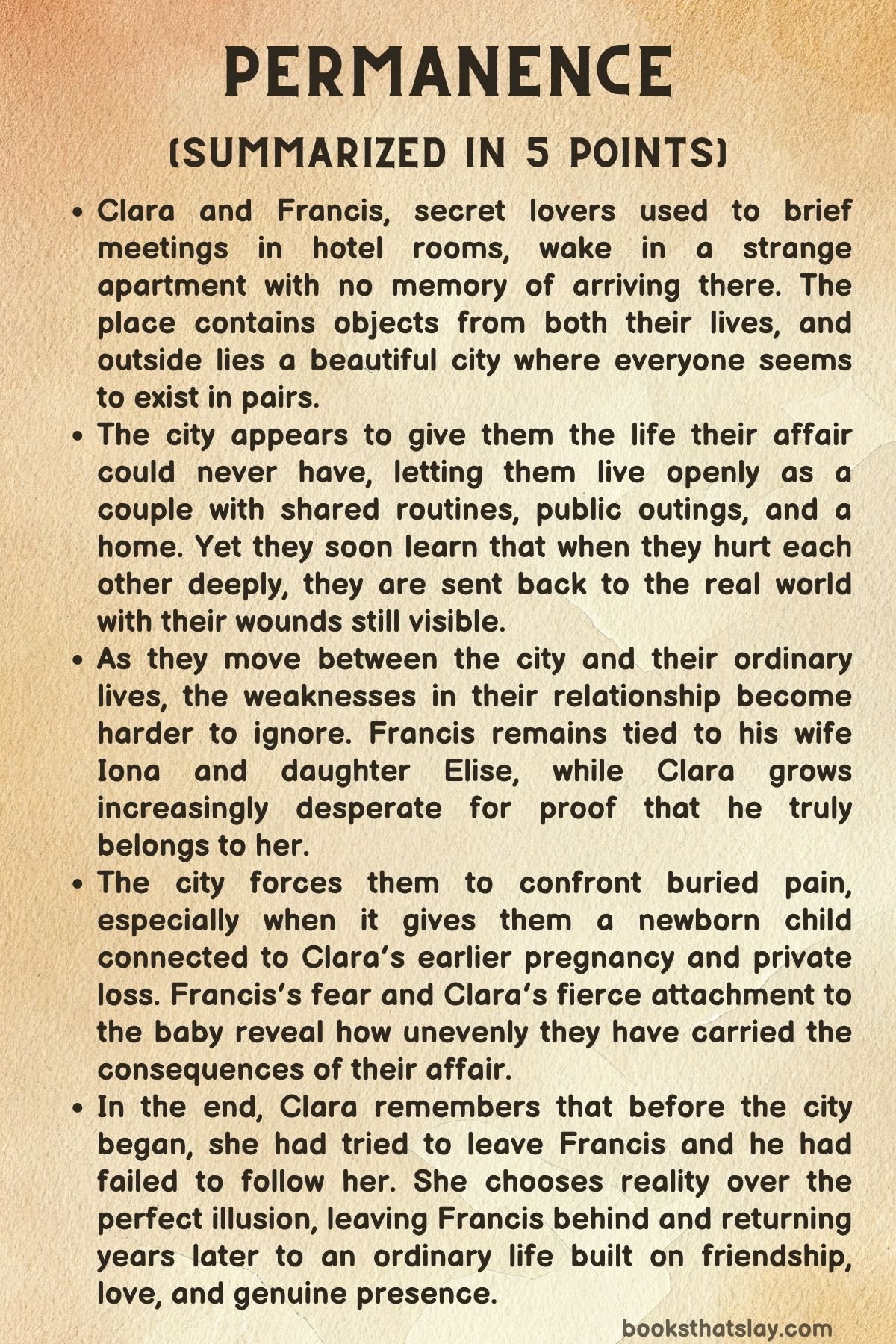
Summary
Clara and Francis wake together in an apartment neither of them recognizes. For Clara, the first shock is not only the unfamiliar room but the fact that she has woken beside Francis at all.
Their relationship has always belonged to hotel rooms, stolen afternoons, messages, absences, and secrecy. Francis is married, with a wife named Iona and a daughter named Elise, and Clara has never been part of his morning life.
Now, suddenly, they are in a shared bed, in a home that seems to contain traces of both of them. Their books are there, along with clothes, toiletries, kitchen objects, and details from their separate lives, as if someone has assembled a domestic future out of their private longing.
Outside the apartment lies a beautiful unnamed city. It has balconies, fountains, cafes, music, markets, museums, rivers, hills, beaches, and streets full of people who appear to exist in couples.
The city feels strangely complete and strangely sealed. Clara is quickly drawn to its beauty and to the possibility that it has given her and Francis what they could never have in the real world.
Francis, however, is frightened. There are no phones, no maps, no dates, and no explanation.
When they try to leave, they discover that the city is surrounded by scorched red earth and a ring of dark water. There seems to be no road out and no other world nearby.
They are trapped, but Clara feels the trap as a gift before she feels it as a danger.
The story then returns to the beginning of their affair. Eighteen months earlier, Clara met Francis in a museum in front of a seventeenth-century painting called “Still Life with Cherries and Mouse.” Francis was older, polished, married, and magnetic.
Clara followed him through the museum rooms, and their attraction began with very few words. He belonged to a family life with Iona and Elise, while Clara lived with her friend Arturo and waited for signs from him.
Their relationship was intense but uneven from the start. Francis could come and go according to the demands of his marriage, while Clara had to live inside waiting.
Because they could not keep ordinary proof of each other, Clara collected small objects connected to him: scent strips of his cologne, a pencil, a button, a hotel key card. These relics gave shape to a love that had no official place.
In the mysterious city, Clara and Francis begin to live as though their affair has been transformed into a real partnership. Gold coins appear in their pockets, and the city seems to provide food, clothing, and objects whenever they need them.
They explore markets, cafes, museums, streets, the metro, the shore, and the hills. They find a version of the museum painting that once marked the beginning of their affair, but it has been altered, as if the city has absorbed and rearranged their history.
At first, the place appears almost perfect. They buy flowers, take pictures in a photo booth, drink coffee in bed, cook together, walk in public, and call the apartment home.
What was once hidden can now be displayed. What was once temporary can now be repeated.
Yet the city is not simply a paradise. It has rules, and those rules reveal themselves through pain.
When Clara and Francis harm each other badly enough, they are sent back to the real world. The first return is terrifying.
Clara wakes alone in her own bed, while Francis wakes beside Iona and accidentally says Clara’s name. No time has passed in ordinary life, but the wounds they received in the city remain on their bodies.
This proves that the city is not merely a dream, yet it also proves that their actions there have consequences. The city allows them to live out their desire, but it also records the damage they do to each other.
After days of misery and longing, Clara and Francis return to the apartment. Clara then begins to understand that other couples also live this double existence.
At a party, she meets Lili, who explains that everyone in the city has an “other,” and that serious harm crosses a threshold. When that threshold is crossed, the city marks the lovers with wounds and sends them back.
Some couples have been moving between the city and the real world for years. This gives Clara a sense of belonging, because her impossible situation is not unique.
It also suggests that the city feeds on patterns of attachment, injury, return, and forgiveness.
As Clara and Francis settle into their second life, the city becomes less like a holiday and more like a domestic arrangement. Their gold coins run out, so they take jobs as gardeners in a boating park.
They buy groceries, tend plants, clean, make routines, and try to sustain happiness through ordinary habits. Clara is drawn to Paula, who introduces her to a devotional circle centered on preserving love through forgiveness, attention, and presence.
Clara wants to believe in this discipline. She wants the city to be not only a magical refuge but a permanent proof that Francis belongs with her.
Francis joins the circle, but he remains more divided. He misses Elise.
He feels guilt toward Iona. He cannot give himself to the city as fully as Clara wants him to.
The imbalance between them grows sharper. Francis has a family elsewhere, while Clara has built much of her emotional life around him.
Clara wants certainty, but Francis’s life is built on withholding it. In a rowboat, their conflict becomes cruel.
Francis calls Clara childish, selfish, and lazy, while Clara strikes back by speaking about his family. Their words injure deeply enough to send them back to the real world.
Once again, they suffer through separation until they return, but the city has changed. Its brightness has dimmed.
The sky is gray, cafes have vanished, buildings are decaying, and gaps covered with tarpaulin appear where structures once stood. Their private damage has begun to appear in the world around them.
The city continues to reflect their instability. At another party, Francis becomes jealous of Clara’s ease with other people and accidentally says Iona’s name.
Later, at a nightclub, while high and unsteady, he nearly kisses a waitress. His wound bleeds badly, and the trust between him and Clara weakens further.
The place that once seemed to free them now makes their fears visible. Clara fears that Francis will never choose her completely.
Francis fears that Clara’s demand for total possession will erase the parts of his life he cannot abandon. Their love depends on escape, but the city keeps forcing them to face what escape cannot solve.
Then the city gives them a child. Clara and Francis wake to find a newborn boy in a bassinet.
Clara instinctively nurses him and responds with immediate tenderness, while Francis recoils and insists the baby is not real. The child is connected to Clara’s earlier pregnancy, which she ended alone while Francis remained with his family.
This event brings one of the deepest hidden wounds of their affair into physical form. For one day, Clara cares for the baby in a city that has emptied around them.
She loves him fiercely, while Francis remains horrified and distant. The baby represents not only a lost possibility but also the unequal cost of the relationship.
Clara carried the consequences in her body and in silence, while Francis was able to return to his established life.
When they return to the real world after the baby’s appearance, something in Clara begins to change. Francis grieves the child, but Clara starts loosening herself from him.
She goes dancing with Arturo and sleeps with a man who smells of woodsmoke. This act is not presented simply as revenge.
It is also a sign that Clara is recovering a life outside Francis’s orbit. Francis, meanwhile, retreats into family life with Iona and Elise, but he cannot stop longing for Clara and for the city.
When Clara and Francis meet again in the city, Clara confesses that she slept with someone else. Francis is furious, even though his entire life with Clara has existed alongside his marriage.
Clara points out the unfairness of his anger. He has always had a wife, a child, a house, and a public identity, while she has been asked to accept secrecy and fragments.
Their argument becomes brutal. He accuses her of selfishness and betrayal; she accuses him of keeping her hidden and giving her less than a real life.
They apologize and make love, but the city marks them again and sends them back.
This return lasts much longer. Clara tries to live in the ordinary world.
She eats, walks, draws, works, spends time with Arturo, and begins to experience the real city as something that may still hold her. Francis becomes ill, takes care of Elise, faces Iona’s growing awareness, and visits the museum painting alone.
Both continue to think about the city and believe they would do anything to return, yet the distance between them has altered. Their longing remains, but it is no longer innocent.
It carries memory, harm, guilt, and the knowledge that their paradise has always required denial.
At last, they wake in the city again. This time it is restored, bright, and festive.
A parade moves through the streets toward the shore, and Clara and Francis share what becomes their final day there. They go to dinner at the same restaurant they visited early in their time in the city.
During the meal, Clara remembers what happened before their first awakening. She had been leaving Francis in a hotel, ending the affair, and he had failed to follow her.
Francis remembers too. This revelation changes the meaning of the city.
It was not simply a gift given to lovers. It was born from the moment when Clara was trying to leave and Francis did not choose her.
Francis begs Clara to stay, calling the city their paradise. But Clara now understands that a life built from longing is not the same as a life that can endure.
She says she wants what is real. As she chooses to leave, the city collapses around them.
Lights fail, the fountain crumbles, streets split, rain pours in, and Clara receives the final wound. Francis kisses her desperately, but she is already gone.
The city cannot survive her refusal to keep mistaking fantasy for truth.
Years later, Clara returns to the museum. She has not seen Francis again, though traces of him and the city still haunt certain streets, tastes, seas, and rooms.
She has discarded most of the relics she once kept, and the painting remains as the central object of memory. For a moment, she mistakes a stranger for Francis and feels the old pull.
Then she turns away. In the next room, Arturo, his partner, their child, friends, and a man who is now part of Clara’s life are waiting.
Clara joins them and takes the child’s balloon, stepping back into an ordinary shared life. The ending suggests that what lasts is not the impossible city or the affair that tried to become a world, but the life Clara chooses after she stops asking fantasy to save her.
Characters
Clara
Clara is the emotional center of the book and the character whose movement gives Permanence its deepest force. At the beginning, she is defined by longing, secrecy, and the painful discipline of waiting.
Her affair with Francis has trained her to accept fragments: messages, hotel rooms, private signs, and small objects that stand in for a relationship she cannot openly claim. The mysterious city seduces her because it offers the thing she has been denied, not only Francis’s presence but a public and domestic life with him.
Clara wants to turn desire into proof, and the city seems to answer that wish by giving her an apartment, shared routines, and the appearance of belonging. Yet Clara is not simply naive.
Her longing is mixed with anger, intelligence, and an increasing awareness of imbalance. She understands, slowly and painfully, that Francis’s divided life allows him to enjoy both secrecy and safety, while she is left building meaning out of absence.
The child given by the city is especially important for her because it brings her private loss into visible form. Her earlier pregnancy and lonely abortion reveal how much of the affair’s cost fell on her body and her silence.
By the end, Clara’s choice to leave the city is not a rejection of love itself but a refusal to keep treating fantasy as justice. She becomes someone capable of grief without surrendering her future to it.
Francis
Francis is a polished, magnetic, and deeply divided figure in the novel. He draws Clara in through charm, elegance, and an aura of controlled mystery, but his appeal is tied to the very life that makes him unavailable.
He has a wife, Iona, and a daughter, Elise, and his attachment to them is not false even when he betrays them. This makes him more complex than a simple villain.
He genuinely longs for Clara, and the city tempts him because it offers a version of himself unburdened by the consequences of marriage, fatherhood, and guilt. Still, Francis repeatedly resists the full implications of the world he has entered.
He wants Clara, but he also wants his family to remain intact somewhere else. He wants the city’s pleasures, but not its demands.
His fear of the newborn child reveals the limits of his romantic fantasy. When the city produces a baby connected to Clara’s lost pregnancy, Francis recoils because the child turns hidden harm into undeniable reality.
His jealousy after Clara sleeps with another man also exposes his double standard. He expects loyalty from Clara while having built their entire relationship on disloyalty to Iona.
Francis’s tragedy lies in his inability to choose with courage. He loves Clara, but he loves escape too, and the book shows how destructive that combination becomes.
Iona
Iona exists mostly outside Clara and Francis’s magical city, but her presence shapes the moral pressure of the story. She is not merely an obstacle to the lovers.
She represents the life Francis has already made, the commitments he cannot erase, and the human cost hidden behind his romance with Clara. Because the reader sees her largely through the edges of Francis’s divided existence, she can seem distant at first.
Yet that distance is meaningful. It mirrors how Clara tries not to think too fully about the woman whose life is being damaged by the affair.
Iona’s importance grows when Francis returns to the real world and accidentally speaks Clara’s name beside her. That moment cracks the boundary between his secret life and his marriage.
Iona’s confrontation of Francis later suggests that she is not blind to his absence, illness, guilt, and emotional withdrawal. Her character gives the story an ethical weight that the city cannot dissolve.
She reminds the reader that romantic intensity does not cancel responsibility. Even when she is not present in the city, she stands as a living claim on Francis, and her existence prevents his relationship with Clara from becoming an uncomplicated fantasy.
Elise
Elise, Francis’s daughter, is one of the quietest but most important figures in the book because she embodies the innocence affected by adult desire. Francis misses her when he is in the city, and that longing reveals that his family life is not just a social arrangement or a burden.
He loves his daughter, and this love complicates every attempt to imagine a clean escape with Clara. Elise also exposes the difference between Clara’s and Francis’s positions.
Francis has a child in the real world, while Clara’s possible child was lost in solitude and secrecy. When the city gives Clara and Francis a newborn boy, Elise’s existence becomes part of the emotional contrast.
Francis can be tender toward the daughter he recognizes as real, but he recoils from the mysterious child connected to Clara’s pain. Elise does not need to appear often to matter.
Her presence makes Francis’s guilt concrete and prevents the story from treating the affair as though it affects only the lovers. She represents continuity, dependence, and the ordinary responsibilities that fantasy cannot simply cancel.
Arturo
Arturo is Clara’s friend and one of the main figures connecting her to the real world. He offers a form of care that is less dramatic than Francis’s love but far steadier.
Clara lives with him before and around the affair, and his presence suggests that she has a life outside waiting, even when she struggles to value it. Arturo is important because he helps reveal what Clara has been neglecting in herself.
Francis pulls her toward secrecy and intensity, while Arturo belongs to friendship, daily care, social life, and ordinary continuity. When Clara goes dancing with him after the episode with the baby, the scene marks a shift in her emotional direction.
She begins to return to her body, her city, and her own choices. Arturo does not replace Francis as an object of obsession; instead, he helps create the conditions in which Clara can stop organizing her life around Francis.
In the ending, Arturo appears with his partner, their child, friends, and the man who is now part of Clara’s life. This final placement matters.
Arturo is part of the wider human world Clara rejoins after leaving behind the impossible city. He represents friendship as a form of rescue, not through grand speeches, but through presence.
Lili
Lili acts as a guide to the city’s hidden logic. When Clara meets her at a party, Lili explains that everyone there has an “other” and that the city sends people back to the real world when harm crosses a certain threshold.
Her role is partly practical because she gives Clara information that helps her understand the place. More importantly, Lili shows that Clara and Francis are not special in the way Clara may want to believe.
The city contains many couples caught in similar cycles of longing, injury, return, and attempted repair. Lili’s knowledge makes the city feel less like a private miracle and more like a system.
She also challenges the romantic idea that Clara and Francis’s situation is unique enough to be exempt from ordinary consequences. Through Lili, the story suggests that many people want love to exist outside time, duty, and moral cost.
Her presence widens the meaning of the city, turning it from a personal fantasy into a strange community built around repeated emotional patterns.
Paula
Paula introduces Clara to the devotional circle that focuses on preserving love through forgiveness, presence, and commitment. She represents one possible response to the city’s strange conditions: instead of questioning the place, she turns love into a practice that must be maintained through discipline.
For Clara, Paula’s circle is attractive because it offers a language for making the city feel stable. If love can be preserved through enough attention and forgiveness, then Clara might be able to keep Francis and turn their fragile arrangement into something lasting.
Yet Paula’s influence is also unsettling. The circle risks treating endurance as a virtue even when the relationship itself is causing harm.
Clara’s attraction to Paula’s ideas reveals her desperation to believe that devotion can overcome imbalance. Francis’s weaker commitment to the circle shows how differently the two lovers understand their situation.
Paula is not simply wrong; her belief in presence and forgiveness has real emotional power. But the book also questions whether forgiveness becomes dangerous when it asks one person to accept less than the truth.
The Child
The newborn boy given to Clara and Francis by the city is less a conventional character than a living manifestation of buried grief. His sudden appearance forces the lovers to confront the pregnancy Clara once ended alone.
For Clara, the baby is immediately real in feeling, even if his origin is impossible. She nurses him, protects him, and loves him with an intensity that comes from both maternal instinct and unresolved mourning.
For Francis, the child is terrifying because he cannot place him within the boundaries of his existing life. The baby demands recognition of a consequence Francis avoided.
He is connected to the future Clara and Francis never had, the loss Clara carried privately, and the unequal emotional burden of the affair. The child’s brief presence changes Clara more than almost anything else in Permanence.
After him, she begins to separate herself from Francis because she can no longer ignore what their love has required her to bear. The baby reveals that fantasy cannot undo harm; it can only give harm a form that must finally be seen.
The Waitress
The waitress Francis nearly kisses at the nightclub has a small role, but she is important because she exposes how unstable his devotion to Clara can be. The moment occurs in the city, the very place that is supposed to prove his love for Clara and give their relationship the freedom it lacks in real life.
His attraction to someone else there weakens Clara’s belief that the city guarantees fidelity or truth. It also reveals that Francis’s restlessness is not only caused by marriage or secrecy.
Even inside the fantasy space, he can drift, desire, and betray. The waitress therefore functions as a brief but sharp test of the lovers’ assumptions.
If Francis can almost repeat betrayal in the place built for Clara, then the problem is not only the outside world. The problem lies within his character and within the fragile foundation of the relationship itself.
Themes
Fantasy as a Shelter from Consequence
The city in Permanence gives Clara and Francis the life their affair cannot have in the real world, but it does so by creating a shelter from ordinary consequence rather than a true solution. In the city, they can wake together, walk in public, buy flowers, cook meals, and behave like a recognized couple.
These acts feel powerful because they are exactly what their hidden relationship has denied them. Yet the city’s beauty depends on removal.
Iona, Elise, social judgment, time, and practical responsibility are kept at a distance, at least at first. The lovers mistake this distance for freedom.
As the city begins to decay, it becomes clear that a fantasy world cannot remain untouched by the emotional truth of the people living inside it. Every cruel argument, every jealousy, every avoided responsibility leaves a mark.
The city promises escape, but it also becomes a mirror. It shows that consequence can be delayed or disguised, but not abolished.
Clara’s final rejection of the city matters because she recognizes that a beautiful unreality is still unreality. What she needs is not a perfect stage for desire, but a life that can survive truth.
Love, Possession, and the Hunger for Proof
Clara’s love for Francis is shaped by the constant need for proof. Because their affair has no public status, she turns small objects into evidence: a scent strip, a pencil, a button, a hotel key card.
These things matter because Francis himself is so often absent. The city appears to answer that hunger by providing larger proof: an apartment, shared routines, public togetherness, even a child.
Yet the more proof Clara receives, the more she senses its instability. Francis can live with her there, but he still belongs elsewhere.
He can call the apartment home, but he still misses Elise and feels tied to Iona. The story shows how possession can grow out of insecurity.
Clara does not simply want Francis’s affection; she wants certainty that he has chosen her fully. Francis, however, wants Clara without surrendering the rest of his life.
This creates a painful conflict between love as devotion and love as ownership. The novel does not mock Clara’s need for proof, because her insecurity has real causes.
Still, it shows that no object, city, ritual, or repeated return can make a divided love whole if one person refuses the cost of choosing.
The Unequal Cost of an Affair
The affair between Clara and Francis is not equal, even when their feelings appear mutual. Francis has a wife, a daughter, a home, and a socially recognized identity.
Clara has secrecy, waiting, and the emotional labor of making fragments feel meaningful. This imbalance shapes almost every conflict between them.
Francis can feel guilty and still return to family life. Clara must live with the absence he leaves behind.
The pregnancy Clara ended alone is the clearest example of this unequal cost. It shows that the consequences of the affair were not abstract; they entered her body, her future, and her grief.
When the city gives them the newborn boy, it forces Francis to face what Clara has already carried. His horror reveals how protected he has been from the full reality of their relationship.
His anger after Clara sleeps with another man further exposes the imbalance. He expects a loyalty that his own life has never offered her.
Through this dynamic, the story examines how romantic intensity can hide unfairness. Love may be real, but real feeling does not erase unequal sacrifice.
Clara’s growth depends on seeing that being loved in secret is not the same as being chosen.
Choosing Reality over the Perfect Illusion
Clara’s final decision is powerful because it does not come from a lack of feeling. She still loves Francis, and the city still holds memories of beauty, desire, and imagined domestic happiness.
Her choice to leave is painful precisely because the illusion has given her things she genuinely wanted. Yet by the end, Clara understands that the city began at the moment she tried to end the affair and Francis failed to follow.
This memory changes everything. The city is not proof that Francis chose her; it is a suspended answer to the fact that he did not.
Staying would mean accepting a world built to cover over that failure. Clara’s desire for what is real is not a simple preference for ordinary life over wonder.
It is an ethical and emotional awakening. Reality includes loss, aging, imperfect relationships, friendship, work, and the absence of magical repair.
But it also includes genuine choice. In the final museum scene, Clara turns away from the old pull and joins Arturo, friends, a child, and a new partner.
The ordinary world is not presented as lesser. It is where life can be shared without needing to be hidden, invented, or defended against the truth.