Poverty, by America Summary, Analysis and Themes
Poverty, By America by Matthew Desmond offers a deep and thought-provoking analysis of the systemic issues surrounding poverty in the United States. Through his personal experiences and extensive research, Desmond explores the structural problems that perpetuate poverty in a nation of immense wealth.
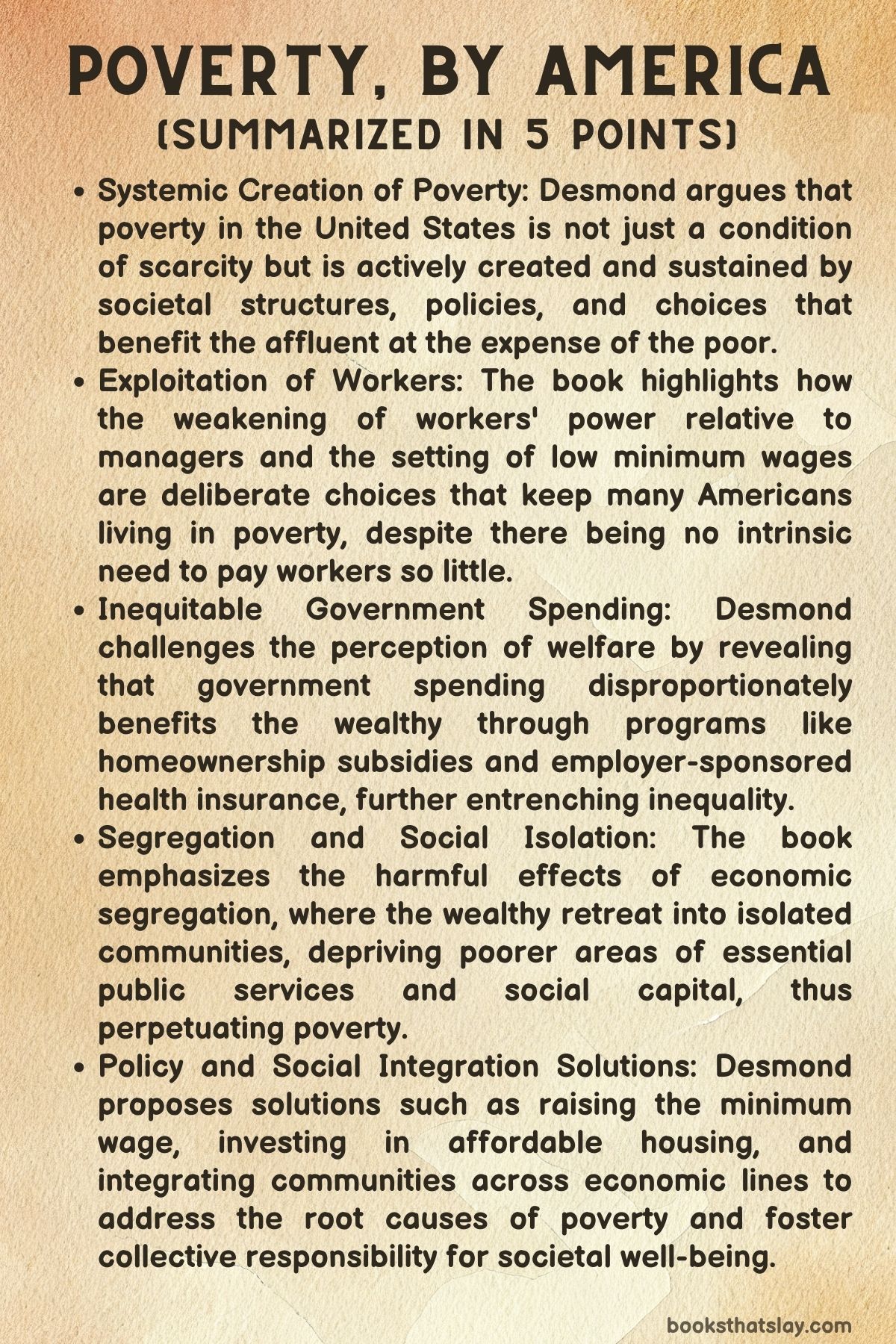
The book sheds light on the lives of low-income Americans, drawing attention to the stark disparities in wages, healthcare, housing, and racial inequality. Desmond argues that poverty is not merely a result of personal failure or bad luck, but a product of policies and structures that disproportionately benefit the wealthy at the expense of the poor. It challenges readers to rethink the notion of scarcity and consider how a more equitable society could be achieved.
Summary
Matthew Desmond opens Poverty By America with reflections from his own life, growing up in Winslow, Arizona, where he was raised in a modest home as the son of a pastor. Despite his father’s education and efforts to provide for the family, they faced significant financial struggles, culminating in the loss of their home.
This experience became the catalyst for Desmond’s lifelong exploration of poverty in America. Throughout his academic and professional career, Desmond has studied poverty’s deeply ingrained roots, observing firsthand the challenges faced by low-income individuals and families.
Desmond notes that, despite the United States being one of the wealthiest nations in the world, it has a poverty rate higher than other developed countries. Millions of Americans struggle to meet basic needs, with a significant number of children living in poverty and many families facing homelessness.
The paradox of poverty in a rich country persists, revealing a deeper, structural issue beyond simple resource scarcity. Desmond argues that poverty in America is not merely about a lack of money but involves physical and emotional tolls, such as trauma, instability, and physical pain.
One example Desmond shares is that of Crystal Mayberry, a young woman who, after aging out of the foster care system, faced homelessness and poverty, struggling to survive on a limited income. Her story highlights the cyclical nature of poverty, where inadequate housing, limited access to social services, and mental and physical strain further entrench people in their hardships.
This experience reflects the broader struggles many poor Americans face, from eviction to the lack of affordable healthcare, low-wage jobs, and poor working conditions.
The book discusses the systemic issues that contribute to poverty, such as inadequate healthcare, exploitative low-paying jobs, and insufficient wages. Desmond points out that many of these low-wage jobs are physically demanding and unsafe.
Furthermore, the rise of gig work and temporary employment opportunities has only worsened the instability faced by workers, leaving them with little to no benefits or long-term security. The high cost of housing exacerbates this issue, with many working families spending a disproportionate amount of their income on rent, leading to evictions and homelessness.
A key issue discussed is racial inequality in poverty. Black and Hispanic Americans experience higher rates of poverty compared to their white counterparts, a disparity rooted in centuries of systemic racism.
The book emphasizes the significant wealth gap between Black and white households, with Black families owning far less wealth on average. This disparity is exacerbated by discriminatory policies that restrict access to employment, education, and housing opportunities for people of color.
Desmond also explores the role of government programs designed to alleviate poverty, such as welfare, Medicaid, and unemployment insurance. However, he argues that these programs are often inefficient, underfunded, or poorly managed, preventing many from receiving the help they need.
Welfare reform in the 1990s led to a shift from direct aid to the poor, reducing the overall impact of such programs. Additionally, many individuals who are eligible for assistance do not apply for benefits due to a lack of awareness or bureaucratic obstacles, further perpetuating their struggles.
The persistence of poverty in America, despite technological advances and growing national wealth, raises the question of why it persists. Desmond challenges the notion that poverty is simply a result of personal failure or bad luck, arguing instead that it is a structural problem rooted in policies that favor the wealthy.
He points out that large corporations and the wealthiest Americans profit from exploiting workers, especially in industries where wages are stagnant, and job security is minimal. This has resulted in a system where corporate profits rise as labor costs decrease, leaving workers to bear the brunt of the economic imbalance.
One notable issue discussed in the book is the exploitation of workers, particularly in low-wage industries. Desmond describes how companies like Walmart rely on government assistance programs, such as the Earned Income Tax Credit (EITC), to supplement their employees’ low wages, while benefiting from lower labor costs.
However, this system ultimately advantages corporations more than workers, and the growing wealth disparity between the rich and the poor continues to widen.
The housing market is another area where exploitation is evident. Desmond describes how landlords in poorer neighborhoods profit from charging high rents for substandard housing.
In contrast, landlords in wealthier areas can charge lower rents due to better-quality housing. The lack of affordable housing options further exacerbates poverty, and government policies have often failed to address these systemic issues, leaving the poor to endure exploitative conditions.
Another example of exploitation is the payday loan industry, which targets vulnerable individuals with high fees and interest rates. Many low-income individuals rely on these financial services, which often trap them in cycles of debt, further deepening their poverty.
The book argues that such practices are allowed to persist because they benefit the financial system at the expense of the poor.
Desmond also addresses the issue of economic inequality and how it is perpetuated by the privatization of public goods. As public services like healthcare, education, and housing become increasingly privatized, the wealthy are able to afford the best services, while the poor are left with deteriorating public options.
This growing divide between the rich and the poor leads to a system where the wealthy continue to benefit from tax breaks and subsidies, while the poor remain dependent on insufficient public assistance programs.
The book concludes by calling for a shift in mindset and policy to address poverty. Desmond challenges the “scarcity mindset” that has shaped much of American society, where people believe that resources are limited and must be hoarded, leading to resistance against policies aimed at addressing poverty and inequality.
He argues for a shift toward an economy of abundance, where resources are shared, and everyone has access to the necessities of life. This would require a political movement supported by workers, the poor, and allies from all sectors of society to demand systemic changes, including a living wage, affordable housing, healthcare, and the dismantling of racial segregation.
Desmond envisions a society without poverty as one that would provide greater fairness, security, and opportunity for all. While it would not eliminate all inequality, it would significantly reduce the gap between the rich and the poor.
Achieving this goal would require collective action and political will, but the transformation it could bring would be profound, creating a more just and equitable society for all.
Key People
Matthew Desmond
Matthew Desmond, the author of Poverty By America, serves as both the narrator and a central figure throughout the book. Desmond’s journey into understanding poverty is deeply personal, beginning with his own childhood in Winslow, Arizona, where he witnessed his family’s struggle to make ends meet despite his father’s educational background and hard work.
This early exposure to economic hardship shaped his view of the world, leading him to explore the pervasive issue of poverty throughout his adult life. As a journalist and researcher, Desmond’s empathy for the poor is evident in his portrayal of the systemic issues that perpetuate poverty.
He doesn’t view poverty as an individual failure but as a complex societal issue rooted in deep-seated economic and political structures that benefit the wealthy. His character is one of introspection and dedication to uncovering the truths about inequality, particularly how institutions and policies continue to maintain a divide between the affluent and the poor.
Desmond’s personal experiences with poverty in his youth and his academic pursuits provide him with the lens to critique the broader issues of wealth inequality in America.
Crystal Mayberry
Crystal Mayberry, a young woman featured in Poverty By America, represents the harsh reality many individuals face as they transition out of the foster care system. Her story encapsulates the cycle of instability that many poor Americans experience, struggling with homelessness, poverty, and limited opportunities.
After aging out of the foster care system, Crystal finds herself battling not only financial difficulties but also a lack of adequate housing and social support. Her experiences highlight the psychological and physical toll that living in poverty can take, demonstrating how systemic failures in housing, healthcare, and social services perpetuate her situation.
Crystal’s character is symbolic of the broader struggles that many young people, especially those from marginalized backgrounds, endure as they try to navigate adulthood in an unforgiving and unstable economic system. Her story illustrates the cyclical nature of poverty, where access to basic needs and stability is a constant battle, pushing individuals further away from the opportunity to escape their circumstances.
Low-Wage Workers
The low-wage workers in Poverty By America are a collective group that the author frequently references to illustrate the systemic issues that contribute to poverty in the United States. These individuals work in physically demanding jobs, often in unsafe conditions, for wages that do not meet the cost of living.
Their daily struggle is compounded by the instability of gig work and temporary positions, which lack benefits and job security. Despite working full-time, many of these workers rely on government assistance programs like food stamps, Medicaid, and the Earned Income Tax Credit (EITC) just to survive.
The story of these workers reveals the exploitation in American labor markets, where the value workers provide to corporations is often far greater than what they are compensated for. These individuals represent the broader working-class population that is caught in a cycle of poverty despite contributing significantly to the economy.
Their character serves as a reflection of the exploitation faced by low-income workers and the persistent inequality within the American economic system, where corporations profit by keeping wages low while employees struggle to make ends meet.
Black and Hispanic Americans
The Black and Hispanic communities in Poverty By America are portrayed as facing a unique set of challenges in the fight against poverty. These groups experience higher poverty rates compared to their white counterparts, largely due to systemic racism that has historically and continues to disadvantage them in areas such as education, housing, and employment.
The character of Black and Hispanic Americans in the book is crucial in understanding the intersectionality of race and poverty. Desmond outlines how these racial disparities in wealth and access to resources create compounded disadvantages, especially for Black Americans, who face a significant wealth gap compared to white Americans.
This disparity is reflected not only in income but also in access to opportunities for upward mobility, which is hindered by both historical and ongoing discrimination. These communities’ experiences are emblematic of the larger racial inequality that underpins much of the American poverty system, where policies and practices have marginalized people of color for generations.
Their struggles exemplify the broader societal issue of racial segregation, which fuels economic inequality and perpetuates cycles of poverty.
Landlords and Corporate Entities
The landlords and corporate entities in Poverty By America are characterized as exploitative figures who profit from the suffering of low-income communities. Landlords, particularly in impoverished neighborhoods, are shown to make higher profits by charging exorbitant rents for substandard housing.
This is a stark illustration of how the housing market exploits poor families, particularly when housing supply is scarce. These individuals benefit from the lack of affordable housing, taking advantage of tenants’ desperation for a place to live.
Similarly, corporate entities, especially large corporations like Walmart, are depicted as using government assistance programs like the Earned Income Tax Credit (EITC) to subsidize low wages, thereby allowing them to maintain high profit margins while paying workers insufficient wages. The character of these corporate figures reflects a system that prioritizes profit over people, where the rich accumulate wealth by exploiting the labor and needs of the poor.
Desmond emphasizes the role of these corporate entities in perpetuating economic inequality, showing how they have created a system where the working class remains trapped in a cycle of poverty while corporate profits soar.
The Wealthy Americans
The wealthy Americans in Poverty By America are portrayed as the beneficiaries of a system that maintains and exacerbates wealth inequality. These individuals are not only disconnected from the struggles of the poor but also contribute to policies that further entrench the economic divide.
The character of the wealthy Americans is shaped by their ability to influence policies that benefit them, often at the expense of low-income individuals. The text highlights how they profit from tax breaks and subsidies that disproportionately benefit the rich, while programs meant to help the poor are underfunded or poorly managed.
The wealthy’s role in perpetuating the status quo is crucial to understanding how poverty persists in America. Desmond argues that the wealthy’s political and economic influence ensures that resources remain concentrated at the top, reinforcing a system of inequality where the rich continue to gain while the poor struggle to survive.
Their character underscores the systemic nature of poverty, where the policies and practices that maintain the wealth gap are designed to benefit the affluent while leaving the poor at a disadvantage.
Themes
Systemic Inequality and Structural Poverty
Poverty in America cannot be understood simply as a consequence of individual failure or bad luck; it is deeply embedded in structural inequality. The persistence of poverty despite the country’s considerable wealth points to a systemic issue that goes beyond personal circumstances.
This theme explores how policies, economic structures, and societal norms have created and perpetuated a system that keeps a significant portion of the population in poverty. High-income inequality is one of the central pillars of this system, where wealth is disproportionately concentrated among the few, leaving the majority struggling to meet basic needs.
Corporate power plays a significant role in this dynamic, as companies increasingly profit from the labor of low-wage workers, forcing them to work under precarious conditions with minimal pay. The system is designed to benefit the wealthy by suppressing wages, keeping workers in a perpetual state of economic instability.
This has been exacerbated by the decline of organized labor, which once helped secure better wages and working conditions for workers, but has since weakened, leaving workers with fewer protections and little bargaining power. At the core of this theme is the idea that poverty is not a result of scarcity or lack of resources but a consequence of policies that prioritize the wealth of the elite, at the expense of the broader population.
These policies contribute to the lack of affordable housing, limited access to healthcare, and poor working conditions, all of which perpetuate the cycle of poverty.
Racial Disparities in Poverty
The link between poverty and race in America is an undeniable and persistent issue. The theme of racial disparity explores how Black and Hispanic Americans face a higher poverty rate than their white counterparts, driven by historical and ongoing systemic racism.
This systemic racism impacts access to quality education, healthcare, housing, and employment opportunities, creating compounded disadvantages for people of color. The wealth gap between Black and white Americans, which remains significant, is a direct result of this historical inequality.
Black Americans, in particular, experience a significant wealth gap, with the median wealth of Black households being far lower than that of white households. The theme stresses that poverty among marginalized communities is not only a result of economic forces but also the lasting legacy of racism in America.
Discriminatory practices, such as redlining and employment discrimination, have historically prevented Black Americans from accumulating wealth, furthering their disadvantage. This theme emphasizes the intersectionality of race and poverty, as the barriers faced by people of color are not merely financial but are also deeply entrenched in social, political, and economic structures designed to keep them at a disadvantage.
Exploitation of the Working Class
The theme of exploitation in the working class highlights how large corporations and wealthy elites exploit workers for profit. American workers, particularly those in low-wage jobs, are often subjected to poor working conditions and unfair wages.
Despite working long hours and providing significant value to companies, these workers receive minimal compensation, struggling to meet basic needs. The exploitation of labor is not only seen in the low wages paid to workers but also in the growing prevalence of gig work, temporary employment, and jobs that offer no benefits or long-term job security.
This precariousness has become a significant characteristic of the modern job market, where workers face the constant threat of job loss and have little recourse for improving their conditions. Large companies, such as Walmart, actively promote government programs like the Earned Income Tax Credit (EITC), allowing them to pay workers low wages while ensuring that those workers still have access to public subsidies.
This system benefits corporations and shareholders but leaves workers in a cycle of dependency on government aid to survive. The rising corporate profits, often fueled by the exploitation of low-wage workers, showcase how the American economic system prioritizes the interests of the wealthy while keeping workers in a state of economic insecurity.
The Scarcity Mindset and Its Consequences
The concept of scarcity plays a crucial role in shaping American attitudes toward poverty, resource distribution, and social policies. The belief that resources are limited has led to a mindset where people fear that helping the poor will result in a loss of their own wealth or status.
This scarcity mindset has been used to justify policies that prevent the redistribution of wealth and the expansion of social safety nets, such as affordable housing, healthcare, and education. This fear of scarcity often manifests in opposition to integration, where affluent communities resist the development of affordable housing, thus exacerbating issues of gentrification and economic segregation.
Additionally, the scarcity mindset has led to political resistance against policies aimed at reducing economic inequality, such as increased taxes on the wealthy or higher wages for workers. This mindset feeds into divisions among different groups, particularly between the working class and the poor, and prevents solidarity in efforts to combat poverty.
The result is a society where the wealthy continue to accumulate resources while the poor are left with fewer opportunities for upward mobility. The scarcity mindset also has racial implications, as it fosters a divide that prevents marginalized communities from accessing opportunities for wealth and success.
In contrast, the idea of abundance, where resources are seen as plentiful and shared, offers a vision of a more equitable society where wealth is distributed more evenly, and the barriers that perpetuate poverty and inequality can be dismantled.
The Role of Government and Policy Failures
The role of the government in addressing poverty is another critical theme that examines how policies have failed to address the root causes of poverty and inequality. Despite various welfare programs and initiatives designed to support low-income individuals and families, progress has been slow, and many of these programs have been insufficient or inefficient in addressing the needs of the poor.
For example, welfare reforms in the 1990s shifted funding away from direct assistance to the poor, leading to a reduction in the support available for those in need. Additionally, many government programs that are meant to help the poor, such as food stamps, Medicaid, and unemployment insurance, suffer from underutilization, often because low-income families are unaware of their eligibility or face bureaucratic obstacles when attempting to access them.
Moreover, the government has continued to subsidize industries that exploit workers, such as the gig economy, by providing tax breaks to large corporations and wealthy individuals. The failure to properly address the economic realities of low-income workers, particularly in the housing and healthcare sectors, has left many Americans without the basic necessities needed to live healthy, secure lives.
The theme of policy failure underscores the need for a shift in focus, from welfare reform that only addresses short-term needs to long-term structural change that tackles the underlying causes of poverty. The government must provide more comprehensive support to ensure that all citizens have access to a living wage, affordable housing, and quality healthcare.
Vision of a Poverty-Free Society
The final theme explores what a society without poverty could look like, emphasizing the profound societal changes that would occur if poverty were eradicated. A society free from poverty would not be a utopia, but it would offer a more just and equitable framework for living, where individuals would be free from the constant struggle for survival.
In this society, access to basic necessities, such as healthcare, housing, and education, would no longer be a privilege for the wealthy but a fundamental right for all citizens. The end of poverty would also lead to a more connected and harmonious society, as people would be able to focus on their passions and aspirations rather than being driven solely by economic survival.
While inequality would still exist, the gap between the rich and the poor would be significantly smaller, and the effects of poverty would be less pervasive, leading to a reduction in social problems such as crime and mental health issues. This vision emphasizes that eradicating poverty would lead to a more secure and prosperous nation, where freedom is no longer limited by economic constraints.
To achieve this vision, collective action is required, particularly from the poor and working-class communities, who must unite and advocate for systemic changes. The movement to end poverty would require sacrifices from the affluent, who would have to give up some of their advantages, but the benefits of a poverty-free society would outweigh these losses, creating a more just and equitable future for all.