Quicksilver by Callie Hart Summary, Characters and Themes
Quicksilver by Callie Hart is a fantasy romance set between two sharply different worlds: one ruled by hunger, fear, and tyranny, the other shaped by ancient magic, political rivalry, and old wounds that never fully healed. At the center is Saeris Faine, a hard-edged survivor whose life changes when a stolen gauntlet, a hidden power over metal, and a desperate act of defiance pull her into the realm of the Fae.
What follows is a story of survival, power, war, and desire, where old myths prove real, loyalties are tested, and one woman becomes tied to forces far larger than she ever imagined. It is the first book in the Fae and Alchemy series.
Summary
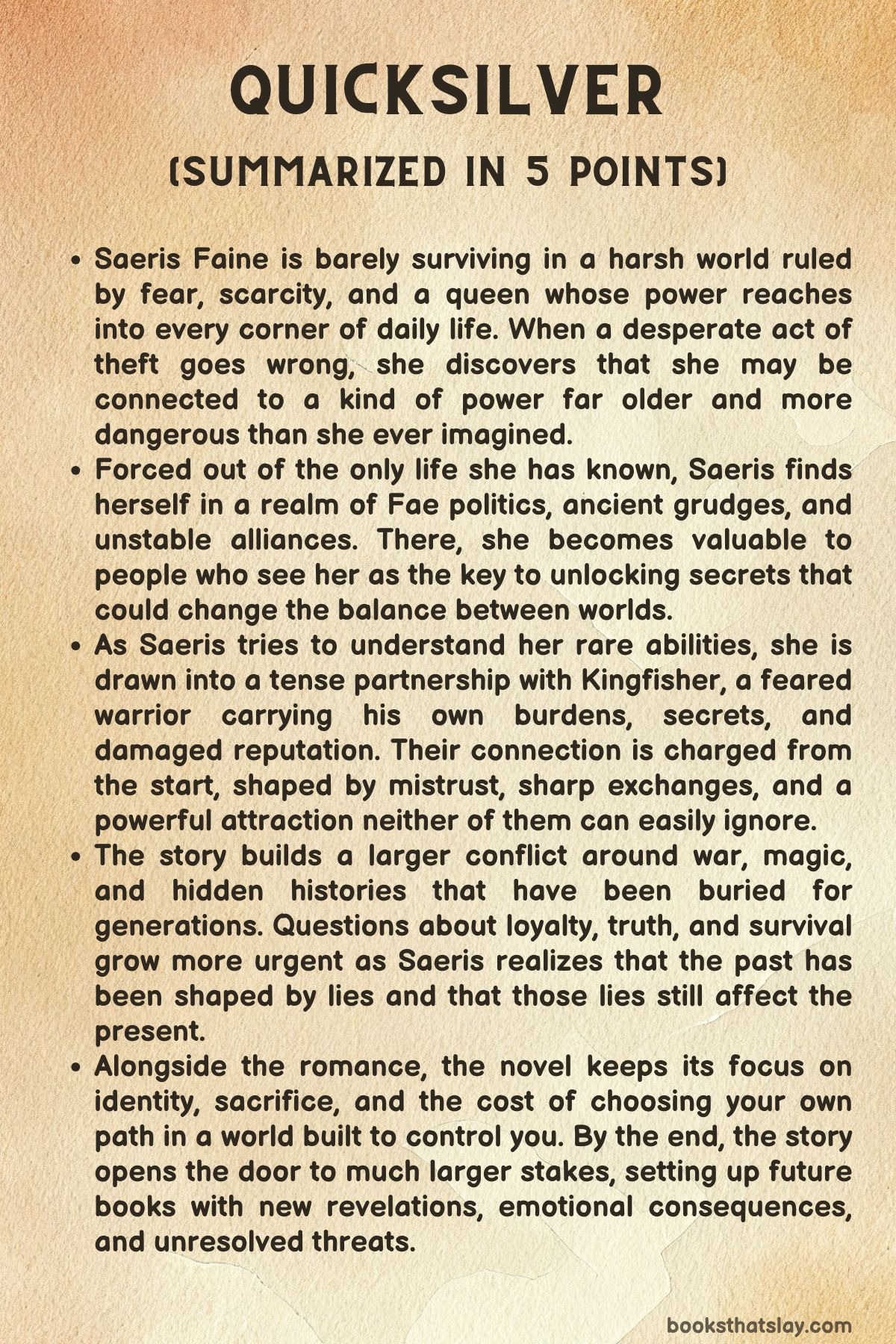
Saeris Faine survives by stealing, lying, and moving faster than anyone expects. Life in Zilvaren has taught her that mercy is rare and weakness is dangerous, especially in the Third Ward, where people live under quarantine, hunger, and the threat of Queen Madra’s cruelty.
When Saeris steals a metal gauntlet from one of the queen’s guardians, the act seems at first like one more risky attempt to stay alive. But the theft exposes something unusual about her: metal responds to her in ways it should not.
She can sense it, influence it, and quiet strange vibrations inside stone. What looks like petty crime is actually the beginning of a larger awakening.
Saeris tries to hide the gauntlet while protecting her younger brother, Hayden, whose impulsive choices often put them both in danger. Their bond is deep, but strained by the brutal reality of their lives.
Saeris carries the burden of protecting him, and Hayden resents being treated like someone who must always be rescued. Matters worsen when guards close in on them.
To save Hayden from torture and execution, Saeris claims responsibility for the theft and fights back with startling skill. She is captured and taken to the palace, where Queen Madra questions her with suspicion and fear.
Madra’s reaction reveals that the queen knows more than Saeris ever did about the old stories. She speaks of the Fae not as myths, but as a real and dangerous force.
In a sealed chamber within the palace lies a strange mechanism tied to a sword and a pool of quicksilver. When Madra threatens not only Saeris but everyone she loves, Saeris acts out of fury and desperation.
Her hidden power bursts free. Metal liquefies under her command, a guard falls, and she pulls the sword that has long served as a key.
That act opens a gate between worlds.
Saeris is pulled from death by a terrifying warrior she first mistakes for Death itself. When she wakes, she finds herself in Yvelia, the realm of the Fae.
There she meets Everlayne, warm and curious, and quickly learns that her arrival has enormous political consequences. The king, Belikon, sees Saeris not as a guest but as a tool.
Because she awakened the quicksilver and drew the sword, he wants to use her to reopen the pathways between realms for his own gain. He makes clear that comfort depends on obedience.
In Belikon’s court Saeris also meets Kingfisher, the feared and broken warrior who rescued her. Once exiled, now dragged back into the king’s orbit, he is both unstable and dangerously capable.
He is mocked, admired, hated, and needed all at once. Though the court treats him like a weapon, his history is full of pain, sacrifice, and silence forced on him by magical bindings.
Saeris is drawn to him almost immediately, though she resists that attraction with sarcasm, anger, and suspicion. He gives as good as he gets, and their connection develops through conflict as much as desire.
Saeris learns that she is likely an Alchemist, someone able to work with quicksilver and shape metal through thought and will. This matters because quicksilver is tied to the gates between worlds and to relics that can protect travelers from being driven mad by portal travel.
Kingfisher, who carries quicksilver inside his own body after once surviving exposure without proper protection, needs Saeris to learn this craft. He claims practical reasons: the war consuming Yvelia may be unwinnable without new relics and weapons.
But Saeris never forgets that she wants to go home. She agrees to cooperate only in the hope of saving Hayden and the people left behind in Zilvaren.
Their early attempts to work together are combative. Saeris does not trust Kingfisher, and he often pushes her through cruelty, concealment, and control.
At one point he binds her to an oath so that she must obey certain commands, a violation she deeply resents even when his stated purpose is to keep her alive. Yet the more time they spend together, the more she sees the cost of what he carries.
He suffers from quicksilver poisoning, seizures, hallucinations, and the pressure of an old crime that he cannot fully explain. Beneath his harshness is someone exhausted by duty, grief, and the certainty that he is beyond saving.
Saeris’s attempt to escape through the quicksilver fails, but it leads to a bargain: Kingfisher will retrieve one person from her world. He returns not with Hayden, but with Carrion Swift, a man from Saeris’s past whose presence complicates everything.
Carrion is flirtatious, provocative, and far more important than he first appears. Through him Saeris learns that Hayden is still alive and that events in Zilvaren are shifting under Madra’s rule.
Carrion becomes both an ally and a reminder that Saeris belongs to more than one world now.
Meanwhile the war in Yvelia grows harder to ignore. The enemy includes vampires, undead Feeders, and Malcolm, a powerful figure tied to Kingfisher’s exile and to a century of horror.
Saeris begins to understand that the conflict around her is built on buried truths. Belikon is manipulative and hungry for power.
Malcolm leads destruction from the other side. Madra, Belikon, and Malcolm are eventually revealed to be siblings whose schemes shaped the closing of the gates, the false narratives surrounding the war, and the suffering of countless people.
Kingfisher’s supposed unforgivable act, the destruction of Gillethrye, turns out to be far more tragic and complicated than anyone admits. He burned the city not out of malice, but to prevent the dead from being added to Malcolm’s monstrous army after Belikon’s betrayal made saving them impossible.
As Saeris continues working in the forge, she begins to hear the quicksilver more clearly. It is not inert material but something ancient, conscious, and demanding.
It bargains. It asks for blood, secrets, songs, and truth.
Through painful trial and error she learns to remake broken weapons and eventually creates a new magical sword. This success changes how others see her.
She is no longer only an outsider or a captive. She becomes someone whose power may alter the future of the war.
Her bond with Kingfisher deepens into love, though neither reaches that point easily. They move from hostility to desire, then from desire to a more frightening intimacy.
Magical runes appear on her skin and later on his, signaling a bond recognized by forces older than either of them. He has known, from prophecy and from his mother’s visions, that Saeris was meant for him.
He kept his distance because loving her would place her in danger. Saeris is furious to learn that he tried to decide her fate without her consent, especially when she discovers he plans to let himself die rather than become fully consumed by the quicksilver.
The story races toward a confrontation at Gillethrye, where old crimes, undead multitudes, and hidden rulers gather around the quicksilver’s call. Saeris, Carrion, Lorreth, and Kingfisher fight through a moving obsidian labyrinth while Belikon, Malcolm, and Madra close in.
Carrion’s true heritage comes to light, Malcolm’s power is challenged, and the central truth of the ancient bargain is finally forced into the open. Saeris claims the real coin at the heart of the long deception, frees trapped souls, and kills Malcolm with Solace, though she is mortally wounded in the process.
At death’s edge, Saeris is pulled into a meeting with divine beings. She learns that her fate and Kingfisher’s have always been tied to something much larger than romance or war.
A god reveals that their bond may shape the survival of entire realms and that Saeris herself was never meant to be only human. She chooses to remain, to fight, and to become something new.
She returns transformed into a being between Fae and vampire, alive again but altered forever.
By the end, Malcolm is dead, but Belikon and Madra remain threats. Everlayne survives.
A way may exist to free Kingfisher from the quicksilver slowly eating him. Carrion’s secrets are out.
And Saeris, once a starving thief from a quarantined ward, is now a maker of magical weapons, the mate of a feared warrior, and the one expected to rule Sanasroth after Malcolm’s fall. Her personal struggle for survival has become a turning point in a far greater conflict, setting the stage for everything still to come.
Characters
Saeris Faine
Saeris is the emotional and structural center of the story. She begins as a survivor shaped by deprivation, state violence, and the daily humiliations of life under Madra’s rule.
Everything about her early behavior comes from necessity: she lies quickly, steals boldly, fights hard, and trusts very little. What makes her compelling is that her toughness is never presented as simple bravado.
It is the result of hunger, grief, fear, and the burden of keeping Hayden alive. She has been forced into adulthood by circumstance, and that pressure gives her a sharp, restless energy that defines nearly every choice she makes.
Her strongest trait is defiance. Saeris refuses to accept the idea that suffering is natural or unchangeable.
Even when rebellion seems hopeless, she still resists, because surrender would mean accepting the world as it is. That quality makes her reckless at times, but it also makes her morally alive in a setting where many people have adapted themselves to cruelty.
She does not simply want to survive; she wants to protect, challenge, and alter what is broken around her. That gives her arc real force, because her power grows in step with her willingness to act on behalf of others.
Saeris also carries a deep contradiction. She sees herself as practical, but much of what she does is driven by feeling, loyalty, and instinct.
Hayden, Elroy, and later Kingfisher all matter to her in ways she tries to minimize. She often speaks harshly, yet her harshness is frequently protective.
She insults Hayden to save him, argues with Fisher because she cannot bear being controlled, and keeps pushing against impossible situations because she cannot walk away from people she loves. Her outward hardness hides someone intensely attached, deeply wounded, and unable to stop caring.
Her development is not only political or magical but existential. She moves from a world where survival narrows every possibility to one where her choices influence war, prophecy, and the balance between realms.
The transition works because she never loses the instincts formed by her earlier life. Even after entering palaces, libraries, and magical forges, she still thinks like someone who has known scarcity.
Water, food, warmth, and safety never become abstract to her. That memory keeps her grounded and prevents her rise in status from feeling artificial.
Saeris’s power over metal reflects her character well. She is not a passive inheritor of destiny but someone who learns through pain, effort, and stubborn repetition.
Her bond with quicksilver is especially revealing because it responds not just to technical skill but to truth, blood, sacrifice, memory, and desire. She cannot master it through force alone.
She has to enter into relation with it, listen to it, and offer parts of herself. That turns her magic into an extension of her emotional arc.
She becomes stronger not by becoming colder, but by becoming more honest about what she wants and what she fears.
Her romantic arc with Kingfisher deepens her characterization rather than replacing it. She does not become less independent because she falls in love.
Instead, love sharpens her sense of self. She demands explanation, consent, honesty, and mutual risk.
Even when desire is overwhelming, she remains unwilling to vanish into someone else’s story. That is why her bond with him matters.
It does not erase her anger, her judgment, or her will. It forces her to decide what kind of future she wants, not merely what kind of man she wants.
By the end, Saeris has changed in scale without losing her core identity. She is still the same person who would steal to survive and fight for the vulnerable, but she has become something larger: an Alchemist, a political figure, a beloved partner, and a player in a cosmic design.
What makes her effective as a protagonist is that she never feels detached from her beginnings. Her rise matters because it remains tied to memory, loss, and a refusal to stop choosing life even when life becomes stranger and more dangerous than she ever imagined.
Kingfisher
Kingfisher is built around contradiction. He is feared, admired, desired, unstable, ruthless, and deeply protective all at once.
At first he appears as a dark, dangerous force whose motives are difficult to trust. He saves Saeris, but he also manipulates her, binds her with an oath, withholds information, and uses intimidation as a way of maintaining control.
Yet the story steadily reveals that this harshness is not empty cruelty. It is the scar tissue of someone who has spent centuries under pressure, bound by silence, poisoned by quicksilver, and marked by loss he has never been allowed to explain.
One of the most effective aspects of his characterization is how power and damage coexist in him. He is a legendary warrior, a military symbol, and a figure around whom others build stories of heroism.
At the same time, he is profoundly unwell. The quicksilver inside him affects his mind and body, producing pain, hallucinations, and episodes that make him fear what he will become.
His authority never feels clean or stable. Every display of strength carries the sense that something inside him is fraying.
That creates a tension that makes him more than a fantasy archetype; he is not just powerful, but endangered by his own endurance.
Kingfisher’s cruelty is often a defensive language. He uses mockery, provocation, and bluntness to create distance, especially when he feels vulnerable.
He knows attachment can be exploited, and he has been repeatedly placed in situations where love and loyalty become weapons against him. That helps explain his treatment of Saeris early on.
He is drawn to her almost immediately, but because he fears what proximity will cost, he chooses friction over tenderness. His insults and provocations become a method of self-protection, even while his actions reveal concern that his words deny.
His silence is one of his defining burdens. The magical compulsion that prevents him from speaking openly about Gillethrye and other truths turns him into a character repeatedly misread by the world around him.
He bears blame for actions others do not understand, and because he cannot defend himself honestly, resentment calcifies around his name. This gives his tragedy a specific shape: he is not merely traumatized, but trapped inside a public identity built on partial truths and lies.
The gap between who he is and what others think he is becomes central to his pain.
His relationship to duty is equally complex. He resists leadership while still acting like a protector.
He claims detachment while constantly putting himself at risk for others. He insists on using Saeris as a means to an end, yet repeatedly behaves as someone who cannot stop caring.
That contradiction is not hypocrisy so much as exhaustion. He has lived too long with impossible responsibilities and compromised choices.
He no longer believes clean moral positions are available to him, so he settles for effectiveness, even when it costs him intimacy or trust.
Kingfisher’s love for Saeris becomes meaningful because it is not easy, gentle, or immediately redemptive. He does not meet her and suddenly become simple.
Instead, love forces him to confront the parts of himself he would rather manage through distance. He wants her safe, but his instinct is to decide safety for her instead of with her.
He wants closeness, but fears that closeness will destroy her. He wants to believe in a future, but has already planned his own death.
These tensions make him a more substantial romantic lead because he must unlearn control and despair at the same time.
His backstory with his parents also adds depth. The loss of his mother, the suspicion around his father, Belikon’s hostility, and the burden of inherited expectation all position him as someone formed within a family structure that was never safe.
Even his status is painful. Home, lineage, sword, and title are all tied to injury as much as legacy.
That is why moments in Cahlish matter so much. They show the version of him that might have existed in another life: lighter, more rooted, less guarded.
By the close of the story, Kingfisher stands as both a romantic figure and a tragic political one. He is a champion, exile, witness, and near-martyr.
What makes him memorable is that his darkness is not decorative. It comes from actual ethical conflict, long-term suffering, and a terrifying awareness of how easily love can become ruin.
In Quicksilver, he is not just the wounded male lead; he is a man trying to remain himself while magic, history, and obligation continually threaten to strip that self away.
Hayden
Hayden is important not because he dominates the page, but because he helps define who Saeris is before the larger fantasy plot overtakes her life. He represents the person she has been trying to protect for years, and through him the story shows the cost of that role.
He is no longer a child, yet Saeris still feels responsible for him in a near-parental way. That creates tension between them.
She sees his recklessness and vulnerability; he likely sees her control, judgment, and inability to let him stand on his own.
His mistakes matter because they are believable responses to the world he inhabits. Gambling, desperation, and poor choices do not make him weak so much as immature within a brutal system that offers little room to grow safely.
He does not possess Saeris’s discipline or hardness, and that difference between them is one of the more realistic sibling dynamics in the story. They love each other, but they are not idealized mirrors.
Their bond is marked by frustration, resentment, and sacrifice.
Hayden also functions as an anchor to Saeris’s original world. Even after magic, prophecy, and romance begin to reshape her life, her concern for him remains one of the clearest measures of her humanity.
She wants to save more than a realm or a war effort; she wants her brother alive, fed, and free. That emotional scale matters.
Hayden keeps her connected to the concrete stakes of family and memory.
Though he spends much of the story offstage, his absence is active. Saeris’s choices are influenced by what she believes has happened to him or might still happen to him.
He is a source of guilt, hope, and urgency. In that sense, Hayden is not a secondary ornament but one of the central emotional engines of the narrative’s first half.
Elroy
Elroy represents a form of resistance very different from Saeris’s. He is older, more cautious, and painfully aware of how power retaliates.
Where Saeris sees action as necessary even when success is uncertain, Elroy sees survival and discretion as their own forms of wisdom. This difference creates an important ideological contrast.
He is not a coward; he is someone who has lived long enough to understand consequences in intimate detail.
His workshop and his craft matter symbolically. Glassmaking suggests patience, heat, fragility, and shaping under pressure, all qualities that fit his role in the story.
He has likely seen enough failed rebellion to mistrust grand gestures, yet he is not morally empty. The summary makes clear that he has helped dangerous causes before.
His caution is therefore born not from indifference but from experience. He knows what happens when people like Saeris attract the wrong attention.
Elroy’s connection to Saeris’s mother adds another layer to his character. He is linked to Saeris not only through mentorship but through old affection, loss, and loyalty.
That likely deepens both his protectiveness and his frustration. He is one of the few figures who can challenge Saeris without feeling like an enemy, because his criticism comes from care.
He understands her fierceness, but he also sees the self-destructive edge in it.
As a supporting character, Elroy broadens the social world of the story. He shows that under oppression, people respond differently.
Some fight directly, some hide what they can, some preserve skills and memory, and some try to keep the young alive long enough to make a different future possible. His presence strengthens the realism of the world Saeris comes from.
Carrion Swift
Carrion is one of the most slippery and entertaining characters in the story because he is always operating on more than one level. Initially he appears as a charming criminal with a provocative history with Saeris, someone reckless, flirtatious, and morally flexible.
He brings friction wherever he goes, yet he is also practical, informed, and often more perceptive than people realize. His early scenes make him seem like a local danger from Saeris’s old life, but his later revelations dramatically expand his significance.
What makes Carrion interesting is his instability as a category. He is never only one thing.
He is an ex-lover, a nuisance, an ally, a manipulator, a source of jealousy, a political surprise, and eventually a figure with hidden lineage and longevity. Because he moves so easily between tones, he prevents the story from becoming too rigid.
Around him, conversations can turn from sharp comedy to serious revelation in a few lines.
His relationship with Saeris is not only sexual history used for tension. He stands for an alternative path or at least an alternative familiarity.
He is tied to the world she came from and to a version of herself formed before the Fae realm changed everything. That makes his presence particularly useful in the middle of the story, when Saeris is being pulled into new loyalties.
Carrion reminds her of the life she has not fully left behind, even as he himself turns out to belong to deeper histories than she ever suspected.
Carrion’s secrecy is a key part of his characterization. He knows far more than he initially says, and the fact that he has lived hidden in plain sight for so long suggests patience, strategy, and long-term adaptation.
Unlike Kingfisher, whose silence is often bound up with pain and compulsion, Carrion’s secrecy feels cooler and more deliberate. He reveals himself when necessary, not when emotionally pressed.
That difference gives him his own identity rather than making him a lesser version of the main male lead.
He also contributes strongly to group dynamics. His flirtation irritates Kingfisher, embarrasses or amuses Saeris, and adds social unpredictability to tense settings.
Yet he is not there merely for triangle energy. He helps with forging, offers practical insights, and survives long enough to show that his value is real.
His eventual revelation as Fae royalty reframes his earlier behavior without erasing it. He has always been playful and evasive, but that playfulness covered an extraordinary secret.
Everlayne
Everlayne provides warmth, culture, and emotional balance within the Fae world. She is one of the first people in Yvelia to treat Saeris with kindness rather than suspicion or political calculation.
Through her, the world becomes more than a court of threats and manipulations. She introduces custom, faith, luxury, and social nuance, but she does so in a way that feels personal rather than purely expository.
Her kindness is especially striking because it contrasts so sharply with Saeris’s experiences in Zilvaren.
At the same time, Everlayne is not merely gentle. She belongs to the center of power and carries the complicated awareness that comes with it.
She understands court tensions, her father’s cruelty, her brother’s suffering, and the fragile balance of appearances. Her optimism is therefore not ignorance.
It is a chosen mode of being inside a dangerous political structure. That makes her more substantial than a simple kind princess figure.
Her bond with Kingfisher is one of her strongest functions in the story. She humanizes him by revealing family intimacy, old loyalty, and grief that he does not easily voice.
Their history suggests affection strained by time, exile, secrecy, and pain. She has not abandoned him emotionally, even after a century apart, and her concern for him reflects badly on those who treated him as disposable.
Through her, the reader sees the version of him that exists within family feeling rather than military legend.
Everlayne’s later victimization by Malcolm raises the stakes considerably because she is not just politically valuable but emotionally cherished. Her endangerment matters to multiple people for different reasons, and that makes the rescue effort feel layered rather than strategic alone.
She becomes a focal point for love, guilt, family loyalty, and the costs of the larger conflict.
Renfis
Renfis, often called Ren, is one of the story’s most stabilizing presences. He is competent, loyal, emotionally intelligent, and often forced into the role of mediator between volatile personalities and impossible demands.
In many ways, he represents disciplined service at its best. He is a warrior and commander, but unlike many military figures in fantasy, he is not defined by harshness alone.
He notices emotional realities, tries to guide people toward healthier choices, and often acts with more patience than the circumstances deserve.
Ren’s loyalty to Kingfisher is profound, but it is not blind. He challenges him, argues with him, and openly objects when he believes he has gone too far, particularly regarding Saeris.
That gives their relationship credibility. Ren is not a worshipful subordinate but someone whose devotion has been earned through history, sacrifice, and mutual need.
He sees Kingfisher’s weaknesses clearly and remains anyway, which says a great deal about both men.
He also performs an important narrative function by embodying the perspective of those who never stopped believing in Kingfisher during his exile. Through Ren, the story explores memory, military morale, and long-term faith in a damaged leader.
He understands the weight of Kingfisher’s past and the pressures of the present war, and he navigates both with admirable steadiness.
Ren’s protectiveness toward Saeris grows in a way that feels organic. He begins skeptical and pragmatic, but over time he recognizes her courage, value, and emotional importance to Kingfisher.
He becomes one of the people most invested in keeping both of them alive, even when they themselves make that difficult. This makes him feel like far more than a side commander; he is one of the moral supports holding the narrative upright.
Queen Madra
Madra is a tyrant shaped by paranoia, control, and an appetite for absolute power. She rules Zilvaren through fear, deprivation, and the manipulation of myth.
Her governance depends not only on violence but on the manufacture of belief. By elevating herself into a godlike figure, she turns oppression into ritual and obedience into something spiritualized.
That makes her especially dangerous, because she controls both the body and the imagination of her people.
What stands out most in her characterization is that she is not merely cruel for effect. She is strategic and deeply fearful.
Her response to Saeris reveals that she knows the old powers are real and that her authority is more fragile than it appears. The brutality of her rule seems designed in part to suppress threats before they fully emerge, whether those threats are rebellion, magic, or the return of forces from beyond her realm.
Her later connection to Belikon and Malcolm enlarges her role significantly. She is not just the local dictator from the protagonist’s first world but part of a wider network of ancient ambition and betrayal.
This revelation strengthens her as an antagonist because it reframes her actions as part of a long game rather than isolated cruelty. She is a figure of continuity between the human and Fae spheres, corruption in one world echoing corruption in another.
Madra also works thematically as a distortion of immortality. Where Saeris fights to protect life and Kingfisher struggles under the burden of prolonged existence, Madra uses longevity as entitlement.
She is what power becomes when it is no longer answerable to human limits. That gives her a chilling symbolic function within the story.
Belikon De Barra
Belikon is a ruler defined by calculation, vanity, and rot beneath ceremony. At first he appears as the cold king of the Fae, politically manipulative and willing to exploit Saeris for his own purposes.
As the story progresses, however, he becomes something worse: a patriarch of betrayal whose choices have shaped war, exile, family breakdown, and mass death across generations.
His most defining feature is instrumental thinking. He sees people in terms of use.
Saeris is a tool, Kingfisher is a weapon or embarrassment depending on convenience, Everlayne is part of dynastic structure, and war itself becomes an arena in which suffering is acceptable if it sustains his power. He is not chaotic like Malcolm or theatrically cruel like Madra; he is methodical, which can be even more chilling.
Belikon’s relationship with Kingfisher is especially revealing. His hostility toward him appears at first personal and political, but later revelations expose the deeper corruption beneath it.
He has helped construct a false narrative that leaves Kingfisher carrying public blame while shielding the truth of his own crimes. In this sense, Belikon is not just an antagonist but an architect of misrecognition.
He benefits from lies that isolate the very people who threaten his control.
His alliance with his siblings shows that for him kinship is secondary to domination. Family, realm, and history are all things he is willing to deform.
That makes him a compelling foil to characters like Saeris, Everlayne, and Ren, for whom loyalty still has moral content. Belikon preserves structure while hollowing out its purpose.
Malcolm
Malcolm represents corruption taken to its most expansive and monstrous form. He is charismatic, ancient, strategic, and terrifying, not because he lacks intelligence or restraint, but because he combines them with a complete comfort in consuming others.
His refusal of the cure that would have ended the Fae blood curse reveals a central truth about him: he does not simply want life, he wants dominion through appetite.
As the source of the vampire threat and the creator of the Feeders through secondary infection, Malcolm functions as both a military antagonist and a metaphysical one. He turns bodies into instruments and death into multiplication.
The horror attached to him is not only physical but social. He erases identity by converting people into extensions of his force.
That makes him a fitting enemy in a story so concerned with autonomy, consent, and the struggle to remain oneself.
His history with Kingfisher adds another dimension. Malcolm is not a distant evil but someone linked to Kingfisher’s exile, silence, and guilt.
The labyrinth, the coin, and the trapped souls of Gillethrye all reveal Malcolm’s love of theatrical cruelty. He does not only destroy; he stages destruction so that memory itself becomes a torture device.
This makes him particularly effective as a villain because his violence is imaginative, prolonged, and psychologically targeted.
Even so, Malcolm is not pure chaos. He understands bargains, ritual, and leverage.
He uses Everlayne as pressure, manipulates old wounds, and recognizes the significance of bonds and blood. His intelligence makes his brutality feel purposeful rather than random.
When he falls, it feels not like the defeat of a beast alone but the toppling of a carefully sustained order of horror.
Lorreth
Lorreth grows into one of the most quietly rewarding supporting characters. He begins as a military captain and member of Kingfisher’s elite circle, but over time he develops a more personal and emotionally resonant presence.
His loyalty to Kingfisher is not based simply on command structure. It comes from a profound act of saving that permanently bound their fates together.
Because of that, Lorreth carries devotion with a near-sacred seriousness.
He is also notable for combining martial competence with artistic memory. His connection to song becomes unexpectedly important when the quicksilver demands music in exchange for transformation.
That detail enriches him considerably. He is not only a soldier but someone with a cultural and emotional interior life, and it is precisely that non-military part of him that becomes crucial.
His singing helps bring forth a new magical weapon, suggesting that creation and beauty still matter in a world dominated by war.
Lorreth’s reverence for Kingfisher is intense, yet he does not feel one-dimensional. He can be skeptical, practical, and occasionally amused.
His reactions to Saeris shift over time from caution to respect. He recognizes her significance not only because Kingfisher cares for her but because she proves herself in battle, in the forge, and in the moral seriousness with which she faces danger.
His newly claimed sword also reflects his character. The weapon does not return to Danya but chooses him, implying worthiness grounded in something deeper than inheritance.
Lorreth becomes one of the strongest examples of earned honor in the story.
Danya
Danya is proud, aggressive, and difficult, but she serves an important role in the ensemble. She embodies resentment within Kingfisher’s own military circle, the perspective of those who suffered his absence and are not inclined to romanticize him.
Her anger is not always appealing, but it is understandable. She remembers a history of abandonment and carries it directly into the present.
Her attachment to her sword reveals how much identity, lineage, and status are tied to weaponry in this world. When Saeris destroys it, Danya does not react as though she has lost a tool; she reacts as though a part of herself and her place in the order has been violated.
That helps explain the sharpness of her hostility. Saeris does not only embarrass her, she disrupts the symbolic world through which Danya understands value.
Danya’s flaws are clear. She is often ungenerous, status-conscious, and prone to insult at the worst possible moment.
Yet she also prevents the inner circle from becoming too harmonious or self-flattering. Her resistance forces conflict into the open.
She is a reminder that old wounds do not vanish because the story’s central romance grows stronger.
Rusarius
Rusarius is a gentler intellectual presence whose importance lies in what he adds to the atmosphere of Yvelia. He offers knowledge without menace and helps frame Saeris’s abilities in terms she can begin to understand.
In a story full of rulers, warriors, and manipulators, he brings scholarly stability. His kindness matters because it shows that the Fae world contains genuine curiosity and generosity, not only political opportunism.
He also helps establish the scale of history behind current events. Through libraries, records, and old categories such as Alchemists, the narrative gains a sense of depth.
Rusarius is part of that mechanism, but he never feels purely functional. His friendliness toward Saeris gives her some of the first non-hostile intellectual support she receives in Yvelia.
Archer
Archer may be a smaller character, but he is emotionally useful because he reveals a domestic, affectionate side of Cahlish and of Kingfisher’s past. His response to Kingfisher’s return is immediate and heartfelt, suggesting long-standing bonds that existed before war and exile consumed everything.
Through Archer, Cahlish feels like a home rather than just a strategic location.
He also softens the tone in scenes that might otherwise become too heavy. Characters like Archer show the everyday ecosystem of care around great houses and warriors.
They remind the reader that powerful figures are also people who were fed, raised, watched over, and loved by others in less dramatic roles.
Te Léna
Te Léna represents healing, continuity, and lived knowledge. She is practical and emotionally grounded, someone who works within the body’s realities rather than the abstractions of prophecy or war strategy.
Her presence becomes increasingly significant as questions of venom, transformation, mating runes, and quicksilver damage deepen. She is one of the few characters who consistently addresses what magic does to flesh and long-term survival.
Her explanations about marital runes and rare divine bindings are especially important because they convert what might seem like private romantic symbolism into cultural and historical fact. Through her, the story gains a framework for understanding the stakes of Saeris’s bond with Kingfisher.
She also carries social confidence, particularly in her interactions with Carrion, making her feel like a person with boundaries and presence rather than a generic healer figure.
Iseabail
Iseabail represents the return of a knowledge system largely absent from the main centers of power. As a witch strong enough to potentially help Everlayne, she reminds the story that Fae kings and military leaders do not control all meaningful forms of power.
Her role broadens the magical landscape and hints at traditions sidelined or mistrusted for political reasons.
She also complicates simplistic blame narratives. Characters like Lorreth carry inherited suspicions toward witches, but Iseabail’s presence challenges those assumptions.
She stands for marginalized expertise and for the possibility that salvation may come from those dismissed by dominant structures.
Taladaius
Taladaius enters late but leaves a strong impression because he complicates the vampire side of the story. He is proof that vampirism is not a single fixed moral category.
Unlike Malcolm’s monstrous appetite, Taladaius carries autonomy, memory, and ambivalence. He can act with care, make choices against his former leader, and occupy a morally gray but not wholly corrupt position.
His offer to transform Saeris is ethically unsettling, but that discomfort is part of what makes him effective. He stands at the intersection of violation, necessity, and altered survival.
He becomes an agent of transition, helping move Saeris into her next form while raising serious questions about consent, desperation, and what it means to save someone at terrible cost.
Harron
Harron functions as an enforcer of cruel systems, first under Madra and later under the influence of quicksilver and darker powers. He is not as grand in scale as the main antagonists, but he is memorable because he embodies institutional violence at close range.
His early treatment of Saeris establishes how authority operates in her original world: with entitlement, brutality, and the belief that the poor are disposable.
His later transformation makes him even more grotesque. He becomes an example of what happens when power and corruption merge with magical contamination.
Harron does not need deep nuance to be effective. His role is to personify the kind of violence that protagonists must literally and symbolically fight their way through.
Iris Faine
Though absent in the present timeline, Iris is crucial to understanding Saeris. Her death, labor, and stigma shaped the protagonist’s worldview long before the main plot began.
Iris survives in the narrative as memory, example, and wound. She was a mother forced into vulnerable and judged forms of survival, yet she also participated in resistance through smuggling weapons.
That combination of marginalization and bravery helps explain why Saeris grows into someone both hardened and politically conscious.
Iris’s murder is one of the foundational injustices in Saeris’s life. It is not just personal tragedy but evidence of the regime’s cruelty and of how women’s bodies are policed, used, and discarded.
Her influence lingers in Saeris’s refusal to accept official morality at face value.
Finran
Finran is more absent than present, yet his absence is active. As Kingfisher’s father, former husband to Everlayne’s mother, and founder of protective wards around Cahlish, he exists as a lost alternative to Belikon’s rule.
He stands for loyalty questioned by power, for a lineage interrupted by political manipulation, and for truths buried beneath official accusation.
What matters most about Finran is that multiple characters continue to orient themselves around what happened to him. That makes him one of the story’s ghost figures, someone whose missing body and unresolved history shape the present as strongly as many living characters.
Wendy
Wendy is a brief but meaningful presence because she gives the village setting emotional texture. Her maternal fondness toward Kingfisher reveals that he is not only feared or revered; he is also remembered in ordinary, affectionate ways.
Characters like Wendy matter because they show what peace, continuity, and communal life look like in contrast to court and battlefield. She helps illuminate what is worth fighting for.
Zareth
Zareth arrives as a god whose perspective radically widens the scale of the story. He is unsettling because he combines vast knowledge with a willingness to sacrifice worlds for balance.
Unlike mortal rulers, he does not think in personal or even political terms but cosmological ones. That makes his interactions with Saeris both awe-inspiring and disturbing.
What makes him effective is that he is not framed as simply benevolent or cruel. He is operating on a level where ordinary ethics blur.
He meddles with fate, separates Saeris from her original design, and positions her as part of a possible universal salvation. His presence transforms the narrative from epic fantasy romance into something touching cosmic catastrophe and divine strategy.
In Quicksilver, he is the figure who reveals that even the grand war and the central love story are part of a much larger design.
Bal and Mithin
Bal and Mithin, the twin gods, are brief but vivid figures who help make the divine realm feel more textured and embodied. They are not abstract voices but personalities, distinct enough to suggest that godhood in this world is familial, active, and relational.
Their appearance also softens the transition into the divine sequence by giving Saeris guides who are strange but not wholly inaccessible.
Their main role is to bridge mortal confusion and cosmic revelation. Through them, the story signals that divinity here is not silent background lore but an active force with interest in mortal outcomes.
Themes
Power, Control, and the Politics of Survival
Power in this story is not presented as something distant or ceremonial. It reaches directly into the body, the home, the food supply, and the imagination.
Saeris’s life in Zilvaren makes that clear from the beginning. Hunger, rationed water, quarantine, public force, and the threat of imprisonment show that oppression works most effectively when it becomes ordinary.
People are not simply ruled; they are managed into exhaustion. Madra’s regime depends on creating conditions where survival itself consumes so much energy that resistance becomes difficult to sustain.
This is why Saeris’s early acts of theft and defiance matter so much. They are not only crimes against authority but refusals to accept that the powerful have the right to define who deserves safety, comfort, or dignity.
The same logic of control appears in Yvelia, though in a more polished form. Belikon does not govern through scarcity alone.
He uses hierarchy, court ritual, prophecy, and selective mercy to turn people into instruments. Saeris is valuable to him only because of what she can awaken and produce.
Kingfisher is treated in a similar way, not as a full person with grief and moral burden, but as a military asset, a scandal, or a threat, depending on what best serves the king’s interests. The story therefore suggests that power can appear in different costumes while remaining fundamentally predatory.
One realm starves people into submission, another dresses exploitation in royal language, but both are willing to reduce human worth to usefulness.
What makes the theme especially strong is that control is not only political but intimate. The oath that binds Saeris to Kingfisher shows how easily protection and domination can blur.
Even when the commands are framed as necessary, the loss of choice remains real. That tension keeps the story from offering easy moral comfort.
It asks whether good intentions excuse coercion and whether love can survive when one person has magical authority over another. Saeris’s anger toward that violation is important because it preserves the theme’s seriousness.
She does not let care erase the fact of control.
By the end, power is shown as something larger than crowns or armies. Gods alter fate, quicksilver bargains for obedience, and ancient rulers manipulate entire wars for personal gain.
Yet the story never loses sight of a basic truth: control becomes most dangerous when it convinces people that they have no right to resist it. Saeris’s arc challenges that assumption at every level.
Her survival becomes meaningful because she refuses to remain manageable. In Quicksilver, power is never neutral.
It is always shaping who gets to choose, who gets used, and who dares to fight back.
Love as Risk, Bond, and Transformation
Love in this novel is never calm, decorative, or separated from danger. It arrives through conflict, mistrust, need, and physical intensity, and it changes the stakes of nearly every decision once it takes hold.
The bond between Saeris and Kingfisher begins in antagonism because both characters are accustomed to seeing closeness as a liability. Saeris has learned that attachment creates vulnerability in a cruel world.
Kingfisher has spent centuries carrying pain, silence, and the certainty that anyone close to him will eventually suffer for it. Their attraction therefore develops under pressure.
It is not a soft escape from the world around them but one more force that makes the world harder to navigate.
What makes this theme effective is that love is tied to choice as much as desire. The physical connection between them is immediate and powerful, but the deeper emotional bond takes longer because trust has to be built against habits of concealment and control.
Kingfisher wants Saeris safe, yet he repeatedly tries to decide her future for her, which turns care into something almost unbearable. Saeris wants him, yet refuses to disappear inside his authority or his suffering.
Their relationship matters because it never asks her to become passive. Love sharpens her, angers her, and forces her to articulate what she will and will not accept.
The magical runes make the emotional bond visible, but they do not simplify it. Instead, they make love feel heavier, older, and more dangerous.
The bond is not merely personal preference; it is tied to prophecy, fate, and sacrifice. That could have made the romance feel predetermined in a shallow way, but the story avoids that by keeping consent central to the emotional conflict.
The runes may appear without permission, but accepting what they mean remains a moral and personal struggle. Saeris must decide whether she wants the bond, and Kingfisher must confront the fact that love does not give him the right to make that choice alone.
Love also acts as a force of revelation. Through intimacy, each sees the other more clearly.
Saeris comes to understand the pain behind Kingfisher’s cruelty, and he comes to see that her strength is not something to manage but something to honor. Their connection does not erase trauma, guilt, or political danger, but it does change how those burdens are carried.
Love becomes a way of resisting despair. It gives both characters a future tense, something they had nearly stopped imagining for themselves.
The theme reaches beyond romance as well. Saeris’s love for Hayden, Everlayne’s love for her brother, Ren’s loyalty to Kingfisher, Archer’s affection, and even Lorreth’s devotion all show that love in this story takes many forms.
Again and again, characters are defined by whom they refuse to abandon. That is why love feels transformative here.
It is not presented as comfort alone, but as the force that makes sacrifice meaningful and survival worth more than endurance.
Identity, Secrecy, and the Struggle to Be Known
Identity in this story is unstable, hidden, and often weaponized. Nearly every major character lives at some distance from how they are publicly understood.
Saeris begins as a thief from a quarantined ward, someone dismissed by the world as disposable, yet she is also an Alchemist with extraordinary power and a figure tied to ancient forces she does not yet understand. Kingfisher is known as a disgraced destroyer and dangerous exile, while the truth of his history is locked behind magical silence.
Carrion appears to be a rogue from Saeris’s old life, only to emerge as something much older and more significant. Even the political structure of the world rests on concealed truths, false narratives, and carefully maintained misunderstandings.
This makes identity less a fixed fact than a contested space between self-knowledge, social labeling, and hidden history. Characters are constantly being misread, either by design or by force.
Belikon benefits from those distortions. Madra rules through manipulated myth.
Malcolm turns people into reflections of his will. The novel repeatedly suggests that domination depends on controlling the story of who someone is.
If a person can be renamed, falsely judged, silenced, or reduced to one public act, then they become easier to contain.
Saeris’s development is closely tied to this theme because her sense of self keeps expanding under pressure. She is not merely discovering new powers; she is confronting the fact that she has always been more than the world she came from allowed her to be.
Yet the story does not frame this as a simple empowerment fantasy. New knowledge complicates her life.
Learning that she may have Fae ancestry, that she is linked to prophecy, and that her fate has been touched by gods does not erase the reality of her earlier identity. Instead, it layers her.
She remains the girl shaped by deprivation even as she becomes something difficult to categorize.
Names are particularly important within this theme. Names hold power in the Fae world, and the hesitation around using Saeris’s true name shows how identity can carry emotional and magical weight.
Kingfisher’s use of a nickname is not random teasing alone; it is a strategy of distance, fear, and reverence. Public titles also matter.
Fisher is hero, exile, dog, champion, and disgrace, depending on who is speaking. Each label reveals a political or emotional agenda.
The story’s interest in secrecy is not just suspense-based. It raises deeper questions about whether a person can live whole when essential truths remain hidden or unspeakable.
Many characters have survived by concealing themselves, but concealment always has a cost. Misunderstanding breeds resentment, isolation, and false judgment.
Being known, by contrast, is both dangerous and necessary. Love, friendship, and alliance become meaningful precisely because they move characters closer to recognition.
The struggle is not only to discover hidden truths, but to live in a world where truth can be spoken without becoming another weapon.
Fate, Sacrifice, and the Burden of a Larger Design
Fate in this novel is not romantic decoration or vague destiny language. It is heavy, intrusive, and often frightening.
Characters do not simply learn that they are special; they discover that their lives have been shaped by forces older and wider than their own desires. Saeris and Kingfisher are connected not only by attraction or shared struggle but by prophecy, divine interest, and a future that appears to stretch far beyond personal happiness.
This gives the story a persistent tension between freedom and design. If powerful beings have already marked out the significance of certain lives, then what does it mean to choose anything for oneself?
The novel does not answer that question by dismissing fate. Instead, it makes fate real while insisting that choice still matters.
Saeris may be drawn into a role she never asked for, but the force of her character comes from how she responds to that pressure. Again and again, she is confronted with demands greater than she wanted: saving her brother, surviving political manipulation, helping end a war, loving someone marked for death, and eventually accepting that her existence may matter to the balance of entire realms.
These escalations could flatten her into a symbolic figure, but the story avoids that by keeping sacrifice personal. The grand design always lands in the realm of the body, the relationship, or the impossible decision.
Kingfisher’s arc is equally shaped by sacrifice. He has spent centuries carrying consequences that began with an impossible choice at Gillethrye.
He gives parts of himself to others literally and spiritually, takes on blame he cannot explain, and prepares for his own death as though that is simply the final duty left to him. What makes the theme resonate is that sacrifice is never glorified in a simple way.
The story recognizes nobility in it, but also exhaustion, loneliness, and injustice. Some sacrifices are chosen, some are coerced, and some are inherited from the decisions of the powerful.
That difference matters.
The quicksilver intensifies this theme because it always asks for exchange. It does not grant power without cost.
Songs, blood, secrets, pain, and loyalty all become currencies. Magic here is transactional in a way that mirrors fate itself.
Nothing comes free. Even survival can require transformation so extreme that the self is changed forever.
Saeris’s death and rebirth push this idea to its limit. To remain in the world she chooses, she must become something new, and that change carries enormous implications for who she is and what she may yet owe.
When divine figures finally enter the narrative directly, the burden of larger design becomes explicit. Universes can die, branches of fate can be cut away, and mortal love can become part of cosmic conflict.
Yet the story’s most interesting move is that it does not ask Saeris to become abstract in response. She is still driven by love, anger, loyalty, and fear.
Fate may surround her, but it does not erase her ordinary human insistence on wanting specific people alive. That is what gives the theme emotional force.
Destiny matters, but it only feels significant because it collides with individual will, private grief, and the painful cost of choosing to go on.