Redeeming 6 Summary, Characters and Themes
Redeeming 6 is a contemporary romance and coming-of-age novel by Chloe Walsh, set in the emotionally charged world of Ballylaggin and the wider Boys of Tommen series. At its center are Joey Lynch and Aoife Molloy, two young people deeply in love but carrying more pain than most adults could bear.
The book focuses on addiction, family violence, teen pregnancy, loyalty, and the difficult effort to change when life keeps pushing back. More than a romance, Redeeming 6 is a story about survival, responsibility, and whether love can endure when both people are forced to grow up far too quickly.
Summary
Joey Lynch and Aoife Molloy begin the story already in pain. Joey has ended their relationship even though he still loves her, convinced that his addiction and damaged life make him dangerous for her.
He has recently stopped using heroin after Aoife found him close to death, but he does not trust his own recovery. Aoife does not accept his decision.
She knows he loves her, and she cannot understand why he thinks shutting her out is a form of care. Their separation is full of anger, longing, and unfinished conversations, and both of them remain deeply tied to each other even when they pretend otherwise.
Aoife continues with school, work at the pub, and life at home with her family, but she is constantly pulled back to Joey. Joey, meanwhile, is trying to keep his family afloat.
He works as a mechanic for Aoife’s father, plays hurling, and acts as a stand-in parent for his younger siblings. His home life is ruled by fear.
His father Teddy is violently abusive, cruel, and predatory, while his mother Marie is weak, unreliable, and often unable or unwilling to protect her children. Joey carries the weight of this household on his shoulders, and every responsibility pushes him closer to the edge.
The distance between Joey and Aoife does not last. At a party hosted by boys from Tommen, their unresolved feelings break open.
Jealousy, hurt, and desire bring them back together, and they admit that their connection has never gone away. They decide, in effect, that whatever problems exist between them, they still want each other.
For a time, they fall back into the intensity of their relationship. They steal moments together at parties, at school, in Joey’s room, and wherever else they can.
Their bond is physical, emotional, and consuming, but underneath that closeness there are cracks that neither of them can truly fix by wanting each other hard enough.
At the same time, Joey’s life becomes more strained. He worries constantly about his sister Shannon, who is starting at Tommen and has a history of being bullied.
He is fiercely protective of her, but he cannot be everywhere at once. Shannon begins forming friendships, especially with Johnny Kavanagh, and while Joey is suspicious at first, it slowly becomes clear that Johnny genuinely cares for her.
Even so, Joey’s focus never eases at home, where Teddy’s violence remains a constant threat and money is always scarce. Joey sometimes slips into old patterns, including dealing small amounts of drugs for cash, telling himself it is for survival rather than self-destruction.
Meanwhile, Aoife notices changes in her body and mood. At first she dismisses the signs, but eventually she is forced to face the possibility that she is pregnant.
Fear takes over. She knows Joey loves her, yet she also knows how fragile his sobriety is and how overwhelmed he already is by his family’s chaos.
She delays telling him, hoping for certainty, hoping for the right moment, hoping to protect him and herself. Her friend Casey supports her, and when Aoife finally admits the truth to her mother, Trish responds with care rather than rejection.
Aoife decides that she wants to keep the baby, but that decision only adds to the pressure building around her.
Before she can tell Joey properly, disaster strikes in another form. Teddy attacks Aoife in Joey’s home.
The assault does not go further because Joey returns, but the damage is devastating. Aoife is shaken, disgusted, and traumatized.
Joey is consumed by guilt because he was not there to protect her from the man he has spent his whole life fearing and hating. Afterward, Aoife cannot bear Joey’s touch without being reminded of his father, and Joey cannot forgive himself.
Their relationship breaks under the weight of that moment, even though they still love each other. Joey relapses, turning back to drugs to numb the guilt, rage, and shame.
This relapse changes everything. Aoife tries to reach him, but Joey spirals.
When she finally tells him about the pregnancy, he is too high to understand it. Later, when he learns she is already several months pregnant, he feels blindsided and terrified.
Still, after the initial shock, he tries to step toward her. He attends appointments with her, hears the baby’s heartbeat, and starts imagining what fatherhood might mean.
But his fear of becoming like Teddy never leaves him. He cannot separate fatherhood from violence, and he is horrified by the idea that his child might inherit any part of him.
As news of the pregnancy spreads, both teenagers are judged harshly. Aoife faces gossip and humiliation at school.
Joey faces disapproval from Aoife’s father Tony, who sees the danger in him but also knows the abuse he has survived. Their families are pulled into conflict.
Trish stands firmly by Aoife, while Marie remains trapped in the toxic cycle of her marriage. Even when Joey tries to improve, he keeps slipping backward.
Drugs, fights, and family emergencies drag him away from Aoife again and again.
The Lynch household then reaches a breaking point. Teddy’s violence escalates to horrifying levels, especially against Shannon.
One night, Joey comes home to blood, chaos, and another brutal attack in progress. He tries to stop Teddy and nearly kills him.
The younger children are terrified, Shannon is critically injured, and the whole family is pushed into emergency action. The aftermath sends Joey and Shannon to the hospital.
Doctors confirm that the abuse Joey has endured stretches back to infancy. For a brief moment, there is hope that the truth will finally bring change, but Joey is too damaged and exhausted to hold himself together.
He disappears from the hospital, uses again, and sinks deeper into despair.
Aoife refuses to stop caring for him, even when everyone around her questions whether she should. She searches for him, protects him, pays his dealer to leave him alone, and keeps believing there is still a part of Joey worth saving.
Shannon and the Kavanagh family also become essential supports. Johnny’s parents, Edel and John, step in with warmth, food, legal help, and eventually the possibility of fostering Joey’s younger siblings.
They offer the kind of steady care the Lynch children have rarely known.
Joey’s situation worsens before it improves. He is arrested after a violent fight connected to Shannon’s bullying, but the case is thrown out when the court sees the long record of abuse and neglect behind his actions.
Soon after, Teddy sets fire to the family home, killing himself and Marie. The younger children survive, but Joey is shattered.
The deaths of his parents do not free him; instead, they leave him buried under grief, guilt, and self-hatred. Believing he is a danger to everyone he loves, he signs himself into rehab.
Rehab is slow and painful. Joey wants detox without emotional honesty, but therapy gradually forces him to face the truths he has avoided: his father’s abuse shaped his sense of self, his sexual history includes violations he never fully named, and his addiction is tied to pain far older than any recent relapse.
He resists, bargains, lashes out, and then slowly begins to participate. Throughout this period, Aoife keeps sending messages and holding on.
She studies, works, struggles with pregnancy, and imagines a future where Joey comes back changed. Their eventual phone calls become small lifelines.
Joey reaches sobriety day by day, and for the first time he begins to picture a life that is not ruled by Teddy’s shadow.
When Joey is finally released, he returns to Ballylaggin determined to do better. He reconnects with his siblings, accepts support from the Kavanaghs, and starts building a practical future.
Aoife is close to giving birth, and when labor begins unexpectedly, Joey is there. The delivery is frightening because Aoife suffers heavy blood loss, but both she and the baby survive.
Holding his son changes Joey completely. The child, named Anthony Joseph Lynch, becomes proof that his story does not have to end where his father’s began.
The final part of the book shifts from survival to rebuilding. Joey starts at Tommen, tries to stay clean, and takes fatherhood seriously.
Aoife struggles with the fear and exhaustion of early motherhood, including moments that suggest postpartum depression, but she is not alone. Trish helps her.
Joey helps her. Their love is no longer based only on urgency and desire; it begins to take the shape of shared work, trust, and second chances.
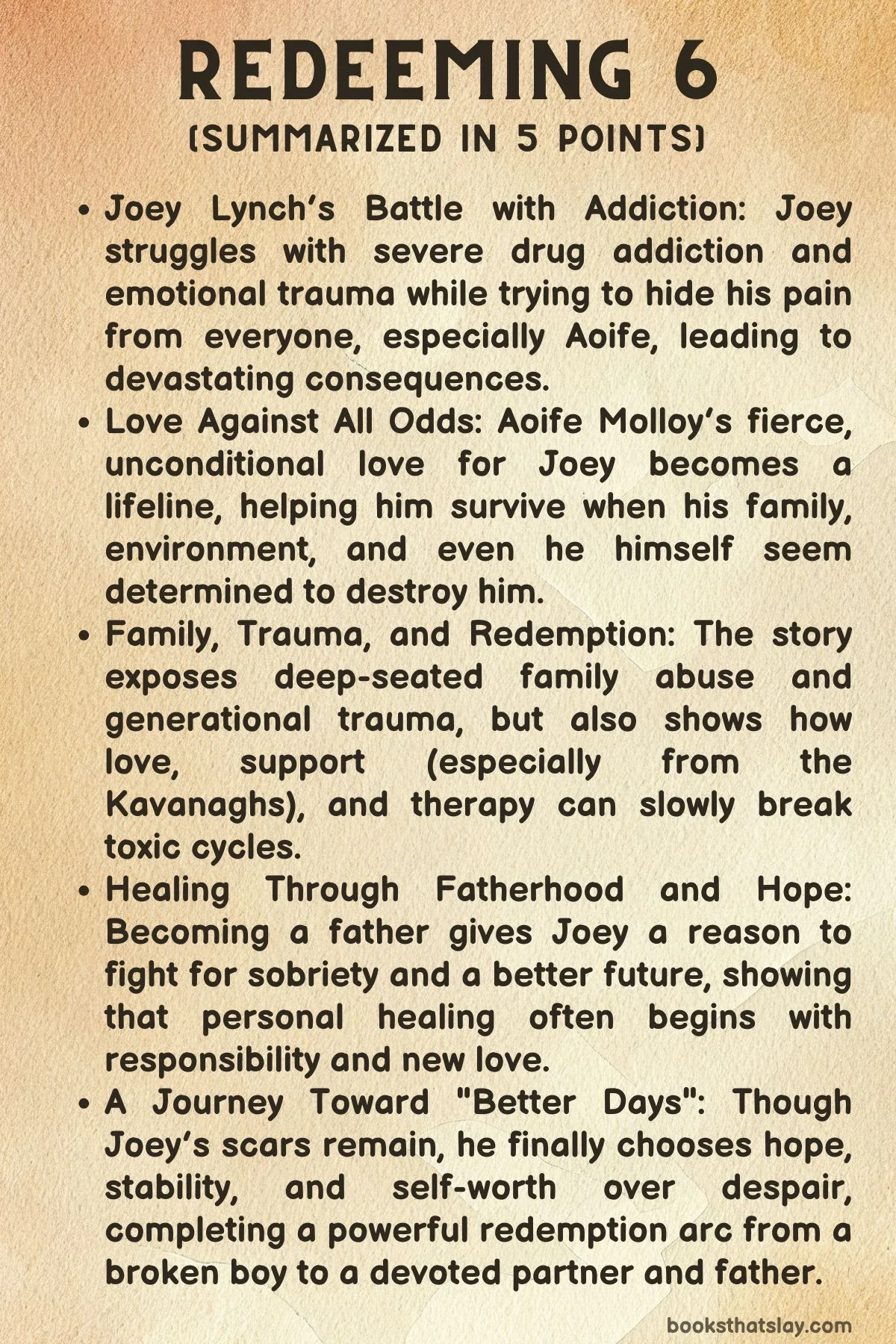
Joey still has anger, shame, and setbacks ahead of him, but he is no longer running from every hard truth. By the end, he and Aoife are not living a perfect life, but they are making a real one together, with their son, with Joey’s siblings nearby, and with hope that feels finally earned.
Characters
Joey Lynch
Joey is the emotional center of the story and by far its most conflicted character. He is loving, intelligent, protective, and capable of deep tenderness, yet he is also self-destructive, volatile, and trapped in the belief that he is fundamentally poisoned by his father’s legacy.
His addiction is not presented as a shallow flaw but as something tied to years of physical abuse, emotional neglect, parentification, and learned shame. Joey has been forced into the role of substitute parent for his younger siblings, financial provider for the household, and emotional shield for everyone around him.
Because of this, he sees himself less as a young man with a future and more as a body that absorbs damage for others. That mindset explains why he repeatedly sacrifices his own stability, why he believes he does not deserve Aoife, and why sobriety remains emotionally terrifying for him: without drugs, he is left alone with the full weight of memory and responsibility.
At the same time, Joey is not defined only by pain. His strongest trait is devotion.
He loves with frightening intensity, whether that is directed toward Aoife, Shannon, or the younger children. He notices what people need, carries burdens before being asked, and feels most purposeful when he is protecting someone.
Yet that same instinct becomes destructive because he cannot distinguish between care and self-erasure. He constantly makes decisions for others in the name of protecting them, from breaking up with Aoife to hiding the truth about his struggles, and these choices often strip other people of their agency.
His tragedy is that he mistakes martyrdom for love. Even when he imagines a future, he does so through sacrifice rather than healing.
One of the most powerful aspects of Joey’s characterization is the way he fears becoming Teddy. This fear governs nearly every major decision he makes.
He dreads fatherhood not because he is incapable of love, but because he believes violence is hereditary and masculinity itself is dangerous inside him. He interprets his addiction, his temper, and his sexual history as proof that he is already half-lost.
This is why moments of hope matter so much: his entrance into rehab, his growing honesty in therapy, his attempts to show up for Aoife and AJ, and his decision to keep living all signal that he is slowly learning identity is not destiny. Joey’s arc is ultimately about rejecting inherited ruin.
He does not become whole overnight, but he begins to understand that being different from his father requires more than hatred of him; it requires choosing responsibility, truth, and care over numbness and despair.
Aoife Molloy
Aoife is the novel’s emotional anchor and moral force. She is passionate, loyal, sharp-tongued, impulsive, and deeply compassionate.
What distinguishes her most is that she refuses to love passively. She does not stand on the sidelines admiring Joey’s pain; she enters it, challenges it, argues with it, and demands more from him than anyone else does.
Her love is fierce rather than gentle, which makes her a compelling counterpart to Joey. She sees his wounds clearly, but she never romanticizes them.
She understands why he is broken, yet she still insists that understanding cannot excuse every choice. That balance gives her character strength and dignity throughout the story.
Aoife is also notable for how often she is forced to carry emotional realities before she is ready. She is young, but her storyline pushes her into questions of sex, bodily autonomy, pregnancy, trauma, and future planning long before most people are prepared for them.
Even so, she rarely reads as childish. Her vulnerability comes from the fact that she feels everything intensely: jealousy, fear, desire, humiliation, grief, and hope all move through her in full force.
She wants certainty from Joey because she is building her life around him emotionally long before she does so physically. That makes his inconsistency devastating for her.
Still, she remains far more resilient than many characters assume. She is frightened by pregnancy, shaken by assault, and exhausted by Joey’s relapse, but she continues making choices, seeking support, and protecting both her baby and her own sense of self.
Another key part of Aoife’s characterization is her struggle between unconditional love and necessary boundaries. For much of the story, she believes that staying means proving love.
She keeps returning, forgiving, and hoping because she can still see the real Joey beneath addiction and self-hatred. But her development lies in learning that love without limits becomes self-abandonment.
When she finally begins prioritizing the baby, questioning whether belief in Joey is enough, and refusing to cover for everything he does, she becomes even stronger. She is not transformed into someone cold; instead, she matures into someone who understands that nurturing another person cannot come at the cost of total collapse.
Her final position is not blind loyalty but chosen partnership. She still loves Joey completely, yet that love is paired with standards, honesty, and a demand for safety.
Shannon Lynch
Shannon functions as one of the clearest embodiments of innocence damaged by violence, yet she is never written as weak. She begins as a vulnerable younger sister marked by bullying, fear, and the emotional scars of abuse, but over time she shows striking depth, emotional intelligence, and quiet courage.
Shannon understands the emotional weather of her family better than most adults in the story. She knows when Joey is near breaking, when their home is unsafe, and when silence is a survival tactic.
Her fragility is real, but it coexists with sensitivity, loyalty, and a strong instinct for emotional truth.
Her bond with Joey is one of the most important relationships in the narrative. He is not simply her brother; he is protector, parent figure, and emotional refuge.
Shannon’s presence also reveals the best and worst parts of Joey. His gentleness with her shows his capacity for care, while his obsessive protectiveness exposes how trauma has made him controlling and reactive.
Shannon loves him deeply, but she also becomes one of the characters most capable of seeing that he cannot save everyone by force. Her relationship with Johnny helps this further.
Through that connection, she begins stepping into a life that is not defined only by the Lynch home, and this creates a subtle but important shift: she is no longer only someone being protected, but someone beginning to imagine happiness for herself.
Shannon also represents the long afterlife of abuse. The bruises, panic, school troubles, and learned fear around men all show that violence is not confined to isolated incidents.
Yet her arc resists hopelessness. By the end, she is still scarred, but she is also safer, more loved, and more able to envision a future.
Her closing presence is important because it shows what recovery can look like in its earliest form: not forgetting, but finally having space to breathe.
Teddy Lynch
Teddy is the clearest antagonist, but he is more than a stock abusive father. He represents generational violence as a system of domination that infects everyone around him.
He is physically brutal, sexually threatening, manipulative, entitled, and consumed by the need to control his family through fear. He humiliates, beats, terrorizes, and degrades others not just out of anger, but as a way of preserving power.
The home revolves around anticipating him, surviving him, and cleaning up after his destruction. In that sense, he is not merely one bad man; he is the organizing principle of the Lynch family’s suffering.
What makes Teddy especially horrifying is how he attacks identity. He does not only hurt Joey physically; he makes Joey fear that he is the same kind of man.
He does not only beat Shannon; he sexualizes and shames her. He does not only abuse Marie; he traps her in cycles of fear, dependency, and emotional confusion.
Even characters outside the family, especially Aoife, are threatened by his presence. He poisons environments long before he enters the room.
That constant shadow explains why his violence continues to shape the children even in his absence.
Teddy’s final destruction of himself and Marie is consistent with his characterization because he would rather annihilate everything than relinquish control. He cannot bear a world in which his family escapes him.
Even in death, he leaves trauma behind. Yet the narrative also strips him of mythic power in the end.
He is not an unstoppable force, only a cruel man whose power depended on the silence and helplessness of others. Once the children begin leaving, speaking, and surviving him, his dominance is exposed as parasitic rather than absolute.
Marie Lynch
Marie is one of the most morally complicated figures in the story. She is both victim and enabler, harmed and harmful, and that duality is central to understanding her.
She lives under Teddy’s abuse, suffers physically and emotionally, and appears at times exhausted, frightened, and genuinely broken. Yet she also fails her children repeatedly.
She minimizes violence, chooses Teddy over them again and again, leans on Joey in profoundly inappropriate ways, and allows him to become emotional caretaker, co-parent, and substitute partner in the practical sense of household survival. Her dependence on him is one of the most painful parts of his character arc, because it trains him to believe love means rescue without reciprocity.
Marie’s tragedy is that she has been hollowed out by prolonged abuse to the point where her maternal role becomes warped. She is not devoid of feeling; there are moments where her grief, fear, or tenderness appear sincere.
But sincerity does not erase damage. She cannot protect her children because she cannot fully detach herself from Teddy, and in failing to choose them clearly, she becomes another source of injury.
To Joey especially, this is a devastating betrayal. He can understand cruelty from Teddy because it is open and obvious.
Marie’s failures hurt differently because they come from the person who should have chosen safety first.
As a character, Marie is important because she disrupts simplistic ideas of motherhood. She is neither monster nor saint.
She shows how abuse can deform judgment, loyalty, and selfhood until a person begins preserving the system that destroys them. That does not excuse her choices, but it makes them tragically believable.
Her death is painful not because she has earned redemption, but because she remains unresolved: a mother her children loved, needed, resented, and could never fully trust.
Trish Molloy
Trish is one of the strongest adult presences in the narrative and serves as a crucial counterweight to the chaos surrounding the younger characters. She is perceptive, emotionally available, practical, and instinctively protective.
Unlike many adults in the story, she notices emotional shifts quickly and takes them seriously. Her first concern is always Aoife’s wellbeing, but her care extends beyond her daughter.
She sees Joey more clearly than many others do, recognizing both his damage and his capacity for goodness. Because of this, she often acts as one of the few mature voices able to hold compassion and accountability together.
What makes Trish especially effective as a character is that her care is not sentimental. She does not excuse bad behavior, and she understands consequences in a grounded way.
When Aoife is pregnant, traumatized, or overwhelmed, Trish offers support without trying to erase reality. She stands up for Aoife, helps her navigate fear, and becomes one of the reasons Aoife does not collapse entirely under the pressures around her.
Her emotional steadiness is one of the story’s few reliable shelters.
Trish also functions as a model of motherhood distinct from Marie. She is not perfect, but she is present, vocal, and morally awake.
She intervenes, comforts, advocates, and acts. Even when she cannot fix everything, she provides something essential: a home where truth can be spoken without immediate destruction.
That contrast deepens the novel’s exploration of family, because it shows that care is not abstract love but repeated, protective action.
Tony Molloy
Tony is a stern, complicated father figure whose importance grows as the story progresses. He initially appears as someone suspicious of Joey and worried about Aoife’s future, which can make him seem rigid or judgmental.
But beneath that hardness is a deeply protective man who understands more than he says. Tony represents lawful, structured masculinity in contrast to Teddy’s violent domination.
He is not warm in an easy way, but he is consistent, responsible, and motivated by the need to keep his family safe.
His relationship with Joey is particularly meaningful because Tony becomes the closest thing Joey has to a decent paternal standard. Joey works for him, seeks his approval, and is wounded by his disappointment precisely because Tony matters.
Tony’s anger at Joey is not rooted in contempt but in fear for Aoife and the baby. He sees Joey’s potential, but he refuses to ignore the danger Joey’s addiction and instability can pose.
That makes his role especially important: he neither fully rejects Joey nor blindly embraces him. He forces Joey to understand that love is not enough without responsibility.
Tony also helps broaden the story’s treatment of fatherhood. He is protective to the point of harshness, but his protection is tied to duty rather than ego.
Even when angry, he does not become predatory or abusive. That distinction matters.
He is one of the few men in the story who demonstrates that paternal authority does not have to mean terror. His respect must be earned, and that makes his eventual willingness to give Joey a chance more meaningful.
Casey
Casey brings energy, blunt honesty, and fierce friendship to the story. She is emotional, impulsive, and at times chaotic, but beneath that volatility lies real loyalty.
She loves Aoife in a protective, almost combative way, often responding to perceived threats with anger or confrontation. Her instinct is to defend first and think later, which can make her seem dramatic, yet that same instinct also makes her dependable in moments of crisis.
She is the kind of friend who may not always use the right words, but she will not disappear when things get ugly.
Her importance lies in the fact that she is one of the first characters to read emotional danger clearly. She worries about Joey hurting Aoife, pushes Aoife to face uncomfortable truths, and refuses to let her hide forever behind denial.
When pregnancy enters the story, Casey becomes even more significant because she serves as both emotional witness and practical support. She does not try to dominate Aoife’s choices, but she insists that reality must be faced.
That honesty gives her real moral weight.
Casey also helps keep the story grounded in female friendship rather than making everything revolve only around romance. She represents the value of peer support, shared outrage, and the kind of love that tells hard truths.
Even when she is messy, she is never false. Her presence reminds the reader that survival is not built only through lovers and family, but also through the friends who refuse to look away.
Katie
Katie is quieter than Casey, but her role is still important because she often acts as a moderating influence within Aoife’s friendship circle. She is more measured, more diplomatic, and generally less explosive, which makes her useful in scenes where emotions are running high.
Where Casey tends to escalate, Katie tends to observe, interpret, and nudge. She helps create balance in Aoife’s social world, offering support without always turning every feeling into confrontation.
Her characterization also helps illuminate Aoife. Through Katie’s responses, the reader sees how visible Aoife’s pain is to people around her, even when Aoife believes she is hiding it.
Katie notices jealousy, hesitation, and emotional contradictions, and she often gently pushes Aoife toward honesty. She is not as central as some others, but she helps make the emotional ecosystem around Aoife feel real.
She represents the friend who may not dominate the room, yet whose steadiness contributes to survival.
Podge
Podge is one of Joey’s most important friends because he offers loyalty without feeding every destructive impulse. He understands Joey’s environment, knows the practical realities of his life, and can read him in a way that outsiders often cannot.
Podge sees the difference between Joey’s bravado and his vulnerability. He jokes, pushes back, helps when needed, and repeatedly acts as one of the few people willing to call out Joey’s self-sabotage directly.
What makes Podge valuable is that his friendship has substance. He is not there only for comic relief or school scenes; he often becomes a stabilizing force when Joey is close to collapse.
Whether helping physically, checking on him, or acting as an informal messenger between Joey and Aoife, he proves that male friendship in the story can include caretaking and emotional concern. He does not always have solutions, but he shows up.
That reliability matters in a world where many adults fail Joey.
Podge also represents the ordinary life Joey might have had under different circumstances. Around him, Joey sometimes gets to be just a teenage boy joking with friends rather than a traumatized provider holding a family together.
That contrast quietly emphasizes everything Joey has lost.
Alec
Alec, like Podge, belongs to Joey’s close support system, but his energy is more overtly forceful. He is protective, physically assertive, and quick to act on Joey’s behalf.
His loyalty is unquestioned, and he often expresses care through action rather than emotional language. He is the kind of friend who will fight, intervene, or stand guard without needing a speech first.
This makes him an important part of Joey’s world, especially in public settings where Joey’s vulnerability would otherwise leave him exposed.
At the same time, Alec’s character reflects the environment these boys come from. Protection often takes aggressive form because violence is normalized in their social world.
Yet Alec’s actions usually come from solidarity rather than cruelty. He is not deeply introspective on the page, but he matters because he helps show that Joey is not entirely alone.
The fact that others are willing to defend Aoife and stand beside Joey reinforces the idea that chosen loyalty can exist even among damaged teenagers.
Kevin Molloy
Kevin is a painful but believable portrait of sibling resentment, immaturity, and gendered judgment. He reacts to Aoife’s pregnancy with cruelty, anger, and blame, exposing how quickly family loyalty can fracture under shame.
His instinct is to police his sister rather than protect her, and he channels his own frustrations into moral condemnation. In this way, Kevin becomes a representation of how patriarchal attitudes can take root even inside families that are not outwardly monstrous.
Yet he is not written as pure evil. His later attempts to apologize suggest that some of his behavior comes from confusion, fear, and emotional incompetence rather than total lack of conscience.
Even so, the damage is real. He fails Aoife at a crucial moment, and that failure changes their bond.
Kevin’s character is useful because he shows that harm does not always come from dramatic villains. Sometimes it comes from ordinary people who choose judgment over empathy when someone is vulnerable.
Johnny Kavanagh
Johnny is one of the clearest symbols of an alternative future. He is talented, socially admired, and associated with a more privileged world, yet he is consistently more thoughtful and decent than his status might initially suggest.
His relationship with Shannon reveals his patience, sincerity, and emotional maturity. He does not approach her as someone to possess or rescue, but as someone to understand.
That makes him a quietly healing presence in her life.
Johnny also becomes important to Joey’s development. At first, Joey views him through suspicion and territorial protectiveness, but over time Johnny proves himself reliable.
He helps Shannon, protects the younger children, and becomes part of the network that keeps the Lynch family alive when everything is collapsing. His family’s support later becomes transformative.
Through Johnny, Joey is exposed to a model of male success that is not built on domination, addiction, or violence.
As a character, Johnny represents hope without naïveté. He is not untouched by the world’s ugliness, but he is not shaped by it in the same destructive way as Joey.
This contrast helps illuminate Joey’s tragedy while also suggesting that love, care, and masculine strength can coexist without cruelty.
Gibsie
Gibsie brings warmth, humor, and generosity into scenes that might otherwise become unbearably heavy. He is socially confident, playful, and often irreverent, but underneath the charm is real decency.
He helps repeatedly without demanding recognition, whether through emotional support, money, transportation, or social mediation. Because of this, he becomes one of the story’s quiet examples of how kindness often arrives through people who do not present themselves as solemn heroes.
His importance also lies in the bridges he creates between social worlds. He is part of the Tommen crowd, but he treats Joey and Aoife with openness rather than condescension.
In doing so, he softens class divisions and widens the circle of people who care about the central couple. He is proof that support can come from unexpected places, and that friendship does not always need dramatic declarations to be meaningful.
Lizzie
Lizzie is a smaller but crucial character because she appears at moments when Joey is on the edge of self-destruction. Early on, her presence is misread through jealousy, but she later becomes something far more important: a witness who interrupts annihilation.
Her intervention on the bridge is one of the most significant acts in the story because it happens at the exact moment when Joey is closest to disappearing entirely. She does not save him through romance, guilt, or melodrama, but through blunt human connection and shared pain.
Lizzie’s own history gives her words weight. She understands the reality of suicide’s aftermath, and because of that, she can cut through Joey’s distorted thinking in a way others cannot in that moment.
She represents the stranger-friend figure who arrives not to dominate the narrative, but to redirect it decisively. Her compassion has force because it is grounded in experience rather than idealism.
Shane Holland
Shane is the embodiment of predatory addiction culture. He is manipulative, opportunistic, and skilled at identifying weakness.
Unlike Teddy, whose violence is domestic and overt, Shane’s harm comes through temptation, dependency, and calculated timing. He appears whenever Joey is most fragile, offering escape disguised as relief.
His power lies in knowing exactly how to weaponize Joey’s pain.
Shane is important not because he is psychologically complex in the same way as Joey or Aoife, but because he personifies the external machinery that keeps trauma cycling. He profits from collapse.
Every time Joey reaches for numbness, Shane is waiting to translate suffering into transaction. That dynamic helps the story show addiction not only as personal struggle, but as something exploited by others for gain.
Shane is less a friend gone wrong than a parasite feeding on vulnerability.
Darren Lynch
Darren is another morally difficult character. As the older brother who got out, he carries both legitimacy and guilt.
From Joey’s perspective, Darren is the one who escaped and left the rest behind, which makes his later reappearance emotionally explosive. Darren tries to intervene in practical ways, especially regarding rehab and the baby, but his methods are often controlling, judgmental, and emotionally clumsy.
He sees danger clearly, yet he frequently approaches it with coldness rather than empathy.
Still, Darren’s flaws are rooted in his own history. He is not indifferent; he is damaged in a different direction.
Where Joey internalizes responsibility and stays, Darren distances, controls, and hardens himself. He appears to believe that emotional detachment is the only way to survive a family like theirs.
This makes him frustrating but believable. He is trying to prevent repetition, yet in doing so he often strips Joey and Aoife of dignity and choice.
His role is important because he shows that escaping abuse does not automatically teach someone how to love well.
Tadhg Lynch
Tadhg is one of the younger siblings through whom the long-term damage of the household becomes undeniable. He is still a child, yet he is pushed into situations that no child should face, including direct confrontation with Teddy.
His most dramatic moment, when he threatens Teddy with a knife, reveals just how completely the home has collapsed. Tadhg is not naturally violent; he is cornered into terror-driven courage.
That moment is shocking because it shows abuse reproducing itself downward through the children, forcing them into impossible acts of survival.
He also represents why Joey keeps fighting. Tadhg, like the other younger brothers, is part of the future Joey is desperate to save.
His vulnerability gives emotional urgency to Joey’s choices. By the end, Tadhg’s move into a safer environment suggests that intervention has finally come before total destruction.
Ollie Lynch
Ollie often appears in moments that underscore how much the younger children rely on Joey and Aoife, even when they do not fully understand the adult crises around them. His calls for help and frightened dependence reveal the household from a child’s perspective: chaotic, dangerous, and unstable.
Ollie matters because he keeps the stakes concrete. The violence in the Lynch home is never abstract while younger children are still living inside it.
Sean Lynch
Sean, like Ollie, represents innocence under pressure. Joey often worries about him, cares for him, and factors him into every major decision.
Sean helps highlight Joey’s parentified role because Joey’s concern for him is not brotherly in a casual sense; it is practical, constant, and parental. Through Sean, the story reinforces the idea that Joey’s fear of fatherhood is bitterly ironic, because he has already spent years raising children.
Hughie Biggs
Hughie occupies a smaller role, but he helps establish class contrast and social texture. He initially appears as one of the more privileged boys from the other side of town, someone whose world is far removed from Joey’s struggles.
Yet he is not drawn with the malice of major antagonists. Instead, he functions more as part of the wider teenage social environment, where desire, reputation, and status constantly intersect.
His connection to Katie and his presence in party scenes help expose the emotional insecurity simmering beneath surface glamour.
Claire
Claire’s role is limited, but she contributes to the social atmosphere that surrounds the main couple. Her flirtation and visibility at parties help trigger Aoife’s jealousy and emotional comparison, which makes her useful less as a deeply independent figure and more as part of the emotional pressure-cooker in which Aoife and Joey keep colliding.
She represents the world of ordinary teenage attraction that exists around the central drama, making the lovers’ intensity seem even more consuming by contrast.
Paul Rice
Paul represents a more commonplace but still ugly form of male cruelty. He is petty, mocking, invasive, and quick to exploit vulnerability for social attention.
His treatment of Aoife reflects the nastiness of school culture, where shame becomes public entertainment. He is not terrifying in the way Teddy is, but he is still part of the ecosystem that humiliates girls and punishes them for sexuality and pregnancy.
His later apology adds some complexity, showing that he is capable of regret and perhaps growth. Even so, the apology does not erase his earlier behavior.
Paul is significant because he shows how harm can come not only from extreme abusers, but also from ordinary boys performing cruelty for status.
Bella Wilkinson
Bella is another example of social aggression operating through teenage hierarchies. Her attack on Shannon reinforces how girls, too, can become agents of cruelty within a status-driven environment.
She is less psychologically explored than the central characters, but her role is important because she contributes to the cumulative pressures that keep Shannon unsafe even outside her home.
Edel Kavanagh
Edel is one of the most nurturing adult figures in the novel. She offers food, shelter, practical help, and deep emotional generosity without making others feel indebted in a humiliating way.
Her home becomes a model of what care can look like when it is not tangled with violence or control. She mothers expansively, not only toward Johnny but toward Joey and the Lynch children as well.
What makes Edel especially moving is that she does not offer abstract sympathy; she creates structure and refuge. She is one of the first adults to treat Joey as someone worth saving without either condemning him or collapsing under his pain.
Her support helps make recovery imaginable. In a story filled with failed adults, Edel feels revolutionary simply because she is dependable.
John Kavanagh
John is another restorative adult presence, though his care is often expressed through action and authority. As a lawyer and father, he uses his social position to protect rather than dominate.
He steps in for Joey legally, thinks strategically, and helps build a path toward safety for the younger children. His masculinity is calm, competent, and ethical, which matters enormously in a narrative so full of violent men.
John’s presence also broadens the story’s theme of chosen family. He is under no obligation to carry the Lynch children’s burdens, yet he does.
In doing so, he becomes proof that adults can intervene meaningfully, and that systems of protection do not have to fail every time.
Dr. B
Dr. B represents one of the hardest things for Joey to accept: help that requires honesty rather than endurance. She is patient, firm, and psychologically perceptive.
Instead of treating addiction as only chemical dependence, she pushes Joey toward the deeper truths beneath it, especially his trauma, shame, sexual history, and self-concept. Her role matters because recovery in the story is not presented as simple detox.
Through her, the narrative insists that healing requires language, memory, and emotional confrontation.
She is also important because she refuses to be manipulated by Joey’s avoidance. He bargains, deflects, and resists, but she remains steady.
That steadiness gradually gives him something rare: a relationship in which truth is not punished. Her breakthrough with him feels earned because it comes only after he has exhausted all his defenses.
AJ Lynch
Although AJ is a newborn by the end and not yet a developed personality, he is symbolically vital. He represents both terror and possibility.
For Joey, AJ initially embodies the fear of becoming his father, but later becomes the clearest reason to remain accountable, present, and alive. For Aoife, AJ turns abstract hope into immediate responsibility.
He is not merely a baby used to create drama; he is the living future both parents must now build themselves worthy of.
AJ also changes the emotional structure of the story. Once he arrives, love can no longer be only romantic or self-sacrificing.
It has to become practical, sober, and daily. In that sense, AJ is the final test of whether the characters can turn feeling into stability.
Themes
Love as Care, Burden, and Moral Responsibility
Love in Redeeming 6 is shown less as a source of comfort alone and more as a force that demands action, sacrifice, patience, and painful honesty. The central relationship is shaped by devotion, but that devotion is never simple.
Joey and Aoife do not merely want each other; they are constantly forced to decide what loving someone actually requires when addiction, fear, shame, and trauma are involved. Joey often convinces himself that leaving Aoife is an act of care because he believes his damaged state will ruin her life.
That mindset reveals an important idea: love can become distorted when a person’s self-hatred is so deep that they confuse absence with protection. Aoife, on the other hand, rejects the idea that she needs to be protected from the truth of who he is.
Her version of love is rooted in staying, seeing, and insisting that she has the right to choose the full reality, not a polished version designed to spare her. This tension gives emotional weight to their relationship because both of them are trying to love, yet they keep defining love differently.
The theme also grows beyond romance. Joey’s care for his siblings is one of the clearest expressions of love in the story.
He cooks, supervises, worries, earns money, and repeatedly places himself between them and danger. His love is parental long before he becomes a father.
That matters because it shows that love is not measured only through tenderness or words, but through exhausting daily labor. Aoife’s care expands in similar ways.
She supports Joey, helps with his younger brothers, stands by Shannon, and later confronts the frightening reality that loving someone cannot mean allowing them to destroy themselves while she pretends not to see it. The arrival of pregnancy makes this theme even more demanding.
Love stops being only about desire and becomes tied to duty, safety, and future consequences. By the end, love is presented as something that must include boundaries, accountability, and growth.
It is not enough to feel deeply. The story keeps asking whether love can survive when it must carry trauma, addiction, parenthood, and history all at once, and its answer is that love can endure only when it becomes an active commitment to protecting life rather than merely clinging to emotion.
The Lasting Violence of Family Trauma
Family trauma shapes nearly every major conflict, not as a background detail but as the structure around which the characters’ lives are built. Abuse in Joey’s household affects the way he sees himself, the choices he makes, the relationships he forms, and the future he fears he will repeat.
The damage caused by Teddy is not limited to moments of physical violence. His cruelty creates an atmosphere of terror, instability, humiliation, and inherited despair.
Joey has grown up learning that love can coexist with brutality, that home can become a battlefield, and that survival often depends on silence, endurance, or self-sacrifice. Because of that, trauma becomes something that keeps reproducing itself in behavior, memory, and fear.
Joey’s addiction is linked to this history, but so is his extreme protectiveness, his constant guilt, and his belief that he is fundamentally contaminated by his father’s legacy. He does not simply fear becoming a bad partner or father in an abstract sense; he fears becoming a version of the man who terrorized his family.
The novel also refuses to place all blame on one obvious villain while ignoring the broader family system that allowed harm to continue. Marie’s failures are deeply important to this theme.
Her inability to protect her children, her repeated return to Teddy, and her dependence on Joey create another layer of injury. Joey is not only wounded by his father’s violence; he is also wounded by his mother’s inability to choose her children over that violence.
This is why his pain is so conflicted. He feels responsible for everyone, furious at everyone, and loyal to people who have failed him.
The younger children and Shannon reveal how trauma spreads across a family. Each child carries fear differently, whether through silence, panic, secrecy, rebellion, or dependency on Joey.
The abuse is therefore not presented as one person’s suffering but as a corrosive force that shapes an entire household across years.
Aoife’s assault makes this theme even sharper because it shows how the violence of one family can spill outward and damage others. After that event, trauma enters her body, her thoughts, and her relationship, changing how she responds to Joey despite knowing he is not Teddy.
That distinction matters. Trauma does not follow logic neatly.
It stains trust, intimacy, and memory. The story presents healing as difficult precisely because trauma is not solved when the abuser is absent; it remains in the habits of fear, self-blame, and emotional confusion left behind.
In this way, the narrative argues that family trauma is not only about what happened in the past. It is about how the past continues to live inside people until safety, truth, and intervention finally interrupt its hold.
Addiction, Relapse, and the Struggle for Selfhood
Addiction is presented not as a single bad choice but as a condition tied to pain, shame, hopelessness, and the desperate need to escape unbearable reality. Joey’s substance use is central because it affects nearly every bond in his life, yet the narrative does not reduce him to that condition.
Instead, it shows the exhausting contradiction of a person who sincerely loves others while repeatedly endangering himself and failing them. That contradiction is what makes the theme powerful.
Joey understands the damage drugs cause. He has already nearly died.
He wants sobriety at several points. He also hates what addiction turns him into.
But desire alone is not enough to free him. The story insists that addiction is bound to deeper wounds, especially his abuse history, his lack of stable support, and his belief that he is irreparably broken.
Drugs offer him numbness, but they also reinforce his worst idea about himself: that he is weak, dangerous, and doomed to fail the people who trust him.
Relapse is treated with similar seriousness. It is not framed as a sudden twist but as something built through pressure, guilt, access, and emotional collapse.
Each return to substance use follows emotional devastation, fear, or self-loathing. That pattern matters because it shows addiction as cyclical rather than linear.
Even when Joey has good intentions, moments of crisis reveal how fragile recovery is without structural help. His repeated insistence that he is in control exposes one of the painful truths of addiction: the mind protects the habit through denial, minimization, and false confidence.
Aoife’s position in relation to this is equally important. She loves him fiercely, but she cannot love the addiction out of him.
Her support matters, yet the narrative makes clear that loyalty without limits can become dangerous, especially once pregnancy and the baby’s safety are involved. That shift strengthens the theme by showing that addiction harms not just the user but the emotional and physical lives of everyone nearby.
Rehab becomes significant because it marks the point where recovery begins to involve more than detoxification. Joey initially wants only to remove the substances, not confront the inner damage beneath them.
His therapy scenes show that getting sober is also about facing memory, shame, sexuality, violence, and identity. He has to question whether he is truly his father’s son in a moral sense or whether he can build a separate self.
That is why addiction in the story is closely tied to selfhood. Joey is not simply trying to stop using drugs; he is trying to discover whether a version of himself exists that is not ruled by fear, inherited violence, and chemical escape.
Recovery becomes meaningful only when he begins to imagine that he deserves a future. The theme therefore moves beyond substance dependence and becomes a larger examination of whether a damaged person can still claim dignity, responsibility, and the right to change.
Fear of Inheritance and the Hope of Breaking Cycles
One of the strongest concerns in the narrative is the fear that suffering passes from one generation to the next. Joey’s terror about fatherhood is not ordinary nervousness.
It comes from the belief that blood carries doom, that being Teddy’s son means he might one day become a source of harm himself. This fear shapes his reactions to Aoife’s pregnancy, his efforts to push her away, and his recurring conviction that she and the baby would be safer without him.
He does not just worry about practical matters like money, age, or readiness. He worries that violence, addiction, and emotional damage are waiting inside him, ready to surface.
That fear is reinforced whenever others compare him to his father or imply that his family background determines his future. The emotional force of this theme comes from how believable that fear is for someone raised in sustained abuse.
When cruelty has defined manhood in a household, becoming a father can feel less like an opportunity and more like a threat.
At the same time, the story refuses to accept inheritance as destiny. Joey’s life offers repeated evidence that he is already different from Teddy in essential ways.
He protects children instead of terrorizing them. He worries constantly about consent, safety, and responsibility, even when he fails in other respects.
He feels guilt because he has a conscience, and he fears hurting others because he values them. These distinctions matter.
They suggest that inherited damage is real, but inherited evil is not inevitable. Aoife plays an important role here because she sees the difference before he can fully believe it himself.
Her faith in him is not blind; she knows his failures clearly. Yet she continues to argue that his origins do not have to define his end.
Pregnancy turns that argument into a concrete future. The unborn child becomes both a source of pressure and a symbol of possibility.
The question is no longer only whether Joey can survive his past, but whether he can create a home unlike the one that made him.
The conclusion gives this theme its emotional payoff. Rehab, the support of the Kavanaghs, the safety of the younger siblings, the birth of AJ, and Joey’s return to school all point toward interruption rather than repetition.
Nothing is magically solved, and that restraint is important. The scars remain, the fears remain, and trust has to be rebuilt through action.
But the ending still suggests that cycles are broken not through one dramatic decision alone but through many sustained choices: accepting help, facing trauma, protecting children, pursuing education, staying sober, and refusing the lies of the past. The final image of family is especially meaningful because it offers a contrast to the violent household that shaped Joey.
Stability, care, and hope begin to replace terror and secrecy. In that sense, the narrative argues that inheritance is powerful, but chosen responsibility, community support, and honest love can begin to create a different legacy.