Rejected by Jaymin Eve Summary, Characters and Themes
Rejected by Jaymin Eve is a paranormal romance set in a shifter-controlled town where power decides who gets protected and who gets crushed. Mera Callahan has spent years paying for her father’s defiance, carrying bruises, keeping quiet, and counting down to the night her wolf finally awakens—because that night is also her best chance to escape.
What begins as a survival story quickly widens into something bigger: forced bonds, broken mate ties, strange magic that shouldn’t exist in her world, and a dangerous being from beyond it who claims Mera is the key to a locked realm.
Summary
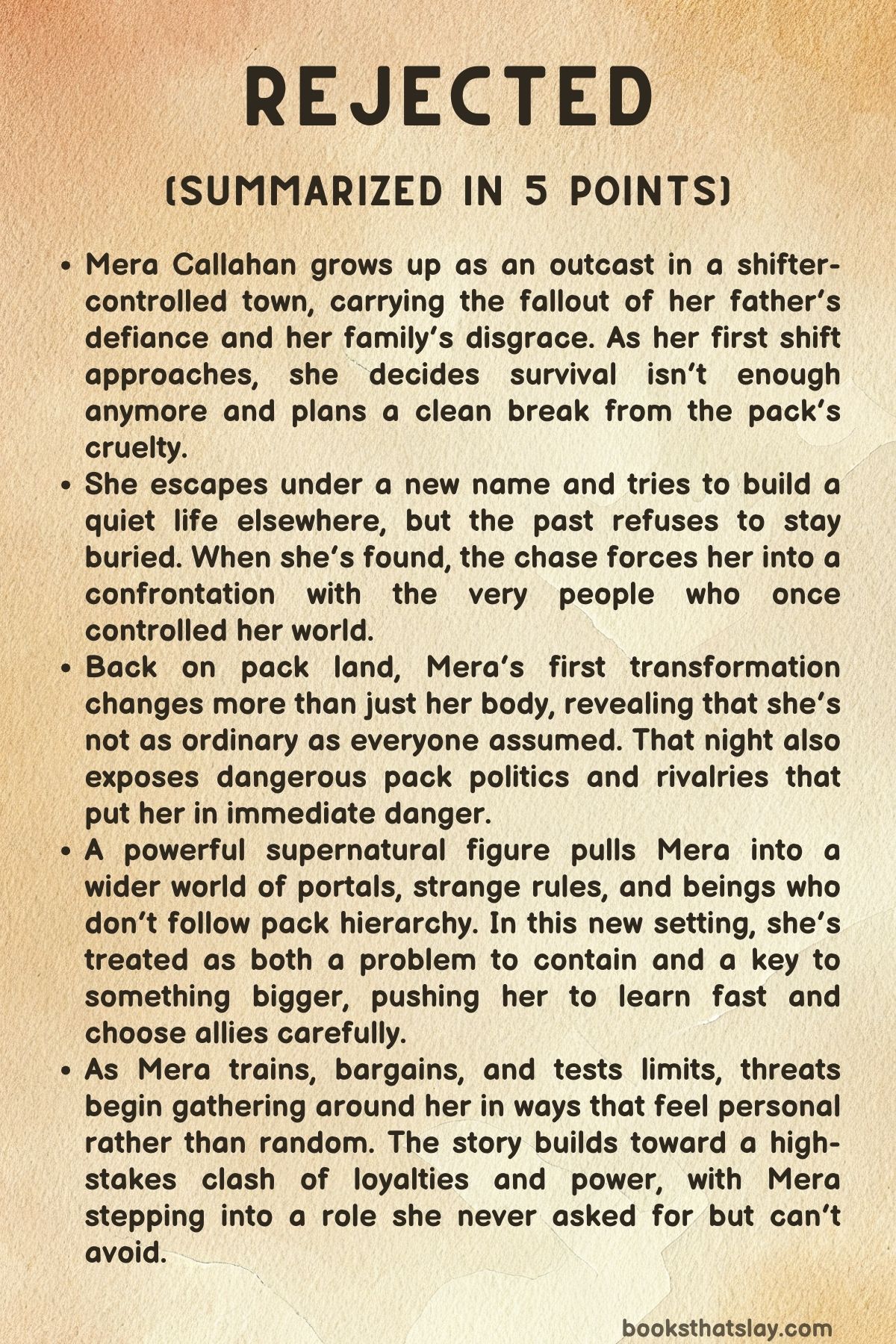
Mera Callahan is twenty-two, finishing college, and living in Torma, California—an isolated town controlled by the most powerful shifter pack in America. The pack has hated her family ever since her father challenged the alpha, Victor Wolfe, and was killed for it.
Since then, Mera and her mother have been treated like stains that won’t wash out. Mera learns to endure: she hides injuries, avoids attention, and focuses on one goal—make it to the winter solstice full moon, the night shifters first change at twenty-two.
Once she has her wolf and can control it, she plans to leave Torma forever.
At school, Mera’s only real friend is Simone, whose parents are pack enforcers and therefore untouchable. Simone is frustrated by life in Torma but still has time before her own first change.
Mera doesn’t. She’s a target every day.
Torin Wolfe, Victor’s son and the future alpha, watches her with cold distance, while Sisily Longeran—who expects to be Torin’s future mate—openly torments her. Jaxson Heathcliffe, Torin’s closest friend and someone Mera once knew as a child, is worse.
He humiliates her and hurts her with a personal edge, as if his cruelty is fueled by history.
Mera’s one safe place is her job at Dannie’s Books. Dannie is older, sharp-tongued, and oddly fearless about criticizing pack leadership.
She notices Mera’s bruises and quietly helps her by paying her in cash, urging her to keep an escape fund hidden. When Victor calls the pack to a mandatory meeting, he announces preparations for the new shifters’ first changes and a social event meant to push mate bonds.
He follows it with a group run that triggers a mass shift. Simone pulls Mera away before wolves fully take over, and in the panic of an emptied town and a head full of dread, Mera admits she wants to run that very night.
Simone begs her not to, warning that a first shift without an alpha’s guidance can be deadly. Mera hesitates, but the choice gnaws at her until she can’t stand it anymore.
Mera runs. She leaves Torma behind and starts over in Hood River, Oregon, using the name Lucy Jones.
She rents a remote cabin and works at a diner, trying to enjoy a normal life without pack cruelty. But her first change is closing in, and the fear returns in a new form: what if she loses control alone?
She also starts to feel watched. Her instincts sharpen, her nerves fray, and the woods around her cabin stop feeling like protection.
One day, her boss mentions a “friend from California” came asking about her. Mera understands immediately—she’s been found.
She abandons her shift, races to her cabin for her hidden money, and tries to disappear again. Instead, she walks into an ambush.
Torin and Jaxson have tracked her to the forest. A wolf attacks, Mera fights back with a blade, and she’s injured badly.
In the chaos she manages to hurt Torin and nearly reaches the safety of a human crowd, but Jaxson catches her and she blacks out, convinced she’s dying.
She wakes in the pack’s underground cells in Torma. Victor’s mate, Glendra, beats and threatens her, promising to break her for Victor’s purposes.
Mera escapes through a less-used exit and flees into the forest, diving into icy water to hide her scent. Exhaustion and injury nearly drown her—but she’s dragged out by Jaxson.
He calls her “Sunny,” a childhood nickname, and insists he didn’t mean to kill her. He claims he brought her back so she’d heal and so Victor could oversee her first change.
Mera doesn’t believe his concern cancels out the harm. Still, she’s taken back to pack lands, where Victor makes his intentions plain: after Mera shifts, he plans to lock her to the pack through an unbreakable alpha bond and force her to serve him for life.
Mera refuses him outright, and Victor answers with violence. She’s thrown back into a cell and warned that no one is to go near her.
Jaxson lingers anyway, claiming his presence is the reason she hasn’t been hurt again. Dannie storms in, furious and protective, insisting the pack has punished Mera for something she never did.
She brings Mera a homemade drink that eases her pain and reminds her that the people who hurt her have weaknesses too.
On the solstice full moon, the new shifters gather for their first change. The transformation is brutal, but something unexpected happens: Mera’s mind clears in wolf form far sooner than it should.
She can think, plan, and choose—an advantage she hides while searching for an escape route. Her freedom lasts only hours.
Jaxson catches up to her in wolf form, trying to claim her through pack dominance games, and she pretends to comply so no one notices she’s unusually aware.
When the pack is called back by the alpha’s pull, Mera is dragged toward the pack house again, and the future she feared rushes at her. Then Torin scents her.
Mera’s wolf reacts with a force she can’t control, recognizing Torin as her true mate. Shock spreads through the pack.
Mera moves toward Torin, but Sisily attacks her viciously, desperate to protect her own claim. Mera fights back on instinct until Victor’s command freezes them.
Torin makes his choice in front of everyone: he rejects Mera, declares Sisily his partner, and forces the rejection deeper with a public display meant to ruin the bond. The pain hits Mera like a body-wide fracture.
Her howl becomes so strong it drops pack members to the ground. Victor orders her killed.
Dean Heathcliffe tries to snap her neck, but something inside Mera erupts—an unfamiliar power tied to a “Shadow Beast.” Her vision shifts into strange purple tones, and she sees shapes and layers in reality that shouldn’t exist. When she touches that shadow layer, a shockwave blasts outward and drops the entire pack unconscious.
Mera tries to flee, but the pack leadership recovers quickly enough to stop her. She wakes chained in Torin’s room, forced to endure more rejection theater designed to crush her.
Mera refuses to break. In the middle of this, she calls out to the Shadow Beast—and the house is swallowed by unnatural darkness.
A shimmering midnight portal forms, and a being steps through: Shadow, the Shadow Beast himself. He claims he’s been searching for Mera, accuses her of touching the Shadow Realm, and treats her like a dangerous puzzle.
When Victor tries to challenge him, Shadow burns Victor alive without effort and carries Mera away through the portal.
Mera is dragged through a corridor of doors that lead to different realms and powerful beings. Shadow warns her that some doors are worse than death for humans.
He brings her to his territory—part prison, part fortress—and interrogates her, trying to force the shadow-vision to return. When she can’t explain it, he pushes her body and magic to the edge.
Exhausted, she eventually finds herself in the Library of Knowledge, a vast supernatural hub full of creatures and books connected by doorways between worlds. A goblin concierge, Gaster, explains that inside the library she can understand languages and that she’s been given temporary access—though debts and favors are a currency here.
Over time, Mera learns the basics of the ten worlds and starts forming connections. She meets Angel, a warrior who has been alone for centuries and no longer uses her original name.
Angel bonds with Mera through a rare link that will eventually allow silent communication. Shadow returns and notices Mera’s growing web of allies.
He remains controlling, insisting she belongs to him and that he will destroy her if she threatens the Shadow Realm. He also admits unsettling facts—such as having escorted Mera’s father to his afterlife—while refusing to let her cross that line.
Shadow’s main problem becomes clear: a powerful sealing spell blocks him from returning fully to his realm, and Mera’s strange ability seems to brush against it. Shadow takes her on hunts for shadow creatures appearing on Earth, creatures that seem drawn to Mera’s presence.
During one mission, Mera is attacked by a spider-like demon and saved only because Shadow burns the poison out of her body. Back at the library, she tries to bargain for small freedoms and clings to one goal: regain control of her life, even if it means using Shadow’s rules against him.
A short trip into Faerie goes wrong when a fae enchantment traps Mera in painful compulsion, and Shadow helps her survive it, afterward admitting it was his mistake to enter at that time. Their relationship becomes tense but more complicated: he can be ruthless, but he also acts when her survival is on the line.
Soon after, Shadow contains a growing number of shadow creatures on pack lands, explaining that many can’t be permanently destroyed by ordinary weapons. He begins considering a long-term plan—using Mera as a conduit to form a stable doorway and finally confront whoever trapped him behind the sealing spell.
Before anything can settle, intruders strike the library with a dark powder that incapacitates Shadow and Mera. Mera is seized and dragged back to Torma by Torin and Jaxson, who claim they’re “saving” her.
Back in the pack house, Torin forces obedience through alpha command and tries again to push Mera toward accepting him as her mate. Simone returns in tears, and Mera learns more bad news: her mother is dead, and Dannie may have been taken.
Simone arranges a secret meeting at the school theater. Mera escapes during a distraction and sneaks into a storage space beneath the stage, where she and Simone overhear pack leaders revealing the truth.
Dean boasts that the powder was obtained from an “explorer,” and that a “virgin sacrifice” was used to interrupt the library portal and block Shadow from returning. They also confirm they killed the “wanderer”—Dannie—to complete the spell.
Rage and grief crack something open in Mera. Her power flares into fire, and Shadow’s presence closes in as darkness gathers.
Mera steps forward into that shadow, burning with the same dangerous energy, ready to face what she’s becoming—and what the pack has made her.
Characters
Mera Callahan
Mera is the story’s emotional and moral core in Rejected, defined first by endurance and later by escalation. She begins as a young woman shaped by long-term pack cruelty—hypervigilant, strategic, and quietly determined—who survives by shrinking herself, hiding evidence of harm, and postponing hope until her first shift gives her a chance to disappear.
Once she runs, her identity becomes fluid in a practical way (Lucy Jones is less reinvention than camouflage), but her internal drive stays consistent: autonomy at any cost. Her first shift reveals a crucial contradiction in her life—she has been treated as powerless, yet her instincts, resilience, and unusual awareness in wolf form show she was never truly helpless, only constrained.
That contradiction becomes the engine of her transformation: when she is forced into increasingly impossible situations, her latent connection to shadow power manifests as something both protective and frightening, implying she is not merely a mistreated pack member but a destabilizing force in the supernatural order. Across the arc, Mera’s key trait is refusal—refusal to accept a bonded fate, refusal to accept pack hierarchy as justice, and eventually refusal to accept that her power belongs to anyone who wants to use it, including the beings who claim ownership over her.
Lockhart Callahan
Lockhart is more absence than presence, yet his shadow stretches over Mera’s entire life. His challenge to Alpha Victor and the resulting death function as the pack’s justification for social punishment, making him a symbol of “treason” in their narrative and a cautionary tale used to keep others compliant.
For Mera, he is also the origin point of inherited stigma, meaning she grows up paying for an act she did not commit. Later revelations that Shadow escorted Lockhart to his afterlife deepen Lockhart’s role as a hinge between worlds: he is tied both to pack politics and to the larger cosmology beyond Earth.
In effect, Lockhart becomes a silent proof that the story’s power structures extend far beyond Torma, and that Mera’s lineage may intersect with forces the pack never understood.
Simone
Simone is the most consistent source of human warmth in Mera’s early life, and her kindness is made more meaningful by how dangerous it is in Torma to be openly allied with a pariah. She embodies a cautious empathy—helping Mera hide bruises, offering safe space, and urging endurance—not because she agrees with the pack, but because she fears the cost of open rebellion.
That caution sometimes reads as complicity, yet the story treats it as a survival strategy common to people raised under authoritarian structures. As the plot darkens, Simone’s role evolves from friend to covert collaborator: she becomes a conduit for information, a link to the pack’s internal cracks, and eventually a participant in high-risk resistance.
Her emotional complexity is strongest when she balances loyalty to Mera against terror of what the pack can do, showing that bravery in this world often looks like trembling but still showing up.
Dannie
Dannie is a protector figure with teeth—eccentric on the surface, but quietly radical in how she refuses the pack’s narrative about Mera. By paying Mera in cash and encouraging contingency planning, Dannie acts like someone who understands systems of control and knows that escape requires resources, secrecy, and timing.
She also functions as a moral mirror to characters who hide behind pack law: Dannie speaks plainly, challenges Torin’s coldness, and refuses to pretend that punishment equals justice. Her “energy drink” is a small but significant symbol of care—practical aid disguised as humor—underscoring how she supports Mera’s agency rather than demanding gratitude.
Her later fate, revealed through the conspirators’ discussion, reframes her as a true martyr of resistance: not just a kind shop owner, but someone whose death is weaponized by the pack’s leadership, proving she was dangerous to them precisely because she helped Mera survive.
Torin Wolfe
Torin is written as a living paradox: the future alpha trained for authority, yet emotionally stunted in how he exercises it. Early on, his cruelty is defined by omission—he watches abuse, issues cold warnings, and allows violence to stand as law—making him complicit even when he is not the one drawing blood.
The mate bond complicates him by exposing instinctive attachment that clashes with his political choices; his rejection of Mera reads less like certainty and more like a calculated performance to protect status, control the narrative, and uphold expectations tied to Sisily. Yet his possessiveness betrays that performance: even after rejecting Mera, he acts as though she is still his to command, creating a deeply unsettling pattern of claiming without protecting.
When he later returns as part of the “rescue,” he occupies an unstable space between antagonist and potential ally, but the story keeps his power imbalance front and center—his alpha command can override Mera’s will, which means any tenderness he offers is always shadowed by coercion. Torin ultimately represents the danger of a leader who confuses entitlement with destiny.
Jaxson Heathcliffe
Jaxson is the most intimate form of threat in the early story because his cruelty is personal, familiar, and laced with history. His shift from childhood companion to abuser suggests a psychology built on insecurity and status: he weaponizes proximity—nicknames, memories, physical closeness—to destabilize Mera and assert ownership.
Even when he claims he “never intended to kill her,” his actions reveal a pattern of control through harm, where rescue becomes another leash rather than an act of care. His obsession is overt, framed as possession (“belong to me”), and his volatility makes him unpredictable—capable of fury at Glendra’s unauthorized torture, yet also willing to drag Mera back into the same system that breaks her.
Later, his participation in extracting Mera from Shadow’s realm reframes him less as a reforming figure and more as someone who believes saving Mera grants him rights over her. Jaxson’s character is a study in coercive attachment: he doesn’t pursue Mera’s wellbeing, he pursues her submission, and even his moments of softness function as tactics in a longer campaign of dominance.
Alpha Victor Wolfe
Victor embodies institutional brutality—the pack as a machine with a face. He frames his authority as tradition and necessity, but his actions expose a leader driven by domination: public meetings become enforcement rituals, first shifts become opportunities to bind and enslave, and disobedience is met with immediate violence.
His obsession with the unbreakable alpha bond shows that what he values is not loyalty but ownership that cannot be revoked. He also represents hypocrisy at the heart of the pack’s “law”: he claims order while enabling sadism, demands respect while using fear as governance, and treats Mera’s personhood as a resource to exploit.
His death at the hands of the Shadow Beast is narratively significant because it denies him a heroic end or a political downfall—he is simply erased by a greater predator, showing that Victor’s cruelty, while absolute on Earth, is small within the larger supernatural hierarchy.
Glendra
Glendra is cruelty given domestic form—Victor’s mate and Torin’s mother, but also an active instrument of punishment who seems to draw personal satisfaction from breaking Mera. Unlike Victor’s overt authoritarianism, Glendra’s violence reads as intimate and sadistic, delivered in private spaces where power has no witnesses and mercy has no social cost.
Her behavior suggests a need to protect her family’s status by destroying threats before they can become public, which makes her torture both personal and political. The fact that Jaxson claims she acted without permission doesn’t absolve her; instead it reveals how normalized brutality is in this pack, where even “unauthorized” torture is plausible and easily hidden.
Glendra’s role highlights that oppressive systems rely not only on rulers but on enforcers who enjoy the work.
Dean Heathcliffe
Dean functions as both official muscle and ideological architect, especially once the conspiracy around the portal-blocking powder and “virgin sacrifice” emerges. Early, he is a traditional enforcer figure—supervising shifts, attempting execution—representing the pack’s readiness to kill to preserve control.
Later, his bragging about procurement and ritual reveals a deeper menace: he is not only violent, but strategic, willing to collaborate with outsiders and use sacrificial magic to alter the balance of power between realms. That shift transforms him from a simple henchman into a principal villain, because his actions are about reshaping reality itself to keep Shadow out and Mera contained.
Dean’s confidence and cruelty suggest he views supernatural forces as tools, underestimating the cost of provoking something larger than pack politics.
Sisily Longeran
Sisily is status anxiety turned predation: positioned as Torin’s expected partner, she treats Mera as a contaminant whose existence threatens her future. Her cruelty begins as social humiliation but escalates into lethal violence, especially once the mate bond makes Mera an existential rival.
In wolf form, Sisily’s attack is not merely jealousy—it is an attempt to erase a competing destiny by force, exposing how the pack’s concept of “mates” becomes another arena for power rather than connection. Her later insistence that Torin kill Mera, and her willingness to participate in public rejection rituals, show a character who relies on institutional validation and fears any outcome she cannot control.
Sisily’s presence underscores the story’s theme that complicity can be active: she doesn’t just benefit from the system, she enforces it.
Greg
Greg is a small but pivotal figure because he represents the vulnerability of Mera’s attempted normal life. As her boss in Oregon, he is not portrayed as malicious, yet his casual remark about a “friend from California” proves how easily Mera’s safety can collapse when ordinary people unknowingly become conduits for predators.
He functions narratively as the reminder that secrecy is fragile: Mera can change names, jobs, and cabins, but she cannot fully control what others notice, share, or reveal. Greg’s role intensifies the realism of the threat—sometimes the most dangerous moments come from mundane interactions.
Tessie
Tessie offers a glimpse of what uncomplicated companionship could look like for Mera, even if brief. By covering Mera’s shift, she becomes part of Mera’s survival chain, showing that in a healthier environment, help can be given without bargaining, fear, or hierarchy.
Tessie also highlights how starved Mera is for normalcy: a coworker’s simple support becomes meaningful because it contrasts so sharply with pack life. Her presence is small, but thematically she represents the kind of community Mera tries to build outside abuse.
Lace
Lace appears as a trigger-point character—someone whose report of scent sets events in motion and allows Jaxson to frame his actions as “necessary.” Even without deep characterization, Lace’s function is important: she symbolizes the pack’s surveillance culture, where social policing is constant and any slip can become an excuse for capture. She also serves as a reminder that cruelty in Torma is not only enacted by leaders and bullies; it is sustained by ordinary members who choose reporting and conformity over empathy.
Gaster
Gaster is the library’s small, sharp-edged guide—part concierge, part gatekeeper, and part comic relief who nonetheless carries genuine authority within the Library of Knowledge. He introduces rules, currency, access, and the practical mechanics of moving between worlds, turning the library from a mystical backdrop into a functioning institution.
His warnings about locked books and harmful key inserts position him as someone who has watched curiosity get people hurt, implying a long familiarity with the library’s dangers. Gaster’s attitude suggests a survivalist professionalism: he may not be tender, but he is reliable, and he offers Mera a pathway to competence in a world where knowledge is literally transactional.
Angel
Angel is loneliness made fierce—an ancient being who has endured centuries of isolation, carrying wounds deeper than physical pain. Her bond with Mera through treasora is emotionally significant because it is freely chosen, not enforced by hierarchy, and it creates connection without ownership.
Angel’s refusal to use her real name hints at trauma and self-erasure, while her gratitude toward Mera emphasizes how rare simple kindness is in their world. Her willingness to confront Shadow physically shows she is not intimidated by power, and her immunity to his influence makes her an important counterweight to his dominance.
Angel’s role is both ally and amplifier: she strengthens Mera not by controlling her, but by offering solidarity that doesn’t demand submission.
Inky
Inky appears as an efficient, loyal assistant figure whose actions demonstrate that Shadow’s domain runs on systems, not just raw power. By procuring clothing and being associated with sealing and containment methods, Inky functions like an extension of Shadow’s order—quiet, competent, and ever-present in the infrastructure of confinement.
Even without extensive dialogue, Inky’s presence adds texture to Shadow’s world: there are servants, procedures, and standardized ways to lock things away, implying Shadow’s “lair” is closer to a governed territory than an isolated cave.
Reece
Reece is the story’s interpreter of arcane mechanics, offering a crucial reframing of the sealing spell as a living, adaptive intelligence rather than a static barrier. That explanation shifts the conflict from a simple “break the lock” problem into something more dangerous: a sentient defense that learns and responds, meaning brute force is futile and experimentation has escalating consequences.
Reece also validates Mera’s uniqueness by noting the spell has never reacted to someone the way it reacted to her, indirectly confirming that Mera is not just stumbling into shadow power—she is interacting with it in a way that changes the rules. His role grounds the supernatural in logic and stakes, making the threat feel systemic rather than random.
Themes
Power, Punishment, and the Politics of Control
In Rejected, authority is shown less as leadership and more as an organized system for deciding who gets safety and who gets sacrificed. Torma is effectively a company town owned by a pack, and that ownership reaches into school hallways, workplaces, housing, and even the body.
Mera’s life becomes a case study in how power maintains itself through public humiliation, selective protection, and the threat of violence that never needs to be spoken aloud because everyone already understands it. The pack’s social rules function like law, but they are enforced through cruelty and silence rather than fairness.
When Torin watches Mera being harmed and responds with cold indifference, it communicates that the hierarchy is stable precisely because those at the top don’t need to get their hands dirty; they only need to signal permission. Victor takes this further by treating bonds and mating as legal instruments—tools to bind someone permanently to a collective that has already decided they are disposable.
That turns the “alpha bond” from a spiritual connection into a mechanism of lifelong confinement, and it reframes tradition as a contract written under duress. The story also reveals how systems of control recruit participants by distributing small privileges: Simone is safer because of her parents’ role, which proves that protection is conditional and can be used to limit dissent.
Even when Mera runs, the system follows—through information networks, tracking, and the assumption that she can be dragged back because she “belongs” to someone else. Later, Shadow’s domain introduces a different kind of authority—more cosmic, less bureaucratic—but it mirrors the same impulse: he declares ownership, sets rules, and tests her usefulness, even when his actions sometimes prevent immediate harm.
Across both worlds, the theme presses on a hard question: when power claims it is “for your own good,” how can the victim tell the difference between protection and possession? The answer Rejected leans toward is that intentions matter less than the structure itself—if the structure requires obedience backed by fear, it is control, no matter how politely it is framed.
Survival as Identity, Not Just Circumstance
Mera’s resilience in Rejected is not presented as a motivational trait; it is a shaped identity built from repeated exposure to danger, shame, and isolation. She learns early that survival requires planning, secrecy, and a constant awareness of how quickly safety can vanish.
Keeping spare clothes in Simone’s locker, avoiding enclosed spaces, reading the moods of stronger people—these are not minor details, they are the habits of someone trained by threat. Her goal of making it to her first shift is not a rite of passage she looks forward to; it is a deadline she treats like a prison sentence’s end date, a moment after which she hopes she can finally leave the jurisdiction of the pack’s cruelty.
Even her relationship with places shows survival logic: Dannie’s bookstore feels safe not because it is magical, but because it is one of the only spaces where Mera’s suffering is seen without being used against her. When she flees and becomes “Lucy Jones,” the name change is not only disguise; it is an attempt to separate the self who was hunted from the self who might live normally.
Yet the narrative refuses to let “starting over” be clean. Her body carries the fear forward as hypervigilance, the sense of being watched, the pressure of an approaching shift without guidance.
The theme deepens when her first change happens and she regains awareness faster than expected. That early clarity in wolf form becomes a survival advantage, but it also becomes a trap: she has to pretend not to know what she knows, because being unusual draws predators.
Survival forces her into performance, even inside her own transformation. Later, in the library world, survival becomes transactional through “daems,” debts, and expected labor.
Freedom is granted, revoked, and priced. Mera’s survival instincts adapt: she studies, builds alliances, and measures risk, but she is also constantly placed in situations where her body is a site of conflict—pain, healing, compulsion, magical attack.
The story’s insistence is that survival changes how a person understands choice. When every environment demands strategies for staying alive, identity becomes fused with endurance.
Rejected also shows the cost: the inability to rest, the suspicion toward help, and the anger that flares when anyone calls control “care.” Mera survives not because the world rewards goodness, but because she refuses to accept the role assigned to her. Survival, here, is a form of resistance that keeps evolving into something sharper.
Rejection, Humiliation, and the Manufacture of “Unworthy” People
The emotional engine of Rejected is not only romantic rejection; it is societal rejection used as punishment, entertainment, and social glue. Mera is treated as a living reminder of her father’s challenge and death, and the pack turns that legacy into justification for ongoing harm.
The abuse she receives at school is not random bullying; it is enforcement of a community verdict: she is permitted to be hurt. That permission is important, because humiliation becomes public policy.
Sisily’s attacks and Jaxson’s violence are extreme, but they thrive because the social environment normalizes them. Even well-meaning advice—Simone urging endurance—shows how rejection pressures victims to accept suffering as the price of staying alive.
The mate bond arc intensifies this theme by staging rejection as ritual. Torin’s denial is not only personal; it is performed in front of the pack, using intimacy as a weapon to prove allegiance to expectations.
By choosing Sisily publicly and escalating the rejection, he converts a private bond into a political act meant to stabilize his future rule and crush Mera’s status further. The result is not just heartbreak; it is agony powerful enough to knock others down, which turns Mera’s pain into an event that the community witnesses and participates in.
That makes rejection a tool with two effects: it isolates the target and reassures everyone else that the hierarchy still works. Later, Shadow’s claim that Mera “belongs” to him echoes the same pattern in different language.
Ownership replaces acceptance; her worth is measured by threat level and utility. Even when she forms a bond with Angel that is freely given, it stands out because it is rare: a relationship not grounded in social ranking or transactional need.
The story keeps returning to how easily communities manufacture “unworthy” people. Labels like traitor’s daughter, troublemaker, threat, virgin sacrifice—each label is a shortcut that makes cruelty feel justified.
The harshest twist is that rejection does not end when Mera proves strength; it escalates. Her emerging power does not inspire support; it inspires containment plans, spells, and sacrifices.
Rejected argues that rejection is not merely the absence of love or belonging. It is an active system that trains bystanders to look away, rewards aggressors with status, and convinces victims that their pain is normal.
Mera’s defiance, then, becomes more than personal pride—it becomes a refusal to accept the story others wrote about her value.
Bonds, Consent, and the Thin Line Between Protection and Possession
Relationships in Rejected repeatedly test what a bond means when power differences are extreme. The pack treats bonding as ownership: Victor announces an “unbreakable” bond as if it is a legal annexation of Mera’s future.
Jaxson’s language is even clearer—he promises she will “belong” to him—turning desire into entitlement and reducing Mera’s autonomy to a challenge he intends to defeat. Torin embodies contradiction: he rejects her publicly while later acting possessive, suggesting that the bond is less about love and more about control over what others can claim.
That contradiction is important because it shows how someone can weaponize intimacy from both directions—denying a bond to punish, then invoking it to justify domination. Against this, the story offers a few counterexamples that clarify the theme.
Simone’s friendship is imperfect but rooted in choice, and Dannie’s support is practical and quietly radical: she gives Mera money, safety, and truth, without demanding loyalty in exchange. Angel’s “treasora” bond pushes the contrast further.
It is portrayed as a gift that carries honor and mutuality, and it creates connection without coercion. That makes it a direct challenge to the pack’s version of bonding, where connection is enforced by rank.
Shadow complicates the theme rather than resolving it. He is capable of stopping harm and offering knowledge, and he sometimes acts with restraint, but he also sets conditions, isolates her socially, forces dangerous tests, and frames her body as a gateway to his own goals.
Even when he helps her survive the Faerie song, the dynamic remains unequal: she is acted upon, managed, and later left to deal with the emotional consequences while he controls the narrative of what it “meant.” The theme is not asking the reader to sort characters into simple heroes and villains; it’s asking a sharper question: can consent exist when one person can imprison, command, or magically overpower the other? Rejected keeps showing that protection and possession can look similar on the surface—both involve vigilance, proximity, and intervention—but they feel different to the person being protected.
Mera’s reactions become the clearest measure: when help comes with freedom and respect, she can breathe; when help comes with rules and claims of ownership, she fights. In this story, bonds are never neutral.
They are either chosen connections that expand a person’s agency, or enforced ties that shrink it.
Transformation, Awakening Power, and the Fear of Becoming a Weapon
Shifting in Rejected is not only a supernatural milestone; it is an exposure event that reveals what the community wants from Mera and what her body is capable of doing beyond anyone’s consent. The winter solstice full moon is framed as something the pack controls through supervision, guidance, and hierarchy, turning a deeply personal transformation into a monitored ceremony.
Mera’s unusual early clarity while in wolf form immediately creates tension because it threatens the pack’s belief that they can manage new shifters through authority. Her awareness becomes a form of private sovereignty, and that sovereignty is dangerous in a system built on obedience.
The mate recognition adds another layer: her wolf’s instinct chooses Torin, but that choice is treated as an inconvenience to political plans, not as destiny to be honored. When Sisily attacks and the pack reacts with commands instead of care, it shows that “tradition” matters only when it supports leadership.
Then Mera’s other power breaks through—the shadow vision, the shockwave, the ability to drop an entire pack into unconsciousness. This is the moment where transformation becomes terrifying not just for others, but for Mera herself, because the power arrives without explanation and without training.
She is not celebrated; she is labeled a threat, targeted for death, and then taken by a being who understands the shadow realm better than anyone on Earth. The library world reframes transformation as cosmological: there are ten worlds, doors, spells that behave like living minds, creatures drawn to her presence.
Here, awakening power is inseparable from surveillance. Her abilities attract hunters and predators, and they also attract allies who see opportunity.
The narrative builds a constant pressure: if Mera cannot understand what she is, others will define it for her—pack leaders define it as something to control, Shadow defines it as something to test and possibly eliminate, and the spell itself reacts as if she is an anomaly. Even her sexuality becomes entangled in this theme through the wager and the warnings, suggesting that “firsts” in her life can trigger consequences larger than personal choice.
The fear beneath all of this is simple: becoming powerful might mean becoming usable. The pack wants her as a bound servant; Shadow wants her as a conduit; enemies want her as a sacrifice to fuel magic.
Mera’s struggle is therefore not only to survive, but to prevent her own transformation from being converted into someone else’s weapon. Rejected keeps the stakes personal by tying power to bodily experience—pain, healing, compulsion, exhaustion—so the reader feels that magic is not glamorous.
It is invasive. Awakening is not empowerment by default; it is a crisis of identity where the central battle is who gets to decide what Mera becomes.
Knowledge, Secrets, and the Economy of Truth
Information in Rejected carries a price, and the story treats knowledge as something guarded by institutions rather than freely shared. In Torma, the pack controls knowledge through intimidation: everyone knows what happens to those who challenge the alpha, and that shared awareness keeps people compliant.
Mera’s survival depends on secret-keeping—hiding bruises, hiding plans, hiding money, hiding even the desire to leave. Dannie’s cash payments are significant because they acknowledge an underground economy created by oppression: when official systems are hostile, survival requires informal channels.
Once Mera reaches the Library of Knowledge, the theme becomes literal. The library is a crossroads of worlds, languages become understandable within its walls, and books can be locked, trapped, or restricted.
Access is not a right; it is managed through “daems,” debts, and rules enforced by beings with authority. Even when Mera’s sweeping debt is declared paid, she learns quickly that freedom inside a knowledge institution still depends on who wants to block her.
Shadow’s ability to influence how visitors treat her shows how social access can be shut down without changing any written policy. The wager about losing her virginity is also a knowledge conflict: Mera wants information and access to her friends; Shadow wants control over variables he believes are tied to her power.
Neither has full understanding, and that gap creates manipulation, bargaining, and strategic withholding. The sealing spell described as intelligent pushes the theme into a sharper territory: truth itself resists capture.
Attempts to break the spell change the spell, as if knowledge is a living opponent that learns. That forces Mera into a new relationship with learning—she cannot simply gather facts; she has to interpret reactions, consequences, and patterns.
The pack leaders’ later reveal about powder and sacrifice brings the theme back to Earth with brutal clarity: secrecy is how atrocities become possible. A “virgin sacrifice” is not only violence; it is an act hidden behind coded language that turns murder into a tool.
The death of Dannie as part of a plan to block Shadow is the ultimate proof that controlling knowledge and controlling bodies belong to the same logic in this world. Rejected suggests that truth is never purely enlightening; it can also be used as leverage.
Characters hoard information to maintain dominance, trade it for advantage, or suppress it to prevent revolt. For Mera, the path forward depends on building a different economy of truth—one where knowledge is shared to create agency rather than to tighten chains.