Run for Your Life Summary, Characters and Themes
Run for Your Life by Lucinda Berry is a survival story built around Riley Fletcher, a disciplined endurance athlete whose ordinary morning run becomes the beginning of a terrifying abduction.
What first appears to be a struggle between a captive woman and a violent stranger gradually expands into a conflict involving grief, revenge, moral responsibility, and the possibility of mass violence. Riley must rely on physical endurance, observation, emotional intelligence, and courage while trying to understand Dawson Miller, the man holding her captive. The book ultimately asks what survival means when protecting oneself is no longer enough and the lives of strangers also depend on a single decision.
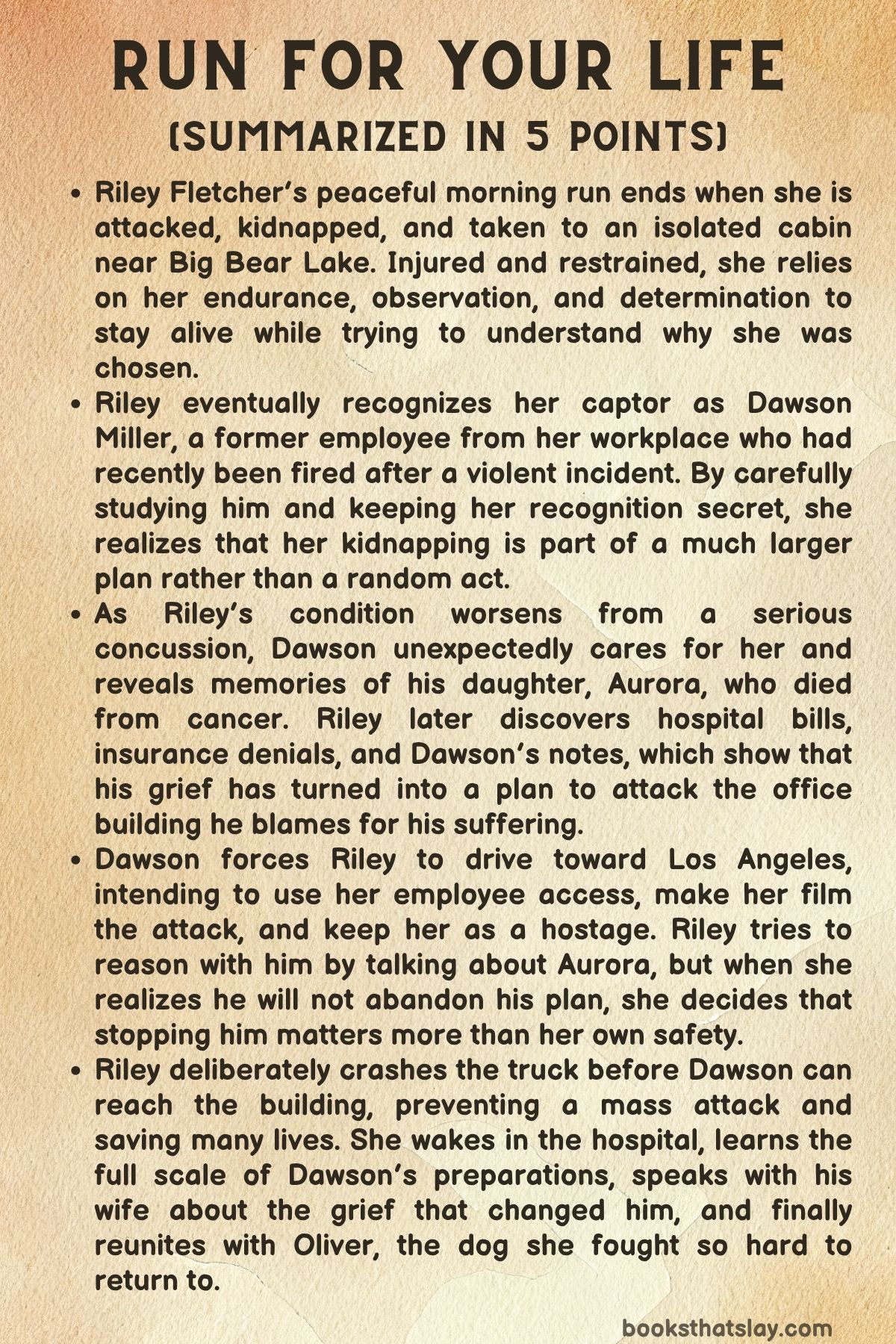
Summary
Riley Fletcher begins an early-morning run through a quiet Los Angeles park, enjoying one of the rare periods of the day when nobody expects anything from her. She thinks about Oliver, her beloved dog waiting at home, and settles into the familiar comfort of running until an unseen attacker strikes her from behind and destroys the peaceful routine in an instant.
When Riley regains consciousness, she is bound and gagged in the dark bed of a moving truck with a serious head injury and little understanding of where she is being taken. Panic threatens to overwhelm her, but memories of past hardships and her mother’s insistence on resilience help her focus on the one thing she can still control: whether she continues fighting to survive.
The truck eventually stops in a cold mountain region, where Riley encounters her masked captor and is dragged toward an isolated cabin. She fights desperately despite having her wrists and ankles tied, attempting to crawl toward the trees and deliberately disturbing the ground and doorway in the hope that searchers might someday notice evidence of her presence.
Her background as a marathon runner and triathlete becomes an important source of mental strength because she understands how to continue through exhaustion, fear, and pain. When she recognizes the surrounding lake and mountains as Big Bear Lake, a place linked to happy memories from childhood, the familiarity makes her captivity even more disturbing because a place once associated with safety has become the site of her imprisonment.
Inside the cabin, Riley is left on a filthy mattress while she studies her captor and searches for useful information. She fears sexual violence at first, but his behavior suggests a different motive, and the groceries, prepared cabin, and organized supplies convince her that the kidnapping was planned rather than impulsive.
Riley’s worsening concussion makes observation difficult, yet she continues wondering who will first notice that she is missing. Because she is normally dependable, she believes her friends Jill and Rebecca, her mother, her coworkers, and others in her life will quickly recognize that something is wrong, while her concern for Oliver repeatedly reminds her of the ordinary life she desperately wants to regain.
A crucial discovery comes when the captor removes his ski mask and Riley recognizes him as Dawson Miller, a former employee from the building where she works. She remembers that Dawson was recently fired after a violent workplace confrontation, but because she cannot identify anything she personally did to him, she begins to suspect that she has been selected for reasons connected to a larger grievance.
Instead of revealing that she recognizes him, Riley decides to preserve that knowledge as an advantage. She begins thinking about how she might humanize herself in Dawson’s eyes, believing that if he starts to see her as an individual rather than merely part of his plan, harming or killing her might become emotionally harder for him.
Dawson’s secretive behavior strengthens Riley’s suspicions when she sees him studying a thick folder and reacting intensely to its contents. His declaration that people will pay attention to him this time makes Riley realize that her abduction may be only one component of something he has prepared carefully, and that his anger is directed toward people or institutions beyond her.
During a humiliating trip outside to use a bucket as a toilet, Dawson tells Riley that what is happening is not really about her. Riley uses the conversation to tell him about herself and Oliver, intentionally challenging the emotional distance he appears to need, while also making a potentially life-saving discovery when she realizes he overlooked the running belt she was wearing when he kidnapped her.
Hidden inside the belt is a Kubotan that might be sharp enough to cut through her restraints. Riley secretly retrieves it while Dawson’s back is turned and conceals it in her hands, gaining for the first time a practical means of freeing herself without his knowledge.
Before she can take full advantage of that opportunity, her physical condition becomes dangerous as repeated vomiting, dizziness, headaches, and weakness suggest that her concussion may be severe. Dawson reveals another piece of his plan when he says Riley was supposed to be the easy part, confirming that she serves a specific function in a much larger operation.
When Dawson leaves the cabin, Riley cuts through her restraints and attempts to escape, but her body repeatedly collapses whenever she tries to stand. Her determination remains intact even as her physical strength disappears, and she finally loses consciousness on the floor without managing to reach safety.
When Riley awakens, Dawson’s behavior has changed in a way she did not expect. He has found her critically ill and, rather than punishing her for freeing herself, places her on the mattress, cools her fever, feeds her, reads to her, and remains close enough to help her survive.
During these periods of care, Dawson mentions his daughter, Aurora, whom he once looked after when she was ill. The tenderness with which he speaks of her shows Riley that his daughter occupies the center of his emotional world, forcing her to confront the unsettling reality that the man who kidnapped and assaulted her is also capable of parental love, grief, and gentleness.
After Riley’s fever breaks, the relationship between captive and captor becomes more psychologically confusing because Dawson leaves her untied and temporarily behaves almost like a caretaker rather than a jailer. That fragile calm breaks when he tries to kiss her, but after Riley refuses him, Dawson stops, apologizes, and eventually collapses emotionally against her rather than attacking her.
Riley later searches Dawson’s backpack while he is outside and discovers the documents that finally explain his plan. Hospital bills, insurance-denial letters, Aurora’s medical records, and Dawson’s notebook reveal that Aurora died from cancer after an experimental treatment was denied, and Dawson has come to believe that people connected to the system responsible for that decision must suffer for what happened to his daughter.
His notebook contains plans for killing multiple people so that Aurora’s name will be remembered, while diagrams and information concerning the building where Riley works reveal the scale of his intentions. Riley now understands that Dawson is preparing an attack on his former workplace, transforming her goal from simply escaping into preventing him from killing innocent people.
This knowledge also complicates Riley’s judgment of Dawson because she can understand the grief that destroyed his former life without accepting what he intends to do. She sees a man who loved his daughter deeply and has converted that love into rage, creating a form of moral reasoning in which unrelated people can be treated as acceptable targets.
Dawson soon orders Riley into his truck and forces her to drive toward Los Angeles while he holds a gun. A suspicious duffel bag containing wires and metallic objects makes her fear that explosives are involved, and she attempts to delay the journey by pretending the truck has mechanical problems and secretly interfering with wires beneath the hood.
The attempt fails, and Dawson eventually explains why Riley was chosen. He intends to use her employee access to enter Atticus, force her to film the attack, and keep her beside him as a hostage so that police will hesitate to shoot him.
Riley tries to reach the part of Dawson that still loves Aurora, arguing that murdering innocent people cannot honor his daughter or repair the injustice he believes destroyed his family. Dawson instead becomes furious, describing Aurora’s childhood dreams and insisting that the system abandoned her, and he strikes Riley when she continues challenging the logic of his revenge.
As Los Angeles comes closer, Riley understands that persuasion has failed and that only immediate action can stop the attack. She thinks about Oliver and her own desire to survive, but she also imagines the employees, families, children, and other innocent people who could die if Dawson reaches the building.
Approaching a sharp curve, Riley makes the most dangerous choice available to her: she accelerates and deliberately drives the truck into a tree. She has no guarantee that she will survive the collision, but stopping the vehicle before it reaches Atticus becomes more important to her than protecting herself.
Riley awakens several days later in a hospital after suffering another head injury and requiring stitches. Dawson has also survived but is critically injured and under police guard, while investigators confirm that he had assembled homemade bombs, ammunition, blueprints, and other materials intended for a catastrophic attack on the office building.
Dawson’s wife, Elizabeth, later visits Riley and brings photographs of Aurora, explaining that Dawson had once been a loving husband and father before his daughter’s illness and death consumed him. Elizabeth says she sought support for her own grief while Dawson refused help and increasingly depended on anger, eventually allowing his belief in injustice to become the organizing force of his life.
Riley is therefore left with two truths that cannot comfortably cancel each other out. Dawson has caused enormous suffering and planned to kill innocent people, yet he is also a bereaved father whose collapse began with the loss of a child, and Riley can recognize the humanity behind his actions without excusing them.
The story closes when Riley’s sister brings Oliver to the hospital. Oliver races toward her, giving Riley the reunion she repeatedly imagined during captivity, and her return to him represents not only physical survival but the recovery of the ordinary life that Dawson’s actions nearly destroyed.
Characters
Riley Fletcher
Riley Fletcher is the central character of Run for Your Life, and nearly every major conflict is filtered through her effort to remain mentally active while her physical freedom is taken away.
Her first defining quality is discipline: years of marathon running and triathlon training have taught her that exhaustion and pain do not automatically require surrender, so she treats survival almost like an endurance event in which the next decision matters more than imagining the entire distance ahead.
Her intelligence appears less through specialized knowledge than through observation, patience, and emotional calculation. She studies Dawson’s routines, notices his discomfort when she personalizes their interaction, hides the fact that she recognizes him, searches for weaknesses in his planning, and understands that information may be as valuable as physical strength.
Riley is also deeply connected to ordinary relationships, especially her attachment to Oliver, which repeatedly gives her something concrete to return to. Thoughts of her family, friends, job, and dog keep her identity intact when Dawson’s control could otherwise reduce her to the role of hostage.
What makes Riley more than a conventional survivor is the change in her moral responsibility once she discovers the intended workplace attack. Escape would protect her alone, but she chooses to remain focused on preventing a larger tragedy, eventually accepting the possibility of her own death by crashing the truck before Dawson can reach Atticus.
Her response to Dawson’s grief also reveals emotional maturity because she does not confuse understanding with forgiveness. Riley can recognize that Aurora’s death caused devastating damage while still holding Dawson responsible for kidnapping her and planning the deaths of innocent people, allowing her to occupy a morally difficult position without simplifying him into either monster or victim.
Dawson Miller
Dawson Miller is the book’s antagonist, but Run for Your Life presents him as a man whose cruelty exists beside genuine love, parental devotion, shame, tenderness, and catastrophic grief. His contradictions are essential to understanding him because he can abduct Riley, beat her, threaten her, and plan mass murder while also cooling her fever, feeding her soup, reading to her, and showing sincere remorse after crossing a boundary with her.
Aurora’s death has become the event through which Dawson interprets nearly everything, especially the insurance denial and the loss of employment that he associates with his family’s collapse. Rather than accepting uncertainty about whether the experimental treatment could have saved his daughter, he builds a fixed narrative in which identifiable people and institutions caused her death and therefore deserve punishment.
His desire to make people remember Aurora’s name shows how remembrance has become distorted into spectacle. Dawson no longer sees private grief as sufficient; he wants public violence to force strangers to acknowledge his daughter’s existence and the system he believes failed her.
The planning behind his attack also shows that he is not acting during a brief loss of control. He gathers weapons, studies building access, prepares explosives, selects Riley for her credentials and usefulness as a hostage, and constructs a plan in which she will film events, demonstrating sustained intention despite his emotional instability.
Dawson remains morally responsible because suffering explains the direction of his anger but cannot justify his decision to transfer that suffering onto unrelated people. His tragedy lies partly in the fact that the love he once had for Aurora survives, yet he gradually turns that love into a justification for behavior that contradicts the ordinary future his daughter herself wanted.
Aurora Miller
Aurora never appears alive within the present action, yet she has enormous influence over the events because Dawson’s memory of her governs his choices. She exists through medical documents, photographs, Dawson’s recollections, and Elizabeth’s account, making her presence indirect but central.
Her illness and death represent an irreversible loss that Dawson cannot integrate into his life. He remembers her as a real child with ordinary hopes rather than simply as a patient, and that memory explains why he experiences institutional decisions surrounding her treatment as personal betrayals rather than detached administrative outcomes.
Aurora also functions as an unspoken moral challenge to Dawson’s revenge. Riley repeatedly tries to make him consider whether the daughter he loved would actually want her name attached to the murder of innocent people, exposing the gap between honoring Aurora’s life and using Aurora’s death to authorize violence.
The information provided by Elizabeth adds an important limit to Dawson’s certainty because even the doctors could not know whether the experimental treatment would have saved Aurora. That uncertainty matters because Dawson’s entire revenge plan depends on transforming an uncertain medical possibility into an absolute conviction that specific people caused his daughter’s death.
Elizabeth Miller
Elizabeth, Dawson’s wife and Aurora’s mother, appears late in the story but provides an essential perspective on Dawson before and after their daughter’s death. Through her, Riley learns that Dawson was not always defined by rage and that he had once been a caring father and husband whose personality changed under the weight of bereavement.
Elizabeth’s own response to Aurora’s death creates an important contrast with Dawson’s. She attends support groups and finds ways to live alongside grief, while Dawson rejects help and allows anger to become the force that gives his pain direction.
Her willingness to meet Riley also shows courage and moral clarity because she does not attempt to erase what Dawson has done merely because she remembers the man he used to be. By bringing photographs of Aurora and explaining the family’s history, Elizabeth helps Riley understand the origins of Dawson’s collapse without asking her to excuse the kidnapping or planned attack.
Elizabeth therefore represents grief that remains connected to reality rather than becoming a demand for retaliation. Her presence suggests that devastating loss can permanently alter a person without inevitably producing the kind of violence Dawson chooses.
Oliver
Oliver is Riley’s dog, but his importance goes far beyond being a pet mentioned during moments of stress. He represents home, routine, responsibility, affection, and the ordinary future Riley fears losing when she is abducted.
Riley repeatedly worries about whether Oliver has food and whether anyone will reach him, showing how captivity makes even small responsibilities feel painfully urgent. Thinking about him gives Riley a personal reason to survive that is immediate and emotionally concrete rather than abstract.
Oliver also becomes a measure of how thoroughly Dawson’s actions separate Riley from her normal identity. Inside the cabin, she is a hostage whose body and movements are controlled, but in her thoughts about Oliver she remains the person who runs in the morning, cares for a dog, works, meets friends, and expects to return home.
His appearance at the hospital therefore completes Riley’s emotional return. When he races into her arms, the reunion confirms that the life she spent imagining throughout her captivity is still available to her despite everything that happened.
Riley’s Mother
Riley’s mother is not physically present during the kidnapping, but her influence survives through the values Riley has internalized. Early in captivity, Riley remembers the resilience her mother encouraged in her, and those lessons help her resist the feeling that helplessness must lead to surrender.
This influence is especially important because Riley has very little external support while isolated in the cabin. Her mother’s voice has effectively become part of Riley’s own inner language, allowing earlier guidance to function as psychological support when direct rescue is unavailable.
The character therefore contributes to Riley’s strength without needing a large role in the immediate action. She represents the kind of formative relationship whose importance becomes clearest during crisis, when remembered advice becomes a practical tool for surviving fear.
Jill
Jill is one of the friends Riley believes will quickly notice her disappearance because Riley is normally reliable and predictable. Although Jill does not directly participate in the main confrontation, Riley’s thoughts about her help establish that Riley belongs to a social world in which her absence matters.
That detail becomes psychologically useful during captivity because Riley can tell herself that people will not simply assume she has chosen to disappear. The expectation that Jill and others will recognize something is wrong gives Riley a rational basis for hope rather than forcing her to depend entirely on chance.
Jill therefore represents the protective value of ordinary social connection. Reliability, friendship, and daily routine become part of Riley’s survival network even when the people involved are physically far away.
Rebecca
Rebecca serves a role similar to Jill as one of the people Riley expects to notice immediately when she fails to appear for normal commitments. Her presence in Riley’s thoughts reinforces the idea that Riley’s identity exists within a dependable pattern of friendships, work, and daily obligations.
For someone being held in isolation, that knowledge matters enormously because disappearance is less frightening when the captive believes others will react quickly. Rebecca’s importance is therefore emotional and structural rather than action-based, helping sustain Riley’s confidence that a search is likely underway.
She also contributes to the contrast between Riley’s ordinary social life and the extreme isolation imposed by Dawson. The fact that something as simple as missing coffee could become an alarm demonstrates how everyday relationships can unexpectedly become safeguards.
Riley’s Sister
Riley’s sister appears near the conclusion when she brings Oliver to the hospital, making her part of the story’s return from crisis to family connection. Her role is brief, but the timing gives it emotional significance because she helps restore something Riley has spent much of her captivity fearing she might never see again.
By bringing Oliver directly to Riley, her sister reconnects the hospital room with Riley’s home life. The gesture allows the closing moments to center not on Dawson, police evidence, or the planned attack, but on Riley’s survival and the people and relationships waiting for her beyond the violence.
The sister therefore represents continuity. Riley’s life has been radically interrupted, yet her family remains present to help bridge the distance between the person who entered the park for a morning run and the survivor who wakes after preventing a mass attack.
Themes
Survival as a Mental Discipline
Survival in Run for Your Life depends as much on controlling thought as on physical endurance. Riley’s athletic background matters because running has taught her to tolerate discomfort, divide difficult experiences into manageable stages, and continue functioning when her body wants to stop, but those habits become even more valuable when she must manage panic and uncertainty during captivity.
Her most important survival decisions often involve restraint rather than direct resistance. She hides the fact that she recognizes Dawson, studies his behavior, notices which subjects make him uncomfortable, preserves the Kubotan until she has a useful opportunity, and later conceals her knowledge of his attack plans so that she does not surrender an informational advantage.
The book also distinguishes determination from physical invulnerability. Riley succeeds in cutting her restraints but cannot escape because her concussion causes her body to collapse, showing that courage cannot magically erase injury or physical limits.
Survival therefore becomes an adaptive process rather than a single heroic act. Riley fights when fighting creates an opportunity, remains still when resistance would be useless, accepts Dawson’s medical care when she is too weak to refuse it, and later risks her own life when stopping him becomes more urgent than protecting herself.
Her final decision to crash the truck completes this development because survival is no longer defined only as staying alive. Riley’s understanding of survival expands until it includes preserving the lives of people she does not know, even when doing so may cost her the future she has fought to regain.
Grief, Anger, and the Desire for Someone to Blame
Dawson’s response to Aurora’s death shows how grief can become destructive when uncertainty becomes intolerable and anger offers a simpler explanation. The experimental treatment denied by the insurance company may or may not have saved Aurora, but Dawson gradually converts that unresolved possibility into certainty that a system and the people associated with it are directly responsible for taking his daughter away.
That certainty gives his suffering a target. Instead of living with the unbearable fact that a child can become ill and die despite desperate efforts to save her, Dawson creates a moral universe in which somebody must have caused the outcome and somebody must therefore be punished.
His planned attack is not presented as an uncontrolled burst of rage. Dawson collects documents, writes about his beliefs, studies the office building, prepares weapons and explosives, selects Riley for a specific purpose, and imagines violence as a public message that will force people to remember Aurora.
Elizabeth provides the clearest contrast because she experiences the same parental loss without reaching the same conclusion. She seeks support and gradually learns to continue living with grief, while Dawson rejects assistance and allows rage to become the emotional structure holding his life together.
The contrast makes an important distinction between suffering and responsibility. Dawson’s pain is real, and the story never requires Riley to deny that reality, but pain does not remove his agency when he chooses to kidnap one person and prepare the deaths of many others.
Humanizing an Enemy Without Excusing Harm
Riley’s relationship with Dawson becomes morally difficult because understanding him makes his actions easier to explain but no more acceptable. At first he is primarily the masked man who attacks, binds, humiliates, and imprisons her, yet his behavior during Riley’s illness reveals tenderness that does not comfortably fit the image of a purely emotionless aggressor.
The discovery that Dawson once cared for Aurora in the same gentle manner forces Riley to recognize that violent people may still possess love, attachment, shame, and vulnerability. His apology after attempting to kiss her, his emotional collapse, and his memories of his daughter further complicate Riley’s judgment without erasing the danger he presents.
This distinction becomes essential after Riley reads the medical documents and learns the history behind his rage. She can feel sympathy for a father who watched his daughter die while simultaneously understanding that innocent employees cannot be made responsible for the loss.
Riley’s eventual willingness to consider writing to Dawson after the crash strengthens this idea. Compassion does not require pretending the kidnapping did not happen, forgetting the planned attack, or treating grief as justification for murder.
The story therefore separates empathy from absolution. Riley’s ability to recognize Dawson’s humanity does not weaken her moral judgment; instead, it makes that judgment more demanding because she must oppose a person she partially understands rather than an enemy she can dismiss as entirely incomprehensible.
Responsibility Beyond Self-Preservation
Riley’s goal initially appears simple because captivity makes personal survival the only immediate concern. She wants to escape the cabin, return to Oliver, contact her family and friends, receive treatment for her injuries, and regain control of a life that has been violently interrupted.
Everything changes when she discovers Dawson’s plans for Atticus. From that point onward, escaping alone would leave Dawson free to carry explosives and weapons into a building filled with employees, visitors, families, and children, meaning Riley now possesses knowledge that creates a responsibility extending far beyond her own safety.
That responsibility is especially demanding because Riley has already endured severe physical and psychological harm. Nobody could reasonably accuse her of selfishness for wanting only to survive, yet she refuses to treat her own escape as sufficient once she understands the likely consequences for others.
Her decision at the curve represents the fullest expression of that moral transformation. Riley deliberately causes a crash without knowing whether she will survive because she calculates that allowing Dawson to reach his destination creates a far greater danger than the immediate risk to herself.
The aftermath confirms the scale of that choice when investigators determine that Dawson possessed explosives, ammunition, and detailed plans capable of causing mass casualties. Riley’s courage therefore develops from resistance into responsibility, showing how heroism can emerge when an individual decides that the lives of strangers deserve protection even at extraordinary personal cost.