Sea of Charms Summary, Characters and Themes
Sea of Charms by Sarah Beth Durst is a fantasy adventure and the third standalone in the Spellshop series, centered on Marin Eversay, a sailor who has rebuilt her life around independence after a painful betrayal.
Set across an island-filled world of sea serpents, magical storms, sentient plants, dragons, winged cats, musicians, and political upheaval, the story combines romance, adventure, humor, and questions about personal freedom. Marin’s travels gradually bring together an unconventional crew whose members are all searching for the right to determine their own futures. At its center, the book explores how freedom can coexist with love, trust, responsibility, and belonging without requiring one person to surrender themselves to another. It’s the 3rd book of the Spellshop series.
Summary
Marin Eversay begins her life aboard Silver determined to be independent. Her former fiancé, Iovar, had secretly sabotaged her parents’ supply-running business because he wanted her to abandon sailing and become the wife he imagined she should be, and Marin’s parents went deeply into debt to help her escape him and obtain her enchanted boat.
Although her parents never blame her, Marin carries guilt over what happened and becomes wary of emotional attachment. While traveling through the dangerous Painted Pass, she rescues an injured sea serpent trapped among the rocks, and the creature later follows her until she names him Perri.
Two years later, Marin and Perri arrive in Alyssium, the imperial capital. The city feels disturbingly quiet, but Marin continues with her scheduled deliveries and visits her friend Dax, a gifted young composer at the Music Conservatory.
Marin is attracted to Dax but refuses to trust those feelings because of her experience with Iovar. Dax, meanwhile, is struggling to create the grandmaster opus expected of him and admits that Marin’s stories about the wider world make him feel inspired in ways the conservatory no longer does.
Outside the conservatory, Marin discovers that a revolution has begun and that the emperor has been overthrown. At the Great Library, Head Librarian Rijes Velk asks Marin to secretly transport a lifelike wooden statue that is actually Terlu, a librarian transformed into wood as punishment for illegally using magic.
Rijes also gives Marin a letter for the reclusive gardener Yarrow Verdane on the distant island of Belde. Marin later discovers that the letter contains instructions for reversing Terlu’s transformation, but she decides that her responsibility is simply to complete the delivery.
After leaving Terlu and the letter on Belde, Marin returns home to Flicker, where her loving parents encourage her to stop hiding from the life she once had. They want her to attend the End-of-Harvest Festival despite the possibility that she will encounter Iovar.
Continuing her route, Marin eventually returns near Belde and discovers that Terlu has been restored. She also meets Ree, a sentient shrub who desperately wants to become a sailor, and Marin agrees to take him aboard as her apprentice because his excitement reminds her of her own childhood dreams.
Marin now has another reason to return to Alyssium because she wants to know whether Dax survived the revolution. When she reaches the capital, she finds widespread destruction and sees the Great Library burning.
Perri insists on finding Dax, and Marin discovers that the conservatory has deliberately hidden the true danger from him. When Dax refuses to abandon his friends, Marin evacuates all of them, carrying fourteen musicians aboard Silver and escaping the burning city with Perri’s help.
Afterward, Dax learns that his friends and teachers had been controlling his access to information because the conservatory expected him to finish his opus. He is particularly moved that Marin rescued him because she valued him as a person rather than because of his reputation.
Dax begins making music with Perri and discovers forms of inspiration that could never have existed within the controlled environment of the conservatory. When the refugees reach Eventrid, he decides that he does not want to stay with his friends and instead asks to join Marin’s crew.
Marin reluctantly agrees on one condition: Dax must pretend to be her fiancé at Flicker’s upcoming festival. His friends object to his decision to sail, but Marin recognizes that their objections resemble Iovar’s attempts to decide her future for her.
Dax chooses the sea anyway. As he and Ree become genuine members of the crew, Marin teaches them to swim and survive at sea, while a hidden orange winged cat named Stowy becomes another unexpected passenger.
At the village of Dew, Dax discovers the pleasure of performing joyful music for ordinary people rather than playing for experts judging his worth. Marin also finally tells him the full story of Iovar’s betrayal, and Dax challenges her habit of blaming herself for being deceived.
When the crew reaches Flicker, Marin’s parents immediately welcome Dax and Ree. Marin and Dax dress as a couple for the festival, where her father wins the pie contest and Dax becomes fascinated by the local musicians.
The situation changes when Iovar appears. Dax kisses Marin as part of their supposed relationship, although the kiss carries real feeling, and Iovar reveals that he has helped arrange harsher repayment terms on the debt Marin’s family owes.
Unless Marin earns a large amount of money quickly, her parents could lose their home. Marin therefore begins looking for more profitable work, despite her parents insisting that she should not sacrifice her happiness for a debt they willingly accepted to help her.
Back in Alyssium, Marin agrees to transport Yarrow’s displaced family to Belde even though the job pays little and delays her efforts to save her parents. Once there, Terlu offers Marin a heartsinger ruby valuable enough to clear the entire debt if Marin will find Rijes Velk and take her somewhere safe.
Marin accepts the mission. Dax, Ree, and Perri all refuse the opportunity to remain behind, declaring through their actions that they are no longer merely passengers but her crew.
Their journey back toward Alyssium takes them into a violent magic storm, whose power has been worsened by the empire’s attempts to restrict ordinary spellcasting and concentrate magical authority. Silver is badly damaged, and Marin loses consciousness after the crew is thrown into chaos.
Marin awakens on an unfamiliar shore with Dax and immediately assumes that her decisions may have killed Ree and Perri. They soon discover that both survived, largely because Perri protected Ree during the disaster, but Silver remains missing.
Perri eventually locates the boat, forcing Marin, Dax, and Ree to ride across the sea on his back. They find Silver stranded high on a mountain on Ilreka, where an enormous golden dragon named Keva has claimed it.
The people of Ilreka explain that dragons collect unusual personal treasures and that no one has discovered what Keva wants. Dax proposes offering music, believing that a performance may interest her more than material wealth.
Before confronting the dragon, Marin makes it clear that she will not exchange Dax himself for her boat. Dax then admits that the kiss he gave Marin was not merely part of their performance for Iovar; he kissed her because he genuinely wanted to.
Dax plays a song for Keva about fully seeing and accepting another person without trying to change them. The dragon responds to the music, releases Silver, and returns the boat to the sea.
While Silver is repaired, Marin begins reconsidering her belief that avoiding love is the safest way to prevent pain. She finally admits that she loves Dax, although she remains convinced that his proper future lies at the conservatory rather than with her.
As the crew resumes its journey, Dax discovers that they can earn money through informal performances involving himself, Ree, Perri, and sometimes Marin. The performances confirm his growing belief that music belongs to anyone who creates it and does not need institutional approval to have value.
Marin then faces another test when Perri encounters other sea serpents and chooses to leave with them. Although devastated, she refuses to call him back because doing so would violate everything she believes about another being’s right to choose.
Later, Perri returns of his own accord. His return means far more to Marin because she knows that he experienced another possible life and freely chose to come back to Silver and the family he had formed there.
When the crew finally returns to Alyssium, Marin learns that Rijes is no longer at the Great Library. Dax uses his conservatory connections to locate her in a government facility where the provisional authorities are effectively detaining her.
Marin now faces an impossible choice: technically finding Rijes could allow her to keep the ruby, but freeing Rijes requires giving up the gemstone that could save her parents’ home. Marin chooses Rijes’s freedom and sacrifices the ruby to secure her release.
Dax must return to the conservatory to finish his opus, and Marin leaves him behind because she believes keeping him on Silver would be selfish. During the voyage to Belde, however, conversations with Ree and Rijes force her to recognize a contradiction in her thinking.
Marin has spent much of her life defending people’s right to choose, yet she has decided for Dax that the conservatory is where he belongs. Realizing that love does not give her the right to make his decision for him, she races back to Alyssium before his grandmaster performance.
Dax’s completed opus, The Charms of the Sea, transforms everything he experienced during the voyage into music. Ree and Perri participate in the performance, and Dax combines the traditions of the conservatory with the sounds and experiences of the wider world.
The audience responds enthusiastically, proving that Dax has achieved artistic success without allowing the institution to define the limits of his creativity. He becomes a grandmaster and tells Marin that he creates his best music while sailing and wants to remain with her.
Dax offers enough money from the performance rights to his opus to clear Marin’s family debt. Marin refuses to allow him simply to buy his place in her life and instead proposes that he purchase half of Silver, making them equal partners.
They confess their love, settle the debt, and Marin faces Iovar one final time. She does not seek revenge or reconciliation; once he has no financial control over her family, she simply says goodbye and walks away.
Three months later, Marin, Dax, Ree, and Perri continue sailing together, combining supply work, music, exploration, and assistance to refugees. Marin understands that opening her life to other people has not reduced her independence.
Instead, companionship has made her world larger. With Dax beside her, Ree aboard Silver, and Perri traveling through the waves, Marin chooses a future in which freedom means not isolation but the ability to love others without possessing them, to belong without surrendering choice, and to sail wherever their lives lead.
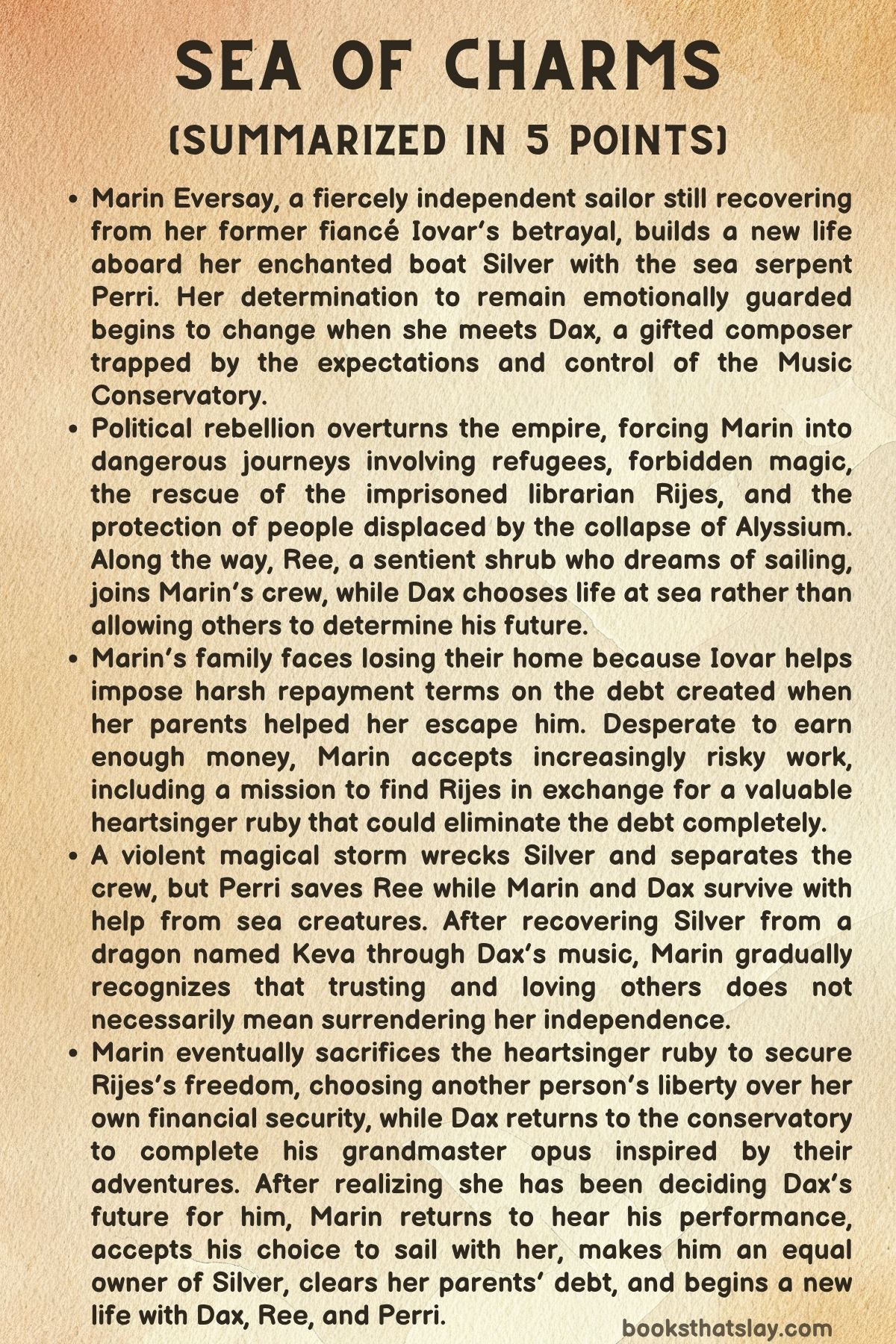
Characters
Marin Eversay
Marin is the emotional and moral center of Sea of Charms, and much of her development comes from learning that independence does not require emotional isolation. Iovar’s betrayal leaves her convinced that trusting another person can place her freedom, family, and identity at risk, so she constructs a life in which she can control her own movements and keep romantic attachment at a safe distance.
Her guilt is one of her defining weaknesses. Even though her parents willingly helped her escape Iovar and repeatedly refuse to blame her, Marin treats their debt as evidence of a personal failure and assumes responsibility for repairing damage caused primarily by someone else’s manipulation.
At the same time, Marin is consistently compassionate in ways that contradict her desire to remain uninvolved. She rescues Perri despite the danger, transports Terlu, accepts Ree as an apprentice, evacuates Dax and the musicians, carries displaced families, searches for Rijes, and ultimately gives up the ruby that could save her parents’ home in order to free someone being unjustly detained.
These choices reveal that Marin’s true nature has never been solitary or detached. She repeatedly accepts personal risk when another being’s freedom or safety is at stake, demonstrating that her deepest values are generosity, responsibility, and respect for choice rather than mere self-protection.
Her relationship with Dax becomes the greatest challenge to her understanding of freedom. Marin is so afraid of controlling him that she eventually makes the opposite mistake and decides on his behalf that he belongs at the conservatory, only later recognizing that denying him the opportunity to choose her is another form of taking away his agency.
By the end of the book, Marin no longer sees attachment as surrender. Her decision to offer Dax half of Silver instead of simply allowing him to join her crew shows how completely her idea of partnership has changed: love should place two people beside each other as equals rather than make one responsible for defining the other’s life.
Dax
Dax initially appears to be a sheltered musical prodigy whose entire identity has been constructed around talent, expectation, and institutional approval. In Sea of Charms, his development shows what can happen when a person who has always been valued for what he produces begins asking what he actually wants.
The conservatory has raised him since the age of four and provided education, friendship, status, and artistic opportunity, but that care comes with severe limitations. His friends hide the revolution from him, and the institution restricts his ability to leave until his opus is completed, treating his genius as something that gives others a claim over his choices.
Marin’s arrival changes Dax because she treats his curiosity and happiness as more important than his reputation. Her stories about strange islands, creatures, people, and customs offer him an image of a world in which music can grow from lived experience instead of obligation.
His time aboard Silver therefore becomes both artistic education and personal liberation. He learns to swim, performs for ordinary people, improvises with Perri and Ree, hears unfamiliar musical traditions, encounters dragons and magical landscapes, and discovers that creative value does not depend on approval from experts.
Dax is also essential to Marin’s recovery because he never treats love as ownership. When she explains Iovar’s betrayal, he rejects her self-blame, promises not to take anything she does not freely give, and later makes clear that his attraction to her does not create an obligation.
His completed opus proves that leaving the conservatory did not require rejecting everything it gave him. Dax instead combines formal training with everything he learned at sea, allowing him to return as a changed musician and then choose to leave again as a grandmaster who finally possesses the freedom to define his own career.
Perri
Perri begins as a sea serpent Marin rescues in the Painted Pass, yet the relationship immediately resists the language of ownership. Marin repeatedly explains that she did not tame or acquire Perri; he chose to follow her, establishing a pattern that later becomes central to the story’s treatment of love and freedom.
He is highly intelligent, emotionally perceptive, loyal, and capable of making decisions that Marin sometimes cannot make for herself. It is Perri who insists on returning for Dax when Alyssium is burning, and his refusal to abandon him directly leads Marin to rescue the conservatory musicians.
During the magic storm, Perri becomes the crew’s protector. He shelters Ree by swallowing him and later carries him to safety, demonstrating both quick judgment and extraordinary devotion when Marin is physically incapable of protecting everyone herself.
His temporary departure with other sea serpents is especially important because it tests whether Marin genuinely believes in the freedom she continually defends. She is devastated but does not call him back, accepting that affection cannot justify restricting his future.
Perri’s eventual return transforms their bond. He has seen another possible life among his own species and chooses Marin again, proving that relationships based on freedom can become stronger precisely because departure remains possible.
Ree
Ree is a sentient wax-myrtle shrub whose desire to become a sailor gives the story one of its clearest expressions of self-determination. He approaches the sea with uncomplicated enthusiasm and asks for an opportunity that many others might dismiss as ridiculous simply because of what he is.
Marin recognizes something of her younger self in him and becomes his teacher. Ree learns sailing, swimming, and reading while gradually changing from an excited passenger into someone who genuinely understands the responsibilities and emotional commitments of being part of a crew.
His apparent innocence should not be mistaken for lack of insight. Ree often understands emotional truths before Marin does, including the fact that a person can miss one home while still choosing another and that belonging somewhere does not require abandoning every previous attachment.
His own history with the sentient plants of Belde reinforces this perspective. He explains that being protected through confinement was never what he wanted, making him an important voice against the assumption that safety automatically justifies taking away freedom.
Ree also helps transform the crew into a family. His affection is direct, his loyalty is unquestioned, and his willingness to join Marin on dangerous missions reflects the fact that he no longer considers himself merely an apprentice being carried from place to place.
Iovar
Iovar functions as the clearest example of affection distorted into control. His betrayal is not simply that he sabotages Marin’s parents’ livelihood; it is that he does so because he believes Marin’s preferred life is wrong and that manipulating her circumstances is acceptable if it produces the future he wants.
His behavior therefore attacks Marin at the level of identity. Sailing is not a casual pastime for her but the activity through which she experiences freedom and purpose, so his attempt to force her away from it reveals that he loves an imagined version of Marin rather than the person she actually is.
Even after their engagement ends, Iovar continues seeking leverage through the family debt. By helping accelerate repayment terms, he demonstrates that financial power can become another instrument for extending control after a personal relationship has ended.
His final defeat is deliberately quiet. Marin does not need to humiliate him or gain an apology; once the debt is settled, she understands that his ability to shape her choices has disappeared.
Her simple goodbye matters because it removes him from the center of her emotional life. Iovar becomes someone she can leave behind rather than someone whose actions continue determining what she believes about herself.
Rijes Velk
Rijes is defined by a strong belief that knowledge and magic should not be controlled through unjust authority. Her decision to secretly rescue Terlu places her in direct opposition to imperial restrictions, even though she holds an important position within one of the empire’s major institutions.
She is also willing to remain in danger when Alyssium collapses because she feels responsible for protecting the Great Library and its irreplaceable contents. That loyalty initially makes her appear inseparable from the institution she leads.
Her later experiences force her to reconsider what the library became. Rijes recognizes that an institution created to preserve knowledge for everyone can gradually begin withholding that knowledge when fear and authority become more important than access.
Her comparison between books and the sea expresses her mature understanding of knowledge as a form of connection. Both allow people to encounter lives and worlds beyond their immediate surroundings, making restrictions on knowledge another way of restricting human possibility.
Rijes ultimately becomes capable of imagining life beyond her former position. Rather than trying to restore the exact system that existed before the revolution, she accepts the possibility that something better may be built from what remains.
Terlu
Terlu embodies the cruelty of the former empire’s restrictions on ordinary magic. Her transformation into a wooden statue is an extreme punishment made even more disturbing by the reason for her crime: she used forbidden magic to make herself a friend.
Once restored, Terlu becomes part of the network of people who help one another outside official systems. Her connection to Yarrow, Ree, and Rijes shows how resistance often depends on private acts of loyalty rather than formal authority.
Her offer of the heartsinger ruby gives Marin what initially appears to be the perfect solution to her family’s debt. Yet by making the gemstone conditional on finding Rijes, Terlu unintentionally creates the moral test that reveals how completely Marin values another person’s freedom over her own financial security.
Terlu therefore influences the story well beyond her initial rescue. Her own restoration from unjust confinement eventually becomes the reason Marin is placed in a position to free Rijes from another form of confinement.
Yarrow Verdane
Yarrow remains mostly outside the immediate action, but his influence reaches several characters. As the gardener on Belde capable of reversing Terlu’s transformation, he represents the quiet survival of forms of magic that imperial law attempted to control or suppress.
His willingness to participate in Terlu’s restoration suggests that he values justice above obedience to an unjust law. The fact that Rijes trusts him with the illegal spell indicates both magical competence and moral reliability.
Yarrow’s relationship with his family also connects the personal cost of revolution to Marin’s wider journey. When his relatives are displaced in Alyssium, Marin chooses to transport them to Belde even though she urgently needs higher-paying work.
His character therefore acts as a connecting point among the book’s concerns with magic, family separation, refuge, and informal communities of assistance.
Marin’s Mother
Marin’s mother represents a model of parental love built around support rather than possession. She helps Marin escape Iovar and later refuses to treat the financial consequences of that decision as a debt Marin owes emotionally.
Her repeated encouragement for Marin to return to Flicker shows that she understands how shame has caused her daughter to isolate herself. She wants Marin to reclaim her home without allowing the possibility of encountering Iovar to determine where she is permitted to feel comfortable.
Her warmth toward Dax and Ree reflects the same instinctive generosity. Instead of questioning whether they fit conventional expectations, she welcomes them because they matter to Marin.
Through this behavior, she provides an important contrast to controlling figures elsewhere in the story. Her love offers security while leaving the recipient free.
Marin’s Father
Marin’s father shares his wife’s unconditional commitment to their daughter while bringing humor and domestic warmth into the story. His cooking, especially his beloved peach pie and enthusiasm for the festival competition, gives Marin’s home life a sense of joy that contrasts with the fear associated with Iovar.
He is especially important when Marin tries to assume complete responsibility for the family debt. He reminds her that helping her obtain Silver was a decision he and her mother made themselves and that she should not sacrifice the rest of her life because of a choice they willingly made.
This statement reflects one of the book’s central moral principles: genuine love does not turn generosity into leverage. Marin’s father helps her understand that accepting help does not give another person permanent ownership over her future.
His enthusiastic response to Dax also suggests that he sees possibilities Marin is still afraid to acknowledge. Rather than demanding that his daughter follow a particular romantic path, however, he leaves the ultimate choice to her.
Shiare
Shiare is one of Dax’s close friends and serves as a connection to Eventrid, the island where music functions as both communication and cultural tradition. Through Shiare’s home, Dax and Marin encounter yet another example of music existing outside the conservatory’s formal definitions.
Shiare and the other musicians care sincerely about Dax, but their objections when he chooses to sail expose the complicated relationship between affection and control. They believe they are protecting his future, yet their certainty that they know what his genius requires leaves little room for his own preferences.
This makes Shiare’s role morally more complicated than Iovar’s. The concern is genuine, but the behavior still helps demonstrate that benevolent intentions do not automatically justify limiting someone else’s choices.
Stowy
Stowy, the orange winged cat discovered among Dax’s belongings, adds humor and unpredictability to the growing crew. His presence also becomes another small but meaningful test of Marin’s developing belief that affection does not create ownership.
When Stowy repeatedly flies back to Marin’s parents instead of remaining aboard Silver, Marin accepts his decision even though she had grown accustomed to him. She recognizes that keeping him by force would contradict the values she is trying to live by.
His choice foreshadows the much more painful moment when Perri later leaves with other sea serpents. Through Stowy, Marin first practices accepting departure on a smaller emotional scale.
Tavo
Tavo is a fellow supply runner who provides Marin with important news after the fall of the empire. His report that Alyssium’s fires have been extinguished and that the old political order has genuinely collapsed awakens cautious hope in Marin.
Although his appearance is brief, Tavo represents the informal networks through which sailors and ordinary citizens understand a rapidly changing world. He also reminds readers that Marin belongs to a wider community of working people even when she thinks of herself as solitary.
Yvex
Yvex is the sorcerer to whom Marin’s family owes the debt associated with Silver. Although he is not developed through direct personal interaction in the supplied material, his financial connection to the family creates the mechanism through which Iovar continues exerting pressure on Marin.
The accelerated repayment terms turn Marin’s private emotional history into an immediate economic threat. Yvex therefore occupies a structural role in the book, representing how agreements involving money and power can restrict freedom even when the original decision was made for compassionate reasons.
Keva
Keva, the enormous golden dragon who claims Silver, initially appears to be another obstacle separating Marin from her freedom and livelihood. Yet Keva is not malicious; she simply values something the islanders have not yet understood.
The revelation that her desired treasure is music reinforces the story’s repeated rejection of narrow assumptions. A dragon’s hoard does not have to be gold, just as a musician does not have to belong in a conservatory and a sailor does not have to fit any conventional image.
Keva also creates one of the most important moments in Marin and Dax’s relationship. Marin explicitly refuses to treat Dax himself as something that can be exchanged, while Dax uses his art voluntarily to help recover the boat that represents Marin’s independence.
The resulting exchange succeeds because everyone gives freely. Keva receives music, Dax chooses to perform, and Marin recovers Silver without sacrificing another person’s autonomy.
The Emperor
The unnamed emperor is less an individual personality than the embodiment of the political order collapsing around the characters. His government restricts ordinary magic, concentrates power among approved sorcerers, and uses severe punishment against those who violate its rules.
The consequences extend beyond direct oppression. The restriction of ordinary spellcasting disrupts the natural balance of magic and contributes to increasingly dangerous storms affecting communities far from Alyssium.
Even after the emperor is overthrown, the story refuses to suggest that injustice disappears instantly. Rijes is detained by the provisional government, refugees remain displaced, and institutions must decide whether they will reproduce old patterns of control.
The emperor therefore represents both a fallen ruler and a warning. Removing one person from power cannot by itself repair systems built around secrecy, fear, restricted knowledge, and limited choice.
Themes
Freedom, Choice, and the Right to Define One’s Own Life
Freedom in Sea of Charms is presented not merely as the ability to travel wherever one wants, but as the right to make meaningful choices without another person deciding what is supposedly best. Marin’s conflict with Iovar establishes this idea immediately because his greatest wrongdoing is not simply financial sabotage; it is his conviction that he has the right to reshape Marin into the partner he prefers.
The same pattern appears in less obviously cruel forms. Dax’s conservatory teachers and friends care about him, yet they hide information and restrict his movement because they believe his talent makes his future too important to leave to his own judgment.
Ree’s history with the sentient plants of Belde reinforces the difference between protection and imprisonment. Being kept safe means little if safety requires surrendering every opportunity to experience the world and determine what kind of life one wants.
Marin eventually realizes that she can also violate this principle despite good intentions. When she leaves Dax at the conservatory because she has decided that his proper future lies there, she is choosing for him just as others have done.
Perri’s departure and return provide the clearest emotional proof of the theme. Marin allows him to leave despite her pain, and his voluntary return makes their relationship stronger because belonging becomes something he actively chooses rather than something he owes.
Love Without Ownership
The story repeatedly distinguishes between loving someone and claiming authority over that person. Iovar represents the destructive version of love because his affection depends on Marin becoming different, while Marin’s parents represent the opposite by helping their daughter even when her choices create financial difficulty for them.
Dax also demonstrates a form of intimacy based on consent. When Marin describes what happened with Iovar, he refuses her self-blame and assures her that he will never take anything she does not choose to give, making respect part of romantic attraction rather than something separate from it.
Marin needs much longer to understand the same principle from the other direction. Because she is terrified of controlling Dax, she initially believes that loving him requires letting him go, but this still allows her to decide what his future should be without asking what he wants.
Her eventual proposal that Dax buy half of Silver resolves this conflict through equality. She does not want him as a dependent passenger, an employee, or someone who owes her his presence.
She wants a partner who owns an equal share of their home and livelihood and remains because he continues choosing their shared life. Love therefore becomes strongest when neither person has to become smaller for the relationship to survive.
Belonging, Home, and Chosen Family
Home gradually changes from a physical location into a relationship between people who choose to make space for one another. Marin initially treats Silver as the safest possible home because a boat can move, belongs to her, and appears to protect her from the emotional dangers she associates with depending on others.
Yet Silver slowly fills with companions. Perri follows her, Ree becomes her apprentice, Dax chooses to join the crew, Stowy briefly becomes part of their household, and even groups of displaced strangers are repeatedly carried to safety.
Instead of making Marin less independent, these relationships reveal that a home can remain open without becoming controlling. Ree can miss Belde and still belong at sea, Dax can value the conservatory while choosing Silver, and Perri can spend time with other sea serpents before returning to Marin.
Marin’s parents reinforce this idea by welcoming people who matter to their daughter without demanding proof that they fit conventional roles. Their home on Flicker and Marin’s moving home aboard Silver operate according to the same principle: belonging is offered generously rather than enforced.
By the end, Marin recognizes that her life has not become smaller because others now share it. What began as a refuge built around solitude becomes a chosen family whose members can leave, return, grow, change, and still remain connected.
Art, Knowledge, and Connection Beyond Institutions
Music and books repeatedly challenge the idea that institutions should control who is allowed to create, learn, or participate. Dax begins as a musician whose extraordinary talent has been cultivated by the conservatory, but the institution’s narrow expectations gradually separate artistic achievement from personal freedom.
His journey teaches him that music exists far beyond formal halls. It lives in Eventrid’s drum communication, Perri’s singing, Ree’s simple songs, performances for ordinary travelers, local festivals, dragons who treasure melody, and even natural landscapes whose sounds inspire new compositions.
Dax does not need to reject formal training in order to escape its limits. His grandmaster opus succeeds because he combines everything the conservatory taught him with experiences the conservatory could never have provided, showing that artistic growth depends on openness rather than isolation.
Rijes reaches a parallel understanding through books. The Great Library was intended to preserve knowledge, yet fear and authority turned preservation into restriction, and imperial forces ultimately burned the library partly to prevent others from accessing its knowledge and magical power.
Her comparison of books to the sea captures the larger idea. Art and knowledge matter because they connect people with experiences beyond themselves, and any system that protects them by cutting them off from ordinary people risks destroying the very purpose they were meant to serve.