Savage Lands Summary, Characters and Themes
Savage Lands by Stacey Marie Brown is a dark fantasy romance set in a broken Budapest where war, magic, and political control have reshaped everyday life. Humans and fae occupy opposite sides of the city, while the poorest struggle in the violent borderlands between them.
At the center is Brexley Kovacs, a trained human soldier raised among privilege but drawn toward rebellion. Her life changes after one dangerous choice exposes secrets, betrayals, and hidden powers around her. The book follows her shift from protected ward to hunted prisoner and survivor, mixing dystopian conflict, fae politics, prison brutality, and intense emotional tension.
Summary
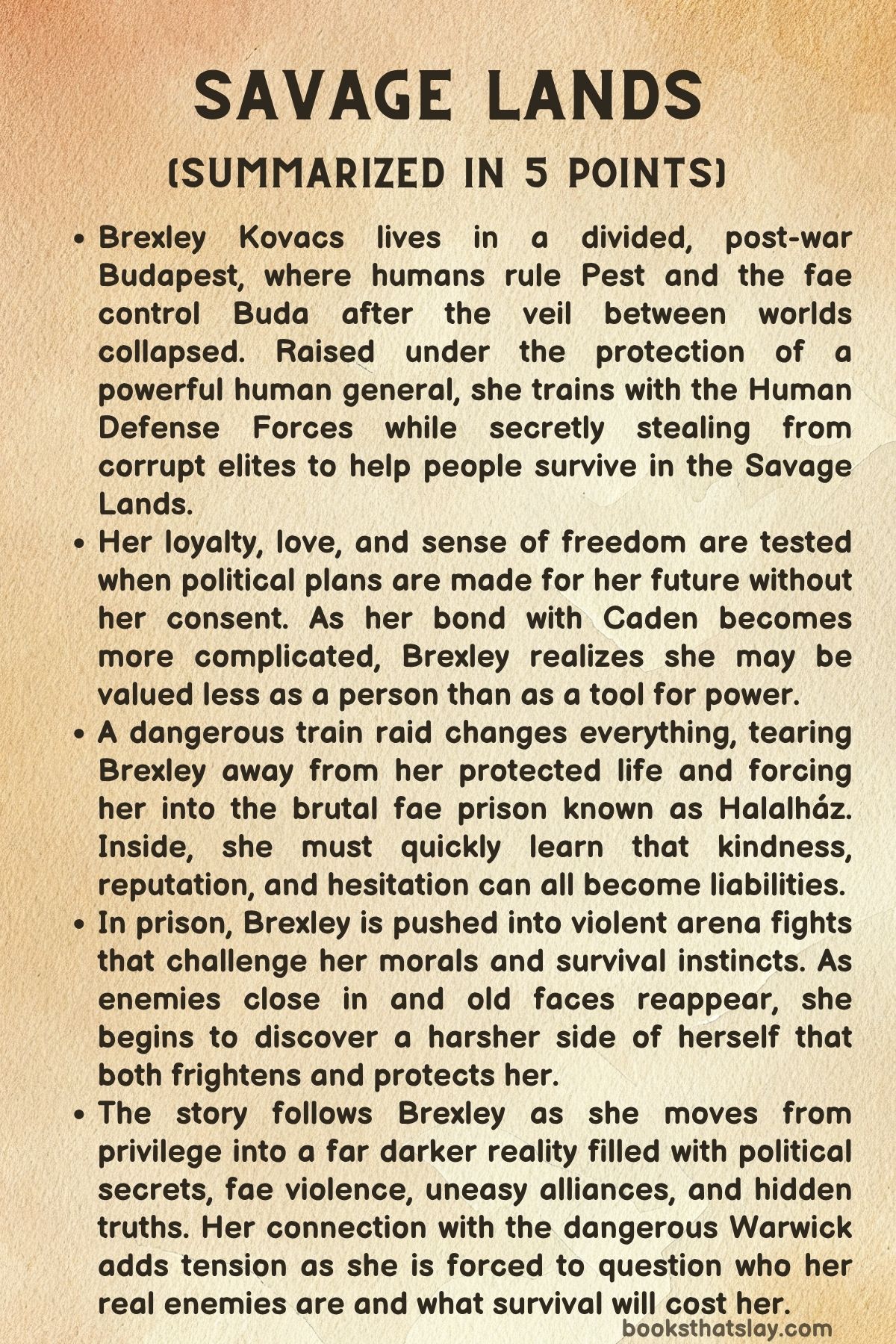
Brexley Kovacs has grown up in a fractured version of Budapest, a city split by war and magic. Since the veil between Earth and the fae Otherworld fell on the day she was born, the world has been unstable and dangerous.
Humans control Pest, fae hold Buda, and between them lies the Savage Lands, a place of poverty, crime, and survival. Brexley lives in Leopold, a guarded wealthy district, under the care of General Istvan Markos, leader of the Human Defense Forces.
To the public, she is a privileged ward being shaped for military service. In private, she is restless, angry at injustice, and unwilling to accept the neat lies of the world around her.
Brexley trains as an elite HDF cadet alongside Caden Markos, Istvan’s son and her closest friend. Their bond is complicated by attraction, loyalty, and the pressure of their future roles.
At night, they secretly raid cargo trains crossing Margaret Bridge. Brexley steals from the rich, traffickers, and fae-connected shipments, then passes goods through her maid, Maja, so people in the Savage Lands can sell them and survive.
These raids give Brexley a sense of purpose beyond the rigid life Istvan has planned for her.
One raid goes badly when Brexley and Caden find magic-laced drugs hidden among the cargo. They are spotted, chased by fae soldiers, and forced to leap into the freezing Danube to escape.
When they return to HDF headquarters, Istvan catches them. Caden lies, but Istvan knows something is wrong.
His anger exposes the expectations placed on Caden as a future leader and the limited freedom both young people truly have. Caden later lashes out at Brexley, accusing her of pulling him into danger.
His words wound her because she loves him and senses him moving away from her as duty closes in.
The next day, Brexley is exhausted and injured during combat training. Aron Horvát, a cruel fellow cadet with whom she once had a brief sexual encounter, taunts her in front of the others.
Brexley answers with sharp humiliation, then defeats him brutally in a sparring match. Caden hears the exchange and is hurt by the reminder of Aron.
Brexley’s friend Hanna suggests that Caden’s jealousy proves he feels more than friendship, but Brexley has little time to process it before another blow lands.
At a political party hosted by Istvan, Brexley is dressed and presented like an ornament. Rebeka, Istvan’s wife, gives her a warning disguised as advice, telling her that women often gain power through duty, obedience, and sacrifice.
During the party, Brexley and Caden nearly admit their feelings. Caden reveals how angry he was that Aron touched her and begins to speak about wanting her as more than a friend.
Before they can cross that line, Istvan interrupts and introduces Sergiu, the son of Romanian Prime Minister Alexandru Lazar.
Istvan announces that Brexley is to marry Sergiu to strengthen an alliance between Hungary and Romania. Caden erupts, but Istvan shuts him down.
Rebeka reinforces the idea that Brexley and Caden are like siblings, making their romantic feelings seem forbidden and foolish. Brexley realizes that Istvan never saw her as family in the way she hoped.
He has been raising her as a political asset, someone he can trade for power.
Devastated, Brexley escapes to the rooftop, where Caden finds her. He admits he has wanted her for a long time, but he refuses to kiss her because he knows losing her to Sergiu would destroy him.
Brexley remembers hearing Istvan and Lazar discuss secret cargo leaving on the last night train before dawn. Angry and desperate for one last act of freedom, she convinces Caden to raid the train with her.
On board, they discover guns, cash, and hidden compartments filled with glowing blue pills charged with magic. Brexley gathers evidence, but she stays too long.
The train reaches the fae side before they can escape. Under gunfire, they run for the bridge.
Caden gets ahead, but Brexley is shot in the back. Knowing he cannot save her, she urges him to jump.
He does, heartbroken, while fae soldiers capture her.
Brexley wakes six days later chained to a bed in a fae healing room. A healer tells her she should have died from the wound.
Instead, she survived, though no one understands why. Fae guards led by Sloane arrive to move her.
Brexley fights hard and nearly reaches a weapon, but she is subdued. She is taken across the fae side of Budapest and sees her former home across the river, close but unreachable.
Her destination is Halalhaz, the House of Death, a prison with a reputation for swallowing captives forever.
Halalhaz is hidden deep underground beneath tunnels, the Labyrinth, and the Citadella. Guards named Zion and Jade escort Brexley into a vast prison filled with cages, filth, screams, violence, and despair.
Her old life vanishes the moment she enters. She is no longer Istvan’s ward, an HDF trainee, or Caden’s secret love.
She is a prisoner, surrounded by beings who hate humans and by guards who enjoy cruelty.
Inside Halalhaz, Brexley is forced into the Games, brutal arena fights staged for entertainment and control. Her first major battle is against Mio.
To survive, Brexley gives in to a savage part of herself and kills Mio with a broken staff. The crowd names her “Piranha,” a title that follows her through the prison.
The victory saves her life but leaves her shaken by what she has become. Afterward, guard Boyd threatens her, but Zander intervenes.
Brexley also confronts Tess, Mio’s friend, forcing her to return stolen blankets and making it clear their feud is finished.
Brexley’s reputation grows, but reputation does not feed her. She remains weak, hungry, and constantly watched.
Then Aron Horvát arrives as a new prisoner. Shocked to find Brexley alive, he blurts out her real name, exposing her identity as General Markos’s ward.
This makes her even more valuable and hated. Aron tells her that Caden believed she died and has become reckless, attacking fae guards.
Brexley tells Aron to stay quiet and follow prison rules, but his arrogance brings punishment. After he insults work in the laundry room, Hexxus whips him viciously.
Brexley begs for mercy, and Boyd carries Aron away with a cruel promise.
Later, Brexley enters the arena expecting one kind of fight and is instead matched against Rodriguez, a powerful bull-shifter. He wants revenge because humans experimented on and killed his sister.
Brexley uses speed, timing, and strategy to injure him badly. Before she can finish the fight, Boyd throws Aron into the arena.
Only one person can leave alive. Brexley and Aron first work together against Rodriguez, but Aron soon turns on her.
He admits jealousy over Caden and claims he loved her, yet chooses his own survival. Brexley kills him.
She then refuses to turn Rodriguez’s death into a spectacle and ends his suffering more quietly when he begs to die.
The killing nearly breaks her. Zander tries to comfort her, but Brexley withdraws.
Warwick, a terrifying prisoner with a reputation for violence, later appears while she showers. He does not offer soft comfort.
Instead, he tells her he knows the darkness that follows killing and that death takes payment from the survivor. His understanding steadies her more than kindness would, though his motives remain hard to read.
Once her identity is known, Brexley becomes a target. Inmates threaten her, attack her, and test her limits.
Kek, a demon, begins protecting her, while Opie and Bitzy provide small moments of relief in the prison’s misery. Before another fight, Bovidae-shifters beat Brexley.
Warwick intervenes, kills their leader, and declares Brexley “his,” not as a lover or protector, but as his chosen kill. Soon after, she is matched against Warwick himself.
Before the fight, Zander kisses Brexley and warns her that not everything is what it seems. In the arena, Warwick taunts her and fights with brutal skill, yet he repeatedly holds back.
Brexley wounds him, but he seems to be delaying rather than trying to end her quickly. As he strangles her, an explosion tears through Halalhaz.
The prison erupts into chaos. Guards, inmates, and hidden allies move at once.
Warwick pulls Brexley from the arena and leads her through tunnels as the prison collapses into riots and violence. Zander is revealed to be part of the escape plan.
Warwick gets Brexley out of Halalhaz and into Budapest, where they flee through danger and confusion. Their escape takes them toward the Savage Lands, the place Brexley once tried to help from a distance but never truly understood.
There she sees the poverty, hunger, and suffering hidden from her protected life in Leopold.
Warwick brings Brexley to Madam Kitty’s, where Rosie tends her injuries. Brexley and Warwick continue to clash, both stubborn, distrustful, and shaped by violence.
Yet their forced alliance becomes harder to dismiss. They hide from soldiers, face bounty hunters, resist dangerous supernatural threats, and prepare to move again through a city that wants to capture, use, or kill them.
By the end, Brexley has lost the illusion of safety, but she has gained a harsher understanding of power, survival, and the truth behind the world that raised her.
Characters
Brexley Kovacs
Brexley Kovacs is the central character of Savage Lands, and her journey is built around the collapse of the protected identity she has been given. At the beginning of the book, she appears to be an elite HDF trainee: disciplined, physically capable, privileged, and connected to one of the most powerful human families in post-war Budapest.
Yet beneath that official image, she is restless, angry, compassionate, and rebellious. Her secret raids with Caden show that she is not satisfied with the polished safety of Leopold when poverty and desperation exist just across the boundaries of her world.
She steals not simply for thrill, but because she recognizes the injustice around her, even if she does not yet fully understand its scale.
Brexley’s emotional life is shaped by contradiction. She has been raised under Istvan’s authority and trained to serve human power, but she instinctively resists being controlled.
Her love for Caden reveals her longing for intimacy, freedom, and choice, while the arranged marriage to Sergiu exposes how little ownership she truly has over her life. This betrayal becomes one of the first major fractures in her worldview.
She realizes that she has not merely been protected by Istvan; she has been groomed, positioned, and prepared as a political tool. That realization pushes her toward the reckless final raid that ultimately changes her life completely.
Her imprisonment in Halalhaz transforms her from a rebellious trainee into a survivor. Brexley’s violence in the arena is not presented as simple toughness; it is a brutal awakening.
Killing Mio, then Aron, then mercy-killing Rodriguez forces her to confront what survival costs. The name “Piranha” symbolizes the version of herself that emerges under pressure: small compared with many enemies, but vicious, fast, and impossible to dismiss.
Still, Brexley is not reduced to violence. Her guilt, grief, fear, and resistance remain central to her character.
She hates what the prison demands from her, yet she adapts because dying would mean letting her captors define the end of her story.
By the later part of the book, Brexley becomes more aware of the lies that shaped her earlier life. Seeing the Savage Lands directly forces her to confront the poverty that was hidden behind military privilege.
Her relationship with Warwick complicates her instincts further because he is dangerous, secretive, and morally dark, yet he also understands the psychological burden of killing in a way few others do. Brexley’s strength lies not only in her ability to fight, but in her refusal to stop questioning power, loyalty, love, and survival.
She is a character defined by endurance, but also by the painful process of discovering who she is when every identity given to her is stripped away.
Caden Markos
Caden Markos is Brexley’s closest friend, love interest, and emotional anchor in the first part of the story. As Istvan’s son, he lives under enormous pressure to become a future leader, and that pressure shapes much of his behavior.
He is brave enough to raid trains with Brexley and loyal enough to follow her into danger, but he is also deeply trapped by expectation. His anger after they are caught by Istvan shows that he is beginning to feel the conflict between what he wants and what his father demands from him.
He loves the freedom Brexley represents, but he also fears the consequences of choosing that freedom.
Caden’s feelings for Brexley are intense but conflicted. His jealousy over Aron makes his romantic attachment obvious, and his rooftop conversation with Brexley reveals how long he has wanted her.
Yet he refuses to fully act on those feelings because he understands the destructive power of the world around them. The arranged marriage to Sergiu does not merely separate him from Brexley; it exposes how helpless even Istvan’s own son can be when political ambition is involved.
Caden’s pain comes from knowing what he feels but being unable to protect it.
His decision to jump from the bridge after Brexley is shot is one of his most important moments. It is not a simple act of abandonment, because Brexley urges him to save himself, but it still leaves a wound between them and within him.
Later, Aron reveals that Caden believes Brexley is dead and has become reckless, attacking fae guards. This suggests that losing her destroys the careful balance he had been trying to maintain.
Caden represents love constrained by duty, privilege poisoned by control, and the emotional damage caused by being raised as a political heir rather than a free person.
General Istvan Markos
Istvan Markos is one of the most powerful human figures in the book, and his character represents military authority, political ambition, and patriarchal control. As Brexley’s guardian, he appears at first to occupy the role of protector, but his actions reveal something far more calculating.
He has raised her within the safety of Leopold and the structure of the HDF, yet that protection comes with ownership. His plan to marry her to Sergiu proves that he sees her value in strategic terms.
She is useful because of her beauty, training, connections, and symbolic position, not because of her desires.
Istvan’s relationship with Caden is also defined by control. He expects his son to become a future leader and reacts with fury when Caden behaves irresponsibly.
His anger is not only parental disappointment; it is political fear. Caden’s recklessness threatens the image of discipline and authority Istvan needs to maintain.
This makes Istvan a character who treats even family as an extension of power. He is not openly chaotic or impulsive.
His cruelty is organized, polished, and justified through duty.
What makes Istvan especially threatening is that he understands how to use social structures to trap people. The party scene reveals his skill at turning private lives into public arrangements.
By announcing Brexley’s engagement in a political setting, he removes her ability to object without consequence. His power lies not only in command but in presentation.
He controls rooms, narratives, alliances, and futures. Istvan stands as one of the clearest examples of human authority being just as manipulative and dangerous as the fae power Brexley has been trained to fear.
Rebeka Markos
Rebeka Markos is a quieter but deeply significant figure because she embodies the social machinery that supports Istvan’s power. Her speech to Brexley about women using duty and sacrifice as forms of power is ominous because it frames oppression as strategy.
Rebeka does not openly rescue Brexley from the arranged marriage or challenge Istvan’s plan. Instead, she prepares Brexley to accept the role being forced upon her.
This makes Rebeka unsettling because she understands the system well, but rather than dismantling it, she teaches younger women how to survive inside it.
Her behavior at the party is especially revealing. By describing Brexley and Caden as siblings, she helps erase the romantic tension between them and makes Brexley’s marriage to Sergiu seem socially acceptable.
This is a subtle form of control. Rebeka uses language, etiquette, and social framing to reshape emotional reality.
She may not wield weapons or command soldiers, but she helps enforce the political order through appearances.
Rebeka’s character suggests that women in this world can hold influence while still being trapped by the same structures they help maintain. She is not powerless, but her power is compromised.
She has learned to survive by aligning herself with duty, image, and sacrifice. In that sense, she acts as a warning to Brexley: this is what a woman can become if she accepts the role powerful men design for her.
Prime Minister Alexandru Lazar
Prime Minister Alexandru Lazar functions as a political mirror to Istvan. His presence at the party makes clear that Brexley’s personal life is being negotiated as part of a larger alliance between Hungary and Romania.
He does not need to be shown as physically cruel to be dangerous. His power comes from diplomacy, status, and the willingness to treat marriage as a political contract.
Through him, the book shows that violence does not exist only in prisons, battles, and raids; it also exists in elegant rooms where leaders calmly decide the futures of others.
Lazar’s importance lies in what he represents. He is part of a broader human political order that claims to protect civilization while still using people as bargaining pieces.
His alliance with Istvan suggests that national survival and political ambition have become intertwined. Brexley’s engagement to his son is not about affection or compatibility.
It is about influence, territory, and advantage. Lazar therefore helps expose the hypocrisy of the human leadership: they condemn fae domination while practicing their own forms of coercion.
Sergiu Lazar
Sergiu Lazar is important less for his personal actions and more for what his role means in Brexley’s life. As the man she is ordered to marry, he becomes the human face of her loss of freedom.
He represents a future chosen for her by powerful men, a life in which her body, name, and social position would be used to strengthen a political alliance. Even though he is not developed as deeply as Caden or Warwick, his presence changes the emotional direction of the story.
Sergiu also functions as a contrast to Caden. Caden represents forbidden love, shared rebellion, and emotional history, while Sergiu represents arrangement, duty, and political usefulness.
Brexley’s reaction to the engagement is not only about rejecting Sergiu personally; it is about rejecting the idea that her future can be assigned to her. His character therefore becomes a symbol of the polished cage waiting for Brexley before Halalhaz replaces it with a much more brutal one.
Aron Horvát
Aron Horvát is one of the most bitter and tragic secondary characters in Savage Lands. At HDF, he is arrogant, cruel, and eager to humiliate Brexley by exposing their sexual past in front of others.
His behavior reflects insecurity disguised as dominance. He wants power over Brexley through shame, but she defeats him verbally and physically, making it clear that his hold over her is weaker than he believes.
From the beginning, Aron’s masculinity is fragile, reactive, and tied to resentment.
When Aron reappears in Halalhaz, his presence forces Brexley’s old life into her new nightmare. By blurting out her real name, he makes her even more vulnerable, whether through stupidity, shock, or carelessness.
His arrogance also proves unsuited to prison life. He insults the sewing work, provokes Hexxus, and is quickly brutalized.
Aron cannot adapt because he still carries the assumptions of HDF status into a place where that status means nothing.
His final fight with Brexley reveals the emotional ugliness beneath his earlier behavior. Aron claims he loved her, but his love is tangled with jealousy, entitlement, and resentment over Caden.
When survival is at stake, he turns on her. This does not make him purely monstrous; it makes him painfully weak.
He cannot rise above fear, humiliation, or jealousy. Brexley killing him is devastating because he is not a faceless enemy.
He is a piece of her past, and his death proves that Halalhaz does not only kill strangers. It forces her to destroy people who once belonged to her world.
Hanna
Hanna serves as one of Brexley’s few ordinary emotional supports before the prison section of the story. Her role is smaller, but she helps reveal Brexley’s inner life by noticing what Brexley and Caden struggle to admit.
When Hanna suggests that Caden’s reaction to Aron proves his feelings, she acts as the perceptive friend who sees through denial. She understands the emotional tension around Brexley even when Brexley herself is too hurt, proud, or confused to fully name it.
Hanna also represents the life Brexley might have continued living if she had remained within the HDF world. She belongs to the social and training environment that Brexley loses after her capture.
Because of that, Hanna’s presence gives the early part of the story a sense of friendship and normality. In contrast to the violence of Halalhaz, her scenes remind the reader that Brexley once had conversations about love, jealousy, embarrassment, and hope.
Hanna helps humanize Brexley before the book forces her into survival mode.
Maja
Maja is significant because she connects Brexley’s privileged world to the poverty of the Savage Lands. As Brexley’s maid, she occupies a lower social position, but she is trusted with the stolen goods Brexley takes from trains.
Through Maja, those goods reach poor people who can sell them to survive. This makes her part of Brexley’s quiet rebellion against the inequality of Budapest.
Maja’s role also reveals that Brexley’s compassion is practical rather than abstract. Brexley does not merely feel sorry for the poor; she creates a risky channel of redistribution, and Maja helps make that possible.
Maja therefore represents the hidden networks of survival that exist beneath official power. She is not a warrior or politician, but she matters because she participates in resistance on a human, everyday level.
Sloane
Sloane is the elite fae guard who leads Brexley’s transfer after she wakes from her gunshot wound. Her role is to establish the fae side’s efficiency, discipline, and danger.
Brexley fights fiercely during the transfer and nearly reaches a weapon, but Sloane subdues her, showing that Brexley’s old training is not enough to overcome every enemy in this new world. Sloane becomes one of the first figures to make Brexley understand that she has crossed into a system where she no longer has status or protection.
Sloane’s character also contributes to the fear surrounding Halalhaz. She is not presented as chaotic or sadistic in the same way Boyd is; instead, she is controlled, capable, and professional.
That makes her frightening in a different way. She is part of the machinery that delivers prisoners to the House of Death.
Her presence marks the transition between Brexley as a wounded captive and Brexley as an inmate entering a world designed to erase her.
Zion
Zion is one of the guards who escorts Brexley deep into Halalhaz. His role is connected to initiation and descent.
Through him and Jade, Brexley is physically moved away from the city above and into the underground prison system. Zion helps create the sense that Halalhaz is not merely a building but an entire hidden world beneath Budapest, complete with its own rules, threats, and hierarchy.
Although Zion is not as individually developed as Boyd, Zander, or Warwick, his function matters. He is part of the controlled procedure that transforms Brexley from captured enemy into imprisoned property.
Characters like Zion show that institutions of cruelty do not depend only on dramatic villains. They also depend on guards who carry out the process, escort prisoners, enforce boundaries, and normalize horror through routine.
Jade
Jade, like Zion, helps escort Brexley into the depths of Halalhaz. Her presence reinforces the prison’s atmosphere of intimidation and control.
As Brexley enters the vast underground space filled with cages, screams, filth, and threats, Jade is part of the system that makes escape feel impossible. She stands at the threshold between Brexley’s former life and the brutal reality of imprisonment.
Jade’s importance lies in how she contributes to Brexley’s first understanding of the prison. The journey downward is psychological as much as physical.
Every guard, tunnel, and locked passage strips away the illusion that Brexley can rely on her old identity. Jade is one of the figures who helps deliver Brexley into that new reality, where survival will depend on instinct rather than rank.
Mio
Mio is the opponent whose death marks Brexley’s first major transformation inside Halalhaz. The fight against Mio forces Brexley to embrace a feral part of herself that had previously been controlled by training, discipline, and moral hesitation.
Killing Mio with the broken staff is not only a physical victory; it is the moment the prison begins reshaping Brexley’s identity. The crowd’s chant of “Piranha” turns that act of survival into a public reputation.
Mio’s role is tragic because she becomes part of the prison’s machinery. She is not simply an enemy Brexley defeats; she is another prisoner caught in a system that demands violence for entertainment and control.
Her death shows how Halalhaz turns captives against one another. Brexley’s horror afterward matters because it proves she has not become numb.
Mio’s death gives Brexley power in the prison, but it also leaves a moral scar.
Tess
Tess is Mio’s friend, and her conflict with Brexley reflects the social consequences of arena violence. After Brexley kills Mio, Tess’s hostility is personal.
She is not just another inmate looking for weakness; she represents grief and resentment within the prisoner community. Her theft of Brexley’s blankets is a small but meaningful act in a place where warmth and resources are tied to survival.
When Brexley forces Tess to return the blankets and declares their feud over, it shows Brexley learning how to use authority inside Halalhaz. She does not beg for peace; she asserts it.
This moment reveals Brexley’s growing understanding of prison politics. Mercy alone will not protect her, but endless conflict will weaken her.
Tess therefore helps show Brexley’s shift from reactive survival to strategic control.
Boyd
Boyd is one of the cruelest figures in the prison and represents sadistic institutional power. Unlike guards who merely enforce rules, Boyd seems to enjoy fear, humiliation, and manipulation.
His threat toward Brexley after her shower, his handling of Aron, and his decision to alter the arena fight all show his taste for psychological cruelty. He does not simply want prisoners to die; he wants them to suffer in ways that entertain him and break them emotionally.
His manipulation of the Rodriguez fight is especially important. By throwing Aron into the arena and making it clear that only one person can leave alive, Boyd turns personal history into spectacle.
He understands that forcing Brexley to fight someone from her past will hurt her more deeply than a normal match. This makes him dangerous because he recognizes emotional vulnerabilities and weaponizes them.
Boyd’s character shows how systems like Halalhaz are maintained by people who benefit from dehumanization. He treats prisoners as pieces in a game, changing rules to increase pain.
His cruelty sharpens Brexley’s hatred of the prison and makes her survival feel not only physical but moral. To endure Boyd’s world, she must resist becoming the kind of monster he wants the arena to create.
Zander
Zander is one of the most ambiguous and intriguing characters in the book. At first, he appears to be a guard who sometimes intervenes in ways that complicate his position.
He stops Boyd from threatening Brexley, escorts her, warns her, and later kisses her before her fight with Warwick. His behavior suggests sympathy, attraction, and hidden motives, but he never becomes entirely transparent.
This ambiguity makes him difficult for Brexley to trust completely.
Zander’s warning that not everything is what it seems becomes crucial when the prison escape unfolds. He is revealed to be part of the escape plan, meaning his earlier actions were connected to a larger design.
This changes how his character is understood. He is not simply a guard with occasional kindness; he is someone moving within the prison system while working against it from the inside.
His relationship with Brexley is emotionally charged but uncertain. The kiss suggests personal feeling, yet the surrounding secrecy makes it hard to separate desire from strategy.
Zander represents the difficulty of reading loyalty in a world built on deception. He may be an ally, but he is also a reminder that help often comes wrapped in secrets.
Rodriguez
Rodriguez is a powerful bull-shifter whose fight with Brexley adds moral complexity to the arena. He wants revenge because he believes humans killed his sister after experimenting on her.
This motivation prevents him from being a simple monster. His rage is rooted in grief, trauma, and the history of human violence against nonhuman beings.
Through Rodriguez, the book complicates Brexley’s inherited human perspective and shows that fae and shifters have also suffered under human cruelty.
His battle with Brexley is physically intense, but its emotional weight comes from the fact that both fighters are victims of larger systems. Rodriguez enters the arena carrying grief; Brexley enters it carrying fear and the burden of survival.
When he later begs her to let him die, the fight shifts from spectacle to mercy. Brexley’s decision to end his suffering quietly, rather than give the crowd the bloody performance they want, shows that she is still trying to preserve some part of her humanity.
Rodriguez’s character deepens the political world of the novel. His sister’s fate suggests that the conflict between humans and fae is not cleanly divided into good and evil.
Humans have committed atrocities too, and Brexley must begin facing that truth. Rodriguez becomes one of the characters who forces her to see beyond the propaganda of her upbringing.
Warwick
Warwick is one of the darkest and most magnetic figures in Savage Lands. He is violent, feared, secretive, and difficult to categorize.
When he declares Brexley “his,” the statement is deliberately complicated. It sounds possessive and threatening, especially because he frames it as his right to kill her rather than as protection.
Yet his actions repeatedly suggest that he is keeping her alive, even when he disguises that protection as menace.
His fight with Brexley reveals his complexity. He taunts her and battles her fiercely, but he also appears to hold back and stall.
This suggests that Warwick is performing a role within a larger plan, one Brexley does not yet understand. When the explosion rocks Halalhaz, his real purpose becomes clearer: he pulls Brexley out and guides her through the chaos.
Warwick is not safe in any simple sense, but he is more than the brutal killer he first appears to be.
Warwick’s emotional connection with Brexley is rooted in shared darkness. The shower scene after Aron and Rodriguez’s deaths is significant because Warwick understands the burden of killing without trying to soften it with false comfort.
He tells her that death demands payment from the survivor, acknowledging the moral and psychological cost of what she has done. This makes him one of the few characters who sees Brexley’s trauma clearly.
His partnership with Brexley after the escape is full of conflict, distrust, and tension. He pushes her, hides information, and often speaks harshly, but he also helps her survive the dangers of the Savage Lands.
Warwick represents the kind of ally who cannot be separated from danger. He challenges Brexley’s assumptions about enemies, monsters, and protectors, forcing her to recognize that survival outside the prison may be just as morally complicated as survival inside it.
Kek
Kek is a demon who begins protecting Brexley after her identity is exposed. His role is important because once the other prisoners learn she is Brexley Kovacs, ward of General Markos, she becomes a more valuable and hated target.
Kek’s protection gives her a small but meaningful shield in an environment where vulnerability invites attack. His presence suggests that alliances in Halalhaz can form in unexpected ways.
Kek also helps complicate the idea of monstrosity. As a demon, he might be expected to be frightening or dangerous, but in Brexley’s prison life, he becomes one of the figures who helps her endure.
This contrast matters because the book repeatedly challenges the divisions Brexley was raised to believe in. Humans can be cruel, fae can be allies, and beings labeled monstrous may show loyalty.
Kek’s protection is part of Brexley’s growing education in the moral complexity of her world.
Opie
Opie provides comfort in one of the bleakest parts of Brexley’s journey. In Halalhaz, where violence, hunger, and fear dominate daily life, small sources of warmth become emotionally significant.
Opie’s presence helps keep Brexley connected to tenderness and companionship. This matters because the prison constantly pressures her to become only brutal, only reactive, and only concerned with survival.
Opie’s role may be smaller than those of Warwick or Zander, but the emotional function is important. Characters like Opie remind the reader that survival is not sustained by strength alone.
Brexley also needs moments of connection, familiarity, and relief. Opie helps preserve a softer emotional thread in a section of the story otherwise marked by death and dehumanization.
Bitzy
Bitzy, like Opie, serves as a small but meaningful comfort for Brexley during her imprisonment. In a place designed to strip prisoners of dignity and hope, Bitzy’s presence offers emotional relief.
The importance of such a character lies in contrast. Against the darkness of cages, arena fights, and guard brutality, Bitzy helps show that gentleness can still exist.
Bitzy also contributes to the found-family texture of Brexley’s prison experience. Brexley loses her old home, her status, and her presumed future, but she does not become completely alone.
Even minor bonds matter in Halalhaz because they resist the prison’s attempt to isolate and destroy its inmates. Bitzy represents the fragile but necessary comfort that helps Brexley keep going.
Hexxus
Hexxus is a brutal prison figure whose whipping of Aron demonstrates how quickly arrogance is punished inside Halalhaz. Aron’s insult about the sewing work provokes Hexxus, and the response is savage.
This scene reveals the prison’s hierarchy and the danger of misunderstanding it. In the outside world, Aron could rely on status, training, and confidence.
In Halalhaz, those things mean nothing when someone like Hexxus has power over him.
Hexxus also helps show Brexley’s remaining compassion. Even though Aron has humiliated and hurt her, she begs Hexxus to stop.
This reaction is important because it proves Brexley has not lost her moral instincts. She may be becoming more dangerous, but she is not becoming indifferent.
Hexxus’s violence therefore serves two purposes: it displays the cruelty of the prison and reveals Brexley’s refusal to completely surrender her humanity.
Madam Kitty
Madam Kitty enters after the escape from Halalhaz and represents a different kind of survival outside formal power. Her place offers shelter, but it exists within the dangerous and morally unstable space of the Savage Lands.
Madam Kitty’s role suggests that survival in this world often depends on unofficial networks, hidden spaces, and people who know how to operate beyond the reach of governments, armies, and prison systems.
She also marks a shift in Brexley’s journey. After the underground horror of Halalhaz, Madam Kitty’s place becomes part of the wider, lawless world Brexley must learn to navigate.
It is not the safety of Leopold, and it is not the structured brutality of prison. It is something more uncertain.
Madam Kitty’s presence helps expand the story from captivity into fugitive survival.
Rosie
Rosie is the caretaker figure who tends Brexley’s injuries after Warwick brings her to Madam Kitty’s. Her role is important because Brexley’s body has been repeatedly used as a battleground: shot, chained, starved, beaten, and forced into combat.
Rosie’s care offers a necessary counterpoint to that violence. She represents healing in a world where most people have been hurting Brexley or using her.
Rosie’s presence also helps humanize the post-escape section of the story. Brexley and Warwick may still be clashing, hiding, and facing danger, but Rosie’s treatment of Brexley reminds the reader that recovery is part of survival too.
She may not control the larger political conflict, but her care matters because it gives Brexley a moment of physical restoration after relentless trauma.
Themes
Division, Power, and Social Control
Savage Lands presents a world where geography itself becomes a tool of control. Budapest is not merely separated by a river; it is divided by race, class, military power, and fear.
Pest represents human order, wealth, and discipline, while Buda stands for fae dominance, and the Savage Lands expose the suffering ignored by both sides. Brexley’s life in Leopold shows how privilege can hide injustice behind polished walls and military language.
She is trained to see the fae as enemies, yet her secret raids reveal that corruption exists among humans too. Istvan’s authority depends on obedience, alliances, and appearances, not moral justice.
His plan to marry Brexley off proves that even those protected by power can become property within its system. The divided city reflects a larger truth: rulers maintain control by teaching people whom to fear, where they belong, and what they must sacrifice.
Brexley’s journey forces her to see that the world she defended was built on selective truth.
Identity, Survival, and Moral Change
Brexley’s identity shifts under pressure, not because she becomes someone entirely new, but because danger strips away the version of herself shaped by comfort, training, and expectation. At HDF, she is a privileged trainee, a ward of power, and someone expected to serve a political future chosen by others.
In prison, those labels become dangerous, and survival requires instinct, violence, and emotional endurance. Her arena fights force her to confront what she is capable of when mercy has no safe place to stand.
The name “Piranha” captures how others begin to define her through brutality, yet Brexley’s inner conflict shows that she has not lost her conscience. Killing Mio, Aron, and Rodriguez affects her deeply because survival does not erase guilt.
Her strength lies not only in fighting but in continuing to feel the cost of each act. Savage Lands uses her transformation to show that survival can protect the body while wounding the soul, especially when a person must become feared in order to stay alive.
Freedom, Choice, and the Cost of Rebellion
Brexley’s rebellion begins as secret theft, but it grows into a fight against every structure trying to claim her life. Her raids with Caden are not simple acts of recklessness; they are attempts to reclaim agency in a world where her future is already being negotiated by powerful men.
Stealing from traffickers and wealthy elites allows her to act on a moral code that official systems refuse to honor. However, rebellion in this world always carries a cost.
The final train raid gives Brexley one last moment of choice before she is shot, captured, and thrown into a prison designed to erase individuality. Later, escape from Halalhaz does not bring safety; it throws her into poverty, pursuit, and uncertainty.
The theme suggests that freedom is not a single dramatic escape but a difficult condition that demands risk, loss, and constant decision-making. Brexley’s choices matter because they are made under pressure, when obedience would be easier, safer, and more socially acceptable.
Love, Loyalty, and Betrayal
Love in the story is complicated by duty, jealousy, politics, and survival. Brexley and Caden’s relationship is shaped by deep affection, but also by fear of the roles waiting for them.
Caden’s anger after learning about Aron reveals desire and possessiveness, while his refusal to kiss Brexley on the rooftop shows the pain of wanting something he believes duty will destroy. Their bond is sincere, yet it is not strong enough to stop the machinery of political ambition.
Istvan’s betrayal is more disturbing because it comes from a guardian figure who has raised Brexley while preparing to use her as a diplomatic asset. Aron’s betrayal in the arena is different but equally revealing: affection collapses when survival becomes urgent.
Even Warwick’s actions blur threat, protection, and personal interest, making trust difficult to define. Through these relationships, the story shows that loyalty is tested most severely when love conflicts with power, fear, or self-preservation.
In this world, betrayal often comes from people who once seemed closest.