Scavengers by Kathleen Boland Summary, Characters and Themes
Scavengers by Kathleen Boland is a contemporary novel about how people react when a life plan collapses—and what they grab for when stability disappears. Bea Macon, a young finance worker with a weather specialty, makes a single high-stakes mistake that costs her career and leaves her unmoored.
She retreats to Utah to stay with her unpredictable mother, Christy, who is fixated on an online treasure hunt that promises quick money and a fresh start. As the hunt turns obsessive and dangerous, Bea and Christy are pulled into a desert town where desperation, rivalry, and hope collide.
Summary
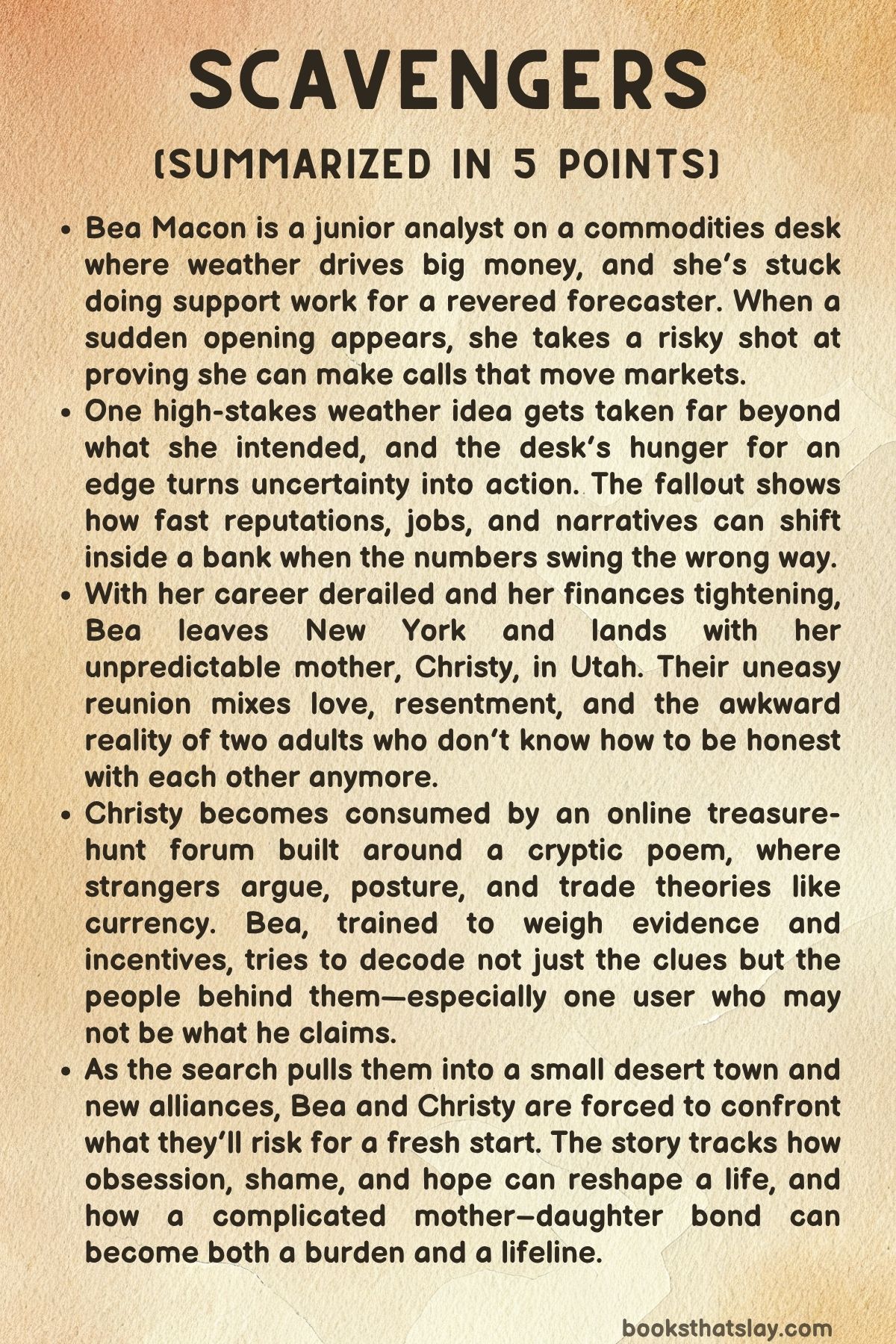
Bea Macon is a junior analyst on a commodities trading desk in New York, assigned to Phil, the desk’s quiet “weather guy.” Phil is respected for his calls and guarded about how he reaches them. Bea’s work is mostly support: write-ups, tracking, the kind of tasks that keep the machine running while someone else gets the credit.
Weather on the desk is treated like a necessary gamble—important enough to move money, uncertain enough to excuse anything that goes wrong.
When Phil suffers a stroke, the desk suddenly feels exposed, and Bea feels an opening. She wants to prove she can do more than follow instructions, and she also wants the role Phil holds: the salary, the security, the status.
Searching for something that will make people pay attention, she thinks back to a terrifying storm from her Iowa childhood and settles on a derecho, a fast-moving wind event that can flatten crops and spike agricultural prices in a short window.
In mid-June, Bea notices conditions that could support severe storms across the Midwest at a sensitive point in the growing season. Her evidence is suggestive, not certain, but she believes that is how weather work functions: a probability story with consequences.
She mentions the possibility to Matt, a trader already under pressure in his personal life and eager for a decisive edge. Matt pushes for details and, instead of taking Bea’s idea as a cautious flag, turns it into a major bet.
He builds a huge position, and the desk’s move triggers a chain reaction. Other desks follow.
Hedge activity shows up overseas. The rumor hardens into a market narrative, and prices surge.
As the office becomes glued to radar and television coverage, Bea’s excitement shifts to fear. She realizes she has started something she can’t control.
Phil returns unexpectedly, wheeled in by his wife, looking fragile but still sharp. He reviews Bea’s work and concludes that even if the storm arrives, the likely impact won’t justify the massive exposure Matt has taken.
The next day brings wind and scattered reports, but nothing close to the catastrophe the market priced in. Positions unwind, prices settle, and the desk tries to move on as if the mania was normal.
Compliance does not move on. Bea is called into HR meetings and a federal call.
Her research access is frozen. People avoid her.
Matt disappears after a supposed smoke break and never properly returns to the story. Within weeks, the bank is interviewing a polished replacement, and within a month Bea is handed termination papers.
The job that once felt like her ladder becomes the reason she can’t get another rung.
Bea burns through severance while pretending she is fine. She tries to manage insomnia with routines and “wellness” fixes, but the quiet hours are full of dread.
At a boutique workout class she runs into Martha, an old college friend who casually delivers a humiliating update: Grant, Bea’s on-and-off late-night comfort, is now with Carolyn, Bea’s former roommate. The news stings because Bea’s past with Carolyn was already strange—Carolyn once left abruptly and, in a final act of chaos, abandoned jars of vomit under the bed.
Bea becomes determined not to let anyone see how stranded she is becoming.
With recruiters not responding and her finances shrinking, Bea books a one-way flight to Salt Lake City to see her mother, Christy, who has recently moved there. Christy greets her with forced cheer, an awkward homemade spread, and a house full of fake plants that smell like Bea’s childhood.
Bea spots small signs that Christy is hiding something, including a postcard signed only with a “B,” quickly pocketed when Bea notices it.
Their relationship snaps into old patterns: Bea cleaning up, Christy improvising, both of them avoiding the deepest truths. Christy isn’t opening bills.
Bea pays for groceries and rent when she can. Bea suspects shoplifting is back in the picture, but Christy reveals a different obsession: an online community where women trade tips, brag about stolen “hauls,” and chase a bigger fantasy—an outdoor treasure hunt for a chest supposedly worth a million dollars.
The hunt revolves around clues in a poem printed in a self-published memoir by a man the community calls the Poet. The Poet’s online presence is messy and rambling, but whenever he mentions the treasure, the internet floods his site.
After he is arrested and convicted for illegal antiquities dealing, interest explodes, the website crashes, and treasure seekers migrate to a message board known as the Conversation, moderated by someone called MadMax. The forum is part research project, part fight club, with users mocking one another while posting coordinates, theories, and long threads about maps, water sources, and wordplay.
Christy believes the treasure is in Utah. She has turned the dining table into a taped-together collage of maps and notes.
She is also communicating closely with a forum user named OnlyBob, who supports her desert theory and shares what he claims is evidence that he is closing in. Bea, trained to read incentives and bluffing, suspects Bob may be baiting Christy or trying to recruit free labor.
A housing crisis hits fast. Christy’s new interest in essential oils leads to an accident: she spills patchouli into a vent, and soon their landlord Flint and a repairman claim the air conditioner is ruined and demand an expensive replacement with an upfront payment.
Bea argues about deposits and leases but ends up paying anyway, terrified of being evicted and unable to admit she can’t afford it. When Christy offers a check to cover part of the cost, Bea tears it up rather than accept help.
The forum turns nastier. A vulgar photo appears from OnlyBob’s account—someone urinating on quartz—and commenters treat it as a joke aimed at Christy, who is known online for her crystal fixation.
Christy messages Bob and gets no response. Shortly after, an eviction notice appears on their door, escalating the pressure and exposing how unstable their living situation really is.
Christy announces she’s leaving for the weekend to a small desert town called Mercy to pursue the hunt, and she intends to take the car. Bea fights with her, then, afraid of being left alone and ashamed of how little control she has, decides to go too.
On the drive, Bea’s anxiety makes her reroute off highways onto isolated roads. She clings to a hopeful recruiter email, trying to believe her life can still restart.
In Mercy they stay at a modest RV park. Christy drags Bea into a poorly planned scouting hike in brutal heat with vague guidebooks and misplaced confidence.
They run out of water, lose the trail, and have no cell service. Bea collapses into panic and dehydration.
Christy returns with help: two local climbers, Tag and Hank, who are shocked by how far the women have wandered and guide them out through a canyon route. It’s rough and frightening, but they get back safely, with Tag’s calm competence and Hank’s blunt irritation keeping them moving.
Tag becomes a key figure. Bea learns his backstory: he once dropped out of college, drifted through California doing unpaid activism for food and beer, then worked fast food, then made money selling weed and eventually his own infused comfort-food products.
He enjoyed the success until paranoia and constant pressure pushed him to vanish and drive east, chasing the fantasy of becoming “no one.” Hearing this, Bea admits her own implosion—how a careless forecast turned into a market stampede, how federal scrutiny followed, and how her career in finance may be over.
Mercy grows louder and stranger. At a karaoke pizza place, Bea, Christy, Tag, and Hank sing and drink.
Later, a pale young man with striking blue eyes corners Bea outside, touches her without permission, insults her, and follows her down the road. Tag and Hank intervene just enough for Bea to escape, leaving her rattled and alert to how quickly a town can turn dangerous when you have no allies.
Meanwhile, Christy finally meets OnlyBob in person. He reveals a pistol in their motel room and carries it on a hike, insisting it’s for protection.
The romantic fantasy Christy built online starts to crack. Bob treats her like a tool, not a partner.
He focuses on logistics, keeps secrets, and frames everything as “business.” Christy, desperate to matter, tries to keep up.
Bea, hungover and anxious, stays behind and works on a job application by writing a report about wildfire data and weather impacts. She studies Christy’s map collage, then logs onto the Conversation to read what people are saying and to test how quickly information spreads.
Her texts to Christy fail to deliver, increasing the feeling that something is off.
Christy and Bob hike to meet the blue-eyed young man, who argues with Bob about a plan and a backpack. Christy ends up with the backpack and later finds a brass lighter engraved with initials.
In town, a chaotic local meeting erupts about paving the Dell Trail. The council votes to pave it, and Bob and the young man celebrate as if the decision unlocks access to something important.
At a burger stand afterward, Bob and the young man talk strategy while Christy is pushed aside. When Christy realizes Bob has taken her phone, she finally snaps, throws his burger into the street, and walks away.
She ends up at a women-only gathering where strangers feel safer than her supposed partner. There’s wine, dancing, and relief in being seen as a person again.
But Christy loses track of Bea in the night. Bea, trying to find her mother, drinks with men at the RV park, then follows an invitation from Tag and Hank.
What begins as companionship takes a dark turn when Hank proposes “Operation Sushi,” a petty revenge mission against outsiders: they sabotage a koi pond and steal fish. Bea is horrified but goes along, carrying the wet thrashing weight in Tag’s backpack against her spine, a physical reminder of how easily people compromise themselves when they want belonging.
The next day Bea finds Christy safe but hungover at Pat’s Grill. They work through a rush together, falling into a familiar teamwork that feels steadier than their fights.
Bea reports that someone broke into her cabin. Soon Christy realizes her treasure map is missing, and the most obvious suspect is Bob.
Bob has already fled. Christy and Bea learn he left early with the young man.
They pay their own bill and get help from Tag and Hank to leave town. On the drive, a violent storm hits—lightning, mud, blocked paths—and Tag and Hank guide them toward safer routes.
Afterward, Bea and Christy return to search for a marker Christy believes matters and instead find a lost dog and then a body lodged in flood mud: Bob. The young man—whose real name is Clayton Woods—disappears without a trace.
Bob’s wife and twin daughters arrive to identify the body, and Christy’s guilt and shock harden into something quieter. She posts about Bob’s death on the forum, triggering panic, accusations, and fresh speculation, then quits the Conversation entirely.
The treasure hunt, once an escape, now looks like a machine that feeds on lonely people.
Bea stays in Mercy longer than planned. She helps with storm cleanup and spends time at the hot springs, letting her former life in New York fade into the background.
Christy moves in with Hank’s father, Jim, choosing stability where she can find it. Over time, Bea and Christy begin speaking with more honesty, not fixing everything, but naming more of what they’ve been avoiding.
One day, at the hot springs, as they joke and float, Bea feels something metal under her foot at the bottom of the pool—an object that suggests the hunt may not be finished, and that the line between fantasy and reality might be thinner than either of them wants to admit.
Characters
Bea Macon
Bea is the novel’s nervous center of gravity in Scavengers, a person whose entire sense of safety depends on being seen as competent—and whose worst decisions come from that same hunger. On the trading desk, she lives in the shadow of Phil’s aura, doing the “clean” work that keeps the machine running while believing, privately, that she could do the high-status work if anyone would just let her.
When Phil’s stroke creates a sudden opening, Bea’s ambition turns reactive: she doesn’t build authority slowly, she tries to seize it in one dramatic leap, choosing a rare, cinematic weather event because it feels like the kind of call that would force the room to notice her. That choice reveals her key contradiction: she understands probability and uncertainty intellectually, yet emotionally she craves certainty—so she overweights her own memory, fear, and narrative framing until the forecast becomes less about truth and more about proof-of-worth.
After the desk turns on her, Bea’s collapse isn’t only professional; she loses the identity that made her feel real, and the shame makes her lie, hide, and isolate, even from the one person who might offer refuge. In Utah, she keeps translating life into market logic—bluffs, incentives, bait, and information asymmetry—because it’s the only language that still feels like power.
Her gradual shift in Mercy, where she helps with ordinary work, faces actual weather, and reconnects with her mother in messy honesty, suggests the beginning of a different competence: not performative mastery, but endurance, care, and the ability to live with uncertainty without turning it into catastrophe.
Phil
Phil is the embodiment of institutional trust: calm, liked, and opaque, a figure whose authority depends as much on mystique as on skill. His secrecy about method makes him both valuable and unchallengeable; the desk’s belief in him functions like a financial instrument—confidence priced in, questions discounted.
When he returns in a wheelchair, Phil becomes a living reminder of how fragile that authority is, yet he still reasserts it through judgment rather than drama. He reads Bea’s work with a practitioner’s sobriety, separating “possible” from “position-sized,” and his assessment exposes the desk’s real problem: not that weather is uncertain, but that people turn uncertainty into a permission slip for reckless appetite.
Phil isn’t framed as purely benevolent—his gatekeeping helped trap Bea in a subordinate role—but he represents a disciplined relationship to risk that everyone else, in different ways, violates. His presence also underlines a quiet cruelty of the workplace: even damaged, he is treated as the “real” weather mind, while Bea’s bid for legitimacy is treated as contamination.
Matt
Matt is the novel’s clearest portrait of leverage—financial and psychological—and how quickly both can snap. Under pressure, he hears Bea’s cautious signal as an opportunity for salvation, and his “all in” response shows a temperament built for momentum rather than reflection.
What matters to him is not whether the forecast is responsibly probable; it’s whether it’s tradable, scalable, and fast. Matt’s power is contagious: once he moves, everyone else moves, and the chain reaction shows how markets can turn a half-formed idea into a collective hallucination.
He also functions as a moral mirror for Bea: her error is the spark, but his is the accelerant, the person who converts ambiguity into maximal exposure because he can’t tolerate the slow grind of doubt. His disappearance after the collapse—reduced to rumor and an “alleged smoke break”—feels like the system protecting its appetite by shedding its most visible scapegoat or liability, leaving Bea to absorb consequences that were never hers alone.
Christy
Christy is both comic and heartbreaking: buoyant, erratic, performative, and also deeply shaped by long-term economic and relational injury. Her overly bright hosting rituals—the fake aspen tree, forced cheer, awkward food—read like a survival strategy, a way to keep despair from taking the house over.
The treasure hunt becomes her substitute for stability: it offers community, structure, and the dream of a clean reversal of fortune, while also echoing her history of risky attachments—men who promise escape, schemes that feel like destiny, and a chronic underestimation of how predatory others can be. Christy’s parenting is conflicted: she embarrasses Bea, drags her into chaos, and still shows fierce, wordless tenderness when Bea is broken, especially in moments of physical caretaking and shared exhaustion.
Her relationship with the forum—especially her vulnerability to OnlyBob—reveals a longing to be chosen and taken seriously, not just pitied. Yet Christy also grows; the women’s party, her eventual break from the Conversation, and her movement toward a different life in Mercy suggest that she isn’t doomed to repeat her cycles.
She is a character searching for dignity in a world that keeps offering her spectacle instead.
OnlyBob / Bob
Bob is predation disguised as collaboration. Online, he offers Christy what the forum economy rewards—certainty, insider status, and the feeling of being on a “team”—while keeping his real life obscured.
His vulgar forum provocation, the quartz photo, exposes how he uses humiliation as control, turning community attention into a weapon and testing how much disrespect Christy will absorb to remain close to him. In person, Bob becomes colder and more transactional: romance is a tool he withholds, and he reframes the hunt as “business” to justify manipulation.
The pistol he flashes isn’t just a threat of violence; it’s a symbol of how he stabilizes himself through intimidation and power, especially when the treasure’s promise starts to feel threatened. His theft of Christy’s map and his alliance with the young man make him the human version of a rug pull—someone who extracts free labor and insight, then disappears with the value.
His death in flood mud carries an ugly irony: a man chasing mythic wealth is swallowed by real weather, and the community that fed his ego immediately turns the event into more discourse, more paranoia, more story.
Tag / Taggart
Tag is a portrait of drift that hardens into self-mythology, then collapses back into ordinary regret. His early “activism” phase shows how easily he can adopt a narrative that makes him sound purposeful while actually living off leftovers and couches; he is charismatic enough to be tolerated, tidy enough to be excused, and restless enough to keep moving before anyone asks for accountability.
His weed-business arc is a parody of entrepreneurial fantasy—brand names, lifestyle accessories, the illusion of independence—followed by paranoia and the desire to become “no one,” as if anonymity could rinse him clean. In Mercy, Tag’s charm becomes more grounded: he can be funny and generous, but he also drags Bea into morally rotten local revenge, revealing a capacity to normalize cruelty when it feels like belonging.
Tag is important to Bea because he offers a different kind of escape than the one she chased in finance. He doesn’t promise prestige; he offers proximity, laughter, and the possibility that a ruined life can still be inhabited.
His self-awareness later—admitting the book that inspired him was terrible—suggests he might be capable of growing up, but only after he stops romanticizing disappearance.
Hank
Hank is the novel’s local hardness: a person shaped by scarcity, resentment, and the feeling of being watched and judged by outsiders. He carries a strong moral vocabulary when it suits him—scolding Christy for littering, insisting on what’s “right”—but he also rationalizes cruelty when it flatters his sense of territorial justice, as seen in “Operation Sushi.” That contradiction makes him feel real: he isn’t an ideological villain, he’s someone who uses ethics as a weapon and as a shield, depending on whose side he’s on.
Hank’s competence in the landscape—the canyon route, the practical decisions, the knowledge of distances—puts him in contrast with Bea’s desk-trained confidence, which collapses when the environment stops being an abstraction. He also provides a bridge into a different community structure, one that ultimately shelters Christy through Jim, suggesting that even harsh people can be embedded in networks of care.
Jim
Jim functions as a quiet anchor: the older stability that Mercy can offer when the glamour of the treasure and the panic of the city fall away. He isn’t framed through flashy interiority, but through the practical fact that he can provide space, shelter, and a kind of grounded routine that Christy has rarely had.
Jim’s significance is less about romance or drama and more about infrastructure—what happens when someone stops chasing a miracle and starts building a life that can hold.
MadMax / MM
MadMax is the sovereign of chaos: a moderator who rarely intervenes, which becomes its own ideology. By stepping in only to shut things down when threats spike, MM enables the forum’s core addiction—endless interpretation, bickering, and performance—while preserving the illusion that the Conversation is self-governing.
MM’s distance also makes the community feel like fate rather than management, as if the cruelty and obsession are organic instead of designed. The role highlights how online power works in Scavengers: influence is often exercised through absence, not presence, and “order” is defined as whatever keeps the engine of attention running.
The Poet
The Poet is a carefully engineered myth-maker whose “treasure” is both confession and control. He frames the hunt as art, legacy, and moral puzzle, but his history—antiquities dealing and the appetite for collecting—suggests a worldview built on extraction and entitlement.
Even when punished legally, he continues to dominate through narrative: the poem, the memoir, the blog posts, the idea that strangers should dedicate their bodies and lives to solving his riddle. The Poet’s genius, such as it is, lies in turning his own greed into a communal religion where everyone else supplies the labor, the obsession, and the meaning.
He becomes the story’s link between white-collar speculation and wilderness obsession: both are systems where belief can be monetized, and where a “signal” becomes valuable only because crowds agree to chase it.
The Poet’s Son
The son is the technician of the myth—less hungry for attention than his father, but deeply implicated in building the machine that consumes people like Christy. His arc carries a muted tragedy: he grows up in the shadow of a charismatic, morally compromised parent, learns to survive by helping, and discovers that competence—coding, moderation, building platforms—can also be complicity.
The son’s relationship with his father has warmth, even joy, in the shared laughter over forum posts, which makes the harm harder to separate from affection. He is also a study in inheritance: tasked to hide the chest, asked to protect the father, and pulled into a story that will outlive them both.
Where the father performs grandeur, the son provides systems, and the novel suggests that systems are often the more enduring form of power.
Clayton Woods
Clayton is the most unsettling kind of figure in the novel: not fully explained, not easily pinned down, and therefore able to absorb everyone’s fear and projection. With the blue-eyed, green-hatted presence and the sense of moving just ahead of others’ understanding, he reads like the forum made flesh—an avatar of rumor, threat, and opportunism.
His alliance with Bob suggests he is young enough to be underestimated and smart enough to exploit that underestimation, using secrecy and speed as weapons. After Bob’s death, Clayton’s disappearance deepens the novel’s theme that accountability is slippery; in both markets and myths, the people who cause the most damage can evaporate, leaving others to narrate what happened without ever knowing.
Clayton is less a fully rendered psychology than a force: the reminder that strangers in a speculative frenzy can become dangerous, especially when money and myth converge.
Gertie
Gertie appears as a background presence, but she sharpens the novel’s portrait of intergenerational instability. Her secret online gambling echoes Christy’s financial chaos and suggests that the family’s relationship to risk isn’t an anomaly—it’s a pattern.
Gertie represents the older version of the same escape impulse: the desire to convert small money into a life-changing reversal through secrecy and hope, even when the odds are brutal.
Carolyn
Carolyn is a symbol of Bea’s private humiliation and social displacement. Her earlier behavior—moving in, leaving suddenly, abandoning hidden mess—marks her as someone who can shed consequences and leave others to clean up.
In the present, her curated social media image and connection to Grant become a fresh injury, not because Bea is naïve about relationships, but because she is already stripped of dignity in every other arena. Carolyn’s power over Bea is mostly psychological: she represents the kind of person who seems to fail upward socially while Bea is failing downward materially.
Grant
Grant functions as emotional leverage: the intimate relationship that never becomes secure, kept alive through ambiguity and late-night access. His public “like” on Carolyn’s photo lands as betrayal precisely because it is so small; it is the casual confirmation that Bea is not the chosen center of his world.
Grant isn’t explored as a deep interior character so much as a recurring proof of Bea’s disposability, mirroring how her workplace treated her—useful until inconvenient, present until replaced.
Martha
Martha is the bright, socially smooth messenger of pain—the kind of friend-adjacent figure who delivers devastating information with cheerful obliviousness. Her role underscores how Bea’s crisis is invisible to the people around her; Bea can be unraveling financially and psychologically while her peers continue to treat life as a stream of updates and pairings.
Martha isn’t malicious, but she shows how casual cruelty can emerge from social ease, and how Bea’s shame thrives in that environment.
Flint
Flint represents petty power and plausible-deniability exploitation: a landlord who can dress pressure up as procedure, turning Christy’s accident into a financial threat and an eviction lever. Whether he is running a scam or simply weaponizing bureaucracy, his significance lies in how quickly “home” becomes conditional when money is thin.
He is the domestic version of the trading desk: rules, deposits, and documents used to force decisions under stress.
Lindsey
Lindsey’s essential-oil enthusiasm looks harmless, even sweet, but she becomes a catalyst for disaster—a reminder that vulnerability attracts commerce in every form. Christy buys from her out of pity and curiosity, and the accidental spill becomes the justification for financial extraction.
Lindsey isn’t a villain so much as a representative of a broader economy of hustle, where small interpersonal transactions can snowball into serious harm for people living close to the edge.
Pat
Pat appears through the grill as a node of real work—hot, repetitive, grounded, and unglamorous. The grill’s world contrasts sharply with Bea’s former life of screens, forecasts, and cascading trades.
Pat’s space becomes a temporary refuge and a proving ground of a different kind: you feed people, you clean up, you get through the rush. In the middle of scams, forums, and fantasies, the grill represents reality’s stubborn continuity—and the possibility that starting over might look less like redemption and more like showing up.
Themes
Ambition, credibility, and the cost of being believed
Bea’s decision to chase a dramatic forecast is shaped by a workplace where status rests on reputation, not transparency. On the trading desk, Phil’s authority functions like a sealed box: people trust him because he has been right before, even if no one can fully explain why.
Bea lives on the wrong side of that arrangement. She is close enough to see the machinery of the job, but far enough from power that her contributions are treated as support work rather than judgment.
When Phil’s stroke creates a sudden vacancy, it exposes how quickly institutions convert uncertainty into hierarchy. Bea does not simply want recognition; she wants legitimacy, the kind that makes other people stop questioning whether you deserve the chair you sit in.
The tragedy is that legitimacy in this environment is not earned through careful reasoning but through impact. A forecast becomes valuable not because it is responsible, but because it moves money.
Bea’s choice to raise the possibility of a derecho is initially cautious, yet the room she is in has no patience for caution. Probabilities become commitments the moment they touch a trader’s fear or hunger.
The story shows how a person can be punished for outcomes that were never under their control while still being accountable for the spark that helped ignite them. Bea’s rise and fall happens at the speed of a rumor, and the system treats that speed as normal.
After the trade collapses, the same institution that rewarded boldness rebrands boldness as misconduct, freezing her work and pushing her out with procedural efficiency. What looks like personal failure is also a lesson in how credibility is distributed: it is granted upward, withheld downward, and revoked the moment it becomes inconvenient.
Scavengers presents ambition as something that can be both necessary for survival and weaponized against the person who carries it, especially when the surrounding culture confuses confidence with truth.
Uncertainty as a force that reshapes behavior
The book repeatedly places characters in situations where the information is incomplete and the stakes feel immediate, and it tracks how uncertainty changes what they do to themselves and to each other. In finance, uncertainty is supposed to be modeled, priced, and managed, yet the desk turns it into spectacle.
People refresh radar, chase updates, and feed off the collective adrenaline of not knowing. Bea’s internal experience is even harsher: uncertainty is not an abstract variable but a bodily state, one that produces insomnia, panic, and compulsive checking.
After her firing, uncertainty becomes the atmosphere of her days—recruiters may or may not answer, money may or may not last, her identity may or may not recover. That uncertainty does not stay contained; it changes how she speaks, what she hides, and what she can admit.
The Utah sections mirror the market frenzy in a different setting. The treasure forum thrives because uncertainty is addictive when it comes packaged as a puzzle.
The Conversation converts not knowing into a communal activity: arguments, coordinates, theories, status games, and the pleasure of feeling close to an answer. Christy’s belief in the treasure is partly desperation and partly an attempt to impose structure on chaos.
If the treasure exists and can be solved, then her financial problems, her loneliness, and her humiliations can be reframed as temporary. But the hunt also shows how uncertainty can produce cruelty.
People bait each other, post vulgar provocations, and treat humiliation as entertainment because no one is accountable in a crowd. The wilderness trip pushes uncertainty into physical danger—heat, distance, no service, wrong turns—until it becomes a threat to the body.
Later, the storm and the flood mud underline a darker truth: uncertainty is not always a game you can step away from. It can kill.
The final scene at the hot springs, where Bea feels metal underfoot, does not erase uncertainty; it intensifies it by raising new questions about what “finding” even means. The novel suggests that uncertainty is not simply the absence of knowledge; it is an active pressure that reveals who people become when they can’t secure the future through normal means.
Shame, secrecy, and the fragile bond between mother and daughter
Bea and Christy are linked by care, resentment, and a long history of unstable ground. Their relationship is full of practical intimacy—money paid, groceries bought, bills avoided, rides given—yet emotionally they circle each other with guarded language.
Both women are trying to manage how they are seen. Bea hides her professional collapse, her dwindling finances, and her fear that she is becoming irrelevant.
Christy hides the depth of her financial dysfunction, the forum relationships, and the compulsions that keep pulling her toward schemes. Shame sits underneath nearly every exchange.
Bea tears up Christy’s check not because she doesn’t need help but because accepting it would confirm how far she has fallen. Christy’s forced cheerfulness, the fake plants, the staged burrito spread, and the theatrical optimism read like defenses against the possibility that her daughter will finally name her as a burden.
Their arguments have the rhythm of people fighting about the surface because the deeper truth is too painful to say directly: both are scared of being abandoned, and both have reasons to believe abandonment is likely. The past reinforces this fear—Christy’s history with a charming, destructive husband; the bankruptcy; the years spent away; the pattern of running toward reinvention and away from consequences.
Bea’s social humiliations and romantic disappointments echo a similar pattern: she keeps getting positioned as secondary, replaceable, someone whose value others can revoke. What makes the relationship compelling is that care survives in spite of the secrecy.
Even at their worst, they keep moving in the same direction. In the canyon rescue, Christy’s impulsiveness is dangerous, but her determination to keep Bea moving is also love expressed in the only language she reliably has: action.
Bea’s rational skepticism toward OnlyBob protects Christy, but it also reveals how deeply Bea has learned to treat emotion as something that must be managed like risk. The book does not romanticize their bond; it shows how love can coexist with manipulation, how support can turn into control, and how honesty becomes hardest precisely where it is most needed.
The mother–daughter relationship becomes a study of how people protect each other while also protecting their own pride, and how those two impulses can collide until the truth is forced out by circumstance.
Extraction, exploitation, and the ethics of taking
A recurring moral question runs through the book: when does wanting something become taking something, and what does taking do to the taker? This theme appears in the obvious places—commodities markets that treat weather as an opportunity, treasure hunters who treat wilderness as a vault, and an antiquities dealer who treats cultural heritage as inventory—but it also shows up in quieter forms.
Bea’s forecast is not theft in a literal sense, yet it functions as a kind of extraction: she pulls meaning from uncertain data and watches others convert that meaning into profit. The market then extracts something from her in return—her job, her stability, her name.
Christy’s forum world is built on the fantasy of extraction without consequences: a million dollars waiting to be lifted out of the ground by the person clever enough to decode a poem. That fantasy creates a social economy where attention and humiliation are also resources to be harvested.
OnlyBob’s provocations and the forum’s cruelty are ways of taking status from others without paying a price. The story of the Poet and his history with artifacts pushes the theme into explicit ethical territory.
He rationalizes collecting as harmless, then escalates into selling human skulls, building wealth out of objects that were never his to claim. His later invention of the treasure hunt reframes extraction as public entertainment, a way to launder the desire to possess into a communal challenge that feels less dirty.
Yet the consequences keep arriving: federal attention, threats, violence, and finally a body in flood mud. Even Tag and Hank’s “Operation Sushi” fits the pattern.
The koi sabotage is petty compared to skull trafficking, but it shares the same logic: someone else has something, resentment makes it feel justified, and the act of taking becomes a bonding ritual. Bea’s horror in that moment shows her moral line, but her participation shows how easily a person can be pulled into wrongdoing when they are exhausted, lonely, and trying to belong.
The closing image at the hot springs—metal under Bea’s foot—lands with moral complexity. If it is the treasure, it is not a clean victory; it is an object now weighted with everything that has happened around it: greed, obsession, danger, and the need to believe in a way out.
The book treats extraction as both a social system and a personal temptation, showing how quickly people learn to justify taking when they feel the world has already taken from them.