Second Chance Romance Summary, Characters and Themes
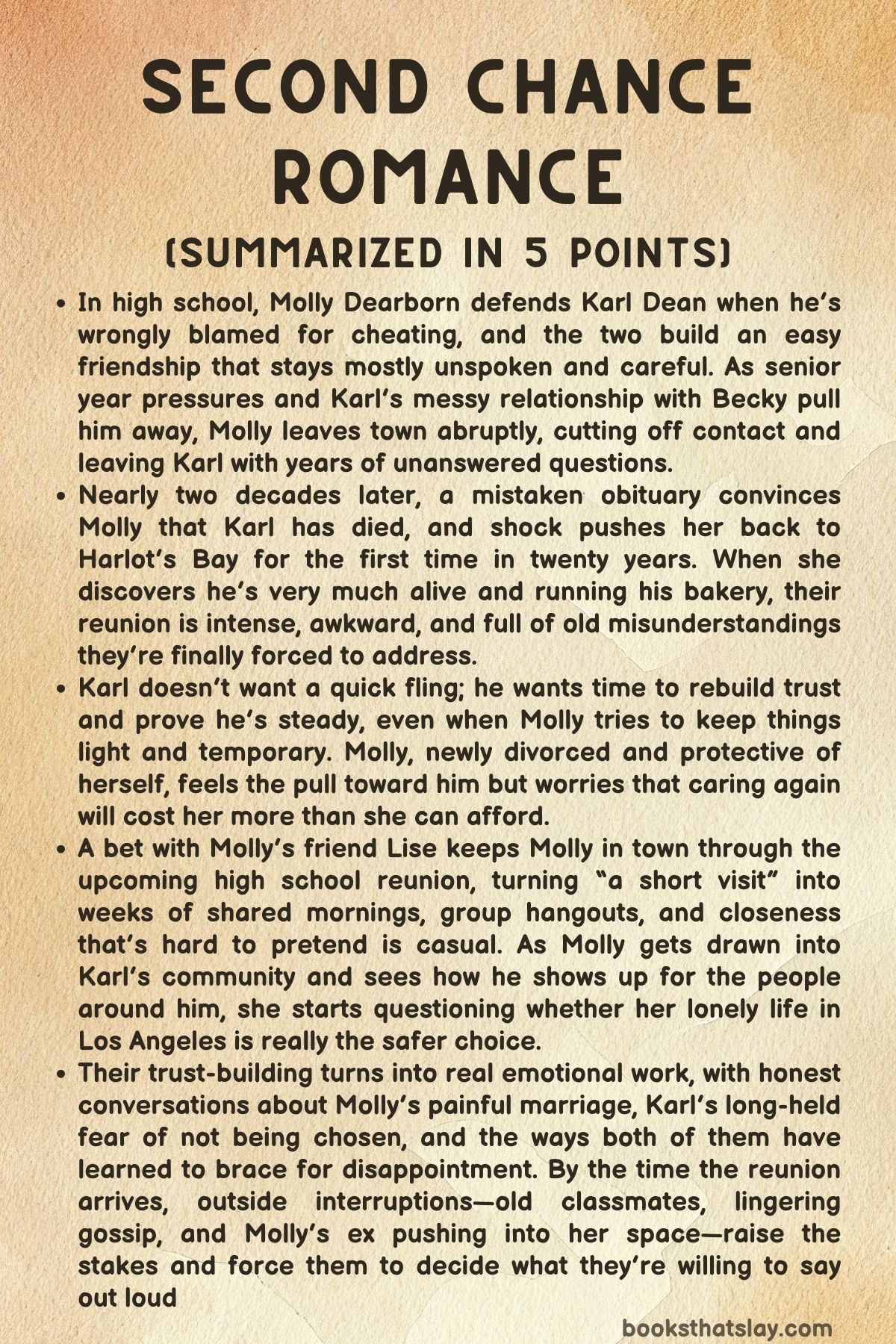
Second Chance Romance by Olivia Dade is a contemporary romance about two people who never quite got over what they almost had. Set in the coastal town of Harlot’s Bay and moving between past and present, it follows Molly Dearborn, now a successful audiobook narrator, and Karl Dean, the kind, blunt baker who once made high school feel survivable.
A mistaken obituary drags Molly back home after twenty years, forcing unfinished business into the open. What starts as shock and nostalgia turns into a deliberate, sometimes messy attempt to rebuild trust, speak the truths they avoided, and choose a life that fits them both. It’s the 2nd book in the Harlot’s Bay series by the author.
Summary
Twenty-two years ago, Molly Dearborn arrives at a new Maryland high school and immediately ends up in trouble. Her chemistry teacher accuses Karl Dean of helping another student, Ned, cheat.
Karl is hauled into the principal’s office with Molly and Ned, and the situation gets worse when Karl loudly argues with his father, making it obvious he is incapable of quiet scheming. When it is Molly’s turn, she calmly dismantles the accusation: Karl has no reason to risk punishment for a boy who is not his friend, and Ned would never pick Karl as a secret helper because Karl cannot hide anything.
She also points out the teacher’s bias. Molly admits she spoke out of turn, but insists Ned cheated and Karl did not.
Pressed by the truth, Ned confesses. The principal apologizes to Karl and thanks Molly for being honest.
Afterward, Karl awkwardly thanks her, and a cautious friendship forms. Molly starts eating lunch with Karl and his friend Matthew.
She also sees Karl at her weekend job at the Ice Queen ice cream shop, where he comes in to read quietly. Molly’s family decides to stay until she graduates, and she slowly settles into the town.
She keeps her feelings guarded and does not push Karl for anything deeper, even when she wants more.
By senior year, their easy closeness has thinned. Karl starts dating Becky Waller and is thrilled at first, but Becky dislikes Molly, and Karl’s time becomes fragmented by school, work, and family stress.
Money is tight, Karl’s mother loses a job, and Karl takes on extra shifts at the bakery until he is constantly exhausted. Becky and Karl break up and get back together repeatedly, leaving Karl stuck in a loop of hope and disappointment.
A school project pairs Karl and Molly, pushing them into each other’s orbit again. They volunteer at Historic Harlot’s Bay, wearing colonial clothes and doing tedious tasks while younger staff tease them.
Despite the annoyance, Karl is happy to be around Molly. She softens with him—warmer, funnier, more present—and he begins to believe they might finally move forward.
Near the end of the project, he tries to ask her to prom and leans in to kiss her, but a swarm of kids barges in and ruins the moment. Karl plans to call her later, but Becky contacts him and pulls him back into their unstable relationship.
After the project ends, Molly retreats again.
Then Molly leaves. Right after prom season, she tells Karl she is moving to California immediately and will finish school remotely.
She gives him an email address but offers no real goodbye. Karl writes to her, clumsy but sincere.
After Becky ends things for good, Karl sends more messages, hinting at wanting something real with Molly. Molly replies once, saying it does not feel right, and then disappears.
Soon his emails bounce back, and he is left with silence he cannot explain.
Years pass. Karl keeps building his life in Harlot’s Bay, eventually running Grounds and Grains.
He dates, but something always feels missing, and no girlfriend tells him she loves him. Eighteen years after graduation, he hears an audiobook playing from a customer’s car and recognizes the narrator’s voice instantly.
He learns she is “Molly Cressley,” buys the audiobook, and then buys everything she has narrated. For two years, he listens to her work constantly, letting her voice fill the bakery and the quiet corners of his life.
In the present, Karl is recovering from a flu that forced him to close the shop for a week. While he is in the back, his clerk Bez jokes with an elderly reporter, Sylvia Plude, about Karl being “killed,” even adding a ridiculous detail about him being baked into muffins.
Sylvia does not treat it as a joke. She prints an obituary claiming Karl was murdered, with absurd hints of cannibalism and baked goods.
In Los Angeles, Molly receives the obituary link from her friend Lise Utendorf, a romance author who writes under a pen name. Molly is horrified.
Despite two decades away and the way she vanished from Karl’s life, she cannot ignore the idea that he is dead. She flies to Harlot’s Bay for the “funeral,” checks into a B&B, and walks straight into Grounds and Grains.
She orders coffee and a doughnut, then asks about Karl’s funeral plans. The staff laughs, and Molly almost explodes—until Bez explains the obituary was a mistake.
Karl is alive, in the back.
Karl steps out and recognizes Molly immediately. Before either can think, she pushes through the counter opening and falls into his arms.
In the back room, the truth finally gets said: Karl explains that Becky had already dumped him when he sent those romantic emails years ago, and he understands why Molly assumed he was cheating. Molly shares that she narrates audiobooks under multiple names and that she is divorced.
The attraction between them sparks fast, but Karl does something unexpected—he asks for time. He insists Molly “owes” him a chance to rebuild trust and demands she stay until their high school reunion in early October.
Only after he earns her trust will he sleep with her. Molly argues, half tempted and half panicked, but before they resolve it, Karl’s employee Charlotte rushes in with her toddlers.
Molly misreads the scene, assumes Karl is in a family unit with Charlotte, and Karl snaps at her for assuming the worst again.
Molly leaves, telling herself it is safer to go back to California. But her time with Karl keeps replaying in her head.
She meets up with Lise, runs into reunion organizer Janel Altman, and gets pressed to attend the reunion. Later, at Colonial Karaoke Night, Molly tries to dodge Lise’s request to stay by setting a condition she thinks is impossible: if Lise seduces someone before Friday, Molly will stay until October.
Lise accepts, and shockingly, she succeeds.
With no escape left, Molly returns to Karl and agrees to four weeks in town. She asks Karl to be her reunion date, and he says yes immediately.
Housing becomes the next issue, and through Karl’s friends Matthew and Athena, Molly rents the narrow “Spite House” for the month. The arrangement gives her space while keeping her close to Karl.
Karl designs “trust-building” days—meals, games, and structured activities—trying to prove he is safe. Molly pushes back, explaining that physical safety is not the same as emotional reliability.
She drags him to an escape room as a stress test, and the two of them fail spectacularly, learning more about how they react under pressure than any scripted exercise could teach. Their chemistry keeps escalating, and they begin crossing physical lines, with Karl checking in and Molly discovering that being wanted does not have to mean being used.
Still, when Karl asks if she trusts him enough to stay in Harlot’s Bay long-term, Molly panics. She hears not a proposal but a demand to give up her life.
Karl, frustrated and scared, seeks advice from Matthew and Athena. They tell him to stop hiding behind logistics and speak plainly about what he feels.
Meanwhile, Molly gets pulled into Karl’s community, including his romance book club, the Nasty Wenches, where she is welcomed with warmth and outrageous humor. She begins to notice how lonely her Los Angeles life has been.
On a picnic date, they finally trade real stories. Molly admits her ex-husband, Rob, exploited her support and still pressures her, leaving her unsure of her own judgment.
Karl reframes her story, insisting the blame belongs to Rob, not her. Karl shares his own old wound: Becky never returned his love and made him feel like a placeholder, feeding his fear that he will never be enough.
They begin to see each other with clearer eyes. Molly also confesses a health scare—insomnia, headaches, rising blood pressure—and admits isolation and stress are wearing her down.
Karl confesses he owns every audiobook she has narrated and has listened to them for two years. That night, they choose each other fully and sleep together, careful and intentional.
At the reunion, Karl is juggling catering and Molly, and Becky appears to apologize for the past. Molly spirals, offering to step aside, but Karl refuses.
He drags Molly into a private room and asks her again to stay in Harlot’s Bay. Under pressure, he lists practical reasons instead of telling her what she needs: what he feels.
Molly leaves hurt, convinced he cannot meet her emotionally.
Then Rob shows up, having tracked Molly down, and tries to corner her into selling her house. Molly refuses, and Karl steps between them.
With friends nearby, the confrontation becomes public. Rob tries to humiliate Molly by claiming Karl will never love her and demands Karl admit it.
Molly, steady now, says Karl does love her even if he has not said it yet. Cornered and finally brave, Karl says the words: he has loved Molly for over twenty-two years, and he loves her like oxygen.
He even offers to move to California if that is what she wants.
Molly chooses Harlot’s Bay. She tells Karl she is willing to move, but she also wants him to build a life that includes rest, support, and shared responsibility at the bakery.
Rob is driven off, his attempt at control collapsing under the group’s refusal to play along. Molly reveals she already posted online about moving before Karl said the words because she trusted him.
She tells him she trusts him completely, and she loves him too.
In the epilogue ten years later, they are married and thriving. Karl has trained strong staff, including Charlotte, who has grown into a central part of the bakery’s future.
Molly and Karl have a full life rooted in community, daily walks, and the simple security of saying “I love you” without fear.
Characters
Karl Dean
Karl Dean is a central character whose journey is filled with emotional growth and resilience. From the start, he is portrayed as a man who grapples with the challenges of his past, especially his first love, Becky, and his lingering fear of inadequacy.
Karl’s initial relationship with Becky, where she left him emotionally unfulfilled, set the stage for his deep-rooted fears of never being enough for someone. This insecurity affects his relationship with Molly as he struggles to express his feelings and needs in clear terms.
Throughout the novel, Karl is a hard-working individual, running a bakery while balancing the demands of his personal life and business. His growth comes from the way he learns to open up emotionally, particularly with Molly.
He constantly pushes for honesty, seeking to build trust with her, even using trust-building exercises. His ability to listen and his caring nature, especially in moments of stress, show his commitment to Molly.
Karl’s struggle to express his feelings directly makes him come across as emotionally distant at times, but by the end of the novel, he overcomes this and shows Molly the depth of his love through both actions and words. His declaration of love at the high school reunion, after years of unspoken feelings, is a pivotal moment, showing how far he has come from the insecure young man he once was.
Molly Dearborn
Molly Dearborn is a woman who, despite her initial reluctance to engage deeply with Karl, is profoundly shaped by her past experiences. Leaving her high school years abruptly and moving away to California, Molly builds a career as an audiobook narrator under a pseudonym, carefully guarding herself from deep emotional connections.
Her past marriage, marred by her ex-husband Rob’s manipulative behavior, plays a significant role in her hesitance to trust Karl. Molly’s journey is one of self-discovery and healing.
Her guardedness and reluctance to invest in a relationship with Karl stem from her deep fear of getting hurt again. The pain from her divorce, combined with her fear of abandonment, influences her initial responses to Karl’s advances.
Despite these fears, she is drawn to him and his stability. As the story unfolds, Molly gradually opens up to the possibility of trusting Karl and even confronts the insecurities she has carried for years.
Her vulnerability becomes evident in her admission of her fears about her health and her lack of support in Los Angeles. Her journey with Karl is one of learning to let go of the past and embrace a future with someone who truly understands her.
Her decision to move back to Harlot’s Bay symbolizes her willingness to take a chance on love and trust, a significant step in her emotional growth.
Becky Waller
Becky Waller plays a crucial yet secondary role in the narrative, acting as a catalyst for the tension between Karl and Molly. She is Karl’s on-again, off-again girlfriend during high school and is someone who, at the time, deeply influenced his emotional state.
Becky is portrayed as someone who initially seems to have strong chemistry with Karl but ultimately leaves him feeling like a placeholder. Her inability to commit to Karl, coupled with her harshness in breaking up with him, marks her as an emotionally immature character in contrast to Karl’s more earnest nature.
When she reappears in the present, she seems to have grown somewhat but remains selfish in her interactions, particularly when she tries to rekindle something with Karl. Becky’s presence serves as a reminder of Karl’s past emotional wounds and the lack of closure he had with her.
Her apology to Karl during the reunion, however, shows that she has come to terms with her past actions, even if it doesn’t entirely redeem her character. In many ways, Becky represents the emotional baggage that both Karl and Molly must confront in order to move forward with their lives.
Lise Utendorf
Lise Utendorf is a supportive friend to Molly and plays an essential role in encouraging her to open up to Karl. She serves as a foil to Molly’s more guarded personality, often pushing her friend to take risks and face her emotions.
Lise’s friendship with Molly is built on a deep understanding of Molly’s fears, especially when it comes to trusting men. Lise’s role as a catalyst for change is evident when she challenges Molly to attend the reunion, a decision that forces Molly to confront her unresolved feelings about Karl.
Lise also offers her perspective on love, encouraging Molly to see that Karl’s actions—his devotion, his subtle affection—are clear indications of his feelings, even if he struggles to verbalize them. Lise’s willingness to help Molly, even at the cost of her own comfort, speaks to her selflessness and the strength of their bond.
Her ability to see beyond Molly’s emotional walls helps push the plot forward and allows Molly to take the necessary steps toward healing and love.
Charlotte
Charlotte is one of Karl’s employees at his bakery, and while she initially seems to be a background character, she plays a vital role in the narrative. Her relationship with Karl evolves from that of a subordinate to a more familial connection, with Karl ultimately offering her an apprenticeship.
Charlotte’s role expands as she becomes someone who helps Karl realize the importance of direct communication, especially when she pushes him to express his feelings for Molly. She is more than just a supportive character for Karl; she also provides him with guidance, especially when he is unsure about how to navigate his complicated feelings for Molly.
Charlotte’s personal journey, as she confronts her own insecurities about her place in Karl’s life and her ambitions, mirrors the main narrative’s themes of growth and self-discovery. Her emotional growth is seen in her acceptance of Karl’s offer and her own recognition of her value, both in the bakery and in her relationship with Karl.
Themes
Trust and Healing from Past Trauma
In Second Chance Romance, trust plays a pivotal role in the emotional development and healing of both Karl and Molly. Both characters have experienced betrayal and pain in their pasts, shaping their actions and views on relationships.
For Molly, her past marriage to Rob, who used and emotionally manipulated her, has left deep scars. She finds it hard to trust Karl at first, even though he shows her consistent care and respect.
The emotional baggage of her failed marriage causes Molly to be guarded and avoid commitment, fearing that any new relationship would mirror the betrayal she once endured. The novel presents trust as a gradual process, not something instantly given but something that must be earned through understanding, patience, and vulnerability.
Karl, too, has trust issues. His previous relationships, particularly with Becky, have left him with a deep-seated fear of being inadequate or unworthy of love.
He hesitates to declare his love for Molly, even when his actions and feelings clearly show his affection for her. Both characters are forced to confront their insecurities and past wounds in order to rebuild their trust in one another.
Their journey is marked by a series of trust-building exercises, such as the escape room challenge and their conversations about past heartbreaks. These moments not only allow them to heal but also to understand each other’s emotional needs and vulnerabilities.
Through this, the book illustrates that trust is not just about the grand gestures but about small, everyday actions that prove loyalty and commitment. The novel highlights that the path to healing is not linear, and it requires both self-reflection and open communication, as well as the willingness to forgive both oneself and others.
The Impact of Past Relationships on Present Choices
Second Chance Romance explores how the characters’ past relationships shape their decisions and perceptions of love in the present. Molly’s past with Rob influences her view on relationships, leading her to believe that love can be manipulative and self-serving.
As a result, she approaches Karl with caution, even though she feels a strong connection with him. Her fear of repeating past mistakes makes her hesitant to open her heart fully to him, causing moments of tension between them.
She is wary of Karl’s intentions, often second-guessing his motives and actions, believing they might echo the deceit she faced in her marriage. Her hesitation to trust Karl and her resistance to forming a deeper connection with him reflect the emotional scars that linger long after the end of a toxic relationship.
On the other hand, Karl’s history with Becky also influences how he perceives his relationship with Molly. His unspoken love for her and his failure to communicate his feelings stem from the hurt he experienced when Becky left him without ever returning his feelings.
This emotional residue makes him fearful of being vulnerable, especially when it comes to expressing his love. His experiences with Becky cause him to overthink and second-guess his actions, leading to misunderstandings and missed opportunities with Molly.
The novel suggests that unresolved emotions from past relationships often cloud the characters’ judgment and decision-making in present relationships, making them hesitant to take risks. However, as the characters confront and acknowledge their pasts, they begin to make more informed choices, guided by what they have learned from their previous experiences.
Personal Growth and Self-Discovery
The journey of personal growth and self-discovery is at the heart of Second Chance Romance, particularly for Molly and Karl. Both characters are forced to confront their own insecurities and fears in order to embrace the possibility of a future together.
For Karl, this process involves learning to express his emotions more openly and confront his fear of inadequacy. He has spent years building walls around his feelings, afraid to express his love for Molly and hesitant to believe that someone could love him as he is.
Over time, he learns that love is not about perfection but about acceptance and understanding. His growth is symbolized by his willingness to open up to Molly and express his emotions more directly, even if it feels uncomfortable.
Molly’s personal growth revolves around her ability to let go of her fear of being hurt again. She has built walls around herself to protect her from the pain of her past marriage, but she slowly learns that not all relationships are doomed to fail.
Her emotional journey is about learning to trust herself again, to value her own worth, and to recognize that she deserves love and happiness. Her growth is marked by her decision to stay in Harlot’s Bay, despite the challenges and risks of starting over.
She learns that vulnerability is not a weakness but a necessary part of building a meaningful relationship. The novel portrays personal growth as a gradual and ongoing process, where characters evolve through their interactions with others and their willingness to confront their own fears and desires.
The Power of Friendship and Community
The theme of friendship and community is central to the development of Karl and Molly’s relationship in Second Chance Romance. The small town of Harlot’s Bay becomes a microcosm of support and belonging, where Karl and Molly are surrounded by friends who care about them deeply and encourage their growth.
The novel highlights how important it is to have a supportive network of people who can provide guidance, encouragement, and comfort during times of emotional turmoil.
Karl’s friendships with Matthew, Athena, and Charlotte provide him with the emotional support he needs to navigate his feelings for Molly. These friends are not just sounding boards but also sources of wisdom and perspective, offering Karl advice on how to communicate more openly with Molly and how to approach the trust-building process.
Similarly, Molly’s friendship with Lise plays a crucial role in helping her understand her feelings for Karl and giving her the courage to take risks. Lise, in particular, challenges Molly to stop overthinking and to act on her feelings instead of letting her fears control her.
The community in Harlot’s Bay also helps Molly feel connected and valued, making her reconsider her decision to leave and start over in California. The theme of friendship emphasizes the importance of surrounding oneself with people who genuinely care and offer unconditional support, especially when facing difficult decisions.
Forgiveness and Letting Go of Resentment
Forgiveness is a key theme in Second Chance Romance, particularly in the way the characters learn to forgive themselves and others for past mistakes. For Karl, this process involves forgiving himself for the way he handled his relationship with Becky and acknowledging that his fear of rejection has shaped his interactions with Molly.
He learns to forgive himself for not expressing his feelings sooner and for allowing his insecurities to dictate his actions. This self-forgiveness is crucial for his emotional growth, as it allows him to approach his relationship with Molly without the burden of guilt and regret.
Molly’s journey of forgiveness is equally important. She must forgive herself for the role she played in her marriage’s failure and learn to release the resentment she holds toward Rob.
Her inability to forgive him has kept her emotionally bound to her past, preventing her from moving forward. The novel illustrates that forgiveness is not about excusing the actions of others but about freeing oneself from the emotional weight of past hurt.
Both Karl and Molly find healing through the process of forgiveness, which enables them to embrace the possibility of a new, healthy relationship with each other. The theme suggests that in order to move forward, one must let go of past grudges and resentments, making space for love and growth.