Seek the Traitor’s Son Summary, Characters and Themes
Seek the Traitor’s Son by Veronica Roth is a science-fiction novel about prophecy, political conflict, alien contact, and the difficult choices people make when survival demands sacrifice.
Elegy Ahn, the reluctant Hope of Cedre, and Theren Forint, a young man condemned by his mother’s betrayal, become central to a struggle between Cedre and the Talusar empire. Their personal histories are tied to a living extraterrestrial plant, a hidden doorway among the stars, and competing visions of the future. Through war, captivity, grief, resurrection, and chosen loyalty, the novel examines whether destiny controls people or merely presents possibilities that human beings must decide how to face. It’s the first book of the Burning Empire duology.
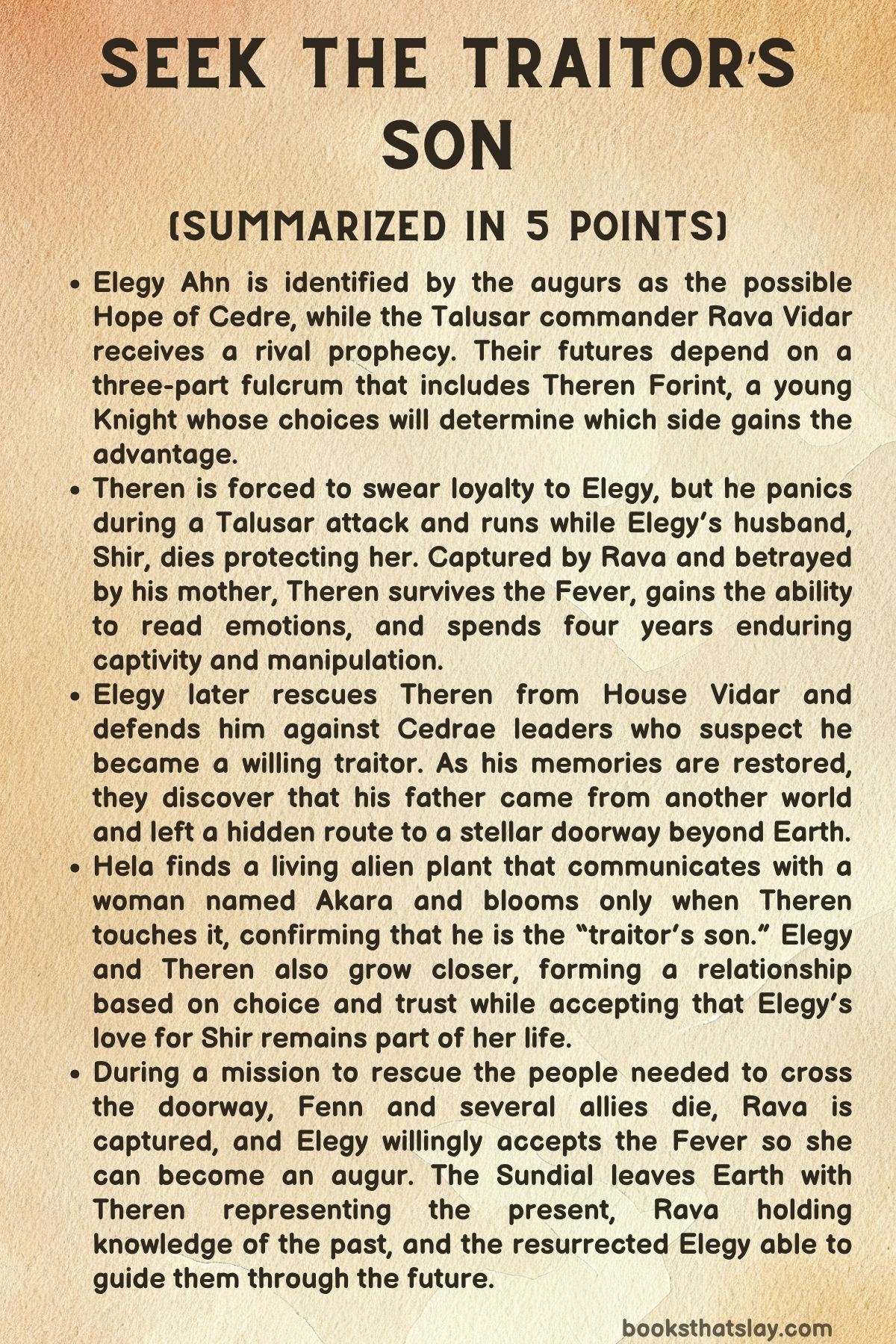
Summary
An unidentified traveler carries a remarkable plant through the Manifold, a network of gates connecting different universes. The plant has dark leaves and glowing veins, and the traveler risks execution by entering Earth, a forbidden world known to outsiders as the Cloistered Planet.
He hides the organism inside a coastal cave, feeding it drops of his own blood before leaving it behind. His arrival reveals that Earth was once connected to a wider interstellar civilization and that humanity’s isolation hides secrets far older than the conflict between Cedre and the Talusar empire.
Elegy Ahn travels with her biological mother, the Sword of Cedre, and her husband, Shir, to meet the augurs at the neutral Cenobium. The augurs reveal that Elegy and the feared Talusar commander Rava Vidar descend from two branches of the same ancient family and stand on opposite sides of a prophecy.
The prophecy compares Cedre and the Talusar to two weights balanced on a lever. A three-part fulcrum will determine which side wins, and Elegy is told that one of the participants will be a mysterious man who brings her death and whom she will eventually love.
Elegy is disturbed because she loves Shir and has no desire to become a prophetic national symbol. Shir responds with generosity, telling her that the future need not erase their marriage and that she may be capable of loving more than one person.
Meanwhile, Theren Forint is ordered to abandon his independent life and fulfill a promise made before his birth. His mother, Kesia, was among the Talusar exiles who received sanctuary from Cedre after agreeing that their firstborn children would become Knights.
Theren must swear himself to Elegy because the prophecy has made her the possible Hope of Cedre. Although both resent the lack of choice surrounding the oath, they recognize that they have been forced into connected roles by decisions made by their families and governments.
During the ceremony, Theren vows to protect Elegy above everyone else, even at the cost of his own life. Almost immediately, Talusar forces attack, and the terror of the assault overwhelms him.
Instead of protecting Elegy, Theren runs. Shir becomes Elegy’s shield and is struck by Rava’s arrows, while the Sword is also wounded during the escape.
Elegy leaves believing that both her husband and mother have been killed. Theren is captured with several Knights and learns that Kesia willingly helped Rava organize the attack because she believed betraying Cedre would free both herself and her son.
Rava offers Theren the opportunity to renounce Cedre, but he refuses and declares himself a Knight. She infects him and the other prisoners with Fever, a virus that kills everyone exposed to it but resurrects some survivors with extraordinary abilities.
Theren dies and returns with the ability to perceive emotions, motives, and immediate intentions. Rava imprisons the surviving Knights in the Crucible, where they are trained, controlled, and forced to fight for the entertainment of Talusar spectators.
Four years pass. Elegy has rejected public life and now works illegally as a Scout under the protection of her sister Hela, hunting criminals and avoiding the Cedrae government.
When Elegy learns that Theren survived and remains inside House Vidar, she enters Talusar territory alone to rescue him. Rava captures her and orders Theren to examine her memories, but he lies about what he sees and creates false information that sends Rava’s soldiers in the wrong direction.
Theren later kills several guards, frees Elegy, and helps her escape. He is badly wounded, but Cedrae rescuers locate them and bring him to Losan.
Returning home does not end Theren’s captivity psychologically. He distrusts medical workers, expects punishment from authority figures, and believes surviving under Rava’s control has made him a traitor.
Cedrae officials want to interrogate or imprison him, but Elegy invokes her status as the Hope of Cedre to protect him. In exchange for his conditional freedom, she publicly accepts the role she spent four years rejecting.
Theren gradually reveals what happened inside House Vidar. Rava’s mother, Ileth, could create and alter memories, using false experiences of torture to destabilize him while Rava presented herself as his only source of safety.
Elegy also learns that Rava’s supposedly divine connection to ancient warriors is propaganda. Her actual ability is that of an epocha, a person who can see the distant past.
Theren agrees to participate in an erczet, a Talusar mourning ritual through which the families of the dead Knights can experience his memories. The ritual reveals that only Theren, Maeve, and Fenn survived the Fever.
The three became a family in captivity and planned to kill Rava. Theren and Fenn also became lovers, finding companionship during years of violence and uncertainty.
When Rava discovered that Fenn possessed the sacred gift of an epocha, Theren exposed that ability to prevent Fenn’s execution. The decision saved Fenn’s life but condemned him to permanent imprisonment in a monastery.
Maeve was given no such protection. Knowing Rava intended to make Theren kill her publicly, Maeve asked him to make her death quick, and he followed her request while the Crucible audience celebrated.
The ritual forces Elegy and the families to understand that Theren survived through decisions that offered no morally clean outcome. Julia Martin, Maeve’s mother, responds not with condemnation but with compassion for the man who carried her daughter through her final moments.
At the same time, Hela retrieves the alien plant for a scholar calling himself Dr. Canterbury. When she touches it, her consciousness enters a distant greenhouse where she meets Akara, a woman living on another planet.
Akara explains that the plant is a communication device and instructs Hela to find the person capable of making it bloom. Her only direct clue is a command to seek the traitor’s son.
Evidence connects the plant to Kesia and to an advanced ship that left Earth roughly two decades earlier. Hela suspects that Kesia’s history contains secrets beyond her betrayal of Cedre.
Theren also discovers a sealed gap in his memory. Julia restores it, revealing that Fenn is alive and that Rava’s own version of the prophecy identifies Theren as the man she will love.
Fenn once looked into Theren’s ancestry and saw his father, Sevik, arriving through a doorway among the stars with a living seedling. The augurs predicted that Theren would eventually cross that doorway aboard Cedre’s ancient exploration ship, the Sundial, and meet the father who had been waiting for him.
Rava’s victory depends on keeping Theren alive while preventing him from leaving Earth. Elegy understands that her own victory must therefore involve placing him aboard the Sundial and guiding him through the doorway.
Kesia confirms that Sevik came from another world. He fathered Theren and hid stellar coordinates inside one of his own powerful memories, expecting an epocha to retrieve them through Theren’s family line.
Theren confronts Kesia for watching his suffering without rescuing him. Although she claims that secrecy and prophecy limited her choices, he refuses reconciliation and chooses to end their relationship.
When Theren touches the plant, it immediately blooms, confirming that he is the traitor’s son. Through it, he meets Akara, whose resemblance to him proves that she is a member of his extraterrestrial family.
Elegy and Theren’s relationship becomes increasingly intimate. Their growing love does not erase Shir or the damage Rava caused, but it gives both characters a form of closeness based on patience and choice.
Rava and Ykev Talus begin coordinating an attack against Cedre. Their agents smuggle Fever priests onto Cedre Station inside equipment crates, allowing the virus to spread among millions of uninfected citizens.
Elegy uncovers the operation and warns Cedre’s leaders. During the resulting quarantine, Rava offers peace in exchange for Theren, but Elegy refuses and declares that Rava will never control him again.
The augurs explain that crossing the stellar doorway requires three people representing past, present, and future. An epocha must recover Sevik’s coordinates, Theren’s emotional gift represents the present, and an augur must perceive the future well enough to navigate the passage.
Elegy, Theren, Hela, Arias, Parekh, Isre, and several allies organize an unauthorized mission to rescue Fenn and the missing primary augur from a Talusar monastery. Their plan is actually a trap created by Rava, who has already killed the augur.
Theren surrenders himself to Nyx, one of Rava’s commanders, and manipulates Rava into revealing the truth about the augur’s death. Nyx’s religious loyalty to the sanctity of prophets proves stronger than her loyalty to Rava, so she turns against her commander.
While battle breaks out, Kesia attempts to abduct Fenn. She attacks Hela and nearly kills her, forcing Arias to stab Kesia in order to save Hela’s life.
Elegy realizes that the prophecy’s reference to someone who has tasted the salt of the Cenobium points to her. Since the primary augur is dead, she decides that she must accept Fever and attempt to resurrect with the ability to see the future.
She enters the monastery’s infection chamber and voluntarily drinks the virus. She knows that there is no assurance she will return, but without future sight, the Sundial cannot pass safely through the doorway.
Theren defeats Rava but hesitates to kill her. Rava then stabs Fenn, hoping to destroy the epocha needed for the mission.
Elegy returns and persuades Theren to spend Fenn’s final moments at his side instead of choosing revenge. Theren holds Fenn until he dies, fulfilling a final promise of companionship.
Elegy realizes that Rava herself can serve as the past component of the fulcrum because she bears the Vidari name and possesses the gift of an epocha. She drugs Rava and negotiates with Nyx, who agrees to guard the prisoner and accompany the group.
The survivors board the Sundial and leave Earth before either government can stop them. Parekh, Kesia, and Fenn are dead, Orda is critically injured, and Elegy is dying from Fever.
As the virus consumes her, Elegy hallucinates Shir. Hela and Theren allow her to speak to the husband she still carries within her rather than treating her old love as something that must be discarded.
Theren remains beside her until her heart stops. He and Hela prepare her body according to Talusar custom while the Sundial begins its journey away from Earth.
During death, Elegy sees multiple possible futures, including Earth’s destruction, the Sundial’s failure, vast alien fleets, and the stellar doorway. Her visions confirm that the Fever has given her the gift of an augur.
The story ends when Elegy opens her eyes. Her resurrection completes the three-part fulcrum and gives the travelers a chance to reach Sevik, Akara, and the civilization that once placed Earth behind a forbidden gate.
Characters
Elegy Ahn
Elegy is the central political and emotional force of Seek the Traitor’s Son, yet she begins the book wanting neither authority nor prophetic importance. She has built her adult identity around direct action, first as a soldier and later as a Scout, because rescuing individuals feels more honest to her than becoming a symbol controlled by politicians.
Her relationship with her mother has taught her to distrust inherited duty. Elegy was conceived as a possible replacement for Larke, and she grew up knowing that even her existence was connected to political necessity rather than uncomplicated parental desire.
Shir’s death leaves Elegy angry at every system that attempts to make suffering meaningful after the fact. She refuses to accept that losing him was necessary for Cedre’s future because such reasoning threatens to reduce the person she loved to a useful sacrifice.
Her decision to rescue Theren demonstrates the quality that eventually makes her a leader. She acts because one abandoned person matters, even when her government considers him expendable and when saving him may damage her reputation.
Elegy’s understanding of power changes as she protects Theren from interrogation, challenges Larke, and forms a team whose members follow voluntarily. She learns that refusing authority does not prevent abusive people from exercising it; sometimes ethical leadership requires accepting power and using it differently.
Her love for Theren does not replace Shir. Instead, Elegy discovers that grief and new attachment can exist together, allowing her emotional life to expand without rewriting her past.
By choosing Fever, she finally accepts that hope is not a promise of safety. It is the willingness to act when every possible path contains loss and when success remains uncertain.
Theren Forint
Theren is shaped by conflicts of nationality, family, obligation, and personal identity. Born to a Talusar mother but raised within Cedre, he is never fully accepted by either society and grows up carrying the suspicion attached to being the son of an exile.
His original failure at the Getty becomes the defining shame of his life. Although his panic is a human response to sudden violence, he interprets running as proof that he is fundamentally cowardly and spends years believing that every later act must repay that single moment.
Captivity intensifies this self-condemnation. Rava and Ileth train him to associate obedience with temporary safety, resistance with punishment, and usefulness with the right to remain alive.
Theren’s emotional gift makes him exceptionally perceptive but also exposes him to the inner states of people who intend to hurt him. His sensitivity is therefore both a strategic advantage and a source of repeated psychological violation.
His choices in the Crucible resist simple judgment. He reveals Fenn’s gift to prevent an execution, kills Maeve at her request, and enters a sexual relationship with Rava while trying to gain influence over the person who owns him.
These actions burden him because every survival decision protected one thing by sacrificing another. He initially believes that accepting blame for everything will give his experiences a clear moral shape, even when such blame ignores coercion.
Theren’s recovery begins when Elegy, Julia, Arias, Isre, and others refuse to treat him as either a perfect hero or willing collaborator. Their responses allow him to consider that survival under domination does not make him responsible for the structures controlling him.
His greatest development appears in the movement from compulsory loyalty to chosen devotion. When he becomes Elegy’s Knight again, he does so without an oath, contract, or inherited debt, turning service into partnership.
Rava Vidar
Rava is a military commander, political strategist, religious figure, and personal abuser whose authority rests on fear and manufactured legend. Her public image presents her as the vessel of ancient warriors, allowing Talusar society to view her ambition as sacred destiny rather than personal hunger for control.
Her actual Fever gift connects her to the distant past. Ileth hides this truth because an epocha would ordinarily be confined to a monastery, and the false story allows Rava to pursue military power.
Rava’s obsession with Theren begins with prophecy. She learns that she will love him and that her victory depends on preventing him from crossing the stellar doorway, so she treats possession of his body and future as a strategic necessity.
Her feelings may contain genuine attachment, but they are inseparable from ownership. Rava defines love as the right to confine, punish, preserve, and reshape another person according to her needs.
She is particularly dangerous because she understands how to combine violence with selective kindness. By allowing brief safety after terror, she conditions Theren to experience her protection as relief, even though she created the danger from which she appears to save him.
Rava is also trapped by the prophecy she believes she controls. She cannot kill Theren because she needs him alive, and her attempts to prevent one future repeatedly create the alliances and decisions that bring it closer.
Her defeat begins when the religious and political myths surrounding her break apart. Once Nyx recognizes that she murdered an augur, sacred law becomes a force against Rava rather than a tool supporting her command.
Hela Ahn
Hela is Elegy’s sister, partner, investigator, and emotional anchor. Her experience as a Scout has made her practical, suspicious of institutions, and skilled at surviving through speed, deception, and unconventional thinking.
She resents Elegy’s tendency to face danger alone because she recognizes isolation as one of her sister’s most destructive habits. Her anger after Elegy enters Talusar territory is therefore rooted in love and in the frustration of being denied the chance to help.
Hela becomes the principal investigator of the extraterrestrial mystery. Her contact with the living plant and Akara places her outside the political conflict dominating everyone else and allows her to uncover a reality larger than Cedre or the Talusar.
She approaches knowledge ethically. When Canterbury intends to dissect the possibly sentient plant, Hela rejects the idea that curiosity automatically grants ownership over another living being.
Her relationship with Theren develops from suspicion to genuine affection. She watches how he treats Elegy, understands that he does not demand the erasure of Shir, and eventually accepts him as someone capable of sharing her sister’s grief rather than competing with it.
Hela’s improvisation becomes essential during the monastery mission. Even when captured, she continues creating opportunities, resisting Kesia, and protecting the group through the practical courage that defines her.
Shir
Shir represents the life Elegy possessed before prophecy and war took it away. He is loving, brave, emotionally generous, and willing to consider possibilities that frighten both him and his wife.
When the augurs predict that Elegy will love another man, Shir does not accuse her of future betrayal. He suggests that love may not be limited to one person and that destiny need not invalidate the relationship they already share.
His death at the Getty demonstrates both courage and devotion. He deliberately turns his body into a shield, using his final moments to protect Elegy from Rava’s arrows.
Shir remains influential long after his death. Elegy remembers his teachings during interrogation, measures later intimacy against her marriage, and continues speaking to him in moments of fever and fear.
The novel refuses to treat him as an obstacle that must be forgotten before Elegy can love Theren. His continuing presence shows that death can end a shared life without ending the emotional meaning of that life.
Larke Ahn
Larke is Elegy’s older half sister and the political heir produced before Elegy became the family’s reserve. She is intelligent, disciplined, image-conscious, and determined to use prophecy to strengthen Cedre’s military position.
Her public affection toward Elegy often serves a strategic purpose. She presents family unity before cameras while privately attempting to control Elegy’s movements, reputation, and access to authority.
Larke views people primarily through their institutional value. Theren is a potential intelligence source, Elegy is the Hope, and the Sundial is a national resource whose purpose should be determined by the state.
Her distrust is not entirely irrational. Cedre has endured displacement, terrorism, military defeat, and the dangerous consequences of earlier leadership decisions, so Larke fears disorder and unauthorized action.
However, fear causes her to repeat the controlling behavior she criticizes in others. By threatening truth serum, restricting information, and manipulating public narratives, she risks turning Cedre’s government into another system that values obedience more than consent.
Her conflict with Elegy is ultimately a conflict between two models of leadership. Larke believes stability comes from centralized control, while Elegy gradually argues that legitimacy must be earned through trust and accountable action.
The Sword of Cedre
Elegy’s mother embodies the burden of hereditary office. She was expected to produce children, lead Cedre, and maintain continuity regardless of whether she desired motherhood or felt suited to it.
Her honesty about failing to become a warm parent gives her complexity. She understands the emotional cost imposed on her daughters but has spent so long fulfilling duty that she struggles to imagine a life outside it.
The Sword often expresses care through strategy rather than tenderness. She prepares Elegy for danger, studies threats, and attempts to protect the political future of Cedre, yet these actions leave her daughters emotionally distant from her.
Her apparent death at the Getty forces Elegy into a symbolic role she never wanted. Even after her absence, her decisions continue shaping the government’s secrecy, the handling of Sevik’s arrival, and the rivalry between Larke and Elegy.
She demonstrates how inherited systems can injure even the people who appear to command them. The Sword possesses authority, but the office has also controlled her body, relationships, and choices.
Kesia Forint
Kesia is one of the novel’s most morally difficult figures because she combines victimhood, secrecy, ambition, and betrayal. As a Talusar woman, she was once subject to laws controlling reproduction and personal freedom, which helps explain her desire to escape the empire.
Her relationship with Sevik offers her a path outside the future assigned to her. She becomes the mother of a child connected to another world, but the secrecy surrounding that child gradually becomes an excuse for choices that repeatedly harm him.
Kesia betrays Cedre during the Getty attack and delivers Theren to Rava. She claims that she is securing freedom for herself and her son, yet she continues cooperating even after witnessing the conditions of his captivity.
Her central failure is not ignorance but accommodation. She repeatedly decides that Theren can endure a little more suffering because intervention might endanger her plans.
When Theren refuses reconciliation, he rejects the assumption that biological connection entitles a parent to forgiveness. His boundary acknowledges that understanding Kesia’s motives does not require restoring a relationship she destroyed.
Kesia’s death while attacking Hela completes her movement away from maternal responsibility. She dies pursuing control over Fenn and protecting secrets rather than repairing the damage inflicted on either of her sons.
Isre Forint
Isre is Theren’s younger stepbrother and one of his strongest connections to ordinary life. Unlike Theren, he undergoes Imbuing and occupies a more accepted position within Cedrae society.
Their reunion is joyful but painful because Isre cannot immediately understand the realities of prolonged captivity. His suggestion that Theren might have escaped earlier reveals how easily people outside coercive systems underestimate the forces preventing departure.
Isre is capable of recognizing his mistake. He apologizes and begins rebuilding their bond by sharing ordinary details from the years Theren missed, giving his brother access to family life without demanding immediate emotional recovery.
His continued hope regarding Kesia contrasts with Theren’s refusal to reconcile. This difference does not make either brother wrong; it shows how one parent’s betrayal can create different emotional needs in different children.
Isre’s participation in the later mission proves his loyalty. He supports Theren’s search for the truth and helps extract the group from Talusar territory, becoming an active ally rather than merely a symbol of the home Theren lost.
Fenn Kovek
Fenn is a Knight, survivor, lover, teacher, and hidden epocha whose life is repeatedly determined by the value others place on his gift. In the Crucible, he helps Theren survive physically and emotionally.
Their romantic relationship grows from companionship under extreme danger. It gives both men comfort, trust, and a temporary sense of belonging in a place designed to erase individual identity.
Theren saves Fenn from execution by revealing his ability to see the past. The rescue is also a betrayal because Talusar law then confines Fenn permanently within a monastery.
Fenn understands the impossible nature of Theren’s decision more clearly than Theren does. His later survival confirms that the sacrifice preserved his life, even though that life continued under religious imprisonment.
His gift becomes essential because he can locate Sevik’s hidden coordinates through Theren’s ancestral memories. Rava kills him partly to destroy that possibility and partly to regain control over the prophecy.
Fenn’s death gives Theren a final chance to choose companionship over revenge. By remaining beside him rather than killing Rava, Theren honors the emotional bond that captivity could damage but never entirely erase.
Maeve Martin
Maeve is a Cedrae Knight whose courage appears not only in combat but also in her clear understanding of impossible situations. She becomes part of the small family that supports Theren inside the Crucible.
Maeve helps train him for the tournament and participates in the plan to assassinate Rava. She sees resistance as necessary even when success is uncertain.
After their plan fails, Maeve recognizes that Rava intends to turn her death into another method of controlling Theren. By asking him to kill her quickly, she reclaims a small amount of agency over the manner of her death.
Her request leaves Theren with lasting guilt because carrying out an act of mercy still requires him to become the instrument of her death. The Crucible audience’s celebration makes the experience even more damaging.
Maeve remains present through Theren’s memories and Julia’s grief. Her story shows how the dead continue shaping the moral lives of survivors and how testimony can restore individuality to people reduced to public spectacle.
Julia Martin
Julia is Maeve’s mother and a gifted practitioner capable of restoring altered memories. Her first meeting with Theren carries the possibility of condemnation, since he survived while her daughter died by his hand.
Instead of responding immediately, Julia asks for time. Her restraint allows her to approach the truth with emotional honesty rather than using grief to produce a simple accusation.
During the erczet, Julia experiences Maeve’s final decision and recognizes the burden placed on Theren. Her gesture of tenderness afterward gives him a form of forgiveness he never expected to receive.
Julia’s approach to memory differs sharply from Ileth’s. Ileth violates memory to control people, while Julia uses it to restore knowledge, support mourning, and return stolen pieces of identity.
She also recognizes the Hoatzin exiles as a family whose survival matters beyond military usefulness. Her treatment of Theren helps redefine him as a person worthy of care rather than an object of suspicion or intelligence gathering.
Arias
Arias represents a model of authority based on consent, patience, and recovery. Rather than interrogating Theren aggressively, Arias uses movement, routine, and ordinary conversation to help him remain connected to the present.
Arias understands that useful information cannot be separated from the well-being of the person providing it. This approach directly challenges Cedre’s tendency to reproduce the coercive methods it condemns in the Talusar.
During the monastery mission, Arias proves equally capable of decisive violence. When Kesia is strangling Hela, Arias kills her because no less dangerous option remains.
The act creates guilt because Kesia is Theren and Isre’s mother, regardless of her choices. Theren’s acceptance does not erase Arias’s emotional burden, but it confirms that protective violence and cruelty are not automatically the same.
Arias demonstrates that gentleness is not weakness. Careful treatment, disciplined combat, and moral responsibility can exist within the same person.
Parekh
Parekh is a trusted member of Elegy’s team whose presence contributes warmth, loyalty, and practical support. Parekh participates in dangerous missions despite lacking the prophetic importance surrounding Elegy or Theren.
During the rescue of Julia, Parekh helps create the sense of teamwork Theren has been denied for years. These shared experiences allow him to participate in combat without being isolated as a weapon.
Parekh also offers Elegy a compassionate perspective on desire after bereavement. By explaining that physical attraction does not betray Shir, Parekh helps Elegy separate involuntary feeling from deliberate disloyalty.
The death of Parekh during the monastery operation demonstrates the cost paid by people who stand beside symbolic leaders. Prophecies may name a few central figures, but their fulfillment depends on many others whose sacrifices receive less recognition.
Selio Orda
Orda is a former Crucible trainer who helped Theren, Maeve, and Fenn survive. Although he participated in a violent institution, his loyalty to the captives distinguishes him from those who treated suffering as entertainment.
Theren once used his tournament reward to secure Orda’s freedom rather than his own. That choice creates a lasting bond between them and shows that even during captivity Theren retained the ability to care for another person.
Orda agrees to help rescue Fenn without demanding payment. His request for a place in Cedre is not opportunistic but an effort to escape the system that has controlled his life.
He also offers Elegy insight into the affectionate language Theren uses for her. By understanding both Talusar culture and Theren’s personal history, Orda becomes a bridge between parts of Theren’s identity that Cedre tends to treat as incompatible.
His severe injuries during the mission underline the risks taken by those who choose solidarity. Survival leaves him wounded, but it also gives him the possibility of beginning again outside Talusar control.
Nyx
Nyx is one of Rava’s most capable soldiers and a major influence on Theren’s combat skills. She initially appears to represent absolute loyalty to House Vidar.
Her devotion, however, is directed more deeply toward Talusar religion and the sacred status of augurs. When Theren forces Rava to reveal that she murdered the primary augur, Nyx’s moral hierarchy becomes clear.
Turning against Rava requires Nyx to betray her commander, risk execution, and abandon her existing identity. Her decision demonstrates that loyalty can become immoral when it protects a person who has violated the principles that originally justified obedience.
Nyx does not suddenly become Cedrae or reject her culture. She negotiates the right to serve as Rava’s warden and insists that Talusar law must eventually judge the commander.
Her alliance with Elegy is therefore practical but principled. It shows that cooperation does not require identical beliefs when people share a commitment to preventing further abuse.
Sevik
Sevik is Theren’s biological father and the extraterrestrial traveler who brings the plant to Earth. His arrival connects the political struggle on the planet to the larger interstellar world surrounding it.
He develops a relationship with Kesia while completing a hidden mission. Fathering Theren is not merely personal but part of a plan intended to create a future connection between Earth and his civilization.
Sevik knows that he cannot remain to raise his child. Instead, he hides coordinates within a significant ancestral memory, trusting that Theren will someday survive Fever and that an epocha will recover the path.
This plan gives Theren a destination and a family beyond the two societies that have rejected or exploited him. It also raises questions about how much of Theren’s life was designed before his birth.
Sevik’s choices are less visibly cruel than Kesia’s or Rava’s, but they still involve using a future child as part of a mission. His eventual meeting with Theren may therefore require both reunion and accountability.
Akara
Akara is Theren’s relative on another planet and the first living representative of the wider civilization waiting beyond Earth. Her conversations with Hela occur through the plant, which functions as both organism and communication device.
She limits the information she shares because future-seers might detect a direct explanation and interfere. Her secrecy is therefore protective, although it reproduces the frustration created by the augurs’ cryptic statements.
Akara’s instruction to seek the traitor’s son directs Hela toward Theren without placing his identity openly before hostile prophets. When the plant blooms under his touch, it confirms both his ancestry and his importance.
Her physical resemblance to Theren gives him immediate evidence of belonging. After a life spent being treated as foreign in Cedre and politically useful in Talusar territory, he sees a person who shares his features without attaching shame to them.
Akara’s brief appearance expands the scale of Seek the Traitor’s Son. She represents an unexplored family history, a society beyond Earth, and the possibility that the conflict defining Theren’s life is only one part of a much larger human story.
Themes
Destiny and Personal Choice
Prophecy in Seek the Traitor’s Son does not function as a simple announcement of an unavoidable future. It creates pressure, influences political strategy, and changes how people interpret their own desires, but each major outcome still depends on decisions made under uncertainty.
Elegy and Rava receive parallel predictions involving the same man, yet they respond in opposite ways. Rava attempts to force destiny through possession, confinement, manipulation, and violence, while Elegy gradually learns that fulfilling a future requires respecting the freedom of the people involved.
Theren is repeatedly treated as a signpost rather than a person. Kesia conceals his origin, Rava owns him because prophecy says she will love him, and Cedre values him for the intelligence hidden in his memories.
His development depends on reclaiming decisions within a life shaped by other people’s plans. Becoming Elegy’s Knight voluntarily matters because the choice resembles his original oath externally while reversing its moral meaning.
Elegy’s acceptance of Fever is also an act of choice rather than passive surrender to fate. The augurs show that she may resurrect, but they cannot guarantee it, so she acts without certainty that sacrifice will be rewarded.
The novel therefore presents destiny as a field of possibilities rather than a controlling hand. Visions may reveal destinations, but the ethical meaning of reaching them depends on how people treat one another along the way.
Survival, Coercion, and Moral Responsibility
Theren’s captivity challenges the desire to divide behavior into clean categories of innocence and guilt. Every decision he makes inside the Crucible occurs under conditions created to eliminate genuine freedom.
He kills Maeve because she asks him to prevent a more degrading death. He reveals Fenn’s gift to stop an execution, enters Rava’s bed while trying to gain influence, and obeys commands because resistance may bring punishment to other prisoners.
From the outside, these actions can be described as betrayal, collaboration, or violence. Within the conditions of captivity, however, each one represents an attempt to preserve some fragment of life, dignity, or attachment.
Theren’s self-condemnation reflects the belief that total blame can restore order to morally chaotic experiences. If everything is his fault, then the world becomes understandable, even though that understanding is cruel and inaccurate.
Elegy and Julia respond by refusing both extremes. They do not pretend that nothing terrible happened, but they also reject the idea that a captive should be judged as though he acted with the freedom of his captor.
The story distinguishes responsibility from shame by examining power. Rava has choices, resources, and control, while Theren acts inside threats designed by others.
Recovery begins when survival is no longer treated as evidence of corruption. Theren must learn that remaining alive does not make him responsible for every compromise demanded by the people who controlled whether he lived.
Love, Grief, and Emotional Continuity
Elegy’s relationship with Shir establishes love as something that death can transform but cannot simply erase. Her grief remains active throughout the story, influencing her anger, her fear of intimacy, and her resistance to the prophecy.
The prediction that she will love another man initially appears to threaten her marriage. Shir rejects that assumption before his death, suggesting that affection is not a limited resource that must be removed from one person before it can be offered to another.
Theren does not ask Elegy to forget Shir or prove that her new feelings are stronger. His willingness to share emotional space with a dead husband makes their relationship possible because it does not require Elegy to rewrite her own history.
Theren also carries earlier relationships into their partnership. His love for Fenn, the coercion he endured from Rava, and the family he formed with the Knights continue affecting his body and emotional responses.
Their intimacy succeeds when neither person treats the past as competition. They acknowledge former lovers, traumatic memories, fear, desire, and grief rather than pretending a new relationship creates untouched versions of themselves.
Hela’s understanding of the heart as capable of expansion captures the novel’s approach to emotional continuity. New love does not reduce old love, and continuing to live does not insult those who died.
This theme also shapes communal mourning through erczet. Grief becomes bearable not when it disappears but when memories are shared and no single person is forced to carry the full weight alone.
Power, Leadership, and Voluntary Loyalty
The struggle between Elegy, Larke, and Rava presents three different approaches to authority. Rava rules through ownership and fear, Larke relies on institutions and controlled narratives, while Elegy gradually builds leadership through protection, trust, and shared risk.
Rava’s followers obey because her military strength and prophetic mythology make resistance dangerous. Even her expressions of affection reinforce hierarchy because she interprets closeness as entitlement to another person’s body and future.
Larke’s authority is less openly violent, but she frequently treats individuals as state resources. Her efforts to interrogate Theren, control Elegy’s image, and prevent unauthorized action reveal how institutions can reproduce coercion while claiming to protect the public.
Elegy initially rejects leadership because she associates it with manipulation. Her years as a Scout allow her to help individuals directly, but avoiding formal responsibility also leaves Larke free to define the Hope of Cedre for political purposes.
Her growth requires accepting that ethical people cannot always remain outside systems of power. She must claim authority strongly enough to challenge harmful commands, secure the Sundial, and protect those whom the government considers disposable.
The loyalty she earns differs from the obedience demanded by Rava or inherited by the Sword. Hela, Theren, Arias, Parekh, Isre, Orda, and Nyx cooperate because they understand the mission and choose to participate.
Theren’s renewed service as Elegy’s Knight completes this contrast. Loyalty becomes meaningful only when the loyal person retains the right to question, refuse, leave, and choose again.