Shadowland Summary, Characters and Themes
Shadowland by Alyson Noel is a young adult paranormal romance about love, guilt, immortality, and the cost of desperate choices. As the 3rd book the Immortals series, it continues Ever and Damen’s troubled story as they face a curse that keeps them apart even though they love each other deeply.
Their enemy Roman controls the one thing that might save them, and Ever’s need to fix the damage pushes her toward dangerous magic, secrecy, and moral choices she is not prepared to handle. The book focuses on temptation, sacrifice, friendship, and the painful truth that good intentions can still lead to serious consequences.
Summary
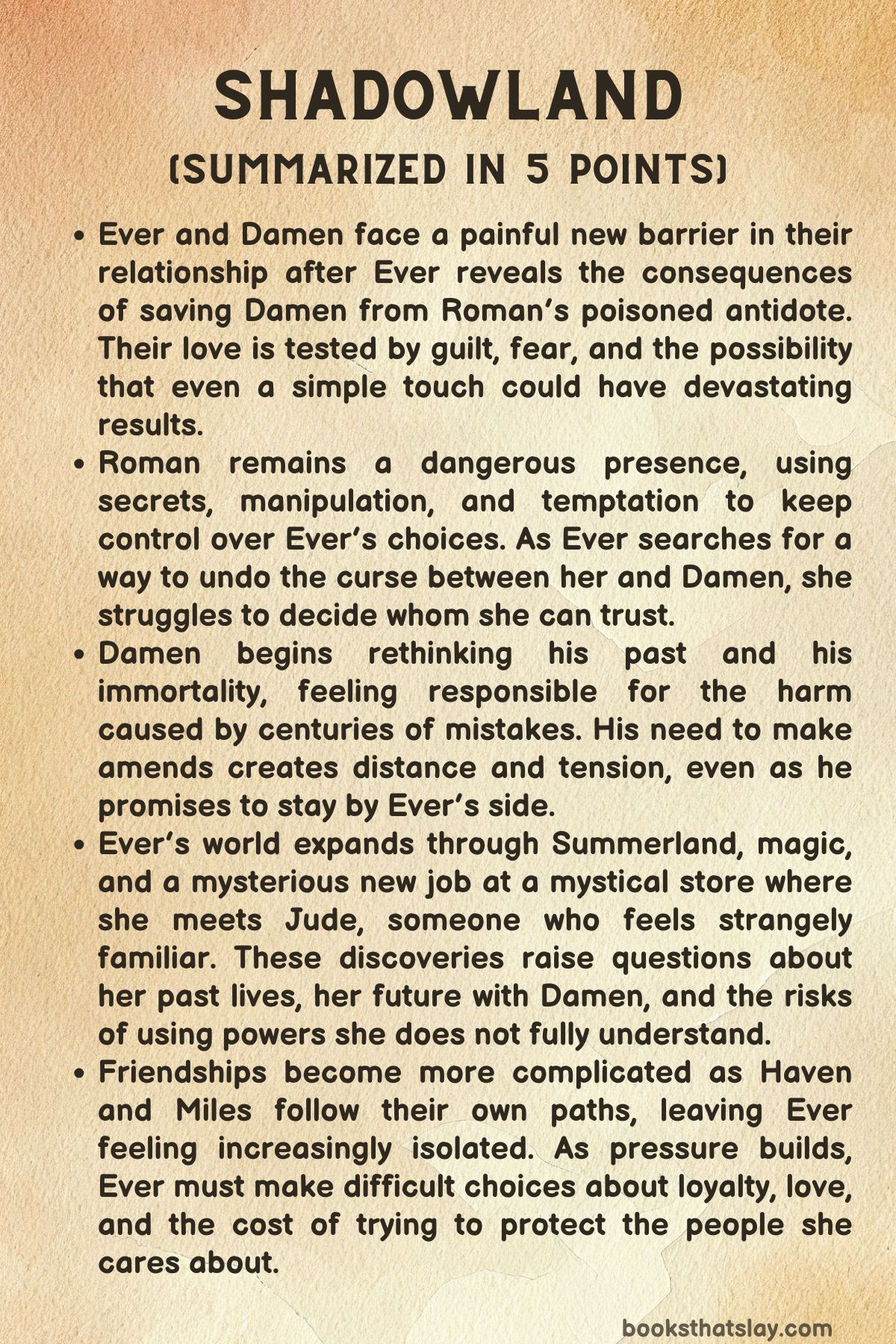
Ever and Damen begin Shadowland in the shadow of a terrible discovery. Ever finally tells Damen the full truth about what happened when she tried to save him from Roman’s poisoned antidote.
In her panic, she added her own blood, not realizing the result would be deadly for them. Because of that mistake, any exchange of DNA between them could kill Damen.
They can still love each other, speak to each other, and stay together, but they cannot touch in the way they both want. The future they have fought for is suddenly out of reach.
Damen is crushed by the news, but instead of blaming Ever, he turns the blame inward. He sees their suffering as punishment for his past.
Over many lifetimes, he made choices that hurt others, especially when he created immortals and acted from selfish desire. Now he believes the universe is forcing him to pay for those mistakes.
Ever tries to convince him that Roman is the one responsible for trapping them in this situation, but Damen cannot fully accept that. His guilt changes him.
He gives up his expensive car, his beautiful possessions, and even thinks about selling his house. He wants to strip away the luxury and privilege he has lived with for centuries, believing that sacrifice might help him make things right.
Ever, however, does not want punishment. She wants a cure.
Roman claims he has what she needs: an antidote to the antidote, a way to undo the problem and allow her and Damen to be together safely. But Roman does not offer it freely.
He enjoys having power over her and hints that he will give her the cure only if she pays the right price. Ever is tempted to believe him because she is desperate.
Damen warns her that Roman is only playing with her, but Ever cannot ignore the possibility that he really does have the answer.
At school, Ever tries to keep up a normal life with Miles and Haven, but normality feels thin and false. Her friendships are strained, especially because Ever is hiding so much.
Miles announces he is going to acting camp in Florence, which brings up painful history for Damen. Florence is connected to his past, to Drina, Roman, and the other immortals he created during the plague.
Damen’s reaction reminds Ever that their present problems are tied to centuries of choices and consequences.
Ever and Damen visit Summerland, the magical realm where they often seek guidance and knowledge. There, Damen shows Ever something terrifying: the Shadowland.
It is not peaceful like Summerland. It is a dark void where immortal souls go if their bodies are destroyed.
Damen explains that when he briefly died, he did not move into light or peace. He went toward that empty darkness.
Now both of them understand that their danger is greater than physical death. If either of them is destroyed, they may face eternal separation in the Shadowland.
This makes their inability to touch feel even more painful. Their love is still alive, but it is trapped by fear, danger, and the threat of a fate worse than death.
Meanwhile, Sabine wants Ever to get a summer job. She hopes work will give Ever structure and keep her from spending all her time with Damen.
Ever ends up working at a mystical store owned by Lina and run by Jude, who uses the name Avalon. Jude is kind, calm, and attractive, and there is something strangely familiar about him.
Ever feels drawn to him in a way she does not fully understand. As she learns more, she discovers that Jude has appeared in her past lives.
He has often been connected to her, sometimes as someone who cared for her. This makes Damen uneasy because Jude is not simply a new person in Ever’s life.
He is part of a pattern that reaches across her many lives.
At the store, Ever also finds a hidden Book of Shadows. She becomes convinced that it may help her force Roman to give up the cure.
Romy and Rayne, the young witch twins, confirm that the book is real and powerful. But power does not mean safety.
Damen warns Ever not to use it, knowing that magic can bring consequences she does not understand. Ever hears the warning, but she is too desperate to obey it.
She believes that if she can control Roman, she can repair everything.
Roman continues to work against her, not only by refusing to hand over the cure but also by moving closer to Haven. Haven already feels ignored, lonely, and less important than Ever.
Roman uses that weakness. He gives Haven attention and pulls her toward his world.
He introduces her to other rogue immortals, Misa and Rafe, making her feel included in a glamorous and secret circle. Ever sees the danger, but her attempts to protect Haven are weakened by her own secrecy.
She keeps making private decisions, including visiting Roman and casting a binding spell meant to force him to obey her.
The spell is a serious mistake. Ever performs it during the dark moon without understanding what that timing means.
Instead of gaining control, she calls on dark forces and gives Roman even more room to manipulate events. She believes she has taken action, but she has actually made herself more vulnerable.
The crisis comes during Miles’s going-away party. Roman arrives with Haven, Misa, and Rafe, showing that he has gained influence over Haven and is not afraid to display it.
Ever thinks her spell will make Roman give her the cure. Instead, Roman remains fully in control.
He leaves with Haven, supposedly for a fortune-telling appointment, and soon Ever receives a frightening call from Ava. Haven is at Roman’s house and barely breathing.
Ever rushes there and finds Haven poisoned with belladonna. Roman has arranged the moment carefully.
He reveals the true price of the cure. Ever can have the antidote and finally be with Damen, but only if she lets Haven die.
If she chooses Damen and the cure, she must abandon her friend. If she saves Haven, she must give her the immortal elixir, turning her immortal and dragging her into the same dangerous world Ever has been trying to survive.
Roman frames the choice as a test. He wants Ever to prove what kind of person she is.
He wants to see whether her love for Damen will outweigh her loyalty to Haven. Damen begs Ever not to give Haven the elixir because he understands what immortality really means.
It is not just endless beauty and life. It is also danger, loss, isolation, and the possibility of ending in the Shadowland.
Ever cannot let Haven die. Even knowing the cost, she gives Haven the elixir.
In doing so, she gives up her chance to take Roman’s cure. Haven survives, but she becomes immortal.
Ever saves her friend’s life, yet the decision creates a new set of problems. Haven has now been pulled into a world she does not understand, and Roman’s influence over her may not be over.
Damen forgives Ever because he understands that she acted from love, not selfishness. Still, forgiveness does not solve their problem.
Ever and Damen remain unable to touch. Roman still holds power over them.
Haven is now immortal, and the danger of the Shadowland hangs over all of them. Shadowland ends with Ever having made a compassionate choice that also deepens the conflict, proving that in her world, saving someone can come with a heavy and lasting price.
Characters
Ever Bloom
Ever is the emotional center of Shadowland, and her character is shaped by guilt, love, fear, and desperation. In this book, she is not simply dealing with a romantic problem; she is carrying the burden of having accidentally made her relationship with Damen dangerous.
By adding her blood to the antidote that saved him, she created a situation where any exchange of DNA between them could kill him. This makes her love feel both powerful and painful because the person she wants to be closest to is the one person she cannot safely touch.
Ever’s main struggle comes from her inability to accept helplessness. She wants a cure immediately, and that urgency pushes her into risky decisions.
Her desire to save Damen and restore their relationship is sincere, but it also makes her vulnerable to Roman’s manipulation.
Ever’s greatest flaw in the story is that she often acts alone, even when others warn her not to. She ignores Damen’s advice about Roman and later ignores his warning about the Book of Shadows.
This does not make her selfish in a simple way; rather, it shows how fear can make a caring person reckless. She believes she is fighting for love, but her choices repeatedly create more danger.
Her use of the binding spell is especially important because it shows that she is willing to cross lines she does not fully understand when she feels cornered. Her desperation makes her easier to manipulate, and Roman uses that weakness against her.
At the same time, Ever’s compassion remains one of her strongest qualities. When Roman forces her to choose between saving Haven and receiving the cure, Ever chooses Haven.
This moment reveals that, despite all her mistakes, she is not cruel or cold-hearted. She cannot sacrifice her friend simply to get what she wants, even though saving Haven means losing her best chance to be with Damen physically.
Her decision proves that her love is not limited to romance. Ever may be impulsive and secretive, but she is also deeply loyal.
By the end of the book, she has not solved the central problem, but she has shown that she still has a moral core strong enough to resist becoming like Roman.
Damen Auguste
Damen is one of the most conflicted characters in the book because he responds to suffering by turning inward and blaming himself. When Ever tells him the truth about the poisoned antidote, he is devastated, but instead of blaming only Roman, he sees the situation as punishment for his own past.
His belief that this is karma shows how heavily his history weighs on him. Damen has lived for centuries, and the choices he made in the past continue to shape his present.
His guilt is not shallow; it changes his behavior. He gives up his expensive car, his possessions, and even considers selling his house because he feels he must atone.
Damen’s transformation shows a desire for spiritual and moral cleansing. He no longer wants to be defined by luxury, control, or old patterns of selfishness.
However, his guilt also weakens him in some ways. Instead of fighting Roman with clarity, Damen becomes consumed by the idea that he deserves punishment.
This makes him more restrained and cautious than Ever, but it also makes him seem emotionally distant at times. He loves Ever deeply, yet his fear of the Shadowland and his guilt over the past create a heavy atmosphere around him.
His role as Ever’s guide is also important. He introduces her to the terrifying reality of the Shadowland, explaining that immortality has consequences far worse than ordinary death.
This knowledge gives the story a darker emotional weight. Damen understands what is at stake more fully than Ever does, which is why he reacts so strongly when she considers using magic or when she gives Haven the elixir.
His plea for Ever not to save Haven comes from fear, not cruelty. He knows that immortality is not a simple gift.
Still, when Ever chooses to save her friend, Damen forgives her. This forgiveness shows growth.
He may be burdened by guilt and fear, but his love for Ever includes understanding, not just desire.
Roman
Roman is the main manipulative force in the book. He is dangerous not because he uses strength alone, but because he understands emotional weakness and knows exactly how to exploit it.
He holds the cure Ever wants and turns it into a weapon. By claiming he has the “antidote to the antidote,” he keeps Ever trapped between hope and suspicion.
Roman’s power comes from uncertainty. Ever cannot fully trust him, but she also cannot ignore him because he may truly have the solution she needs.
Roman’s cruelty is psychological. He enjoys watching Ever struggle, and he uses Haven as part of his larger game.
His offer at the end reveals how carefully he understands Ever’s character. He does not simply ask for payment; he creates a moral test designed to hurt her no matter what she chooses.
If Ever lets Haven die, she gets the cure but loses part of her humanity. If she saves Haven, she loses the cure and brings Haven into the dangerous immortal world.
Roman’s trap is effective because it attacks Ever’s deepest values.
He also represents the corrupt side of immortality. Unlike Damen, who is trying to change, Roman seems to embrace manipulation, resentment, and control.
His connection to rogue immortals such as Misa and Rafe shows that he has built a circle around rebellion and moral decay. He draws Haven in because he recognizes her loneliness and need for attention.
Roman does not only threaten Ever and Damen directly; he damages the relationships around them. His villainy lies in how he turns love, friendship, and fear into tools of control.
Haven
Haven is one of the most vulnerable characters in the story, and her weakness comes from feeling ignored, lonely, and less important than the people around her. Her friendship with Ever is strained because Ever is hiding too much, and Haven senses the distance even if she does not understand the full reason for it.
This emotional gap makes her more open to Roman’s attention. Roman gives her a sense of importance, danger, and belonging, which she badly wants.
Her attraction to his circle is not just about rebellion; it is about wanting to feel chosen.
Haven’s role becomes tragic because she is pulled into the immortal world before she understands it. She does not have the knowledge or preparation that Ever and Damen have.
Roman uses her as bait, poisoning her with belladonna and turning her life into a bargaining tool. In that moment, Haven becomes the center of Ever’s moral test.
She is not merely a side character who needs saving; she represents the cost of Ever’s secrets and the danger of Roman’s influence.
When Ever gives Haven the elixir, Haven survives, but her survival is complicated. Becoming immortal is not presented as a simple rescue.
It saves her body but exposes her to the same dangers that haunt Ever and Damen, including the possibility of the Shadowland. Haven’s transformation also changes the friendship permanently.
Ever acts out of love, but she makes an enormous decision for Haven. This creates future emotional tension because Haven has been saved and condemned at the same time.
Her character shows how easily someone who feels overlooked can be drawn into danger when attention is mistaken for care.
Miles
Miles provides a connection to Ever’s ordinary life, but his presence also highlights how impossible normalcy has become for her. At school, Ever tries to return to her usual routine with Miles and Haven, but the tension beneath the surface is too strong.
Miles’s announcement that he is going to acting camp in Florence seems exciting on the surface, yet it worries Damen because Florence is connected to painful parts of his past. This turns Miles’s personal opportunity into a reminder that the immortal world can intrude on even the most ordinary human plans.
Miles is important because he represents the life Ever might have had if she were not surrounded by secrets, immortality, and danger. He is connected to friendship, ambition, and youthful possibility.
Unlike Ever, Damen, Roman, and Haven, he is not deeply involved in the supernatural conflict. That makes him feel more innocent, but it also makes him vulnerable in a different way.
His planned trip to Florence suggests that even characters outside the central conflict can unknowingly move closer to danger.
Miles also helps show the growing distance between Ever and her human friends. She cares about him, but she cannot be fully honest with him.
This secrecy isolates her further. Through Miles, the story shows that Ever’s supernatural life does not simply create danger; it damages her ability to maintain honest, ordinary relationships.
Sabine
Sabine represents structure, responsibility, and the adult world that Ever often resists. She wants Ever to get a summer job because she believes it will give her discipline and keep her away from Damen.
From Sabine’s perspective, this is practical and protective. She does not understand the immortal conflict, but she can see that Ever’s life is unstable and that her attachment to Damen is intense.
Her concern is grounded in ordinary guardianship rather than supernatural knowledge.
Sabine’s importance lies in the contrast she creates. While Ever is dealing with curses, antidotes, immortality, and dark magic, Sabine is focused on work, routine, and healthy boundaries.
This makes her seem disconnected from Ever’s real problems, but it also makes her a necessary presence in the book. She reminds the reader that Ever is still supposed to be living a human life with responsibilities.
Sabine’s attempts to guide Ever may not solve the deeper conflict, but they show that Ever still has someone trying to protect her in a normal, parental way.
Her role also reveals Ever’s isolation. Because Sabine cannot know the full truth, Ever cannot receive the kind of help she actually needs.
This creates a painful gap between them. Sabine is not uncaring; she is simply limited by what she understands.
Her character adds realism to Ever’s life by showing how supernatural secrecy affects family relationships.
Jude
Jude is a mysterious and emotionally significant character because he creates uncertainty in Ever’s relationship with Damen. He is kind, attractive, and strangely familiar to Ever, which immediately sets him apart from an ordinary new acquaintance.
His presence at the mystical store introduces a different kind of energy into the story. Unlike Roman, Jude does not appear threatening, but his connection to Ever’s past lives makes him unsettling in a quieter way.
Jude’s role is important because he complicates the idea of destiny. Ever’s bond with Damen has always seemed central, but Jude’s repeated presence in her past lives suggests that her emotional history is broader and more tangled than she realized.
He is not simply a romantic distraction; he represents the possibility that Ever’s soul has connections Damen cannot control. This makes Damen uneasy, and his discomfort reveals his fear of losing Ever not only physically but emotionally.
Jude also serves as a link to the world of magic. Through the store and the hidden Book of Shadows, Ever gains access to forces she does not fully understand.
Jude’s environment becomes the place where Ever’s desperation turns into action. Even though Jude himself is not presented as malicious, his presence helps lead Ever toward choices that become dangerous.
He stands at the intersection of attraction, past-life mystery, and magical temptation.
Lina
Lina is a quieter character, but she is important because she owns the mystical store where Ever begins working under the name Avalon. Her store becomes a major setting for Ever’s exploration of magic, identity, and hidden knowledge.
Lina’s presence suggests a world of spiritual and magical practice that exists alongside the immortal world. Even if she does not dominate the central conflict, her role helps create the atmosphere that allows Ever to discover the Book of Shadows.
Lina’s character is connected to mystery and possibility. By owning the store, she indirectly gives Ever access to tools and ideas that Ever is not mature enough to handle safely.
This does not make Lina responsible for Ever’s mistakes, but it does make her part of the chain of events that leads Ever toward the binding spell. Lina’s store represents knowledge, but the book shows that knowledge without wisdom can become dangerous.
She also contributes to Ever’s attempt to create a separate identity. Ever works there using the name Avalon, which suggests her desire to step into a different role and perhaps gain control over her situation.
Lina’s world offers Ever an escape from Sabine’s ordinary expectations and Damen’s warnings, but that escape comes with consequences.
Romy and Rayne
Romy and Rayne, the young witch twins, bring knowledge and warning into the story. They confirm that the Book of Shadows is real and powerful, which validates Ever’s belief that it may help her.
However, their confirmation also makes the danger more serious. The book is not a harmless object or symbolic curiosity; it contains real power, and Ever’s decision to use it matters.
The twins represent magical understanding that Ever lacks. They know enough to recognize the seriousness of what she is dealing with, but Ever’s desperation makes her listen selectively.
This is one of the key patterns in the story: Ever receives warnings, but she focuses on the possibility of solving her problem rather than the risks. Romy and Rayne therefore function as voices of caution, even though Ever ultimately ignores the deeper meaning of that caution.
Their youth also creates an interesting contrast. Although they are young, they understand magical danger better than Ever does in this situation.
This reverses expectations and shows that maturity in the book is not only about age. It is about knowledge, discipline, and respect for consequences.
Romy and Rayne understand that power must be handled carefully, while Ever learns that lesson through failure.
Ava
Ava plays a smaller but crucial role by alerting Ever when Haven is in danger. Her call pushes Ever into the final moral crisis at Roman’s house.
Without Ava’s warning, Ever may not have reached Haven in time. This makes Ava important as a messenger figure, someone whose action moves the story into its most intense emotional moment.
Ava’s role also emphasizes the interconnected nature of the supernatural world around Ever. Even characters who are not at the center of the conflict can become essential when danger escalates.
Ava’s warning shows that Ever is not completely alone, even though she often behaves as if she must solve everything by herself. In this moment, Ava becomes part of the chain that allows Haven to survive.
Although Ava does not carry the same emotional weight as Ever, Damen, Roman, or Haven in this part of the story, her presence matters because she helps reveal the urgency of Roman’s cruelty. Her call is not just information; it is the trigger that forces Ever to make the defining choice of the book’s ending.
Misa
Misa is one of the rogue immortals connected to Roman, and her presence helps show that Roman’s influence extends beyond his personal conflict with Ever. She represents the dangerous social world into which Haven is being drawn.
Misa’s role is not as individually developed as Roman’s, but she matters because she is part of the group that makes Roman’s circle feel seductive and threatening.
For Haven, Misa and the others offer a sense of belonging that Ever has not been able to provide. This makes Misa symbolically important.
She is part of the crowd that validates Haven’s desire to be included, noticed, and transformed. Her presence at Miles’s party with Roman, Haven, and Rafe shows how openly Roman is beginning to invade Ever’s social life.
Misa also helps define the rogue immortal world as careless and morally dangerous. She is not just a background companion; she contributes to the atmosphere of temptation surrounding Haven.
Through characters like Misa, the book shows that immortality can become a social trap, not just a supernatural condition.
Rafe
Rafe, like Misa, is connected to Roman’s group of rogue immortals and helps expand the sense of threat around Ever and Haven. His presence suggests that Roman is not acting in isolation.
He has allies or followers who share his dangerous lifestyle, and this makes him more powerful. Rafe helps turn Roman’s influence into a group dynamic, which is especially dangerous for someone like Haven, who wants acceptance.
Rafe’s importance comes from the way he contributes to the atmosphere of rebellion and temptation. He is part of the world that seems exciting from the outside but is actually tied to manipulation, poison, and immortal consequences.
His presence at the party helps show how Roman brings danger directly into Ever’s human surroundings.
Although Rafe is not explored as deeply as the central characters, he still serves a purpose in the book. He helps show that the immortal world has factions, loyalties, and corrupt social circles.
Through him, Roman’s power feels broader and more socially rooted.
Drina
Drina is important mainly through Damen’s past and the history surrounding Florence. Even though she is not central to the present action described here, her connection to Damen, Roman, and the immortals created during the plague gives her lasting influence.
The mention of Florence brings her memory and Damen’s old mistakes back into focus. This shows how the past is never truly separate from the present in Shadowland.
Drina represents the consequences of Damen’s earlier life. Her connection to jealousy, immortality, and old emotional wounds helps explain why Damen feels so burdened by karma.
The fact that Miles’s trip to Florence worries Damen shows that Drina’s history still has power over him. She is part of the larger pattern of choices Damen made long before Ever, choices that continue to create danger and guilt.
Her character also deepens the book’s theme of repetition. Ever, Damen, Jude, Roman, and the other immortals are all shaped by past lives, old betrayals, and unresolved attachments.
Drina’s presence in the background reminds the reader that immortality does not erase the past. It preserves it, sometimes painfully.
Themes
Sacrifice and Moral Choice
Ever’s decision to save Haven becomes the clearest example of sacrifice because it forces her to choose between personal happiness and another person’s life. Roman designs the situation so that either choice will hurt her: if she lets Haven die, she gains the cure and can finally be with Damen, but she would carry the guilt of abandoning her friend.
If she saves Haven, she loses the cure and pulls Haven into the dangerous immortal world. This choice shows that love in Shadowland is not only romantic; it also appears as responsibility, loyalty, and the refusal to treat someone else’s life as less valuable than one’s own desire.
Ever’s action is not perfect, because it creates new problems, but it proves that she is not willing to become cruel in order to get what she wants. The theme becomes powerful because sacrifice is shown as painful and complicated, not simple or heroic.
Ever saves Haven, but the cost remains heavy for everyone.
Guilt, Karma, and the Need for Redemption
Damen’s response to the curse reveals how deeply guilt controls him. Instead of blaming Roman alone, he sees the situation as punishment for the harm he caused across centuries.
His decision to give up wealth, possessions, and comfort shows that he believes suffering can somehow balance the wrongs of his past. This theme is important because it presents redemption as more than regret.
Damen does not simply feel bad; he tries to change how he lives. However, his guilt also becomes dangerous because it makes him accept blame for things Roman deliberately caused.
Ever challenges this by insisting that Roman is responsible for his own cruelty. Through this conflict, Shadowland suggests that redemption requires honesty, not self-punishment.
A person must face the past, but they must also recognize when guilt is being used against them. Damen’s struggle shows that healing cannot come from shame alone; it must come from responsibility, change, and forgiveness.
Power, Manipulation, and Control
Roman’s control over the antidote gives him power not only over Ever and Damen’s relationship but also over their emotions, choices, and fears. He understands what Ever wants most, and he uses that desire to push her into desperate decisions.
His manipulation works because he rarely attacks directly; instead, he offers hope, hides the real cost, and waits for Ever to make a mistake. This theme is also seen through Haven, who is drawn toward Roman because he makes her feel noticed and included.
Her loneliness becomes a weakness he can use. Ever’s binding spell reflects another side of the same theme: when she feels powerless, she tries to force control through magic without fully understanding the danger.
The result shows that control gained through fear, pressure, or dark forces only creates more harm. The story presents power as morally dangerous when it is separated from care, honesty, and self-restraint.
Love, Separation, and Fear of Loss
Ever and Damen’s relationship is shaped by a painful contradiction: they love each other deeply, but physical closeness could destroy him. Their separation is not caused by lack of feeling but by the danger attached to touch, which makes their love emotionally intense and constantly frustrating.
The Shadowland adds an even darker fear because death would not bring peace or reunion. Instead, it would mean endless emptiness and permanent separation.
This changes the meaning of immortality. What once seemed like a way to keep love alive now carries the threat of eternal punishment.
Their love is tested not by ordinary jealousy alone, but by fear, restraint, guilt, and uncertainty. Jude’s presence adds further tension because he represents a connection Ever does not fully understand, while Damen sees him as a reminder that love can be challenged by the past.
The theme shows that love requires trust when certainty and physical comfort are taken away.