Some Girls Bite Summary, Characters and Themes
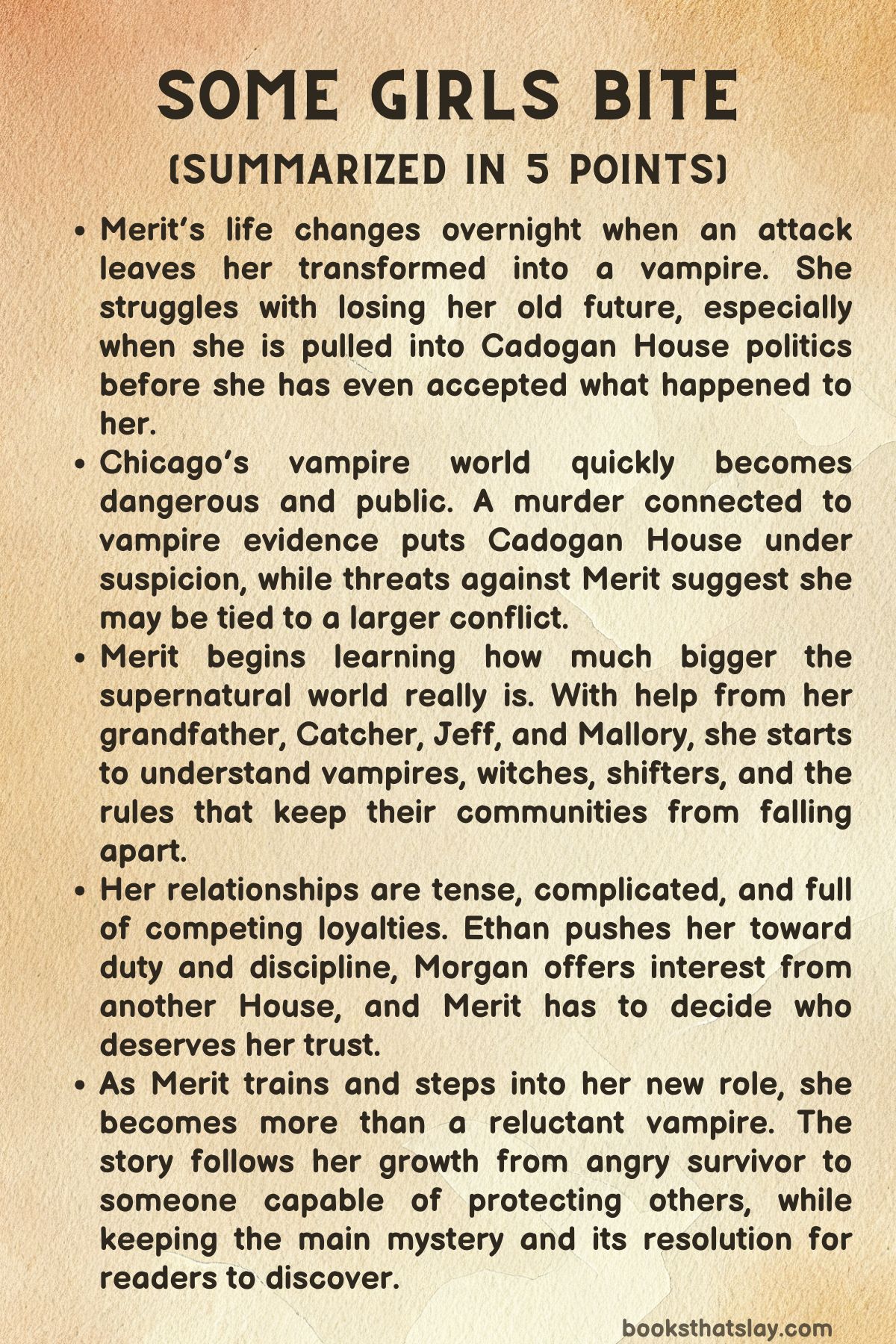
Some Girls Bite by Chloe Neill is an urban fantasy novel set in Chicago, where vampires live openly under a political House system. The story follows Merit, a graduate student whose life changes after a violent attack forces her into vampirism without her consent.
As she struggles with anger, power, family pressure, and unwanted loyalty to Cadogan House, Merit is pulled into a murder investigation that threatens the city’s supernatural balance. The book mixes mystery, vampire politics, romance, and self-discovery, building a world where immortality comes with rules, danger, and difficult choices.
Summary
Merit is a twenty-seven-year-old graduate student living in Chicago with her best friend, Mallory. Her life has been ordinary in many ways, shaped by academic work, independence, and a complicated relationship with her wealthy family.
That life ends after she is attacked on the University of Chicago campus. Her last human memory is terrifying: a vampire tearing into her throat before two other vampires chase the attacker away.
Three days later, Merit wakes in the back of a limousine. She is no longer injured, and she is dressed in expensive clothes she does not recognize.
She soon learns that Ethan Sullivan, the powerful Master of Cadogan House, changed her into a vampire to save her life. The decision preserved her body but took away the human future she had expected.
Merit is returned to the Wicker Park brownstone she shares with Mallory, but everything familiar now feels different.
A representative from Cadogan House named Helen arrives to explain Merit’s new situation. Merit is now an Initiate of Cadogan, one of Chicago’s three recognized vampire Houses.
She is expected to attend a formal ceremony, swear loyalty to Ethan, and accept the obligations of vampire society. She also discovers that she has been removed from the university and that her new identity as a vampire has been made public.
Merit is furious. She did not choose this life, and she resents being treated as property or a political asset.
Her anger is sharpened by the fact that others seem to expect her obedience simply because Ethan saved her.
Mallory tries to comfort her, but Merit’s shock and anger keep building. She visits her parents in Oak Park, hoping for some kind of family support.
Her mother shows concern, but her father, Joshua Merit, focuses mainly on reputation. He worries about how Merit’s change will affect the family name and warns her not to bring embarrassment on them.
The visit confirms Merit’s old belief that her father values status more than her feelings.
Soon after, Merit and Mallory see a news report about Jennifer Porter, a woman found murdered in Grant Park with her throat torn out. A Cadogan medal was discovered at the scene, making it appear that someone from Ethan’s House is responsible.
Jennifer resembles Merit closely enough to suggest that Merit may have been the original target, or that both women are connected to a larger plan. The danger becomes personal when someone throws a brick through Mallory’s window with a death threat aimed at Merit.
Realizing that she cannot ignore Cadogan House or the supernatural world, Merit goes there with Mallory. She meets Ethan properly and confronts him about changing her.
Their meeting is charged with anger, attraction, and distrust. Merit challenges him, and the conflict leads to a sparring match.
Ethan defeats her easily, but Merit discovers that vampirism has given her strength, speed, and instincts she never had before. Ethan’s staff, including Malik and Luc, begin considering the possibility that a Rogue vampire is killing women in order to frame the official Houses.
During this time, Mallory’s own hidden nature is revealed. She is identified as a witch, which shocks both her and Merit.
The two friends are no longer ordinary humans caught near supernatural politics; both have become part of that world in different ways.
Merit later visits her grandfather, Chuck Merit, and learns that he is not merely a retired city worker as she had believed. He is Chicago’s supernatural Ombudsman, responsible for handling conflicts among vampires, shifters, nymphs, demons, and other supernatural groups.
His office includes Catcher, a sorcerer, and Jeff, a young shifter with strong investigative skills. This discovery gives Merit another connection to the hidden side of Chicago and helps her understand that supernatural society is broader and more organized than she imagined.
Catcher begins training Merit in sword fighting, giving her a way to control her new physical abilities. He also helps Mallory begin to understand her magic.
Merit is still angry about becoming a vampire, but training gives her a sense of direction. She is not ready to surrender her independence, yet she starts to see that survival requires skill, information, and allies.
The murders continue. A second woman, Patricia Long, is killed, and the evidence this time points toward Grey House, another vampire House in Chicago.
The pattern suggests that someone is trying to create conflict among the Houses by planting evidence and feeding public suspicion. Fear spreads, and the political pressure on Ethan and Cadogan grows.
Merit also meets Morgan, Second of Navarre House. He is charming, attractive, and openly interested in her.
His attention offers a possible escape from Ethan’s control, but it also carries political meaning because Morgan belongs to another House. Navarre’s Master, Celina Desaulniers, treats Merit with hostility and tries to dominate her with glamour.
Merit resists, proving that she has unusual strength of will for a new vampire. This resistance makes Celina dislike her even more.
As Merit prepares for her Commendation ceremony, Ethan continues pressing her to accept her place in Cadogan House. Merit resents his authority, but she also cannot deny the pull between them.
Their relationship is tense, marked by power struggles, mutual suspicion, and attraction neither of them fully trusts. Ethan represents the system that claimed her, but he is also the person who saved her life and seems to believe she can become something important.
At the ceremony, Merit takes the formal oaths to Cadogan House. Then Ethan surprises everyone by naming her Sentinel.
The role makes her responsible for defending the House itself. For a new vampire, the appointment is extraordinary.
Merit is stunned, and others are shocked. The title gives her status, but it also places her directly in the center of Cadogan’s conflicts.
At a later vampire gathering, tensions rise further when Morgan confronts Ethan over a death threat supposedly found in Celina’s room and signed by Ethan. The accusation could cause open conflict between Houses.
Merit steps in as Sentinel and prevents Morgan from attacking Ethan. Her actions show that she is beginning to act within her new role, even if she remains uncertain about her loyalty.
Morgan then publicly claims romantic and political interest in her, creating another problem. Merit becomes a symbol in the rivalry between Cadogan and Navarre, whether she wants that or not.
The mystery finally points back to Celina. She lures Ethan into a confrontation and reveals the truth.
She arranged the murders and used Rogue vampires to carry them out. She also used Amber from Cadogan to steal House items so that Cadogan and Grey would appear guilty.
Her goal was to weaken trust in the other vampire leaders and make herself look like the only stable authority in Chicago. By creating fear, suspicion, and conflict, she hoped to gain control over the city’s vampire Houses and eventually push events toward a larger war.
Celina attacks Ethan with hidden blades, and Merit is forced to act. Using an aspen stake, she strikes Celina in the shoulder and stops her before she can kill him.
The act saves Ethan, but it also leaves Merit shaken. She has defended Cadogan, harmed another vampire, and stepped fully into the violent reality of her new world.
After Celina is taken away to face punishment, the immediate crisis ends. Morgan is likely to become the new leader of Navarre, which may change the balance among the Houses.
Merit returns home changed by everything that has happened. She is still angry about the loss of her human life, still uncertain about Ethan, and still unsure what kind of vampire she will become.
Yet she has also proven herself brave, capable, and difficult to control.
By the end of Some Girls Bite, Merit has moved from victim to active defender. She has lost her old future, but she has gained power, enemies, allies, and a role she never asked for.
Her new life is dangerous and political, but she is no longer standing outside it. She must now decide how to live as a vampire while holding on to her own judgment, loyalty, and sense of self.
Characters
Merit
Merit is the central character of Some Girls Bite, and her role in the book is built around loss, anger, identity, and reluctant transformation. At the beginning, she is a twenty-seven-year-old graduate student whose life is violently interrupted when she is attacked and turned into a vampire without her consent.
This makes her one of the most emotionally conflicted figures in the story because her new existence saves her life while also taking away the human future she expected for herself. Her anger toward Ethan is not simply stubbornness; it comes from the fact that her body, choices, career, privacy, and social identity have all been changed by other people’s decisions.
Her removal from university and public listing as a vampire deepen her sense that she has been robbed of control.
Merit’s personality is defined by intelligence, independence, sarcasm, pride, and a strong instinct for justice. She does not immediately accept vampire hierarchy or Cadogan House loyalty just because others expect her to.
Instead, she questions rules, challenges Ethan, resists pressure, and tries to understand the political world she has been forced into. Her sparring match with Ethan reveals not only her new physical power but also her unwillingness to be passive.
Even when she is inexperienced, she has the courage to confront authority directly.
As the book develops, Merit changes from someone who sees vampirism only as a violation into someone who begins to understand that her new role gives her responsibilities. Her appointment as Sentinel is important because it recognizes qualities she has not fully accepted in herself: loyalty, courage, discipline, and the ability to defend others under pressure.
By the end, when she stops Celina from killing Ethan, Merit proves that she is no longer merely reacting to what has happened to her. She is making active choices within her new life, even when those choices frighten her.
Her character remains emotionally unsettled, but that uncertainty makes her realistic. She is brave without being fully confident, powerful without being fully trained, and loyal without becoming blindly obedient.
Ethan Sullivan
Ethan Sullivan is one of the most powerful and complicated figures in the book. As Master of Cadogan House, he represents authority, tradition, control, and vampire politics.
His decision to turn Merit into a vampire saves her life, but it also creates the central emotional conflict between them because he does not ask for her consent. Ethan sees his action as necessary and practical, while Merit experiences it as a violation.
This difference between duty and personal freedom shapes much of their relationship.
Ethan is commanding, disciplined, elegant, and politically aware. He understands the dangers facing the Houses and knows that every public action can affect Cadogan’s reputation.
Because of this, he often behaves with calculation rather than warmth. His leadership style can seem cold, but it is also shaped by the burden of protecting a large vampire House during a time of public suspicion and internal threat.
The murders place Cadogan in danger, and Ethan must respond not only as an individual but as a political leader responsible for his people.
His relationship with Merit is tense because he is both her maker and her superior, but also someone who is drawn to her strength. He challenges her, pressures her, and sometimes underestimates how deeply she resents what has happened.
At the same time, he recognizes her potential before many others do. Naming her Sentinel shows that he sees beyond her inexperience and understands that she has the instincts of a defender.
Ethan’s character is morally complex because he can be controlling and arrogant, yet he is not cruel. He is a leader shaped by responsibility, and his connection with Merit forces him to face the limits of command when dealing with someone who refuses to be treated like a possession.
Mallory Carmichael
Mallory is Merit’s best friend and one of the most important emotional anchors in the story. She provides comfort, humor, loyalty, and stability at the moment when Merit’s life has been overturned.
When Merit wakes up as a vampire, Mallory does not abandon her or treat her like a monster. Instead, she supports her through shock, anger, fear, and confusion.
This makes Mallory essential because she represents the human intimacy and trust that Merit is afraid of losing.
Mallory’s own discovery that she is a witch gives her character more depth than the role of supportive best friend alone. Like Merit, she learns that the supernatural world has been hidden around her and that she has a place in it.
However, Mallory responds to this revelation differently. Where Merit is furious and resistant, Mallory is more open, curious, and energetic about her magical identity.
This contrast helps show the different ways people respond when their ordinary lives are replaced by something extraordinary.
Mallory also brings warmth and lightness to a story filled with danger and political tension. Her friendship with Merit is affectionate and honest, and she often helps keep Merit emotionally grounded.
At the same time, Mallory is not merely comic relief. Her magical potential connects her to the larger supernatural community, especially through Catcher’s training.
Her character suggests that hidden power can emerge unexpectedly and that identity can expand rather than only be destroyed.
Celina Desaulniers
Celina Desaulniers is the main antagonist of the book and one of its most dangerous political figures. As Master of Navarre House, she presents herself as elegant, powerful, and authoritative, but beneath that surface is a manipulative desire for control.
Her hostility toward Merit is immediate and revealing because she recognizes Merit as both politically useful and potentially threatening. Celina’s attempt to overpower Merit with glamour shows her habit of domination: she does not simply want obedience; she wants psychological control.
Celina’s villainy is especially effective because she understands public fear and political perception. She does not commit violence randomly.
Instead, she arranges murders, uses Rogues, and plants evidence in ways that make other Houses look guilty. Her plan depends on creating panic, suspicion, and division so that she can present herself as the only trustworthy leader.
This makes her more than a physical threat. She is a strategist who uses reputation, fear, and institutional weakness as weapons.
Her actions reveal a hunger for power that goes beyond personal rivalry. She is willing to sacrifice innocent lives and destabilize Chicago’s vampire community in order to increase her own influence.
Her hidden blades and direct attack on Ethan expose the violence beneath her polished image. Celina is dangerous because she combines beauty, status, charm, ambition, and cruelty.
She represents the corrupt side of supernatural politics, where leadership becomes domination and protection becomes a mask for conquest.
Morgan Greer
Morgan is the Second of Navarre House and a character caught between attraction, ambition, loyalty, and political uncertainty. He is drawn to Merit and treats her as both a romantic interest and a valuable figure in vampire politics.
His attraction to her is not purely personal because her connection to Cadogan makes her politically significant. This gives his interest in her a complicated quality.
He may genuinely like her, but he also understands the advantage of being linked to her.
Morgan’s public claim on Merit places her in a difficult position between Navarre and Cadogan. His behavior shows confidence and boldness, but also a lack of sensitivity to how much Merit values her independence.
Like Ethan, Morgan sometimes treats political gestures as if they can define Merit’s place in the world. However, unlike Ethan, Morgan is not yet fully established as a leader.
He is still operating under Celina’s shadow, which makes his role unstable.
By the end of the story, Morgan is positioned as someone who may inherit Navarre after Celina’s exposure. This creates an important turning point for him.
He has the chance to become a better leader than Celina, but the book leaves him with unresolved tension. Morgan is charming and passionate, yet he is also impulsive and politically motivated.
His character matters because he represents another possible path for Merit within vampire society, one that is tempting but not necessarily safe or simple.
Malik
Malik is Ethan’s trusted Second in Cadogan House and serves as a calm, loyal, and stabilizing presence within the House. His importance lies in the quiet authority he brings to moments of tension.
While Ethan carries the visible burden of leadership, Malik supports the structure of Cadogan from within. He appears controlled, thoughtful, and dependable, which makes him valuable in a world where panic and suspicion can easily spread.
Malik’s loyalty to Ethan does not make him seem mindless or weak. Instead, he represents the discipline and order that allow a vampire House to function.
During the investigation into the murders, he is part of the inner circle trying to understand who is framing the Houses and why. His presence helps show that Cadogan is not simply Ethan’s personal domain but a structured community with layers of responsibility.
As a character, Malik is less emotionally dramatic than Merit, Ethan, or Morgan, but that restraint is part of his role. He reflects the professionalism and seriousness of Cadogan House.
He also helps balance Ethan’s more forceful personality by providing steadiness. In the book, Malik stands for loyalty that is earned through trust and shared duty rather than loud declarations.
Luc
Luc is another important member of Cadogan House and contributes to the House’s sense of defense, investigation, and internal loyalty. He is connected to the practical side of Cadogan’s response to danger.
While Ethan represents command and Malik represents steadiness, Luc helps embody the active security and operational strength of the House. His role becomes especially important because the murders make Cadogan vulnerable to public blame and supernatural conflict.
Luc’s character adds a sense of grounded competence. He understands threats, House politics, and the need to protect Cadogan from both external enemies and internal weakness.
His presence also helps Merit begin to see Cadogan as more than a prison or political machine. Through figures like Luc, the House becomes a community with people who have responsibilities, loyalties, and personalities of their own.
Although Luc is not at the emotional center of the story, he supports the development of the world around Merit. He helps show that becoming part of Cadogan means entering a working system of guards, leaders, traditions, and defenders.
His character strengthens the atmosphere of the House and helps make Merit’s new role as Sentinel feel connected to a larger structure.
Helen
Helen is the Cadogan representative who explains Merit’s new status after her transformation. Her role is brief but important because she becomes the first official voice of the vampire system Merit has been forced into.
Helen tells Merit that she is now an Initiate, that she must attend the Commendation, swear oaths, and accept her place in Cadogan House. Because of this, she becomes associated with bureaucracy, rules, and the loss of Merit’s former freedom.
Helen is not presented as a villain, but she is part of the institution that Merit resents. Her calm explanation of Merit’s new obligations contrasts sharply with Merit’s emotional shock.
This makes the scene tense because Helen treats the situation as procedure, while Merit experiences it as the collapse of her human life. Helen’s character helps show how organized and formal vampire society is, but also how impersonal it can feel to someone who has not chosen to enter it.
Her importance lies in what she represents. She is the messenger of a new reality, and Merit’s decision to throw her out shows Merit’s refusal to quietly accept a life that has been assigned to her.
Helen helps establish the conflict between individual choice and supernatural hierarchy that continues throughout the book.
Joshua Merit
Joshua Merit, Merit’s father, is one of the clearest examples of emotional distance and social pride in the story. When Merit visits her parents after becoming a vampire, his reaction reveals that he is more concerned with reputation than with his daughter’s trauma.
Instead of focusing on the fact that she was attacked, killed in a human sense, and forced into a new existence, he worries about embarrassment and public perception.
His character is important because he helps explain some of Merit’s independence and defensiveness. Growing up with a father who values status over emotional honesty likely taught Merit not to rely too easily on family approval.
Joshua’s coldness also contrasts with the loyalty Merit receives from Mallory and, eventually, from parts of Cadogan House. This contrast suggests that family is not only about blood but also about who stands beside someone in crisis.
Joshua represents the human world’s version of power and hierarchy. Like vampire politics, his world is shaped by image, influence, and control.
However, unlike Ethan’s authority, Joshua’s concern feels selfish and shallow because it lacks protective purpose. His role in the book deepens Merit’s emotional isolation and reinforces why she must build her own identity apart from her family’s expectations.
Merit’s Mother
Merit’s mother is a softer figure than Joshua and shows more personal concern for Merit’s well-being. Her worry suggests that she does care about her daughter, even if she exists within the same socially conscious family environment.
She does not dominate the scene in the way Joshua does, but her reaction helps create a contrast between parental anxiety and parental pride.
Her character matters because she reveals that Merit’s family is not emotionally simple. Merit’s home background contains both concern and coldness, both affection and pressure.
Her mother’s worry is genuine, but it is not powerful enough to overcome Joshua’s controlling attitude. This makes her a somewhat passive figure in Merit’s life, someone who cares but does not fully protect.
In the wider story, Merit’s mother helps show what Merit has lost and what she may not have had strongly in the first place. Becoming a vampire separates Merit from her human family, but the visit to Oak Park shows that emotional distance already existed.
Her mother’s concern is meaningful, yet it cannot give Merit the understanding and support she needs.
Chuck Merit
Chuck Merit, Merit’s grandfather, is one of the most significant guides in the book. His revelation that he is Chicago’s supernatural Ombudsman changes Merit’s understanding of both her family and the city.
Unlike Joshua, Chuck is connected to the supernatural world in a way that is practical, compassionate, and protective. He helps manage conflicts among vampires, shifters, nymphs, demons, and other groups, which makes him a bridge between different communities.
Chuck’s character is wise, steady, and quietly powerful. He does not respond to Merit’s transformation with panic or shame.
Instead, he gives her information and context. This makes him one of the few people who helps Merit understand her new world without trying to control her.
His work as Ombudsman also expands the scope of the story beyond vampire politics, showing that Chicago is filled with many supernatural groups and that balance among them requires diplomacy.
As Merit’s grandfather, Chuck also offers a healthier form of family connection. He is involved, knowledgeable, and supportive without being overbearing.
His presence helps Merit see that secrecy and power are not always corrupt. They can also be used to protect communities and solve conflicts.
Chuck gives Merit access to truth, and that makes him one of the book’s most trustworthy authority figures.
Catcher Bell
Catcher is a sorcerer and one of the most important mentors in Merit’s early supernatural life. He trains Merit in sword fighting and helps Mallory understand her magic, placing him at the center of both women’s development.
His role is practical, but it is also personal because he helps translate supernatural power into discipline. He does not simply tell Merit and Mallory that they are powerful; he begins teaching them how to survive with that power.
Catcher’s personality brings confidence, sharpness, and a sense of experienced ease. He knows far more about the supernatural world than Merit and Mallory, and his training helps ground their discoveries in action rather than fear.
With Merit, he helps develop the physical skills she will need as Sentinel. With Mallory, he becomes a guide into magic, helping her understand an identity she did not know she possessed.
His character also adds texture to the supernatural community outside the vampire Houses. Through Catcher, the book shows that power exists in many forms and that vampires are only one part of a larger world.
He is valuable because he combines knowledge with directness. He may not soften every truth, but he prepares others for danger, and that makes him a necessary ally.
Jeff
Jeff is a shifter and a member of Chuck Merit’s Ombudsman team. His role helps broaden the supernatural world of the book by showing that the city’s hidden society includes more than vampires and sorcerers.
As part of the Ombudsman’s office, Jeff contributes to the work of managing supernatural conflicts and gathering information. His presence reinforces the idea that Chicago’s supernatural order depends on cooperation among different beings.
Jeff’s character brings a different kind of energy from the more formal vampire figures. Where Cadogan and Navarre are shaped by hierarchy and ceremony, Jeff belongs to a more flexible investigative world.
He helps make Chuck’s team feel active and varied, with each member bringing a different kind of knowledge and ability. His shifter identity also hints at wider tensions and alliances that extend beyond the immediate murder investigation.
Although Jeff is not one of the central emotional figures, he is important for world-building and support. He shows that Merit’s new life will involve a much larger network of supernatural relationships than she first realizes.
His character helps move the story beyond House politics and into the broader hidden city.
Jennifer Porter
Jennifer Porter is one of the murder victims whose death drives the central conflict. Although she does not function as an active character in the present action, her importance is undeniable because her murder creates public suspicion against Cadogan House.
The Cadogan medal found at the scene makes the House look guilty and turns her death into a political weapon.
Jennifer’s resemblance to Merit gives her role a disturbing emotional weight. It suggests that Merit may have been connected to the killer’s plan from the beginning or that she could have been another intended victim.
This resemblance makes Jennifer more than a name in an investigation. She becomes a shadow version of what could have happened to Merit, reminding the reader that Merit’s survival was not guaranteed.
Her character represents innocence caught inside supernatural ambition. She is not killed because of personal guilt or conflict but because Celina’s plan requires fear, confusion, and blame.
Jennifer’s death exposes the cruelty of using human lives as political tools. Through her, the book shows the cost of power struggles among supernatural leaders.
Patricia Long
Patricia Long is the second woman murdered, and her death increases the danger surrounding the vampire Houses. Like Jennifer, she is important because her murder is used to manipulate public perception and deepen conflict.
Evidence connected to Grey House makes the situation more unstable, suggesting that someone is deliberately trying to turn the Houses against one another.
Patricia’s role in the book reinforces the pattern of calculated violence. Her death proves that Jennifer’s murder was not an isolated act but part of a larger strategy.
This raises the stakes for Merit, Ethan, and the other supernatural authorities because the killer is not only violent but politically intelligent. Patricia becomes part of the evidence that points toward conspiracy rather than simple bloodlust.
As a victim, Patricia represents the vulnerability of ordinary people in a world where supernatural politics can become deadly. Her death helps reveal Celina’s ruthlessness and the willingness of powerful figures to use innocent lives for influence.
She may not have a developed personal arc, but her place in the story is crucial because she helps expose the scale and intention of the villain’s plan.
Amber
Amber is a Cadogan vampire whose betrayal becomes important once the truth behind the murders is revealed. She helps Celina by stealing House items, allowing evidence to be planted in ways that frame Cadogan and Grey.
Her actions make her dangerous not because she is the mastermind, but because she enables the mastermind from inside the system.
Amber’s role shows that threats to a House do not always come from outside enemies. Internal weakness, divided loyalty, or personal corruption can be just as damaging.
By helping Celina, Amber turns Cadogan’s own symbols and possessions into weapons against it. This betrayal intensifies the political danger because it makes Cadogan appear guilty while hiding the real source of the crimes.
Her character also helps reveal Celina’s manipulative reach. Celina’s plan depends on using people who can move within other Houses and exploit trust.
Amber’s betrayal damages the sense of security that Cadogan tries to maintain, and it reminds Merit that loyalty cannot be assumed simply because someone belongs to the same House. In Some Girls Bite, Amber represents the danger of hidden collaborators within a community under threat.
Themes
Consent, Autonomy, and the Loss of a Chosen Life
Merit’s transformation is not presented as a simple rescue, because survival comes at the cost of choice. Ethan saves her from death, but he also makes an irreversible decision about her body, future, identity, and social position without asking her.
That conflict gives Some Girls Bite much of its emotional force. Merit does not wake into power with gratitude alone; she wakes into anger, confusion, and grief for the human life that has been taken from her.
Her removal from university, public exposure as a vampire, and forced connection to Cadogan House all show how quickly personal freedom can be replaced by institutional control. Even when others insist that rules, oaths, and ceremonies are necessary, Merit’s resistance matters because it protects her sense of self.
Her struggle is not only about becoming supernatural but about deciding whether she can still own her life after others have rewritten it for her.
Power, Politics, and Public Image
Vampire society is shaped by hierarchy, reputation, and careful public performance. The Houses do not function only as families or communities; they operate like political institutions, with leaders, alliances, rivalries, and public relations crises.
The murders place Cadogan and Grey under suspicion, showing how easily fear can be manipulated when supernatural groups are already viewed with distrust. Celina understands that image can be as dangerous as violence, so she plants evidence, uses stolen House items, and creates confusion in order to make herself appear like the only reliable leader.
Merit’s father reflects a similar concern with reputation on a human scale, caring more about embarrassment than his daughter’s trauma. Against this world of appearances, Merit’s directness becomes important.
She is inexperienced, but she sees the moral cost of political games. The novel suggests that power becomes most dangerous when leaders care more about control than truth.
Identity, Belonging, and Reinvention
Merit’s new life forces her to rebuild her identity before she has fully mourned the old one. She was a graduate student with a familiar home, friendship, and future; suddenly she is an Initiate, a public vampire, and later Sentinel of Cadogan House.
This shift creates a deep conflict between who she was, who others expect her to become, and who she chooses to be. Her friendship with Mallory helps preserve continuity, because Mallory responds to Merit as a person rather than a symbol.
At the same time, Mallory’s own discovery of magic shows that identity is changing around both women, not just Merit. Cadogan offers protection and purpose, but it also demands loyalty.
Merit’s path in Some Girls Bite is therefore not about accepting a new label passively. It is about shaping that label into something she can live with, even when family, politics, attraction, and duty pull her in competing directions.
Duty, Courage, and Moral Responsibility
Merit’s appointment as Sentinel gives outward form to a responsibility she has already begun to feel. She does not enter vampire life seeking authority, yet she repeatedly acts when danger threatens others.
Her courage is not fearless confidence; it is action taken while she is angry, uncertain, and still learning the rules of the world around her. Training with Catcher, confronting Ethan, resisting Celina’s glamour, and stopping violence at the gathering all show her growth from victim to protector.
The final confrontation makes this theme sharper because Merit must use force to save Ethan, leaving her shaken rather than triumphant. That reaction matters: the novel does not treat violence as glamorous or easy.
Duty requires judgment, sacrifice, and the willingness to carry consequences. Merit’s role as Sentinel becomes meaningful because she protects the House without losing her moral discomfort, proving that real strength includes conscience as well as skill.