Shadows Upon Time Summary, Characters and Themes
Shadows Upon Time by Christopher Ruocchio is a gripping tale set in a complex, intergalactic empire. The protagonist, Hadrian Marlowe, is caught in a web of political intrigue, war, and moral dilemmas as he navigates the fall of the Empire of Mankind.
The story follows Hadrian’s rise to power, his internal conflicts, and his struggle to protect humanity from existential threats like the alien Cielcin and other malevolent forces. As Hadrian grapples with the weight of leadership, betrayal, and the consequences of his actions, Shadows Upon Time explores themes of power, loyalty, and the human cost of war. It’s the 7th book in The Sun Eater series.
Summary
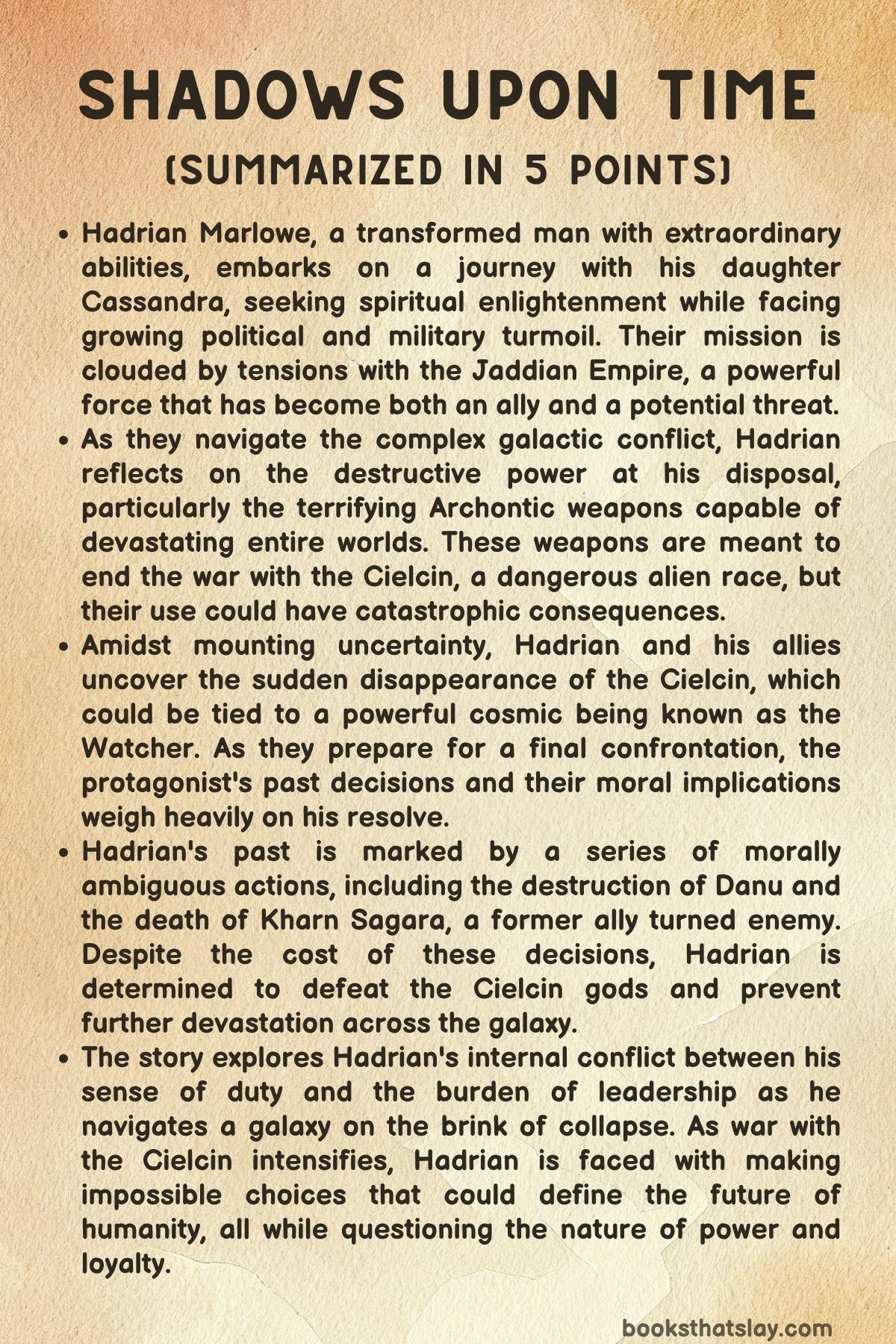
The story begins with Hadrian Marlowe and his daughter Cassandra, who embark on a pilgrimage to a remote, dark planet. Hadrian, a being remade into something more than human, possesses mystical powers that he tries to pass on to his daughter.
However, Cassandra struggles to hear the divine “cosmic song” her father teaches her, a reflection of her inability to connect with the spiritual knowledge Hadrian possesses. As they journey, they discuss the arrival of the Jaddian Empire, which marks the beginning of their departure from the planet.
Cassandra fears the looming conflict, but Hadrian, burdened with a sense of inevitable war, presses forward, carrying with him a powerful weapon named Demiurge that he plans to use to defeat the Cielcin, a destructive alien race allied with dark cosmic forces.
The tension builds as Hadrian and Cassandra board a Jaddian ship and meet Prince Kaim Olorin. Once a trusted ally, Kaim is now a reminder of the political complexities that surround Hadrian’s mission.
As the group travels, Hadrian reveals the terrifying power of the Archontic weapons—machines built to destroy the Cielcin. While Kaim and his men are intrigued by the potential to end the war, Hadrian’s ultimate goal is to kill the Cielcin gods, powerful entities manipulating space and time.
His internal struggle, however, deepens as he contemplates the cost of using such destructive power. As the journey continues, Hadrian realizes that the weapons designed to save them may also destroy everything they hold dear.
In the midst of political unrest, the Cielcin, the main threat to humanity, mysteriously vanish, leaving the galaxy in confusion. Hadrian, knowing the Cielcin’s true nature, speculates that their disappearance is linked to a powerful cosmic being known as the Watcher, who manipulates events from behind the scenes.
This revelation signals that the stakes of the galactic conflict are higher than anyone had anticipated. Hadrian plans to use Demiurge’s weapons to strike at the heart of the Cielcin’s power, with Kaim’s help, but as the political and military landscape shifts, the battle becomes more complicated.
Hadrian reflects on his past, recounting battles and his previous confrontation with Kharn Sagara, an antagonist responsible for the creation of many of the weapons at his disposal. His encounter with Sagara during the Battle of Vorgossos, which resulted in the destruction of the geothermal plant and the securing of the Demiurge ship, haunts him.
He realizes that his desire to destroy the Cielcin gods stems from a need to prevent further devastation, but the moral ambiguity of his past actions continues to weigh on him. Despite the internal turmoil, Hadrian remains resolute in his mission, knowing that the survival of the galaxy hinges on the destruction of the Cielcin.
As Hadrian takes control of the warship Demiurge, he broadcasts a message declaring the fall of Vorgossos and the death of Monarch Kharn Sagara. His orders include the deployment of the Archontic weapons to prevent any enemy ships from escaping.
Meanwhile, Lord Ohannes Douro, questioning Hadrian’s authority, suspects that Hadrian may be after the Demiurge for himself. The situation becomes more tense as the Vorgossene fleet surrenders under Hadrian’s leadership, but doubts about his intentions persist.
The conflict escalates when a shuttle from Vorgossos carrying Sagara’s captains is revealed to be a suicide weapon intended to destroy Demiurge. Hadrian’s quick thinking prevents catastrophe, but the situation worsens when Sagara’s mind is revealed to have been split into multiple copies, including one aboard the Demiurge.
The revelations of Sagara’s manipulation send the crew into disarray, but Hadrian presses forward, determined to secure control over the fleet and eliminate the remaining threats. However, it becomes clear that Sagara’s influence will continue to challenge Hadrian’s leadership, pushing him to the brink.
Despite his best efforts, Hadrian is forced to deal with Sagara’s missile swarm and the threat it poses. Using the powerful weapon Albedo, he neutralizes the threat and temporarily secures the situation, but his hold on the Demiurge is still uncertain.
The political landscape remains unstable, with tensions rising among his allies and enemies alike. Marlowe must navigate a complex web of alliances and betrayals while continuing to confront the larger threat of the Cielcin and the impending collapse of the Empire.
As the narrative progresses, Hadrian’s role becomes more pivotal as he is appointed Auctor of the Imperium, the Emperor’s representative. Despite his doubts about his ability to lead, he is thrust into a central role in the war with the Cielcin.
The Empire’s survival depends on Hadrian’s ability to unite fractured factions and withstand the mounting pressure from both within and outside the empire. However, his actions lead to the destruction of the planet Danu, a decision that shakes the foundations of the Empire and forces him to confront the moral implications of his choices.
With the Emperor’s health declining, Hadrian is forced to navigate a divided Empire, where political rivalries, betrayals, and alliances complicate every decision. As the Cielcin threat grows, Hadrian must prepare the empire for war, even as he faces opposition from within his own ranks.
The escalating conflict, combined with his personal struggles, pushes Hadrian to question his loyalty to the Emperor and his own role in the galaxy’s future.
In the final stages of the story, Hadrian’s leadership is tested to its limits. The Cielcin invasion reaches its peak, and the galaxy stands on the brink of destruction.
Hadrian must rally the remaining forces of the Imperium to resist the Cielcin, but the political tensions, internal betrayals, and complex power dynamics make every decision feel like a gamble. As the fate of the Empire hangs in the balance, Hadrian faces the ultimate test of his leadership and his ability to save humanity from annihilation.
Despite the uncertainties and the betrayal that follows, Hadrian’s influence will continue to shape the galaxy’s destiny long after the dust settles.
Characters
Hadrian Marlowe
Hadrian Marlowe is the central figure of Shadows Upon Time and a complex character shaped by both personal and political struggles. Once a trusted servant of the Emperor, Hadrian finds himself thrust into an enormous leadership role when the Emperor falls gravely ill.
He is burdened with the title of Auctor, a position that grants him immense power and authority, but it is a role he approaches with reluctance due to his own history and moral uncertainties. Throughout the story, Hadrian is forced to navigate the delicate web of political intrigue, where loyalty is often tested, and alliances shift like the sands.
He is an individual haunted by the past, particularly the destruction of the planet Danu, and the consequences of his actions weigh heavily on him as he contemplates the coming war with the Cielcin. Despite his inner turmoil, Hadrian is resolute in his decisions, acknowledging the need for a greater purpose even as he questions the methods he must employ.
His internal conflict is marked by his commitment to the survival of the human race, even if it means making difficult, morally ambiguous decisions. As a leader, he is strategic, constantly reflecting on the political dynamics around him, and is determined to preserve the empire, though the methods he chooses often come into question.
Cassandra
Cassandra, the daughter of the protagonist, represents the innocence and uncertainty of the younger generation that struggles to comprehend the cosmic and spiritual knowledge that her father possesses. At the beginning of Shadows Upon Time, she is depicted as someone who is attempting to connect with the cosmic song—a divine manifestation that her father is deeply attuned to.
However, she struggles to hear it, symbolizing her inability to fully understand the mystical and divine powers that shape her father’s worldview. This gap between them becomes a central theme, with Cassandra caught in the shadows of her father’s power and wisdom.
Despite her doubts and fears, especially when faced with the looming Jaddian threat, she demonstrates courage in her own way. Her relationship with her father is marked by love and reverence, but it is also tinged with the understanding that she does not share in the same abilities and responsibilities he bears.
As they journey through the unknown, Cassandra must grapple with her own fears and the realization that she may never be able to fully step into the role her father envisions for her. Her character represents both the potential and the limitations of the younger generation, caught between the old ways and the new, and her journey is one of self-discovery and acceptance.
Kaim Olorin
Prince Kaim Olorin of the Jaddians is a figure wrapped in both mystery and political complexity. Initially, he is seen as a potential ally to the protagonist, having once shared a relationship built on trust.
However, as the story progresses, it becomes clear that Kaim is bound by the interests and constraints of the Jaddian Empire, making his true loyalties difficult to gauge. His relationship with the protagonist is fraught with tension, as both men have histories that complicate their interactions.
Kaim is portrayed as pragmatic, a leader with a sense of caution and measured intelligence, and he recognizes the devastating power that the protagonist wields in the form of the Archontic weapons. Despite the promise of an alliance, Kaim is hesitant to fully commit, aware of the moral and political consequences that could arise from using such destructive power.
His character represents the tension between duty and personal conviction, as well as the challenges of navigating alliances in a fractured galaxy. Kaim is not a villain, but rather a figure caught in the crossfire of larger cosmic forces, trying to balance his responsibility to his people with the greater war that looms over them all.
Kharn Sagara
Kharn Sagara serves as one of the central antagonists in the novel, his actions setting much of the conflict in motion. Sagara is a powerful and calculating figure, whose role in creating weapons of mass destruction has far-reaching consequences for both the protagonist and the galaxy at large.
His split personality, with various copies of his mind transmitted across multiple host bodies, adds an element of unpredictability and danger. Sagara’s ultimate goal is to escape the war, using the very weapons that have caused such widespread devastation to secure his own freedom.
His cold, strategic mindset allows him to manipulate situations to his advantage, and he is unafraid to sacrifice countless lives for his own survival. Throughout the narrative, Sagara’s presence is felt even when he is not physically present, as the chaos he orchestrates continues to unfold.
His ultimate plan to destroy the Demiurge and his manipulation of his own fleet add layers of complexity to his character, making him a formidable adversary. Sagara is not simply a villain but a character who represents the corrupting influence of power and the extremes to which one might go to secure personal safety in a universe marked by war and destruction.
Lord Ohannes Douro
Lord Ohannes Douro is a character who embodies the traits of skepticism and political caution. As a leader within the empire, Douro is quick to question Hadrian Marlowe’s authority and actions, particularly when it becomes apparent that Marlowe’s intentions may not align with the interests of all involved.
Douro is not easily swayed by the charismatic appeal of those around him and remains grounded in his own perception of right and wrong. His suspicions of Hadrian’s motives, especially in the wake of the destruction of Vorgossos and the manipulation surrounding the Demiurge warship, position him as a critical voice in the broader narrative.
Douro’s role highlights the complexities of leadership in times of war, where decisions made by powerful figures often come under intense scrutiny. Although he may not be an outright antagonist, Douro’s distrust of Hadrian adds a layer of tension to the political landscape, as his cautionary stance questions the larger goals of the protagonists and their moral alignment.
Anaryan
Anaryan, the daughter of Hadrian Marlowe, is a pivotal character who carries her father’s legacy while also forging her own path within the complex political and military world she is thrust into. Throughout the narrative, she is tasked with seeking alliances among the lesser houses of the Imperium to fight against the rising power of the Chantry.
Anaryan’s journey is one of survival, political acumen, and learning to trust in her own abilities. She embodies the new generation that must take on the mantle of leadership in the wake of the older generation’s mistakes.
Her relationship with her father is central to her motivations, as she must navigate the difficult terrain of loyalty, family expectations, and the broader galactic conflict. Unlike her father, who struggles with the weight of his past, Anaryan is more pragmatic, taking on the mantle of leadership with a sense of resolve that shows her capacity to adapt to the harsh realities of the empire’s political landscape.
Her story is one of transformation as she steps into the role of a leader in her own right, showing both strength and vulnerability as she faces the challenges ahead.
Alexander
Alexander, the son of a former Emperor, emerges as one of the more tragic figures in the narrative, his rise to power marking a major turning point in the story. Once a figure of potential, he becomes a ruthless antagonist who seeks to claim the throne for himself.
His motivations are driven by a desire for vengeance and power, with his accusations against Hadrian—including the claim that Hadrian killed his father—serving as a justification for his harsh actions. Alexander’s character is marked by ambition and the willingness to do whatever is necessary to achieve his goals, including betraying those who once supported him.
His reign is built on lies, and his accusations against Hadrian are as much about securing his own legitimacy as they are about exacting revenge. In his final confrontation with Hadrian, Alexander’s actions reflect the deep political corruption and betrayal that run rampant within the empire.
Despite his rise to power, Alexander’s rule is marked by the same cycle of ambition and destruction that ultimately consumes those who seek to control the galaxy.
Themes
Power and Corruption
The central theme that dominates Shadows upon Time is the exploration of power and its inherent capacity to corrupt. Hadrian Marlowe, the protagonist, is thrust into a series of leadership roles, both by birthright and circumstance, and is forced to confront the consequences of his decisions.
Throughout the narrative, Hadrian’s internal struggle with the responsibilities of leadership is evident. He grapples with the weight of holding immense power, especially as the Emperor of All Mankind, and the moral cost of using that power to manipulate others and control vast resources.
The story examines how power, when concentrated in the hands of a few, leads to immense ethical compromises. Hadrian’s actions, from the destruction of planets to the manipulation of alliances, reflect a man who, while acting with the best of intentions, becomes increasingly isolated in his pursuit of what he believes to be the greater good.
The tension between doing what is necessary for survival and maintaining one’s humanity is a recurring issue, and it forces Hadrian to reflect on his past and the cost of his actions. Ultimately, the narrative implies that even the most well-intentioned leaders, like Hadrian, are not immune to the corrupting influence of absolute power, which often leads to tragic outcomes for themselves and those around them.
Moral Ambiguity and Sacrifice
A prominent theme in the book is the moral ambiguity of the protagonist’s actions and the sacrifices he makes in the pursuit of what he believes is the greater good. Hadrian is not a traditional hero; his path is fraught with difficult decisions, each of which challenges his sense of morality.
His willingness to sacrifice countless lives in the name of defeating the Cielcin and protecting the empire shows the complex nature of leadership during wartime. Throughout his journey, Hadrian is constantly forced to weigh the needs of the many against the lives of the few, and this tension reveals the blurry line between heroism and villainy.
The destruction of Danu, the creation and use of devastating weapons like the Archontic machines, and his brutal confrontations with former allies highlight the extent of his moral compromise. However, this theme also explores the personal toll of these choices, as Hadrian is haunted by the consequences of his actions.
The narrative suggests that true leadership involves making painful sacrifices and facing the emotional aftermath of those decisions. Hadrian’s internal conflict, paired with his external battles, shows the price of being a leader in a universe where survival often comes at the expense of one’s soul.
Family and Legacy
The theme of family and legacy is intricately woven into the storyline of Shadows upon Time, particularly through the relationship between Hadrian and his daughter, Cassandra. Their dynamic represents the passing of knowledge, power, and responsibility from one generation to the next.
Hadrian’s attempts to impart his wisdom and abilities to Cassandra reflect his desire to ensure that she is prepared to navigate the complexities of the galaxy and its politics. However, Cassandra’s struggles to fully grasp the divine powers that Hadrian possesses reveal the gap between the generations and the challenges of inheriting such monumental responsibilities.
This generational divide is central to the story, as Hadrian’s journey is not just about war and leadership, but also about how he must reconcile his legacy with the future of the empire and his family. The theme of legacy is also explored in the context of Hadrian’s eventual death, which, though a personal tragedy, becomes a symbol of the enduring influence he has had on the galaxy.
Even in death, his actions and decisions continue to shape the future, suggesting that the true measure of a person’s impact is not necessarily their life, but the ripple effect of their choices that persists beyond their existence.
War and Its Consequences
War is another key theme explored in Shadows upon Time, and the novel provides a nuanced portrayal of the toll that prolonged conflict takes on individuals, empires, and the fabric of the universe itself. The war between the humans and the Cielcin serves as the backdrop for much of the narrative, but it is the personal and societal consequences of this war that form the heart of the story.
Hadrian’s leadership in the war, along with his involvement in battles that result in the destruction of planets and the deployment of world-ending weapons, shows the devastating power of conflict and the moral compromises that arise when survival is at stake. The theme of war is further complicated by the political machinations and betrayals that emerge from it.
As various factions vie for control, alliances are constantly shifting, and loyalty becomes a scarce commodity. The novel demonstrates that war is not just about the physical battles fought between armies but also about the emotional and psychological toll it takes on those involved.
Hadrian’s struggles with his own conscience, the betrayal of allies, and the irrevocable consequences of his actions illustrate that war, even when fought for noble causes, often leaves behind an irreparable sense of loss and a shattered world. This theme calls attention to the cyclical nature of war, where even victories come with hidden costs, and peace is always fleeting.
Identity and Transformation
The theme of identity and transformation is deeply explored through Hadrian’s character arc. At the outset, he is a man who has been “remade” into something more than human, both physically and metaphysically.
This transformation not only alters his appearance and abilities but also his understanding of self and his place within the larger cosmic order. The narrative delves into the psychological effects of such a profound change, as Hadrian navigates the tension between who he was and who he has become.
His struggles with his identity are mirrored by the struggles of those around him, particularly his daughter Cassandra, who must grapple with her own limitations in comparison to her father’s otherworldly capabilities. The novel explores how the protagonist’s transformation affects his relationships and decisions, as he is torn between his human past and the inhuman powers he now possesses.
The theme of identity is also tied to the broader political context, as Hadrian’s transformation into a figure of immense power forces him to question the role of the individual in a universe governed by fate and cosmic forces. In the end, Hadrian’s identity is not static, but continually evolving as he faces the consequences of his transformation, ultimately challenging the very notion of what it means to be human.
Cosmic Forces and Divine Intervention
In Shadows upon Time, the influence of cosmic forces and divine beings plays a significant role in shaping the events of the story. The protagonist’s mystical abilities, the presence of the Watchers, and the looming threat of the Cielcin gods all suggest that the characters are not merely at the mercy of their own choices, but also subject to the will of greater cosmic forces.
The Watchers, ancient entities that manipulate time and space, are central to the novel’s exploration of destiny and divine intervention. These forces, both seen and unseen, guide the actions of the characters in ways that are not always clear or benevolent.
The protagonist’s awareness of these cosmic entities and their role in the larger conflict reveals a universe that is not only vast and complex but also deeply entangled with forces beyond human comprehension. The theme of divine intervention raises questions about free will and the extent to which individuals can control their own fate when faced with overwhelming cosmic power.
Ultimately, the novel suggests that even the most powerful individuals, like Hadrian, are at the mercy of these higher forces, which raises profound questions about the nature of existence and the true nature of divinity.