Skyshade Summary, Characters and Themes
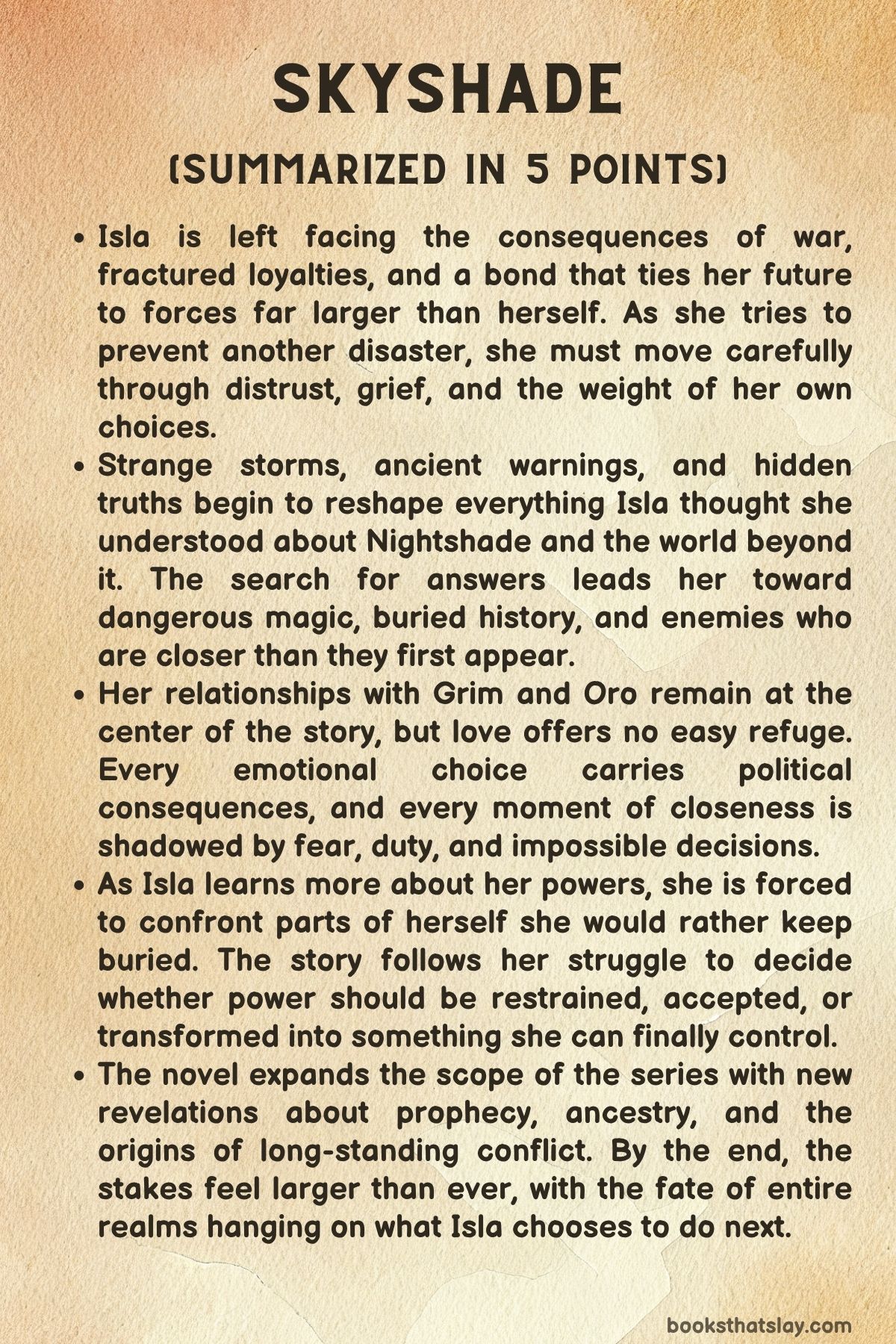
Skyshade by Alex Aster is the third book in the Lightlark series, and it picks up after betrayal, war, and impossible choices have reshaped every bond Isla cares about. Now tied by fate to Grim while still loving Oro, Isla is trapped in a crisis that is both deeply personal and world-changing.
Storms are tearing through Nightshade, old prophecies are closing in, and every path forward seems to demand a terrible loss. This book expands the series into darker territory, with higher emotional stakes, more dangerous magic, and a heroine forced to decide what kind of person she will be when love, power, and survival can no longer be separated.
Summary
After the devastation of war, Isla is brought back from death through a bond that links her life to Grim’s. His choice saves her, but it creates a new disaster: if she dies, Grim and Nightshade may fall with her.
The only permanent way to preserve her life seems connected to a portal that could also destroy Lightlark and threaten Oro. Horrified by the lives already lost because of her, Isla refuses to let Grim sacrifice the world for her survival.
She decides that the only way to stop him is to stay close, earn his trust, and quietly search for another answer before fate closes in.
In Nightshade, Isla is feared and resented. Grim’s people see her as the cause of their losses and as a queen they never wanted.
Even so, Grim protects her position and insists on her value, while Isla secretly tries to help Lightlark by sending away precious healing elixir. At the same time, strange storms begin tearing through Nightshade, bringing sickness, violent creatures, and signs that something ancient and unnatural is stirring.
Isla believes the storms may be tied to the portal, and she starts searching for knowledge that might help her stop both the destruction and her own approaching death.
Afraid of losing control of her power and hurting more people, Isla has the blacksmith make bracelets from shademade to suppress her magic. The choice reflects how deeply she fears herself.
Grim, however, wants her to stop hiding who she is. Their relationship becomes a constant push and pull between anger, longing, mistrust, and old love that neither of them has fully escaped.
Though Isla tells herself she cannot forgive him, their closeness continues to return in moments of danger and honesty.
Her search leads her toward prophecy. She seeks out those who may know what lies ahead and learns that another portal exists in Nightshade, hidden even from Grim.
She is told that she will drive a blade into a powerful heart and begin a new age, a warning that sharpens her fear that she will be forced to kill either Grim or Oro. She also learns that a traitor is moving against her, that the storms can be traced to deeper magic, and that her life will not last long if nothing changes.
As Isla travels through Nightshade, she begins acting outside the law. In disguise, she hunts violent men and brings their hearts to an augur in exchange for information.
These actions reveal a disturbing truth about her: killing gives her a sense of release that frightens her, as if some darker side of her power is growing stronger. At the same time, she forms unexpected bonds with ordinary people, especially Sairsha and others who see her as a protector rather than a monster.
Their trust offers Isla a brief sense of belonging, though it is built on unstable ground.
Oro remains a constant presence in her heart. Though distance and magic weaken their connection, he still comes to her, still believes in her, and still tries to save her from the path she is on.
Isla, convinced that staying close to him will only bring him pain or death, tries to drive him away. She returns his necklace, wounds him with cruel honesty, and claims she has become the enemy.
Even as she does this, she knows she is breaking both his heart and her own.
Meanwhile, Grim and Isla grow close again in ways neither fully expects. He tends her wounds, shares pieces of his childhood, and shows her parts of Nightshade that belong not to the king people fear but to the boy he once was.
Isla sees his loneliness, the violence that shaped him, and the sincerity of his love. Though she still carries anger over his betrayals, she finds herself wanting a future with him.
Their second marriage becomes both political and personal, an attempt to rebuild trust in the middle of chaos. Yet even on the day of their wedding, signs of treachery and unrest interrupt any hope of peace.
Isla’s investigation deepens when messages seem to arrive from Aurora through a white quill linked to another world. Aurora begins teaching her the lost art of skyres, magical markings created with shademade that can sharpen control, track power, and unlock hidden abilities.
Isla uses them in secret, even though they damage her body. Nosebleeds, pain, and collapsing spells show that every attempt to master this ancient craft costs her more than she first realizes.
Still, she continues, believing precision is her only chance of saving others from the raw force inside her.
The traitor problem grows worse. Prophet-followers manipulate Isla through Sairsha, luring her into a trap and forcing her to kill people who believe their deaths are part of some greater design.
The loss devastates her and convinces her that she needs her full powers back. When the bracelets come off, her strength returns, but so does the risk that she may become exactly what she fears.
Soon afterward, a town is destroyed under suspicious circumstances, and witnesses claim Isla was responsible, raising the possibility that some hidden force inside her is acting beyond her control.
Then the truth breaks open. Isla is dragged underground and meets Lark Crown, her ancestor and one of the founders of Lightlark.
Lark has survived, and so has Cronan. Lark reveals a buried history of betrayal, imprisonment, and fury.
She plans to kill Grim and Oro, reshape the world, and use Isla as both heir and weapon. Suddenly the storms, the serpents, the visions, and the prophecy all connect to a much older conflict.
Grim admits he knew Lark existed and hid it from Isla, fearing what she might do if she learned the truth. Even this betrayal does not stop them from needing each other, because now the threat is larger than any one kingdom.
To stop Lark, Isla travels with Oro in search of a missing page from the prophet’s book and a relic tied to the founders. Their journey forces them back into intimacy, memory, and the full weight of their unresolved love.
Oro listens when she confesses the prophecy and her fear that she ruins everyone she touches. Instead of condemning her, he reminds her of every good thing she has done.
His faith in her stands in direct contrast to her own self-loathing.
When Lark’s attacks escalate, Grim and Oro are forced into an uneasy alliance. Isla reveals that she loves both of them, and the war around them becomes inseparable from the emotional truth she has tried to deny.
Together they gather weapons, relics, and cursed magic that might weaken Lark. Yet every plan comes with sacrifice.
One path suggests Oro’s death could break the old nexus that binds rulers to their people. Another points back to the portal and to the founders’ ancient powers.
Isla is caught between love and duty, survival and mercy, trying to invent a third option where none should exist.
Captured at one point and restrained again by the same bracelets she once chose for herself, Isla finally realizes the full nature of her power. Every life she has taken has left something behind.
She carries abilities gained through death, including the means to free herself. This understanding changes how she sees her past and what she may be capable of in the future.
She also learns the painful truth of her childhood: her first cry killed her parents, and the people who raised her were trying to contain a power that had always been dangerous.
Near the end, Isla discovers a hidden house built by her parents and a letter explaining that they accepted their fate because they believed she could still save the world. Armed with this knowledge, ancient relics, skyres, and a clearer understanding of who she is, Isla prepares for a final confrontation.
She unleashes the great storm foretold across Nightshade, draws Lark into the maze, and sets the battlefield on her own terms. During the fight she realizes that the voice guiding her through the quill was not Aurora at all, but Lark, and that she herself helped free this enemy long ago without knowing it.
At last Isla opens the portal to the other world, Skyshade. Her plan is desperate and revealing: she intends not only to stop Lark, but to take Lark’s power and use it to restore the dead, undoing the blood that has followed her across the series.
As Oro and Grim race after her, they finally understand that Isla has been protecting them by leaving them behind. The book ends with Isla and Lark crossing into Skyshade and Grim and Oro entering the maze too late to stop it, setting up a final reckoning beyond the world they know.
Characters
Isla Crown
Isla stands at the center of Skyshade as a ruler, lover, descendant, and possible destroyer, and her character is defined by conflict at every level. She is torn between Grim and Oro, between guilt and hope, between restraint and power.
What makes her compelling is not just that she faces impossible choices, but that she believes she deserves to suffer for the damage already done. She carries an enormous burden of responsibility for war, death, and the instability spreading across the realms, and this guilt shapes nearly every decision she makes.
Even when she is trying to save people, she often does so through secrecy, self-denial, and sacrifice, which shows how deeply she distrusts her own happiness.
A major part of Isla’s character arc is her fear of herself. She does not only fear external enemies; she fears what her own power will become if she stops controlling it.
The bracelets she commissions to suppress her magic are more than a practical tool. They are a symbol of shame and self-punishment.
She believes that power, left unchecked, will make her monstrous. Yet the story repeatedly forces her to recognize that suppressing herself is not the same as mastering herself.
Her journey becomes one of painful self-knowledge. She learns that her strength cannot be locked away forever and that denial often creates greater danger.
By the end, she begins to understand that her power is not evil on its own, but it becomes dangerous when guided by fear, rage, or manipulation.
Isla is also defined by the unusual emotional structure of her heart. Her love for both Grim and Oro is not treated as confusion that can be easily solved.
Instead, it reveals different truths about her. With Oro, she is seen, forgiven, and gently reminded of her goodness.
With Grim, she confronts darkness, passion, history, and a bond that feels both destructive and unavoidable. Her emotional complexity makes her more believable than a simple heroic figure.
She does not move cleanly from one love to another, and she does not become morally pure as her suffering grows. Instead, she remains complicated, often contradictory, and painfully human.
Another important element of her characterization is the way she moves closer to death and violence. Her nighttime hunts and the grim satisfaction she feels while killing reveal a side of her that terrifies even her.
These moments are important because they show that her struggle is not only about saving the world, but about deciding what kind of person she will be while doing it. She wants redemption, but she is not innocent.
She wants to protect others, but she is capable of brutality. This tension gives her arc force.
She is not trying to return to a simpler version of herself. She is trying to become someone who can carry terrible power without losing every part of her conscience.
By the close of the novel, Isla emerges as someone no longer waiting for prophecy to define her. Though she is still bound by predictions and fate, she begins acting with greater authorship over her own choices.
Her final decisions show courage, but they also show a desire to make meaning out of all the blood and grief behind her. She becomes a tragic and powerful figure because she does not seek survival alone.
She seeks repair, even when the cost may be everything.
Grim
Grim is written as a character of extremes: devoted yet manipulative, tender yet ruthless, deeply loving yet responsible for terrible harm. His greatest strength as a character lies in the fact that he is never reduced to a simple dark romantic figure.
He is dangerous in real ways, and the novel does not erase the damage he has caused. At the same time, it allows his emotional depth, loneliness, and sincerity to remain visible.
His love for Isla is absolute, but that same intensity is part of what makes him frightening. He is willing to place her above kingdoms, armies, and morality, which turns devotion into a form of danger.
What makes Grim especially interesting is that he truly believes in his love, yet he has repeatedly failed to understand what love should look like. He lies, withholds information, and acts unilaterally in the belief that he is protecting Isla or securing a future with her.
This pattern reveals one of his central flaws: he confuses possession, rescue, and sacrifice with emotional honesty. Even when he is sincere, he often acts as though wanting something deeply gives him the right to shape reality around it.
His arc in this book is partly about recognizing that love cannot survive on intensity alone. He has to learn trust, restraint, and transparency, even if he learns them imperfectly.
The novel also gives Grim unusual vulnerability. Through his memories and the scenes in the winter palace, the reader sees how his childhood shaped him into a person trained for cruelty.
He grew up under a father who treated affection, softness, and joy as weakness. This history does not excuse his choices, but it explains why love feels revolutionary to him.
Isla is not merely someone he desires; she is the person who awakens a life he was never meant to have. The quiet domestic moments between them matter because they reveal what he has been denied: freedom, gentleness, and the chance to be ordinary.
Grim’s relationship with power is also central to his character. Unlike Isla, he does not fear his own nature in the same way.
He is far more accepting of violence as a necessary part of rule. He can kill, threaten, or command without collapsing under guilt.
Yet this steadiness has a cost. He can become desensitized to the suffering his actions create, especially when Isla is involved.
His protective instinct is sincere, but it can easily become tyrannical because it lacks proportion. He does not naturally think in limits where she is concerned.
At the same time, Grim is not static. The novel shows him trying, however unevenly, to become worthy of Isla rather than merely claiming her.
He tends her wounds, respects some of her boundaries, and speaks openly about wanting to learn how to love her correctly. These moments are important because they show self-awareness.
He knows he has failed her. He knows love has not made him good by itself.
The tragedy of Grim is that he may be capable of deep transformation, but that transformation is always racing against the consequences of everything he has already done.
Oro Rey
Oro serves as a moral and emotional counterweight to Grim, but he is not merely the gentler alternative. He is a fully realized character whose strength comes from steadiness, emotional intelligence, and enduring loyalty.
He loves Isla without trying to dominate her, and his presence in the novel often creates a sense of clarity in contrast to the turmoil of Nightshade. Yet his role is not passive.
He acts, searches, confronts, and risks himself repeatedly. His love is active, not ornamental, and that makes him more than a symbol of goodness.
One of Oro’s strongest traits is his capacity for forgiveness without naïveté. He does not ignore what Isla has done or what has happened between them, but he continues to see her as more than the worst parts of her past.
This is one of the reasons their bond remains powerful. He offers Isla something she cannot give herself: belief that she is still worthy of love even after failure, bloodshed, and betrayal.
His emotional steadiness is not weakness. It is a discipline, and it is especially striking because it remains intact even when he is personally wounded by her choices.
Oro also represents duty in a more balanced form than many of the other rulers in the story. He does not stop being a king when he loves Isla, and he does not let love erase his responsibilities.
This balance gives him a quiet dignity. He is willing to fight for her, but he also thinks in terms of consequences, alliances, and the protection of his people.
The tension in his character comes from the fact that he is asked to choose between emotional truth and political necessity again and again, and neither choice is ever simple.
His scenes with Isla are marked by longing, restraint, and openness. Unlike Grim, he does not force closeness through intensity.
He often invites honesty rather than demanding it. That makes the pain between them more sorrowful, because so much of their separation comes not from lack of love, but from circumstance, prophecy, and Isla’s fear that loving him will destroy him.
His willingness to keep loving her even after rejection reveals both strength and vulnerability. He is not emotionally invincible.
He simply chooses not to harden.
Oro’s significance grows further because of the prophecy surrounding Isla. He is not only a romantic figure but also a possible sacrifice.
This raises the stakes of his character enormously. The possibility that his death may solve larger magical problems gives his tenderness a tragic edge.
He becomes the embodiment of what Isla may have to lose to save everyone else. That possibility sharpens his entire role in the story and makes his compassion feel even more painful, because he continues to love without guarantee of survival.
Lark Crown
Lark is one of the most important revelations in Skyshade because she transforms the central conflict from a personal and political struggle into an ancestral one. As Isla’s forebear and one of the original founders, Lark is both a villain and a dark reflection of what Isla might become.
She is driven by betrayal, imprisonment, rage, and a desire to rebuild the world according to her own design. What makes her especially effective is that she is not an outsider to Isla’s story.
She is rooted in Isla’s bloodline, which gives their confrontation a deeper emotional and symbolic force.
Lark represents power hardened by suffering. Where Isla still questions herself, Lark has moved far beyond doubt.
She has suffered enough that she now sees destruction as justice and domination as renewal. This makes her dangerous not only because of her magic, but because of her certainty.
She believes the existing world is broken beyond repair and that violent remaking is justified. That ideological confidence makes her more than a revenge-driven antagonist.
She becomes a figure of radical refusal, someone who rejects compromise, mercy, and inherited structures altogether.
Her link to the quill and to the false guidance Isla receives is one of the cleverest aspects of her characterization. She succeeds not only through force but through manipulation.
By occupying the space of trusted counsel, she shapes Isla’s choices long before revealing herself openly. This gives her a haunting presence in the novel, because she is influencing events from the shadows in ways that distort Isla’s understanding of both the past and herself.
Lark’s threat is therefore psychological as well as physical.
Lark also expands the theme of inherited burden. Through her, ancestry becomes something dangerous rather than comforting.
Isla does not inherit wisdom or stability from her line. She inherits unfinished rage, buried history, and the possibility of repeating old violence in a new form.
Lark is what happens when pain is preserved instead of transformed. She becomes a warning about what survival without healing can produce.
At the same time, Lark is not empty of emotional truth. Her anger comes from genuine betrayal, and that history gives her motives weight.
She has been wronged, imprisoned, and used. The problem is not that her suffering is false, but that she turns suffering into permission for annihilation.
That distinction makes her compelling. She is not evil because she hurts.
She is dangerous because she decides everyone else must be remade through that hurt as well.
Astria
Astria enters the story as a guarded and skeptical figure, but she develops into one of the most meaningful supporting characters because she offers Isla a rare connection rooted in family rather than romance or prophecy. As Grim’s general and Isla’s cousin, Astria exists at the meeting point of political authority and personal history.
She does not trust Isla easily, and that hesitation makes her believable. She has inherited loyalty, expectations, and grief, and she is not willing to abandon those simply because blood has resurfaced.
Her early distance is important because it shows that family in this world is not automatically healing. Astria has her own opinions about betrayal, legacy, and duty.
She sees Isla through the lens of war and scandal as much as through kinship. Yet once their relationship begins to soften, Astria becomes an understated source of stability.
Their bond grows through conversation, shared ancestry, and small personal details rather than dramatic declarations. This makes her role feel grounded and earned.
Astria’s value in the novel also lies in the way she broadens the emotional world around Isla. Much of the story is dominated by love triangles, prophecy, and catastrophe, but Astria introduces a different kind of closeness: familial recognition.
Through her, Isla learns more about her father and begins to connect with a lineage that is not entirely defined by disaster. Astria helps recover memory from myth.
She takes the grand, painful history around Isla and makes parts of it intimate and human.
As a military figure, Astria also reflects discipline and realism. She is less ruled by overwhelming passion than many of the central characters, and that makes her perspective useful.
She functions as someone who observes, questions, and withstands. Though not as flashy as the rulers or magical beings, she contributes weight to the political and emotional structure of the story.
Her role shows that trust does not have to arrive through fate. Sometimes it is built slowly through honesty and endurance.
Azul
Azul plays the role of observer, ally, and subtle truth-teller. He does not dominate the plot, but his importance lies in how often he provides Isla with tools, warnings, and perspective at moments when she most needs them.
He is one of the few characters who speaks to her with a blend of care and distance, neither wholly consumed by romantic attachment nor motivated by control. This gives his scenes a useful clarity.
Azul helps frame the approaching disaster in larger terms. His omens and understanding of storms position him as someone attuned to patterns beyond immediate politics.
He sees what is coming before many others do, and he equips Isla with objects that become crucial in her attempts to trace and understand the tempests. In that sense, he functions almost like a bridge between knowledge and action.
He may not always be in the foreground, but what he provides alters the course of the narrative.
Emotionally, Azul also matters because he trusts Isla at times when she struggles to trust herself. His willingness to safeguard important objects for her and return them when needed suggests faith in her judgment, or at least faith in the possibility that she can still choose well.
That trust is significant because it comes without the overwhelming possessiveness or pain that mark her bonds with Grim and Oro. His presence is less turbulent, which allows him to anchor scenes that might otherwise be consumed by emotional extremes.
Azul’s character also reinforces a wider truth in the novel: that rulers and allies are shaped not only by what power they hold, but by the quality of the guidance they offer. He is valuable not because he dominates events, but because he remains perceptive, useful, and composed while others are pulled by prophecy and love.
Sairsha
Sairsha begins as a vulnerable woman whom Isla saves, but she develops into one of the most unsettling supporting characters because of how she embodies false refuge. For a time, she gives Isla something precious: ordinary companionship.
Through Sairsha and the bar community around her, Isla experiences a form of belonging unconnected to crowns, prophecy, or ancient destiny. This makes Sairsha’s eventual betrayal especially effective.
She does not betray Isla from a position of obvious hostility, but from apparent friendship.
That betrayal matters because it strikes at one of Isla’s deepest needs. Isla is not only starved for love; she is starved for uncomplicated human connection.
Sairsha seems to offer that. Their conversations about guilt and redemption create the illusion of emotional safety.
When that illusion shatters, the result is more than a plot twist. It reinforces Isla’s fear that trust always hides a blade.
Sairsha also represents fanaticism disguised as devotion. She believes that Isla’s destiny requires bloodshed and that dying by Isla’s hand is an honor.
This is a chilling inversion of friendship. Instead of seeing Isla as a person who needs care, she sees her as a figure in prophecy who must be pushed toward violence.
In this way, Sairsha becomes a symbol of how belief systems can erase individual humanity. She claims reverence, but what she really offers is exploitation.
Her importance lingers even after her death because she marks a turning point in Isla’s development. The trap she sets helps convince Isla to reclaim her full powers and deepens her mistrust of peace, intimacy, and belonging.
Sairsha leaves behind emotional damage far larger than her page time might suggest.
Terra and Poppy
Terra and Poppy occupy a morally complicated place in the story because Isla begins with the belief that they destroyed her family, only to discover that their role in her life was far more painful and protective than she knew. As her guardians, they become symbols of concealed truth.
They are maternal figures, but not warm or transparent ones. Their care has always been tied to fear of what Isla could do, and that makes their relationship with her feel burdened rather than comforting.
What makes them compelling is that they are not revealed to be simple villains or innocent protectors. They made harsh choices around Isla’s upbringing, including suppressing her power through shademade traces, but they did so because they were trying to prevent catastrophe.
This introduces one of the novel’s recurring questions: what does care look like when the person you love is also dangerous? Terra and Poppy answer that question through secrecy and control, which protects Isla physically but damages her emotionally.
Their eventual truth reshapes Isla’s understanding of her childhood and of herself. Through them, she learns that her first cry caused her parents’ deaths.
This revelation is devastating because it changes guilt from something acquired later in life into something present from the beginning. Terra and Poppy therefore serve an important structural role.
They are the custodians of a truth that Isla must face before she can fully understand the roots of her fear and power.
They also add emotional texture to the Wildling side of the story. Their presence reminds the reader that inheritance is not just royal or magical.
It is domestic, relational, and painful. They helped raise Isla in the aftermath of catastrophe, and though they did not do so perfectly, they remained part of the long struggle to keep her alive.
Wren
Wren is a quieter supporting figure, but she carries emotional significance because she represents loyalty without spectacle. She is tied to the Wildlings and to the practical realities of survival, healing, and observation.
Isla initially wonders whether she might be a traitor, which shows how suspicious and isolated the atmosphere has become. That Wren proves trustworthy gives the story an important note of contrast.
Not every uncertainty ends in betrayal.
Her role becomes more meaningful because she is connected to medicinal knowledge, serpents, and the movement of information through the Wildling world. She reflects the novel’s interest in characters who are not always at the center of power but who still sustain the world through expertise and steadiness.
She is useful, attentive, and grounded.
Wren’s fate later in the story adds weight to her character. Her death is not just another casualty.
It reinforces the scale of Lark’s threat and the cost of the conflict spreading outward from Isla’s choices and lineage. Characters like Wren matter because they reveal what is lost beyond the main emotional triangle.
Through her, the war feels communal rather than abstract.
Cleo
Cleo is driven by grief more than by loyalty to any cause, and that grief shapes her into a volatile, morally unstable figure. Her desire to be reunited with her dead child pushes her toward catastrophic choices, including support for acts that could destroy entire realms.
This makes her an example of how personal loss can distort judgment until almost any bargain feels acceptable. She is not guided by collective good.
She is guided by private yearning so intense that it narrows the whole moral field.
At first, Cleo appears self-serving and dangerous, hoarding prophecy and knowledge for herself. Yet she remains more layered than a straightforward antagonist because her motives come from pain rather than ambition alone.
She is consumed by absence, and that makes her vulnerable to terrible alliances. Her choices expose one of the darker truths of the novel: love and grief do not automatically make people noble.
Sometimes they make them reckless.
Her eventual shift is therefore significant. When she turns against Lark, it shows that her character still contains the ability to choose differently.
She is not permanently fixed in betrayal. That does not erase what she has supported, but it does restore some complexity to her role.
She becomes a reminder that damaged people can still act decisively in the right direction, even after long periods of moral failure.
The Blacksmith, Ferrar
The blacksmith begins as a grim, unsettling figure connected to death, invention, and shademade, but he becomes one of the most quietly tragic and meaningful characters in the novel. He is ancient, burdened, and eager for release.
His bargain with Isla is rooted in his desire for rest, which immediately sets him apart from many other characters who are fighting to survive, rule, or possess. He exists closer to exhaustion than ambition.
He is crucial to the story because he gives Isla both physical tools and philosophical challenges. The bracelets, armor, and other crafted objects are important, but even more important is the way he speaks to her about power.
He repeatedly suggests that what she needs may already be within her, though she is too frightened to trust that truth. His perspective cuts through her cycle of suppression and panic.
He sees more clearly than she does that self-erasure will not save her.
His final revelation, including the recovery of his name, Ferrar, gives his character a moving sense of restored identity. For so long he has existed almost as a function, a maker bound to suffering and long memory.
Recovering his name turns him back into a person. His death is meaningful because it is not just an ending but a release.
He becomes one of the story’s clearest examples of someone whose long endurance has become its own form of pain.
Aurora
Aurora’s role is built around memory, absence, and misdirection. For much of the novel, she seems to function as a guide from beyond, a lingering intelligence helping Isla through the quill and the secret language of skyres.
This apparent mentorship gives Aurora a posthumous influence that feels intimate and mysterious. She represents legacy in its most seductive form: the idea that the dead can still guide the living toward truth.
What makes her role especially interesting is that the story later undercuts that certainty. Once Isla learns that the communication she trusted was not what it seemed, Aurora becomes part of a broader theme about false inheritance and manipulated memory.
Even so, Aurora still matters. The quill, the markings, and the association with hidden knowledge all keep her presence alive in the emotional architecture of the novel.
Aurora is important less as an active personality on the page and more as a figure onto whom Isla projects trust, longing, and the desire for guidance. She symbolizes the hope that the past might contain wisdom rather than only damage.
That this hope is partly deceived makes her role even more haunting.
Lynx and Wraith
Lynx and Wraith are more than magical companions. They reflect loyalty, instinct, and emotional truth in ways many human characters cannot.
Lynx is deeply bonded to Isla and often functions as an extension of her interior life. Through that bond, memory, emotion, and trust can move in ways that bypass speech.
Lynx offers protection, connection, and a kind of nonjudgmental constancy that Isla rarely receives elsewhere.
Wraith, meanwhile, is tied more closely to Grim and to the dangerous grandeur of Nightshade. Yet Wraith also becomes a space where Isla and Grim reconnect, whether through shared travel, danger, or physical closeness.
The dragon carries both threat and intimacy. His presence often heightens the tension between fear and desire that defines Isla and Grim’s relationship.
Together, these companions strengthen the emotional world of the novel. They are not ornamental creatures added for spectacle.
They carry memory, loyalty, and symbolic force. They also remind the reader that bonds in this story are not limited to romance or bloodline.
Some of the truest attachments are wordless.
Zed
Zed functions as a sharp reminder that not everyone around the central love story is willing to forgive or wait. His actions are shaped by loyalty to Oro and by distrust of Isla, and he helps represent the anger of those who have watched destruction unfold from the outside.
He is important because he introduces resistance into scenes that might otherwise become consumed by emotional reconciliation. When he wounds Isla, the act carries symbolic weight.
It shows that consequences remain active, even when love is trying to speak louder than politics and memory.
He also contributes to the realism of the larger conflict. Not every ally will quietly accept Isla’s motives or suspend judgment because her pain is visible.
Zed stands for those who view her through results rather than feelings, and that makes him a useful counterforce within the story’s emotional structure.
Remlar
Remlar is an ancient being whose brief role carries major thematic weight. He belongs to the older, stranger layer of the world’s mythology and helps push the story beyond palace conflict into something older and less human.
His cursed dagger and knowledge make him an essential figure in the effort to weaken Lark, but his importance is not only practical. He gives the sense that Isla’s struggle is taking place inside a much larger system of old powers, forgotten costs, and dangerous bargains.
His conversation with Isla about fate and sacrifice is especially important because it strips away comforting illusions. Through him, the novel presents one of its bleakest possibilities: that some curses are built so deeply into the world that ending them may require unbearable loss.
His death further reinforces how costly this war has become. Like several of the supporting mythic figures, he is important because he brings scale, gravity, and a sense of ancient consequence to the final stages of the conflict.
Themes
Love as Devotion, Burden, and Ruin
Love in Skyshade is never presented as simple comfort. It carries loyalty, desire, tenderness, guilt, rivalry, and destruction all at once.
The emotional core of the novel rests on Isla’s bond with Grim and Oro, but the story refuses to reduce that bond to a neat romantic question of who deserves her more. Instead, love becomes a force that changes judgment, sharpens sacrifice, and makes every decision more dangerous.
Grim’s love is absolute and consuming. He is willing to choose Isla over nations, morality, and survival itself.
That intensity gives his love real emotional force, but it also makes it frightening, because it can justify terrible actions. Oro’s love works differently.
He continues to believe in Isla even when she believes the worst about herself, and his devotion carries patience, dignity, and forgiveness. Yet his love is not safe either, because it makes him willing to risk himself again and again for someone who fears she may be fated to kill him.
What gives this theme its depth is that love does not rescue the characters from suffering. It often makes suffering harder to escape.
Isla loves both men, and that truth does not clarify her path; it complicates it. Her love for Grim brings her back toward a bond shaped by betrayal, memory, and desire.
Her love for Oro keeps alive a gentler vision of trust and emotional honesty. Because she cannot erase either attachment, she is forced to live inside contradiction.
The novel treats that contradiction seriously. Love here is not proof of moral purity.
People can love deeply and still lie, abandon, wound, or manipulate each other. That is why the emotional stakes feel so high.
The characters are not choosing between love and indifference. They are trying to understand whether love can exist without becoming possession, self-destruction, or sacrifice.
This theme also extends beyond romance. Cleo’s grief for her dead child drives her toward disastrous choices.
Lark’s old wounds and betrayals curdle into a violent vision of remaking the world. Isla’s parents made peace with death because of their love for each other and for the child they believed could still save the future.
Again and again, love is shown as something that can produce courage, but also blindness. It can preserve humanity, or it can become the excuse for unforgivable acts.
That tension gives the novel much of its emotional power. Love is not a reward at the end of suffering.
It is one of the main reasons suffering becomes so difficult to bear.
Power, Restraint, and the Fear of the Self
Isla’s relationship with power shapes nearly every major conflict in the novel. She does not experience power as confidence or freedom.
She experiences it as threat. From the beginning, she fears what her magic can do to other people and what it may reveal about her nature.
That fear is so strong that she chooses suppression over mastery, asking for bracelets that lock away her abilities because she believes restraint is the only way to keep others safe. This choice says a great deal about her inner life.
She is not only afraid of external enemies or prophecy. She is afraid that her own existence may be fundamentally destructive.
Power, for her, is tied to shame.
The novel keeps testing whether self-denial is actually a form of safety. Again and again, Isla learns that refusing her power does not solve the problem; it only postpones it, often at greater cost.
When she lacks access to her magic, she becomes more vulnerable to manipulation, less able to protect others, and more likely to lose control when fear finally overwhelms her. This is why the theme works on both a magical and psychological level.
The struggle is not simply about learning stronger spells. It is about whether she can face herself without collapsing into self-hatred.
The more she tries to divide herself into acceptable and monstrous parts, the more unstable she becomes.
The skyres deepen this theme by showing that control comes through pain, study, and risk rather than denial. Isla turns to an older, harsher system of magic because she wants precision instead of chaos.
Yet even this effort demands physical suffering. Her body pays for every attempt to become more exact, more deliberate, more capable of carrying what lives inside her.
The story does not suggest that true power is effortless or glorious. It is costly, frightening, and physically intimate.
To wield it well, Isla has to accept that she cannot remain innocent, untouched, or separate from what she is.
Other characters reflect this theme from different angles. Grim does not fear his own power in the same way, and that makes him both formidable and morally dangerous.
Lark represents what power becomes when pain hardens into certainty and restraint disappears altogether. The blacksmith, Ferrar, sees earlier than Isla does that suppression is not the same as wisdom.
By the later stages of the novel, power becomes inseparable from identity. Isla’s task is not to become less powerful.
It is to become someone capable of carrying immense power without surrendering her conscience. That challenge is one of the most important pressures the novel places on her, and it gives the story much of its emotional and moral tension.
Fate, Prophecy, and the Fight for Choice
Prophecy governs the atmosphere of the novel long before it governs any single event. Characters live under predictions, inherited warnings, and fragments of future knowledge that shape how they trust, fear, and love one another.
Isla is told she will drive a blade into a powerful heart and begin a new age, and that statement hangs over nearly every major decision she makes. The force of this theme comes from the way prophecy changes behavior in advance.
Even before the foretold act happens, it creates suspicion, guilt, and emotional paralysis. Isla looks at Grim and Oro not only as lovers or rulers, but as possible victims of a fate she may be unable to escape.
This changes the emotional meaning of closeness itself. To love someone under prophecy is also to fear becoming their destroyer.
What makes the treatment of fate especially strong is that prophecy in the novel is never clean or complete. It comes through fragments, stolen pages, hidden truths, false guidance, and characters with partial knowledge.
Because of that, the problem is not just destiny but interpretation. People act on incomplete visions and make disastrous choices because they think they understand what the future requires.
Grim withholds truth because he believes he knows what must happen. Cleo hoards prophecy as a source of control.
Prophet-followers turn Isla into an object within a script they barely understand. The result is that fate becomes dangerous not only because it may be real, but because human beings distort it through fear, obsession, and selfishness.
Isla’s arc is shaped by her refusal to accept a passive role inside this structure. She does not simply wait to discover whether she is destined to save the world or ruin it.
She keeps searching for alternatives, even when the alternatives seem impossible. Her resistance is meaningful because the story never makes freedom easy.
There are moments when prophecy appears unavoidable, especially when her power lashes out and one of its violent possibilities seems ready to become real. Yet the novel keeps returning to the idea that knowledge of the future does not erase moral responsibility in the present.
Isla must still choose how to act, whom to protect, and what kind of person she will be while moving through events larger than herself.
This theme reaches beyond Isla as well. Her parents accepted their own deaths because they believed in a future larger than their lives.
Lark emerges from an older chain of betrayal and consequence that suggests history itself can behave like prophecy, repeating old patterns through descendants who inherit unfinished wounds. By the end, the novel does not offer the comfort of total freedom from fate.
Instead, it presents something more complex: prophecy may define the field of struggle, but character is revealed by how one moves within it. Choice matters, even when the choices are made under impossible conditions.
Inheritance, Ancestry, and the Weight of the Past
The deeper the novel moves into its central conflict, the more it reveals that the present crisis is built on buried history. Inheritance in this story is not limited to crowns, titles, or magical ability.
Characters inherit wounds, betrayals, obligations, unfinished wars, and private acts of love that continue shaping the future long after the dead are gone. Isla’s journey becomes increasingly tied to ancestry, especially once she learns more about her parents, her family line, and her connection to Lark.
This gives the novel a strong sense that identity is never self-made in any simple way. People begin in histories they did not choose.
The emotional force of this theme comes from the fact that inheritance is both gift and burden. Isla inherits extraordinary power, but she also inherits fear surrounding that power.
She learns that her first cry killed her parents, which turns the story of her beginning into something traumatic before she is even capable of memory. Terra and Poppy’s secrecy, the shademade traces built into her upbringing, and the confusion surrounding her origins all show how thoroughly the past has shaped her before she can name it.
Even her emotional life is tied to inheritance. She keeps discovering that the tensions she lives through in the present echo older conflicts between worlds, rulers, and bloodlines.
Lark intensifies this theme by becoming a living form of ancestral return. She is not just family in a biological sense; she is the violent survival of history itself.
Through her, inheritance becomes dangerous because it threatens repetition. Isla is forced to confront the possibility that she may not simply descend from power, but from unresolved rage that can still claim her.
The conflict between them is therefore more than hero versus villain. It is also descendant versus legacy, present conscience versus ancient grievance.
Lark shows what happens when pain is preserved without mercy or transformation, and that makes her a frightening image of what inherited suffering can become.
Yet the novel does not treat the past as only destructive. The hidden house on the island, the letter from Isla’s father, and the sacrifice made by her parents offer another model of inheritance.
Their love leaves behind not just death, but hope, intention, and trust in a future they would never live to see. Astria’s stories about family history also help restore human texture to a lineage that might otherwise feel defined only by prophecy and catastrophe.
In this way, the novel suggests that ancestry can wound, but it can also steady. The past is not dead weight alone.
It is a field of meanings that must be interpreted, resisted, and sometimes redeemed. That makes inheritance one of the richest themes in Skyshade, because it ties the personal, magical, and historical strands of the novel into one ongoing struggle over what must be repeated and what can finally be changed.