Small Town Smokeshow Summary, Characters and Themes
Small Town Smokeshow by Holly Renee is a contemporary small-town romance about Maggie Dawson, a hardworking bakery owner who has spent much of her life feeling overlooked beside her sister, and Hunter Calloway, the rancher she has secretly loved for years. Their attraction is complicated by Hunter’s past relationship with Maggie’s sister, Ella, and by Maggie’s fear that choosing him will make her selfish or disloyal.
Beneath the romance, the book explores independence, family pressure, emotional safety, jealousy, and the difference between being needed and being truly chosen. It follows two people learning that love can offer freedom rather than another form of control. It’s the 2nd book of the Calloway Ranch series.
Summary
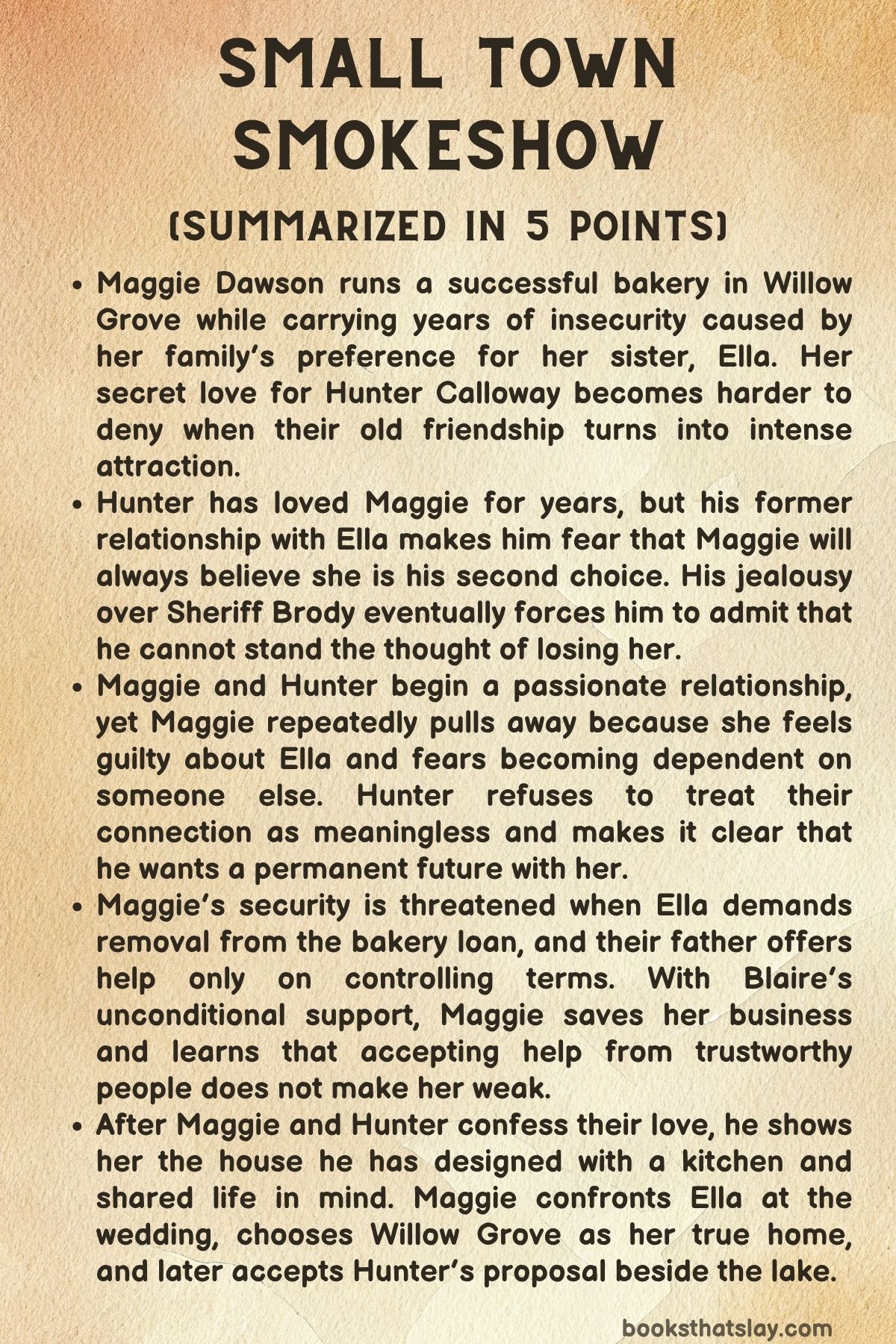
A year before the main story, Maggie Dawson visits Calloway Ranch to return a jacket and finds Hunter Calloway, her sister Ella’s former boyfriend and the man Maggie has secretly wanted for years. When her truck breaks down, Hunter repairs it and asks for a swim as payment, leading them to go skinny-dipping in the lake.
Their teasing turns serious when Hunter encourages Maggie to admit what she wants for herself, and she confesses that she wants him. They kiss and nearly go further, but Ella calls and unknowingly asks Maggie to tell Hunter she has been thinking about him, bringing Maggie’s guilt and Hunter’s hurt back between them.
In the present, Maggie runs Darlin’ Delights, the Willow Grove bakery she built through relentless work. Her best friend Blaire persuades her to take a night off, but Ella soon calls to announce that she is marrying Dean, the man with whom she cheated while dating Hunter, and expects Maggie to provide desserts for the engagement celebration and wedding.
Ella also urges Maggie to return permanently to Alabama, claiming that nothing remains for her in Tennessee. Maggie refuses because Willow Grove and the bakery are the first parts of her life that belong entirely to her, although the argument leaves her feeling guilty and uncertain.
Hunter spends his days working on the family ranch while pretending that Maggie does not occupy his thoughts. His brothers Colt and McCoy see through the denial, especially when Hunter reacts jealously to the suggestion that McCoy might ask her out.
At The Dusty Spur, Maggie sees Hunter with another woman and allows McCoy’s teasing attention and the arrival of Brody, Willow Grove’s new sheriff, to provoke him. Hunter sits close, touches her possessively, and insists on dancing with her while still claiming that they are only friends.
Maggie later overhears Hunter saying that her family has made her live in Ella’s shadow and assumes he sees her the same way. Hunter follows her outside, explains that he was condemning her family’s treatment, and tells her that she is far too fierce to be reduced to anyone’s shadow, but they stop short of kissing.
Hunter visits the bakery the next morning with breakfast and helps Maggie through a difficult cake order. He invites her to a Calloway lake day and Sunday dinner, and his mother, Louise, personally convinces Maggie to come.
At the lake, Hunter openly admires Maggie, calls her Sunshine, and becomes increasingly jealous when Brody gives her gentle, uncomplicated attention. Ruby, Hunter’s young niece, recognizes his feelings and asks whether he loves Maggie, but Hunter is not yet ready to say the word.
Brody asks Maggie to dinner, and she accepts because he seems safe, kind, and free from the painful history surrounding Hunter. During the date, Brody listens to her ambitions and explains that home can be built through chosen people, yet Maggie realizes that his calm warmth cannot replace the intensity she feels with Hunter.
At McCoy’s rodeo, Hunter sees Maggie standing beside Brody, but their eyes meet across the arena after McCoy’s successful bull ride. Later, Hunter pulls Maggie against him in front of everyone, and Blaire points out that Maggie describes Brody as merely nice while becoming visibly overwhelmed whenever Hunter looks at her.
Blaire arranges for Hunter to drive Maggie home, but Maggie angrily asks him to take her to Brody’s house instead. Their argument ends on the roadside, where Hunter admits he cannot stand seeing her with Brody, and years of restrained attraction erupt in a desperate kiss before Colt and Blaire accidentally interrupt them.
At Maggie’s apartment, she tries to dismiss the encounter as a mistake involving two friends with a complicated past. Hunter refuses to let her hide behind Ella’s name, and Maggie finally asks him to stay, choosing her own desire instead of allowing guilt to decide for her.
They sleep together, and Hunter makes it clear that Maggie is not a substitute for anyone. He remains the next morning, cooks breakfast, and asks her to tell him honestly whether she wants him gone, but Maggie admits that she wants him to stay.
Fear soon causes Maggie to withdraw and insist that their relationship remain simple. Hunter follows her during a bonfire, tells her that he has missed her, and refuses to be treated as disposable because he wants ordinary mornings, shared responsibilities, disagreements, and a complete life with her.
Maggie then travels to Alabama for Ella’s wedding preparations and discovers that the bedroom the sisters once shared has been remade entirely around Ella, while Maggie’s belongings have been boxed away. Ella reveals that she needs her name removed as guarantor from the bakery mortgage so she and Dean can buy a house, leaving Maggie only weeks to refinance.
Their father suggests that Maggie sell the bakery, share the money with Ella, or let him take control of the refinancing. His criticism reinforces the family belief that Ella is dependable while Maggie is reckless, so Maggie rejects his help and returns to Willow Grove determined to protect the business alone.
The bank tells Maggie that she lacks enough collateral and reliable cash flow to refinance by herself. She ends her growing connection with Brody because continuing would be unfair, then pushes Hunter away when he offers support because his kindness frightens her and reminds her of the control attached to her father’s assistance.
Hunter responds by returning to the unfinished house he began building on Calloway land. As he adds a large kitchen island, double ovens, and space for family life, he realizes that the house became meaningful only when he imagined Maggie living there.
During a group camping trip, Hunter refuses to accept Maggie’s claim that she is fine and offers to carry any part of her burden. Maggie finally tells Blaire and Sutton about the loan, and Blaire immediately offers inherited land as collateral, explaining that love is not a debt and family support does not require repayment through obedience.
That reassurance begins to change Maggie’s understanding of dependence. When she enters Hunter’s tent and reaches for him, he stops her because he will no longer accept physical closeness followed by emotional denial, forcing both of them to speak honestly.
Maggie admits that their relationship means everything to her and terrifies her for that reason. Hunter confesses that he has never loved anyone as deeply, and Maggie says that she has loved him for years, turning their secret connection into an acknowledged relationship.
Hunter later reveals that he wanted Maggie from the moment she arrived in Willow Grove and even told Ella, who claimed Maggie would never return his feelings before pursuing him herself. Maggie admits that Ella already knew she loved Hunter, proving that Maggie was never his second choice and that Ella knowingly stood between them.
Blaire’s land allows Maggie to refinance Darlin’ Delights without surrendering control to her father. Hunter then shows Maggie the unfinished lakeside house and the kitchen designed for her, offering a future that may include children but requires only the two of them choosing one another.
At Ella and Dean’s wedding, Maggie presents the documents removing Ella from the loan and refuses to accept her father’s criticism of Blaire’s help. Hunter appears without being asked because he will not let Maggie face her family alone, and Maggie crosses the lawn to kiss him.
Ella accuses Maggie of ruining the wedding and says she never belonged in their family home. Maggie accepts the truth beneath the insult, recognizing that Willow Grove, her friends, the Calloways, her bakery, and Hunter have become the home where she can live without making herself smaller.
One year later, Maggie and Hunter live in the completed house, while Darlin’ Delights thrives with enough staff for Maggie to rest. At the lake where they first admitted their desire, Hunter proposes with a pear-shaped diamond, and Maggie accepts because being chosen by him no longer requires surrendering any part of herself.
Characters
Maggie Dawson
At the center of Small Town Smokeshow, Maggie Dawson is a woman whose independence has been built as both an achievement and a defense. Darlin’ Delights proves her talent, discipline, and courage, but her refusal to pause or accept help also shows how deeply she believes that security must be earned through constant effort.
Maggie has spent years being treated as less dependable, less important, and less worthy than Ella. Her family’s favoritism has shaped her into someone who expects love to come with conditions, which is why Hunter’s devotion frightens her almost as much as she desires it.
Her central conflict is not simply whether she should date her sister’s former boyfriend. It is whether she can choose something for herself without immediately translating that choice into selfishness, betrayal, or debt.
Maggie’s attraction to Hunter exposes the parts of herself she has tried to control. Around him, she is bold, teasing, sensual, angry, vulnerable, and fully alive, yet she repeatedly retreats because she fears that losing him would confirm every insecurity she carries.
The bakery crisis forces Maggie to confront the difference between independence and isolation. By accepting Blaire’s collateral, Hunter’s emotional support, and the Calloways’ love, she learns that receiving help does not make her weak when the help is freely given and does not demand obedience in return.
Her development reaches completion when she faces Ella and refuses to shrink herself for the sake of family peace. Maggie does not gain strength because Hunter rescues her; she gains strength by believing that she deserves the life, work, friendships, and love she has chosen.
Hunter Calloway
Hunter Calloway is the romantic lead of Small Town Smokeshow, but his importance comes from more than his attraction to Maggie. He represents a form of love that is protective and committed, yet he must learn to express that commitment without hiding behind jealousy, silence, or possessive gestures.
Hunter has loved Maggie for years, even before his relationship with Ella. His decision to date Ella was partly an attempt to forget Maggie, but that choice created the very history that later made him afraid to pursue the person he truly wanted.
His greatest fear is that Maggie will see herself as a replacement. Because he understands how often her family has made her feel second best, he avoids acting on his love in the belief that restraint will protect her, although his silence eventually causes confusion and pain.
Hunter’s jealousy around Brody, McCoy, and any man near Maggie reveals both his emotional certainty and his immaturity. He knows what he wants long before he is willing to speak honestly, so his body language and behavior communicate claims that his words refuse to support.
As the story progresses, Hunter becomes more direct. He stops accepting a secret physical relationship, tells Maggie that he loves her, builds a home with her needs in mind, and travels to Alabama because he understands that partnership means showing up during the moments she most wants to face alone.
His unfinished house mirrors his emotional life. Hunter could construct walls, rooms, and a future, but he could not imagine the house as a home until he admitted that Maggie was the person he wanted inside it.
Ella Dawson
Ella Dawson functions as both Maggie’s sister and the embodiment of the family system that has diminished Maggie. She is accustomed to receiving attention, accommodation, and protection, which allows her to treat Maggie’s sacrifices as natural rather than generous.
Her betrayal operates on several levels. She knew about Maggie’s feelings for Hunter before pursuing him, later cheated on Hunter with Dean, and eventually endangered Maggie’s bakery by demanding removal from the loan without showing meaningful concern for the consequences.
Ella is not presented merely as a romantic rival, because Hunter no longer wants her. Her deeper role is to trigger Maggie’s guilt and expose how thoroughly Maggie has been trained to place Ella’s comfort above her own happiness.
Even Ella’s wedding request reflects entitlement. She expects Maggie to provide labor, emotional support, and compliance while offering little respect for the independent life Maggie has built.
When Ella claims Maggie never belonged in the family home, she intends to wound her. Instead, the statement helps Maggie recognize that belonging should not require permanent self-erasure, making Ella’s cruelty part of the moment when Maggie finally releases her need for family approval.
Blaire
Blaire is Maggie’s closest friend and one of the strongest examples of chosen family in the novel. She sees Maggie clearly, challenges her evasions, and refuses to let Maggie confuse exhaustion with strength.
Her humor and directness keep the story grounded, especially when she points out the obvious difference between Maggie’s mild appreciation for Brody and her intense reaction to Hunter. Blaire is willing to say what Maggie avoids, but her honesty is rooted in loyalty rather than judgment.
Her most important act is offering inherited land as collateral for the bakery. The financial help matters, but the greater significance lies in her explanation that love is not a transaction and that family support does not create a lifelong debt.
Blaire helps Maggie revise her understanding of dependence. She proves that accepting aid from someone trustworthy can strengthen a person’s freedom instead of reducing it.
Her presence also creates continuity between romance, friendship, and community. Maggie’s future becomes possible not through one relationship alone, but through a network of people who repeatedly choose her.
Brody
Brody is a decent, emotionally mature man whose role is not to become a villainous obstacle. He offers Maggie kindness, stability, and uncomplicated attention at a moment when Hunter’s mixed signals have left her exhausted.
His family history explains his protective nature. After losing his mother and growing up with an absent father, he became deeply responsible for Sutton, which gives him an understanding of loyalty, loss, and the need to create a new home.
Brody listens to Maggie’s ambitions and treats the bakery as a meaningful part of her identity. His observation that home can be formed through chosen people prepares Maggie to recognize what Willow Grove already represents in her life.
He also behaves with dignity when Maggie ends their possibility. Instead of punishing her for not returning his feelings, he tells her that she deserves happiness, confirming that his kindness is genuine rather than a strategy for winning her.
Brody’s calm compatibility helps clarify Maggie’s emotional truth. He may appear safer than Hunter, but safety without full desire cannot become an honest relationship, and Maggie’s decision to release him shows growing responsibility.
Sutton
Sutton begins as Maggie’s new employee, but she quickly becomes part of Maggie’s social and emotional support system. Her confidence, competence, and willingness to join the group help Darlin’ Delights feel less like a burden Maggie must carry alone.
As Brody’s sister, Sutton offers insight into his history and assures Maggie that he understands the rejection. She does not turn the situation into a conflict between women, which prevents the romantic tension from damaging Maggie’s workplace or friendships.
Sutton also participates in the camping conversation where Maggie reveals the bakery crisis. Her presence reinforces the idea that Maggie has built a community in Willow Grove even when she still feels emotionally homeless.
Her character demonstrates how new relationships can become meaningful quickly when they are based on respect and honesty. She is a practical reminder that Maggie’s life continues expanding beyond the limits set by her biological family.
Colt Calloway
Colt is one of Hunter’s brothers and an important source of emotional accountability. He understands Hunter well enough to recognize that his denial is false, and he refuses to let him pretend that jealousy is unrelated to love.
His conversation with Hunter at the unfinished house is especially important. Colt separates Hunter’s history with Ella from his love for Maggie and asks the direct questions Hunter has avoided answering.
By making Hunter admit that he never loved Ella and has loved Maggie for years, Colt removes the excuse that the situation is morally uncertain. He pushes Hunter to see that fear, rather than loyalty, has been controlling him.
Colt also serves as a warning and an example through his own relationship with Blaire. His presence shows Hunter that lasting love requires honesty, consistency, and the courage to stop hiding behind complicated history.
McCoy Calloway
McCoy brings humor, energy, and brotherly provocation to the story. His teasing often exposes Hunter’s jealousy, especially when he suggests asking Maggie out or behaves playfully affectionate toward her.
His rodeo career also reveals the closeness of the Calloway family. Hunter’s concern during the bull ride and relief afterward show that the brothers express love through jokes, practical support, and shared risk.
McCoy is not a serious romantic threat, but he becomes a useful mirror for Hunter. Hunter’s reactions to McCoy touching or flirting with Maggie reveal feelings that Hunter is still trying to deny.
His lighter presence balances the heavier family conflict surrounding Maggie. He helps make the Calloway world feel lively, affectionate, and emotionally safe.
Ruby
Ruby is Hunter’s young niece and one of the most perceptive characters in the book. She recognizes Hunter’s love for Maggie before he is ready to name it, simply by comparing his expression with the way her father looks at Blaire.
Her innocence allows her to speak truths that the adults avoid. Because she has no interest in protecting pride or managing complicated history, her observations cut directly through Hunter’s excuses.
Ruby also reveals Hunter’s tenderness. His willingness to release fishing worms, accept blame, and surrender to her wishes shows a patient and nurturing side that supports Maggie’s vision of him as a future partner and possible father.
Her comfort with Maggie suggests that Maggie already fits naturally within the Calloway family. Ruby’s affection helps transform the romance from private desire into a believable shared life.
Louise Calloway
Louise is the warm maternal presence Maggie has lacked. She welcomes Maggie into family gatherings without treating her as an outsider or measuring her against Ella.
Her invitation to Sunday dinner carries emotional weight because it gives Maggie access to a household where affection is ordinary rather than conditional. Maggie’s ease beside Louise in the kitchen allows Hunter to imagine a future that feels both domestic and emotionally secure.
Louise does not need to make dramatic speeches to influence Maggie. Her consistent acceptance helps establish the Calloway home as a place where Maggie can contribute without being exploited and belong without proving herself.
June Calloway
June is a blunt observer who refuses to indulge Hunter’s avoidance. She recognizes the connection between Hunter and Maggie and tells him to stop pretending that distance is noble.
Her directness represents the Calloway family’s broader attitude toward love. They may tease one another, but they also expect honesty and action when fear begins causing unnecessary harm.
June helps move the relationship into the open by naming what everyone already sees. Her role is small but useful because she adds pressure against secrecy and emotional cowardice.
Mr. Calloway
Hunter’s father represents stability, time, and the quiet awareness that his children must eventually build lives of their own. His questions about Hunter’s unfinished house suggest that he understands the project is emotionally stalled rather than practically difficult.
His worsening tremor reminds Hunter that family life changes and that waiting forever carries consequences. The detail adds urgency to Hunter’s desire to stop delaying the future he wants.
Mr. Calloway’s ranch also provides the physical foundation for Hunter and Maggie’s home. Through him, the story connects inherited land with a new generation’s chance to create something emotionally different upon it.
Maggie’s Father
Maggie’s father is the clearest source of her fear that help always becomes control. His history of alcoholism, infidelity, anger, and criticism has taught Maggie that dependence gives another person the power to define her.
When the bakery loan becomes unstable, he offers assistance only in forms that reduce Maggie’s authority. He suggests selling the business, sharing its value with Ella, or allowing him to manage the refinancing, all while repeating the belief that Maggie is irresponsible.
His behavior explains why Maggie initially rejects Blaire and Hunter’s support. She has learned to expect that every favor will later be used as evidence that she is incapable.
By refusing his terms and later accepting help from people who respect her choices, Maggie breaks the emotional pattern he created. His role is therefore less about direct change and more about showing the kind of conditional power Maggie must reject.
Maggie’s Mother
Maggie’s mother is less openly aggressive than her father, but her participation in the family’s favoritism still shapes Maggie’s pain. She helps maintain a household in which Ella’s needs, wedding, and belongings receive priority while Maggie’s place becomes increasingly invisible.
Her failure is largely one of protection and recognition. She does not adequately defend Maggie from her father’s criticism or challenge the assumption that Maggie should repeatedly accommodate Ella.
This quieter neglect matters because emotional harm is not created only through obvious cruelty. Maggie’s mother contributes to the system by allowing unequal treatment to appear normal.
Dean
Dean is Ella’s fiancé and the man with whom she cheated during her relationship with Hunter. His presence confirms that Ella’s romantic history with Hunter ended through betrayal rather than because Hunter failed to love her correctly.
Dean remains mostly outside Maggie’s emotional world, yet his plans with Ella create the immediate pressure on the bakery loan. Their desire to purchase a house becomes the reason Ella demands removal as guarantor, placing Maggie’s livelihood at risk.
He functions more as a catalyst than as a fully developed personality. Through him, the consequences of Ella’s self-interest reach into Maggie’s present life.
Mrs. Alden
Mrs. Alden is an exacting bakery customer whose elaborate demands highlight the pressure Maggie accepts in her professional life. Maggie’s determination to satisfy her shows both pride in her craft and an inability to set limits when overwork is damaging her.
Her attraction to Hunter also gives the story a humorous opportunity for Hunter to assist Maggie. The interaction shows how easily Hunter steps into Maggie’s daily world, even before they openly become a couple.
Betty
Betty, the restaurant server during Maggie’s date with Brody, adds humor and local familiarity to the evening. Her teasing about Maggie’s wild side and Brody’s handcuffs helps relax the date and reinforces Willow Grove’s close-knit atmosphere.
She also helps display the difference between how the community sees Maggie and how Maggie sees herself. Others recognize her boldness, while Maggie has spent years trying to contain it.
Themes
Choosing Yourself Without Becoming Selfish
Small Town Smokeshow repeatedly places Maggie in situations where personal desire feels morally dangerous. Loving Hunter, remaining in Tennessee, protecting the bakery, rejecting her father’s terms, and confronting Ella all require her to place her own needs above expectations that have governed her for years.
Maggie has been trained to believe that a good daughter and sister should accommodate Ella, preserve family peace, and accept criticism without resistance. Because of that training, even happiness feels suspicious, and she interprets the act of choosing herself as evidence that she is disloyal.
Her growth comes through recognizing that self-respect is not cruelty. She can refuse Ella’s demands, reject her father’s control, and still remain capable of love, generosity, and responsibility.
The romance makes this lesson physical and emotional. Hunter repeatedly asks Maggie to name what she wants, forcing her to speak from desire rather than guilt, but the final choice remains hers.
By the wedding, Maggie no longer seeks permission to belong elsewhere. She understands that protecting her work, love, and identity is not a betrayal of family; it is the refusal to continue betraying herself.
Love Without Debt or Control
Maggie’s deepest fear is not simply abandonment. She fears that every form of help will eventually become a claim upon her freedom, because her father has taught her that assistance can be used to prove incompetence and demand obedience.
This fear explains why she pushes Hunter away when he offers support and why she initially rejects Blaire’s land as collateral. The practical solutions are available, but accepting them requires Maggie to trust the motives of the people offering them.
Blaire changes Maggie’s understanding by describing support as an expression of family rather than a debt. She does not ask for control of the bakery, emotional repayment, or future compliance, and her generosity leaves Maggie more secure rather than less independent.
Hunter must also prove that his protectiveness is not ownership. His healthiest moments occur when he asks what Maggie wants, accepts her right to choose, and offers a shared future without making children, marriage, or dependence conditions of his love.
The story separates control from commitment. Love becomes safe when it strengthens Maggie’s authority over her own life, allowing her to receive care without surrendering her voice.
Home as Emotional Belonging
Alabama is Maggie’s birthplace, but it does not provide the emotional security normally associated with home. Her old bedroom has been reorganized around Ella, her possessions have been boxed away, and the family house is filled with memories of anger, favoritism, and pressure.
Willow Grove becomes home gradually through work, friendship, routine, and acceptance. Darlin’ Delights gives Maggie purpose, Blaire and Sutton give her community, the Calloways welcome her without comparison, and Hunter sees a future shaped around who she actually is.
Brody’s belief that home is created through chosen people introduces the idea clearly. Maggie initially misses the family life she wished she had, but she eventually understands that longing for an imagined home should not force her back into a harmful reality.
Hunter’s unfinished house gives the theme a physical form. It remains only a structure until he designs the kitchen for Maggie and imagines ordinary life with her inside it.
The lakeside house becomes meaningful because neither person must become smaller to live there. Home is finally defined as the place where Maggie can work, rest, argue, love, and belong without continually earning her right to stay.
Being Chosen Instead of Feeling Second Best
Maggie’s insecurity is rooted in repeated comparison with Ella. Her family treats Ella as responsible, central, and deserving of accommodation, while Maggie’s achievements are minimized and her space is easily removed.
Hunter’s history with Ella appears to confirm Maggie’s worst fear. Even though Hunter wants Maggie, she worries that dating him will make her the second sister he selected after the first relationship failed.
The revelation that Hunter wanted Maggie first changes the emotional meaning of the triangle. He dated Ella while trying to forget Maggie, and his later hesitation came from concern that Maggie would feel like a substitute, not from unresolved love for Ella.
Still, verbal reassurance alone is not enough. Hunter must consistently choose Maggie through his actions by rejecting secrecy, designing a future around her, attending the wedding, and standing beside her when her family attacks her belonging.
Maggie’s final security does not come from defeating Ella in a competition. It comes from rejecting the idea that sisters must compete for value at all and accepting relationships in which she is seen as a complete person rather than measured against someone else.