Snow Kissed Summary, Characters and Themes
Snow Kissed by RaeAnne Thayne is a tender contemporary romance set in the snowy town of Shelter Springs, Idaho. It follows florist Holly Moore, a hardworking single mother balancing her flower shop, motherhood, and the emotional weight of her past.
When a favor spirals into a white lie about having a boyfriend, Holly unexpectedly finds herself in a pretend relationship with Ryan Caldwell—a Navy pilot temporarily in town caring for his niece. As the holiday season unfolds, the two navigate family struggles, second chances, and the possibility of love when least expected. Warm, reflective, and filled with seasonal charm, the story celebrates healing and rediscovering joy. It’s the 3rd book in the Shelter Springs series.
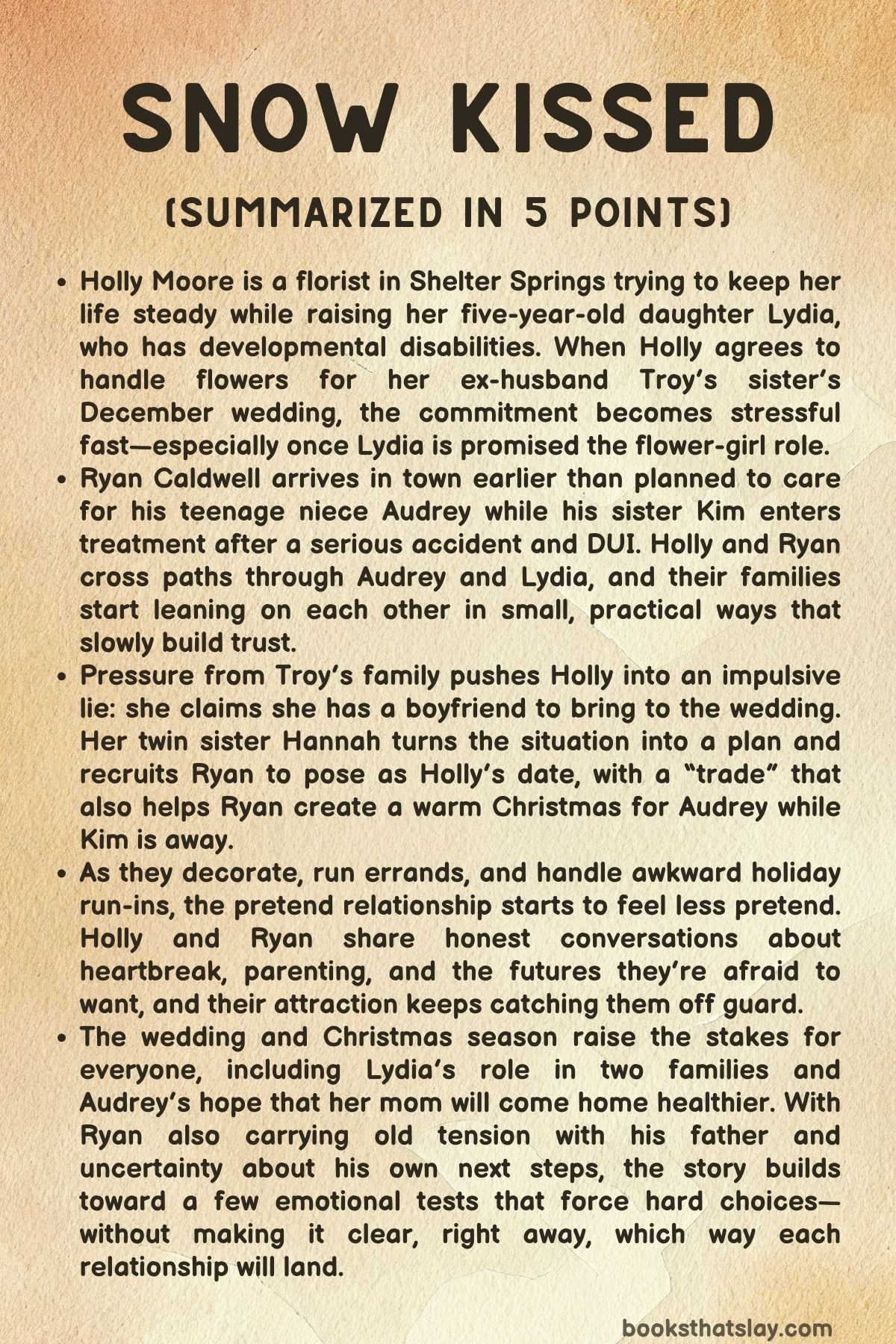
Summary
Holly Moore, a florist in Shelter Springs, Idaho, leads a busy life running her flower shop, Evergreen & Ivy, while raising her five-year-old daughter, Lydia, who has developmental challenges. December is her busiest season, yet she agrees to design flowers for her ex-husband Troy’s sister Kristine’s wedding.
Though it adds pressure, Holly feels obligated—especially since Kristine has asked Lydia to be the flower girl. Holly’s twin sister, Hannah, often reminds her to stop overextending herself, but Holly struggles to say no.
While arranging flowers one afternoon, Holly meets Ryan Caldwell, a visiting Navy pilot who has come to town early to care for his teenage niece, Audrey. Ryan’s sister, Kim—Holly’s employee and friend—is in rehab after an accident caused by her addiction to painkillers and alcohol.
Ryan plans to stay temporarily while Kim recovers, though he’s nursing an injured leg from a helicopter crash. Despite the awkward first meeting, Holly and Ryan quickly find themselves crossing paths as their families connect through work and friendship.
Holly juggles her business, her responsibilities as a mother, and the social expectations of her ex-husband’s family. Kristine’s wedding looms, and when Kristine teasingly suggests that Holly find a date for the event, Holly impulsively lies—claiming she already has a boyfriend.
The fib spirals out of control when Hannah learns about it and insists on helping her sister maintain the charade. After rejecting several unsuitable candidates, Hannah suggests Ryan as the perfect stand-in: handsome, single, and temporary.
Initially mortified, Holly resists, but the idea lingers.
Meanwhile, Ryan tries to create a sense of stability for Audrey. His niece misses her mother deeply and clings to holiday traditions.
One afternoon at the grocery store, Ryan meets Hannah, who cleverly convinces him to play along with Holly’s fake-boyfriend story. Amused and sympathetic, Ryan agrees, partly for Audrey’s sake and partly because he feels drawn to Holly’s kindness and quiet strength.
When Ryan visits Holly to finalize their “arrangement,” she’s embarrassed but eventually agrees to the plan, on the condition that they help each other. Ryan will attend the wedding with her, pretending to be her boyfriend, and she will help him make Christmas special for Audrey.
Their partnership begins with mutual humor but quickly grows more personal as they spend time together decorating Kim’s house and preparing for the holidays. Working side by side, they share pieces of their past—Holly’s painful divorce and Ryan’s fractured relationship with his father, Colonel Douglas Caldwell.
Through these small moments, affection blooms naturally between them, though both are cautious about acknowledging it.
When Kristine’s bridal shower arrives, gossip about Holly’s “new romance” spreads quickly. Holly endures playful teasing from her ex-husband’s family, all of whom are thrilled that she seems to have moved on.
After the event, she runs into Ryan and Audrey at the town’s Christmas light display. The evening feels magical as Lydia laughs under the twinkling lights, and Ryan’s warmth with the child softens Holly’s heart.
As they walk through the park, Ryan opens up about his childhood—the loss of his mother, the emotional distance from his father, and his years at military school. Moved by his honesty, Holly offers comfort, and under softly falling snow, they share a tender kiss.
Though Ryan later downplays it as “practice” for their upcoming role, both are deeply affected.
As Christmas approaches, their pretend relationship begins to feel increasingly real. Ryan helps Holly prepare for Kristine’s wedding, delivering flowers and offering quiet support.
Holly’s ex-husband’s family continues to treat Ryan as her genuine partner, and he plays the part effortlessly—attentive, kind, and protective. During the wedding reception, he dances with both Holly and Lydia, making them feel cherished.
Yet beneath the joy, both know that Ryan’s time in Shelter Springs is temporary. He intends to return to San Diego and resume his military career once Kim is home and recovered.
After the wedding, the growing tension between desire and duty weighs on them. A passionate kiss after the celebration nearly deepens into something more before Lydia interrupts, reminding them of the responsibilities and realities separating them.
Both withdraw emotionally, trying to convince themselves that the relationship was only an arrangement.
When Kim finally completes rehab and returns home, the Caldwell family gathers for an emotional reunion. Kim’s recovery brings forgiveness and healing to old family wounds—especially between Ryan and his father, who expresses remorse for his past coldness.
Witnessing this reconciliation stirs Ryan deeply, and he begins to question his own avoidance of love and permanence. Meanwhile, Holly wrestles with her feelings for him.
Though she tells herself he will leave soon, she can’t ignore the ache of missing him.
On Christmas Eve, Holly faces another heartbreak when Lydia spends the night with Troy and his new wife. The quiet house feels unbearably empty until Ryan appears at her door, bringing gifts and comfort.
Their conversation is interrupted by a panicked call from Brittany—Lydia is missing from the Christmas party. Terrified, Holly races out with Ryan, who instinctively drives to Spruce Creek Park, believing Lydia might have gone there to see the lights.
They find her safe but cold beneath the glowing Christmas tree. Holly’s relief turns to tears as she thanks Ryan for trusting his instincts and saving her daughter.
The night ends back at Holly’s home, where gratitude and love overcome hesitation. Ryan confesses his feelings, admitting that he’s fallen in love with her and Lydia.
Holly, realizing she feels the same, tells him she doesn’t want him to go. They kiss again, this time with the promise of a future.
Though their paths seemed temporary, they’ve found a lasting connection in each other.
In the epilogue, a year later, Holly and Ryan are married and celebrating Christmas with their blended family—Kim, Audrey, Doug, Diane, and little Lydia—at the Caldwells’ lakeside home. Ryan has left the Navy and now works flying rescue helicopters in Idaho, embracing the peaceful life he once resisted.
Holly’s shop continues to thrive, and her home is filled with laughter, light, and love. Surrounded by family and snow, she reflects on the journey that began with a lie but led to everything she ever wanted: a second chance, a safe home for her daughter, and a love that feels like Christmas itself.
Characters
Holly Moore
Holly is the emotional anchor of Snow Kissed—a capable, warm-hearted florist whose greatest strength (saying yes, keeping peace, taking care of others) is also the habit that exhausts her. She runs Evergreen & Ivy with a steady, professional hand, but privately she’s stretched thin by single parenting, the pressure of the holiday rush, and the complicated social politics of staying connected to her ex-husband’s family for Lydia’s sake.
Holly’s inner conflict isn’t just romantic; it’s about identity after betrayal—learning to trust her own needs again instead of performing “fine” for everyone else. Her compassion shows up in practical ways: feeding people, making space at her table, and using her work—flowers, celebrations, rituals—to bring comfort and dignity to others.
Over the story, she shifts from reactive survival (managing crises and expectations) into active choice, allowing herself joy, desire, and partnership without shame. Even her “fake boyfriend” lie becomes a turning point, because it forces her to confront how much she’s been shaped by other people’s narratives of her life—and how ready she is to write a new one.
Ryan Caldwell
Ryan enters Snow Kissed as someone defined by discipline and distance: a Navy pilot with an injured knee, a temporary desk-bound life, and a strong instinct to keep emotions compartmentalized. He’s competent and protective, but wary of attachment, because closeness has historically meant loss or disappointment—first through his mother’s death, then through a childhood shaped by grief, neglect, and being sent away.
Caring for Audrey pulls Ryan out of his usual controlled orbit and into ordinary intimacy: grocery lists, Christmas lights, bedtime routines, and the quiet awareness that he actually wants the home-life he’s always told himself he can’t have. His relationship with Holly becomes the mirror that reflects his deeper longing; what begins as a “deal” becomes a slow rehumanizing, where he experiences belonging without conditions.
Ryan’s arc is as much about reconciliation as romance—especially with his father—because he can’t fully choose a future with Holly until he stops living as the kid who was abandoned emotionally. By the end, Ryan’s decision to build a life in Shelter Springs is a statement of growth: he isn’t trapped by love or family; he’s finally choosing them.
Lydia Moore
Lydia is the heart-bright center of Snow Kissed, not as a symbol, but as a fully present child whose needs shape the emotional stakes of every adult decision. She is enthusiastic, affectionate, and open, with a sweetness that draws people in—especially Ryan, who responds to her with instinctive gentleness.
Lydia’s developmental disability is treated in the story as part of her reality rather than her entire identity; what matters most is how the adults around her either honor her excitement and dignity or use her as a reason to control outcomes. Her role as flower girl isn’t trivial—it represents belonging and pride, and Holly’s inability to back out reflects how fiercely she protects Lydia’s happiness.
When Lydia goes missing, the story reveals the deepest truth of Holly’s life: her greatest fear is not being judged, or being single, or being embarrassed—it’s losing her child. Lydia also functions as a kind of emotional truth-teller; she responds to warmth, sincerity, and safety, which makes her a quiet measure of character in others.
Hannah Moore
Hannah is Holly’s twin, but narratively she’s her counterweight: where Holly overfunctions and absorbs pressure, Hannah names the pattern and pushes for change. She’s blunt, lively, and a little delighted by romantic chaos, which is why she labels the situation as a “fake relationship trope” and treats it like a solvable problem.
Yet beneath the humor is real protectiveness—Hannah doesn’t just want Holly to have a date; she wants Holly to stop shrinking herself in a room full of people who view her through pity or nostalgia. Hannah’s meddling is not always gentle, but it’s motivated by loyalty and a belief that her sister deserves pleasure and pride, not just endurance.
She also acts as the bridge that brings Ryan into Holly’s orbit, making her a catalyst for the entire romance. Importantly, Hannah represents family as support rather than obligation—the kind of love that challenges you, not the kind that drains you.
Audrey Caldwell
Audrey is a thirteen-year-old navigating a frightening instability: her mother in rehab, her home suddenly cold and quiet, and a life that has to keep moving while her heart is stuck in worry. She’s capable and helpful—watching Lydia, pitching in around the shop—but underneath that competence is the vulnerability of a kid who’s been forced to grow up too fast.
Audrey’s bond with Ryan is one of the story’s most tender dynamics because it’s built on his choice to show up for her emotionally, not just practically. She misses her mother fiercely and tries to cope by focusing on things she can control—decorations, plans, small rituals that make the house feel alive again.
Audrey also becomes a moral voice in the romance: she recognizes Holly’s kindness and advocates for her, which matters because it reframes Holly not as “a woman who needs saving” but as someone who has already been saving others. Her storyline keeps the book grounded in the reality that love is not only about chemistry; it’s also about care, consistency, and repair.
Kim Caldwell
Kim is the character who embodies accountability in Snow Kissed—not the dramatic kind, but the slow, hard, daily kind. Her addiction, the accident, and the DUI arrest position her as someone who has caused harm, but the narrative emphasizes her willingness to face consequences and rebuild rather than excuse or deny.
Kim’s choice to enter treatment is both a legal strategy and an emotional awakening: she recognizes she can’t parent Audrey, or be part of her own life, without getting well. When she returns home, her overwhelm at the decorated house shows how deeply she feels what she almost lost—her child, her family, her chance to become someone steady.
Kim’s arc is also about receiving forgiveness without using it as a shortcut; Diane’s grace doesn’t erase Kim’s responsibility, but it gives her something to live up to. In many ways, Kim’s recovery runs parallel to Ryan’s emotional healing: both siblings learn that strength isn’t isolation—it’s letting people in and doing the work.
Troy
Troy is the embodiment of the kind of hurt that doesn’t always look cruel on the surface: charming, socially smooth, and capable of polite co-parenting, yet deeply self-centered in the ways that matter. His betrayal (leaving Holly for another woman) is the wound that shaped Holly’s guardedness, but his ongoing presence continues to complicate her life because he remains connected through Lydia and his family.
Troy’s “careless charm” reads as a form of emotional irresponsibility—he expects things to stay pleasant and functional, even when his choices created the fracture. The missing-child incident exposes the cost of that trait: not malice, but inattention and entitlement to being forgiven.
Yet the story also allows him a slice of humanity—he apologizes, he wants Lydia in his life—which keeps him from becoming a cartoon villain. Ultimately, Troy functions as contrast: against Ryan’s steady presence, Troy represents the difference between being around and truly showing up.
Brittany
Brittany is not written as a pure antagonist; she’s a new wife and new mother trying to fit into an already complicated system where her existence is painful to someone else. Her tone-deaf comments and attempts at friendliness highlight the awkwardness of blended families: she may not intend harm, but she doesn’t fully understand the emotional terrain she’s walking on.
Brittany also reflects a specific kind of social blindness—assuming the past is “over” because the divorce is finalized, and underestimating how ongoing co-parenting keeps old wounds close. When Lydia goes missing at the Christmas gathering, Brittany’s panic shows that she does care, but it also underscores how fragile the structure is when responsibility is diffuse and adults assume someone else is watching.
Brittany’s role is important because she complicates the story’s emotional morality: she is part of Holly’s pain, but she is also part of Lydia’s extended family reality, and Holly’s growth includes learning how to navigate that reality without losing herself.
Kristine
Kristine is the pressure-cooker catalyst of Snow Kissed: her December wedding forces Holly into visibility, labor, and proximity to her ex-husband’s orbit at the exact time Holly wants to stay small. Kristine isn’t malicious; she’s enthusiastic, wedding-focused, and sometimes oblivious to the emotional weight she puts on Holly—especially when she promises Lydia the flower-girl role and buys the dress before Holly can comfortably say no.
Her attempts to set Holly up on dates come from a mix of affection and social appetite for a “happy ending,” but they also unintentionally infantilize Holly, treating her as a project to be fixed rather than an adult managing a complex life. Kristine represents the well-meaning person who doesn’t realize that pushing optimism can still be pressure.
At the same time, her warmth toward Lydia and her desire for family harmony give Holly a reason to keep engaging, even when it costs her.
Susan
Susan, Holly’s former mother-in-law, embodies tradition, control, and the subtle power dynamics of “family” after divorce. She drops by, critiques details, and brings superstitions into practical planning, signaling that she’s accustomed to being deferred to.
Her involvement is not just about flowers; it’s about maintaining her role as a matriarch in a family that has changed. Susan also participates in the social narrative that Holly should “move on” in a way that is convenient and reassuring to the family—hence the delight over Holly’s supposed new relationship.
While she can be exhausting, Susan’s presence raises the emotional stakes: Holly isn’t simply doing a job; she’s trying to protect Lydia’s place in that extended family. Susan’s character highlights why Holly struggles to set boundaries—because boundaries can be misread as rejection, and Holly fears the fallout will land on Lydia.
Colonel Douglas “Doug” Caldwell
Doug is the story’s portrait of a parent whose grief calcified into distance. As Ryan’s father, he carries authority, tradition, and a practical mindset—offering work at Caldwell Aviation, solving problems with logistics—yet he has a long history of emotional absence.
His past decision to send his children away after their mother’s death becomes the core injury Ryan has carried into adulthood, shaping his resistance to home and intimacy. Doug’s arc is one of late self-awareness: he begins to acknowledge harm, express regret, and attempt repair without demanding instant forgiveness.
Importantly, the story doesn’t treat his apology as a magic eraser; reconciliation is portrayed as fragile and earned, helped along by the family’s willingness to try again. Doug represents a theme central to Snow Kissed: people can change, but only when they stop protecting their pride more than their relationships.
Diane Caldwell
Diane functions as the quiet moral center of the Caldwell family, especially in the aftermath of the accident. Injured and in pain, she still chooses warmth—welcoming Ryan, caring for Audrey emotionally, and offering Kim forgiveness that could have easily been withheld.
Her forgiveness is powerful because it isn’t naive; she was directly harmed, yet she understands that healing the family requires both accountability and grace. Diane’s presence also softens the father-son conflict; she is a bridge figure who makes reconciliation possible by creating a home environment that feels safe rather than punitive.
She represents resilience and generosity, showing that strength can look like gentleness even when you’re suffering.
Ginger
Ginger is a small but meaningful character because she represents levity and community in Holly’s world. Her “hot dad” note on the order form injects humor into a stressful season and hints at the shop’s atmosphere—busy, human, and full of little moments that keep Holly from drowning in responsibility.
Ginger also highlights Holly’s role as a leader: Holly has to manage both the emotional labor of her personal life and the practical demands of a business with employees, clients, and holiday deadlines. Even brief, Ginger helps define the texture of Holly’s daily life and emphasizes that Holly is constantly juggling.
Austin Harris
Austin’s appearance is brief, but he provides an early contrast that reinforces the story’s themes of family and misinterpretation. He is genuinely thrilled about his newborn, openly joyful and uncomplicated in his role, which momentarily places Holly inside a scene of intact, celebratory family life.
That contrast quietly underlines what Holly has lost and what she longs for, even if she won’t admit it yet. He also serves a plot function in the mistaken-identity moment that brings Ryan into Holly’s orbit, but as a character he represents the uncomplicated warmth of domestic happiness—something both Holly and Ryan circle throughout the book.
Hudson
Hudson, Troy and Brittany’s baby, doesn’t have agency in the way the adult characters do, but his existence changes the emotional geometry of the story. He symbolizes the new life Troy has built, which is partly why Holly’s composure takes so much effort; she is forced to witness the forward motion of a relationship that ended her own.
Hudson also complicates Lydia’s world in a realistic way: he is her half brother, part of her family whether Holly likes the circumstances or not. His presence amplifies the book’s theme that families are messy, interconnected systems, and healing often means learning how to live inside that complexity with dignity.
Themes
Emotional Labor, People-Pleasing, and the Cost of Always Being “Fine”
Holly’s daily life is built around saying yes until there is no space left for her own needs. Running Snow Kissed’s florist shop during the busiest season would already demand strict boundaries, but Holly keeps accepting extra obligations—especially those tied to her ex-husband’s family—because refusal feels like a moral failure rather than a practical decision.
That reflex is not presented as simple weakness; it is tied to her identity as a mother raising Lydia, a woman trying to remain steady after divorce, and a community member whose reputation and livelihood depend on being dependable. The wedding flowers become more than a professional assignment: they are a test of whether Holly can maintain peace with people who still have emotional access to her.
Even the smallest moments reveal how quickly responsibility piles up—childcare, homework help, cooking dinner, customer orders, and last-minute wedding “adjustments” from people who assume her flexibility is endless. This creates a quiet but persistent tension: Holly’s kindness is real, yet it is exploited by expectation, tradition, and guilt.
The theme sharpens through how Holly responds to pressure. She does not erupt; she absorbs.
She smooths over awkward comments, absorbs micro-judgments about her parenting, and continues managing other people’s comfort while her own discomfort is treated as an afterthought. The story shows how people-pleasing often disguises itself as maturity.
Holly’s calm is praised, but it also isolates her because it discourages others from recognizing she is overwhelmed. The presence of Hannah is crucial here: Hannah acts like an outside voice calling attention to a pattern that has become normal for Holly.
What looks like competence is also self-erasure. By the time Holly lies about having a boyfriend, it is not a sudden personality shift; it is the moment her coping system breaks into improvisation because honest vulnerability feels too risky.
The emotional labor theme ultimately becomes a lesson about survival: Holly learns that love and responsibility do not require self-sacrifice as the default setting, and that protecting her daughter includes protecting herself from being constantly managed by others’ expectations.
Parenthood Under Pressure and Protecting a Child’s Joy
Motherhood in Snow Kissed is not shown as sentimental perfection; it is practical, exhausting, and filled with decisions that have no clean outcome. Holly’s relationship with Lydia brings constant reminders that parenting includes logistics, advocacy, emotional reassurance, and the steady work of building a child’s confidence—especially when that child has developmental disabilities.
Lydia’s excitement about being a flower girl is not treated as a cute subplot; it becomes a moral anchor that shapes Holly’s choices. Holly’s reluctance to back out of the wedding flowers is partly business and partly social, but it is also about not taking away something Lydia has already claimed as her own.
The red velvet dress and the role in the ceremony represent belonging and pride. Holly protects that pride even when she is overwhelmed, because she knows how easily the world can make a child feel “other.”
The story also highlights the emotional complexity of co-parenting after divorce. Holly is not simply angry at Troy; she is managing a long tail of consequences from his choices while trying to keep Lydia’s experience of family as stable as possible.
When Troy’s new wife and baby enter the picture, Holly must regulate her reactions in real time, balancing her own hurt with the need to keep interactions safe and calm for Lydia. The narrative shows how “being the bigger person” is often demanded of the parent who stayed, while the parent who left can still claim the easy role of holiday fun.
Holly’s decision-making around Christmas Eve is especially painful because it forces her to accept that love sometimes looks like absence—letting Lydia go to her father even when it breaks her heart. The story treats that choice as courage, not weakness.
Lydia’s temporary disappearance intensifies this theme into something raw. The crisis exposes how fragile safety can feel for a parent who is already carrying too much.
Holly’s panic is not melodrama; it is the result of a life spent anticipating risk and trying to prevent disappointment. The resolution matters because it shows parenting as communal when it is done well.
Ryan’s instinct to search the park, the family’s collective relief, and the way joy returns through simple rituals like caroling all reinforce that protecting a child is not only a mother’s solitary job. The theme ultimately argues that a child’s happiness is not maintained by a perfect parent, but by an honest network of adults who learn to show up consistently and treat the child’s feelings as real and worthy.
Recovery, Accountability, and the Work of Repairing Trust
Kim’s addiction storyline gives Snow Kissed emotional weight beyond romance by presenting recovery as both personal and relational. The accident and DUI are not minimized, and Kim’s decision to enter treatment is framed as a turning point that requires humility, accountability, and stamina.
The story does not treat rehab as a magical reset; it shows that the real difficulty begins when Kim returns home and must live inside the consequences. She has to face her daughter’s pain, her family’s fear, and the burden of knowing she hurt Diane.
That tension makes forgiveness feel earned rather than convenient. When Diane forgives Kim despite her own injuries, the moment carries power because it is not about excusing harm—it is about choosing a future where healing is possible without pretending the past was harmless.
Audrey’s role reinforces how addiction affects families in layered ways. She is not simply “the kid who misses her mom.” She is forced into early emotional maturity, learning how to look okay while feeling abandoned, and relying on adults outside her immediate household for stability.
Ryan’s sudden guardianship is a direct result of Kim’s crisis, showing how addiction redistributes responsibility. Ryan is not prepared for school schedules, grocery decisions, and the emotional care a teenager needs.
That struggle makes the recovery theme broader: it is not only Kim rebuilding her life; it is everyone around her relearning how to function without the old patterns.
The narrative also emphasizes that accountability and love can coexist. Kim is allowed to be hopeful—about returning to work, studying nursing, and earning back trust—without the story pretending redemption is automatic.
The warmth of the decorated house matters because it symbolizes a new environment created through community effort, not denial. By welcoming Kim home with visible care rather than silent punishment, the people around her communicate that recovery is recognized and supported, but not taken lightly.
The theme ultimately suggests that repair happens through repeated actions: showing up, telling the truth, accepting help, and staying present even when shame tries to push someone back into hiding.
Grief, Emotional Neglect, and the Long Shadow of Family History
Ryan’s conflict with his father, Doug, shows how old wounds keep shaping adult behavior long after the original events are over. Ryan’s childhood is marked by loss—his mother’s death—and the emotional absence that followed.
Doug’s grief becomes a kind of abandonment because it leaves Ryan and Kim without the warmth, guidance, and reassurance children need. Sending them away to strict schools may have been intended as structure, but it reads to Ryan as rejection.
The story captures how grief can damage a family not only through sadness, but through silence. Ryan’s adult life as a Navy pilot reflects a pattern: he chooses a world built on mission, discipline, and distance.
That lifestyle provides purpose and control, but it also protects him from the vulnerability of attachment. If he is always leaving, he never has to risk being left.
The theme deepens because Doug is not treated as a villain. His later attempts to help—offering work, apologizing, acknowledging mistakes—show that people can be harmful without being malicious.
Doug’s explanation that he was broken and scared after his wife’s death reframes the past without erasing Ryan’s pain. This is important because it mirrors real family dynamics: understanding why someone failed you does not immediately remove the impact.
Ryan’s anger is shown as logical, even protective. It has helped him survive, but it now limits him because it encourages distrust and emotional isolation.
Holly’s presence becomes a catalyst for a different approach to pain. She listens without trying to fix everything, and she challenges Ryan to consider that change is possible.
Her compassion does not force reconciliation, but it creates a space where Ryan can imagine it. The eventual confrontation and apology between father and son demonstrate that reconciliation is not about pretending the past was fine; it is about naming what happened and choosing to build something better anyway.
This theme supports the broader emotional arc of the story: family history can explain present fear, but it does not have to dictate the future. Healing becomes an active decision, made through honest conversation and a willingness to risk closeness again.
The “Fake Relationship” as a Mirror for Shame, Pride, and the Desire to Be Seen
The pretend-boyfriend setup in Snow Kissed is not just a romantic device; it exposes how shame and pride can trap someone into performing happiness. Holly lies because she feels cornered by pity and by the uncomfortable sense that her life is being evaluated through her divorce.
The lie is defensive, but it also reveals a hunger to be seen differently—to be viewed as chosen, valued, and moving forward. The social setting matters: small-town networks and family gossip amplify every detail, turning Holly’s personal life into a topic others feel entitled to manage.
When Kristine and Susan pressure her about dating, it is not concern; it is control disguised as friendliness. The fake relationship becomes Holly’s attempt to reclaim narrative power in an environment where her story keeps being rewritten by others.
Ryan’s agreement to participate also reflects his emotional state. He presents it as a practical deal, but the arrangement gives him a structured way to be close to Holly without admitting he wants closeness.
“Pretend” provides cover for real affection. Both characters use the act as armor: Holly avoids humiliation, and Ryan avoids vulnerability.
Yet the story repeatedly shows how performance can become truth when actions carry genuine care. Ryan shows up at events, supports Holly in tense interactions, connects with Lydia, and becomes part of everyday moments that matter more than public appearances.
Holly, in return, helps Ryan and Audrey build a Christmas that feels safe, proving that intimacy is built through ordinary effort, not dramatic declarations.
The theme also critiques how romance is often judged externally. Holly’s value is treated as higher when she is “with someone,” and the family’s excitement about her dating highlights how singlehood is framed as a problem to be solved.
The fake relationship forces Holly to confront how much she has internalized that framing. She is embarrassed not only by the lie, but by the fact that she wanted the fantasy to be true.
Over time, the pretense pushes both Holly and Ryan to reveal their real selves—fearful, hopeful, protective, and longing for belonging. The theme resolves when they stop hiding behind the arrangement and admit love directly, showing that being seen requires honesty, not performance.
Community as Support System and the Quiet Power of Chosen Family
A steady warmth runs through Snow Kissed in the way people step in for one another without turning help into spectacle. Hannah’s involvement is playful, but it is also deeply practical: she helps with workload, childcare, and emotional reality checks.
Holly’s florist shop is not just a workplace; it is a community hub where stress, humor, and connection collide. Even small interactions—employees teasing, customers placing orders, neighbors appearing with food—build a sense that people’s lives are braided together through daily routines.
This matters because both Holly and Ryan carry burdens that could isolate them. The story argues that isolation is not strength; it is often just a lack of support disguised as independence.
The theme becomes especially clear through Audrey’s situation. Kim’s absence could have left Audrey stranded emotionally, but multiple adults step into the gap.
Holly offers stability and kindness without trying to replace Kim. Ryan tries to learn how to be present despite discomfort.
Doug and Diane, even with their own strained relationships, show up during Kim’s return. The holiday potlucks, shared dinners, decorating sessions, and small-town gatherings are not mere seasonal atmosphere; they function as emotional scaffolding.
These spaces allow characters to borrow hope from one another when their own reserves are low.
Community support also carries tension, because closeness comes with scrutiny. Gossip travels fast, and boundaries are harder to maintain.
The same network that offers casseroles and childcare also spreads Holly’s dating lie like entertainment. This duality makes the theme more realistic: community can heal and pressure at the same time.
What makes it ultimately positive is the presence of people who use closeness to care rather than control—Hannah’s protective honesty, Holly’s generosity toward Audrey and Kim, and Ryan’s steady help during crisis. The ending, with a blended family celebrating together, shows community not as a perfect system but as a practice: people choosing to keep showing up, forgiving, and building new traditions that include everyone.