So Not Meant to Be Summary, Characters and Themes
So Not Meant to Be by Meghan Quinn is a steamy, laugh-out-loud contemporary romance and the second book in the Cane Brothers series.
It delivers an enemies-to-lovers (or more accurately, annoyed colleagues-to-forced-proximity-to-lovers) story packed with witty banter, childish antics, sizzling chemistry, and heartfelt vulnerability.
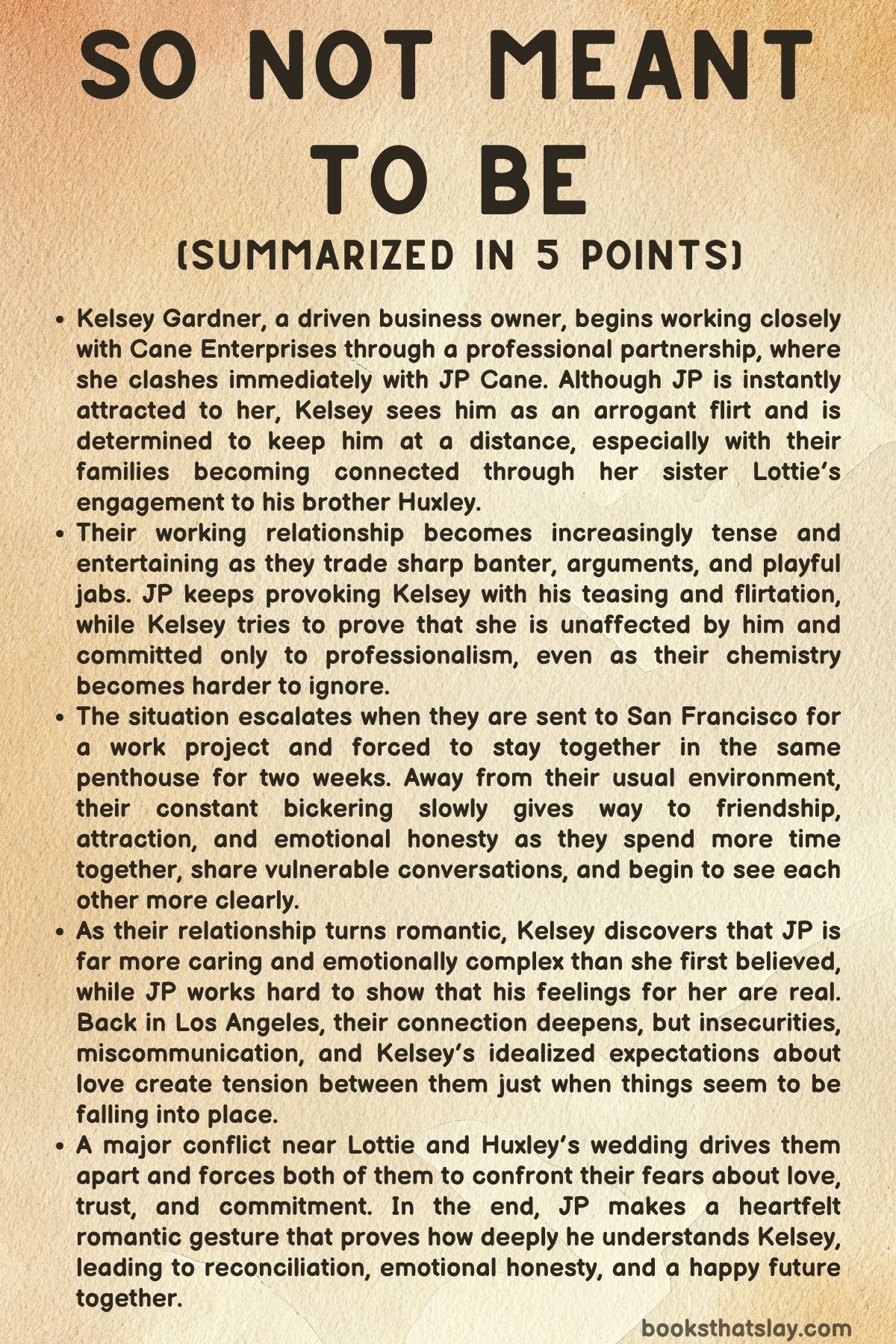
Summary
The novel centers on Kelsey Gardner and JP Cane. Kelsey runs a sustainable organizing and consulting business.
Her company partners with Cane Enterprises, the real estate development firm owned by the three Cane brothers: Huxley, JP, and Breaker. Kelsey is the younger sister of Lottie, who is engaged to Huxley Cane (from the previous book, A Not So Meet Cute).
This family connection adds extra layers of complication and familiarity to the dynamic.
From the moment Kelsey pitches her business in the Cane boardroom, JP is instantly smitten. He finds her intelligent, driven, and attractive.
However, Kelsey views JP as a cocky, playboy-type executive who thrives on flirting and refuses to take things seriously. She is determined to keep their relationship strictly professional, especially since their families are about to intertwine through Lottie and Huxley’s wedding.
Kelsey wants the Canes to respect her as a capable businesswoman, not as someone mixing business with pleasure.
Their interactions are defined by sharp, sarcastic banter. JP frequently references the movie When Harry Met Sally, insisting that men and women cannot work closely together without underlying sexual tension or attraction.
Kelsey vehemently disagrees and works hard to prove him wrong, often treating him with irritation and dismissal. JP, hurt by her rejection and using his “jerk” persona as a defense mechanism, responds by poking her buttons, acting obnoxiously, and flirting shamelessly.
Beneath his loud, shirtless, protein-bar-eating exterior lies a man still grieving the loss of his father and struggling with emotional vulnerability.
The turning point comes when Huxley assigns JP and Kelsey to travel together to San Francisco for an important work project. They must evaluate and plan the redevelopment of a historic building.
To make matters worse (or better), they are forced to share a luxurious penthouse for two full weeks. Living and working in such close quarters—sharing the same air, kitchen, and limited space—ignites the already high sexual tension.
What starts as bickering and awkward avoidance quickly evolves. They engage in hilarious, sometimes juvenile antics: accidental de-pantsing incidents, playful physical fights that blur into charged moments, loud Meg Ryan-style moaning over food (with JP famously declaring “I’ll have what he’s having”), and endless teasing.
Amid the humor, deeper conversations emerge. They explore San Francisco together, bond over small shared experiences, and gradually reveal their insecurities.
Kelsey, a hopeless romantic who hosts the “Meant to Be” podcast (where she interviews couples about their love stories), idealizes grand, movie-like romance. She fears settling or being seen as less than perfect.
JP, who appears commitment-phobic, actually longs for something real but hides behind sarcasm because he fears loss and rejection.
During the penthouse stay, their relationship shifts from enemies to tentative friends to undeniable lovers. The forced proximity allows Kelsey to see JP’s softer, caring side—he is passionate about helping people and animals, shows thoughtfulness in quiet ways, and proves he can be protective and supportive.
JP falls hard and works to show Kelsey he is not the player she assumes. The steam level rises significantly as their banter turns physical, with plenty of spicy, well-written scenes balanced by emotional intimacy.
Back in Los Angeles after the trip, the lines between professional and personal blur further. Their families notice the change, and the connection deepens.
JP makes genuine efforts to win Kelsey over, including sweet gestures and attempts to prove his seriousness. Kelsey begins to question her preconceptions and opens up about her own fears and desires for a meaningful relationship.
However, the path to happily ever after is not smooth. Miscommunications, insecurities, and external pressures create friction.
Kelsey’s tendency to retreat into her idealized version of romance clashes with JP’s more direct (sometimes flawed) way of expressing feelings. The story includes a third-act breakup or major conflict—often cited by readers as somewhat frustrating or unnecessary—that occurs around the time of Lottie and Huxley’s wedding.
This moment tests their growth and forces both characters to confront whether they are truly “so not meant to be” or if they can overcome their emotional baggage.
The resolution features a grand, romantic gesture that perfectly suits Kelsey’s love for love stories. JP orchestrates a heartfelt moment tied to her podcast, narrating their journey in a way that affirms his deep feelings and commitment.
This leads to mutual confessions, vulnerability, and a satisfying emotional payoff. An epilogue shows them happily together, with JP finding personal fulfillment in initiatives like affordable housing.
Characters
Kelsey Gardner
Kelsey is written as a woman deeply invested in control, image, and emotional certainty. On the surface, she appears composed, ambitious, and highly competent, especially in the way she approaches her sustainable organizing business and her partnership with Cane Enterprises.
She wants to be taken seriously on professional terms, which makes her resistance to JP about more than simple annoyance. Her guarded behavior comes from a fear of being reduced to someone’s love interest instead of being recognized for her intelligence and work ethic.
That tension gives her character a strong internal conflict: she wants romance and emotional closeness, yet she also wants to protect the identity she has built as an independent, credible professional. This makes her reactions feel sharper and more defensive, because attraction threatens a balance she has carefully maintained.
Her belief in ideal romance also shapes many of her choices. Through her podcast and her fascination with cinematic love stories, she holds onto a polished version of what love should look like.
That idealism is not presented as shallow; instead, it reveals her longing for something deeply meaningful and emotionally secure. At the same time, it makes her vulnerable to disappointment because real relationships rarely match a perfect script.
She does not simply reject JP because she dislikes him. She rejects the uncertainty he represents.
He is messy, teasing, emotionally inconsistent in appearance, and completely outside the controlled romantic vision she trusts. Her growth comes from learning that sincerity can exist in imperfect forms and that love does not lose value simply because it arrives through conflict, chaos, and vulnerability rather than polished fantasy.
Kelsey’s emotional arc is also tied to pride and misjudgment. She spends much of the story convinced she understands JP’s type, and that certainty becomes one of her major flaws.
Her assumptions allow her to feel safe because they keep him in a fixed category: flirt, playboy, unserious man. As long as she can define him that way, she does not have to engage with the possibility that he may actually see her clearly or care for her deeply.
This makes her compelling because her resistance is not passive. She actively argues, pushes back, and tries to hold the line between them.
Yet the more time she spends with him, the more that line becomes a reflection of fear rather than principle. Her eventual openness therefore feels earned because it requires her to confront her own rigidity, not just his supposed shortcomings.
What makes Kelsey effective as a romantic lead is the contrast between her polished exterior and her emotional uncertainty. She is not simply the “serious” one placed beside a more playful hero.
She is someone whose standards, fantasies, and self-protective instincts all collide when real intimacy appears. Her movement toward vulnerability is less about becoming softer and more about becoming more honest.
By the end, she is strongest not when she is most guarded, but when she is willing to accept a love that does not fit her original script and still recognize it as real, worthy, and lasting.
JP Cane
JP is initially framed through performance. He presents himself as loud, flirtatious, overconfident, and emotionally unserious, using humor and provocation almost like armor.
His constant teasing and shameless behavior create the impression of a man who does not take much seriously, especially relationships. Yet that performance is central to his characterization because it conceals grief, insecurity, and a genuine desire for emotional connection.
He is not simply a carefree flirt. He is someone who has learned to hide sincerity behind a persona that lets him avoid rejection before it can hurt him.
That makes his behavior more layered than it first appears. His immaturity at times is real, but it is also strategic, a way of controlling how others perceive him so they never reach the more vulnerable parts of him too quickly.
His grief over his father adds depth to his emotional landscape. Rather than expressing pain in a quiet or visibly mournful way, he channels it into deflection, humor, and exaggerated confidence.
This creates an interesting contradiction: he seems like the least emotionally available person in the room, yet he may be the one who feels most intensely. His fear is not love itself but the exposure that comes with it.
He wants something lasting and real, but wanting it means risking loss, disappointment, and emotional dependence. That inner conflict explains why he can be both boldly persistent and privately fragile.
When Kelsey dismisses him, it hurts him not merely because he is attracted to her, but because she confirms the false version of himself that he has projected, the one he secretly hopes someone will see past.
JP’s relationship with humor is one of his strongest defining traits. He uses banter not just to entertain but to test boundaries, create intimacy, and protect himself.
His references, childish antics, and exaggerated flirtation make him memorable, but they also reveal how he communicates care in sideways ways before he is ready to do so directly. He often behaves like someone trying to keep emotional conversations in motion without ever naming what they mean.
That is why the forced proximity matters so much for his development. Once the distractions fall away, he has fewer places to hide, and the story allows his tenderness, protectiveness, and genuine attentiveness to become visible.
He does not transform into a different person; rather, the narrative reveals that his warmth and seriousness were always present beneath the noise.
What makes him convincing as a romantic hero is the gradual collapse of his defensive persona. He falls hard, and once he does, he begins trying to love Kelsey in ways she can understand.
That effort matters because it shows growth beyond attraction. He is willing to be clearer, softer, and more intentional, even when it leaves him exposed.
His grand romantic gesture works because it is not only dramatic; it represents his willingness to speak emotionally in a language that matters to her. In that sense, his character arc is about moving from performance to sincerity.
He remains funny and bold, but he becomes far more compelling once those traits stop functioning as shields and start functioning as expressions of genuine feeling.
Huxley Cane
Huxley serves as both a family anchor and a structural force in the romantic conflict. As one of the Cane brothers and Kelsey’s future brother-in-law, he occupies a position that connects the two central characters before they are emotionally ready to deal with that connection.
His presence increases the pressure around professionalism, family loyalty, and social expectation. Because he stands at the intersection of business and family, he helps create the environment in which Kelsey and JP cannot simply avoid each other.
That role makes him more than a background sibling. He becomes part of the machinery that keeps the central relationship moving, especially when he assigns the San Francisco project that traps them in close proximity.
His characterization also reflects a contrast within the Cane family. Where JP appears chaotic and emotionally evasive, Huxley seems more established, more authoritative, and more willing to operate from a place of responsibility.
That difference helps sharpen JP’s role in the story. Huxley’s stability throws JP’s performative recklessness into relief, making the latter seem even less predictable in Kelsey’s eyes.
At the same time, Huxley’s own romantic history with Lottie creates a contextual mirror for the present relationship. Through him, the story suggests that love within this world often begins in unlikely or inconvenient ways, which subtly challenges Kelsey’s resistance even before she admits it.
He also functions as a figure of external authority. When he makes business decisions, those choices carry personal consequences for everyone involved.
That means he is not simply a supportive brother. He is someone whose decisions push characters into emotional confrontation, whether they want it or not.
His role underscores how little separation exists between work and personal life in this setting, and that blurring becomes one of the story’s ongoing pressures.
Lottie Gardner
Lottie represents familial warmth, romantic precedent, and emotional contrast. As Kelsey’s sister and Huxley’s fiancée, she is the reason the two families are already becoming linked, which adds both humor and tension to Kelsey and JP’s relationship.
Through Lottie, the story places Kelsey in a setting where romance is no longer abstract or distant; it is unfolding directly inside her family. This can intensify Kelsey’s self-consciousness because her sister’s happiness becomes both a model and a standard.
Lottie’s visible movement toward a future with Huxley may sharpen Kelsey’s own desires while also making her more cautious about making mistakes in a space where family and love are merging so quickly.
She also serves as a relational mirror. Kelsey’s bond with her likely reveals a softer, more familiar side of Kelsey that differs from the guarded professional version seen in conflict with JP.
In that sense, Lottie helps humanize her sister by situating her within a family dynamic rather than leaving her only in the role of businesswoman or reluctant romantic lead. Lottie’s existing place within the Cane family may also make Kelsey feel both closer to and more trapped by JP, since avoiding him becomes less possible when the families are increasingly connected.
Narratively, Lottie helps raise the emotional stakes of the later conflict near the wedding. A wedding is already a symbol of commitment, expectation, and public romance, so having family tensions and romantic uncertainty surface around that event gives Lottie an indirect but meaningful role in the pressure placed on the central couple.
She is not merely the sister in the background; she is part of the emotional atmosphere that makes decisions about love feel more immediate and more difficult to escape.
Breaker Cane
Breaker appears to function as part of the wider family dynamic that defines the Cane brothers as a unit rather than as isolated men. Even if he is less central to the main romantic arc, his presence contributes to the sense that JP belongs to a family with its own rhythms, loyalties, and masculine performances.
Siblings in romance novels often help reveal dimensions of a lead character that would not emerge in romance scenes alone, and Breaker likely helps with that by showing how JP behaves inside his family role. Through sibling interaction, readers can better understand whether JP is genuinely carefree, whether he competes for attention, or whether his persona is partly shaped by the need to occupy a particular place among the brothers.
Breaker’s value also lies in tonal balance. In a story built on banter, family chemistry matters because it creates a larger social world that can support humor while also grounding the emotional beats.
The brothers together likely create an environment of teasing, affection, and occasional friction, which echoes the central relationship in a different form. That family context makes JP feel less like a standalone romantic archetype and more like a person shaped by long-term relationships and expectations.
Because the series centers on the Cane brothers, Breaker also represents continuity and future possibility. His presence reminds readers that the romantic world extends beyond the immediate couple, and that each brother reflects a different version of masculinity, vulnerability, and love.
Even without dominating the plot, he helps broaden the emotional and familial texture of So Not Meant to Be.
Themes
Love Versus Idealization
Kelsey’s romantic worldview is shaped by stories, symbols, and emotional perfection. She wants love to feel meaningful in a recognizable way, something that can be admired, narrated, and trusted from the beginning.
That desire affects how she judges people, especially JP, because he arrives in her life as the opposite of what she thinks enduring romance should look like. He is messy, provocative, and emotionally difficult to categorize.
The conflict here is not simply whether two opposites can attract. It is whether love must resemble a cherished fantasy in order to be real.
The relationship pushes Kelsey to confront the gap between imagined romance and lived intimacy. Real connection in this story includes irritation, embarrassment, misunderstanding, and emotional inconsistency, yet it still develops into something sincere.
That tension gives the theme weight because idealization is not mocked outright; it is treated as understandable but limiting. The emotional payoff comes when love is recognized not as a perfect script but as a relationship built through honesty, effort, and the willingness to accept someone in a form that initially feels wrong for the role.
Performance and Emotional Self-Protection
Much of the emotional conflict is driven by the versions of themselves the characters present to others. JP performs confidence, shamelessness, and emotional ease so convincingly that people assume there is nothing deeper beneath it.
Kelsey performs competence, control, and certainty in order to avoid appearing vulnerable or unprofessional. Both characters are hiding behind identities that help them manage risk.
His mask keeps rejection from cutting too deeply because he can always pretend nothing mattered. Her mask keeps attraction from disrupting the order she depends on.
The relationship becomes meaningful because forced proximity weakens those performances. Daily contact makes it harder to maintain exaggerated personas when small habits, quiet kindness, sadness, and insecurity start to show.
The theme works because neither character is portrayed as dishonest in a simple sense. Their performances are survival strategies, shaped by grief, fear, pride, and social expectation.
Intimacy becomes possible only when they stop managing perception so aggressively and begin allowing each other to see the less polished parts of who they are. Emotional truth in So Not Meant to Be is therefore not immediate; it is something earned through exposure and trust.
Professional Identity and Personal Desire
Kelsey’s professional ambitions are central to the story’s emotional tension because attraction does not arise in a neutral environment. It develops within a business relationship where reputation, credibility, and power dynamics matter.
She does not resist JP only because she finds him annoying or risky. She resists him because involvement could threaten how she is perceived in a professional setting already complicated by family ties.
Her determination to be respected as a businesswoman gives the romance a sharper edge, since personal desire feels capable of undermining hard-won authority. This theme is especially effective because it does not reduce career ambition to a temporary obstacle before romance can take over.
Instead, it treats professional identity as a serious and valid part of selfhood. The relationship must therefore grow in a way that does not erase Kelsey’s independence or suggest that love requires her to become less disciplined or less ambitious.
The emotional resolution matters because it depends on the possibility that romance and professional respect can coexist. Desire is not meaningful here unless it can make space for dignity, seriousness, and mutual regard.
Healing Through Being Seen Clearly
Both leads are burdened by false readings of themselves, and much of the emotional movement comes from slowly being recognized more accurately. Kelsey is seen by others as polished and capable, but beneath that is someone anxious about disappointment and desperate for love that feels certain.
JP is seen as unserious and casually flirtatious, while beneath that is someone carrying grief and afraid of emotional exposure. Their connection deepens when they begin noticing what other people overlook.
This kind of recognition is healing because it challenges the roles they have been living inside. JP is not forced to remain the charming distraction, and Kelsey is not confined to the image of the perfectly composed woman who always knows what she wants.
The story treats love as a form of witness, not merely attraction. To love someone well is to understand the fears shaping their behavior and still stay present.
That idea gives emotional force to the romance because the couple does not simply become physically close. They become harder for each other to dismiss, misread, or simplify.
The eventual union feels satisfying because it is built on clearer vision, and clearer vision allows both characters to become more honest versions of themselves.