Something Wicked Summary, Characters and Themes
Something Wicked by Falon Ballard is an adult fantasy romance set in Avon, where “Gifted” women—those with supernatural abilities—are controlled by harsh laws and social prejudice. Cate (often called Caterine) works at La Puissance, an elite pleasure club that doubles as a refuge for Gifted women who have nowhere else to go.
She can perceive emotions as color and dull a client’s pain for a little while, but that power comes with a cost. When political upheaval reshapes the kingdom, Cate is pulled into a struggle involving blackmail, forced loyalty, and a prince facing an impossible demand.
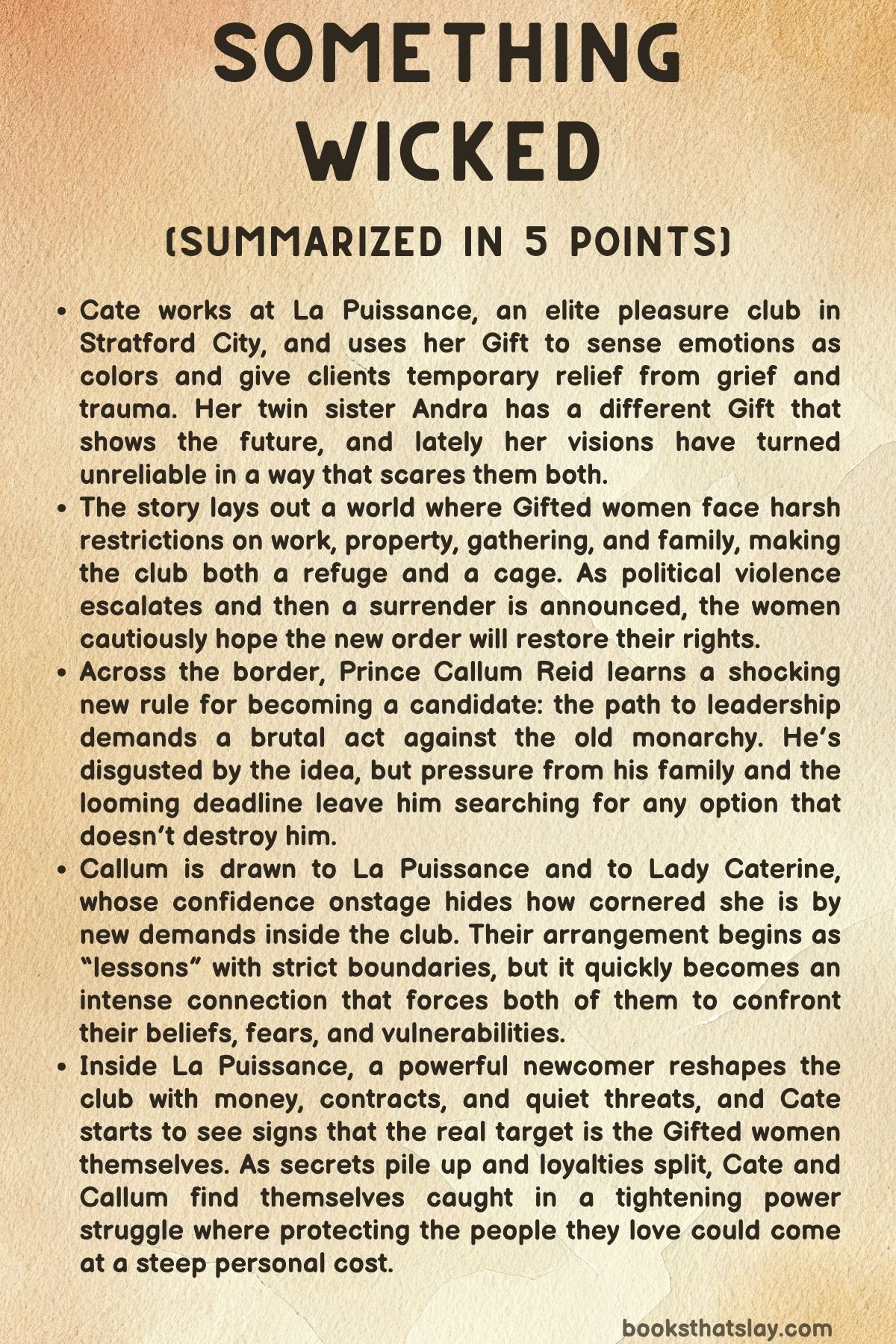
Summary
Cate is one of La Puissance’s most sought-after courtesans, not only because of her beauty and confidence, but because of what she can do in private: she can see emotions as color and temporarily compress a person’s grief, fear, or anguish until it becomes manageable. After a session with Charlie, a client devastated by the death of his wife and child in a recent attack, Cate quietly takes some of his pain away—then has to steady herself afterward, drained from using her Gift repeatedly in one night.
She masks exhaustion with whisky and routine, but her work is never just performance; it’s a way of keeping broken people functional in a world that keeps breaking them.
Cate’s twin sister, Andra, is her anchor. Andra has the Gift of Sight—visions that come like intrusive flashes of possible futures—and lately her Sight has been failing in a way that frightens her.
The sisters’ bond is forged by survival. When Andra’s Gift first appeared, their parents abandoned them.
An orphanage did the rest: cruelty, exploitation, and the constant lesson that Gifted girls are disposable. They ran, fought for scraps, and eventually ended up at La Puissance, taken in by Diana and Harold MacVeigh.
The club is lavish on the surface, but for the women who live there it is also a rare sanctuary, especially in Avon’s legal climate: Gifted women are barred from bearing children, restricted from gathering in groups, dependent on male sponsors to work, and forbidden from owning property or running businesses. La Puissance offers protection, food, and a roof—so long as the outside world stays at bay.
That outside world is in upheaval. The Uprising, a violent political movement, is forcing the monarchs toward surrender.
Among the women at La Puissance—Meri, Rosa, Helen, Tes, Bianca, and others—hope spreads cautiously. If the monarchs truly yield and a new government forms, the laws strangling Gifted lives might finally change.
But relief is complicated by practical fear: Harold admits to Cate that the club is close to financial collapse. The instability of the Uprising has scared off clients and disrupted the city, and without drastic help La Puissance could close.
Cate presses him to do whatever it takes to keep the club alive, because for her and Andra, losing it would mean losing safety.
In Scota, a parallel crisis unfolds inside a palace. Prince Callum Reid trains with his sister, Dominique—Dom—and argues politics with the family that expects him to be both symbol and weapon.
Callum distrusts the Gifted and believes regulation is necessary, a belief rooted in personal trauma. He remembers a Gifted healer from his childhood, present when his mother died, who offered a cold, cryptic judgment instead of comfort.
That memory has hardened into resentment and suspicion.
When the monarchs reach an agreement to surrender, Callum is shaken but not surprised. The deal promises that the old rulers will step down, their titles and lands relinquished, and that restrictions on the Gifted will be rescinded once the new system is established.
Monarchs themselves will be barred from holding office in the new government, but their descendants can run—meaning Callum may be pushed to lead Scota in the new era. Then the new decree arrives, and it is worse than anything Callum imagined: to qualify as a candidate representing a province, a person must assassinate that province’s reigning monarch within a set “killing period.” Peace is being built on sanctioned murder.
Callum refuses. His father insists he must do it “for Scota,” and when Callum resists, he is labeled weak.
Dom sees the trap clearly: their family is being forced into an act that will stain the future before it even begins. She suggests an option Callum hates—seek help from a Gifted woman at La Puissance who might be able to soften what he will feel afterward.
Callum recoils at the idea of emotional manipulation, but his dread is so overwhelming that the thought lingers.
Back in Stratford City, Andra’s visions turn violent. She collapses into a convulsing trance, speaking fragments that terrify Cate.
When Andra comes back to herself, she describes what she keeps seeing: blood, a dagger, and Harold—wearing a crown. Before Cate can make sense of it, Harold gathers everyone in the main salon and makes a shocking announcement: he has married a severe woman who introduces herself as Lady MacVeigh.
The room cheers, assuming this means stability and money, but Andra freezes in fear. Lady MacVeigh’s gaze fixes on the twins with unsettling focus, as if she already knows exactly what they are.
In the weeks that follow, La Puissance does seem to thrive. Repairs happen quickly.
New carpets, brighter lights, fuller crowds. The club looks more secure than it has in years.
Cate should feel relieved, but suspicion grows. Lady MacVeigh begins tightening control, and it becomes clear that her generosity has strings.
She introduces contracts that require the women to meet annual revenue quotas to cover room, board, and “protection.” If someone fails two years in a row, she can be expelled—an especially brutal threat while laws are still changing and sponsorship is still necessary. Cate realizes the contract is a cage dressed as opportunity, but when she sees that others have already signed, she understands how easily desperation can be used as leverage.
Clues surface that Lady MacVeigh’s interest is older and deeper than a business investment. Letters and journal fragments hint at a family dagger carried across years, promises about keeping it “in the family,” and a past connection between the MacVeigh name and La Puissance.
The implication is chilling: this woman did not arrive by chance.
As Callum’s crisis deadline approaches, he sneaks into Stratford City and goes to La Puissance in secret. The trip itself unsettles him: Scota’s relative comfort gives way to Stratford’s poverty and sickness, then to a wealthy district where privilege gathers outside the club’s glittering doors.
Inside, Callum is hit by excess—music, perfume, costumes, crowds. He watches the featured performer, Lady Caterine—Cate—make a dramatic entrance that commands the whole room.
His reaction is instant and alarming, possessive in a way he doesn’t recognize in himself. It scares him enough that when Cate approaches later, he refuses her and leaves before giving his name.
Cate, meanwhile, is hunting for high-paying clients because Lady MacVeigh’s quota system makes survival more precarious. When Dom arrives at the club, she approaches Cate discreetly and offers an enormous sum—fifty thousand marks—for a week of exclusive time with Callum, framed as “lessons” meant to prepare him for marriage and relieve pressure before what’s coming.
Cate agrees, seeing both the financial necessity and the political danger. But Lady MacVeigh immediately uses the arrangement for her own purposes: she orders Cate to spy on Callum, find out how and when he plans to kill his father, and ideally make him fall in love so he can be controlled.
Cate bargains hard for something priceless—release from the contracts for herself and Andra—and Lady MacVeigh accepts, because she is certain obedience will follow.
When Callum arrives for the first session, Cate discovers the truth: her mysterious visitor from the bar is Prince Callum Reid. She lays down rules around consent and boundaries, then starts with something safer than intimacy—dance.
The lessons become a careful negotiation of trust. Callum is guarded, angry at the world, but he’s also lonely and exhausted by expectation.
Cate is practiced at reading people, yet she’s thrown off by how strongly she responds to him. Their chemistry escalates through closeness and conversation, and both of them keep slipping into honesty before snapping back into self-protection.
As the week continues, Cate learns that Andra has become a tool for Lady MacVeigh. The woman has been pushing Andra’s Sight past its limits, mining her visions for advantage.
Cate overhears enough to realize the situation is worse than coercion: Andra is being held hostage to ensure Cate’s compliance. At the same time, Cate discovers that Harold is involved in a plot against King James, acting under Lady MacVeigh’s direction.
Cate is trapped between loyalties she never asked for—her sister’s safety and the future of a kingdom.
On the night everything breaks, Callum asks for one final evening with Cate, wanting escape before he does what he believes he must. Cate gives him that refuge, and for a few hours they cling to each other as if the rest of the world can’t reach them.
Afterward, Callum tries to ask for her help, but Cate stops him and reveals she already knows about the killing period and his intended role in it. She tells him she doesn’t think he chose this freely.
Then she panics as midnight approaches and forces him to leave, finally confessing the truth she has been hiding: Harold, following Lady MacVeigh’s orders, intends to murder King James, and Cate was commanded to keep Callum at La Puissance until after midnight so he couldn’t interfere. If she warned Callum sooner, Andra would be harmed.
Callum’s fury is immediate. He feels betrayed—by Cate, by his family, by the system that engineered this choice.
He storms out, desperate to reach his father in time, demanding to know whether anything between them was real. Cate insists it was, even as she watches him go with the knowledge that she may have destroyed the one person who could help stop what’s coming.
Cate then takes her own risk. She breaks into Harold’s office and finds proof that Lady MacVeigh’s money saved La Puissance from collapse—and contracts that reveal a pattern: only the Gifted women are bound by these agreements, suggesting Lady MacVeigh’s true goal is ownership of their abilities.
Before Cate can warn anyone, guards seize her and lock her in her room.
At the Scotan estate, Callum senses danger immediately. He finds his uncle Alex has fled with Dom and left a warning.
Inside the castle, betrayal is everywhere: assassins, compromised guards, an eerie emptiness in the halls. Near the king’s chambers, Callum hears the confrontation—Lady MacVeigh pushing Harold forward, others keeping the king subdued.
Callum fights his way in and tackles Harold, recognizing the dagger as one linked to Cate. In the chaos, the dagger ends up in King James’s chest.
Callum holds his dying father, hears final words of love and duty, and watches him die. Harold urges Callum to flee before Lady MacVeigh returns, and Callum escapes on horseback, shattered.
At a safe house, Callum learns Alex has been working with the Uprising and claims the night was supposed to be controlled, with protection in place until Callum arrived. Something went wrong, and now Harold—backed by Lady MacVeigh—stands positioned to claim Scota’s candidacy through murder.
Cate remains imprisoned for days. When Harold finally visits, injured and hollow, he admits he killed King James and that Callum escaped.
He also admits he is Bonded to Lady MacVeigh—Grecia—and cannot defy her. He reveals that Andra’s vision that “a MacVeigh would win the election” helped set everything in motion.
Before leaving, he drops a crude map that feels like the smallest possible act of resistance.
With Bianca’s help, Cate gets word out. And then Callum arrives on her balcony, bruised, limping, and burning with grief.
They talk through rage and guilt, admitting betrayals on both sides. Despite everything, they choose action over collapse.
Cate shares what she has: the map, the contracts, the knowledge that Lady MacVeigh is collecting Gifted women like assets. And she shares Andra’s latest vision—simple, urgent, and finally meaningful.
The clue is one word that points toward where Andra is being kept and where the next move must happen: trees.
Characters
Cate “Caterine”
Cate is the emotional center of Something Wicked because her Gift is literally built around feeling—she reads emotions as colors and can compress, hide, or soften what people carry, which makes her both powerful and quietly depleted. Working at La Puissance has trained her to treat intimacy like labor and care like a service, yet the story keeps pressing on the uncomfortable truth that her compassion is routinely exploited by richer, safer people who can buy relief.
Her loyalty is fiercest when it comes to Andra and to the club itself, because La Puissance is not just employment to her but the closest thing she has to home, family, and protection in a world designed to strip Gifted women of autonomy. That loyalty becomes her pressure point: once Lady MacVeigh creates revenue quotas and weaponizes sponsorship, Cate’s instinct to protect turns into a leash others can yank.
When Callum enters her life, she becomes a battleground between survival and conscience—she wants him, trusts him in flashes, and also recognizes the danger of being wanted by a prince who has been taught to fear people like her. Cate’s arc is ultimately about agency: a woman trained to absorb everyone else’s pain learning that her own feelings are not a weakness to be managed, but a truth worth acting on, even when action risks everything.
Andra
Andra functions as both Cate’s anchor and the story’s warning siren, because her Gift of Sight makes the future present in her body—visions seize her, exhaust her, and, once Lady MacVeigh arrives, become a resource to be mined. She carries the sharpest memory of being abandoned for being Gifted, which makes her fear of institutional control visceral; she knows what it means when powerful people start “taking an interest.” The repeated vision—blood, a dagger, Harold in a crown—doesn’t just foreshadow plot, it shows what Andra’s life is like: she experiences catastrophe ahead of time and still has to watch it become real.
Her withdrawal and distress are not just personal decline but a sign of coercion, because the narrative makes clear that pushing a Seer past her limits is a form of violence. Andra also embodies the novel’s moral trap: even truthful foresight can be weaponized when someone else decides what the vision “means” and uses it to justify preemptive brutality.
In that way, Andra is less a mystical oracle and more a young woman whose body becomes contested territory, and her rescue matters not only because she is loved, but because reclaiming her is reclaiming the right of Gifted women not to be used.
Callum Reid
Callum begins as a prince shaped by fear—fear of chaos, fear of Gifted power, and most personally, fear rooted in his mother’s death and the childhood memory of a Gifted healer who offered a cold verdict instead of comfort. That grief hardens into ideology, so his suspicion of Gifted people is not abstract prejudice so much as a defensive story he tells himself to keep pain organized.
The “killing period” decree shatters the moral structure he relies on, because it demands he build a future by murdering his father, and his refusal shows he is not cruel by nature; he is a man terrified of what cruelty will do to his soul. His relationship with Cate destabilizes him because she introduces a new kind of power: not political power, but emotional truth, and he reacts to that with possessiveness he doesn’t understand, the dangerous “mine” impulse that reveals how easily entitlement can masquerade as love.
Yet the book doesn’t leave him as merely privileged and conflicted; it forces him into real consequence when he arrives too late and watches his father die. After that, Callum’s growth is defined by accountability—he has to face how his reluctance, his secrecy, and his assumptions all helped create conditions where others could move first.
His evolving partnership with Cate becomes most meaningful when it stops being about what she can do for him and becomes a decision to act with her, accepting that leadership, if he pursues it, must be built on protection without control.
Dominique “Dom”
Dom is the most pragmatic member of Callum’s immediate world, a sister who sees the political and personal chessboard at once and is willing to make uncomfortable moves to keep her brother alive. Her suggestion to involve Cate is not just mischievous boldness; it’s strategic problem-solving in a moment when the formal structures around them have turned lethal.
Dom’s dynamic with Callum also exposes how grief can create two different survival styles inside the same family: he freezes in morality and fear, while she adapts, bargains, and pushes. She is not portrayed as heartless—she clearly cares, and she takes action to get herself and Alex to safety—but she is willing to treat intimacy and influence as tools in a way Callum resists, which makes her an important mirror for the novel’s themes of consent and manipulation.
Dom also sits at an interesting edge of the new order: as a former royal, she is both threatened and strangely liberated by the rules changing, and her choices suggest she understands that purity will not survive a revolution, only people will.
King James III of Scota
King James is less a distant tyrant figure and more an embodiment of a collapsing world that still contains private tenderness. He represents the old monarchy’s weight and the inevitable reckoning that comes with surrender, yet his final moments reveal a father who loves his son and believes in Scota as something worth protecting beyond titles.
The demand that someone must assassinate the reigning monarch to qualify as a candidate turns him into a ritual sacrifice, which is precisely why his death hits hard: the system requires symbolic blood, and even a flawed human being becomes fuel for political legitimacy. His death also serves as a brutal pivot point for Callum, transforming a theoretical moral crisis into irreversible grief.
In that sense, James’s role is to show that “peace” built on spectacle and sanctioned murder is not peace at all, only a new costume for violence.
Harold MacVeigh
Harold is one of the novel’s most unsettling figures because he begins as caretaker and father-surrogate to Cate and Andra, the man who helped turn La Puissance into a sanctuary, and then becomes a weapon pointed directly at the people he once protected. His financial desperation makes him vulnerable, but the story complicates simple betrayal by introducing Bonding—his confession that he is Bonded to Grecia reframes him as both culpable and constrained, someone who can still make choices but under a coercive tether.
Harold’s secret history with the dagger and his long connection to the club suggest that power in this world is hereditary and symbolic, tied to objects and promises as much as law. When he kills King James with the ruby-hilted dagger associated with Cate, the act becomes doubly violating: it is murder and also narrative framing, a way to implicate the Gifted woman whose body and Gift are already being politicized.
Yet Harold’s small gestures—leaving a crude map, limping in with exhaustion, hinting at resistance—keep him from being a flat villain; he reads as a man who compromised “just this once” until compromise became identity. His tragedy is that he confuses protecting the club with obeying the person who funds it, and by the time he realizes the difference, he is already the instrument of catastrophe.
Lady MacVeigh “Lady M” / Grecia MacVeigh
Grecia is the architect of controlled cruelty, a character who understands that the easiest way to dominate Gifted women is not with open violence but with contracts, quotas, sponsorship, and the ever-present threat of expulsion into a hostile legal world. She arrives wearing legitimacy—marriage, money, renovation—and uses prosperity as camouflage for predation, turning La Puissance into a brighter, busier cage.
Her fixation on Gifts is systematic: the targeted contracts for Gifted workers reveal she is not primarily running a business, she is building an inventory of people whose abilities can be leveraged, sold, or weaponized. Grecia also demonstrates how power prefers to look reasonable; she speaks in the language of protection and stability while practicing extortion and hostage-taking.
The Bonding element makes her even more chilling because it implies she can bind people’s will, turning loyalty into enforced obedience, and it recasts romance and marriage as political technology. Her smirk at Cate and her predatory attention to Andra signal that she reads people the way others read ledgers—assets to control.
Grecia’s deeper connection to La Puissance and the dagger suggests her ambition is not new; she has a long memory, and her version of “home” appears to mean ownership.
Diana
Diana operates as the quiet moral memory of La Puissance, the person connected to the club’s original sense of sanctuary and chosen family. While she is less present in the immediate conflict than others, her significance sits in what she represents: an alternative structure to bloodline power, a woman-made institution designed to shelter Gifted women when the state refused to.
The contrast between Diana’s legacy and Grecia’s takeover clarifies the book’s central tension—safe spaces can be built, but they can also be purchased, rebranded, and weaponized if their survival depends on the money and approval of the powerful.
Charlie
Charlie is an early lens into why Cate’s work matters and why it is dangerous: he is a grieving man whose personal loss intersects with the public violence of the Uprising, and his session demonstrates how Cate’s Gift can provide real relief. At the same time, his presence highlights the unequal exchange at the heart of La Puissance—people with resources come to buy healing from women who are legally constrained and socially disposable.
Charlie is not villainous, but he embodies a system where trauma flows downward: the powerful externalize their pain into the bodies of Gifted women, walk out lighter, and leave those women to drink whisky and recover alone.
Bianca
Bianca is the story’s practical courage, someone who watches, listens, and then moves when movement becomes necessary. Her importance spikes when she is the one who reaches Cate in captivity and becomes the bridge between isolation and action, proving that solidarity in La Puissance is not just affectionate talk over meals but real risk-taking.
Bianca also shows how survival strategies differ among the women: some cope by signing contracts and focusing on income, while she chooses intervention, even when it pits her against the club’s new regime. She functions as a reminder that resistance often looks like small doorways opened at the right moment rather than grand speeches.
Meri
Meri represents the seduction of stability and the heartbreak of coerced consent, because her quick willingness to sign Grecia’s contract suggests not ignorance but exhaustion. When you have lived under laws that deny you property, movement, and future, a contract that promises continued shelter can feel like salvation even when it is a trap.
Meri’s compliance isolates Cate, which is precisely the point of systems like Grecia’s: they turn communal fear into individual bargains so that solidarity fractures. Meri’s role underscores that victims do not all resist the same way, and choosing safety under duress is not the same as choosing oppression freely.
Tes
Tes mirrors Meri in function but adds another layer: she highlights how quickly a community can normalize new harm when the harm arrives packaged as opportunity. If the club is suddenly prospering, if money can finally be sent home, if the streets feel more dangerous than the gilded rooms, then harsh rules start to sound like “business.” Tes helps illustrate how coercive systems recruit their own enforcers without needing explicit brutality—people begin to police themselves and each other because the alternative is terrifying.
Rosa
Rosa contributes to the sense of La Puissance as a living network rather than a backdrop, the kind of friend who makes the kitchen scenes feel like family and therefore makes the later betrayals feel like desecration. Her presence reinforces that the club is not merely erotic spectacle; it is a community of women trading information, comfort, and caution while political forces churn outside their doors.
Through characters like Rosa, the story keeps insisting that what is at stake is not just one romance or one election, but the survival of a home built by women in spite of the law.
Helen
Helen functions as part of the club’s collective conscience and fatigue, someone whose existence in the group scenes reminds the reader that Gifts are diverse and that every Gifted woman carries a different kind of vulnerability under the same discriminatory structure. Her quieter role strengthens the realism of the community: not everyone is central to the coup-level plot, but everyone will be affected by who gains power over La Puissance and by whether “freedom” actually arrives after surrender.
Amanda
Amanda is a measure of Cate’s impact and also a warning about dependency: when Cate helps lift fear and grief from her, Amanda becomes newly able to leave a marriage and imagine a different life. That transformation shows the hope embedded in Cate’s Gift—real healing, real change—but it also raises uneasy questions about the ethics of emotional alteration in a world that already denies Gifted women agency.
Amanda’s storyline suggests that even when Cate uses her power with care, the world around them will always be tempted to turn that care into a service, a tool, or a weapon.
Uncle Alex
Alex is the novel’s political ambiguity given human form, a man who can speak like a mentor while operating like a strategist with hidden alliances. His secret work with the Uprising complicates the simple categories of loyalist and rebel, showing how revolutions recruit insiders and how insiders justify betrayal as necessary for a “bigger plan.” Alex’s belief that the night’s events were supposed to be controlled reveals a dangerous arrogance common to political operators: the assumption that violence can be scheduled, contained, and morally managed.
He serves as a reminder that even movements seeking justice can create collateral damage when they treat people as pieces rather than lives, and his actions deepen Callum’s crisis by forcing him to confront betrayal not only from enemies but from family.
August
August remains more of a looming presence than an on-page personality in the provided material, but his narrative weight is significant because he represents the Uprising’s leadership and the idea that the revolution has a face, a chain of command, and a capacity for organized intervention. The fact that Alex believes he can “contact August” to fix the outcome implies that the Uprising is not merely chaos but structure, and that structure can be as capable of ruthless calculation as any monarchy.
August’s offstage role helps the book maintain tension about what replaces the old order: removing crowns does not automatically remove power.
Themes
Power, Control, and the Price of “Protection”
Something Wicked is set in a world where safety is always conditional, and the story keeps returning to the ways power disguises itself as care. La Puissance begins as a refuge for Gifted women who are legally blocked from ordinary forms of stability—property, independent work, family, and even the right to gather freely.
That legal cage already turns survival into a transaction. What changes the texture of that transaction is Lady MacVeigh’s arrival, because her influence is not only economic; it is psychological and bodily.
The club’s revival—new carpets, lights, crowds—comes packaged with a contract that looks like employment structure but functions as leverage. Revenue quotas, the threat of expulsion, and the timing of incomplete legal reform turn “opportunity” into coercion: the women are told they are now responsible for their own survival, but only within rules designed to keep them dependent.
Even friendship becomes complicated because the contract pressures women to accept terms quickly, and those who sign early appear safe while those who hesitate become isolated.
The same dynamic plays out in politics through the “killing period” decree. A new government promises freedom and equality, then sets a requirement that makes legitimacy dependent on assassination.
That policy manufactures candidates through violence and forces people to prove leadership by committing an irreversible act. The story shows how systems create moral traps so that obedience looks like duty.
Callum’s father frames murder as patriotism and calls refusal cowardice, turning a son’s conscience into a weakness that must be corrected. Lady MacVeigh uses parallel methods: she doesn’t merely demand compliance; she engineers situations where resistance costs someone you love.
The hostage threat against Andra, Harold’s Bond to Grecia, and the targeted contracts for Gifted workers all show control operating through intimacy, dependency, and fear rather than open force. The result is a society where “peace” is announced publicly while private mechanisms of domination intensify, and where protection is never free—it is always purchased with autonomy.
Bodies as Battlegrounds and the Politics of Desire
Sex in Something Wicked is never only personal. It is labor, refuge, currency, weapon, and sometimes the only space characters can claim as their own.
Cate’s Gift is tied to intimacy, and that detail makes a clear statement: her body is not just something she owns; it is also the channel through which she provides relief, absorbs strain, and takes on emotional residue. The sessions with clients like Charlie show how trauma becomes something “managed” through a service economy.
Cate compresses and stores grief, and the cost shows up immediately in exhaustion and reliance on whisky to recover. That cycle makes her compassion tangible, but it also exposes how a system can turn empathy into depletion.
The club’s role as sanctuary is real, yet the story doesn’t pretend sanctuary is the same as freedom. The work asks for emotional closeness on demand, and the Gift makes that closeness literal.
Callum’s relationship to desire is shaped by fear, shame, and ideology. He enters La Puissance believing regulation of the Gifted is justified, and he carries a childhood wound about a Gifted healer present at his mother’s death.
When he sees Caterine perform, his reaction is immediate and possessive, and that possessiveness scares him because it contradicts the self-image he tries to maintain. His attraction exposes how social training can sit beside raw longing without resolving into honesty.
The “sex lessons” arrangement pushes this tension further because it treats intimacy as both instruction and political strategy. Dom frames it as preparation and stress relief, Lady MacVeigh frames it as espionage and control, and Caterine must frame it as survival under quotas.
That means every touch carries multiple meanings at once, and the characters are forced to ask what counts as consent when choice is shaped by threats, money, and obligations.
The story also links sexual boundaries to identity and safety. Caterine’s rules—no mouth-kissing, consent for touch—are not decorative; they are the scaffolding that lets her remain herself inside a job built around access to her body.
When she breaks her own boundary by kissing Callum, it signals both real feeling and the danger of losing the structure that protects her. That kiss is also used as camouflage when she and Callum are hiding from Lady MacVeigh, which underlines the theme: intimacy becomes a disguise, a shield against punishment, and proof of vulnerability all at once.
In this world, bodies are where politics lands first. Laws restrict Gifted women’s lives, contracts monetize them, and public decrees demand blood to authorize leadership.
The characters keep reaching for tenderness, but tenderness is never separate from the power structures pressing on their skin.
Grief, Emotional Labor, and the Ethics of Altering Pain
The book treats grief as a force that shapes choices, policies, and relationships, and it asks what happens when pain can be handled like a substance. Cate’s Gift allows her to perceive emotions as colors and to compress grief temporarily, and that ability raises ethical questions without needing speeches.
Clients leave lighter, sometimes transformed, and one client’s change leads to major life decisions, including leaving a husband. That result can be read as healing, but it also highlights how emotional states influence agency.
If a person’s fear is muted, new options appear. The story pushes the reader to consider whether that is liberation, manipulation, or something that depends on intent and context.
Cate’s motive is care, and her exhaustion proves she isn’t using people casually. Still, the power to edit feelings is inherently political because it can change what someone believes they can endure.
Callum’s internal conflict is also grief-driven, and the narrative makes his stance on the Gifted inseparable from his mother’s death. His suspicion is not presented as pure ideology; it is a defense mechanism built out of loss and a need to assign blame.
The memory of the healer saying “The penance has been paid” becomes a splinter in him: it implies a moral ledger, a cosmic punishment, and a worldview where suffering is deserved. That sentence haunts him because it turns grief into judgment, and judgment into policy.
When he considers asking Caterine for help, it isn’t only about avoiding guilt; it is about confronting the fear that his feelings are too big to survive. The planned assassination of his father threatens to turn grief into permanent self-loathing.
That is why the offer of emotional relief is tempting even when he distrusts the people who can provide it.
The story’s most painful ethical knot comes when Caterine must choose between protecting Andra and warning Callum. The situation forces a question that grief makes sharper: what is the moral weight of one life compared to many?
Caterine’s love for her sister is not abstract. It’s rooted in shared abandonment, abuse, and the club’s role as their only home.
Choosing Andra is not choosing selfishness; it is choosing the person whose survival is directly in her hands. Callum experiences that choice as betrayal because he is trapped in another form of grief—anticipatory grief for his father and for the future he hoped to shape.
Their conflict shows how trauma makes people interpret the same act in incompatible ways. The book refuses easy comfort here: even when Caterine insists the night with Callum was real, the reality of manipulation and withheld truth still stands.
Emotional labor in this world is not limited to clients; it becomes the currency of love itself, and the characters keep paying with parts of their own stability.
Fate, Foreknowledge, and How Prophecy Becomes a Weapon
Andra’s Sight introduces a theme that goes beyond predicting events; it shows how foreknowledge can be turned into an engine for coercion. When Andra cannot read Harold’s future for weeks, that absence itself becomes ominous, suggesting that uncertainty can be as frightening as vision.
Later, her violent convulsions and repeating images—blood, a dagger, Harold wearing a crown—create a fixed set of symbols that other people interpret and act on. The crucial point is not whether the vision is “true,” but how quickly people treat it as instruction.
Harold and Lady MacVeigh use Andra’s vision that “a MacVeigh would win the election” as justification for action, and the story shows the danger of treating prophecy like permission. Once a prediction is believed, it can be used to pressure others into making it real, and that turns Sight into a tool for those already hungry for control.
Lady MacVeigh’s use of Andra also reveals how power exploits limited resources. The Gift is finite, and Andra is pushed past her limits until her body breaks down.
That exploitation looks like interrogation, not guidance. The value of her Gift attracts captors, and the cost is paid in seizures, disorientation, and fear.
This frames prophecy as labor and as extraction. Andra is not a mystical figure on a hill; she is a working woman whose ability is commodified, then weaponized against her own family.
The threat against Andra forces Cate into compliance, and the vision is used to set political dominoes in motion. Foreknowledge becomes the bait in a trap: it offers certainty, and certainty becomes the excuse for violence.
The “killing period” policy intensifies this theme by pretending to be objective. It creates a window where assassination is expected, and therefore almost fated.
Once the state declares murder as a qualifying act, personal intentions matter less than the timeline. Callum tries to resist the role written for him, yet he is surrounded by people—his father, Dom, and later Lady MacVeigh’s scheme—who assume the act will happen and plan around it.
That atmosphere makes choice feel like illusion, but the book still shows moments where choices matter: Callum refusing at first, Caterine deciding to confess, Harold leaving a map as a small act that might undermine Grecia. Those moments suggest that “fate” in the story is often the name people give to a plan when they want it to feel inevitable.
Andra’s final urgent word—“trees”—is important because it is not a full script. It is partial, raw, and human, which keeps agency alive.
The book treats prophecy not as a neat answer but as a contested resource, one that can either guide survival or become the justification for tyranny, depending on who gets to interpret it and who gets hurt to obtain it.
Revolution, Reform, and the Risk of Replacing One Cage With Another
The Uprising and the surrender promise a break from oppression, and the story immediately shows how fragile that promise is. Gifted women are told restrictions will be rescinded once a new government is established, but the delay matters.
In the gap between announcement and implementation, the old laws still bite, and that gap is exactly where predators thrive. Lady MacVeigh’s contract is effective because it is timed to the transitional period: expulsion threatens loss of sponsorship before full reform arrives, which means “freedom” becomes a future tense that can be used to control the present.
The story exposes how reform can be used as cover, allowing people to claim progress while enforcing new systems of dependency.
The political decree requiring assassination is the sharpest example of revolution turning into ritualized violence. It is presented as a rule for legitimacy, but it reads like a test designed to normalize brutality and ensure that leaders begin their tenure with blood on their hands.
That kind of beginning makes accountability harder, because everyone involved becomes compromised. The narrative also shows fractures inside revolutionary movements.
Alex’s secret work with the Uprising suggests idealism mixed with strategy, but the plan goes wrong, and the fallout is devastating. The king dies, Harold becomes the candidate, and the whole point of the controlled “transition” collapses into chaos.
That failure highlights a harsh reality: even movements aimed at justice can miscalculate, and those miscalculations land on real bodies.
La Puissance functions like a small-scale version of the political world outside. Under Diana and Harold, it is flawed but protective, a place where Gifted women can live with some community and safety.
Under Lady MacVeigh, the club’s prosperity increases, but the terms become punishing and targeted. The detail that only Gifted workers have contracts reveals the underlying logic: the real commodity is not sex, or even beauty, but ability.
That mirrors the state’s relationship to the Gifted as a whole—fear them, regulate them, use them when useful, deny them full personhood. The book suggests that revolutions do not automatically change that logic; they can simply change who gets to benefit from it.
What keeps the theme grounded is the characters’ cautious hope. The women hear rumors of surrender and allow themselves to imagine restored rights and an end to casualties.
That hope isn’t naive; it is necessary to keep living. But the story insists that freedom is not guaranteed by announcements, and equality is not created by removing titles if new systems still rely on coercion and exploitation.
The tension between public progress and private control becomes the core conflict: a society can claim to be building something fair while quietly designing new ways to trap the same people. In that environment, resistance becomes personal—protecting a sister, refusing to be emotionally owned, choosing truth even when it shatters trust—and political change becomes inseparable from the fight to keep one’s humanity intact.