Sparks Fly Summary, Characters and Themes
Sparks Fly by Zakiya N Jamal is a contemporary romance set in New York City, where a cautious “late bloomer” and an ambitious tech CEO collide at the worst possible moment. Stella Renee Johnson is twenty-seven, talented, and stuck in a life that feels like it’s moving too slowly—especially compared to everyone around her.
One impulsive night at a masquerade sex club introduces her to Maximo “Max” Martinez Williams, a man who is confident, careful about consent, and unexpectedly easy to trust. What starts as anonymous attraction turns complicated when their worlds collide at Stella’s job, where Max’s company is bringing in an AI tool that threatens everything she’s built.
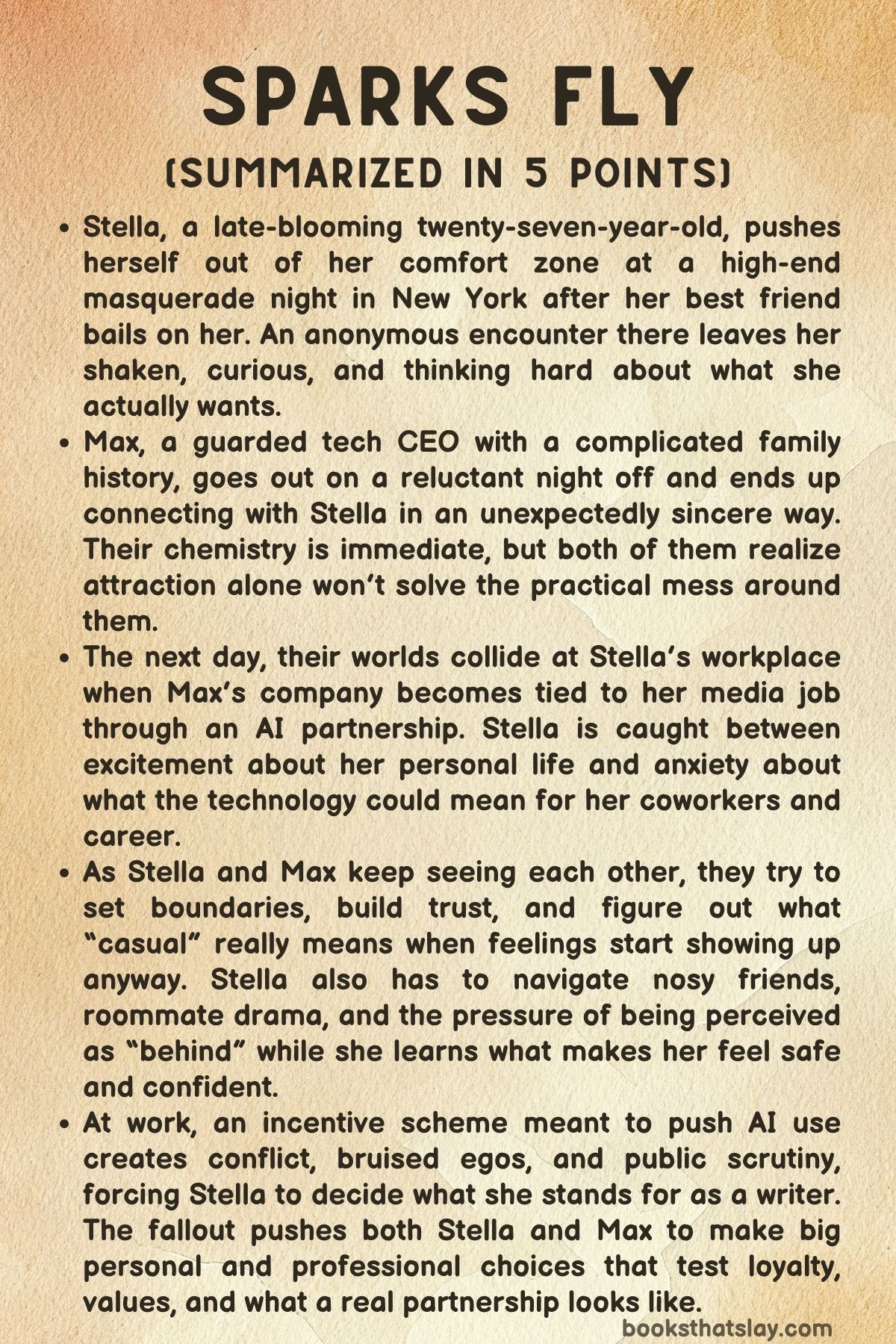
Summary
Stella Renee Johnson stands outside Red as Sin on Valentine’s Day, dressed for a masquerade she never truly wanted. She’s nervous, second-guessing everything, and waiting for her best friend and roommate, Chelsea, who promised to come with her.
Stella is still a virgin at twenty-seven, and Chelsea has been pushing her for months to stop overthinking and have sex already. When Chelsea calls to admit she’s ditched Stella for a concert and a new romantic interest, Stella feels abandoned and humiliated—but also stubborn.
She decides she won’t go home. Using Chelsea’s RSVP name, “Cherry Cherry,” she walks into the club alone.
Inside, Stella is overwhelmed by how open everything is. The place looks like a high-end nightclub at first, but the sexual energy is everywhere, and people aren’t hiding what they’re doing.
Stella tries to act like she belongs, but she’s anxious, hyper-aware of her body, and unsure where to look. She wanders into a corridor where a crowd watches two women having sex behind a plexiglass window.
Startled, Stella turns too quickly, crashes into a tall man, and spills his drink down his white shirt. Her embarrassment comes out as a curse, and the man answers with an easy confidence that makes her blush even harder.
The man is Maximo “Max” Martinez Williams, CEO of an AI company called AIX. Earlier that day, Max had been deep in work when his younger brother, Miles, showed up and insisted they go out.
Miles runs a viral content company called Yellow Sparks and claims he wants Max’s opinion on Red as Sin because he’s considering investing. Max suspects his brother is mostly trying to push him out of his routine and into something fun.
Max finally gives in, shows up masked, and ends up alone when Miles disappears into the club to meet the owner.
After the collision, Max takes Stella’s hand and guides her away from the crowd, giving her space and control instead of making her feel stupid. Stella, fueled by nerves and the mask’s anonymity, blurts out what she came here for: she wants sex.
Max doesn’t rush her. He suggests starting with a kiss, and when she agrees, the chemistry hits immediately.
The kiss escalates fast, but Max keeps checking her reactions, making sure she’s choosing each step. Stella feels bold for the first time in a long time, and she lets herself want what she wants.
They find a private room with a bed and soft light. Stella panics for a moment—she’s alone with a stranger in a sex club—but she pushes through it by asking his name.
He says Max, and she sticks to “Cherry,” trying to keep the night contained in fantasy. As they undress, Max’s attention is focused and patient.
He removes their masks, calls her beautiful, and makes her feel desired rather than judged. When Max goes down on her, Stella experiences an orgasm that shocks her with its intensity—something she’s never reached without her own hands or toys.
The moment is so good it scares her, because it feels real.
Then reality interrupts. Max goes to get a condom and realizes he doesn’t have one.
Stella doesn’t either. Max promises he’ll be right back and tells her to stay put.
Alone in the room, Stella’s confidence collapses. She starts thinking about how reckless this is, how exposed she is, how easily she could end up regretting everything.
Shame hits hard: she feels like she’s acting desperate, like she’s trying to catch up to a life she’s behind on. Unable to sit in that vulnerability, she gets dressed, retrieves her belongings, and leaves—without telling Max.
The next day, Stella goes to work at Yellow Sparks, where she writes quizzes and list-style content but wants to grow into longer pieces. The atmosphere is tense because the media industry has been unstable, and layoffs feel like a constant threat.
Stella pitches an article idea about places to lose your virginity, framing it as a travel-style list, and her boss approves it. Later, during a mandatory all-staff meeting, Stella is stunned to see Miles—the CEO—arrive with a surprise guest: Max.
Miles announces a partnership with AIX that will integrate an AI tool called Sparky into their content system. Stella feels the floor drop out from under her as Max spots her in the crowd and recognizes her immediately.
After the meeting, the office erupts with anger and fear. Writers are furious about AI entering their workflow and worried about job security.
Stella, caught between wanting to disappear and needing answers, runs for the stairwell—and runs straight into Max. He’s equally rattled by the chaos and asks her out to dinner so they can talk about what happened at the club and the situation at work.
Stella is wary about the professional risk, but Max’s directness and calm pull her in. She agrees, telling herself it’s just dinner.
Over Thai food, they settle into conversation that feels like a real date. They share family backgrounds and cultural roots, and Stella learns Max was adopted and raised by white parents, while he and Miles were born in the Dominican Republic.
Stella admits she isn’t actually “Cherry” and tells him her real name. Max gives his full name too.
The openness makes Stella feel safe, and the attraction returns. Still, Stella draws a boundary: no hooking up that night.
She offers Friday instead, and Max agrees eagerly.
At work, AIX holds “office hours” where Max and his colleague Rashid face intense questions. Writers challenge them on accuracy, workload, environmental cost, and whether they’ll be replaced.
Max explains Sparky is designed to assist inside the CMS, not to publish on its own, and claims its use isn’t mandatory. But the more he talks, the more uneasy the staff becomes, especially because the tool improves with more usage.
Friday night, Stella goes to Max’s apartment, stunned by how wealthy and controlled his world feels compared to hers. She asks practical questions about condoms and lube, determined not to repeat the club’s mistake.
He has them. The power briefly goes out, and the interruption forces them into a more honest conversation.
Max jokes about her not running away again, and Stella finally explains she left the club because she felt exposed and because her roommate needed her. Max realizes he sounded accusing, apologizes, and offers to slow down.
They order pizza, watch sitcoms, cuddle, and let intimacy build at Stella’s pace. Max pleasures her with his hands until she orgasms, then stops for the night because he has an early work commitment.
Stella is surprised by the restraint, and it makes her trust him more.
Stella’s friends interrogate her at brunch, especially Effie, who works with Stella and sees the AI partnership as a betrayal waiting to happen. Stella insists Max isn’t a villain, but she agrees to keep the relationship quiet at work and to get clearer answers about Sparky’s purpose.
Max gets busier, cancels plans, but calls her often. When Stella presses him about Miles’s intentions, Max says Miles truly believes the tool will help and promises he’d push back if it became a replacement plan.
To reduce complications, Max offers to step back from the Yellow Sparks project and let Rashid lead, so Stella won’t have to deal with him in the office.
As their relationship deepens, Stella carries a private fear: she hasn’t told Max she was a virgin. Her first time happens in Max’s apartment after trust and comfort build, and afterward she’s filled with happiness and guilt at once—happy because it was good and gentle, guilty because she kept something significant hidden.
Their time together starts to feel domestic: food on the couch, falling asleep beside him, waking up tangled together. Stella surprises herself by enjoying how quickly Max wants her around, even though she’d told herself she wanted something casual.
During a stressful production push at Yellow Sparks called Sprint Week, Stella tries to avoid using Sparky on principle. The company expects everyone to produce a huge number of posts quickly, and the competition becomes a pressure cooker.
Effie uses Sparky and races ahead. Stella finishes her work through sheer effort and talent, then uses her freed-up time to bring Max into her world by inviting him out with her friends.
The evening is tense at first—her friends question Max’s intentions and confront him about AI. Max answers directly, saying he wants to keep getting to know Stella beyond sex and repeating that the tool isn’t meant to eliminate jobs.
The night ends with Max coming back to Stella’s apartment, where Stella lets him see more of who she is: her messy nerves, her pink bedroom, her sex toys, her desire to feel chosen. They have sex again, and Stella feels both empowered and uncertain about what they’re becoming.
Later, Max opens up about his past. He tells Stella about his childhood in the Dominican Republic, his father’s death, and the sudden loss of his mother.
He shares how the adoption changed everything and how he struggles with memory and grief. Stella comforts him, and the intimacy shifts from physical to emotional, making it harder for either of them to pretend this is casual.
Then Sprint Week results drop. Stella has the most views by a wide margin—she won.
But Miles refuses to give her the prize money because the rules required using Sparky, and she didn’t. Stella is furious, and when she confronts her boss, Melanie dismisses Stella’s talent, belittles her ambitions, and admits Stella’s win embarrassed Miles because it undermined the AI rollout.
Stella realizes she’s being punished for succeeding the “wrong” way. Humiliated and angry, she decides she won’t stay and be treated like she’s disposable.
When Max hears what happened, he confronts Miles. Miles insists rules are rules, then reveals his real plan: use Sparky to justify cutting around thirty percent of the staff.
Max is horrified. He knows the tool isn’t capable of replacing writers the way Miles claims, and he realizes his brother is using the tech as cover for layoffs.
Max ends the contract between AIX and Yellow Sparks, even though it will cause fallout. Meanwhile, Stella writes a public essay explaining why she’s leaving, detailing the AI push, the contest manipulation, and the company’s refusal to reward her work.
The post spreads fast, turning Stella into a visible symbol of the conflict between workers and leadership in a changing media landscape. Stella resigns rather than returning to the office, and her friends rally around her.
Max shows up at Stella’s building and tells her what he did—terminating the deal to stop Miles from using Sparky as a weapon. He also admits Miles now knows they’ve been dating and is furious.
In the middle of that chaos, Max tells Stella he loves her and wants a real relationship. Stella is overwhelmed by how quickly everything has escalated and asks for time to think.
A painful truth comes out soon after: Chelsea drunkenly told Max Stella had been a virgin before him. Stella is hurt and embarrassed, but the confession forces overdue honesty between Stella and Chelsea, and they reconcile.
Stella finally allows herself to face what she’s been avoiding: she loves Max too. She goes to his building, blurts out that she loves him, and admits she didn’t tell him about being a virgin because she didn’t want it to change how he saw her.
Max reassures her that nothing about her is a problem to manage, and they choose each other openly.
One year later, Stella and Max live together, celebrating Valentine’s Day and their anniversary. Yellow Sparks has suffered major fallout from its AI decisions, and Miles has stepped down and sold control after public and business consequences.
Stella has built a new career writing a sex-and-dating column, owning her identity as someone who started late and still built something real. Max launches a medical-tech division inspired by his mother’s undetected condition.
As they head into a family dinner with complicated emotions still present, Stella and Max face the future as a team, clear on what they want and who they are to each other.
Characters
Stella Renee Johnson
In Sparks Fly, Stella is written as a woman caught between who she has been trained to be and who she is beginning to allow herself to become. Her virginity at twenty-seven is not treated as a quirky fact so much as the outward symptom of deeper patterns: self-protection, self-consciousness, and a lifelong habit of measuring herself against imagined timelines for what adulthood should look like.
The masquerade at Red as Sin gives her a temporary identity that loosens those restraints, and what begins as a mission to “get it over with” evolves into a complicated awakening where pleasure, desire, and vulnerability arrive all at once. Stella’s arc is powered by the tension between control and surrender: she wants to feel chosen without feeling foolish, wants intimacy without the risk of being judged, and wants to be brave while still needing safety.
Even as she becomes more sexually confident, her emotional growth is just as central—she learns to speak up, to ask direct questions, and to stop shrinking herself to fit other people’s comfort. Her stand against Yellow Sparks also shows that her courage is not limited to the bedroom; when she realizes she is being manipulated and devalued, she refuses to play along, and that refusal becomes the moment she fully claims her own voice.
Maximo “Max” Martinez Williams
Max, in Sparks Fly, is built as a character who looks effortless from the outside but is quietly carrying a lifetime of dislocation and responsibility. He has the polish of a CEO and the practiced calm of someone used to managing rooms, yet his emotional life is shaped by adoption, loss, and the sense that he must constantly translate himself across worlds.
His intimacy with Stella isn’t framed as conquest; it is framed as attentiveness, patience, and a desire to be trusted, which makes him stand out in a setting designed for anonymity and indulgence. The condom search scene becomes revealing not because it is sexy, but because it exposes how much he cares about doing things correctly and not harming her—then how badly he feels when he loses her and can’t control the outcome.
Professionally, Max is positioned in moral conflict: he builds technology that can be used to empower people, but he is confronted with how easily others can weaponize it for profit and control. His love story is therefore inseparable from his ethics; the moment he hears Miles intends to cut jobs, Max stops being merely cautious and becomes decisive, choosing integrity over family loyalty and financial upside.
Max’s tenderness is real, but so is his intensity—he falls hard, commits quickly, and risks everything once he recognizes Stella is not a casual chapter but a life pivot.
Chelsea
Chelsea, in Sparks Fly, functions as both catalyst and caution sign in Stella’s development. She is the friend who pushes Stella into the club, pushes her toward sex as a milestone, and treats the whole thing like a rite of passage Stella is overdue to complete.
That forcefulness can look supportive on the surface, but it also reveals a blind spot: Chelsea sometimes confuses pressure with empowerment, and she doesn’t always respect the pace Stella actually needs. Her choices throughout—ditching the plan for a concert, using Red as Sin casually, treating boundaries as flexible—highlight a personality that prioritizes excitement and immediacy, often at the expense of follow-through.
Yet she isn’t written as a villain; she’s messy, inconsistent, and human, and her later admission that she drunkenly revealed Stella’s virginity shows how her lack of discretion can cause real harm even when she doesn’t intend it. What makes Chelsea important is that she forces Stella to confront an uncomfortable truth about friendship: love can exist alongside selfishness, and closeness does not automatically mean someone is safe with your most private stories.
Their reconciliation lands because it isn’t about pretending Chelsea was right; it is about Stella finally asserting what she needs from her, and Chelsea accepting that she must grow up as a friend if she wants to stay in Stella’s life.
Miles Martinez Williams
Miles is a charismatic disruptor type whose charm masks a dangerously transactional view of people. He plays the role of visionary CEO, but his decisions reveal a leader driven by control, optics, and growth at any cost.
Bringing Sparky into Yellow Sparks isn’t simply a business move; it becomes a power play, one where he tries to force cultural change through surprise announcements, incentives, and coercive systems rather than trust and collaboration. His reaction to Stella winning Sprint Week without using Sparky is especially telling: instead of celebrating merit, he interprets her success as a threat to his narrative, and he chooses punishment to protect the story he wants to sell.
The deeper turn is his willingness to reduce staff by about thirty percent, which reframes him as someone who sees employees as expendable inputs rather than human beings with livelihoods. Miles also embodies the complicated sibling dynamic with Max—he resents being challenged, expects loyalty, and treats Max’s boundaries as betrayal.
By the epilogue, his stepping down and selling control suggests consequences finally arrived, but the story uses him less as a redemption figure and more as an example of what happens when ego-driven leadership collides with public accountability and human cost.
Effie
Effie represents the voice of labor anxiety made personal and sharp. She is not merely skeptical about AI; she is afraid in a grounded way, because she understands what corporate language often hides: efficiency projects usually end with people being cut.
Her bluntness with Stella about dating Max is not moral posturing as much as protective realism—she recognizes how quickly a workplace will frame Stella as compromised, and how a relationship can be weaponized against her reputation. Effie also complicates the narrative around Sparky because she is willing to use it during Sprint Week, not because she is ethically relaxed, but because she is trying to survive a system stacked against workers.
Her loyalty is shown through action: she checks on Stella, shows up when Stella is crushed, and supports the public essay even when that kind of visibility can backfire. Effie’s role is essential because she keeps the story from becoming purely romantic; she anchors it in the material stakes of work, dignity, and solidarity, and she helps Stella recognize that personal happiness cannot require collective silence about exploitation.
Kira
Kira plays the boundary-enforcer in Stella’s circle—the friend who asks the uncomfortable questions that everyone else thinks but avoids. When she interrogates Max about his intentions, it is less about being rude and more about refusing to let Stella drift into a situation where she is emotionally invested while the man remains vague.
Kira’s skepticism also serves as a counterbalance to Stella’s tendency to romanticize; she pushes Stella to consider power dynamics, workplace consequences, and the difference between attention and commitment. At the same time, Kira is not closed-hearted—once Max demonstrates steadiness and respect, the tension eases, suggesting her defensiveness is rooted in care rather than cynicism.
In the friend-group ecosystem, Kira is the one who insists that love should come with clarity, and that Stella deserves a relationship that can withstand daylight, not just chemistry.
Melanie
Melanie is the embodiment of managerial cruelty dressed up as professionalism. She is less interested in fairness or talent than in keeping leadership satisfied, and her reaction to Stella’s Sprint Week win reveals a worldview where workers exist to serve executive agendas, not to be developed or rewarded.
By telling Stella she embarrassed Miles, by dismissing Stella’s success as luck, and by undermining her ambitions with the claim that she is “not a good writer” for news, Melanie uses classic gatekeeping tactics: diminish, belittle, and redirect the employee back into a smaller box. Melanie’s power isn’t just formal; it is psychological, because she understands how to strike at the insecurity of someone who is already fighting to be taken seriously.
Her presence clarifies why Stella’s resignation matters: Stella is not only leaving a job, she is refusing the internalized story that authority figures like Melanie try to install—that she should be grateful for scraps and quiet about disrespect.
Rashid
Rashid operates as a pragmatic counterpoint to both Max and Miles, and he helps show the internal contradictions inside a company building tools like Sparky. As co-lead on the AI integration and a visible face during office hours, he becomes a target for employee fear even when he may not control the broader strategy.
His conversations with Max reveal an engineer’s perspective that is more personal than corporate—he has his own relationship problems, his own frustrations, and he isn’t portrayed as a faceless “tech guy” so much as someone caught in the middle of ethical gray zones. Rashid’s importance to the plot comes from what he accidentally surfaces: he is the conduit through which Max learns the full structure of Sprint Week’s incentive and the pressure Miles is applying.
He therefore becomes a narrative hinge—proof that even well-intended tools become harmful when leadership designs the incentives and rules around them to manipulate behavior. Rashid also implicitly highlights Max’s internal conflict: Max can delegate the project, but he cannot delegate responsibility for what his technology enables.
Jackie
Jackie is the friend Stella turns to when she needs perspective without the immediate heat of workplace politics or roommate chaos. Her role is quieter but meaningful: she provides Stella a space to articulate what is happening without being pushed toward a single conclusion.
Where Chelsea tends to steer and Effie tends to warn, Jackie offers listening and grounding, which helps Stella clarify that she wants Max not just as a thrill but as a choice she is willing to stand behind. Jackie’s function in the narrative is to support Stella’s agency—the decision to keep seeing Max becomes more believable because Stella has a moment to think it through with someone who is not trying to control the outcome.
Katy
Katy is a smaller presence, but she contributes to the workplace atmosphere that makes the AI conflict feel communal rather than isolated. Her noticing Stella’s exhaustion alongside Effie signals that Stella’s personal life is bleeding into her professional presentation, and it also reflects how closely coworkers watch one another when the environment is tense.
Katy helps communicate that Yellow Sparks is a pressure cooker, where rumors, anxieties, and small shifts in behavior become social signals—exactly the kind of setting where Stella’s relationship with Max could become dangerous if exposed.
Eric
Eric primarily functions as a narrative contrast in the Sprint Week outcome. He is close enough in ranking to be visible, and his invitation to claim prize money while Stella is excluded highlights the arbitrariness and cruelty of the rules Miles set up.
Eric’s role underscores the real issue: the company is not rewarding the best work; it is rewarding compliance with a tool adoption scheme. Even without deep characterization, his placement in the results helps reveal how easily workplaces convert creative labor into gamified metrics, then use those metrics to justify unequal treatment.
Gregory
Gregory also serves as part of the Sprint Week comparison set, reinforcing the same structural point as Eric and Effie’s placement: the prize system is designed to showcase Sparky rather than honor excellence. His inclusion in the invited group makes Stella’s exclusion feel even sharper, because it shows that being “good enough” with the approved method matters more to leadership than being genuinely best.
Gregory’s function is to demonstrate how organizations create winners and losers not purely through performance, but through the hidden criteria that serve executive goals.
Themes
Sexual self-knowledge and late-bloomer confidence
Stella’s first night at Red as Sin starts as a performance of confidence and quickly becomes a test of what she actually wants, what she fears, and what she is willing to ask for. In Sparks Fly, her sexual inexperience is not treated as a simple “before” state that disappears once she has sex; it becomes a lens for how she has learned to measure herself against other people’s timelines.
The pressure Chelsea applies—go in, drink, “get it over with”—captures a familiar cultural message: sexuality is a milestone you’re supposed to complete, not a part of yourself you’re allowed to learn slowly. Stella’s experience pushes back against that.
She is anxious, curious, and hungry for change all at once, and the story makes room for those contradictions. Her first encounter with Max is thrilling, but the most meaningful shift is that Stella begins speaking plainly about needs and boundaries: condoms, pacing, the right to stop, the right to try again later under different conditions.
Even when she leaves the private room because she feels exposed, the moment reads less as failure and more as Stella choosing safety over finishing a script she never wrote. As the relationship develops, her confidence becomes less about performing boldness and more about understanding her own patterns—why she panics when she feels “too seen,” why she withholds information to avoid being judged, why she worries that wanting domestic comfort means she is losing control.
The theme lands in the way Stella learns that pleasure is not only physical. Pleasure is also being listened to, being given time, being treated as someone whose comfort matters.
Her transformation is gradual: she moves from borrowing “Cherry Cherry” as a mask to claiming Stella as enough, without the disguise.
Consent, safety, and the negotiation of power
A sex club setting can easily become a shortcut for shock value, but Sparks Fly uses Red as Sin to establish a framework: rules, consent reminders, no phones, no photos. Those details matter because the book keeps returning to how safety is created through shared agreements rather than assumptions.
Max’s repeated check-ins, his pauses, and his attention to permission turn intimacy into an active conversation. That approach contrasts with the kind of coercion Stella experiences elsewhere, which is rarely physical and often social: Chelsea’s pressure, workplace surveillance through productivity contests, the expectation that Stella should be “cool” about professional conflict because it’s inconvenient to other people.
The story also highlights how power can change depending on the environment. In the club, anonymity gives Stella temporary power to ask for what she wants without being categorized.
At work, hierarchy and reputation strip that freedom away, especially once Max is revealed as connected to the AI partnership. Stella suddenly has to calculate how any interaction might be interpreted by coworkers, bosses, or Miles.
The same desire that felt liberating in a masked room becomes risky in fluorescent office reality. The book’s treatment of consent goes beyond sex and extends into labor: employees asking whether they can refuse the tool, the fear that using it trains it to replace them, the way “not mandatory” can still function like coercion when incentives and rankings are attached.
In both arenas, the theme is about what real choice looks like when consequences loom. Stella’s arc suggests that consent without psychological safety is fragile.
She becomes stronger by learning to name what she needs and by refusing situations where her “yes” would be shaped by pressure rather than desire.
Work, AI, and the commodification of creativity
The workplace conflict in Sparks Fly treats AI less as a neutral innovation and more as a management strategy that reshapes what writing is worth. Yellow Sparks frames “Sparky” as support—faster drafts, sourced lists, smoother workflows—but the staff’s suspicion is grounded in experience: tools introduced as “help” often become measurement systems that justify fewer workers.
The mandatory meeting, the tense office mood, and the constant questions about editing burden and environmental cost create a climate where creativity is already being squeezed. Stella’s Sprint Week experience crystallizes the theme.
The contest is not really about celebrating good work; it is about directing behavior. The $10,000 prize becomes a lever to force adoption, and the condition that the winner must use Sparky turns the contest into a public proof-of-concept campaign.
Stella’s refusal to use the tool becomes a quiet act of integrity, and her win becomes an embarrassment to the narrative that the tool is necessary for high performance. The response—denying her prize, dismissing her talent as luck, insulting her as “not a good writer”—shows how institutions protect their chosen story even when reality contradicts it.
Miles’s plan to reduce staff by thirty percent reveals the underlying intent: not partnership, but replacement. The theme also complicates Max’s role.
He is not simply “tech versus writers”; he is a person who built something with one purpose and watches it get used for another. His decision to terminate the contract is both ethical and relational, and the story lets that be messy: he is also protecting Stella, also rebelling against his brother, also defending his own sense of what his work should mean.
The fallout in the epilogue—removed AI posts, traffic collapse, layoffs, leadership changes—reinforces the theme that credibility and trust are part of the product. When audiences feel tricked, the business model breaks.
The book’s critique is not that tools exist, but that the logic of maximizing output can turn human creativity into disposable input.
Friendship, loyalty, and the limits of “help”
Chelsea is a catalyst and a complication, and Sparks Fly uses her friendship with Stella to explore how intimacy between friends can include pressure, projection, and careless harm. Chelsea pushes Stella into the club and then abandons her for a concert.
On the surface it’s comedic irresponsibility, but emotionally it sets a pattern: Chelsea frames her choices as helping Stella, yet often centers her own excitement. The group chat panic later shows that the friends care, but Chelsea’s scolding—treating Stella’s independence as “new for you”—reveals a subtle hierarchy in the friendship.
Stella is the one who is supposed to be cautious, predictable, and slightly behind. When Stella begins changing, that identity threatens the balance between them.
The story treats friendship as a place where growth can be celebrated or resisted. Effie’s warnings about Max and the workplace consequences are protective, but they also carry fear about survival in a shrinking media economy.
Kira’s interrogation of Max is another form of protection, but it pressures Stella to justify her choices. The theme becomes sharper when Chelsea drunkenly tells Max about Stella’s virginity.
That disclosure is a betrayal even if it is not malicious, because it takes Stella’s private narrative and turns it into gossip. What follows is important: the book doesn’t pretend reconciliation is automatic.
The friends finally name the tension—how Stella has been hurt, how Chelsea has been reckless, how affection doesn’t erase harm. Their repair suggests a mature form of loyalty: not blind defense, but accountability.
Friendship here is not just a comfort zone; it is a relationship that must adapt when one person grows. Stella’s shift from avoiding confrontation to speaking honestly with Chelsea mirrors her growth with Max.
Across both relationships, the theme argues that love without respect becomes control, and “help” without listening becomes pressure. True loyalty is shown in Effie’s willingness to refuse prize money in solidarity and in the friends rallying around Stella when she resigns and writes publicly.
They become a safety net not because they are perfect, but because they choose to correct themselves and stand with her when it counts.
Public voice, personal agency, and choosing consequence
Stella’s Medium essay functions as a turning point because it transforms private frustration into public narrative. In Sparks Fly, agency is not just about making a choice; it is about accepting what the choice will cost.
Stella’s workplace experience teaches her that staying quiet preserves employment but kills dignity, while speaking up risks reputation but restores self-respect. The essay is also a declaration of authorship.
At Yellow Sparks, Stella is boxed into quizzes and listicles and told she isn’t “a good writer” for more serious work. When she publishes her resignation story, she proves that her voice has power outside the company’s permission structure.
That power is measurable in how quickly the post spreads and in the investigation that follows. The theme connects to her sexual arc too: she stops letting other people define the meaning of her choices.
Her virginity is no longer a shameful secret or a fact to be managed; it becomes part of her story that she shares on her own terms. With Max, agency appears in her refusal to instantly accept “I love you” as a solution to chaos.
She asks for time, not because she doesn’t care, but because she is learning not to surrender her pace to someone else’s urgency. Max’s decision to cut the contract is a parallel act of agency: he accepts a rift with Miles to stop harm.
The epilogue reinforces that consequences continue, not neatly but realistically. Yellow Sparks suffers public and business fallout; Miles loses control; Stella builds a new career as a sex-and-dating columnist; Max redirects his work toward health.
The theme ultimately says that agency is the ability to tell the truth, set boundaries, and create a life that matches your values—even when doing so breaks familiar structures. Stella’s voice, once hidden behind a borrowed name and a mask, becomes the thing that reshapes both her career and her relationships.