Strangers by Belle Burden Summary and Analysis
Strangers: A Memoir of Marriage by Belle Burden is a memoir about a marriage that collapses overnight, and what it takes to keep living when the ground won’t stop shifting. The story begins on Martha’s Vineyard, where an osprey pair returns each spring to nest above the narrator’s home—an annual cycle her husband, James, treats almost like a vow.
In March 2020, as the family quarantines during COVID, a stranger leaves a voicemail that cracks open the marriage: James is having an affair. What follows is a fast, disorienting exit, a bruising divorce, and years of rebuilding—parenting, grief, money, identity—while the ospreys keep returning on schedule, indifferent and steady.
Summary
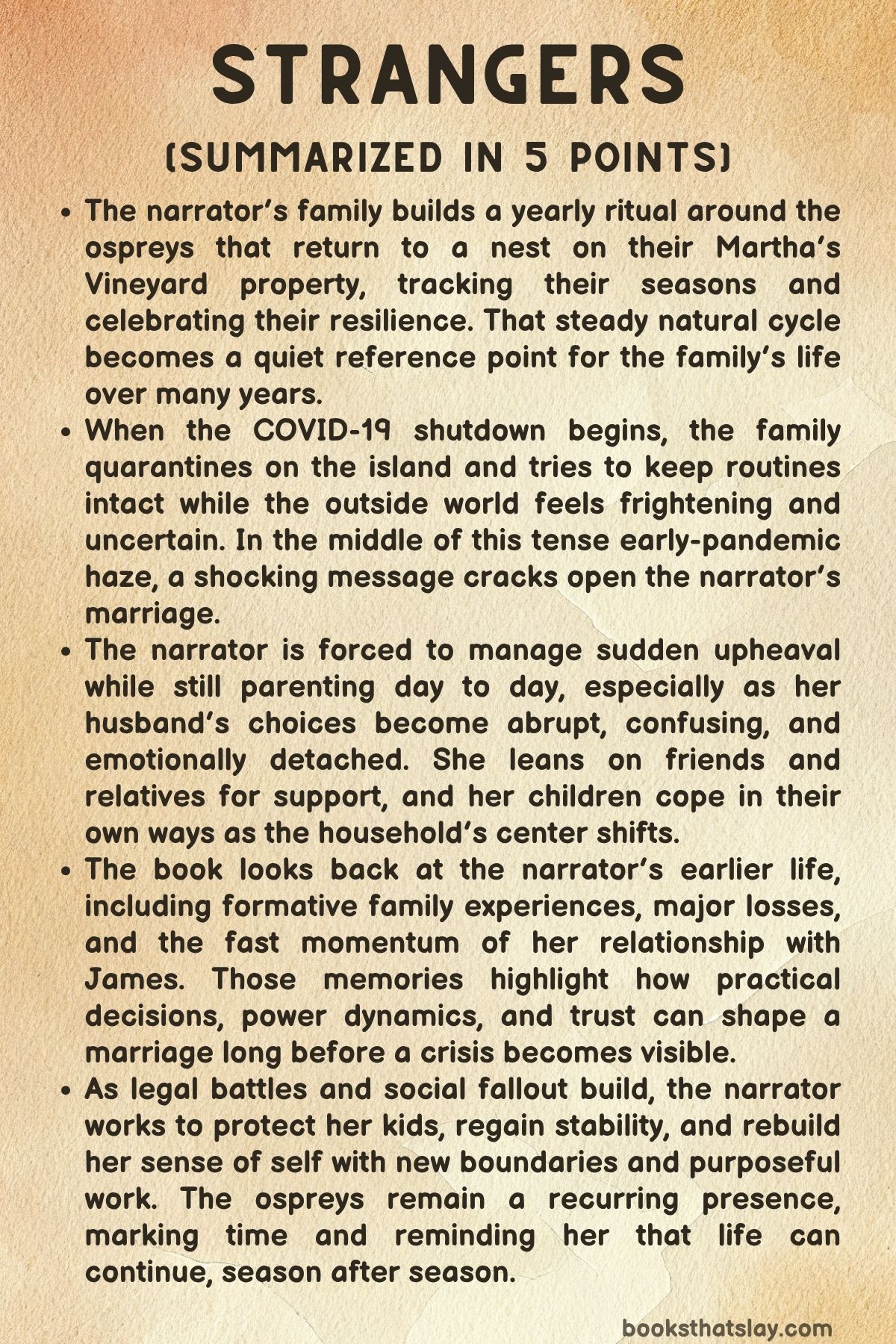
In 2005, the narrator’s family buys a house on Martha’s Vineyard, and with it comes an unexpected tradition: every spring, an osprey couple returns to a nest on the property. The birds arrive, lay eggs, raise chicks, and leave again by early fall, repeating the same pattern year after year.
The narrator’s husband, James, becomes absorbed by the ospreys’ return. He watches the nest closely, brings their children into the routine, and forms friendships with two local osprey experts.
One winter, the experts tag a bird and name it “Belle,” sending the family updates as it migrates. When raccoons repeatedly destroy the eggs, the experts install a safer nesting pole, and the ospreys eventually rebuild.
Over time, the nest grows huge, visible from across the lake—an emblem of continuity the family comes to depend on.
In March 2020, the narrator and James arrive at the Vineyard house as the United States begins to shut down. The nest is intact but empty.
The news is full of rising infections, hospital overload, and death counts. The family decides to quarantine on the island with their two younger daughters—Carrie, fifteen, and Evie, twelve—while their older son, Finn, seventeen, stays with a friend’s family on Long Island.
James sets up his remote work on a card table, wakes in the dark to track markets, locks doors, builds fires, and acts as if vigilance is his job. The narrator scrolls the news compulsively, trying to keep the girls steady.
Carrie retreats into Fortnite, living through a headset with friends. Evie begins cooking elaborate meals, starting with homemade gnocchi on the first night of spring.
That evening, after dinner, the narrator is cleaning the kitchen when she receives a voicemail from an unknown number. A young man asks for “Belle.” He tells her that James is having an affair with his wife.
The words land as if they belong to a different household. The narrator confronts James.
He leads her to a guest room and admits the affair, calling it meaningless, saying it is over, and insisting it has only lasted a few weeks. He initially resists sharing the woman’s name but finally gives it.
The narrator learns the relationship began through work and that the woman has two toddlers. The conversation is interrupted by Carrie asking for pastries.
The narrator returns to the kitchen, bakes frozen turnovers, and then breaks down alone in the shower, trying to understand how domestic tasks can still exist when her life has split in two.
She texts the caller for details and learns something even worse: the mistress has attempted suicide and is in an ambulance. The narrator rushes to tell James.
She finds him on the phone with the mistress, listening intently. When he hangs up, he tells the narrator that the woman “took a few sleeping pills” and is “fine,” and his relief is obvious.
The narrator’s mind starts moving in jagged pieces—fear, rage, disbelief, humiliation, a strange practical need to keep the girls from noticing. She calls her stepmother, Susan, and texts close friends, trying to anchor herself in other voices.
At night, she cannot sleep. James, meanwhile, falls asleep peacefully in Finn’s bed, leaving her alone with the looping replay of every detail.
At six in the morning, James appears dressed to leave. He tells the narrator he wants a divorce and is leaving immediately.
He speaks with confidence, as if he has already stepped into a new life. He says she will be fine, calls her “still young,” and admits he intends to check on the mistress.
He provides proof of the woman’s identity and a recent promotion, then walks out. The narrator hides the truth from Carrie and Evie, telling them their father had to return to New York for work.
Soon after, James calls and says a “switch has flipped.” He is done. He does not want their life, does not want custody, does not want any of it.
Lockdown begins to feel like a sealed room. The narrator swings between pleading for explanations and struggling to complete basic tasks.
James refuses therapy, answers in short bursts, then controls communication through abrupt texts dictating when he will speak. He pressures her to present the separation as friendly, but she refuses and informs his family herself.
For a brief moment she thinks she has allies, but then James’s siblings cut her off and align with him. The narrator feels the loss of an entire extended family, not just a spouse.
The girls react in different ways. Carrie keeps gaming, half protected by routine and half trapped inside it.
Evie becomes quieter, watching her mother closely and cooking dinners as if food is something she can build when nothing else is stable. The narrator alerts Finn’s guardians on Long Island so they can support him when the truth comes.
Friends and relatives begin calling daily. Susan also attempts to confront James, but his reaction is threatening; he signals that he is willing to escalate cruelty if challenged.
As April arrives, the island is cold and bleak. The narrator tries to hold Easter together, forcing herself through decorations and meals while feeling hollow.
Then the ospreys return. The narrator has the instinct to tell James the moment she sees them, and the instinct itself shocks her.
She realizes she cannot keep the divorce secret from the children. She insists James help tell them.
He suggests she do it alone over Zoom. His boss intervenes and arranges a seaplane to fly James to the Vineyard.
Before the visit, the narrator and James call Finn to tell him. Finn hangs up quickly.
The adults scramble to confirm he is safe, terrified that the news will push him into danger.
James arrives masked and paces through the house. He tells Carrie and Evie that he and their mother are separating and divorcing because he has not been happy.
Carrie initially thinks it is a joke, then erupts in screams and runs away. Evie sits rigid and silent.
James stays only ninety minutes. Immediately afterward, he asks the narrator to make him a sandwich.
She does it, stunned by the normality of the request. Instead of comforting Carrie, James searches the basement for the missing prenuptial agreement.
He leaves without finding it, briefly mentions the ospreys’ return, and departs. Later he texts, “That was a great visit!” Weeks afterward, he emails the located prenup as an attachment.
The narrator scrolls to the final page and sees her own signature from days before their wedding, full of trust she can now barely recognize.
The narrative turns back to earlier years to show how the marriage was built. The narrator meets James at Davis Polk, a law firm where she works after giving up an early desire to write.
She has already survived a major rupture: in 1996 her father dies suddenly, and she learns unsettling truths afterward—diet-drug use, hidden debt, the way grief can arrive with financial chaos attached. In 1998 she and James begin working together.
She is not initially impressed, but attraction grows as their professional lives overlap. After their first kiss, she ends a long relationship.
James buys her a first cell phone. They travel to Greece.
He proposes quickly, promising that nothing bad will ever come of it, and they rush toward marriage.
The prenup becomes the first clear warning sign. The narrator’s mother reminds her of an agreement she once promised to sign.
A family lawyer drafts a standard version: premarital assets remain separate, but what is earned during marriage is shared and divided in divorce. James reacts angrily, saying it makes him feel like an outsider.
Close to the wedding, he demands changes: only assets held jointly will be shared; anything in either spouse’s sole name stays separate even if earned during the marriage. With James listening on speakerphone, the narrator pressures the family lawyer to accept the change.
She hides the revision from her mother, Susan, and her brother because she fears they will interfere. They sign it on May 30 and marry June 5.
The wedding is elegant and controlled. The narrator quietly wishes there had been dancing.
James leaves his law firm and joins an investment firm founded by the narrator’s uncle, eventually becoming senior management. The narrator continues working and then shifts into unpaid roles, volunteering and boards, while her paid career fades.
In 1999, James’s close friend dies of a heroin overdose, and James expresses a bleak emptiness afterward, as if the future has been shut off. In 2001, they buy a large Tribeca apartment.
The narrator uses trust assets and puts the apartment in both their names, believing marriage means shared ownership.
She becomes pregnant in August 2001 and witnesses the September 11 attacks from her office window, on the phone with James as the towers fall. Afterward they hear the baby’s heartbeat at a medical appointment, a moment of fragile continuity in a shattered city.
Late in pregnancy, the narrator becomes dangerously ill with HELLP syndrome. Her symptoms are dismissed until labor, and the birth is traumatic.
Finn is healthy, and James is intensely present, filming, documenting, making a first-birthday movie. Evie is born in 2004, and Carrie in 2007, with James supportive during pregnancies and deliveries.
But after Evie’s birth, James’s workload increases and he withdraws from daily parenting, often stating he does not do “bath, bed, or homework.” The narrator becomes the core of the household, supported by a babysitter, while James remains the fun parent—trips, practices, shows, annual family movies that make their life look cohesive on screen.
The narrator’s own childhood helps explain her devotion to being present. Her mother builds a major career and later remarries and divorces a second husband whom the children love.
The narrator remembers loneliness, nannies, and one cruel caretaker named Rose who is fired when the narrator finally tells the truth. Those memories become a private vow: her children will not feel that kind of abandonment.
The couple buys the Martha’s Vineyard house in 2005—Meadowpath—funded by the narrator’s trust assets and titled jointly. They renovate, build trails, join a tennis club, and create a summer world.
Over time, losses accumulate: the narrator’s best friend dies of cancer, James’s father dies after refusing care. Money control shifts toward James.
He scrutinizes bills and spending while indulging expensive hobbies. In 2016 he joins a hedge fund and aims for partnership.
In 2018 he fails to make partner and is told to wait until 2020. In 2019, they discuss estate planning and the idea of extinguishing the prenup, but James stalls.
After James leaves during the pandemic, the narrator tries to manage the reality with her children. Carrie confronts her with the truth: she asked James directly about cheating, and he confirmed it and gave the other woman’s name.
The narrator discovers the woman uses two names, and realizes Evie had known even earlier after seeing a text notification. The narrator fills empty days with television, long walks, sea-glass collecting, and tense grocery trips under COVID rules.
She begins volunteering at a food bank, needing work that is simple and real. Even while shattered, she handles a pro bono immigration case and helps obtain special immigrant juvenile status for a young client, proving to herself that she can still function in pieces.
The prenup becomes a central threat. Because of the revision James demanded, jointly titled property is split, while each spouse keeps individually held earnings accumulated during the marriage.
The narrator searches for the document, realizing James is searching too. Friends warn her to protect herself and stop assuming decency will appear.
In May, her daughters make a birthday dinner and set the table with flowers. The narrator eats for the first time in a while, feeling both cared for and broken.
James sends a cheerful “Happy Birthday!” message after weeks of silence, and his mother and sister echo it as if nothing has happened. The narrator does not reply.
Soon she learns James is throwing away belongings in their New York building, leaving black garbage bags in the refuse room. He sells watches, discards clothes, sheds the symbols of their shared life.
A psychiatrist confirms bluntly that his sudden departure, lack of explanation, and disinterest in custody are not normal. In late May, the narrator takes the girls to New York for orthodontist appointments and to retrieve their dog, hoping the familiar city will restore a thread of connection.
James greets the girls warmly but avoids looking at the narrator. The girls describe him as “weird,” like a different person.
The narrator tries to name it gently, suggesting a “midlife crisis,” while privately searching for something that explains the transformation.
James announces he is splitting time between their apartment and one he bought for his mother, then signs a contract for a two-bedroom on Park Row, signaling a permanent new base. He acts upbeat during brief encounters, bringing sushi and chatting as if the family is still intact.
Finn resists talking about the divorce and later stays away, working with friends. Back on the Vineyard, the narrator watches three osprey chicks hatch and texts a photo to James.
He replies, “Wow!” but nothing more. Summer 2020 at the tennis club resumes cautiously under pandemic rules.
The narrator forces herself to tell people directly that James left and she is devastated, refusing to let gossip shape the story. Some members comfort her; others avoid her.
She learns the club allows only one spouse to keep membership after divorce, and people debate whether she or James will remain. James comes to the island on weekends but stays elsewhere, avoids meals, refuses overnights with the girls, and shows up at the house with his wedding ring off, casual and detached.
After Labor Day, they return to New York and find the apartment stripped of James’s presence. Two weeks later, divorce papers arrive.
James asks the court to enforce the prenup. When the narrator calls him, he is cold and mocking, framing her life as easy and privileged.
In late September, she returns to the Vineyard to close the house and sees the osprey nest empty again—the birds have migrated, as they always do.
The following year becomes a fight over home, money, and survival. The narrator redecorates the apartment to make it hers and begins writing to understand what happened.
James hires an aggressive lawyer. Court proceedings grind forward.
In early 2021, James moves into his Park Row apartment without a bedroom for the kids and rejects shared custody, offering only Thursday dinners. He becomes a peripheral figure in their daily life.
The narrator continues parenting, building boundaries, and insisting on complete financial separation when the divorce ends.
In July, a judge enforces the prenuptial agreement and sets a trial for October to decide child support and ownership of shared property, including their homes. James responds with anger and threatens to pay only minimum child support.
His lawyer proposes appraisals and suggests she either buy James out or sell one or both homes. The narrator cannot afford a buyout and realizes she may have to sell everything.
The pressure triggers a collapse. She cannot get out of bed and is overwhelmed by intrusive images of suicide, though she makes no plan to harm herself.
Her psychiatrist identifies it as suicidal ideation tied to extreme stress and the emotional meaning of home. Medication stops the images within a week, but the shame and fear remain.
As the October trial approaches, the narrator tells people what James is doing, hoping someone will intervene. Many men treat it as normal divorce “hardball.” A few friends support her, and her brother becomes fiercely involved.
An hour before trial, she and James settle on terms largely set by him. She must respond calmly and “gratefully” by email because he threatens to withdraw if she pushes back.
In the final deal, James relinquishes his interests in the house, apartment, beach, and club; he pays child support and covers medical expenses and high-school tuition; he keeps the money accumulated during the marriage. The narrator begins a long administrative untangling: opening new accounts, refinancing, updating deeds, building budgets, and communicating with James in a cold, transactional tone.
With every task completed, she regains a little control.
In 2022, she returns to a Zoom memoir class and writes daily. She reads an essay about James leaving and then turns off her camera and vomits from the aftershock of exposure.
She submits the piece to the New York Times “Modern Love.” In July 2022, her divorce decree arrives by email. She asks to return to her maiden name.
New IDs and credit cards arrive, and she feels energy in the public change. At the Vineyard property, she replaces signage that carried their shared identity, removes the old sign, and burns it in the fireplace.
Later she hosts a large party, not as celebration of loss, but as evidence that she is still here.
In 2023, “Modern Love” indicates interest in publishing but requires that she show the essay to James. She refuses at first, and the process stalls.
After Evie’s graduation, she realizes her physical longing for James has faded. Wanting publication anyway, she emails him.
He eventually responds that the essay is good and that he supports it. The piece publishes in late June 2023 online and early July in print under the title “Was I Married to a Stranger?” The narrator receives a flood of messages from readers sharing their own stories, along with backlash and abuse online.
A tabloid article emphasizes her family background, humiliating her and feeding public judgment. At the club, people congratulate her while others gossip, accuse her of revenge, and claim she harmed her children by speaking.
In the aftermath, she digitizes the DVDs James filmed over the years and watches their family life preserved on screen, feeling both warmth and grief. She admits she still does not know why James left.
She knows he has not remarried and that he sees the children only occasionally, never overnight. In October 2023, near the Brooklyn Bridge, James unexpectedly calls her name from across the street, smiling and waving.
She waves briefly and keeps walking. Later, at home with her children close by, her daughters say they miss the family they had.
The narrator acknowledges the loss but tells them they are still okay.
The osprey nest remains a steady counterpoint. The narrator watches it tilt, get repaired, and then, once again, receive the returning birds.
After everything—pandemic, betrayal, legal war, public exposure—the ospreys arrive on schedule. The narrator greets them with simple words that carry a whole history: welcome home.
Key People
Narrator (Belle)
In Strangers, the narrator is both the emotional center and the consciousness through which everything is measured: nature, marriage, motherhood, and collapse. Her identity is built on steadiness and competence—someone who can keep dinner moving, keep children calm, keep a household running—so the affair and James’s abrupt exit don’t just break her heart, they break her operating system.
She narrates shock in the language of ordinary tasks, like turnovers burning, showers, and locked doors, which shows how she tries to survive by doing, even when feeling is unmanageable. Across the book, her arc is not a neat “healing” story but a hard-earned recalibration: she learns to stop asking the person who wounded her to explain the wound, and instead turns toward control where she can find it—routine, legal and financial separation, writing, and the slow reassembly of a self that is no longer anchored to being chosen by James.
James
James is portrayed as a man who once performed devotion with intensity and then, just as intensely, performed detachment. Early on, he seems energized by rituals and roles: he becomes the family’s self-appointed protector during the pandemic, wakes early for markets, locks doors, makes fires, and manages the vibe of safety.
Yet the same controlling impulse runs through his marriage—scrutinizing bills, shaping spending, shaping narratives—and it curdles into cruelty once he leaves. His defining feature is not simply infidelity but the speed and finality of his emotional evacuation: he insists a “switch has flipped,” rejects therapy, restricts communication, and pressures the narrator to present the separation as “amicable” while acting in ways that destabilize the family.
Even his brief return to tell the children is marked by self-absorption—timed, masked, transactional, followed by a request for a sandwich and a hunt for the prenup—revealing how he treats intimacy as service and conflict as logistics. The book doesn’t offer a clear psychological diagnosis, but it renders James as someone who can be tender in contained scenes and ruthless when faced with accountability, a person whose love can look real while remaining conditional.
Carrie
Carrie embodies the teenage version of triage: when the adults’ world detonates, she defaults to distraction, rhythm, and peer connection. Fortnite is not just a hobby for her; it is a shelter where rules make sense and where she can be competent while the household becomes emotionally unsafe.
Her later confrontation—asking James directly about cheating—shows that beneath the surface retreat is sharp perception and an urgent need for truth. Carrie’s explosive reaction when told about the divorce signals that her earlier calm is not acceptance; it is postponement.
She also becomes a barometer for what feels “off” about her father after he leaves, describing him as “weird” and different, which captures how children often notice shifts in tone and presence long before they can name the cause.
Evie
Evie’s character is built through silence and care that looks like competence. At twelve, she begins cooking ambitious meals immediately, and the act carries emotional weight: she is trying to feed the family back into normalcy when the adults cannot.
Her vigilance—watching to make sure her mother eats—turns food into a language of protection, a way to mother the mother without saying the terrifying thing out loud. Evie’s rigidity during the divorce announcement and her earlier awareness of a suspicious text notification suggest she processes distress internally, carrying knowledge quietly to avoid adding pressure to a collapsing structure.
She represents the child who adapts by becoming capable, and the book treats that capability as both beautiful and heartbreaking, because it is born from necessity rather than childhood ease.
Finn
Finn functions as both the absent presence and the emotional pressure point of the quarantine separation. Physically away with another family, he is still central: his parents’ decision to keep him “safe” from the truth becomes one more fragile system the narrator must manage while in shock.
His reaction when told—hanging up quickly—captures the blunt, adolescent form of grief where speech fails and flight becomes the only available response. Finn’s later choices—to stay on the mainland, to avoid talking, to build a life with work and friends—read as self-protection and also as a quiet mourning for the family structure that vanished without his consent.
His graduation scene, with the forced proximity of the parents and the formal family photo, crystallizes how he is asked to hold two realities at once: achievement and loss, pride and fracture.
Susan (Stepmother)
Susan operates as the narrator’s crisis anchor—someone who can be called at night, someone who will say the unsayable, someone who tries to confront James when the narrator is too shattered to do it alone. She is also a structural mirror: earlier in the narrator’s childhood, she had watched her mother navigate divorce and partnership changes, and in the present Susan becomes the steady adult who models protective loyalty.
Yet Susan’s role is not sentimentalized; her attempts to intervene provoke James to threaten worse behavior, revealing how power can retaliate when challenged. She represents the difference between support that comforts and support that acts, and the narrator needs both, even when action risks escalation.
Mark
Mark appears briefly but leaves a deep contour in James’s history. His death by heroin overdose shocks the social world around them, and James’s reaction—saying he has nothing to look forward to—suggests a susceptibility to emptiness, mortality dread, and dramatic emotional conclusions.
Mark’s function is not only to show grief but to foreshadow the way James later frames his own life as intolerable and in need of total reset. The loss becomes one of the earlier cracks where meaning drains out, hinting that James’s later abandonment is not purely a romantic decision but also an expression of a person who responds to pain by trying to erase the scene of it.
Lynn
Lynn’s death is a quiet but significant pivot for the narrator because it marks another version of sudden absence—one that is tragic rather than chosen, yet still formative. Lynn represents the narrator’s adult intimacy outside marriage, a friendship that likely held parts of her identity that were not wife or mother.
Losing Lynn narrows the narrator’s emotional ecosystem, which matters later when her marriage implodes and she must rebuild connection networks under lockdown conditions. Lynn’s presence in the narrative underscores that the narrator’s grief capacity is not new in 2020; she is someone who has practiced mourning, which partly explains her ability to survive while shattered.
Tenzin
Tenzin, the babysitter, stands for the invisible architecture that makes family life possible. The narrator runs the household “with help,” and Tenzin is part of the quiet labor that allows James to claim he does not do “bath, bed, or homework” without the household collapsing.
In the larger character ecosystem, Tenzin highlights the narrator’s managerial role: she is not only a mother but the operational lead of domestic life, coordinating care, schedules, and stability. That matters during the divorce because James can leave without practical consequence to the day-to-day machine precisely because the narrator has long been the one keeping it running.
Rose (the nanny)
Rose functions as a concentrated symbol of childhood powerlessness. The narrator’s memory of a cruel caretaker and the eventual moment of telling the truth—and being believed—becomes one of the emotional roots of her adult parenting philosophy.
Rose matters because she explains why the narrator later refuses to be emotionally absent in her own children’s lives, and why James’s departure feels not only like betrayal but like a re-creation of abandonment dynamics the narrator has worked her whole life to prevent. Rose is less a fully developed person on the page and more an imprint: the early lesson that adults can harm you and that safety depends on whether another adult intervenes.
Stan (the mother’s second husband)
Stan appears as a rare pocket of warmth in the narrator’s childhood, someone the children loved, which shows that the narrator’s relationship to divorce is not simplistic. Divorce is not automatically devastation in her history; sometimes it is the ending of one structure and the possibility of another, kinder one.
Stan’s presence underscores the narrator’s longing for stable male care that feels generous rather than conditional. His eventual departure from the family system also reinforces a pattern: men can be loved and then vanish, leaving women and children to absorb the aftershock and reorganize.
Themes
Betrayal as a sudden rewrite of reality
Spring 2020 is already charged with dread: hospitals filling, death counts rising, the family tightening the perimeter of the house, and everyone trying to act normal inside an abnormal world. Into that heightened atmosphere comes an unknown caller’s voicemail, and the narrator’s ordinary life is instantly reclassified.
What had been familiar—her husband’s work calls, early mornings, protective rituals, the confidence of their shared home—becomes suspicious, possibly staged, and finally confirmed as false. The betrayal is not presented as a single act but as a conversion of meaning: the same marriage that once felt like a stable structure becomes a scene the narrator now has to re-interpret in real time, while still feeding children and washing dishes.
That is why the pain is not limited to heartbreak; it becomes cognitive and bodily shock, a crisis of perception. The betrayal also refuses to stay private: the caller brings the outside world into the home, and then the mistress’s reported suicide attempt introduces a second emergency that competes with the narrator’s own.
The narrator is forced into a grotesque split role—injured spouse and crisis manager—while James positions himself as calm and decisive, making unilateral judgments about what matters. His early framing (“meant nothing,” “over,” “weeks”) tries to control the narrative before she can even ask full questions, and his later insistence on an “amicable” story shows how betrayal can be followed by a demand for image management.
The cruelty is intensified by timing: lockdown removes escape routes, social distractions, and physical support, so the narrator’s awareness has nowhere to go. She must keep a household functioning while her internal map has been destroyed.
The theme lands hardest in the everyday details—burnt turnovers, a locked bathroom door, insomnia beside a sleeping spouse—because the betrayal doesn’t happen only in confession; it happens in the continuing mismatch between her agony and his ability to proceed as if nothing has happened. In Strangers, betrayal is an event, but it is also an ongoing condition: the narrator keeps learning new facts—two names, prior knowledge by a child, the depth of his detachment—each fact forcing a fresh rewrite of what she thought her life was.
Power, money, and the quiet mechanics of control
The marriage contains an imbalance that only becomes fully visible when it is weaponized. The narrator brings significant assets into the relationship and repeatedly converts private resources into shared life—buying homes, titling property jointly, building stability.
That generosity is grounded in a belief that marriage means mutual belonging. Yet James is shown, across years, tightening control through the administrative side of life: scrutinizing spending, managing finances, monitoring bills, and guiding major decisions while the narrator gradually gives up oversight.
Control here does not look like constant shouting; it looks like “reasonable” household systems that slowly shift expertise and authority to one person. Even the prenuptial agreement becomes a record of how power operates.
James resists the standard version because it makes him feel like an outsider, then proposes a revision that benefits the spouse who earns more and holds accounts separately. The narrator, close to the wedding and desperate to preserve peace, pushes the lawyer to accept terms she doesn’t fully grasp, hides the change from her own family, and signs.
The theme is not “she made a mistake”; it is how love, urgency, and the desire to keep harmony can be exploited by someone who understands leverage. When the divorce begins, James’s control shifts from domestic habits to procedural dominance: dictating when he will speak, refusing therapy, demanding certain public messaging, recruiting his family’s allegiance, and relying on a document designed to shape outcomes.
He also uses uncertainty as a tool—minimal answers, then silence—forcing the narrator into a humiliating posture of begging for information while he withholds it. The legal battle escalates the theme into existential threat: the prospect of losing the homes is not merely financial; it is the destabilization of identity and safety for the children.
The narrator’s collapse after the court enforces the prenup clarifies how economic mechanisms translate into psychological injury. She experiences intrusive suicidal images not because she is weak, but because shelter, continuity, and agency are being stripped away in a period when she is already isolated and exhausted.
What changes the trajectory is not a romantic rescue but the narrator learning power in reverse: separating accounts, refinancing, changing deeds, building budgets, and adopting a coldly transactional communication style. That administrative labor becomes a form of self-defense and self-recovery, reclaiming the terrain James once dominated.
Money is never just money here. It is the language through which belonging is granted or denied, the instrument through which one person can reduce another to pleading, and later the set of tools through which the narrator rebuilds autonomy.
Parenting under rupture and the burden of emotional labor
The divorce is not only a marriage ending; it is a family system forced to operate with a missing pillar while pretending, at least initially, that nothing has changed. The narrator carries the load of keeping the household emotionally safe during lockdown, and the theme is sharpened by the children’s different coping styles.
Carrie disappears into online play and peer chatter, using noise and routine to avoid direct confrontation. Evie turns to cooking, producing elaborate meals that function as care, control, and distraction; she watches whether her mother eats, which quietly reverses the normal direction of caregiving.
Finn is physically separated from the household, and the narrator must coordinate his protection through other adults while handling the terror of telling him the truth. The children’s reactions are not presented as tidy lessons; they are messy and age-specific, with screaming, silence, withdrawal, and the slow dawning realization that a parent can choose absence.
James’s involvement highlights a second layer of rupture: he performs fatherhood in a brief, choreographed visit—masked, paced, timed—then immediately shifts attention to legal paperwork and domestic convenience. The sandwich request after announcing divorce becomes a symbol of how the narrator’s labor is treated as an automatic service even in the moment of devastation.
The theme also covers how the narrator manages community perception to protect her children: she walks into the club, tells people directly, absorbs others’ avoidance, and endures praise of James without collapsing in public. That is emotional labor performed for the family’s stability and social survival.
Later, the custody decisions reveal a colder form of parental abandonment: no bedroom for the kids, limited dinners, reluctance for overnights. The narrator becomes the consistent parent by default, but consistency is not romanticized; it is draining, lonely, and often unseen.
Even moments that should be purely celebratory—Finn’s graduation, birthdays, holidays—become scenes where the narrator must contain her own feelings to keep the child at the center. The theme reaches further back into her own childhood experiences with loneliness, nannies, and her mother’s demanding career, showing how her commitment to being present is partly a corrective.
That history makes James’s withdrawal especially piercing: it threatens the very kind of childhood she promised herself her children would not have. Yet the arc also shows the children participating in resilience, not through speeches, but through small acts: a meal cooked, a table set with flowers, a comment that their father seems “different,” a request for honesty.
Parenting is portrayed as the daily practice of absorbing shock so children don’t have to, even while the parent is breaking, and then slowly transforming that practice into a new, sustainable form of family life.
Cycles of return and the long work of rebuilding identity
The ospreys’ seasonal pattern provides a counterpoint to the narrator’s disrupted human life: return, repair, departure, and return again. What matters is not poetic comparison but the practical contrast between a natural cycle that can be trusted and a relationship that cannot.
The nest is visible, public, and recurring; the marriage becomes opaque, sudden, and inexplicable. During the pandemic spring, the empty nest holds the tension of waiting, and when the birds return, the narrator’s first impulse is to tell James—a reflex that exposes how deeply partnership had been embedded in her sense of daily meaning.
The moment she remembers he is gone shows identity loss: she has not only lost a spouse but also the automatic recipient of her attention, the person who shared the rituals that structured time. Rebuilding identity then becomes a sequence of grounded choices rather than a single transformation.
She starts with survival routines: grocery trips, walks, sea-glass collecting, volunteering at a food bank. These acts look small, but they reintroduce agency, responsibility, and a sense of usefulness when her private life feels pointless.
Her legal work on the immigration case is especially significant because it anchors her in competence and moral purpose while her marriage narrative collapses. Over time, she begins to construct a public self that is no longer attached to James’s approval: she tells people the truth, takes a memoir class, writes the account, and later navigates both praise and abuse when the essay is published.
That publication exposes another aspect of rebuilding: owning one’s story can be empowering, but it also invites judgment, especially when class and privilege become weapons used against her. The theme also includes bodily and symbolic acts of separation: changing IDs, returning to her maiden name, replacing the driveway sign, burning the old shared sign.
These are not decorative gestures; they are identity administration, the same kind of procedural work that once allowed James to dominate outcomes, now repurposed to confirm a new reality. Even the later moment when she waves at James and keeps walking shows a settled boundary: recognition without re-entry.
The ospreys remain present as a measure of time that does not require James to make sense. The nest tilts, is repaired, and the birds return again, reflecting how stability can be rebuilt without pretending nothing was lost.
The narrator’s life after divorce still contains longing and grief, especially in the preserved family videos, but longing no longer dictates action. Rebuilding identity is shown as an extended process of reclaiming time, space, name, money, and narrative—piece by piece—until the self is no longer organized around someone else’s choices.