Such a Clever Girl Summary, Characters and Themes
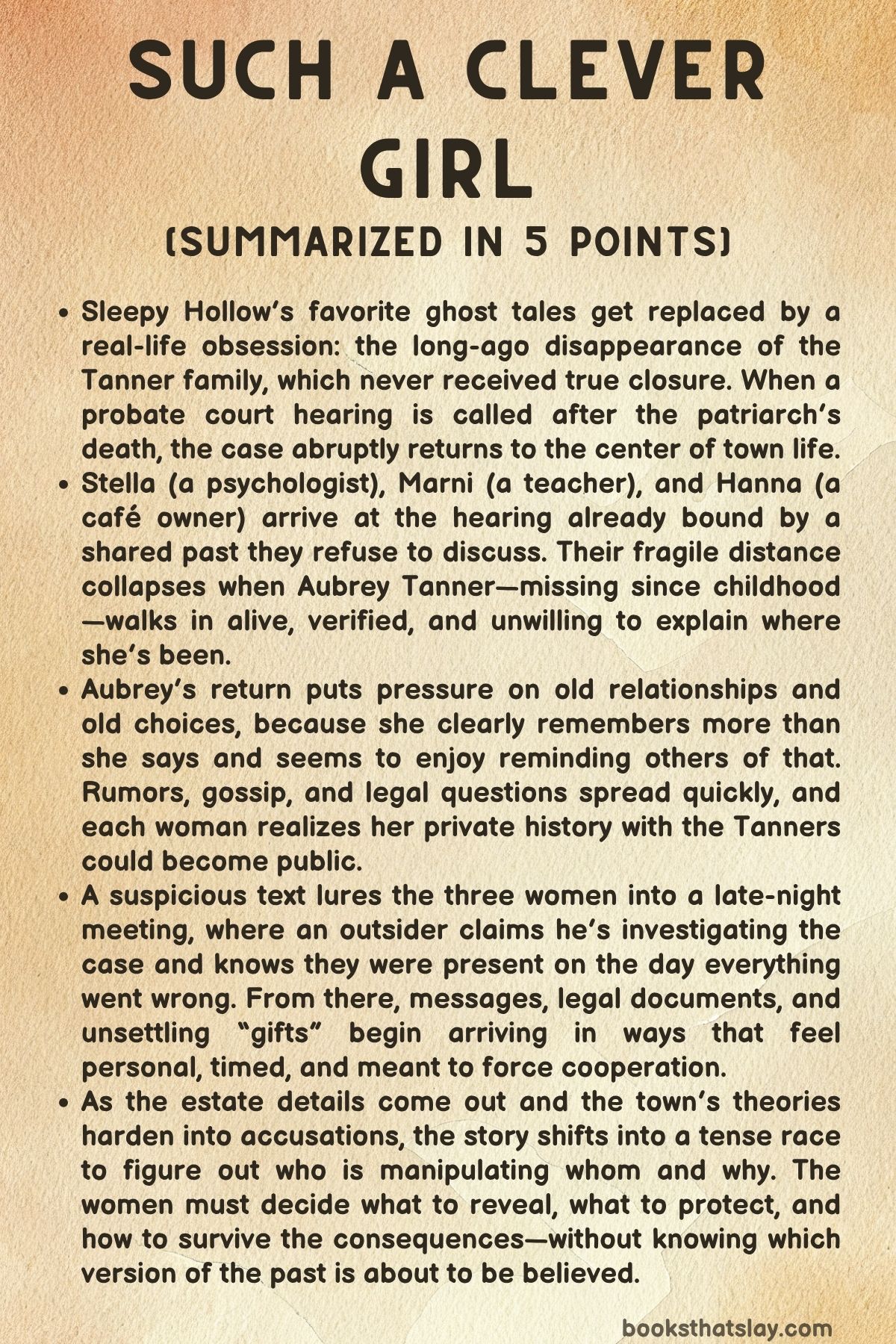
Such a Clever Girl by Darby Kane is a suspense novel set in Sleepy Hollow, New York, where locals trade in ghost stories—but the town’s true obsession is the Tanner family, who vanished fifteen years ago without a trace. When Xavier Tanner dies, a rushed court hearing meant to settle his estate instead cracks open the old case.
The shock arrives in human form: Aubrey Tanner, the missing daughter, walks back into town alive, calm, and unbothered. Her return pulls three women—Stella, Marni, and Hanna—back into the worst day of their lives, forcing them to face what they did, what they hid, and what the Tanners were capable of.
Summary
Fifteen years after the Tanner family disappeared in Sleepy Hollow, their absence still shapes the town’s identity. The abandoned Tanner mansion sits as a rotting reminder, and the story has become local folklore—half crime case, half cautionary tale.
Then Xavier Tanner dies, and the law demands answers: estates can’t be cleanly settled while family members are still legally missing. An emergency hearing is called in Westchester County Surrogate’s Court, drawing in people who have long tried to keep their distance from anything Tanner-related.
Stella, a psychologist and Xavier’s great-niece, arrives with her mother, Isabel Clarke. Isabel depended on Xavier’s money and is panicked about what happens now.
In the courtroom Stella notices two other women she would rather not see: Marni Richards, a schoolteacher, and Hanna Sato, who owns Sleepy Hollow Coffee. The three sit apart, tense with a shared past they refuse to name.
Before the hearing even begins, attorneys get pulled aside, and the room feels charged.
Then the door opens and the impossible happens. Aubrey Tanner—missing since she was a teenager—walks in alive.
She looks older, controlled, and fully aware of what her presence does to the room. She makes a small comment about arriving “just in time,” offers no explanation, and lets the shock do the work.
The judge postpones proceedings so she can get counsel, and Aubrey leaves as quickly as she arrived, still not answering a single question.
The fallout hits immediately. Marni spirals, remembering Aubrey as a frightening teen linked to unsettling “accidents,” a suspicious bedroom fire, and a pattern of lies that never quite stuck to her.
Marni’s fear isn’t only about the town talking again—it’s about investigators looking again. Her guilt about Victoria Tanner, once her closest friend, gnaws at her, and she’s certain Aubrey’s return is not a coincidence.
Hanna tries to bury her panic in routine at her café, but she can’t stop thinking about Aubrey either. Her nineteen-year-old son, Jeremy, pushes for details, curious about the revived mystery.
Before Hanna can shut the conversation down, Aubrey walks into the café like she owns it. She greets Jeremy by name, implying she knew him as a child, and watches the discomfort spread across Hanna’s face.
Aubrey leaves with a wink and a promise to see Hanna soon—delivered like a warning.
Stella turns to her ex-husband, Lukas Grange, a respected prosecutor with political ambitions. She drinks while trying to steady her thoughts and asks Lukas what he knows.
Lukas admits Aubrey already provided DNA and documents to confirm her identity and secured a continuance through her attorney. Stella hears more than he says.
Lukas’s tone makes it clear he’s thinking defensively, already calculating what Aubrey might reveal. He suggests they need to get ahead of it—and that he intends to deal with the problem before it wrecks their lives.
Meanwhile, Jeremy becomes fascinated by the case. Like many in town, he toys with theories: Aubrey killed her family; the family staged their own disappearance; someone covered it up.
Hanna listens, unsettled, because Jeremy’s guesses drift too close to pieces of truth she’s spent years locking away. She knows Aubrey remembers more than she should—and Hanna knows Aubrey saw Hanna at the Tanner house on the day everything happened.
Aubrey, in her own narration, makes her intentions plain. She views Stella, Marni, and Hanna as people who benefited from the Tanners and then ran—an ex-therapist, an ex-friend, an ex-employee.
In Aubrey’s mind they are liars who protected themselves while her family story turned into entertainment for strangers. She returns with a plan: force them to serve her now, and make sure each of them pays a price.
Marni reaches out to Cameron Vincent, a retired detective who worked the original Tanner investigation. Cam is blunt: Aubrey’s return will reopen every question, and Marni, Stella, and Hanna need to stick to their old statements.
He urges coordination because if someone breaks first, the others could go down with them. Marni leaves the meeting more terrified, not comforted.
Soon a text summons all three women to Hanna’s café after closing. They arrive separately, suspicious and angry, ready for Aubrey to appear.
Instead, they discover something worse: none of them sent the message. The text came from a fake number using Hanna’s name.
Before they can decide how to react, there’s a knock at the door, and the outside light stays off. Whoever is there was waiting in the dark.
The visitor is not Aubrey but a young man who introduces himself as Gabriel “Gabe” Harbison. He admits he engineered the text to force them into the same room.
Gabe claims he’s writing about the Tanner case and believes the women are essential to understanding what happened. He pushes hard, hinting he knows about the emergency court hearing and even details of Xavier’s estate plans.
Then he drops the most dangerous claim: he knows they were at the Tanner house the day the family disappeared. He leaves a business card and warns that they should want anything he publishes to be accurate.
After Gabe leaves, the women argue and panic. Stella vows to dig into Gabe’s identity.
Hanna insists they stop acting alone and start sharing information, because someone is moving pieces around them. They agree on coded communication and a cover story about a community project.
That night Hanna finds a hand-delivered postcard in her mailbox: “It’s started. Be ready.” The message confirms what she already feels—this isn’t gossip; this is an active threat.
Stella talks with Lukas again, and Lukas raises a chilling possibility: Gabe’s age fits what Noah Tanner—the missing eight-year-old boy—would be now. Stella rejects it, but Lukas reports he can’t find real background on Gabe.
The digital trail begins only recently, suggesting a new identity. The idea that Noah might be alive, under a different name, slides into Stella’s mind and won’t leave.
Not long after, a formal meeting is scheduled at a law office to discuss Xavier’s estate. Present are Stella, her mother Isabel, Lukas, Marni, Cam, Hanna, and Aubrey.
The attorney reads Xavier’s provisions, and each item is designed to provoke. Lukas receives Xavier’s Mercedes with a note suggesting Xavier expected Lukas to understand why.
Isabel receives an old truck and a large insurance payout. Stella is named beneficiary of retirement accounts with discretion to share with Isabel.
Then Marni is humiliated when she’s left Victoria Tanner’s wedding ring, accompanied by a note: “Because it’s what you always wanted.” Aubrey receives the held assets and the family home, pending probate and legal declarations of death.
Then comes the blow that breaks Hanna. Xavier’s massive family trust—property, investments, and money—is left not to relatives but to Jeremy Sato.
Hanna is named trustee, paid only a small annual fee. The trust language confirms Jeremy qualifies as “family,” pointing straight to paternity.
Aubrey openly mocks Hanna, demanding she explain it. Hanna panics and flees.
At home, Jeremy hears the implication and demands the truth. Cornered, Hanna admits Xavier Tanner is his father.
She explains the relationship began when she was young and vulnerable, and that Xavier used money and attention to pull her in. Jeremy is sickened, interpreting it as a transaction, and storms out, refusing comfort.
Aubrey watches the collapse from outside and considers the first stage complete: Hanna’s secret is exposed, and Jeremy is now trapped in the Tanner orbit.
Then violence escalates. Hanna’s café burns in a suspicious fire.
Her employee Daniela is badly injured and placed in a coma, and investigators suspect she may have been attacked before the fire was set. Even worse, Jeremy disappears.
He leaves behind his wallet, keys, and phone, and no one can find him. Police suggest he might have run off after learning the truth, but Hanna insists he wouldn’t vanish like that.
Stella rushes to help, and the women converge again at Xavier’s estate as Hanna searches for signs Jeremy came there. Police arrive—but not for Jeremy.
They are there for Marni. Bones found on the Tanner property have been identified as Patrick Tanner’s, confirmed by a unique identifier linked to a rod implanted in his leg after an old fracture.
Marni is taken in for interrogation, confronted with evidence: her engraved bracelet, a gift from Patrick, found wrapped around his hand. Under pressure she admits she had an affair with Patrick but insists she didn’t kill him.
She claims Patrick was already dead when she arrived at the house fifteen years ago.
Hanna becomes convinced Jeremy has been taken, not lost. She searches the grounds, checks outbuildings, and visits Daniela under guard in the hospital.
Still no word. Then Hanna finds Aubrey inside Xavier’s mansion.
Aubrey claims Xavier hid her for years, changed her name, and paid her to stay away until he died. She denies setting the café fire and denies taking Jeremy, but she insists someone is framing her and using Jeremy to do it.
Aubrey says multiple people were at the Tanner house the day the family vanished and declares she will punish whoever actually killed her parents. She pushes Hanna to work with her, warning that time is running out.
Desperate, Hanna convinces Stella and Marni to go to the old Tanner home where Aubrey appears to be staying. Inside the decayed house, they sense they’re being watched.
Hanna runs upstairs and finds Noah’s old bedroom disturbed, as if someone recently searched it. A scream erupts downstairs.
Marni has been struck in the head by someone they don’t see. The attack confirms they are dealing with more than threats.
After Hanna and Stella get Marni to safety, the hidden truth starts spilling out. Marni admits that fifteen years earlier Victoria discovered Marni’s bracelet and used Patrick’s phone to lure Hanna to the house, intending to force a confrontation that would set blame where Victoria wanted it.
Marni says Patrick was already dead when she arrived. Hanna admits she picked up a knife and later wiped it to remove fingerprints, destroying evidence because she feared losing her son.
Marni admits she called Cam, who told her to leave and said he would handle it. Hanna admits she called Xavier instead of police.
Stella reveals she was called to the house too, and when she confronts Isabel, Isabel admits she went there as well. The women realize their timeline still doesn’t make full sense—and they are all lying about something.
A grim discovery follows: divers pull another body from Xavier’s pond, likely Victoria. Then Stella pressures Isabel again and finally gets a chaotic confession.
Isabel implies she set fires—including the bookstore fire the night the Tanners vanished and the more recent café fire. She suggests someone told her to do it and that it was meant to scare Hanna and destroy evidence.
Stella secretly records the confession.
Hanna receives a note written as if from Xavier, instructing her to keep Jeremy safe and finish what he could not. The note references “killers,” plural.
Hanna understands Xavier designed his “gifts” to force the truth into daylight after his death. Cam later reveals he’s been delivering these messages for Xavier, following posthumous instructions like an errand that never ended.
On Halloween night, Hanna sets a trap in Xavier’s mansion. She hides Jeremy in the pantry and waits in the dark library.
A motion sensor triggers, and Lukas enters through a hidden passage, dressed in black, carrying a flashlight. Hanna turns on the lights.
Aubrey appears too, and they corner him. Lukas denies wrongdoing until Aubrey forces the past into the open: when she was fourteen, Lukas—nearly thirty and married to Stella—had sex with her repeatedly using the tunnels and passageways.
Lukas tries to twist it into a lie, but Aubrey provides specifics Stella can’t ignore. Stella realizes Lukas has lied about his whereabouts and his role in the old night.
The confrontation becomes dangerous. Lukas pulls a knife and grabs Hanna as a shield.
Stella arrives, admitting she lured him there with a message suggesting Jeremy would speak to police. Stella plays Isabel’s recorded confession, revealing Isabel claims Lukas instructed her to set fires and target Jeremy.
Lukas tries to escape responsibility by framing Aubrey as a killer motivated by inheritance, but timelines collapse under scrutiny.
Jeremy bursts out from a hidden bookcase passage and tackles Lukas, knocking the knife loose. A gunshot hits the ceiling—Aubrey has brought a gun and holds Lukas at gunpoint.
She pushes Stella to shoot him, trying to make Stella complicit. Hanna refuses, warning Stella that killing Lukas would destroy her custody and her life.
In the struggle, another shot shatters a window. Lukas runs, but Hanna grabs the knife and stops him long enough for police to arrive and arrest him.
In the aftermath, authorities recover three bodies: Patrick in the garden area and two bodies from the pond. The second pond body is a young boy, likely Noah, closing the missing-person count in the most brutal way possible.
Hanna, Stella, and Aubrey are offered immunity in exchange for cooperation against Lukas. Marni may still face legal consequences for withholding what she knew.
Cam admits Xavier engineered much of this. Xavier hid evidence, controlled security footage, and collected leverage over people to keep them trapped.
He also arranged for Hanna’s café mortgage to be paid off quietly and ensured Hanna wouldn’t lose Jeremy, partly due to Cam’s influence. Hanna receives Xavier’s final letter, in which he admits he set her up expecting her to fail, then grudgingly respected her refusal to break.
He leaves trustee fees and the trust to Hanna and Jeremy, locking them into the Tanner legacy even as it poisons them.
Life begins to restart in pieces. Hanna plans to rebuild the café with Daniela as a partner once she recovers.
Aubrey reappears with the young man known as Gabe, who admits he’s writing a criminology thesis about true-crime culture and how people profit from real suffering. Aubrey plans to pursue the same PhD program, stepping into the Tanner identity when it suits her.
Finally, Aubrey privately reveals what actually happened. Noah drowned after following her to the pond.
She watched without intervening, felt little, and later weighed his body down to hide it. Victoria returned furious after realizing betrayal connected to Marni’s bracelet and the affair.
While Aubrey was having sex with Lukas in the hidden tunnels, Victoria killed Patrick. Then Victoria was likely killed by Lukas when she caught him with Aubrey.
Xavier and Lukas disposed of bodies and controlled the narrative. Aubrey used what she knew to make a bargain with Xavier: silence in exchange for protection, money, and a new identity—until Xavier’s death gave her the opening to return, collect what she could, and force the survivors to face what they helped bury.
Characters
Aubrey Tanner
Aubrey is the story’s most deliberate force—someone who treats people the way a strategist treats pieces on a board. Her return to Sleepy Hollow isn’t a homecoming so much as a timed detonation, engineered to force everyone who benefited from the Tanner family’s power to relive the day the family vanished.
She projects composure and even charm, but it’s a performance designed to unsettle: she watches reactions like data, savors fear, and speaks in lines that land like threats while still sounding polite. In Such a Clever Girl, what makes Aubrey especially unnerving is that she doesn’t just want answers—she wants authorship.
She frames her plan as a “masterpiece,” which reveals a deeper need to control narrative, blame, and consequence, as if the truth only matters when it’s arranged in a shape she approves. Over time, her cruelty reads less like impulsive violence and more like a cultivated philosophy: she believes people are liars and parasites, and therefore deserving of coercion.
Even when she claims she didn’t start the café fire or take Jeremy, she stays committed to the same core tactic—turning others’ secrets into leverage—until she can decide who gets punished and how.
Stella Clarke
Stella operates from the tension between professionalism and self-preservation: she’s trained to interpret human behavior, yet she repeatedly chooses denial when the interpretation threatens her life. Her connection to Xavier as his great-niece gives her proximity to money and influence, but it also traps her in a legacy of manipulation that she both resents and relies on, especially when Isabel’s financial dependence makes the estate feel like a lifeline.
Stella’s defining trait is how quickly she tries to convert panic into control—calling Lukas, researching Gabe, insisting on strategies—yet that competence is constantly undermined by her blind spots, particularly around Lukas and her mother. She tends to judge Marni and Hanna harshly at first, partly because moral distance is comforting; if their guilt is “worse,” then maybe hers is survivable.
As the story tightens, Stella becomes a figure of reluctant clarity: she realizes her timeline doesn’t add up, recognizes Isabel’s instability, and finally accepts that her marriage and her family were built around a dangerous lie. Her greatest fear is not just scandal, but losing Everly, and that fear shapes her choices into a careful calculus—truth matters, but only if she can stay standing after it’s spoken.
Hanna Sato
Hanna is the character most defined by endurance—someone who built a life, a business, a home, and a child on top of a buried catastrophe and then tried to survive by keeping it sealed. The café is more than her workplace; it’s her proof that she escaped the Tanners’ orbit and made something real.
That’s why Aubrey’s wink and “I’ll see you soon” lands as a personal invasion: Hanna’s stability is targeted, not her reputation alone. When the trust reveals Jeremy’s paternity, Hanna’s internal balance breaks into two competing instincts—protect Jeremy at all costs, and protect the version of herself that believes she wasn’t bought.
Her confession shows she isn’t merely hiding shame; she’s hiding a story that can destroy her son’s sense of identity. Hanna’s choices often look reactive—alarms, frantic calls, searching the grounds—but underneath is a stubborn moral core: she refuses to let Stella become a killer, refuses to be manipulated into crossing a line that would cost Everly a mother, and ultimately sets a trap that forces the hidden predator into the open.
Hanna’s arc is less about becoming fearless and more about staying human while everything around her encourages monstrous solutions.
Marni Richards
Marni is the novel’s portrait of guilt as a long-term illness: she has lived fifteen years with a secret that never stopped burning, and Aubrey’s return turns that low-grade panic into a full-body crisis. On the surface she’s an elementary school teacher—someone associated with care and steadiness—but her inner life is a storm of dread, self-reproach, and the fear of being exposed as someone who wanted what she shouldn’t have wanted.
Her affair with Patrick, the bracelet, and Victoria’s ring in the will combine into a humiliating narrative that Marni can’t escape: she is cast as the woman who wanted another woman’s life, and the story punishes her by making that desire legible to everyone. Marni’s tragedy is that she is both guilty and not guilty in the way that matters; she didn’t commit the headline crime, but she participated in the cover-up ecosystem that let the crime rot into myth.
Even when she tries to seek protection through Cam, it’s clear she’s accustomed to men handling the mess while she carries the emotional cost. Her eventual push to tell the others what happened is less a brave confession than an act of desperation—yet it’s also the first time she attempts honesty without bargaining for safety in return.
Lukas Grange
Lukas is the story’s clearest embodiment of respectable menace: a man whose public reputation is designed to make people doubt victims before they doubt him. His role as a prosecutor and potential judicial appointee isn’t just background; it’s a weapon, because his authority makes his denials feel pre-certified.
He presents himself as controlled and pragmatic, always suggesting he can “handle” the problem, but that language exposes the truth: he doesn’t want to resolve the past, he wants to contain it. The revelation of his sexual abuse of Aubrey when she was fourteen reframes everything—his secrecy, his urgency, his interest in controlling information—as a long campaign to protect himself.
Lukas’s relationship to power is intimate and predatory; he doesn’t just exploit Aubrey, he uses hidden passageways, legal knowledge, and other people’s vulnerabilities to keep his world intact. His later desperation—knife in hand, hostage tactics—strips away the polished persona and reveals the same core entitlement: he believes he should be able to escape consequences because he always has before.
Xavier Tanner
Xavier functions as the dead hand still steering the living—an architect of posthumous pressure who turns inheritance into interrogation. Publicly, he’s a wealthy patriarch whose estate needs legal resolution; privately, he’s a collector of leverage who treated people like files to be stored and deployed.
The will is not a sentimental document but a staged provocation: the car to Lukas with a knowing note, the ring to Marni with a cruel message, the trust to Jeremy with language that detonates Hanna’s life. Xavier’s greatest power is that he understood everyone’s weak points and could make them collide on command.
Even after death, he continues manipulating outcomes through Cam as messenger and through timed “gifts” meant to force confessions. His final letter adds complexity without absolution—he admits he expected Hanna to fail, admired her resilience, and feared Aubrey’s ruthlessness—showing a man who can recognize strength while still treating people as experiments.
In the end, Xavier is less a tragic patriarch than a cynical engineer of human collapse, convinced that the truth only emerges when people are squeezed hard enough.
Victoria Tanner
Victoria is largely absent in the present timeline, but her presence dominates the emotional architecture of the past—friendship betrayed, marriage poisoned, motherhood turned into a story others rewrite. Through Marni’s memories, Victoria appears as someone who wanted control in a life that was slipping from her: a failing marriage, a husband’s infidelity, and a family image under threat.
Her confrontation with the bracelet becomes a symbolic breaking point, because it turns private betrayal into physical proof. Victoria’s reported actions that day read like a final attempt to force accountability by making Hanna and Marni collide, as if only spectacle could produce truth.
She is also portrayed as a woman surrounded by men who reshape reality—Patrick through deceit, Xavier through concealment, Lukas through violence—and that context makes her rage feel less like instability and more like an overdue response to sustained humiliation. Even so, her trajectory is tragic because her anger becomes part of the machinery that destroys her; she is consumed by the very struggle to reclaim agency.
Patrick Tanner
Patrick is defined by absence and aftermath: he is the missing man whose body and objects become evidence, and whose moral rot spreads through everyone who circled him. As husband, he appears manipulative and unfaithful, using secrecy as a lifestyle rather than an exception.
His affair with Marni isn’t just personal betrayal; it’s an action that creates a chain of leverage and shame that can be activated years later, especially when the bracelet reappears as a literal link between his death and Marni’s life. Patrick’s death becomes a narrative battleground—was it violence between lovers, a family implosion, or something orchestrated?—but the story consistently frames him as a catalyst rather than a mystery in himself.
He leaves behind emotional wreckage that others must carry: Victoria’s fury, Marni’s guilt, Hanna’s fear of exposure, and Aubrey’s contempt for adult hypocrisy.
Isabel Clarke
Isabel is a character shaped by dependence and volatility, clinging to Xavier’s support and reacting to its loss with a panic that quickly curdles into dangerous behavior. She presents as a mother who worries about survival, but her actions reveal a willingness to torch anything—literally and figuratively—to protect herself.
Her confession suggests she has set fires across different points in her life, which makes her both an unreliable narrator and a terrifyingly capable tool for someone else’s agenda. Isabel’s instability also explains Stella’s emotional patterns: Stella learned to manage crises, anticipate outbursts, and treat truth as negotiable because the household required constant damage control.
Whether Isabel acts from manipulation, mental unraveling, or both, she represents the way fear can become criminal momentum, especially when reinforced by someone like Lukas who can point her toward “solutions” that erase evidence.
Cameron Vincent
Cam is the worn-down gatekeeper of the case—a retired detective who carries the weight of improvised choices made under pressure and the knowledge that those choices shaped fifteen years of lies. He reads as blunt and pragmatic, advising Marni to keep timelines consistent, not out of morality but out of survival logic.
Cam’s confession that he staged a discovery, returned to a changed scene, and then followed Xavier’s directives shows a man who slid from investigator to accomplice without ever fully deciding to be one. His later role as Xavier’s “mailman” deepens that moral compromise: he becomes the delivery system for Xavier’s posthumous manipulation, even while believing he’s helping uncover the truth.
Cam isn’t portrayed as evil so much as exhausted—someone who knows the system fails in moments of chaos and who chose containment over honesty, then spent years living inside the consequences of that choice.
Jeremy Sato
Jeremy begins as a grounded presence—young, curious, and close enough to his mother to notice when she’s hiding something—but he is quickly turned into collateral damage by adult secrets. The trust revelation forces him into a new identity without consent, and his reaction is raw and moral: he sees the power imbalance, suspects transactional exploitation, and feels disgust not only at Xavier but at the possibility that his own origin story was purchased.
Jeremy’s anger isn’t just teenage outrage; it’s an attempt to protect his sense of self from being rewritten by money and scandal. His disappearance becomes the story’s sharpest emotional threat because it targets Hanna’s central vulnerability: not her reputation, but her child.
When Jeremy later intervenes physically during the confrontation, it signals a shift from passive victim to active agent—he refuses to let the adults’ war decide his fate, even as he remains trapped in the consequences of their long deception.
Gabriel “Gabe” Harbison
Gabe presents himself as a true-crime writer chasing a story, but his real function is as a destabilizer and proxy—someone who manufactures confrontation through deception and then pretends it’s journalism. His lack of a digital footprint, his careful timing, and his knowledge of the women’s presence at the Tanner house mark him as someone with a constructed identity and a hidden stake.
The suspicion that he could be Noah is powerful precisely because it weaponizes uncertainty; it shows how little anyone truly knows and how easily the past can return wearing a new name. When revealed as an accomplice moving through secret passages and striking Marni to prevent discovery, Gabe becomes less an investigator and more an instrument—useful because he can act in shadows while others take the public blame.
By the end, his “criminology thesis” framing connects him to one of Such a Clever Girl’s sharpest critiques: the way real tragedy becomes content. Still, his actions prove he’s not merely observing exploitation—he participates in it.
Everly
Everly is not a driver of plot in the same way as the adults, but she is Stella’s moral anchor and the constant reminder of what is at stake beyond reputation. Her presence forces Stella to make decisions with consequences that extend into the next generation, turning legal danger and public scandal into something more intimate: the threat of losing motherhood.
Everly’s quiet function is to sharpen the stakes of violence and coercion, especially when Hanna refuses to let Stella be manipulated into killing Lukas, explicitly linking that choice to Everly’s future. In that way, Everly represents the possibility of breaking cycles—of choosing a harder, lawful path even when vengeance is being offered as relief.
Daniela
Daniela embodies the cost of the story spilling into ordinary life: she isn’t a player in the Tanner legacy, yet she becomes brutally harmed by its resurgence when the café burns and she is left in a coma. Her injury turns Hanna’s fear from psychological to immediate and bodily—proof that the threat is no longer contained to secrets and gossip.
Daniela also represents what Hanna is fighting to preserve: a community built through work, relationships, and everyday care, all of which can be destroyed by someone else’s obsession with control. The plan to rebuild the café with Daniela as partner underscores the story’s closing movement toward reconstruction, not as triumph, but as refusal to let the Tanners’ darkness be the final author of Hanna’s life.
Dea Tanner
Dea appears mostly through rumor and implication, but her role is thematically important because she widens the Tanner legacy beyond one vanished family event into a longer pattern of suspicion, wealth, and possible violence. The fact that people speculate Xavier arranged her death speaks to the town’s understanding of the Tanners: they are not just unlucky, they are dangerous in the way powerful families can be dangerous—by making truth negotiable and consequences optional.
Dea’s shadow adds depth to Xavier’s character, suggesting that fear of him didn’t begin with the disappearance; it may have been part of the family atmosphere long before Aubrey returned.
Themes
Control as Currency in a Closed Community
In Such a Clever Girl, control doesn’t come from strength or truth; it comes from who can shape what others believe happened. Sleepy Hollow’s public identity is built on spooky folklore, but the real power in town flows through something more practical: secrets that can be traded, withheld, or weaponized.
The Tanner disappearance becomes a local legend not because people lack information, but because the right people have kept information fragmented and contradictory. Xavier’s influence shows how money can be turned into social gravity.
He supports Isabel financially, sets up estate structures that force people into rooms together, and designs inheritance “gifts” that don’t merely distribute wealth but pull emotional levers—humiliation, panic, rage—on command. That kind of control is not an abstract personality trait; it is a system.
He keeps people dependent, then uses that dependency to guide behavior long after his death.
Aubrey’s return escalates this dynamic by shifting the method from quiet leverage to direct psychological pressure. She doesn’t need the town to love her; she needs specific people to fear what she can reveal.
She uses timing—showing up at court, walking into Hanna’s café, sending messages from fake numbers—to create the feeling that she is always one step ahead and can enter anyone’s space at will. Even Gabe’s staged meeting demonstrates how control is performed: he forces an encounter, demands an “official response,” and turns their discomfort into material he can publish.
The women are trapped between two kinds of control: private coercion and public narrative. When the police enter the story, the pressure doesn’t ease—it changes shape.
Interrogations, evidence bags, and media attention become tools that intensify fear, pushing people toward silence or desperate cooperation. What makes this theme especially unsettling is that control rarely looks like a single villain barking orders.
It looks like paperwork, inheritance clauses, missing footage, sealed timelines, and conversations where someone casually says they will “handle” things. In that environment, truth becomes less important than who can make the next move feel inevitable.
Guilt, Complicity, and the Stories People Tell to Survive
The long shadow hanging over the characters is not only what happened fifteen years ago, but what they did afterward to live with it. The women’s present-day anxiety isn’t vague dread; it has structure, because each of them has a specific point where fear turned into a choice.
They didn’t simply “keep a secret.” They made decisions that reshaped outcomes—calling Xavier instead of the police, wiping fingerprints, leaving the house, sticking to rehearsed accounts, maintaining a shared story even when they hated each other. The book treats guilt less like remorse and more like a survival mechanism that becomes permanent.
Once a person crosses a line to protect themselves or their child, the next lie becomes easier, and then necessary. Over time, the lie hardens into identity: the careful mother, the respectable professional, the steady teacher.
Each role is built on not letting the past surface.
That is why Aubrey’s return functions like a knife under the ribs. She doesn’t introduce new information at first; she forces them to feel the weight of what they already know.
Marni’s panic is fueled by the awareness that her guilt is not only about the affair or the bracelet, but about how she benefited from silence. Hanna’s fear is tied to Jeremy—she believes any exposure of her past choices could cost her the one relationship that gives her life meaning.
Stella’s stress has an additional layer: she is trained to analyze minds, yet she responds by drinking, minimizing, and leaning on Lukas, which shows how expertise collapses when the threat is personal. Their arguments in the café demonstrate how guilt fractures solidarity.
They are technically allies, but each suspects the others might sacrifice her first to save herself. That suspicion is not paranoia; it is built from years of knowing they all chose self-protection before.
Complicity also appears through institutions and “helpful” people. Cam’s involvement shows how even a well-intentioned fixer becomes part of the damage once he starts improvising to keep a situation from exploding.
The police, constrained by evidence, still become part of the machinery that re-punishes the same people, sometimes ignoring the most urgent danger, like Jeremy’s disappearance, because it doesn’t fit their neat expectations. The book’s harsh insight is that guilt is rarely pure.
People can be both sympathetic and responsible at the same time. Hanna can be a loving mother and still have made choices that harmed others.
Marni can be terrified and still have betrayed her friend. Stella can be shaken and still cling to someone dangerous because it feels safer than uncertainty.
The theme lands because survival is not portrayed as noble or clean. It is messy, selfish, and often effective—until the bill comes due.
Exploitation and Abuse Behind Respectable Faces
Respectability is used as camouflage throughout the novel, especially by men who operate comfortably inside systems that assume their credibility. Lukas embodies this with chilling clarity.
He presents as a prosecutor with a spotless reputation and ambitions for higher office, someone whose words are expected to carry weight. That status becomes a shield that makes accusations seem unbelievable and makes victims question whether telling the truth will destroy their own lives.
The story highlights how power works when it is social rather than physical: Lukas can threaten with consequences more than fists, and he can frame events by deciding what is “reasonable” for others to believe. Even early on, his instinct is to protect the life he built, not to seek truth.
When someone says he intends to “handle” Aubrey, it signals a worldview where people are problems to be managed, not human beings.
The abuse of Aubrey is especially devastating because it is structured as something that could be dismissed by outsiders as scandal rather than violence. The age gap, the secrecy, the tunnels, the manipulation—these are not details meant for shock value; they show how grooming thrives in hidden spaces and how predators rely on disbelief as part of the trap.
Aubrey’s ability to describe specific encounters matters because specificity is often what society demands from victims, while perpetrators are allowed vagueness. Yet even with detail, denial remains easy for someone like Lukas because his reputation does so much work for him.
The book also shows how abuse doesn’t stay contained to the victim. It radiates outward, influencing investigations, shaping decisions, and becoming leverage.
If Lukas helped conceal bodies and erase footage, it wasn’t only to hide crimes; it was to keep the narrative of who he is from collapsing.
Xavier represents a different, adjacent version of exploitation: the patriarch who collects leverage. He may not be the direct sexual abuser in the same way, but he creates an ecosystem where exploitation is normal—financial dependence, favors with strings, secrets exchanged for protection.
Hanna’s history with the family illustrates how easily a vulnerable young person can be pulled into a relationship that later gets rewritten as rumor and shame. Her son’s disgust shows the social cost of exploitation: the person harmed can be blamed for participating, while the powerful figure is discussed as a scandalous legend.
The theme becomes even sharper when the story connects exploitation to institutions: courts, trusts, official letters, attorneys reading provisions aloud. These spaces look clean and lawful, yet they are used to reassert dominance and force emotional surrender.
By the time Lukas is confronted with a knife and a desperate attempt to escape, the story has already made the point: the worst harm happened long before the weapon came out, and it happened behind the mask of a man everyone was trained to trust.
Identity as Performance and the Weaponization of Truth
Identity in the story is not stable; it is something characters perform to gain safety, influence, or freedom. Aubrey is the clearest example.
Her return is carefully staged, not only to reclaim an inheritance but to reclaim authorship over her own myth. She enters a courtroom at exactly the moment that maximizes impact, offers no explanation, and lets uncertainty do the work.
Later, she chooses when to act like a grieving survivor, when to act like a predator, and when to act like a pragmatic partner. She treats identity the way a strategist treats tools: use what works, discard what doesn’t.
Her Tanner name is both a burden and a key, and she uses it when it opens doors. Even her association with Gabe shows this flexibility.
He presents himself as a writer, perhaps even a concerned investigator, but his thin digital footprint suggests identity can be manufactured, scrubbed, rebuilt. Whether he is Noah or not, the possibility itself shows how fragile certainty becomes when names, timelines, and records can be manipulated.
The women’s identities are also performances, but theirs are defensive rather than aggressive. Stella performs professionalism and composure, even as she drinks and spirals privately.
Marni performs normalcy as a teacher, while panicking at the idea of public scrutiny, because her life depends on being seen as stable. Hanna performs steadiness as a business owner and mother, even as fear drives her to alarms, coded texts, and desperate searches.
What makes these performances tragic is that they are partly true. They are not acting from nothing; they genuinely have built lives.
Yet those lives are built on edited versions of the past, and the return of Aubrey threatens to collapse the boundary between who they are now and who they were forced to be then.
Truth becomes weaponized because it is not released for justice; it is released for control. Xavier’s letters and estate provisions function like timed explosives, revealing just enough to destabilize people.
Evidence appears in ways that feel curated—Marni’s bracelet placed on Patrick’s body, wiped footage, bodies discovered when it best serves pressure. Even the town’s appetite for the story becomes a weapon.
Gossip, true-crime interest, and media attention turn private trauma into public entertainment, forcing people to respond on someone else’s schedule. The theme reaches a sharp point with Jeremy, whose identity is shattered by paternity revelations he never asked for.
He is not just learning a fact; he is being assigned a role in the Tanner saga, complete with money, suspicion, and danger. That is the final cruelty of weaponized truth: it doesn’t simply expose what happened.
It recruits new people into the fallout, rewriting their sense of self before they’ve had a chance to choose who they want to be.