Such a Nice Girl Summary, Characters and Themes
Such a Nice Girl by Andrea Mara is a psychological thriller about two missing young women, their mothers’ lifelong friendship, and the secrets that have shaped both families.
What begins as an apparent fight between Ré and Luna develops into a carefully staged crime built on revenge, manipulation and false assumptions. As Siobhán and Grace search for their daughters, they are forced to reconsider everything they believe about motherhood, loyalty and their shared past. The novel combines a tense missing-person investigation with a study of how lies can survive for decades, changing meaning as they pass from one generation to the next.
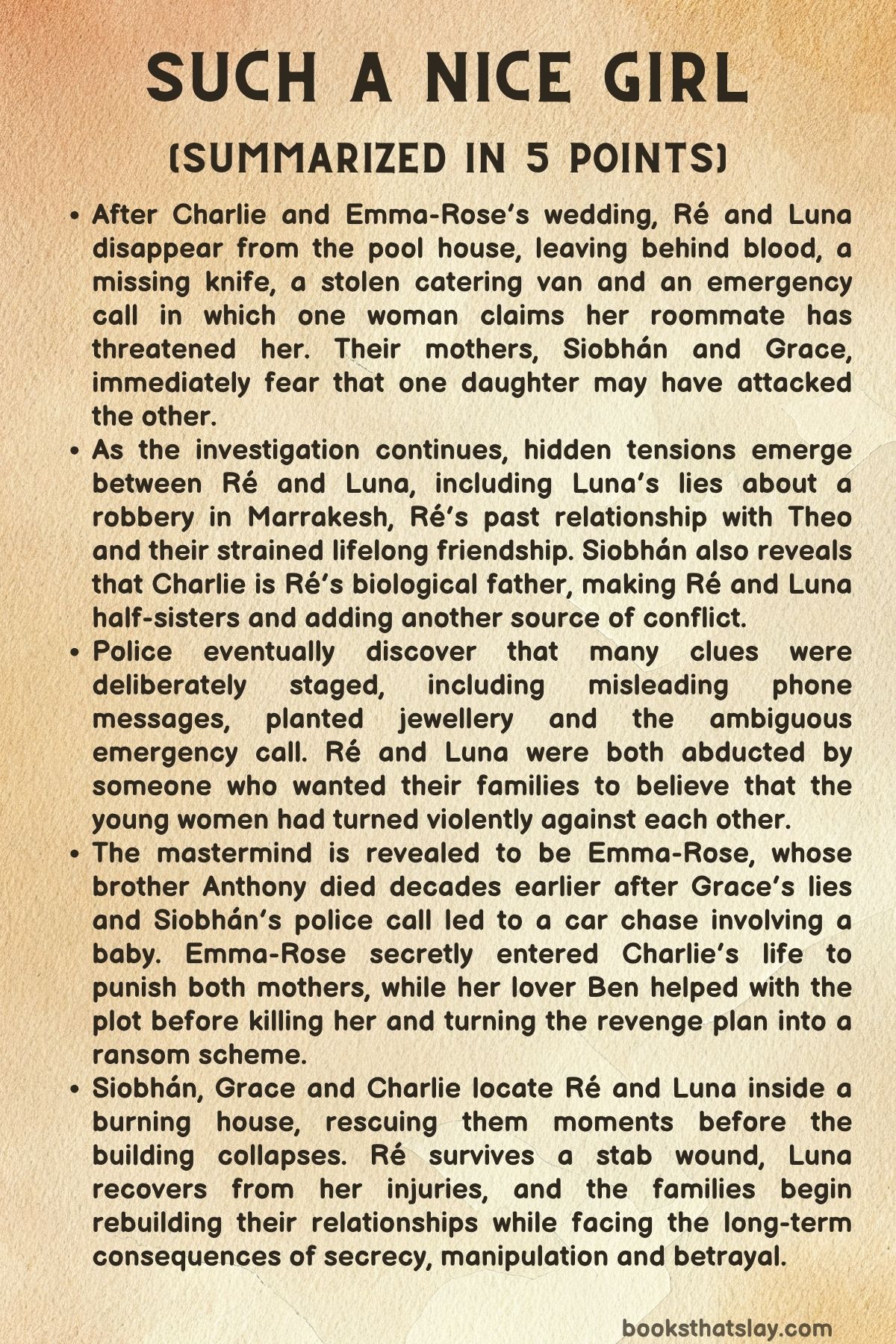
Summary
The morning after Charlie and Emma-Rose’s wedding, Siobhán wakes with a hangover and discovers four missed calls from her daughter, Ré, made at 4:27 a.m. Ré is not answering, and neither is Luna, the daughter of Siobhán’s closest friend, Grace.
The two young women had been sharing Charlie’s pool house during the wedding weekend. When Siobhán and Grace enter it, they find the room disturbed, the bedroom empty and Ré’s phone beneath a bed.
A dark stain on the rug appears to be blood. The gardaí arrive quickly because a frightened woman had called emergency services during the night and whispered that her roommate had a knife and had threatened to kill her.
The caller disconnected before giving the full address. Neither Siobhán nor Grace can confidently identify the voice, and each mother fears that her own daughter may have been the caller while the other was holding the knife.
The situation becomes more alarming when forensic officers confirm that the stain is blood. Additional blood is discovered near the rear gate, which is not covered by Charlie’s security cameras.
The cameras show Luna walking towards the pool house at 3:11 a.m., followed shortly afterwards by Ré. Neither woman is recorded leaving through the front or back of the main property.
Charlie’s son, Xavi, remembers seeing Ré and Luna arguing near the pool. Jasmine, Emma-Rose’s wedding planner, also heard them shouting in the pool house and recalls the word “Marrakesh.”
Ré and Luna had travelled to Marrakesh with friends several months earlier. Siobhán learns that both women claimed to have been mugged after being separated in a crowded area, but the incident created serious tension between them.
Grace already knew about the robbery because Luna had called her from the hotel. Ré had asked that Siobhán not be told because her mother was occupied with an important business presentation and had warned her not to take her grandmother’s sapphire ring.
The discovery hurts Siobhán because it suggests Ré did not believe she could ask her mother for support. Friends also reveal that Ré and Luna’s relationship was much more difficult than their mothers understood.
Although Siobhán and Grace had raised the girls as inseparable companions, their friendship involved jealousy, vicious arguments and repeated cycles of affection and resentment. The mothers had imposed the idea of permanent friendship so strongly that the daughters concealed many of their disputes.
A catering van disappears from Charlie’s property along with its spare keys. One knife is also missing from the catering company’s professional set, creating the appearance that Ré and Luna may have left together after a violent confrontation.
The missing van is later discovered in the garage of Charlie’s neighbours, the Egans. Luna had once babysat for the family and knew how to enter their empty house, strengthening the suspicion that she had directed the escape.
Other discoveries appear to provide a motive. Siobhán and Grace find a Polaroid of Ré kissing Theo, Luna’s former boyfriend, and Grace believes the photograph was taken while Luna and Theo were together.
Police also recover a message Ré sent Theo shortly before the emergency call. It says, “Luna knows,” apparently confirming that Luna had discovered a betrayal and confronted Ré.
Soon afterwards, a message is sent from Luna’s phone to Grace. Luna apologizes and says she “messed up,” which seems like a confession and causes suspicion to move towards her.
The mothers begin turning against one another. Grace recalls Ré’s childhood temper, while Siobhán points to Luna’s jealousy, dishonesty and history of stealing.
Siobhán eventually learns that the supposed nose stud used to date the Polaroid is merely dirt on the photograph. Theo confirms that he and Ré had briefly dated before he became involved with Luna, meaning there was no affair for Luna to discover.
The misleading message to Theo therefore becomes evidence that someone else may have used Ré’s phone. The emergency caller’s description of the attacker as a “roommate,” rather than naming Ré or Luna, also begins to sound deliberately vague.
Meanwhile, Siobhán uncovers several genuine secrets that could have contributed to the women’s argument. Ré had secretly located Aidan, an Australian lecturer whom Siobhán claimed was her father.
Ré discovers that the date of the Robbie Williams concert where Siobhán supposedly met Aidan does not match the timing of her birth. During the wedding, Charlie tells Xavi not to become involved with Ré because they were raised like brother and sister.
Ré correctly concludes that Charlie is her biological father. Siobhán later admits that she became pregnant after sleeping with Charlie shortly before he and Grace began their relationship.
Siobhán invented the story about Aidan to preserve Grace and Charlie’s future together. She also feared that Ré would always feel secondary to Luna if Charlie raised one daughter openly while acknowledging the other only through scandal.
Ré tells Luna that they may be half-sisters, expecting surprise or even happiness. Instead, Luna becomes defensive and appears threatened by Ré’s new claim on Charlie.
Their argument later moves to Jasmine, who had been accused of theft when the girls were teenagers. Jasmine admits stealing medication and a credit card but insists Luna stole Siobhán’s Chanel watch and allowed her to take the blame.
Ré also discovers Luna’s Tiffany moon necklace in the pool house. Luna had claimed the necklace was stolen in Marrakesh, yet it has clearly remained in her possession.
Ré finally opens an email from the Moroccan authorities containing CCTV footage of the robbery. The recording shows Ré being forced into a side street and robbed by two men.
Luna was not attacked. She entered a café, later saw what was happening to Ré and retreated instead of helping her or contacting the authorities.
Ré confronts Luna with the recording. Luna initially denies the truth, leading Ré to strike her and threaten to show the video to everyone they know.
Although the confrontation becomes physical, neither woman uses a knife. Their genuine hostility is later exploited to make a more serious crime appear believable.
As Siobhán and Grace continue searching, their own friendship collapses. Siobhán accuses Grace of protecting Luna from every consequence, while Grace uses Siobhán’s old fears about Ré’s behaviour against her.
The investigation changes when Siobhán finds Emma-Rose dead inside an isolated house belonging to her. Emma-Rose has been beaten, and Luna’s moon necklace has been placed beneath her body.
Blood-soaked bandages and signs of recent occupation suggest that Ré and Luna were held there. Emma-Rose’s murder proves that the case is larger than a drunken fight between two friends.
The police reconsider the emergency call, the staged messages and the carefully placed evidence. Someone appears to be directing suspicion towards both missing women while forcing their mothers to imagine that one daughter has murdered the other.
Attention turns towards an incident from Siobhán and Grace’s youth. Grace once worked as a nanny for a wealthy family and cared for their baby, Arabella.
Grace was involved with Anthony O’Shea, a drug dealer. After leaving Arabella with him during a dental appointment, she discovered that Anthony had taken the baby to a meeting.
Siobhán contacted the police, leading to a high-speed pursuit. Anthony died after crashing his car, while Arabella survived but permanently lost her sight.
To protect Grace, the women supported a false story claiming Anthony had watched Grace, snatched Arabella from the street and driven away. In reality, Grace had allowed him to believe Arabella was his daughter.
Grace had previously told Anthony she was pregnant with his child but concealed that she had lost the pregnancy. When he met Arabella, he assumed she was his baby, and Grace continued the deception because his renewed affection made her feel loved.
Anthony therefore believed he was caring for his own daughter rather than abducting someone else’s child. Although his criminal actions placed Arabella in danger, the public story transformed him into a deliberate child kidnapper.
The families initially suspect Ben, the wedding’s catering manager, because he had access to the pool house, the drinks, the missing knife and the stolen van. His flirtation with Grace also placed him close to one of the intended victims.
A ransom message eventually confirms that Ré and Luna have been abducted together. Charlie is ordered to transfer one million euros in cryptocurrency, and the kidnapper sends a video of Luna apparently handcuffed in a neglected room.
After the payment is made, the family receives an incorrect address. A later call from Ben’s colleague Tara reveals that he secretly lives in an expensive apartment and had been seen drinking champagne with a glamorous blonde woman bearing a blue butterfly tattoo.
The woman was Emma-Rose. Ben and Emma-Rose had maintained a secret relationship while she pursued and married Charlie.
Charlie then reveals that Emma-Rose once mentioned a dead brother named Anthony. She was Anthony O’Shea’s younger sister and had spent years planning revenge against Grace and Siobhán.
Emma-Rose found evidence that Anthony believed Arabella was his daughter. She concluded that Grace had deceived him and that Siobhán had helped destroy his reputation after his death.
The scandal also devastated Emma-Rose’s mother, who was rejected by the community and later died by suicide. Emma-Rose blamed Siobhán and Grace for destroying her family while continuing to enjoy successful lives and close relationships.
She spent years observing them, learning about their daughters and positioning herself near their family. Her relationship with Charlie was part of the plan rather than a chance romance.
Emma-Rose learned about Ré and Luna’s secrets, including Marrakesh, Jasmine, Theo and the possibility of Ré’s true parentage. During the wedding, she encouraged Ré and Xavi’s closeness, planted jewellery, sent false messages and created circumstances that would intensify existing resentments.
Her plan was to kill Ré and Luna after making it appear that they had attacked one another. Their mothers would be left not only grieving but also uncertain which daughter had become a murderer.
Ben secretly drugged the women’s drinks with Rohypnol, disrupting Emma-Rose’s intended scenario. He wanted to convert the revenge plan into a profitable kidnapping and ransom scheme.
Emma-Rose opposed the change because she wanted the women remembered as violent rather than as innocent victims. When she confronted Ben, he killed her with a brick.
Ben then continued the kidnapping alone. He sent the ransom demand, staged Luna’s video, stabbed Ré and set fire to the house where both women were being held.
Siobhán identifies a pink feather boa in the hostage video as part of Emma-Rose’s event-planning supplies. Charlie recognizes the location as Emma-Rose’s grandparents’ empty property.
The incorrect address contained a single mistaken letter. When Siobhán, Grace and Charlie reach the correct house, it is already burning.
They enter and find Luna unconscious beneath a fallen beam. Her handcuff has only been placed over a radiator valve, suggesting Ben wanted her body to appear less restrained and therefore more responsible for what happened.
Ré is found in another bedroom, genuinely handcuffed to a radiator and suffering from a stab wound. Grace risks her life by returning with a metal curtain pole and tearing the pipe from the wall.
Ré survives emergency surgery, while Luna recovers from concussion. Ben escapes immediate capture, but Ré’s testimony identifies him as the kidnapper, Emma-Rose’s killer and the person who attempted to murder both women.
Months later, the families are rebuilding their lives. Charlie begins developing a relationship with Ré while continuing to support Luna and Xavi.
Ré and Luna are adjusting to being half-sisters. Their relationship is no longer required to match the ideal their mothers created for them, allowing them to build something more honest.
Siobhán and Grace remain connected, but their friendship has changed. Siobhán cannot forget Grace’s deception, yet she also cannot dismiss the fact that Grace entered a burning house and injured herself to save Ré.
Siobhán also begins building a friendship with Aidan. Although he is not Ré’s father, he remains someone Ré values and becomes part of their changing family.
The final look into Emma-Rose’s past reveals that she attended the same Robbie Williams concert where Siobhán met Aidan. Aidan briefly spoke to Emma-Rose before later leaving with Siobhán.
Emma-Rose once wondered whether accepting his invitation for a drink might have created another life. Her fate becomes connected to a chain of choices, secrets and missed possibilities that shaped every person involved.
Characters
Siobhán
Siobhán is the central perspective through which the disappearance, investigation and family crisis are experienced. In Such a Nice Girl, she begins as a successful businesswoman who believes she understands her daughter, her closest friend and the history they share, but almost every stage of the case exposes a limit in that understanding.
Her devotion to Ré is genuine, yet it is complicated by work, guilt and emotional avoidance. She has built Scorch Cosmetics through determination and personal sacrifice, but Ré’s decision not to tell her about the Marrakesh robbery forces Siobhán to question whether professional ambition made her seem unavailable.
Siobhán is also defined by her instinct to manage difficult truths. She concealed Charlie’s paternity because she believed secrecy would protect Grace, Charlie and Ré, but the lie denied Ré the right to understand her own identity.
Her willingness to support the false account of Anthony’s actions reveals the same habit. She convinces herself that protecting Grace is an act of loyalty, but she does not fully consider the damage done to Anthony’s family or the long-term consequences of turning a complicated event into a simple story of villain and victim.
The investigation forces Siobhán to examine her habit of judging other people’s children more harshly than her own. Her treatment of Jasmine becomes especially important because she once believed reporting a troubled teenager was responsible parenting, yet she never seriously questioned whether Luna was equally capable of wrongdoing.
Siobhán’s courage becomes most visible when she searches Emma-Rose’s house and later enters the burning bungalow. Her actions are driven by fear, but she refuses to remain passive when Ré may be injured.
By the end, Siobhán accepts that love does not excuse deception and that family relationships cannot be protected through permanent silence. She remains imperfect, but she becomes more willing to face uncertainty, share responsibility and allow Ré to define her own relationships.
Grace
Grace is Siobhán’s oldest friend and the mother of Luna. Her wealth, confidence and dramatic personality often make her appear secure, but her behaviour is shaped by fear, shame and an intense need to protect her image.
Her parenting style is deeply possessive. She sees Luna as an extension of herself and repeatedly treats criticism of her daughter as a personal attack.
Grace’s refusal to accept evidence against Luna reflects more than ordinary maternal loyalty. She has spent much of her life reshaping uncomfortable events into versions she can emotionally survive.
The central example is her relationship with Anthony. Grace allowed him to believe that Arabella was their daughter because she wanted to keep his affection, even though she knew the deception could not continue indefinitely.
After Anthony’s death, Grace permitted him to be publicly described as a calculated child abductor. Her fear of losing her job and reputation outweighed any responsibility she felt towards his family.
Grace also rewrites smaller events. She remembers Luna as the person most angered by Jasmine’s theft, even though Ré had been more openly furious, and she repeatedly rejects evidence that Luna stole the watch or abandoned Ré in Marrakesh.
Her treatment of Siobhán during the investigation is often cruel. She uses private concerns about Ré’s childhood temper to imply that Ré may be violent, violating the trust that made their friendship important.
However, Grace is not without courage or loyalty. Her return to the burning house to save Ré demonstrates that her care for Siobhán’s daughter is real, even when fear and defensiveness have damaged their relationship.
Grace ends the novel as a morally complicated figure rather than a purely selfish one. Her lies caused lasting harm, but her final actions show that she is still capable of sacrifice, accountability and love beyond her own immediate interests.
Ré
Ré is intelligent, sarcastic, independent and emotionally guarded. Her untidy appearance and sharp humour distinguish her from Luna’s controlled public image, but beneath her confidence lies a strong desire to feel chosen and understood.
Her relationship with Siobhán contains affection as well as frustration. Ré recognizes her mother’s achievements but also senses that important conversations are often delayed whenever work or discomfort intervenes.
Her secret meetings with Aidan show both curiosity and restraint. She does not seek money or a replacement family; she simply wants access to a part of her identity that Siobhán has denied her.
Ré’s friendship with Luna is shaped by years of subtle emotional imbalance. Luna excludes, belittles or manipulates her, then restores closeness before Ré can fully confront the pattern.
Because their mothers expect them to remain best friends, Ré rarely feels free to end the relationship. She instead stores resentment until alcohol, betrayal and new information bring everything to the surface.
The Marrakesh footage gives Ré proof that her unease about Luna was justified. Luna did not merely panic during the robbery; she created an elaborate lie that forced Ré to share responsibility for an event she experienced alone.
Ré’s physical aggression towards Luna is wrong, but it emerges from accumulated betrayal rather than a sudden murderous impulse. Her anger makes Emma-Rose’s staged narrative believable, yet it does not make Ré responsible for the crimes committed against them.
Ré also displays emotional maturity after surviving. She does not allow Siobhán to take responsibility for Emma-Rose and Ben’s actions, even while acknowledging that her mother’s lies caused pain.
Her future relationship with Charlie, Aidan and Luna suggests that she can build a family without insisting that every connection fit a traditional category. She moves towards an identity based on knowledge and choice rather than secrecy.
Luna
Luna is charming, polished and socially confident, but her behaviour reveals insecurity, entitlement and a strong desire to control how others see her. In Such a Nice Girl, she initially appears to be either a victim or an aggressor, but she is ultimately revealed as a flawed young woman who has also been manipulated and endangered.
She has learned from Grace that uncomfortable truths can be denied until other people begin doubting their own perceptions. This pattern appears in her response to the Marrakesh robbery, the stolen watch and the Tiffany necklace.
Her decision to abandon Ré during the mugging is cowardly, but the more serious betrayal is the lie she creates afterwards. By pretending that she was also attacked, Luna avoids accountability and prevents Ré from speaking honestly about what happened.
Luna’s friendship with Ré depends upon maintaining emotional superiority. She often treats Ré with small cruelties that are difficult to identify individually but damaging when repeated over many years.
Her reaction to Ré’s possible relationship with Charlie reveals fear of losing her special position. Rather than welcoming the possibility of a sister, Luna initially interprets Ré’s discovery as an attempt to take something from her.
Luna also shows vulnerability. She recognizes that her friendship with Ré matters and eventually admits that she panicked in Marrakesh because she was ashamed of her own behaviour.
Her apology does not erase the damage, but it indicates that she is not incapable of remorse. She has been protected from consequences for so long that honesty feels threatening rather than natural.
As a captive, Luna becomes part of Ben’s attempt to frame her for Ré’s death. The loose handcuff and planted possessions are intended to transform her previous lies into evidence of murder.
By the conclusion, Luna survives both the kidnapping and the collapse of her idealized identity. Becoming Ré’s sister offers her an opportunity to build a relationship based less on competition and more on honesty.
Emma-Rose
Emma-Rose first appears superficial, demanding and preoccupied with appearances. Her obsession with the wedding schedule, guest arrangements and police tape makes her seem insensitive rather than dangerous.
Her controlled behaviour is eventually revealed as part of a carefully constructed identity. She has spent years entering Charlie’s life, studying Siobhán and Grace, and waiting for an opportunity to punish them.
Her revenge originates in genuine family trauma. Anthony’s death, the false kidnapping story and her mother’s suffering gave Emma-Rose understandable reasons to feel angry and betrayed.
However, she converts that pain into a belief that Ré and Luna should be killed for actions committed before either was born. Her desire is not justice but emotional replication: she wants Siobhán and Grace to experience public shame, uncertainty and the loss of a loved one.
Emma-Rose is highly observant and patient. She gathers information about Marrakesh, Theo, Jasmine, Charlie’s wealth and the tensions between Ré and Luna, then uses each detail to encourage conflict.
Her greatest strength as a manipulator is her ability to introduce an idea and allow others to complete it. She does not need to accuse Ré or Luna directly because she understands that their families will interpret ambiguous evidence through fear and loyalty.
Her plan also contains arrogance. She assumes she understands every relationship, yet she is wrong about the timing of Ré and Theo’s romance.
That error exposes the false message sent from Ré’s phone and helps investigators recognize that a third person is directing the narrative. Emma-Rose creates such an elaborate explanation that its unnecessary complexity eventually becomes suspicious.
Her alliance with Ben is another failure of judgment. She believes his greed makes him useful, but she underestimates his willingness to betray and kill her once their goals separate.
Emma-Rose remains tragic because her life could have developed differently. The final concert scene shows a young woman still open to possibility, long before revenge became the organizing purpose of her identity.
Ben Wilson
Ben presents himself as calm, attentive and professionally competent. His gentle treatment of Grace’s cut and his apparent vulnerability make him seem harmless during the wedding weekend.
His position as catering manager gives him extraordinary access. He controls food and drinks, knows where knives and vehicle keys are kept, and can move around the property without attracting attention.
Ben’s primary motivation is financial. Unlike Emma-Rose, he is not committed to revenge as an emotional goal, and he views the abduction as an opportunity to obtain money from Charlie.
His decision to drug Ré and Luna changes Emma-Rose’s original plan. Toxicology would reveal that the women had been incapacitated, making it harder to present their deaths as the result of an uncontrolled fight.
Ben then attempts to turn the situation into a kidnapping. When Emma-Rose objects, he murders her and continues using elements of her revenge plan to protect himself.
His earlier business practices reveal that exploitation is not new to him. He underpaid vulnerable employees, placed them in unsafe accommodation and continued until his own family discovered the truth.
Ben’s charm functions as a practical instrument rather than evidence of warmth. He gives people the version of himself that will make them comfortable while remaining focused on advantage.
His typing error in the Eircode becomes a crucial weakness. The mistake delays the rescue but also allows Siobhán to connect the hostage video to the correct property.
Ben represents greed without loyalty. Emma-Rose believes they are partners, but he sees her as useful only while their interests remain aligned.
Charlie
Charlie is the emotional centre of the extended family. He is wealthy, generous and accustomed to calming conflict, though his apparent stability is partly maintained by avoiding difficult truths.
His relationship with Ré has always contained an unspoken awareness. Charlie suspected that he might be her father, but Siobhán’s repeated denials allowed him to avoid confronting the issue.
His failure is quieter than Siobhán’s lie but still significant. He accepts uncertainty rather than insisting upon a truth that would have changed Ré’s life.
Charlie’s protectiveness towards Grace also suggests unresolved emotional loyalty. His discomfort with Ben appears jealous, paternal and instinctive at the same time.
During the crisis, Charlie tries to reassure everyone and maintain normality. His private collapse after Ré and Luna disappear reveals how much fear he has concealed in order to support the others.
Emma-Rose’s betrayal destroys his understanding of his marriage. He learns that their shared interests, romance and wedding were part of an identity she designed to enter his family.
Charlie nevertheless survives without becoming consumed by humiliation. He reduces his workload, buys a pub and makes time for Xavi, Luna and Ré.
His later life suggests a more active form of fatherhood. Rather than treating money as his primary contribution, he begins offering presence, attention and emotional responsibility.
Xavi
Xavi initially appears carefree, privileged and somewhat immature. His drinking, dancing and relationship with Jasmine during the wedding allow others to underestimate his judgment.
He becomes increasingly important once the crisis begins. His memories of the wedding help reconstruct the timeline, while his observation that the mark on Ré’s nose is dirt destroys the supposed evidence of an affair.
Xavi is also the first person to suggest clearly that someone else may have sent messages from Ré’s phone. His ability to question the emerging narrative helps redirect the investigation away from the two missing women.
His knowledge of cryptocurrency makes him essential during the ransom demand. Charlie has often underestimated his son, but Xavi handles the transfer under enormous pressure.
Learning that Ré is his half-sister is emotionally confusing because he had been dancing with her shortly before Charlie’s warning. However, he adapts without turning the revelation into resentment.
Xavi’s kindness towards Emma-Rose after her death also shows maturity. He admits that she treated him better than he treated her, even though later evidence proves she was manipulating the family.
By the end, his successful property-consulting business gives him independence from Charlie. His growth comes from becoming reliable without losing his warmth or humour.
Jasmine
Jasmine is introduced through the memory of a troubled teenager accused of theft. Siobhán and Grace have treated that accusation as proof of her character for ten years.
As an adult, Jasmine is organized, professional and determined to build a stable life. Her return as Emma-Rose’s wedding planner forces the families to confront how easily they dismissed her as permanently dishonest.
Jasmine admits the offences she committed. Her willingness to accept responsibility for the medication and credit card makes her denial of the Chanel watch more credible.
Her claim that Luna stole the watch reveals how little power she had as a teenager. The adults accepted the account that protected their own daughters, while Jasmine’s grief and previous behaviour made her an easy target.
Jasmine’s reconciliation with Ré is important because it gives Ré permission to reconsider the past. Their conversation leads directly to questions about Luna’s willingness to end the friendship.
She briefly appears suspicious because of her access to the wedding and her shared history with the missing women. However, her alibi during the emergency call removes her from the central crime.
Jasmine represents the consequences of reducing a young person to her worst actions. She made serious mistakes, but the families used those mistakes to deny her the possibility of telling the truth.
Aidan
Aidan is initially presented through Siobhán’s invented story as Ré’s absent biological father. When Ré finds him, he is warm, welcoming and pleased to learn that she exists.
His response exposes the unfairness of Siobhán’s secrecy. She justified withholding his identity by imagining disruption and rejection, but Aidan had no other children and wanted a connection with Ré.
Although he is not Ré’s biological father, their developing relationship remains meaningful. Parenthood is shown here as something that can include emotional choice, curiosity and mutual affection rather than genetics alone.
Aidan is also connected to the coincidence at the centre of the epilogue. He briefly speaks with Emma-Rose at the concert before leaving with Siobhán.
His presence represents an alternative path that none of the characters can recover. Emma-Rose imagines that accepting his offer might have changed her life, while Ré discovers that the man she sought as a father can still become part of her family in another way.
Anthony O’Shea
Anthony is remembered publicly as a drug dealer who abducted a baby and caused a catastrophic crash. The later revelations do not excuse his criminal behaviour, but they change the moral meaning of the incident.
He believed Arabella was his daughter because Grace had told him she was pregnant and never revealed that she had lost the baby. His affection for Arabella was therefore based on deception rather than a deliberate plan to steal someone else’s child.
Anthony acts irresponsibly by taking the baby to a criminal meeting. Even if he believed she was his daughter, he exposed her to serious danger.
His death prevents him from explaining his understanding of events. Grace and Siobhán use that silence to construct a version that protects Grace while permanently defining Anthony as a monster.
The card he wrote to Arabella and the photograph of him holding her become central to Emma-Rose’s obsession. They convince her that her brother was destroyed by a lie rather than simply by his own choices.
Anthony represents the danger of reducing a person to a single narrative. He was neither an innocent victim nor the calculating kidnapper described after his death.
Detective Aisling O’Connell
Detective O’Connell is direct, observant and increasingly frustrated by the families’ interference. She understands that emotional certainty is not the same as evidence and repeatedly warns Siobhán and Grace against drawing conclusions too quickly.
Her investigation must contend with an unusually manipulated crime scene. Every clue is designed to support several interpretations, and the mothers’ competing loyalties make objective discussion difficult.
O’Connell initially considers the possibility that Ré and Luna harmed one another because the blood, messages and missing knife support that theory. She changes direction when the evidence stops fitting, showing flexibility rather than attachment to an early conclusion.
Her questions about the emergency call are particularly important. The caller’s refusal to name the supposed attacker eventually reveals that the ambiguity was intentional.
O’Connell also treats the old Arabella case as relevant when Grace tries to dismiss it. Her insistence that historic grievances can produce present violence helps expose Emma-Rose’s connection to Anthony.
Although she is often irritated by Siobhán’s unauthorized searches, she recognizes that the mothers’ personal knowledge produces valuable leads. Her role is to separate useful information from fear-driven assumptions.
Garda Stephanie Harrington
Stephanie Harrington provides a calmer investigative presence during the later stages of the case. She listens carefully, notices inconsistencies and allows the family to reconsider evidence without immediately dismissing their ideas.
Her questioning of Xavi leads to the examination of the Polaroid. Once the supposed nose stud disappears, the central theory of romantic betrayal loses its foundation.
Harrington also helps test the third-person theory. She considers whether messages could have been sent by someone else and whether the emergency caller deliberately avoided naming either woman.
Her approach highlights the importance of small physical details. A mark on a photograph, a phrase in a phone call or the position of a handcuff can carry more value than emotional certainty.
Theo
Theo functions mainly as the subject of a false motive. His old relationship with Ré and later relationship with Luna make the Polaroid appear far more damaging than it is.
When contacted in Canada, Theo confirms that he and Ré kissed before he dated Luna. His evidence proves that no recent affair existed and that Ré’s message cannot refer to the photograph.
Theo’s role demonstrates how easily true facts can be arranged into a false story. He did have a romantic connection with both women, but the timing changes its meaning completely.
Kayla, Prisha and Abbey
Kayla, Prisha and Abbey provide perspectives that challenge the mothers’ idealized understanding of Ré and Luna. They know that the friendship involves regular conflict, alcohol-fuelled arguments and resentment.
Kayla reveals the Marrakesh robbery and bluntly raises the possibility of violence. Her directness is painful but helps Siobhán recognize that avoiding frightening ideas will not locate the women.
Prisha supplies Luna’s message about learning something upsetting from Ré. The message increases suspicion but also shows how fragments of information can become misleading when removed from their context.
Abbey provides the lead to Theo’s family house and helps contact him in Canada. Together, the three friends show that Ré and Luna presented different versions of themselves to their mothers and peers.
Emma-Rose’s Mother
Emma-Rose’s mother appears mainly through memory, yet her suffering becomes an important force behind the revenge plot. She experiences social rejection after Anthony is publicly identified as a child abductor.
Her grief, isolation and suicide convince Emma-Rose that Siobhán and Grace did more than lie about Anthony. In Emma-Rose’s view, they destroyed the remaining members of his family while continuing with comfortable lives.
She therefore becomes both a victim of the original deception and part of the emotional justification Emma-Rose uses for later violence. Her death does not cause the revenge by itself, but it removes one of the last ties Emma-Rose has to a life outside resentment.
Themes
The Destructive Power of Long-Term Secrets
Secrets in Such a Nice Girl rarely remain contained within the moment that produced them. Siobhán’s lie about Ré’s father begins as an attempt to protect Grace and Charlie, yet it deprives Ré of her history and creates an emotional crisis during the wedding.
Grace’s deception is even more damaging because it changes the public meaning of Anthony’s death. By allowing him to believe Arabella is his daughter, she creates the circumstances that lead him to take the baby, while the later kidnapping story prevents his family from understanding what actually happened.
These secrets survive because the people involved gradually begin treating them as settled truth. Siobhán experiences the Aidan story as almost real after repeating it for twenty-four years, while Grace speaks about Anthony as though her own manipulation played no part in the tragedy.
The novel shows that secrecy can appear protective when viewed over days or weeks but become destructive when measured across generations. Ré, Luna and Emma-Rose inherit consequences from decisions made before they were old enough to understand them.
Truth does not automatically repair the damage. Ré still has to rebuild her identity, and Siobhán and Grace cannot return to their former friendship simply because the facts are known.
However, disclosure creates the possibility of relationships based on informed choice. Ré can decide how Charlie and Aidan fit into her life, while Siobhán can no longer use silence as a substitute for responsibility.
Maternal Loyalty and Moral Blindness
Siobhán and Grace repeatedly judge evidence according to whether it protects or threatens their own daughters. Each mother wants her child to be the victim because victimhood preserves innocence, while being the aggressor would require a more painful form of love.
This instinct creates moral blindness. Grace dismisses evidence that Luna lied about Marrakesh, stole the watch and abandoned Ré because accepting those facts would force her to reconsider the daughter she believes she raised.
Siobhán is initially more willing to imagine Ré as capable of violence, yet she also withholds evidence and keeps the Polaroid because it may be the last image she has of her daughter. Her honesty has limits whenever the investigation threatens her emotional survival.
Their treatment of Jasmine provides an earlier example of selective protection. Both women accept the story that places blame on a grieving teenager because questioning Luna or Ré feels less comfortable.
The theme does not suggest that parental loyalty is inherently wrong. Grace’s return to the burning house proves that fierce love can produce courage and self-sacrifice.
The danger comes when loyalty is treated as proof of innocence. Loving a child does not require denying that the child can lie, steal, panic or hurt another person.
Ré and Luna begin moving forward only after their mothers’ idealized image of them collapses. They are allowed to become imperfect adults rather than permanent symbols of each mother’s success.
Friendship, Control and Imposed Intimacy
Ré and Luna are described as lifelong best friends because Siobhán and Grace created that identity for them. Their linked names, shared schools, holidays and family gatherings make separation seem almost impossible.
The relationship therefore contains affection but lacks freedom. Neither woman appears fully able to ask whether the friendship remains healthy because ending it would challenge the emotional structure of both families.
Luna maintains control through small acts of exclusion and humiliation. These actions are rarely severe enough to justify a dramatic break, which allows her to dismiss Ré’s discomfort and restore closeness on her own terms.
Ré participates in the pattern by suppressing resentment until it erupts. She has learned that open criticism of Luna will also involve Grace and Siobhán, turning a private disagreement into a family crisis.
The mothers’ friendship follows a similar pattern. Siobhán and Grace describe themselves as inseparable, yet their bond includes financial inequality, hidden jealousy, concealed paternity and the shared lie about Anthony.
Longevity becomes mistaken for honesty. Because the friendships have survived for decades, the characters assume that survival proves emotional health.
The crisis removes that assumption. Ré and Luna can become sisters without being forced to perform perfect friendship, while Siobhán and Grace can remain connected without pretending that trust has been fully restored.
The story ultimately presents closeness as meaningful only when people are free to question, redefine or leave it.
Revenge, Narrative and the Manipulation of Perception
Emma-Rose does not simply want to kill Ré and Luna. She wants to control the story told about their deaths, just as she believes Siobhán and Grace controlled the story told about Anthony.
Her plan is built around ambiguity. The emergency caller says “roommate,” the phones send incomplete messages, and the planted evidence can be interpreted in several ways.
These clues succeed because they rely on existing fears. Grace already knows Luna can be dishonest, Siobhán remembers Ré’s temper, and both mothers understand that the friendship has deteriorated.
Emma-Rose therefore manipulates perception rather than creating every conflict herself. Ré and Luna genuinely argue, but she arranges the setting in which that argument can be presented as the beginning of murder.
Her revenge reflects a belief that public narrative determines moral reality. Anthony died as a criminal, but Emma-Rose is most enraged by the identity imposed upon him afterwards.
She attempts to answer one false story by constructing another. In doing so, she repeats the same injustice she condemns, reducing Ré and Luna to characters in a punishment designed for their mothers.
The plan fails because narratives built from partial truths eventually develop contradictions. The Polaroid is real, but its assumed date is wrong; the women argued, but they did not stage the emergency call; Luna lied, but she is not Ré’s attacker.
The novel shows that perception can be directed for a time, especially when fear encourages quick conclusions, but truth often survives in details that the manipulator cannot fully control.