Summer of Love Summary, Characters and Themes
Summer of Love by Kerri Maher is a multigenerational family novel about addiction, creativity, motherhood, secrecy, and the complicated choices people make in the name of love.
Moving between the cultural upheaval of late-1960s and 1970s California and Dawn Hartley’s life in 2015, the story gradually uncovers a family history that has been hidden for decades. At its center are sisters Miranda and Winnie Hartley, whose different temperaments lead them toward very different lives, yet whose decisions remain deeply connected. Through Dawn’s search for truth, the novel examines whether honesty can repair relationships shaped by trauma, fear, sacrifice, and silence.
Summary
In 2015, Dawn Hartley is approaching forty and living in San Francisco, where she works as a set designer. She has recently stopped drinking after a frightening episode she privately calls the Incident, but she still resists defining herself as an alcoholic or committing to permanent sobriety.
Her uncertainty becomes more uncomfortable when Dennis Schulz, a film-history professor she finds attractive, asks her out for a drink. Instead of explaining her situation, Dawn postpones the date, revealing how much shame and fear still surround her changing relationship with alcohol.
The subject is especially difficult because Dawn’s mother, Miranda, is a respected Napa Valley vintner whose career and family identity are built around wine. Dawn and Miranda have always been extraordinarily close, yet Dawn cannot imagine telling her mother that drinking has become dangerous for her.
While preparing for a work assignment, Dawn reads Phoebe and the Burning Vines, the first novel in the immensely successful Vineland fantasy series written by the mysterious E. Lang. The book contains details that seem remarkably similar to Hartley Vineyard, including its mountain landscape, winding road, handmade hammock, creaking stair, and other features of Dawn’s childhood home.
The discovery leads the story back to 1967, when Miranda’s younger sister Winnie is living in San Francisco’s Haight-Ashbury district. Newly graduated from Berkeley and determined to become a writer, Winnie embraces the music, politics, drugs, sexual freedom, activism, and experimental culture surrounding the Summer of Love.
At a music festival, Winnie unexpectedly encounters Lincoln Salyer, the teenage boyfriend who once disappeared from her life. Their attraction quickly returns, and after another meeting in San Francisco they become lovers, building an intense relationship based on creativity, physical attraction, artistic ambition, and shared fascination with altered states.
Miranda follows a very different path. She is deeply attached to Hartley Vineyard and to the memory of her late father, Leo, whose dream of producing great California wine she has adopted as her own responsibility.
Leo’s death has left wounds neither sister fully understands. Winnie increasingly uses alcohol and drugs to avoid emotional pain, while Miranda responds to fear by becoming disciplined, dependable, and controlling, convincing herself that work and responsibility can prevent further chaos.
As Winnie and Lincoln’s relationship develops, its romantic intensity begins masking serious instability. They quarrel over money, chores, careers, jealousy, drugs, absences, and other partners, while Winnie gradually realizes that Lincoln expects his musical ambitions to take priority over her writing.
Miranda, meanwhile, begins reclaiming the artistic side of herself that she abandoned when she devoted her life to the vineyard. Encouraged by Winnie, she returns to painting, and her artwork eventually appears on Hartley wine labels, allowing her to combine creative expression with the profession she had previously believed required complete sacrifice.
Winnie briefly returns to Hartley after her relationship with Lincoln deteriorates. Her writing and promotional abilities help strengthen the vineyard’s public identity, and her relationship with her mother, Joan, temporarily improves.
The sisters also discover disturbing evidence about the property’s earlier history, including the exploitation of Chinese and Indigenous workers. Rather than fully confronting this legacy, they emphasize a more comfortable family history, establishing a pattern that mirrors the Hartleys’ personal tendency to hide painful truths in order to protect the present.
Winnie’s emotional health continues to worsen. Miranda eventually reveals that their father died by suicide and that the sisters themselves encountered the aftermath, a traumatic memory Winnie had partly repressed.
Although this knowledge explains some of Winnie’s lifelong fear and desire to escape, it does not immediately free her from destructive behavior. She returns to Lincoln and tries once more to believe that love and artistic partnership can stabilize them.
Lincoln’s career soon accelerates, while Winnie experiences a professional crisis after one of her poems is accused of borrowing material connected to his songwriting. She expects Lincoln to defend her, but he protects his own reputation instead, forcing Winnie to recognize that his love does not guarantee respect for her work or willingness to sacrifice for her.
During the same period, Miranda develops a relationship with Tom Berlin, an intelligent attorney and grape grower who understands her professional world. For the first time, Miranda begins imagining a future in which she might have both the vineyard and a loving family.
Winnie then discovers that she is pregnant with Lincoln’s child. She initially imagines motherhood as an opportunity to create the stable family she never experienced, but Lincoln reacts with uncertainty and encourages her to consider ending the pregnancy.
Miranda also becomes pregnant, and Tom joyfully proposes marriage. Her happiness ends abruptly when she miscarries, leaving her devastated and causing her to withdraw even from Tom.
Soon afterward, Winnie gives birth to a daughter whom she privately thinks of as Phoebe. Her love for the child is immediate, but so is her awareness that her addiction, unstable relationship with Lincoln, and emotional condition may prevent her from providing the secure childhood she wants for her daughter.
Knowing that Miranda has just lost a pregnancy, Winnie makes an extraordinary proposal: Miranda should raise the baby as her own. Winnie believes her sister can offer the child stability, safety, financial security, and consistency that she cannot.
Miranda eventually accepts. As she spends her first exhausting night caring for the infant, she sees the morning light through the trees and names the baby Dawn, emotionally accepting motherhood and beginning the secret that will shape the next several decades.
The decision destroys Miranda’s future with Tom. He is not unwilling to accept Dawn, but he is deeply hurt that Miranda has made such a major decision without consulting him and that she has hidden so much of her family history from him.
Miranda ends their engagement and takes Dawn to France, where she spends several years working at Château Lemoine. Away from Napa, she discovers that motherhood, artistic expression, and professional accomplishment do not necessarily have to compete with one another.
Winnie does not recover simply because she has surrendered her daughter. The loss drives her further into drugs, alcohol, unstable relationships, loneliness, and shame before she gradually begins seeking sobriety.
Years later, Winnie asks Miranda for permission to see Dawn. Miranda reluctantly agrees, and the young child knows Winnie only as her aunt.
The visits are emotionally overwhelming for Winnie, and instead of admitting how strongly they trigger her desire to drink, she hides her struggle. Before one visit she consumes vodka, falls asleep while caring for Dawn, and fails to notice the child climbing a tree until Dawn falls and breaks her arm.
The relapse convinces Winnie that she cannot safely remain in Dawn’s life. She asks Miranda to tell Dawn that Aunt Winnie has died, believing that permanent separation is the only way to prevent herself from repeatedly returning and causing more damage.
Winnie subsequently spends years in severe addiction before Bernard helps her enter treatment. This time she begins addressing the grief, trauma, resentment, shame, and unrealistic romantic ideals beneath her substance use instead of concentrating only on abstinence.
Writing becomes an essential part of that recovery. Winnie creates the Vineland series, transforming the Hartley landscape, addiction, emotional dependence, family relationships, and her own experiences into a fantasy world that eventually becomes enormously successful.
Back in 2015, Dawn’s investigation leads her to Mason, a man connected with recovery communities who knows the identities of certain pseudonymous individuals. He reveals that E. Lang is actually Winifred Elizabeth Hartley and that Winnie specifically authorized him to disclose the truth to Dawn.
Dawn is stunned because she has always been told that Winnie is dead. Her friend Audrey, who has already built a sober life after her own addiction, helps Dawn continue searching while encouraging her to reconsider the excuses she has made about her drinking.
Miranda finally sends Dawn Winnie’s written account of their family. As Dawn reads, she discovers the truth that transforms her understanding of her life: Winnie is her biological mother, Lincoln is almost certainly her biological father, and Miranda adopted her after Winnie decided that she could not raise her safely.
Dawn feels betrayed, furious, and devastated, but Winnie’s account prevents the situation from becoming morally simple. She sees both Winnie’s desperate attempt to protect her and Miranda’s fear that revealing the truth could expose Dawn to the same instability that had characterized Winnie and Leo.
The revelation creates Dawn’s strongest desire to drink since she stopped. She buys two bottles of wine but remembers the Incident clearly: drinking heavily alone, falling, injuring herself, vomiting, neglecting Alfie, and needing Audrey’s help before finally seeking medical attention.
For the first time, Dawn accepts that her alcohol use has become genuinely dangerous. Instead of drinking the wine, she returns it and chooses sobriety even at a moment when escape seems particularly tempting.
As Dawn and Audrey travel north toward Mendocino, Dawn becomes increasingly willing to imagine sobriety as a different kind of life rather than simply a collection of restrictions. She also tells Dennis the truth about her relationship with alcohol and discovers that honesty produces far less rejection than she feared.
Their search finally leads Dawn to a bookstore, where she asks for Winnie and unexpectedly finds both Winnie and Miranda waiting for her. For the first time, Dawn stands before the two women who are, biologically and emotionally, her mothers.
Rather than beginning with accusation, Dawn tells Miranda the secret she has been keeping: she has a serious drinking problem and is trying to remain sober. Miranda responds with love rather than judgment, proving that Dawn’s sobriety does not threaten their bond even though wine has defined Miranda’s career.
Winnie joins them, and years of silence finally give way to open acknowledgment. The women cannot erase the harm caused by addiction, concealment, grief, or abandonment, but they can stop repeating the belief that love requires hiding the truth.
Nine years later, Dawn remains sober and has built a life with Dennis. They have a young daughter named Phoebe, while Dawn and Audrey have founded FoundSistersMedia and earned an Academy Award nomination for a documentary about changing approaches to recovery.
Dawn has also developed relationships with Winnie and Lincoln, while Miranda has sold Hartley Vineyard, returned more fully to art, and renewed her connection with Tom. Winnie and Miranda are both part of Phoebe’s life, and the family that once relied on secrecy has learned to accept a more complicated form of connection based on truth, boundaries, responsibility, and choice.
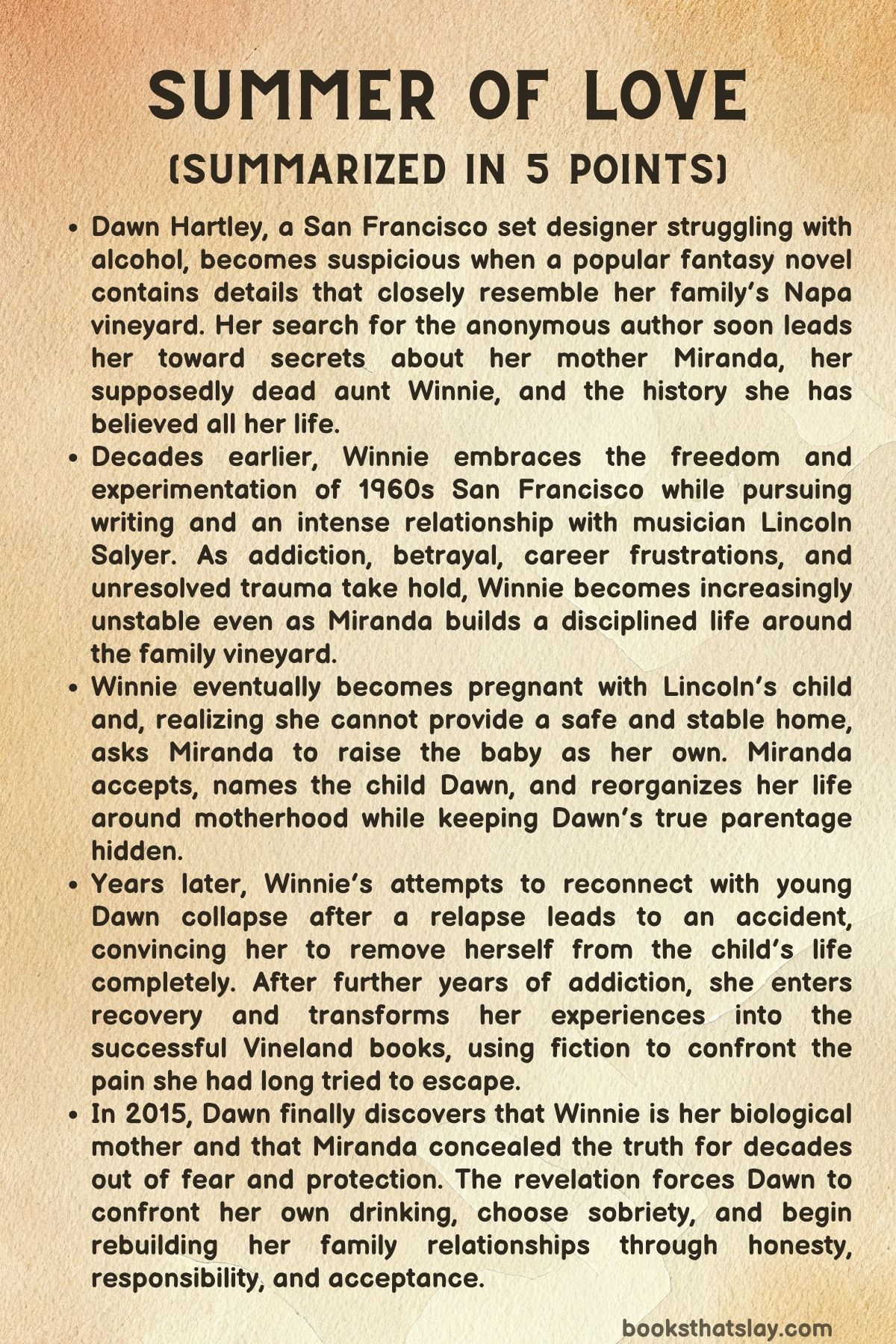
Characters
Dawn Hartley
At the center of Summer of Love, Dawn is both the inheritor of her family’s unresolved history and the person most capable of changing its emotional pattern. She begins the book believing that she knows who she is: Miranda’s daughter, a successful professional, a woman whose drinking may have become excessive but who does not belong to the category of people she associates with addiction.
Her resistance to labels is important because it shows how denial can depend on comparison. Dawn repeatedly measures herself against more visibly destructive drinkers, allowing her to minimize blackouts, unsafe decisions, solitary drinking, physical injury, and the gradual loss of control.
The mystery surrounding Vineland forces her to investigate her family at the same time that sobriety forces her to investigate herself. These two searches operate in parallel because both require Dawn to abandon convenient versions of reality.
Her reaction to discovering that Winnie is her biological mother also shows considerable emotional maturity. Dawn is furious with Miranda, but she eventually recognizes that understanding the reasons for deception does not require pretending the deception caused no harm.
Her most important development occurs when she chooses not to drink after learning the truth. Sobriety becomes meaningful precisely because she chooses it during emotional crisis rather than when life is manageable.
By the end of the novel, Dawn has moved from concealment toward participation. She tells Dennis about her drinking, speaks openly with Miranda and Winnie, builds a creative career around recovery, and raises her daughter within a family whose complexity is acknowledged rather than hidden.
Winnie Hartley
Within Summer of Love, Winnie is one of the book’s most complicated figures because she is simultaneously loving, damaging, imaginative, impulsive, intelligent, self-aware, and repeatedly unable to live according to what she knows. Her life demonstrates the difference between wanting to love people well and possessing the emotional stability required to do so.
Young Winnie embraces counterculture partly because its celebration of freedom matches her artistic temperament, but also because its acceptance of intoxication gives her an attractive language for avoidance. She tells herself that substances expand experience when they often allow her to escape fear, grief, insecurity, and memories she cannot consciously explain.
Her relationship with Lincoln exposes her romantic idealism. Winnie repeatedly interprets intensity as evidence of permanence, treating their artistic and physical connection as proof that practical problems can eventually be overcome.
Motherhood produces her most painful act of responsibility. Giving Dawn to Miranda is not evidence that Winnie lacks maternal love; it arises because she understands that love without reliability can still endanger a child.
Her later relapse around Dawn is therefore devastating because it confirms exactly what she fears about herself. The accident does not destroy her love for her daughter, but it proves that love alone cannot keep Dawn safe.
Winnie’s eventual recovery becomes more durable when she stops seeking a single dramatic rescue. Treatment, accountability, writing, and honest examination of trauma give her a way to remain present in feelings that she previously tried to silence chemically.
Her creation of Vineland turns imagination into a healthier form of transformation. Instead of disappearing from reality, Winnie finally uses art to face it, reconsider her relationship with Miranda, and offer Dawn a truthful account without demanding forgiveness.
Miranda Hartley
Miranda is defined by responsibility, but the book gradually shows that responsibility can become both a virtue and a defense. After Leo’s death and Winnie’s increasing instability, Miranda learns to survive by making herself dependable, productive, rational, and difficult to surprise.
Her devotion to Hartley Vineyard is genuine rather than merely obligatory. Winemaking connects her to Leo, gives her intellectual purpose, and allows her to pursue the ambitious belief that California wine can compete with the finest European traditions.
At the same time, Miranda often treats control as protection. She buries family history, avoids discussing Leo’s suicide, withholds Dawn’s parentage, and limits what she tells Tom because she believes dangerous truths can be contained through silence.
Her artistic identity complicates this image. Painting and photography reveal that Miranda possesses a creative, emotionally receptive side that she has sacrificed because she associates seriousness with duty.
Her relationship with Tom briefly suggests that she might integrate love, work, creativity, and family. The miscarriage then exposes how vulnerable she remains to grief, and her decision to raise Dawn becomes both an act of immense love and another decision she makes without fully allowing another person into her emotional life.
Miranda’s motherhood is nevertheless real in every meaningful sense. She does not treat Dawn as compensation for the baby she lost; she commits her life to raising, protecting, and loving her.
Her later willingness to send Winnie’s account to Dawn marks an important change. Miranda finally accepts that protection cannot indefinitely depend on deciding which truths another person is allowed to know.
Lincoln Salyer
Lincoln initially appears as the embodiment of Winnie’s romantic and artistic ideal. Their teenage history, intellectual connection, sexual attraction, and shared devotion to creative life make their reunion feel extraordinary to Winnie.
Yet Lincoln repeatedly demonstrates the difference between emotional intensity and dependable partnership. His career, freedom, and personal desires take precedence when Winnie requires sacrifice, whether she needs support during professional scandal, stability during pregnancy, or recognition as an artist with ambitions equal to his own.
Lincoln is not presented as incapable of feeling. His difficult family background helps explain his sensitivity to control and his desire to protect his independence, but the novel does not allow explanation to become justification.
His response to Winnie’s pregnancy is particularly revealing. He can express concern and offer practical assistance while resisting the deeper responsibility of reorganizing his life around another person.
Lincoln therefore becomes central to Winnie’s painful education about love. She must learn that chemistry, shared creativity, nostalgia, and desire cannot compensate for a partner who repeatedly refuses accountability.
His later cautious relationship with Dawn suggests that the story does not insist people must remain permanently defined by their worst decisions. At the same time, reconciliation is not presented as something he is automatically owed.
Audrey
Audrey serves as both Dawn’s friend and a living alternative to Dawn’s assumptions about addiction. Once the more visibly chaotic of the two, Audrey has accepted that recovery requires far more than simply avoiding alcohol or drugs.
Her importance comes from the fact that she does not present sobriety as a magical cure. She continues struggling with unhealthy emotional patterns, including her attraction to Jed, but now attempts to recognize those patterns rather than anesthetize herself.
Audrey gives Dawn practical support without forcing her into a particular identity before she is ready. She brings her to meetings, discusses Vineland’s recovery symbolism, helps investigate Winnie, and stays present when Dawn confronts facts that could easily trigger relapse.
Their friendship also reverses an older dynamic. Dawn once viewed Audrey as the person whose drinking and behavior were more serious, yet Audrey becomes the one capable of honesty and self-observation.
By eventually founding FoundSistersMedia with Dawn, Audrey also represents recovery as productive participation in life. Sobriety gives her the possibility of using experience rather than simply surviving it.
Joan Hartley
Joan is a difficult but important maternal figure whose love is often expressed through practicality rather than emotional reassurance. Winnie repeatedly experiences this as rejection because she wants explicit understanding and approval, especially when their political, cultural, and personal values clash.
Food becomes one expression of their complicated relationship. Joan uses feeding and household care as forms of affection, while Winnie often experiences concern about eating as interference and control.
Joan is more adaptable than Winnie initially believes. Her willingness to reconsider decisions affecting vineyard workers and to approach Emilio after conflict suggests that she can change, even if her changes are understated.
When Dawn enters Miranda’s life, Joan responds immediately by gathering clothing, supplies, blankets, toys, and furniture. Her instinct is to turn an overwhelming crisis into something that can be managed through care.
Joan therefore resembles Miranda in significant ways. Both women often communicate love by doing rather than explaining, which can make their devotion appear colder to people who need emotional language.
Leo Hartley
Leo’s physical absence does not reduce his importance. His depression, suicide, work at the vineyard, and relationships with his daughters shape nearly every major family pattern that follows.
Miranda responds to losing him by becoming responsible and attaching herself to his winemaking dream. Winnie responds through repression, emotional instability, substance use, and repeated attempts to escape feelings she cannot understand.
The sisters’ childhood effort to create illustrated stories that might cheer Leo is particularly revealing. Even as children, they learn to connect love with rescue, believing that creativity, attentiveness, or good behavior might save someone whose suffering is beyond their control.
Leo’s legacy is therefore both inspiring and destructive. He gives Miranda her connection to land and wine, while his death leaves both daughters carrying unresolved beliefs about responsibility, abandonment, and personal failure.
His influence also helps explain why Miranda reacts so strongly to Winnie’s addiction. Every time Winnie disappears into intoxication, Miranda sees the possibility of losing someone again.
Emilio Parra
Emilio is one of Hartley Vineyard’s stabilizing figures and an important influence on Miranda. His agricultural knowledge, loyalty, and long history with the family make him far more than an employee, even though the surrounding wine industry does not always treat him with equal professional respect.
Through Emilio, the story acknowledges the racial and economic inequalities underlying California agriculture. His expertise exists within a system that can still reduce him to the category of Mexican farmworker despite his importance to Hartley.
Emotionally, Emilio provides Miranda with something she desperately needs after Leo’s death: continuity. His assurance that he does not intend to abandon the vineyard or family carries exceptional weight for someone who has learned to expect loss.
His discussion of becoming exhausted by his own unhappiness also offers a quiet counterpoint to the Hartleys’ patterns of endurance and avoidance. Emilio suggests that suffering may eventually require an active decision to live differently.
Tom Berlin
Tom represents the possibility of partnership without self-erasure. Because he understands agriculture, land, and business, Miranda does not have to diminish her professional identity in order to interest him.
His willingness to reorganize his own work around personal happiness contrasts with Miranda’s belief that duty must always come first. Through him, she begins to imagine a life containing professional achievement, intimacy, marriage, and motherhood.
The end of their engagement is therefore especially painful because the problem is not lack of love. Tom is hurt by Miranda’s decision to raise Dawn because she excludes him from the process and expects him to accept a transformed future without having trusted him with the truths that produced it.
His reaction exposes the cost of Miranda’s secrecy more clearly than almost any other relationship. She wants partnership while continuing to make major emotional decisions alone.
Their later reconnection suggests that time and greater honesty may create possibilities that fear once destroyed.
Dennis Schulz
Dennis initially functions as a test of Dawn’s willingness to tell the truth about herself. His invitation to have a drink feels threatening because Dawn assumes that admitting she does not drink will require a larger explanation about addiction.
When she eventually tells him, his ordinary and accepting reaction exposes how much of Dawn’s anxiety came from secrecy itself. The information does not become a crisis for him.
Dennis therefore represents an adult relationship built on a different foundation from Winnie and Lincoln’s romance. Rather than depending on extreme emotion or dramatic sacrifice, his connection with Dawn develops through openness, steadiness, and mutual acceptance.
Their eventual family life with Phoebe suggests that stability does not have to mean emotional dullness. For Dawn, intimacy becomes possible when she stops managing how another person is allowed to perceive her.
Bernard
Bernard provides Winnie with one of the most durable relationships in her life. Their friendship begins through the literary world and continues even as Winnie’s romantic, professional, and family relationships collapse.
Unlike Lincoln, Bernard does not require Winnie to organize herself around his ambitions. His presence connects her artistic identity with a form of affection that is less possessive and less dependent on romantic intensity.
He also becomes crucial during Winnie’s later decline. By helping her reach detoxification and treatment, Bernard supports recovery without pretending he can personally solve the emotional forces behind her addiction.
His connection with the Hartleys allows Winnie to hear about Dawn from a distance, which gives her comfort while also forcing her to live with the consequences of relinquishing her daughter.
Alfie
Alfie, Dawn’s dog, occupies a quieter role but remains emotionally significant. His presence connects Dawn’s everyday life before, during, and after her crisis with alcohol.
The Incident becomes especially serious partly because Dawn recognizes that her drinking caused her to neglect Alfie. This makes the consequences of addiction concrete: alcohol has begun interfering not simply with how Dawn feels but with her ability to care responsibly for another living being.
Alfie’s continued presence nine years later also creates continuity across Dawn’s transformation. Her new life does not erase everything that existed before sobriety; it allows her to care more fully for what already mattered.
Rachel
Rachel serves primarily as part of Miranda’s social world and as a contrast through which Miranda recognizes desires she has suppressed. Watching Rachel’s domestic life forces Miranda to admit that professional success has not eliminated her wish for love, companionship, or children.
Rachel therefore contributes to Miranda’s movement away from the belief that wanting a personal life represents weakness. She helps make visible the emotional cost of the self-sufficient identity Miranda has created.
Mason
Mason plays a small but decisive role as the person capable of confirming E. Lang’s identity. His position within recovery circles connects the literary mystery directly to the hidden history of addiction.
His ethical caution is important. He does not casually expose confidential identities but reveals Winnie’s name because she has specifically authorized disclosure to Dawn.
That detail changes the meaning of Dawn’s investigation. Winnie is not merely being discovered against her will; she has deliberately created a route through which her daughter might eventually reach the truth.
Remi
Remi, the tarot reader visited by Dawn and Audrey, functions less as an authority who predicts events than as a catalyst for reflection. Dawn does not need to accept the reading literally for its emphasis on change, choice, and the ending of an old identity to affect her.
The reading parallels the emotional demands of recovery. Dawn is beginning to understand that sobriety may require giving up an established version of herself, even when that identity has become harmful.
Remi therefore contributes to the novel’s larger interest in the stories people use to interpret change. Symbols become useful when they encourage honesty rather than replace it.
Julia
Julia, Winnie’s sponsor, represents the disciplined structure that Winnie previously lacked. Her guidance encourages Winnie to experience painful emotions instead of escaping from them through alcohol.
Julia’s importance lies in refusing the fantasy that sobriety removes grief. Recovery requires Winnie to endure loss, shame, cravings, and uncertainty while remaining responsible for what she chooses to do next.
The sponsor relationship also gives Winnie an alternative to the rescue dynamics that dominate her family. Julia can support Winnie, but she cannot recover on Winnie’s behalf.
Raul
Raul is connected to Hartley through its extended working and family community. His engagement to Clare becomes emotionally significant because Winnie’s reaction reveals how strongly she still longs for security even while dismissing conventional marriage.
Much later, Miranda’s decision to sell Hartley Vineyard to Raul and his son indicates continuity without requiring Miranda to remain permanently responsible for the property. The vineyard can survive without consuming the rest of her identity.
Clare
Clare has a comparatively small role, but her engagement to Raul helps expose the conflict between Winnie’s stated beliefs and private desires. Winnie may describe marriage as outdated, yet seeing another couple move toward commitment intensifies her awareness of everything Lincoln has refused to offer.
Clare therefore becomes part of an ordinary form of stability that Winnie both resists and desires. Her presence indirectly clarifies the emotional cost of Winnie’s unstable relationship.
Sylvia Salyer
Sylvia, Lincoln’s famous mother, helps explain the family environment from which Lincoln emerged. Her celebrity and relationship with George contribute to a household in which Lincoln experiences strong pressures around image, control, and independence.
Understanding Sylvia makes some of Lincoln’s behavior more psychologically legible, particularly his resistance to demands he perceives as attempts to restrict him. The novel nevertheless keeps background separate from absolution: family history can explain patterns without removing responsibility for them.
George
George, Lincoln’s domineering stepfather, contributes to Lincoln’s sensitivity toward authority and control. His presence helps Winnie understand why Lincoln places such high value on personal independence.
Yet Lincoln eventually reproduces a different kind of domination within his relationship with Winnie. Instead of openly controlling her, he repeatedly expects his career and priorities to determine the shape of their shared life.
George therefore helps show how people may reject the exact behavior they experienced while still carrying its deeper emotional effects into adulthood.
Seraphina
Seraphina, Lincoln’s much younger half sister, is part of the family world Winnie encounters when she learns more about Lincoln’s background. Her presence emphasizes the complicated domestic structure from which Lincoln has tried to separate himself.
For Winnie, meeting his relatives strengthens the belief that she understands him in a way other people do not. That sense of special understanding becomes part of the romantic mythology that later makes it difficult for her to accept how unreliable their relationship has become.
Clark
Clark appears mainly through references to Dawn’s earlier emotional decline and the end of their relationship. Miranda notices that something in Dawn has changed around the period of their breakup, even though she does not yet understand that alcohol has become central to Dawn’s struggle.
His narrative importance therefore lies less in his personality than in the period of Dawn’s life he represents. The relationship’s end forms part of the emotional context in which her drinking and unhappiness become increasingly difficult to hide.
Phoebe
Dawn and Dennis’s daughter, Phoebe, represents what becomes possible after the older generations stop organizing family life around concealment. Her name connects her to Winnie’s fictional heroine and to the private name Winnie once imagined for her newborn daughter.
Phoebe grows up with both Winnie and Miranda recognized as grandmothers. She therefore belongs to a family structure that would once have been considered too complicated to explain but is now allowed to exist openly.
Her presence transforms an old symbol of loss into one of continuity. The name that once belonged to Winnie’s secret longing becomes part of a child whose place in the family does not depend on secrecy.
Themes
Secrecy, Truth, and the Limits of Protection
In Summer of Love, secrecy repeatedly begins as an attempt to protect someone. Miranda hides Leo’s suicide, conceals Winnie’s survival, keeps Dawn’s biological parentage secret, and withholds painful parts of her family history because she believes knowledge can destabilize people who are safer without it.
The problem is that protection gradually becomes control. By deciding which truths other people are capable of handling, Miranda prevents them from making informed emotional choices and creates relationships in which intimacy exists alongside hidden realities.
Winnie participates in a different form of secrecy. She hides drinking, cravings, relapses, shame, and the extent of her instability because admitting them would threaten the relationships she desperately wants to preserve.
Dawn repeats the pattern when she conceals her alcohol problem from Miranda and Dennis. Her behavior shows how family patterns can survive even when the younger generation does not consciously know the events that created them.
The eventual movement toward truth does not magically repair every injury. Dawn remains entitled to anger, Winnie remains responsible for the consequences of addiction, and Miranda cannot undo decades of deception simply by explaining her intentions.
What honesty changes is the family’s ability to relate to reality rather than to carefully maintained versions of it. The final reunion becomes meaningful because each woman begins giving the others information without controlling the response it may produce.
Addiction, Avoidance, and the Practice of Recovery
Addiction is presented not simply as excessive substance use but as a repeated attempt to escape emotional experience. Winnie drinks and uses drugs when she feels grief, rejection, loneliness, professional failure, fear, or uncertainty, while Dawn gradually recognizes that she has developed a similar habit of using alcohol to alter states she does not want to tolerate.
The comparison between generations is especially important because their addictions do not look identical. Winnie’s life becomes visibly chaotic, whereas Dawn maintains employment, friendships, and an outwardly functional adult life for a long period.
That difference allows Dawn to believe she cannot have a serious problem because she has not yet reached Winnie’s level of destruction. Recovery forces her to judge her behavior by its actual consequences rather than by whether someone else has suffered more dramatically.
The story also rejects the idea that sobriety automatically resolves emotional problems. Audrey continues making difficult relationship choices, Winnie continues experiencing grief and cravings, and Dawn still has to face uncertainty, anger, family conflict, and fear without chemical escape.
Recovery instead becomes a practice of remaining present. Meetings, sponsors, friendship, accountability, language, boundaries, and daily decisions give the characters ways to experience discomfort without immediately trying to erase it.
Dawn returning the wine at the moment of greatest emotional shock captures this idea clearly. Sobriety becomes real not because she stops wanting escape, but because she begins choosing what she will do with that desire.
Motherhood, Sacrifice, and the Meaning of Being a Parent
Motherhood repeatedly challenges the assumption that biological connection alone defines a parent. Winnie gives birth to Dawn and loves her immediately, but her greatest maternal decision is to recognize that intense love does not automatically make her capable of providing a safe home.
Giving Dawn to Miranda is therefore both devastating and morally complicated. Winnie loses the person she most wants to keep precisely because she believes keeping her might serve Winnie’s emotional needs more than the child’s welfare.
Miranda’s motherhood develops through choice, daily responsibility, and sustained presence. Naming Dawn, feeding her through sleepless nights, reorganizing her career, leaving the country, sacrificing her engagement, and building an entire life around raising the child establish a bond that cannot be reduced to biology.
Yet Miranda’s protective instincts also become excessive. Because she fears Winnie’s instability, she eventually decides that Dawn should believe her biological mother is dead, transforming maternal protection into control over her daughter’s personal history.
The novel consequently refuses to make either woman the single legitimate mother. Winnie gave Dawn life and relinquished her out of love, while Miranda performed the decades of ordinary care through which motherhood became a lived relationship.
The final family structure accepts both truths. Dawn does not have to erase Miranda in order to recognize Winnie, and she does not have to deny Winnie’s biological and emotional significance in order to affirm Miranda as her mother.
Creativity as Escape, Identity, and Healing
Creative work changes meaning throughout the story depending on whether characters use it to avoid reality or understand it. Winnie begins as a poet and journalist who believes artistic freedom can provide an alternative to the conventional life represented by her mother and sister.
Her relationship with Lincoln intensifies that belief. They imagine art, music, sex, altered consciousness, and rebellion as parts of a life liberated from ordinary restrictions, yet their artistic ideals cannot prevent jealousy, addiction, inequality, betrayal, or practical conflict.
Miranda’s creativity follows the opposite path. She suppresses painting because she believes serious adulthood requires sacrifice, then gradually learns that artistic expression does not have to compete with professional responsibility.
The use of her paintings on Hartley labels becomes an early attempt to integrate identities she had treated as incompatible. Later, photography allows her to experience motherhood and life in France with the same attentive imagination.
Winnie eventually discovers the most transformative use of creativity through Vineland. Instead of using intoxication to escape her history, she converts painful experiences into fictional images that allow her to examine addiction, family, dependence, loss, and recovery from a safer but still honest distance.
Dawn eventually follows a related path through documentary filmmaking. Her work with Audrey turns experiences once surrounded by shame into material that may help other people, showing how creativity becomes healing when it increases contact with reality rather than providing another method of disappearing from it.