Summerland Cove Summary, Characters and Themes
Summerland Cove by Ellen Baker is a multigenerational family novel set on the Maine coast during a summer intended for celebration.
Lindy Kauffman expects her husband’s fiftieth birthday, her parents’ anniversary, and her daughter’s wedding to confirm the strength of the life she has built. Instead, David’s unexplained disappearance exposes hidden illness, financial strain, romantic uncertainty, old trauma, and the damage caused by protective silence. Moving between the present crisis and Lindy and David’s youth, the book examines marriage, caregiving, memory, personal identity, and the difficult freedom that becomes possible when a family finally confronts the truth.
Summary
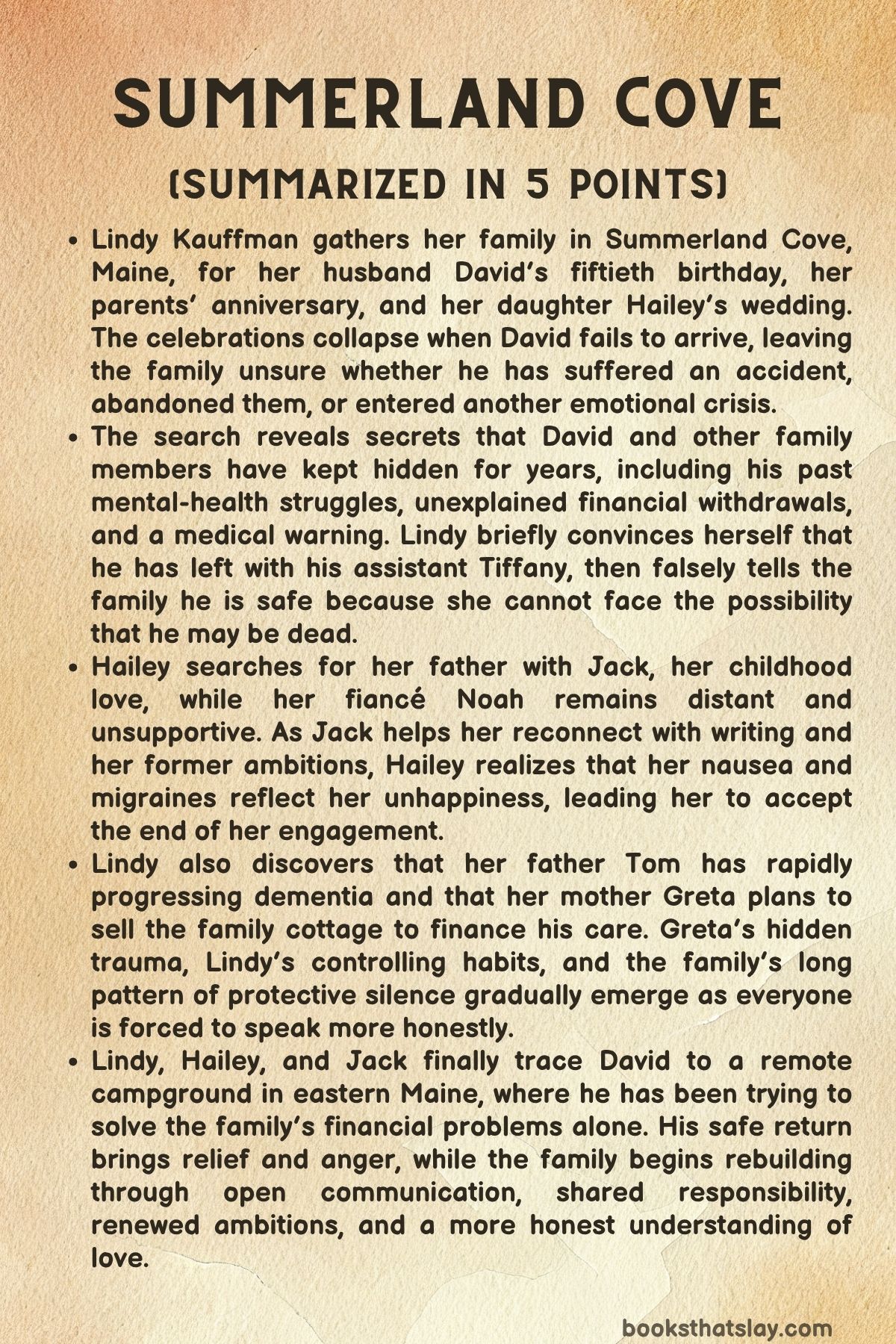
In July 2010, Lindy Kauffman prepares a large fiftieth-birthday party for her husband, David, at his family’s cottage in Summerland Cove, Maine. The celebration is supposed to begin three weeks of important family events, including Lindy’s parents’ fiftieth anniversary and the wedding of Lindy and David’s eldest daughter, Hailey.
Lindy is determined to gather all four of her adult children in one place and create a perfect summer of family happiness. Hailey arrives while worrying about her approaching marriage to Noah, Emma brings her girlfriend Reese without warning, and the twins, Eli and Cody, return to the Cove expecting an ordinary reunion.
David, however, never arrives. He had called Lindy that morning from their home in Cranston, Rhode Island, saying that he was beginning the drive to Maine, but hours pass without any further communication.
The birthday party proceeds without its guest of honor as Lindy tries to hide her growing fear. By nightfall, the family begins contacting hospitals, checking roads, and imagining accidents, yet no one has seen David or admitted him for treatment.
Hailey, Cody, and Eli drive back to Cranston to determine whether their father ever left home. They find that David’s Subaru is gone, the security system was activated after his call, and the house shows no signs of violence or illness, but they discover his cell phone abandoned in a kitchen drawer.
The forgotten phone explains why David cannot be contacted, but it also removes the easiest way to trace him. The family now knows that he left home voluntarily, although they have no idea where he went or what happened after his departure.
Lindy’s fear is intensified by memories of David’s youth. She first became close to him as a teenager during summers in Maine, when their friendship grew through sailing, long conversations, letters, shared dreams, and a gradual romance.
David was intelligent, idealistic, and deeply sensitive, but he also carried emotional suffering that Lindy did not initially understand. When she was fourteen, she found him in the woods after he had cut his wrist, forcing her to confront the fact that love and companionship could not protect him from every danger within his own mind.
David was hospitalized, and Lindy’s parents urged her to end the relationship. Instead, she became more determined to remain beside him, believing that loyalty could give him the hope and stability he could not always create for himself.
Their relationship continued through college and later periods of emotional crisis. David sometimes disappeared into the woods when his thoughts became unmanageable, while Lindy and his family gradually learned to welcome him back without demanding full explanations.
After another serious breakdown in adulthood, Lindy became pregnant with Hailey, and the pregnancy accelerated her marriage to David. Lindy believed that becoming a husband and father would anchor him to life, and she built much of her identity around preserving his hope, protecting his privacy, and maintaining a stable family around him.
In the present, the search becomes more complicated when Lindy discovers that David’s young assistant, Tiffany, is also away from work. A photograph showing Tiffany standing close to David at an office party encourages Lindy to suspect an affair, especially after Reese mentions impressions involving a lighthouse and a possible midlife crisis.
At the same time, the family discovers that David had received a medical warning about possible heart problems. They also learn that he withdrew approximately $109,000 from family accounts without telling Lindy, making it possible that he suffered a medical emergency, planned to leave permanently, or intended to begin another life.
A credit-card charge proves that David reached Maine and bought gas in Kennebunkport. Although this is the first reliable evidence of his movements, it does not reveal his destination, and the uncertainty allows Lindy’s fear of death to compete with her fear of betrayal.
Lindy eventually convinces herself that David has gone camping with Tiffany. She stops the search and falsely tells the family that David called to say he was safe, believing that the lie will protect his history, prevent public humiliation, and allow Hailey’s wedding and the anniversary celebration to continue.
The lie reflects a pattern that has shaped Lindy’s marriage. Whenever reality becomes unbearable, she creates a version of events that appears survivable and expects the people around her to accept it.
Meanwhile, Hailey’s own life begins to change. Her fiancé, Noah, remains in Portland and treats David’s disappearance as an inconvenience, while Jack Westfield, Hailey’s childhood companion and former love, immediately joins the search and supports her without being asked.
Jack remembers Hailey as an imaginative writer rather than simply a future lawyer or bride. In his company, her migraines and nausea ease, and she begins to recognize that the physical symptoms troubling her may come from the strain of forcing herself toward a marriage and career she no longer wants.
Hailey starts writing fiction again and questions whether she chose law school, Noah, and the elaborate wedding because they suited her or because they offered a respectable plan. Her renewed closeness with Jack does not immediately solve her uncertainty, but it reminds her how it feels to be understood rather than managed.
Another crisis emerges at Innisfree, the cottage belonging to Lindy’s parents, Greta and Tom. Greta has concealed that Tom was diagnosed with rapidly progressing dementia and has secretly decided to sell the property to pay for professional memory care in Florida.
David knew about Tom’s condition because Greta had asked him for legal and financial help. She made him promise not to tell Lindy, fearing that her daughter would abandon her own life to care for Tom and resist the sale of the cottage.
Tom’s confusion becomes impossible to hide when he repeatedly fails to recognize family members. During an argument between Noah and Hailey, Greta interprets Noah’s behavior as threatening, produces an old pistol, and orders him to leave.
The confrontation forces Greta to reveal Tom’s diagnosis and her plan to sell Innisfree. Lindy is devastated by her father’s decline, the possible loss of the cottage, and the discovery that Greta and David made major decisions without consulting her.
Lindy immediately offers to bring her parents into her home, but Greta refuses to make her daughter responsible for Tom’s daily care. Greta believes professional treatment is necessary, while Lindy sees the proposed sale as the destruction of a place representing childhood, continuity, and the future she imagined sharing with David.
Tiffany eventually calls and explains that she has been camping in Nova Scotia with her boyfriend, Raj. David is not with her, and the supposed affair never existed.
Lindy must admit that David never contacted her and that she stopped the search because she needed an explanation that kept him alive. Hailey is furious that valuable time was lost, although Jack helps her understand that Lindy acted from terror rather than indifference.
The family finally begins discussing David’s history openly. Lindy tells the children about his suicide attempt and later breakdown, while Greta admits that David knew about Tom’s illness and the planned sale of Innisfree.
This information changes the meaning of the missing money. David may not have been preparing to abandon the family; he may have withdrawn funds while trying to preserve Innisfree, finance Tom’s care, cover Hailey’s wedding expenses, and prevent Lindy from being hurt.
Hailey refuses to allow another lie to guide the search. She, Jack, Tiffany, Raj, Lindy, and the other family members begin reviewing known facts, including David’s camping equipment, the grocery and fuel purchases, the missing money, and his longstanding attraction to remote woods and coastal edges.
Lindy remembers David speaking about the easternmost part of Maine as a place where the road ends and the first light begins. Acting on this memory, she drives alone toward Eastport, hoping he may have gone to the far edge of the state to confront whatever decision had overwhelmed him.
Hailey learns that Lindy left and follows with Jack. During their journey, Noah finally responds to Hailey’s demand that he come to Maine by ending the engagement in a voicemail.
Instead of feeling destroyed, Hailey feels relieved. She recognizes that she was defending the wedding because of its expense, her parents’ expectations, and the effort invested in it rather than because she truly wanted to marry Noah.
In Eastport, Lindy, Hailey, and Jack search stores, motels, campgrounds, and coastal landmarks without success. Lindy’s remembered clue leads them toward Lubec and West Quoddy Head, where they hope David may have gone to see the first sunrise.
Eli then discovers that David’s credit card was used at a grocery store in Lubec. The transaction proves that David reached the area alive and suggests that he purchased supplies before establishing a campsite.
The group finds no evidence at West Quoddy Head, and Lindy is ready to abandon the search. Jack notices information about Cobscook Bay State Park and argues that its remote coastal campground matches David’s habits more closely than the lighthouse itself.
At the park, a ranger recognizes David’s photograph and Subaru. David has been registered at a campsite for several days, alive and apparently unaware of the full panic caused by his absence.
Lindy approaches the campsite alone and finds David calmly sitting near his tent and fire. Her relief immediately turns into fury because the family has imagined death, suicide, betrayal, theft, and violence while he has been safely camping.
David explains that he attempted to call but believed an unclear message had reached the family. Because he forgot his phone and did not understand how completely he had isolated himself, he assumed everyone knew where he was and would continue without him.
He also explains the missing money. Much of it had already been spent on Hailey’s wedding, while the remaining funds were connected to an unsuccessful plan to buy Innisfree from Greta through owner financing so that Tom’s care could be funded without removing the cottage from the family.
David became overwhelmed when he realized that he could not solve every problem. Rather than asking for help, he went away to think, repeating the old habit of treating withdrawal as a private solution even though his disappearance transferred his fear and responsibilities to everyone else.
Lindy tells him that his presence is not optional and that loving him cannot mean repeatedly accepting unexplained absences. David apologizes, acknowledges the harm he caused, and agrees to communicate more honestly.
Back at Summerland Cove, David is greeted with relief, anger, and demands for an explanation. Lindy apologizes to the children for inventing the affair, and the family begins addressing its problems through direct conversation rather than protective stories.
Greta also confronts the childhood trauma that shaped her lifelong need for control. She reveals that she was sexually assaulted at Innisfree as a girl and had carried shame because the adults around her knew something had happened but never spoke openly about it.
Her longtime rival, Marjorie Westfield, helps her understand that the family’s silence was intended as protection, not condemnation. Their renewed friendship allows Greta to accept both emotional support and a practical financing plan that could enable Lindy and David to buy Innisfree while providing money for Tom’s care.
Lindy considers accepting an interior-design position offered by her friend Samantha, reclaiming a creative ability she had placed behind the needs of her husband and children. The income may help her preserve Innisfree without treating the cottage as something that must remain unchanged.
Hailey cancels the formal wedding and receives her parents’ support. She begins imagining a future involving writing, Maine, and a relationship with Jack, although she no longer feels compelled to decide every detail immediately.
The family ultimately realizes that David’s failed voicemail set the entire crisis in motion, but the misunderstanding also exposed truths that had remained hidden for years. The carefully planned summer collapses, yet the family emerges with a more honest understanding of love, illness, responsibility, memory, and the right to choose a life rather than simply maintain one.
Characters
Lindy Kauffman
At the center of Summerland Cove, Lindy is a capable, loving, and intensely controlling woman who has organized her life around protecting other people. She believes that celebrations, routines, beautiful homes, and carefully managed family stories can hold chaos at a distance.
Her devotion to David began when she was young enough to interpret loyalty as a form of rescue. After discovering his suicide attempt, she gradually accepted responsibility for preserving his hope, and that responsibility became inseparable from her understanding of marriage.
Lindy’s greatest strength is her refusal to abandon people when they are frightened, ill, or difficult to understand. That same strength becomes dangerous when she assumes that she alone knows which truths her family can survive.
Her false claim that David contacted her is not motivated by cruelty. She invents the affair because anger at a living, unfaithful husband feels more manageable than the possibility of suicide or death.
Lindy’s character development requires her to distinguish support from control. By the end of the book, she accepts that David must take responsibility for communicating, her parents must participate in decisions about Tom’s care, and Hailey must be free to cancel her wedding.
She also begins recovering an identity beyond caregiving. Her decision to consider professional interior-design work shows that creativity and personal ambition do not weaken her commitment to family; they allow her to participate in that family without disappearing inside it.
David Kauffman
David is the absent center around which much of Summerland Cove moves. His disappearance generates the immediate mystery, but his deeper significance comes from the contrast between the calm, dependable father known by his children and the emotionally vulnerable young man remembered by Lindy.
As a teenager, David is intelligent, philosophical, idealistic, and drawn to questions of justice and personal responsibility. His love of running, sailing, nature, and Thoreau reflects his desire for clarity, independence, and moral purpose.
His mental-health crises reveal that intelligence and love do not prevent severe emotional suffering. David’s repeated retreats into the woods become a coping mechanism, but they also allow him to avoid explaining what he feels or accepting the consequences his absence creates for others.
As an adult, David channels his concern for justice into work with wrongfully convicted people. His professional compassion is genuine, yet his belief that he must solve difficult problems privately causes him to hide medical concerns, financial decisions, and Greta’s request from Lindy.
The money he withdraws is not evidence of an affair or planned abandonment. It reflects his attempt to finance Hailey’s wedding, preserve Innisfree, help Greta, and protect Lindy without admitting that these goals may be financially incompatible.
David is not presented as malicious, but the book does not excuse him simply because he is vulnerable. His return requires him to understand that private withdrawal is not harmless when other people depend on his presence and fear for his safety.
Hailey Kauffman
Hailey begins the book as a woman trying to complete a future she has already planned. She has moved to Portland, left her job, prepared for law school, and organized an elaborate wedding, yet her migraines, nausea, and emotional exhaustion reveal how little confidence she has in those choices.
Her relationship with Noah is based increasingly on obligation rather than emotional partnership. She continually explains his absence, minimizes his selfishness, and assumes responsibility for maintaining their wedding even while he refuses to participate in her family’s crisis.
David’s disappearance forces Hailey to examine the difference between commitment and self-erasure. As she searches for her father, she begins questioning why she is willing to marry someone who remains unavailable when she most needs support.
Jack’s return reconnects her with the writer she once hoped to become. He remembers her imagination and listens without forcing her toward a decision, allowing her to experience companionship without emotional management.
Hailey’s refusal to support another lie during the renewed search is an important sign of maturity. After witnessing how secrecy damaged the family, she insists that facts rather than comforting inventions guide their actions.
Ending the engagement becomes an act of self-recognition rather than romantic impulsiveness. Her final uncertainty about law school, writing, Maine, and Jack represents freedom because she is no longer treating a detailed plan as proof that she has chosen correctly.
Greta
Greta is a proud, disciplined matriarch who has spent her life turning order into a defense against fear. Her immaculate care of Innisfree reflects not only devotion to family tradition but also a belief that perfect surroundings can contain painful memories.
Her decision to conceal Tom’s dementia comes from love, exhaustion, and a deep resistance to dependence. She wants to protect Lindy from becoming a full-time caregiver, but she also refuses to trust her daughter with the truth.
Greta’s plan to sell Innisfree is practical because the property can finance specialized care for Tom. It is also emotionally complicated because the cottage is associated with the sexual assault she experienced as a girl and the silence that followed it.
The gun incident shows the collapse of Greta’s carefully maintained self-control. Believing that Noah threatens Hailey, she reacts with a force that surprises everyone, including herself, and makes her buried terror visible.
Her conversations with Marjorie allow Greta to reinterpret her past. She learns that silence from the adults around her did not necessarily mean blame, though their failure to speak left her alone with shame.
Greta’s growth lies in her willingness to be helped. By accepting Marjorie’s friendship and financial proposal, she begins to understand that dependence can create shared responsibility rather than humiliation.
Tom
Tom is a gentle, intelligent man whose progressing dementia creates one of the book’s quietest and most devastating forms of loss. Although he remains physically present, his ability to recognize his wife, grandchildren, surroundings, and personal history becomes increasingly uncertain.
His earlier life as a history teacher and supporter of nonviolence establishes him as thoughtful and principled. These qualities make his cognitive decline especially painful because the family is losing not only his memory but also the particular mind through which he understood the world.
Tom participates in the decision to hide his diagnosis because he wants Lindy to enjoy one more period of happiness. His desire is loving, yet it contributes to a family culture in which difficult truths are delayed until they become crises.
His confusion exposes the limits of appearance. No amount of careful hosting or prepared conversation can prevent illness from revealing itself.
Tom also challenges the family to reconsider what care means. Love alone cannot guarantee his safety, and accepting professional help does not mean that his family has abandoned him.
Jack Westfield
Jack functions as both Hailey’s former love and a reminder of the self she abandoned. He remembers her as a writer, pays attention to her physical discomfort, and recognizes her fear without dismissing it.
His behavior during David’s disappearance establishes a sharp contrast with Noah. Jack brings food, searches unfamiliar roads, notices practical needs, and remains emotionally available without turning the crisis into a test of Hailey’s affection.
Jack’s importance is not limited to romance. His questions encourage Hailey to examine whether law school, marriage, and life in Portland reflect her desires or merely decisions she is afraid to reverse.
He does not demand that Hailey choose him immediately after the engagement ends. By giving her space, he demonstrates that genuine care can exist without possession or pressure.
Jack also contributes materially to finding David. His attention to the Cobscook Bay State Park brochure converts scattered clues into a final, successful search.
Noah
Noah represents the danger of mistaking a planned future for a supportive relationship. He is connected to food, work, professional ambition, and the practical arrangements of Hailey’s adult life, but he repeatedly fails to respond when emotional responsibility is required.
His refusal to leave the restaurant during David’s disappearance shows that he views Hailey’s crisis primarily through its effect on his schedule. Even when he arrives in Maine, his anger centers on the inconvenience and disruption he has experienced.
Noah expects Hailey to protect his comfort while he offers little protection in return. His final voicemail ends the engagement because she prioritizes her missing father, confirming that his idea of partnership depends on her placing his needs first.
He is not developed as a secret villain or criminal figure. His purpose is to expose how emotional neglect can exist inside a socially respectable relationship.
Emma Kauffman
Emma is outspoken, emotionally reactive, and less willing than Lindy to accept reassuring explanations without examination. Her arrival with Reese immediately disrupts the sleeping arrangements and family expectations, establishing her resistance to being managed.
She responds strongly to the possibility that David willingly disappeared or betrayed the family. Her anger reflects love, but it also shows how personally she experiences secrecy.
Emma becomes especially important when she tells Hailey that David never called. By refusing to preserve Lindy’s lie, she begins the process of returning the family to a reality they can investigate together.
Her relationship with Reese has its own tensions, partly because the family crisis tests how comfortably Reese fits into the household. Emma’s emotional directness can create conflict, yet it also prevents damaging stories from remaining unchallenged.
Eli Kauffman
Eli is analytical, cautious, and inclined to compare evidence before accepting a conclusion. When Lindy becomes convinced that David is having an affair, Eli points out that a photograph, missing money, and simultaneous vacations do not prove her theory.
His ability to monitor accounts, credit-card transactions, and practical information makes him essential to the search. The grocery-store charge he discovers in Lubec provides the clearest evidence that David reached the eastern coast alive.
Eli represents disciplined reasoning within a family overwhelmed by fear. He does not lack emotion, but he understands that emotion can create explanations unsupported by facts.
His role also illustrates how the children are forced into adult responsibility. Rather than being protected from the crisis, he must investigate his father’s finances and help reconstruct decisions his parents concealed.
Cody Kauffman
Cody is energetic, protective, and willing to act quickly when David disappears. He drives family members, participates in the route search, and helps transform the failed birthday gathering into an organized emergency response.
Although he receives less individual attention than Hailey or Lindy, Cody contributes stability through action. He does not dominate the family’s interpretation of events, but he consistently makes himself available.
His reaction to learning about David’s earlier crises reflects the children’s broader shock. The father they considered steady and dependable had a private history that reshapes their understanding of both him and their parents’ marriage.
Cody’s presence reinforces the communal nature of the search. David’s disappearance is not solely Lindy’s marital crisis; it affects every child who depended on the belief that their father would always return.
Reese
Reese enters the family gathering as Emma’s glamorous and somewhat unexpected partner. Her presence initially creates practical tension, yet she becomes involved in the family’s crisis rather than remaining an outsider.
Her intuitive impressions concerning a lighthouse and a possible affair influence Lindy’s thinking. The affair suggestion contributes to a false theory, but the lighthouse reference eventually helps direct attention toward coastal Maine.
Reese occupies an unusual position between intuition and misunderstanding. Her impressions are not presented as precise instructions, and the family’s interpretations reveal as much about their fears as they do about her ability.
Her role also tests the family’s openness to unfamiliar people and perspectives. By the conclusion, her contribution is recognized as meaningful even though it did not provide a complete answer.
Kate
Kate is David’s sister, Lindy’s childhood friend, and one of the few people who knows the full history of his emotional struggles. Her connection with both spouses gives her a complicated position within their marriage.
As a teenager, Kate first notices the attraction between Lindy and David. Later, she carries fear, resentment, and responsibility because David’s crises affected his entire family long before Lindy understood them.
Her accusation that Lindy was expected to take care of David reveals the unfair burden placed on Lindy. It also shows how David’s relatives gradually treated his wife as the person responsible for keeping him stable.
Kate’s own difficulties with alcohol suggest that David’s suffering has wider consequences. Her concern is sincere, but it is sometimes expressed through blame because fear has never been addressed openly.
Josh
Josh is Kate’s partner and a quieter supporting presence during the crisis. He helps accompany Lindy, participates in difficult conversations, and shares Kate’s concern about David’s emotional state.
Unlike Kate, he is less directly shaped by David’s childhood history, which allows him to approach some situations with greater distance. His role is often stabilizing rather than confrontational.
Josh also represents the wider circle affected by family secrecy. Even people willing to help cannot respond effectively when important information is withheld from them.
Tiffany
Tiffany becomes the focus of Lindy’s suspicion because she is young, works closely with David, and is absent at the same time he disappears. A suggestive office photograph and incomplete information allow Lindy to transform her into an imagined romantic rival.
When Tiffany returns with Raj, she proves that the affair theory was false. Her actual conduct is cooperative, practical, and concerned rather than deceptive.
Tiffany’s character demonstrates how fear can turn an ordinary person into a convenient explanation. Lindy interprets Tiffany through jealousy because betrayal offers a less frightening story than death or suicide.
Once the truth is established, Tiffany helps reconstruct David’s movements. Her willingness to join the search shows that she respects him as a colleague and wants to help his family find him.
Raj
Raj is Tiffany’s boyfriend and confirms that she was camping with him in Nova Scotia. His presence immediately removes the romantic interpretation Lindy placed on Tiffany’s absence.
He contributes a practical and sometimes uncomfortable perspective to the search. By pointing out that a person carrying substantial cash could become the victim of violence or theft, he prevents the family from replacing one unsupported certainty with another.
Raj’s role is small but useful because he approaches the situation without the family’s history. He can identify risks and assumptions that relatives caught in emotional patterns may overlook.
Marjorie Westfield
Marjorie initially appears to be Greta’s longtime rival, but the hostility between them is based on silence, misunderstanding, and memories neither woman has honestly examined. Her visit with a pie becomes the beginning of a major reconciliation.
She helps Greta understand that people in her childhood knew she had been harmed and attempted to protect her. Although their silence was damaging, it did not carry the condemnation Greta imagined.
Marjorie’s willingness to listen allows Greta to speak about the assault without being reduced to it. She offers companionship at the exact moment Greta’s identity as an invulnerable matriarch has collapsed.
Her financial proposal is equally important. By offering favorable financing, she creates a possible solution that supports Tom’s care, preserves Innisfree, and prevents Greta or Lindy from carrying the entire burden alone.
Samantha
Samantha represents the professional and creative future Lindy has repeatedly postponed. Her offer of interior-design work recognizes Lindy’s ability to create beautiful, functional spaces and gives that ability value beyond unpaid family labor.
The opportunity challenges Lindy’s belief that her personal ambitions must remain secondary. Accepting the work would not mean abandoning her family; it could help finance Innisfree and create a more balanced partnership with David.
Although Samantha remains largely outside the central crisis, her offer provides evidence that Lindy’s life can expand after the immediate emergency ends. She opens a door that Lindy must choose to enter for herself.
Gina
Gina, one of David’s colleagues, provides information about Tiffany’s vacation and personal life. Her contribution helps the family separate workplace facts from Lindy’s growing suspicions.
She also represents the professional world David kept partly separate from his family. Through Gina, Lindy becomes aware of how little she knows about her husband’s daily relationships, pressures, and routines.
Gina does not solve the mystery, but the information she provides becomes part of the factual process that eventually disproves the affair theory.
Robin and Alexandra
Robin and Alexandra are connected to Noah’s restaurant life and contribute indirectly to Hailey’s insecurity. Noah’s late nights with colleagues and his closeness to his workplace make Hailey feel that she is competing with a world he values more than their relationship.
Alexandra’s presence particularly troubles Hailey because she suspects that Noah may be emotionally or romantically interested in another woman. Whether that suspicion is justified matters less than the absence of trust and reassurance between Hailey and Noah.
Robin, as the head chef, also symbolizes the professional hierarchy Noah uses to justify remaining at work. Together, these figures help reveal that Hailey’s engagement was already unstable before David disappeared.
Themes
Secrecy as Protection and Harm
In Summerland Cove, secrecy usually begins as an attempt to protect someone from fear, shame, responsibility, or disappointment. Lindy hides David’s emotional history from their children, Greta conceals Tom’s dementia, David keeps Greta’s plans from Lindy, and the adults repeatedly decide which truths other family members are prepared to hear.
These choices are motivated by love, but their consequences are destructive. Because Hailey and her siblings do not know about David’s earlier crises, they cannot accurately evaluate the danger of his disappearance, while Lindy’s false claim that he called causes the search to stop at a critical moment.
Greta’s childhood shows the long-term emotional cost of protective silence. The adults around her knew that she had been assaulted and attempted to watch over her, yet their refusal to speak left her believing that she was alone, damaged, and possibly blamed.
Silence also gives fear the power to create false explanations. Without reliable information, Lindy invents an affair, Hailey interprets her physical illness as wedding stress, and family members mistake carefully maintained appearances for genuine stability.
The book does not suggest that every private thought must be disclosed immediately. It argues instead that secrecy becomes dangerous when one person controls reality for everyone else.
Healing begins when family members exchange facts, admit mistakes, and allow difficult knowledge to be carried collectively. Truth creates pain, but it also gives people the ability to respond, choose, forgive, and help.
Love, Caregiving, and the Limits of Rescue
Lindy’s relationship with David is shaped by the belief that remaining beside someone can keep that person alive. After finding him following his suicide attempt, she understands loyalty not simply as affection but as an active responsibility to restore his hope.
This devotion gives David genuine support during periods when he cannot imagine a future. It also encourages Lindy, David’s relatives, and eventually David himself to treat her as the person responsible for managing his emotional survival.
The pressure distorts their marriage. Lindy accepts unexplained disappearances, David assumes she will maintain the family during his absence, and both avoid discussing how exhausting their arrangement has become.
Greta faces a similar problem with Tom. She loves him deeply, but his dementia requires forms of care that affection, memory, and marital loyalty cannot provide by themselves.
Her decision to seek professional support is painful because the family initially interprets institutional care as abandonment. The story instead presents responsible caregiving as a combination of love, practical judgment, honest limits, and shared labor.
No individual can save everyone, no matter how devoted that person may be. Lindy cannot cure David, Greta cannot stop Tom’s decline, and Hailey cannot create family happiness by completing a wedding she does not want.
The healthier form of love that emerges allows people to remain connected without assuming total control over one another’s survival. Care becomes sustainable only when responsibility is acknowledged, communicated, and distributed.
Identity Beyond Family Expectations
Several characters have built lives around roles that gradually replace their individual desires. Lindy becomes the organizer, protector, wife, mother, and daughter who solves problems, while her talent for design remains treated as an optional interest.
Hailey follows an equally structured path toward marriage and law school. The wedding, career plan, and move to Portland create the appearance of progress, but her physical distress suggests that she has confused an organized future with an authentic one.
Both women fear that changing direction will invalidate years of effort. Lindy has spent decades supporting David and raising their children, while Hailey feels responsible for the money, planning, and family excitement surrounding her wedding.
The summer’s crises force them to recognize that devotion does not require permanent self-denial. Lindy can pursue creative work without abandoning her family, and Hailey can cancel a wedding without rejecting the love her parents invested in her.
Jack’s return helps Hailey remember her identity as a writer, but he does not create that identity for her. Writing returns when she gives herself permission to listen to an internal voice that existed before Noah, law school, and the ceremony.
Identity is presented as something that must remain open to revision. Choosing differently is not evidence that earlier years were meaningless; it is evidence that a person has become willing to respond honestly to who they are now.
Home, Memory, and Change
Innisfree is more than a valuable cottage. For Lindy, it represents childhood, family continuity, summers with David, and the future she expects to preserve for her children.
For Greta, the same house contains fear, shame, grief, responsibility, and decades of exhausting maintenance. Their conflict over selling it arises because each woman treats her personal meaning as though it were the complete meaning of the property.
The house illustrates how places can hold contradictory histories. A room can be associated with celebration for one person and trauma for another, while an object preserved as a family heirloom may feel like evidence of silence to someone else.
Greta initially believes that selling Innisfree is the only way to finance Tom’s care and release herself from the burden of its memories. Lindy experiences that plan as the destruction of a stable past she desperately needs while David is missing.
The eventual financing arrangement does not return the cottage to an untouched condition. Ownership, caregiving responsibilities, employment, family relationships, and the emotional meaning of the attic have all changed.
Preserving a home therefore does not mean freezing it in time. Greta must speak about what happened there, Lindy must earn and plan for its future, and the family must allow the property to become something other than a monument to old expectations.
Home becomes meaningful not because it remains perfect but because people can acknowledge its full history and still choose what it will represent next.